
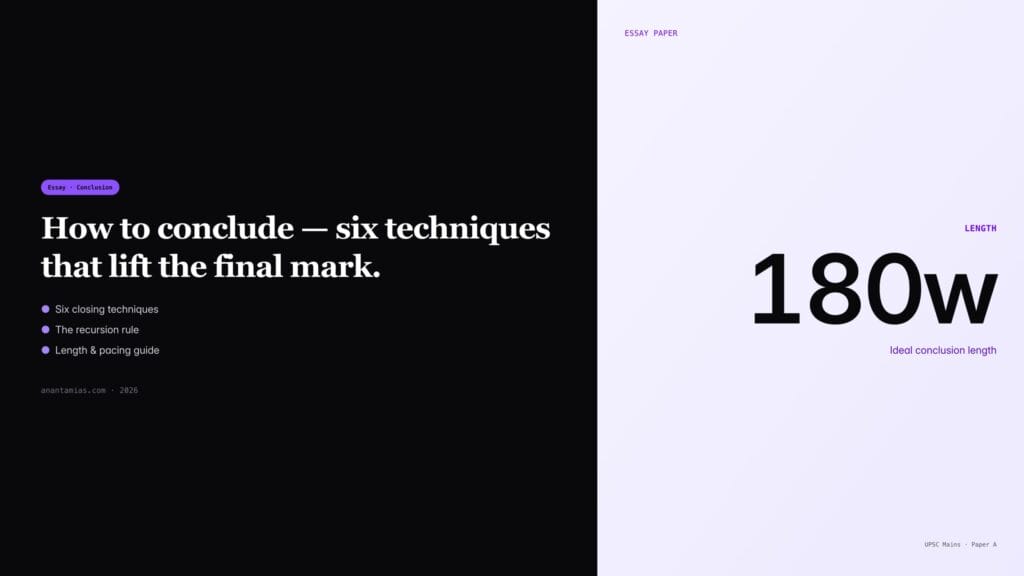
The conclusion is the last 150 words the examiner reads before assigning a mark. Weak conclusions leak 10–15 marks. Strong conclusions ensure your best idea is the last thing on the examiner’s mind. Here is how to close with force, not fatigue.
1. What a Conclusion Must Do
- Synthesise, not summarise
- Return to the hook — close the arc
- Offer a way forward or a reflective image
- Leave a line that lingers
2. Six Conclusion Techniques
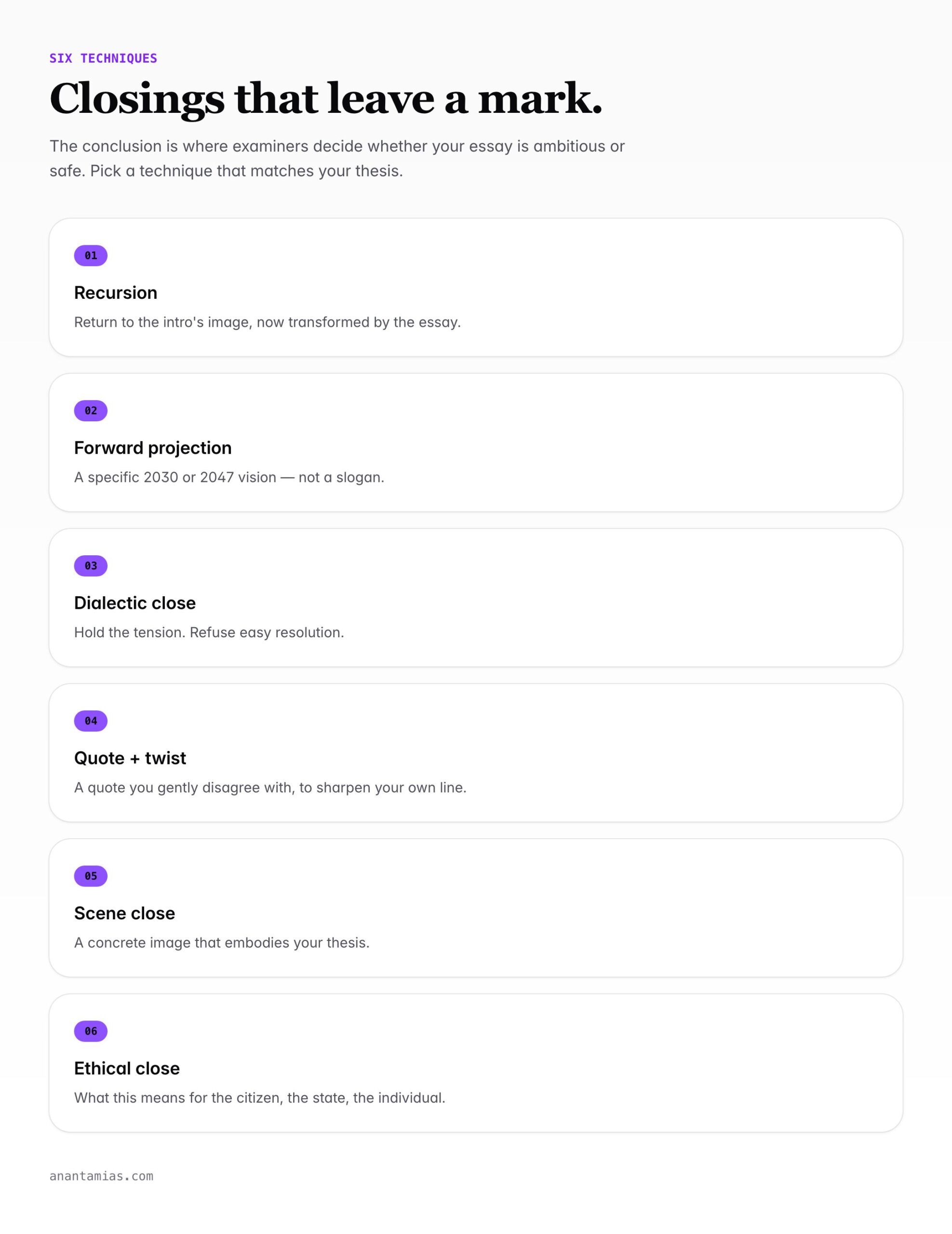
1. The returning arc
Bring back the image, character, or paradox from the intro, now resolved or reframed. ‘The mendicant who refused gold is the wiser of the two.’
2. The synthesis
Weave together three or four threads from the body into one sentence. ‘Economics without equity, ecology without politics, politics without philosophy — none holds.’
3. The question
End with a question that implicates the reader. ‘Do we want a wealthier India, or a wiser one?’ Use sparingly.
4. The literary close
Close with a line from a poet or philosopher. ‘As Tagore wrote, “Where the mind is without fear / and the head is held high” — that is the republic we are yet to build.’
5. The Gandhian triad
Close with individual + institutional + ideational. ‘The citizen must awaken, the state must listen, the civilisation must remember.’
6. The image close
Leave an image that condenses the argument. ‘A banyan tree grows downward before it grows outward; so does a democracy.’
3. Weak Conclusions to Avoid
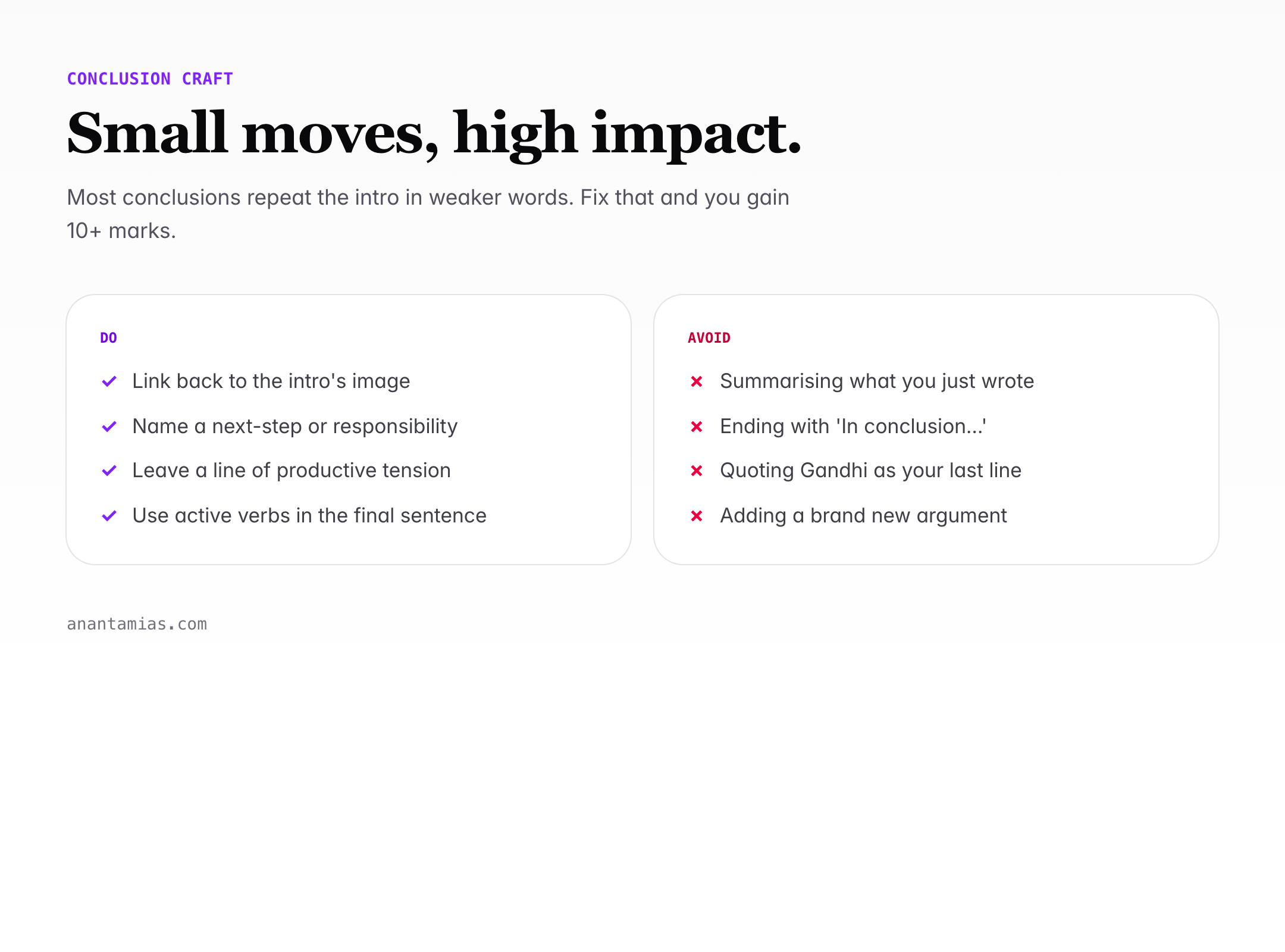
- ‘Thus, we see that…’
- ‘To conclude…’
- ‘In conclusion, we can say that…’
- Summary of every body paragraph
- Sudden introduction of new facts
- Moral sermons (‘We all must…’)
4. Worked Example (Prompt: ‘Courage is not the absence of fear’)
‘Socrates drank the hemlock with a steady hand; Gandhi walked to Dandi with the same. Courage is not a blood type; it is a decision repeated until it becomes character. Fear is not its opposite but its raw material. India’s most consequential moments — 1857, 1930, 1950, 1991 — were not fearless; they were fear-forward. The republic that knows its fears and walks toward them is the republic worth keeping.’ (85 words)
5. The Recursion Rule
A great conclusion recalls the intro. If your intro began with a Gandhi anecdote, your conclusion should echo it — rebuilt, not repeated. This recursion signals architecture, which examiners reward.
6. Length and Pacing
Target 120–160 words. End with a short, punchy sentence — 8–12 words. The last sentence should be quotable.
7. Examples of Last Lines That Work
- ‘And thus the river reaches the sea — not by speed, but by direction.’
- ‘A country is built one patient conversation at a time.’
- ‘The future is a verb we must conjugate together.’
- ‘Silence, after all, is the mother of the truth we dared not say.’
8. Common Errors
| Error | Correction |
|---|---|
| Summary recap | Synthesise into one insight |
| Too long | Cap at 160 words |
| New data | No new facts; only closure |
| Moralising | Evoke, don’t exhort |
| Formulaic phrasing | Remove ‘thus’, ‘hence’, ‘to conclude’ |
9. Practice Drill
- Take 20 past essays you wrote
- Rewrite only the conclusion of each in 120 words
- Pair with a peer and rank each pair
- After 20 iterations, your default conclusion style emerges
10. Final Craft Note
The best conclusions are written in the 5 minutes after you stopped thinking you had anything left to say. That residue — what lingers after the argument — is usually the best sentence of the essay.
Frequently Asked Questions
How long should the conclusion be?
120–160 words, ending with a short, quotable sentence.
Should I summarise all body paragraphs?
No. Synthesise the threads into one insight.
Can I quote a poet in the conclusion?
Yes — a carefully chosen literary line elevates a close.
Is it okay to ask a question at the end?
Yes, if it implicates the reader. Avoid rhetorical overreach.
Tell Google you want more of this.
Add Anantam IAS as a preferred sourceOne tap, and this site shows up more often in your own Top Stories, AI Overviews and AI Mode. Remove it any time.