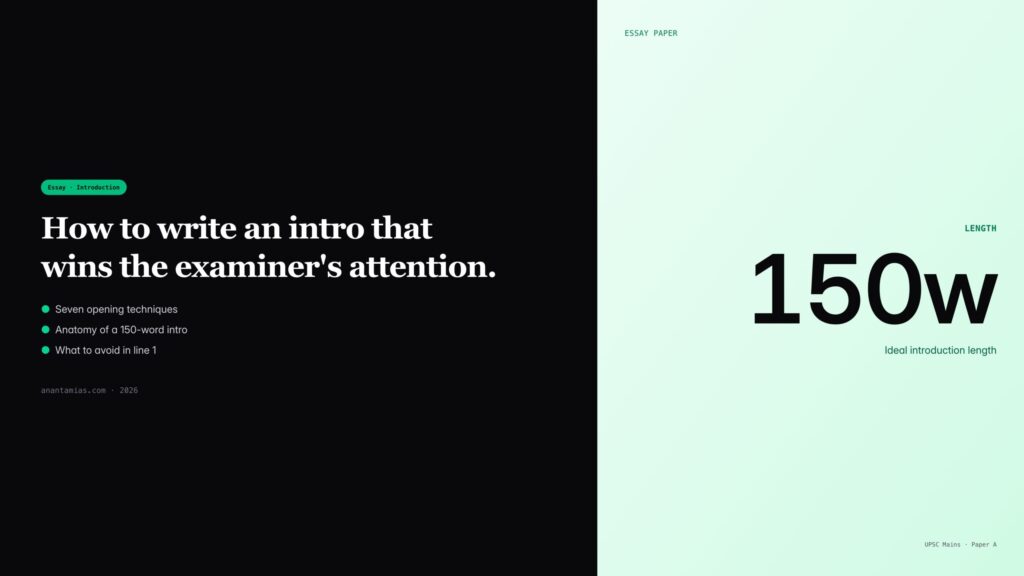
The opening 150 words decide whether the examiner reads the next 1000 with generosity or fatigue. A powerful introduction is not ornament; it is triage. Here are proven techniques, with examples, to write introductions that earn the reader’s attention.
1. What an Intro Must Do
- Earn attention in the first sentence
- Signal awareness of the prompt’s nuance
- Preview the essay’s argument without spoiling it
- Establish voice — literary but disciplined
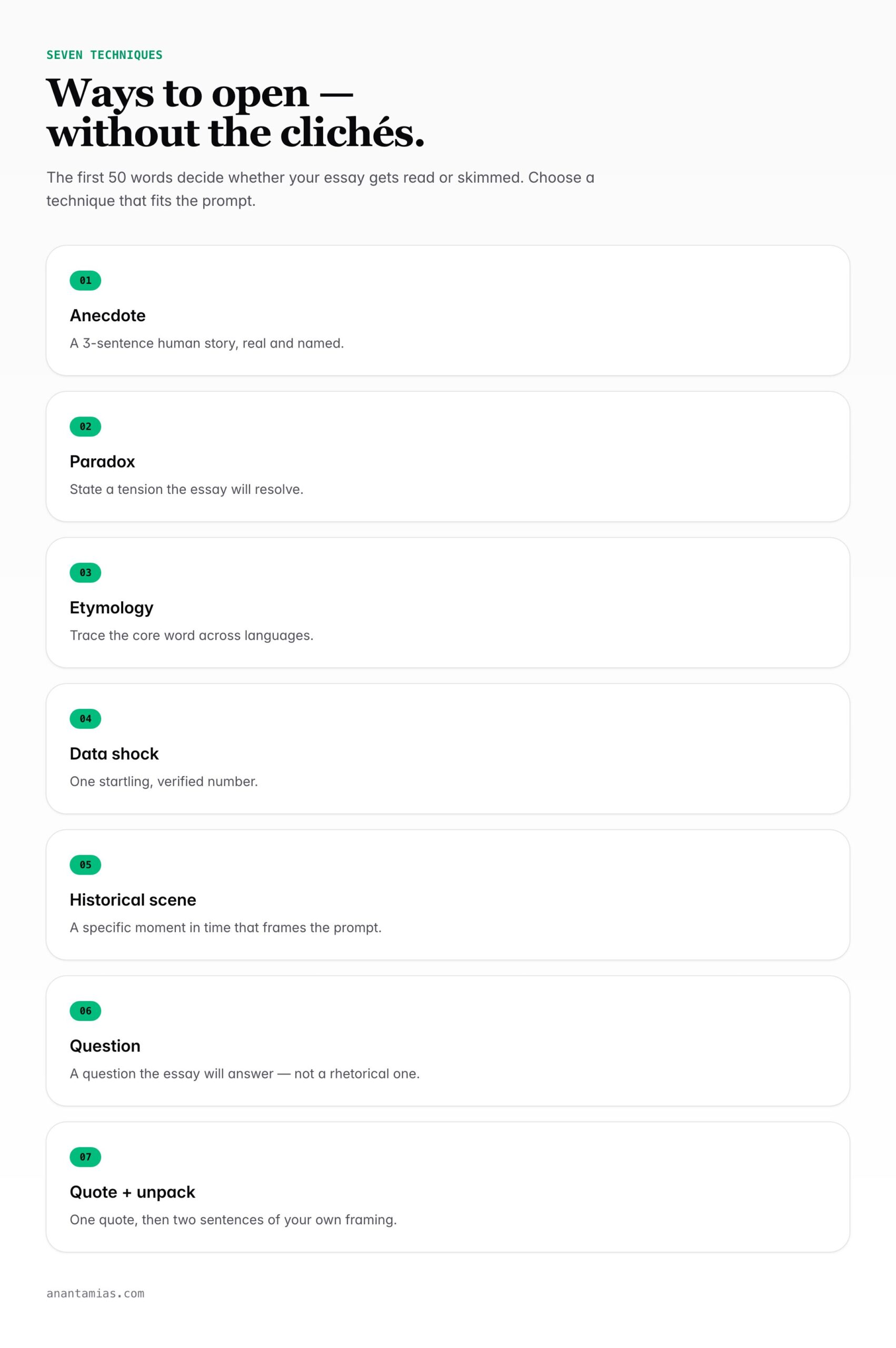
2. Seven Introduction Techniques
1. The story hook
Example (Prompt: ‘Silence is the mother of truth’): ‘In 1930, Gandhi observed his first Monday of silence. The British press mocked the gesture. Twenty years later, the nation he silently led was free.’
2. The paradox hook
Example (Prompt: ‘Courage is not the absence of fear’): ‘The bravest men in the world are the ones who are most afraid. Their courage is a decision, not a temperament.’
3. The image hook
Example (Prompt: ‘Forests are the best case studies in economics’): ‘Imagine an economy with no subsidies, no bailouts, no inflation — where every actor gives what it has and takes only what it needs. The forest has been running that economy for 350 million years.’
4. The data hook
Use sparingly — only when the number is shocking. ‘The top 1% of Indians own 40% of the wealth. This is not a statistic; it is a verdict on our republic.’
5. The question hook
‘What does it mean to be free in a country where 200 million cannot read?’ Frame with restraint — questions must reward reading.
6. The literary hook
Open with a line from Tagore, Kalidasa, Shakespeare, or Neruda if it sharpens the prompt.
7. The civilisational hook
Begin with a historical moment — Ashoka’s Kalinga, the Magna Carta, Tiananmen Square — that frames the essay’s stakes.
3. What the Intro Must Avoid
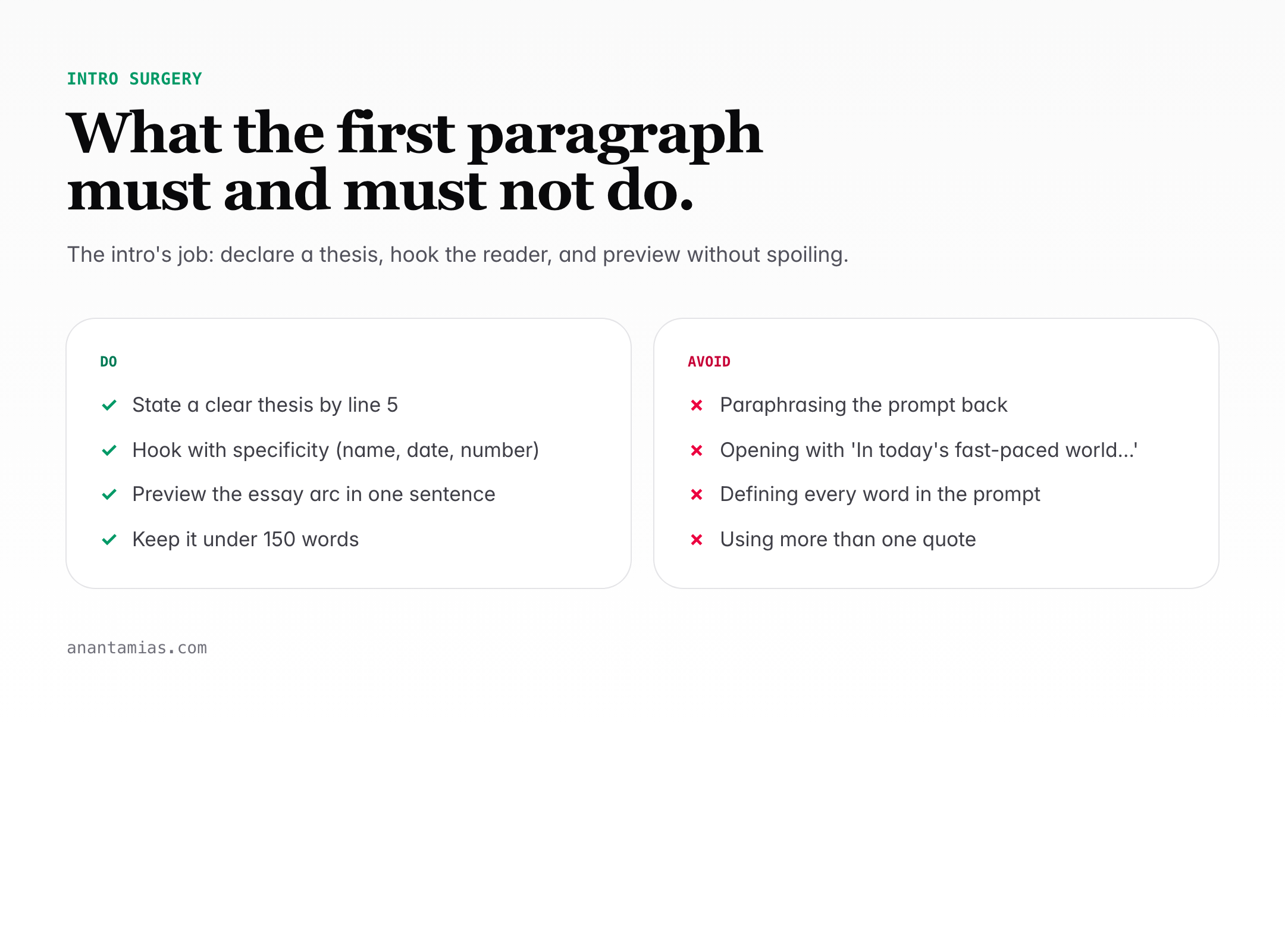
- Definitions from dictionaries
- ‘In today’s fast-paced world…’
- ‘Since time immemorial…’
- Self-referencing (‘In this essay I will discuss…’)
- Three back-to-back quotes
- Moral declarations (‘It is our duty to…’)
4. Anatomy of a Winning Intro (Prompt: ‘Wisdom finds truth’)
‘A mendicant knocks on the Emperor’s door and asks for alms. The Emperor, amused, offers him a fistful of gold coins. The mendicant refuses. “You own so much and yet you do not know what is enough,” he says. “I own nothing, and I have discovered it.” Wisdom is this discovery — the capacity to see through the glitter of accumulation to the bedrock of enough. In the next 1100 words, I examine wisdom across four domains — the individual, the society, the state, and the civilisation — and argue that its truth is harder to bear than its beauty is to admire.’ (130 words)
5. Three Drafting Moves
- Write the intro last if the hook won’t come. Start with body, return when structure is clear.
- Read your intro aloud. If it sounds like an editorial, it is working.
- Cut the first 20% of whatever you wrote. Most intros begin in the middle.
6. Intro by Topic Type
| Topic type | Best hook |
|---|---|
| Philosophical | Story or paradox |
| Economic | Data or paradox |
| Social | Story from the field |
| Environmental | Image |
| Governance | Civilisational moment |
| Tech/ethics | Question or paradox |
7. Length Discipline
Keep the intro to 120–160 words. Longer intros cannibalise the body.
8. Practice Protocol
- Collect 20 PYQ prompts
- Write only the intro for each (10 minutes per intro)
- Get peer feedback on hooks and transitions
- Iterate until five intros feel publication-ready
9. One Last Craft Note
Never repeat the prompt verbatim. Rephrase, reframe, reimagine. The examiner knows the prompt; they want to know you.
Frequently Asked Questions
How long should the intro be?
120–160 words. Longer intros crowd out the body.
Is it okay to start with a quote?
Yes, sparingly. A quote that frames the prompt is strong; a decorative quote is not.
Should I reveal my thesis in the intro?
Hint at it, don’t announce it. Preserve curiosity.
Is writing the intro last okay?
Yes — many toppers do. Start with body when the hook won’t come.
Tell Google you want more of this.
Add Anantam IAS as a preferred sourceOne tap, and this site shows up more often in your own Top Stories, AI Overviews and AI Mode. Remove it any time.