Walk through almost any Indian metro and you see the contradiction in a single glance. On one side of an arterial road, a tower of unsold flats stands half-lit at night, lights off in apartment after apartment. On the other side, a settlement of tin and tarpaulin houses families who have lived in the city for a decade and still cannot find a legal, affordable room. The same city has too few homes for the people who need them and too many homes that nobody lives in.
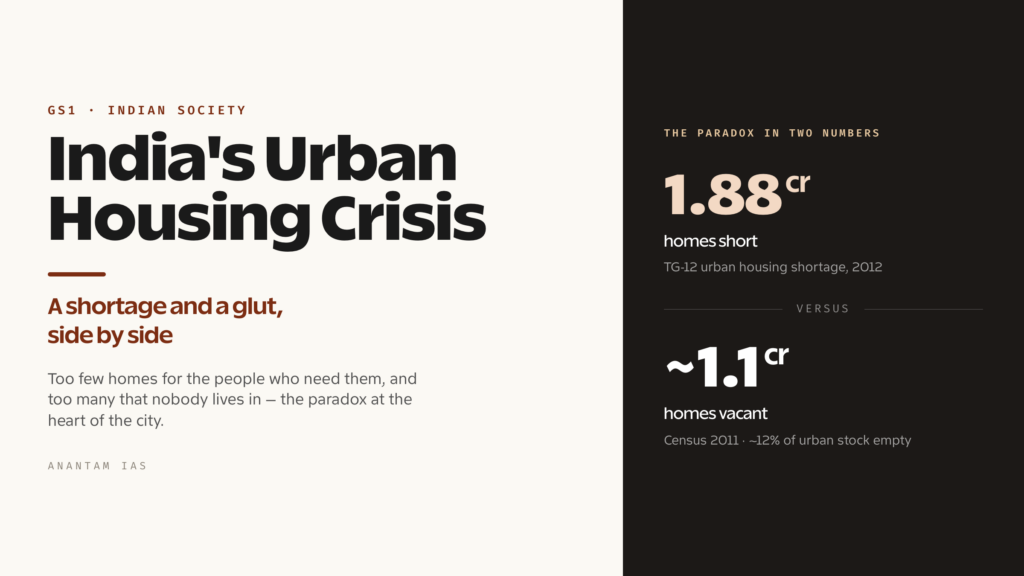
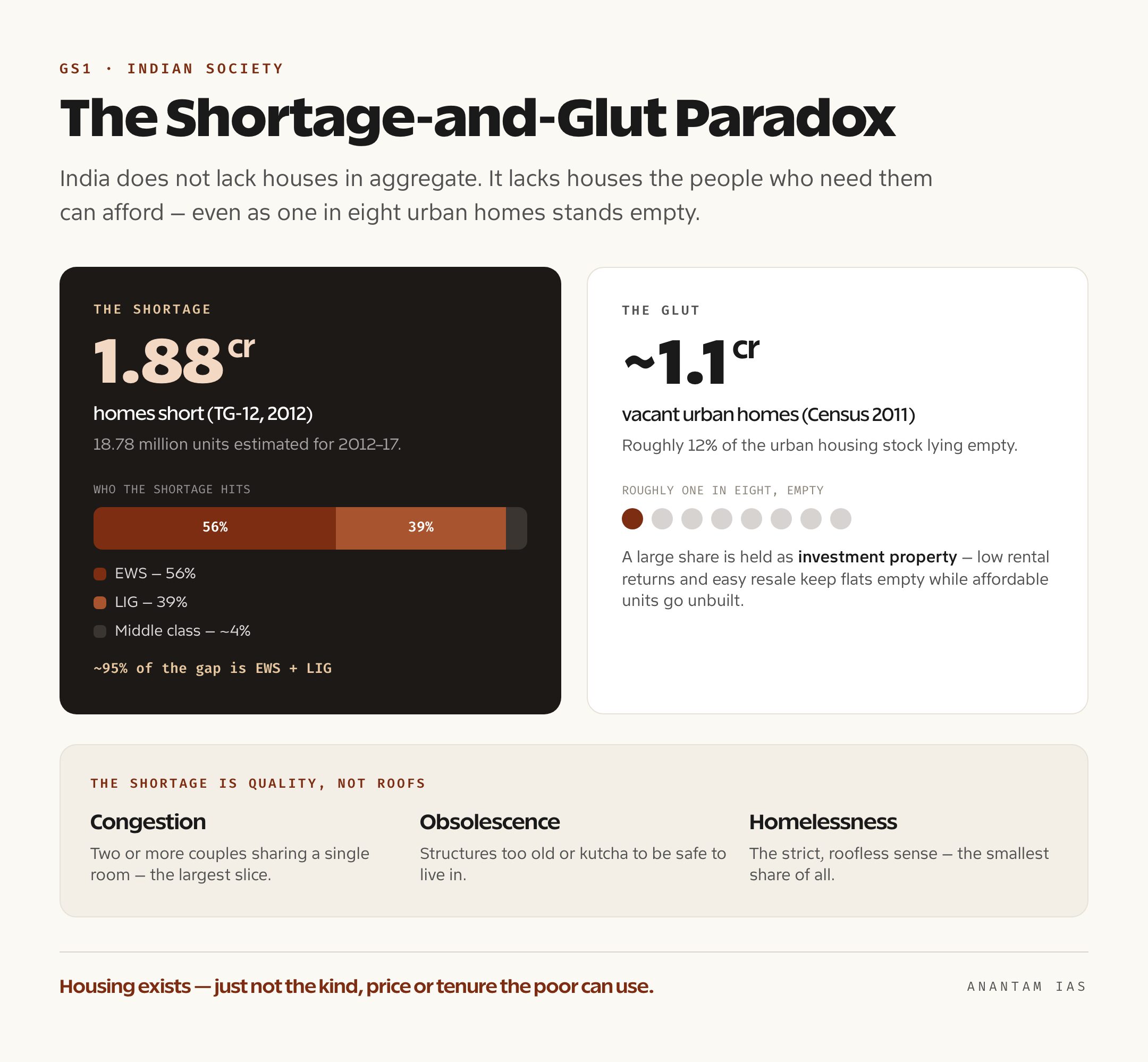
That is the heart of India’s urban housing crisis, and it explains why this is not simply a problem of building faster. The Technical Group on Urban Housing Shortage (TG-12) pegged the 2012 shortage at about 1.88 crore homes, and more than 95 per cent of that gap sat among the poorest households. Yet Census 2011 counted roughly 1.1 crore vacant homes in urban India at the same moment. Land that cannot be titled, finance that does not reach informal workers, a rental market frozen by old laws, and urbanisation running ahead of planning have together produced a shortage and a glut side by side. With India’s towns and cities projected to hold around 600 million people by 2036, the gap will not close on its own.
What the Housing Shortage Actually Looks Like
Start with the number everyone quotes, because it still anchors the policy debate. The Technical Group (TG-12) set up by the then Ministry of Housing and Urban Poverty Alleviation estimated India’s urban housing shortage at 18.78 million units, about 1.88 crore homes, for the 2012-17 period. The composition matters more than the headline. Roughly 56 per cent of that shortage was in the Economically Weaker Section (EWS, broadly households earning up to about Rs 3 lakh a year) and about 39 per cent in the Low Income Group (LIG). Together that’s around 95 per cent of the gap concentrated at the bottom of the income ladder. The middle class accounted for barely 4 per cent. So the crisis is overwhelmingly a poor person’s crisis.
The shortage also hides its real form. The TG-12 was clear that most of the deficit was not households with no roof at all, but households living in unacceptable conditions: congestion, where two or more couples share a single room; obsolescence, where the structure is too old or kutcha to be safe; and homelessness in the strict sense, which is the smallest slice. Read that way, the shortage is less about empty land and more about quality and dignity. A family of six in a 100-square-foot rented room is counted, correctly, as part of the shortage even though they have an address.
And the pressure is building, not easing. India’s urban population is projected to reach roughly 600 million by 2036, close to 40 per cent of the country, up from about 31 per cent at Census 2011. The World Bank has estimated India needs to invest on the order of 840 billion dollars in urban infrastructure by 2036 just to keep pace. Every year of delay adds new households at the EWS and LIG end, which is precisely where formal housing supply is thinnest. The shortage is a moving target, and it moves toward the poor. You can see how this connects to wider deprivation in our explainer on https://anantamias.com/urban-poverty/.
The Affordability Gap and the Vacant-House Paradox
Here’s where the contradiction sharpens. India does not lack houses in aggregate; it lacks houses that the people who need them can afford to buy or rent. The price-to-income ratio, which compares a typical home price with annual household income, has climbed to around 7.5 in 2024 from about 6.6 in 2020, by industry estimates. Anything above 5 is generally read as an affordability problem, and 7.5 means a home costs more than seven years of a household’s entire income. The equated monthly instalment burden has worsened too, with EMI-to-income ratios rising sharply as prices outran wages between 2020 and 2024.
Now place the vacant homes beside that. Census 2011 found about 1.1 crore vacant residential units in urban India, roughly 12 per cent of the urban housing stock standing empty. Some of that is genuine churn, but a large share is investment property: flats bought as a store of value, held vacant because rental returns are low and selling is easy when prices rise. So capital flows into housing as an asset while the housing that is actually needed, small affordable units for low-income families, never gets built. The market is solving the wrong problem.
The rental market should bridge this gap, and in most countries it does. In India it barely functions for the poor. Decades of old-style rent control, which capped rents and made eviction near-impossible, taught owners that letting a property is a trap, so many keep flats empty rather than rent them. Circular migrants, the construction worker or delivery rider who moves city to city, are left with informal arrangements, paying-guest beds, or the slum. Formal rental housing for them is close to non-existent. India’s tenure model is skewed hard toward ownership, which is the most expensive and least flexible option for exactly the households that move most.
Slums, Informal Settlements and the Roots of the Crisis
To understand why the shortage clusters at the bottom, look at where the urban poor actually live. Census 2011 counted about 6.55 crore people, roughly 65.5 million, living in slums, spread across more than 2,600 towns and cities. That was around 17 per cent of the urban population, and the absolute number had jumped from about 4.26 crore in 2001. Maharashtra alone accounted for close to 1.18 crore slum dwellers, with Mumbai holding the single largest concentration. These are not people outside the economy; they are the workers who build the city and clean it, housed in the only stock they can reach.
Slums exist because the formal market never offered the poor a legal alternative. The deeper causes run together. Urban land is genuinely scarce and badly used: high-density slums sit next to under-utilised parcels held by railways, ports, defence and various public sector undertakings, each under different rules, so the land cannot easily be pooled for housing. Restrictive Floor Space Index norms, the cap on how much you can build on a plot, create artificial scarcity of vertical space and push prices up. Cities have grown radially, so new affordable projects land on the periphery with poor transport, far from the jobs that justify the move to the city in the first place.
Two structural problems sit underneath all of this. The first is finance. EWS and LIG households mostly earn informal, irregular incomes and lack the documentation banks want, so they fail the creditworthiness test and never get a formal home loan. The second is land titling. India uses a presumptive titling system: a registered sale deed records that a transaction happened, but the state does not guarantee that the seller actually owned clean title. Titles can be challenged in court for decades, which deters formal construction and lending on exactly the plots the poor occupy. The Digital India Land Records Modernisation Programme is meant to move the country toward conclusive, state-guaranteed titles, but states have resisted the model law, and progress is slow. Rapid in-migration, which our note on https://anantamias.com/urbanization/ traces in detail, then loads more demand onto this broken supply chain every year.
The Policy Response: PMAY-U, PMAY-U 2.0 and the Rental Push
The flagship answer is the Pradhan Mantri Awas Yojana (Urban), launched in 2015 with the goal of housing for all and a beneficiary frame of EWS, LIG and Middle Income Group households. It ran on four verticals: In-situ Slum Redevelopment, which uses land as a resource with private partners and a central grant of about Rs 1 lakh per house; Affordable Housing in Partnership, supporting projects that reserve a share of units for the poor; Beneficiary-Led Construction, which gives a household money to build on its own plot; and the Credit Linked Subsidy Scheme, an interest subsidy on home loans for EWS, LIG and MIG borrowers. By late 2024 the Ministry of Housing and Urban Affairs reported about 1.18 crore houses sanctioned under PMAY-U 1.0, with around 88 lakh completed and delivered, a large delivery record even after accounting for the gap between sanctioned and finished homes.
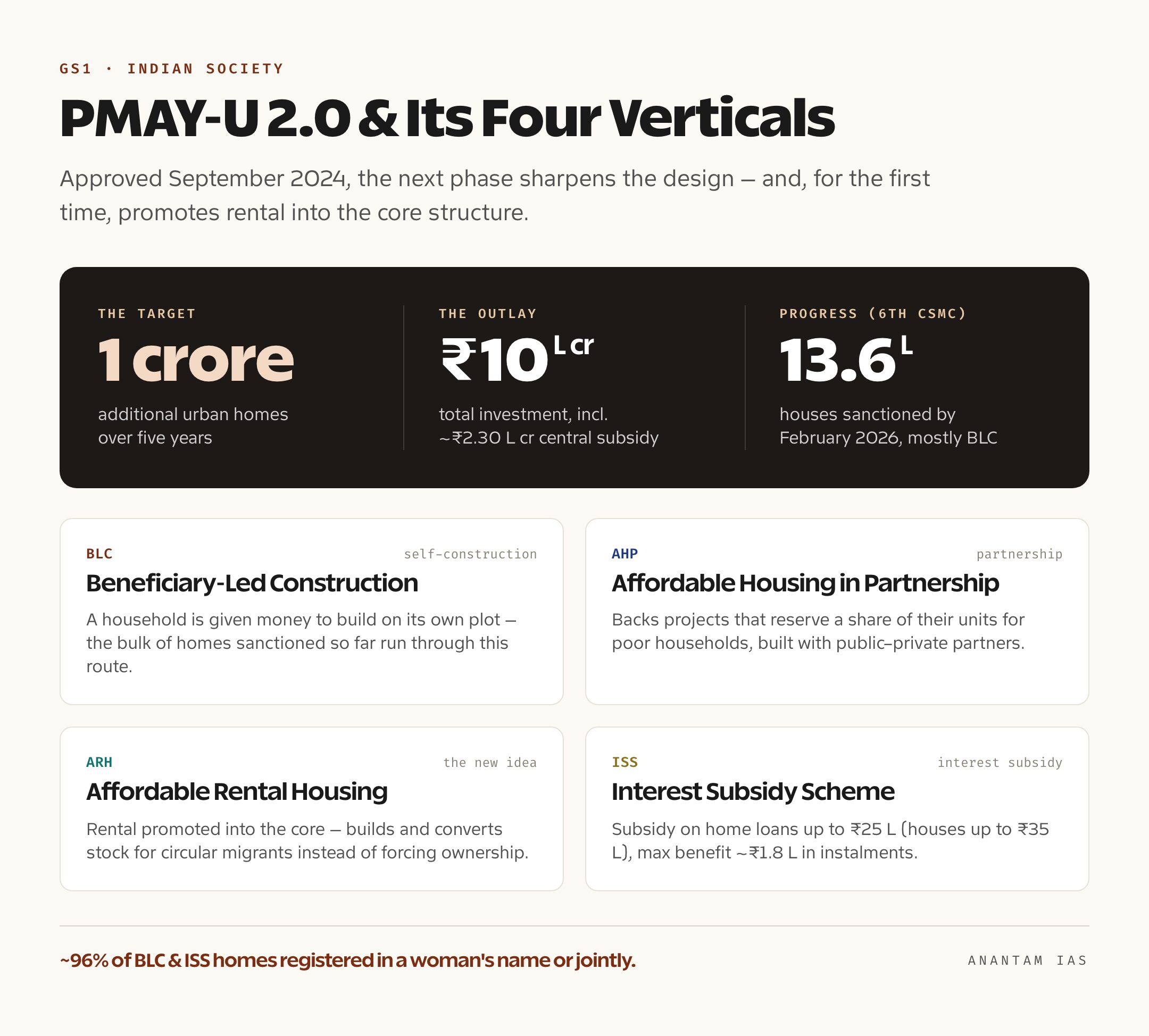
PMAY-U 2.0, approved in September 2024, carries the mission into its next phase with a sharper design. It targets one crore additional urban homes over five years, with a total government investment of about Rs 10 lakh crore including roughly Rs 2.30 lakh crore in central subsidy. The verticals were rationalised and, importantly, rental was promoted into the main structure: Beneficiary-Led Construction, Affordable Housing in Partnership, Affordable Rental Housing, and an Interest Subsidy Scheme. The ISS now offers a subsidy on home loans up to Rs 25 lakh, on houses costing up to Rs 35 lakh, with a maximum benefit of about Rs 1.8 lakh released in instalments. By the sixth Central Sanctioning and Monitoring Committee meeting in February 2026, the scheme had sanctioned more than 13.6 lakh houses, the bulk under the self-construction (BLC) route, with around 96 per cent of BLC and ISS homes registered in a woman’s name or jointly.
The rental piece deserves its own line because it is the genuinely new idea. Affordable Rental Housing Complexes, launched in 2020 during the pandemic as migrants walked home for want of shelter, convert existing vacant government-built housing into rental stock and let public and private players build fresh rental complexes for the urban poor. Alongside it, the Model Tenancy Act of 2021 was circulated to states to replace the old rent-control regime with a balanced framework, capping deposits, protecting both landlord and tenant and setting up fast dispute resolution. The intent is to unfreeze the rental market and coax those 1.1 crore vacant flats back into use. The catch is adoption: tenancy is a state subject, and only a handful of states have notified rules based on the model law, so the reform’s reach is still thin.
What Still Needs Fixing: The Reform Roadmap
For all the scale of PMAY, the binding constraints remain stubborn, and an honest answer names them. Land is first. Cities need to pool and unlock public land parcels for affordable housing, designate plots in state land banks specifically for EWS and LIG units, and rationalise Floor Space Index, raising it where transport and infrastructure can absorb the density, so that affordable supply rises near jobs rather than on the far periphery. None of the subsidy schemes matter if there is no buildable, well-located land to put them on.
Finance is second. Interest subsidies help the household that can already access a loan, but the most housing-insecure, the informal worker with no salary slip, fails at the door of the bank. Extending priority sector lending treatment for affordable housing, building credit-guarantee mechanisms for informal incomes, and stabilising migrant earnings, an urban employment programme has been argued for here, would raise the creditworthiness the current system demands. Subsidy depth is also an issue: a fixed central grant that works in a mid-sized town barely dents a metro property price, so amounts may need to be indexed to local land costs.
Third, the model has to shift from ownership-first to a real tenure mix. In-situ slum redevelopment works where land is valuable enough that a developer can cross-subsidise free units by selling the rest, which is why it succeeds in Mumbai and stalls in smaller cities; it cannot be the universal answer. A functioning rental market, driven by wide adoption of the Model Tenancy Act and a scaled-up Affordable Rental Housing programme, is what actually fits circular migrants. Underneath all of it sits titling: moving from presumptive to conclusive, state-guaranteed titles, backed by digitised records, would unlock lending, cut litigation and let the poor finally hold a secure asset. The way forward is less a single mega-scheme than a stack of unglamorous fixes, on land, finance, rental and titles, done together.
For Your Mains Answer
This topic is a workhorse for GS Paper 1 (urbanisation, its problems and remedies; issues of the urban poor) and GS Paper 2 (government welfare schemes, PMAY, and implementation). It also feeds GS Paper 3 (infrastructure, real estate and inclusive growth) and the Essay paper on inequality and the city. The examiner wants you to show that urban housing is a structural problem, not a construction problem, and that you know the current scheme architecture.
How to Build the Answer
Open with the paradox, not the scheme: a severe shortage concentrated among the poor sitting beside roughly 1.1 crore vacant urban homes. Then lay out the landscape (the 1.88 crore TG-12 shortage, the EWS-LIG concentration, the rising price-to-income ratio), move to causes (land scarcity and titling, weak finance for informal incomes, the frozen rental market, FSI limits), survey the policy response (PMAY-U and PMAY-U 2.0’s four verticals, ARHC, the Model Tenancy Act), and close with a reform stack. That arc, paradox to landscape to causes to policy to roadmap, works for almost any urban-housing prompt.
Common Mistakes to Avoid
Don’t treat the shortage as homelessness; most of it is congestion and obsolescence, and saying so shows you’ve read TG-12. Don’t list every scheme as a hero without naming its limit, the Model Tenancy Act’s slow state adoption, in-situ redevelopment’s failure in small cities, the shallow subsidy in metros. Don’t ignore the vacant-house paradox; it is the single most quotable contradiction in the whole topic. And don’t confuse PMAY-U 1.0’s four verticals with PMAY-U 2.0’s, which folds rental into the core.
A Compact Answer Spine
Shortage and glut coexist (1.88 crore short, ~1.1 crore vacant) → shortage is ~95 per cent EWS/LIG and mostly congestion, not homelessness → causes: land scarcity and presumptive titling, no finance for informal incomes, frozen rental market, low FSI → policy: PMAY-U (four verticals, ~88 lakh delivered) and PMAY-U 2.0 (1 crore target, Rs 10 lakh crore, BLC-AHP-ARH-ISS), plus ARHC and the Model Tenancy Act → roadmap: unlock public land and raise FSI, deepen finance and PSL, build a rental market, move to conclusive titling.
Diagram or Flowchart Idea
Draw a simple two-pan balance: on the left pan, “1.88 crore shortage (95% EWS/LIG)”; on the right pan, “~1.1 crore vacant homes.” Below the balance, a horizontal arrow labelled with the four fixes, land, finance, rental, titles, pointing the two pans toward equilibrium. It captures the whole argument in one frame and is quick to sketch.
A Balanced-Conclusion Line
End by noting that India’s housing problem is fundamentally one of access, not absolute supply, so the answer lies less in any single mega-scheme and more in fixing the four broken markets beneath it, land, finance, rental and title, so that the homes that exist reach the people who need them.
How to Use Data Without Cramming
Anchor with three or four figures, not ten: the 1.88 crore shortage and its EWS/LIG concentration, the ~1.1 crore vacant homes, the PMAY-U 2.0 target of one crore homes at about Rs 10 lakh crore, and the ~7.5 price-to-income ratio. Attribute in-prose, “the TG-12 estimated,” “Census 2011 found,” and you sound like someone who has read the source, not memorised a coaching list.
FAQ
How big is India’s urban housing shortage, and who does it affect most? The Technical Group (TG-12) estimated the urban housing shortage at about 1.88 crore homes for 2012-17. Around 56 per cent of it lay in the Economically Weaker Section and 39 per cent in the Low Income Group, so roughly 95 per cent of the gap is among the poorest households. Most of the shortage is congestion and obsolete housing rather than outright homelessness.
Why does India have a housing shortage and vacant homes at the same time? Census 2011 counted about 1.1 crore vacant urban homes, roughly 12 per cent of the stock. Many are held as investment assets because rental returns are low and old rent-control laws made letting risky, while affordable units for low-income families are barely built. So housing exists, but not the kind, price or tenure the people who need it can use.
What is PMAY-U 2.0 and how is it different from the original PMAY-U? PMAY-U 2.0, approved in September 2024, aims to build one crore additional urban homes over five years with about Rs 10 lakh crore in total investment. It runs on four verticals, Beneficiary-Led Construction, Affordable Housing in Partnership, Affordable Rental Housing and an Interest Subsidy Scheme, and unlike the 2015 mission it promotes rental housing into the core design rather than treating ownership as the only route.
What reforms are still needed beyond building more houses? The binding constraints are land, finance, rental and title. India needs to unlock public land and rationalise Floor Space Index, extend finance to informal-income workers through priority sector lending and credit guarantees, scale the rental market by adopting the Model Tenancy Act and Affordable Rental Housing Complexes, and move from presumptive to conclusive, state-guaranteed land titles backed by digitised records.
Practice Questions
Prelims MCQs
- The Technical Group (TG-12) estimated India’s urban housing shortage for 2012-17 at roughly how many units?
(a) 1.1 crore
(b) 1.88 crore
(c) 6.55 crore
(d) 88 lakh
Answer: (b) — TG-12 pegged the shortage at about 18.78 million, or 1.88 crore homes, for the 2012-17 period. - According to TG-12, the bulk of the urban housing shortage was concentrated in which income groups?
(a) MIG and HIG
(b) MIG alone
(c) EWS and LIG
(d) HIG alone
Answer: (c) — About 56 per cent lay in the EWS and 39 per cent in the LIG, roughly 95 per cent of the gap among the poorest households. - Census 2011 estimated vacant urban residential units at approximately what share of the urban housing stock?
(a) 4 per cent
(b) 12 per cent
(c) 17 per cent
(d) 40 per cent
Answer: (b) — Around 1.1 crore homes, roughly 12 per cent of the urban stock, stood vacant even amid a severe shortage. - Which of the following is NOT one of the four verticals of PMAY-U 2.0?
(a) Beneficiary-Led Construction
(b) Affordable Housing in Partnership
(c) Affordable Rental Housing
(d) In-situ Slum Redevelopment
Answer: (d) — PMAY-U 2.0’s verticals are BLC, AHP, ARH and the Interest Subsidy Scheme; in-situ slum redevelopment was a vertical of the original PMAY-U, not 2.0. - The Model Tenancy Act, circulated to states in 2021, aims primarily to:
(a) cap urban land prices
(b) replace old rent-control regimes with a balanced landlord-tenant framework
(c) guarantee conclusive land titles
(d) raise the Floor Space Index
Answer: (b) — It seeks to unfreeze the rental market by capping deposits, protecting both parties and enabling fast dispute resolution; tenancy being a state subject, adoption remains thin.
Mains Practice Questions
- “India’s cities face a severe housing shortage and a glut of vacant homes at the same time.” Explain this paradox and discuss its underlying causes. (15 marks, 250 words)
- The urban housing shortage is “less about empty land and more about quality and dignity.” Examine this statement with reference to congestion, obsolescence and homelessness. (10 marks, 150 words)
- Evaluate the design and performance of PMAY-U and PMAY-U 2.0, highlighting how the latter rationalised its verticals and promoted rental housing into the core. (15 marks, 250 words)
- Discuss how weak finance for informal incomes and a presumptive land-titling system together constrain affordable housing supply for the urban poor. (10 marks, 150 words)
- “India’s housing problem is one of access, not absolute supply.” Critically analyse the reform roadmap across land, finance, rental and title needed to address the urban housing crisis. (15 marks, 250 words)
Tell Google you want more of this.
Add Anantam IAS as a preferred sourceOne tap, and this site shows up more often in your own Top Stories, AI Overviews and AI Mode. Remove it any time.