
A worker lays bricks for a glass tower she’ll never set foot in, then walks home to a tarpaulin roof on land she doesn’t own. That’s not an edge case. That’s the arithmetic of an Indian city. The country is urbanising at a pace that will define this century, and the World Bank’s July 2025 report, Towards Resilient and Prosperous Cities in India, puts a hard number on it: about 951 million urban Indians by 2050, nearly double today’s level. But the city we’re building is designed around the formal economy, the salaried, the propertied, the counted. The people who actually build and run it, the migrants, the slum-dwellers, the street vendors, get planned around, not planned for.
That gap is the whole topic. Urbanisation, the steady shift of people from villages to towns and cities and the spread of urban ways of living, is supposed to lift people up. And on the income side it often does. But a city that grows its skyline faster than its sewers, its malls faster than its rental housing, hands its costs to whoever can least refuse them. So the mark-scoring question isn’t whether India is urbanising. It’s who the city is being built for.
The Issue, Framed
The argument here isn’t about whether cities should grow. They will, with or without our consent. The argument is about who the growth serves, and who pays the price of the parts we get wrong.
Let’s fix the vocabulary first, because most of the confusion on this topic comes from loose words. Urbanisation is the rising share of a population living in towns and cities, driven by people moving in for work and by villages themselves turning urban. A slum, in the Census of India‘s working definition, is a residential area unfit for human habitation, marked by overcrowding, poor sanitation, unsafe construction, and insecure tenure. The key word is tenure. A slum isn’t just a poor neighbourhood. It’s a neighbourhood where you can be evicted because you have no legal claim to the ground under your feet.
Two more terms run through everything that follows. In-situ upgrading means improving a slum where it already stands, by giving residents secure tenure and laying in water, drains, and pucca housing, instead of bulldozing the settlement and shipping people to the city’s edge. And a ULB, an urban local body, is the municipal corporation, municipality, or town council that’s supposed to actually deliver all of this on the ground, the body the 74th Constitutional Amendment created to govern cities.
Hold on to one hard fact before any number lands. India’s most authoritative urban figures, the urban share, the slum count, the migrant count, all rest on Census 2011. There has been no Census since. The 2021 round was postponed indefinitely, the first such delay in roughly 150 years. So every stock figure in this debate is a 15-year-old baseline that almost certainly undercounts today’s reality. That data gap isn’t a footnote. It’s part of the problem.
A growing city is a duty and an opportunity. A city that grows without housing, services, or a real headcount of its poorest is a liability with a skyline.
What the Data Says
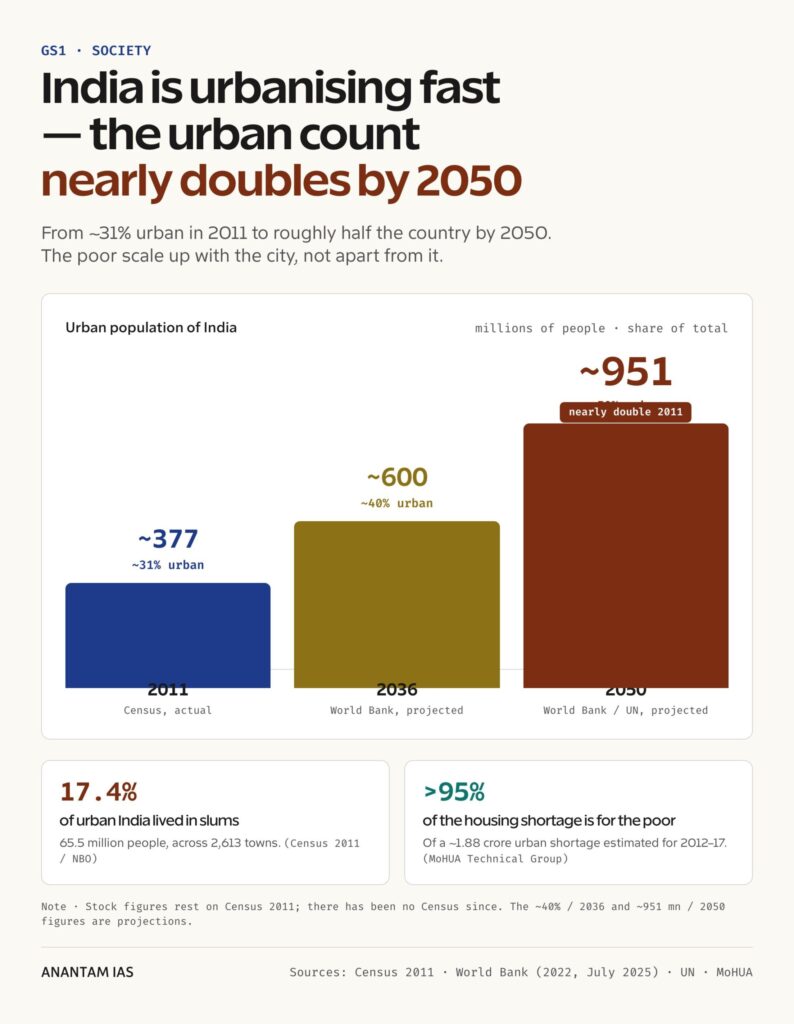
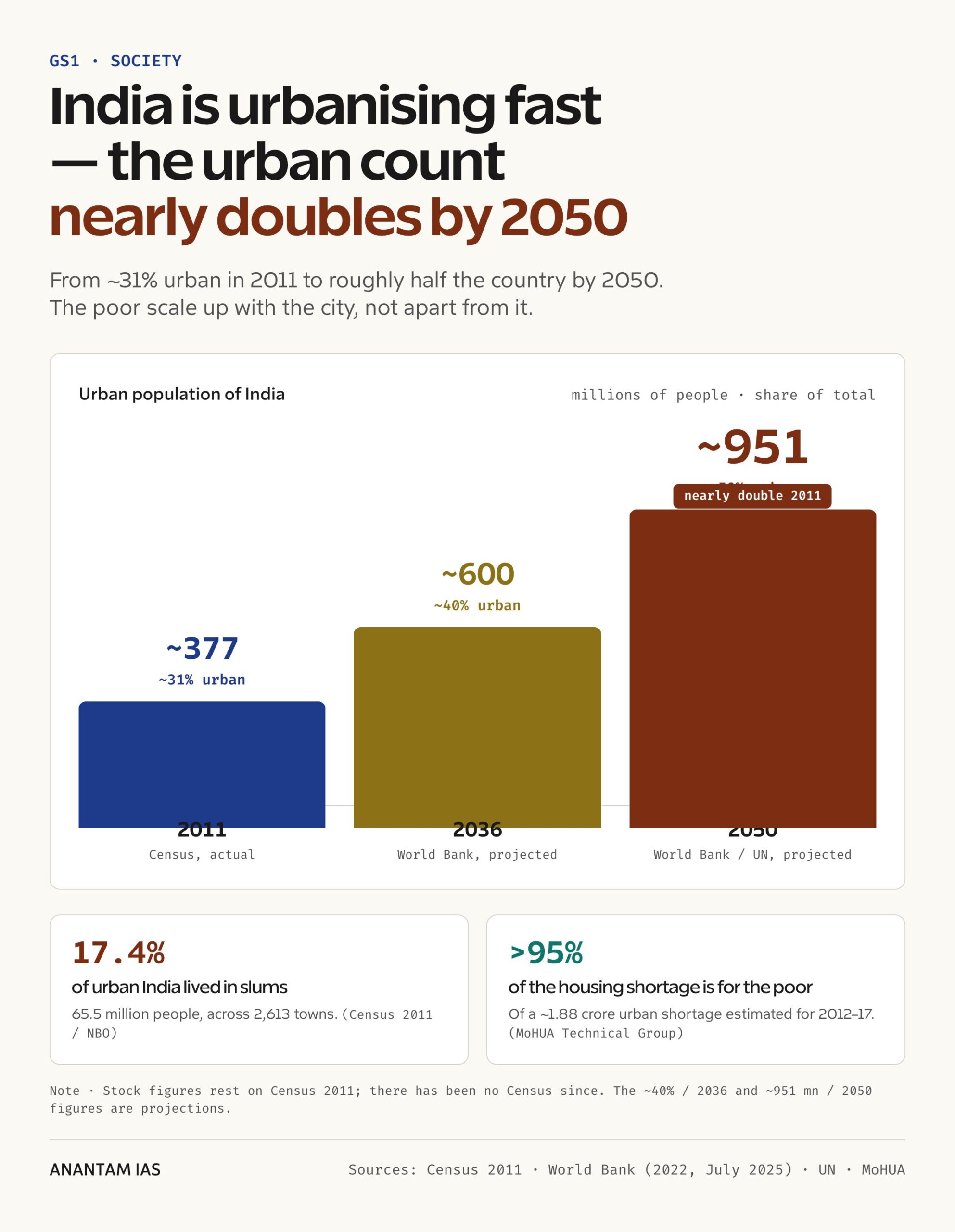
Start with the trajectory, because the scale is the argument. In 2011, about 31% of Indians, roughly 377 million, lived in urban areas. The World Bank’s 2022 work projected that figure to reach about 40%, around 600 million, by 2036. And the 2025 report pushes the horizon further: about 951 million urban Indians by 2050, with the UN’s own projection putting India at roughly half-urban by mid-century. So the country isn’t choosing whether to become an urban nation. It’s already on the way.
Now the part the skyline hides. As of 2011, 65.5 million people, 17.4% of urban India, lived in slums, across 2,613 towns. A 2024 government statement reaffirmed roughly 6.54 crore people in slums nationwide, and read that carefully: it still leans on the 2011 count, because there’s nothing newer. The slum population climbed from 27.9 million in 1981 to 65.5 million in 2011. Slums aren’t a leftover the city is clearing. They’re a structural feature it keeps reproducing.
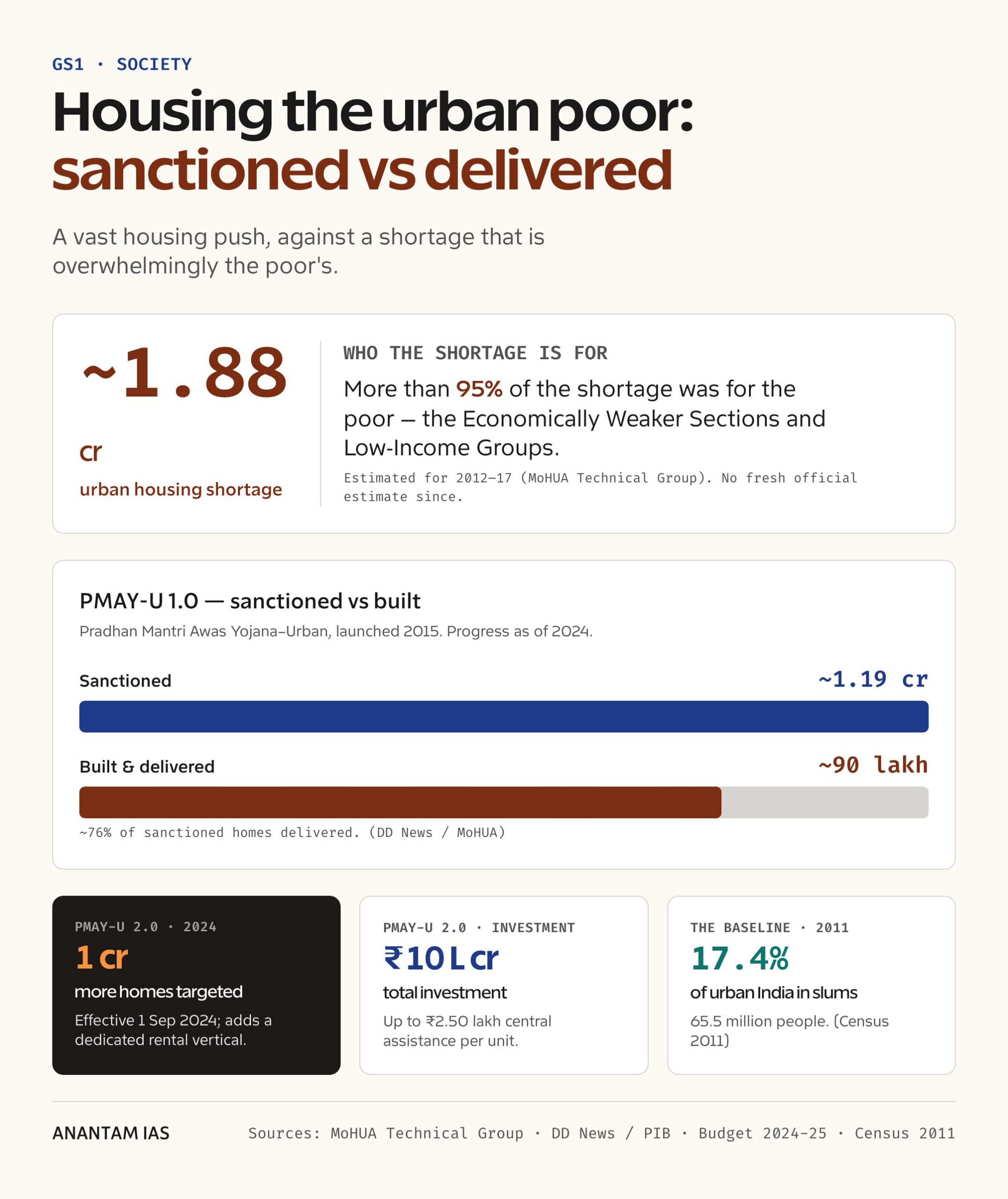
The housing gap tells you exactly who’s being missed. The government’s Technical Group pegged the urban housing shortage at about 1.88 crore units for 2012-17, and more than 95% of that shortage was for the poor, the Economically Weaker Sections and Low-Income Groups. Two cautions matter for an honest answer. That’s a 2012-17 vintage estimate, with no fresh official figure since. And a later, non-government estimate by ICRIER put the shortage closer to 29 million units by 2018. So the precise number is contested, but the direction isn’t: the need is overwhelmingly at the bottom.
Then there’s the mobile half of the story. 45.6 crore Indians, about 37% of the population, were internal migrants in 2011, up 45% over the previous decade. Most move within their own state, but a large stream crosses state lines for work, and the Census is known to undercount the temporary, circular labour that powers construction sites and factory floors. These are the people who build the city and then can’t prove they live in it.
One last figure sets up the deeper failure. India’s municipal bodies, the ULBs meant to deliver all of this, collect and spend revenue worth only about 1% of GDP, a level that’s barely moved in over a decade. Compare that to roughly 7.4% in Brazil. The RBI’s own review called India’s urban local bodies “among the weakest globally” in fiscal autonomy. So the bodies tasked with building an inclusive city are running on pocket change.
The Case For
The government’s response isn’t nothing, and an answer that pretends otherwise will read as lazy. So let’s state the case at full strength.
The housing push is real, and it’s enormous. Under Pradhan Mantri Awas Yojana-Urban (PMAY-U) 1.0, launched in 2015, about 1.19 crore homes were sanctioned and roughly 90 lakh were built and delivered by 2024. That’s among the largest housing programmes anywhere on earth. And it didn’t stop there. PMAY-U 2.0, approved by the Cabinet in August 2024 and effective from 1 September 2024, targets 1 crore more homes with ₹10 lakh crore in total investment and up to ₹2.50 lakh in central assistance per unit. Crucially, 2.0 carries a dedicated rental vertical, an admission that not every urban poor family wants, or can afford, to own.
Migrants got a genuine structural win, too. One Nation One Ration Card (ONORC), the scheme that lets you draw your subsidised food grain at any ration shop in the country instead of only your home village, now covers about 97% of National Food Security Act beneficiaries, roughly 77 crore people, across 35 states and union territories. For a migrant who once lost her ration the moment she crossed a district line, that’s a real change. It decouples a core entitlement from your home address, which is exactly the logic a mobile workforce needs.
The city-systems upgrades are visible. The Smart Cities Mission tendered around 8,000 projects across 100 cities and completed roughly 91% of them, with an Integrated Command and Control Centre now running in every one. AMRUT and AMRUT 2.0 target universal piped water across 4,378 statutory towns and have already added crores of household tap connections. So basic urban plumbing, water and sewerage, is moving, not stalled.
And the poverty trend is real. The National Multidimensional Poverty Index, built by NITI Aayog with the UN, found urban multidimensional poverty roughly halved, from 8.65% in 2015-16 to 5.27% in 2019-21. Multidimensional poverty measures deprivation across health, education, and living standards, not just income, so a fall here means real improvements in homes, not just wallets. The city, on this measure, is lifting people.
The Case Against
Here’s what all of that walks past. Scale and intent aren’t the same as inclusion, and on inclusion the record has real holes.
Slums remain a permanent feature, not a vanishing residual. Roughly 6.5 crore people, 17% of urban India, lived in slums as of 2011, and the most recent official restatement still rests on that decade-old count. So the state can’t even measure the problem in real time, let alone solve it. A programme that builds lakhs of new homes while the slum count holds steady isn’t winning. It’s running to stand still.
The housing supply is aimed at the wrong segment. The shortage was more than 95% concentrated among the poor, yet a great deal of formal housing supply skews to the mid and upper market, the saleable stock that turns a profit. So supply and need are misaligned at the root. Building homes the poor can’t afford doesn’t close a shortage that’s almost entirely theirs.
Migrants are consumed, not housed. The 2020 reverse migration, when the COVID lockdown sent millions of workers walking home for hundreds of kilometres because the city offered them no shelter and no safety net, was the clearest possible proof. The dedicated answer that followed, the Affordable Rental Housing Complexes (ARHC) scheme of 2020, meant to convert vacant public housing and build new rental stock for urban migrants, has largely stalled in uptake. Cities want migrant labour. They just don’t want to house it.
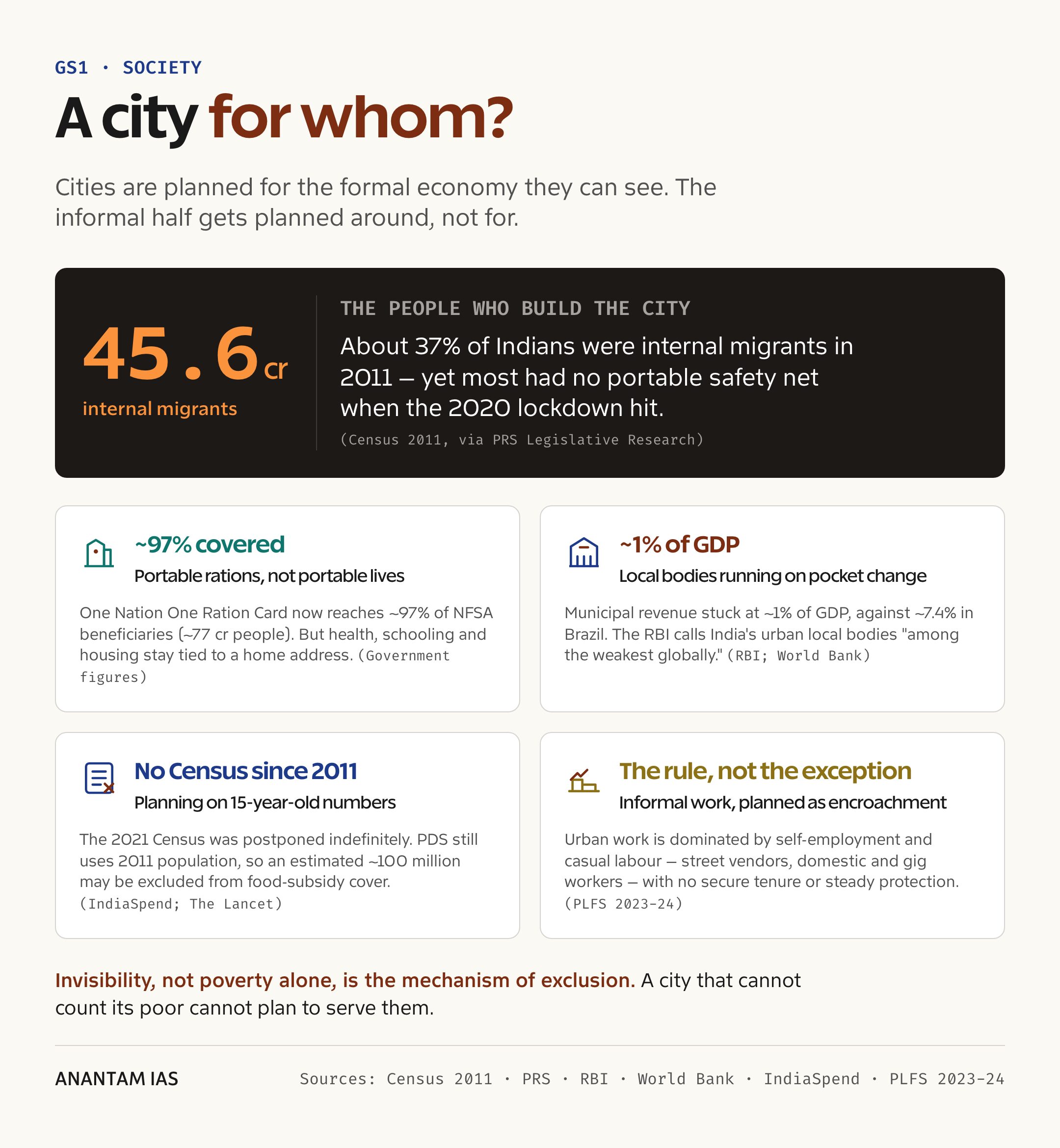
The data blackout corrodes everything above it. With no Census since 2011, urban planning, welfare targeting, and the slum, housing, and migrant counts all run on stale numbers. The consequences are concrete: because PDS allocations still use 2011 population figures, an estimated 100 million people may be excluded from food-subsidy coverage purely on outdated arithmetic. You cannot target a poor person the system can’t see.
The ULBs that should deliver inclusion can’t fund it. Municipal revenue stuck at about 1% of GDP, with own-source revenue under 40% of budgets, means the bodies closest to the urban poor are the most starved. So inclusion gets announced in Delhi and then dies in a municipal corporation that can’t pay for it.
And informality is the rule, treated as the exception. Urban work is dominated by self-employment and casual labour, the street vendor, the domestic worker, the gig rider, none with secure tenure or stable social protection. The infrastructure gap, the World Bank’s estimate that India needs over $840 billion by 2036 and more than $2.4 trillion by 2050 for resilient urban infrastructure, lands hardest on these same people, who live in the least-serviced, most flood- and heat-exposed corners of the city.
The Deeper Structural Read
Step back from the schemes and the real fault line shows up. It isn’t a shortage of money or even a shortage of homes. It’s a planning model that treats the urban poor as a problem to be cleared rather than a population to be served.
Look at how the city sees the slum. The instinct, for decades, has been eviction and relocation: clear the settlement, move the residents to cheaper land on the periphery, free the central plot for “better” use. But that model breaks the one thing the poor have, proximity to work. A domestic worker relocated 25 kilometres out loses her job before she gains her flat. This is exactly why in-situ upgrading, fixing the slum where it stands and granting secure tenure, is the more humane and more effective path. Tenure is the hinge. Give a family a legal claim to the ground, and they’ll invest in the home themselves, which is something decades of slum economics confirms.
Now connect that to the money problem, because they’re the same problem. The ULB is the body that’s supposed to grant tenure, lay drains, run the rental housing, and plan for the vendor. But it collects revenue worth about 1% of GDP and depends on state and central grants for the rest. So the institution closest to the urban poor is the one with the least power and the least money. The 74th Amendment promised to devolve real authority to cities. In practice, much of that devolution stayed on paper. You can’t ask a hollow institution to deliver an inclusive city.
And here’s the part that should bother you most as a future administrator. The city plans for the formal economy because the formal economy is what it can see, the registered property, the salaried taxpayer, the counted household. The informal economy, the migrant who arrived last month, the vendor without a licence, the family in an unrecognised slum, is invisible to the planning system, so it gets no rental housing, no service line, no vote that the local body must answer to. Invisibility, not poverty alone, is the mechanism of exclusion. ONORC matters precisely because it’s the rare scheme that makes a mobile poor person visible to the state wherever she stands.
There’s a federal layer underneath, too. Urbanisation is constitutionally a state and local subject, yet the largest interventions, PMAY, Smart Cities, AMRUT, are centrally designed missions. So a city’s fate is shaped by money and templates from Delhi while the body meant to govern it stays weak. That mismatch is structural, not partisan, and it’s an argument for stronger, better-funded ULBs, not for more centrally-run schemes layered on top of starved municipalities.
The deepest read, then, is this: India is building a 951-million-person urban future on a planning system that can only see the half of the city that’s already comfortable. Fix who the city counts, and you start to fix who it serves.
What Should Be Done
So what does an inclusive city actually require? Not a vague plea for “better planning,” but a set of moves you could hand a municipal commissioner tomorrow. Seven, and none of them slows growth.
- Make rental and EWS/LIG housing the centrepiece, not the afterthought. Fix the stalled rental model and align new supply to the more than 95% of the shortage that sits with the poor, rather than to saleable mid-market stock. The PMAY-U 2.0 rental vertical is the vehicle. Make it the priority, and read the deeper logic in affordable housing in India.
- Upgrade slums in place, with secure tenure. Choose in-situ upgrading over eviction wherever it’s viable. Grant legal tenure, lay water and drains, and let residents invest in their own homes near their own jobs. Relocation to the periphery should be the rare exception, not the default reflex.
- Give migrants portable entitlements, not just portable rations. Extend the ONORC logic beyond food to health, school admission, identity, and social security, so a circular migrant is treated as a resident-in-fact wherever she works. The e-Shram registry of unorganised workers is the scaffolding. Build the benefits on top of it.
- Empower and fund the ULBs. Raise own-source revenue through better property tax and user charges, deepen the municipal bond market, and devolve the 74th-Amendment functions in practice. The target is to move municipal spending toward the Brazil and South Africa benchmark, away from today’s 1%-of-GDP floor. The route runs through urban local body finances.
- Plan for the informal economy as the norm. Designate vendor zones, build dormitory and rental housing near worksites, and write street vendors and gig workers into city master plans rather than treating them as encroachment. A city that runs on informal labour should plan for it on purpose.
- Restore the data backbone. Conduct the Census, refresh the urban poverty line, and re-estimate the slum, housing-shortage, and migrant stocks. You cannot serve a poor person the system can’t count, and right now the system is counting with numbers from 2011.
- Build resilience and inclusion together. Channel the multi-trillion-dollar infrastructure programme toward heat- and flood-resilient services in low-income settlements first, because that’s where the climate risk and the service deficit overlap most sharply.
Every one of these makes the city stronger, not slower. A city that houses its workers, counts its poor, and funds its own municipality is a city that can actually carry 951 million people. That’s the entire point of building it.
For Your Mains Answer
This is a clean GS1 topic that rewards structure. It sits squarely under “urbanisation, their problems and their remedies,” and it pulls in population, migration, poverty, and the effects of globalisation on Indian society.
GS paper mapping: GS1: Indian Society, urbanisation and its problems and remedies; population and associated issues; poverty and developmental issues; effects of globalisation on Indian society. (Cross-links to GS2 welfare schemes and GS3 infrastructure, but keep the frame GS1.)
Likely question frames:
- “Indian cities are growing faster than they can include their poor.” Critically examine, with reference to slums, migration, and the urban housing shortage.
- Discuss how internal migration shapes Indian urbanisation, and assess whether current policy treats migrants as residents or as transient labour.
- “The problem of Indian urbanisation is not the rate of growth but the model of planning.” Comment.
Quotable data points:
- About 31% urban in 2011 (~377 million), heading to ~40% (600 million) by 2036 and ~951 million by 2050.
- 65.5 million people, 17.4% of urban India, in slums in 2011.
- Urban housing shortage ~1.88 crore units (2012-17), more than 95% for the poor.
- PMAY-U 1.0: ~1.19 crore homes sanctioned, ~90 lakh built; PMAY-U 2.0: 1 crore homes, ₹10 lakh crore.
- 45.6 crore internal migrants in 2011 (~37% of population).
- ONORC covers ~97% of NFSA beneficiaries, ~77 crore people.
- Municipal revenue stuck at ~1% of GDP versus ~7.4% in Brazil; RBI calls ULBs “among the weakest globally”.
- Urban infrastructure need: >$840 billion by 2036, >$2.4 trillion by 2050.
Keywords to use: urbanisation, urban poor, slums, in-situ upgrading, internal and circular migration, informal sector, affordable rental housing, urban local bodies, 74th Amendment, municipal finance, liveability versus jobs.
Syllabus linkages: urbanisation and its remedies, population and migration, poverty and development, social empowerment, effects of globalisation on Indian society.
Balanced conclusion line: India will be a city-dwelling nation within a generation; the question that decides whether that’s progress is not how fast the city grows, but whether it counts, houses, and serves the people who build it.
How to Build the Answer
Open with the conflict, not a definition. The tension is that urbanisation lifts incomes while the planning model excludes the poor, so growth and inclusion can pull apart unless the city is designed well. That first sentence shows the examiner you’ve grasped both the opportunity and the failure. The definition of slum or in-situ upgrading can follow in the next line.
Bring data in early, but ration it. A strong first body paragraph can carry three numbers: 31% urban in 2011, ~951 million by 2050, and 17.4% in slums. Then say what they prove. The figure is the anchor; the “this means the poor scale with the city” is the mark.
Steelman the government in the second body paragraph. PMAY-U’s ~90 lakh homes and ONORC’s ~97% coverage are real achievements. Concede them before you critique, because an answer that only attacks reads as one-sided, and an answer that only praises reads as naive.
Group the way forward, don’t scatter it. Cluster the reforms: rental and EWS housing, in-situ upgrading, portable entitlements, ULB finance, planning for informality, restoring the Census, resilience for the poor. Use the topic’s own vocabulary so the answer sounds like governance analysis, not a news recap.
Close on the syllabus link, urbanisation and its remedies, and on judgment, not summary. The reliable pattern is “the question is not X, but X with Y,” which lets you hold growth and inclusion together in one line.
Common Mistakes to Avoid
- Don’t recite scheme names as a substitute for analysis. Listing PMAY, AMRUT, and Smart Cities proves you read the news, not that you understand the failure underneath them.
- Don’t treat slums as a law-and-order or aesthetics problem. The core issue is tenure and exclusion, not encroachment.
- Don’t ignore migrants. A urbanisation answer that forgets the 45.6 crore internal migrants misses the human engine of the whole process.
- Don’t quote stale data as if it’s current. Flag that the big numbers rest on Census 2011, and that there’s been no Census since. Naming the data gap is itself a mark.
- Don’t end on a slogan. Close with an implementable principle, fund the ULBs, count the poor, house the worker, not a flourish about “shining cities.”
A Compact Answer Spine
- Introduction: Open with the growth-versus-inclusion tension in one sentence; define urbanisation and slum in the next.
- Evidence: Two or three attributed numbers, each tied to a policy implication.
- Arguments: The case that India is responding (PMAY, ONORC), then the case on the failure (slums persist, migrants unhoused, ULBs starved). Keep both fair.
- Structural diagnosis: The city plans for the formal economy it can see and ignores the informal one it can’t; invisibility, not poverty alone, drives exclusion.
- Way forward: Four to five grouped reforms, each with a clear actor, ULB, state, Centre, Census authority.
- Conclusion: Adapt the balanced conclusion line to the exact question wording.
Diagram or Flowchart Idea
For a 15-marker, draw one causal chain, not a decorative mind map. The cleanest format here: rural distress and city pull → migration → informal work + slum settlement → no tenure, no portable entitlements, weak ULB → exclusion despite growth → remedies (in-situ upgrading, rental housing, portable benefits, ULB finance). The examiner reads that logic in five seconds.
For a 10-marker, skip the diagram and use a two-column table instead: “What the city builds (towers, malls, formal housing)” against “What the poor need (tenure, rental homes, services, recognition).” It’s faster to evaluate under time pressure and lands the misalignment instantly.
Ethics and Governance Angle
Add one ethical line even in a society-focused answer. The question is always who bears the cost when planning fails. Here it’s a concrete person: the migrant who built the tower and sleeps under tarpaulin, the domestic worker relocated away from her job, the family struck off the PDS because the count is 15 years old. Naming that citizen sharpens the answer.
Then convert empathy into design. Don’t merely say “protect the urban poor.” Say how: grant tenure in place, make entitlements portable, fund the local body, count people honestly. That’s the move from moral language to administrative maturity.
A sentence pattern that travels across topics: “The aim, urban growth, is legitimate; its legitimacy depends on whom the growth includes.” It accepts the goal without handing the State a blank cheque, which is exactly what a balance question rewards.
How to Use Data Without Sounding Mechanical
Use fewer numbers than you know. Three well-explained figures beat ten scattered ones. Lead with one big number (~951 million urban by 2050, the scale), use a second for contrast (17.4% in slums, the exclusion), and use a third to justify reform (municipal revenue at 1% of GDP, the capacity gap). One scale figure, one exclusion figure, one capacity gap is usually enough.
Never leave a statistic standing alone. Follow it with “this means…” or “the policy implication is…” That tiny move turns a fact sheet into analysis. In Mains, facts are raw material; judgment is the finished answer.
Finish by asking one question: can a tired examiner follow this in a single pass? If it needs rereading, simplify. Short introduction, data early, two sides marked cleanly, grouped way forward. For UPSC, clarity is how depth becomes visible.
One last sweep: cut any line that sounds impressive but does no work, and replace it with a fact, a cause, a consequence, or a reform. That habit separates an answer that feels understood from one that feels memorised. Always be specific.
FAQ
Why are India’s slum and migrant figures still based on Census 2011?
Because there hasn’t been a Census since. The 2021 round was postponed indefinitely, the first such gap in roughly 150 years, so the official urban share, slum count (65.5 million, 17.4% of urban India), and internal-migrant count (45.6 crore) all rest on a 2011 baseline that almost certainly undercounts today’s reality. In an answer, cite the figures but flag the vintage, because the data gap is itself part of the problem.
What is the difference between PMAY-Urban 1.0 and 2.0?
PMAY-U 1.0, launched in 2015, sanctioned about 1.19 crore urban homes and delivered roughly 90 lakh by 2024. PMAY-U 2.0, effective from September 2024, targets another 1 crore homes with ₹10 lakh crore in total investment, and it adds a dedicated rental vertical, an acknowledgement that many urban poor families need to rent rather than own.
What does “in-situ slum upgrading” mean, and why is it preferred?
In-situ upgrading means improving a slum where it already stands, granting residents secure legal tenure and laying in water, drains, and pucca housing, instead of evicting them to the city’s periphery. It’s preferred because relocation usually destroys the poor’s proximity to work, while secure tenure lets families invest in their own homes near their own jobs.
Why are urban local bodies central to fixing the urban poor’s problems?
Because the ULB, the municipal body created by the 74th Amendment, is the institution that actually grants tenure, lays services, and plans for migrants and vendors on the ground. But Indian ULBs collect revenue worth only about 1% of GDP, against ~7.4% in Brazil, and the RBI calls them “among the weakest globally.” A city’s poorest depend on the institution with the least money and power, which is why empowering and funding ULBs is the hinge of any real solution.
Tell Google you want more of this.
Add Anantam IAS as a preferred sourceOne tap, and this site shows up more often in your own Top Stories, AI Overviews and AI Mode. Remove it any time.





