The Uttarakhand Uniform Civil Code Act, 2024 made Uttarakhand the first state in independent India to enact a comprehensive uniform civil code. Goa has had a civil code since the Portuguese era, but the Goa Civil Code traces its origin to the Portuguese Civil Code of 1867 rather than to a post-Independence legislative exercise. The Uttarakhand Act, passed by the State Legislative Assembly in February 2024, received the President’s assent in March 2024 and was formally implemented from January 2025. Within the political and constitutional debate over Article 44 of the Directive Principles, this is the first concrete state-level translation of the Article 44 mandate into a working statute.
The Act is significant on three fronts. It engages a long-standing constitutional debate that runs from the framing of the Directive Principles through the Sarla Mudgal ruling to the present day. It introduces a registration regime for live-in relationships that brings personal autonomy into a regulatory frame for the first time in Indian law. And it sits within the federalism architecture of the Concurrent List, requiring presidential assent under Article 254(2) because of overlap with central laws like the Hindu Succession Act and the Muslim Personal Law (Shariat) Application Act. For UPSC aspirants, the Uttarakhand UCC Act is now the single most important contemporary entry-point into the personal-law and federalism debate.
Quick Facts on the Uttarakhand UCC Act, 2024
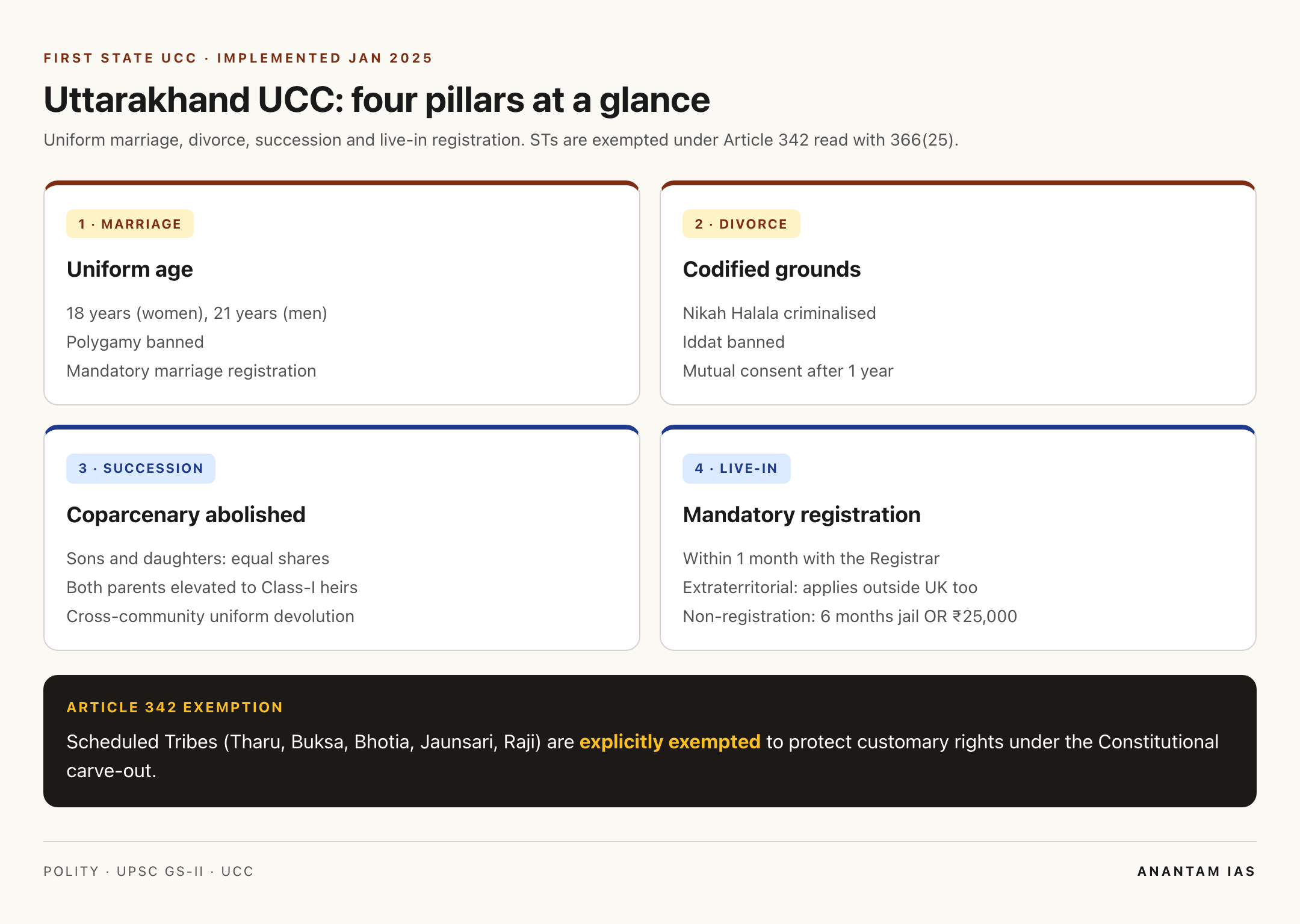
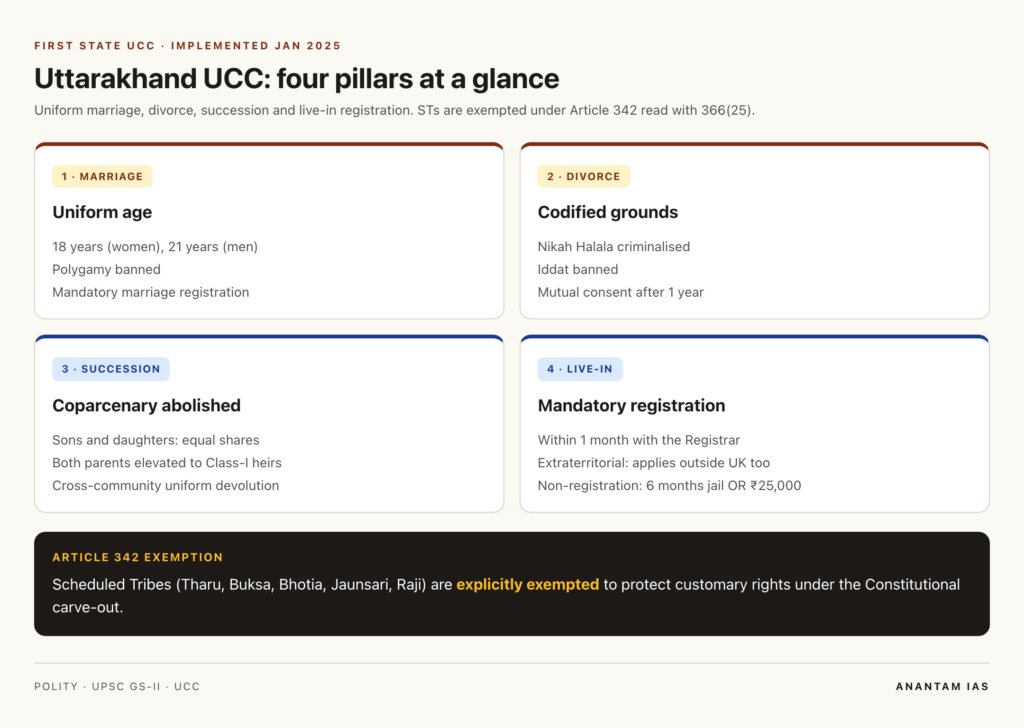
The Act was passed by the Uttarakhand Legislative Assembly in February 2024. It received the President’s assent in March 2024 under Article 254(2) of the Constitution. It was officially implemented from January 2025. The Act applies to all residents of Uttarakhand except members of Scheduled Tribes. The marriage age is standardised at 18 years for women and 21 years for men across all communities. Polygamy, Nikah Halala and Iddat are banned. The coparcenary system in Hindu joint family property is abolished, and sons and daughters get equal shares. Parents, both mother and father, are elevated to Class-I heirs. Live-in partners must register their relationship with the Registrar within one month, and non-registration attracts up to six months of jail or a fine of 25,000 rupees or both.
What the Uttarakhand UCC Act Does
The Act is a unified code that governs marriage, divorce, succession and live-in relationships for all residents of Uttarakhand other than Scheduled Tribes. It does not cover criminal law, employment, property tax or any of the other domains that ordinarily make up “civil law” in the broader sense. The scope is confined to personal-law matters that have historically been governed by community-specific laws like the Hindu Marriage Act, the Muslim Personal Law (Shariat) Application Act and the Indian Christian Marriage Act. By codifying these matters into a single state law, the Uttarakhand UCC Act creates a uniform personal-law framework within the territory of the state.
Background and Historical Context
The constitutional debate over a Uniform Civil Code goes back to the Constituent Assembly. Dr. B.R. Ambedkar, presiding over the drafting of the Constitution, argued strongly for a UCC, but the Assembly settled on placing the matter in Article 44 as a Directive Principle rather than as a Fundamental Right or a justiciable obligation. The compromise reflected the political reality of partition and the need to reassure religious minorities about the autonomy of personal law.
For most of independent India’s history, the UCC remained a constitutional aspiration rather than an operational reality. Several Supreme Court rulings, beginning with the Shah Bano case in 1985 and continuing through Sarla Mudgal v. Union of India in 1995, repeatedly underlined the need for a UCC, particularly to prevent the misuse of personal-law conversion for bigamy. Successive Law Commission reports examined the issue but concluded that a national UCC was neither necessary nor desirable in the immediate term, recommending instead targeted reforms within personal laws.
The political setting changed in 2022 when the Uttarakhand government appointed a five-member committee headed by Justice Ranjana Prakash Desai to draft a state UCC. The committee submitted its report in early 2024, and the Bill was introduced and passed within weeks. The President’s assent in March 2024 cleared the constitutional path, and implementation began in January 2025 after notification of the implementing rules. For more on the constitutional architecture, see our explainer on the Constitution of India.
Key Provisions on Marriage and Divorce
The Act standardises the minimum marriage age at 18 years for women and 21 years for men across all communities, removing earlier community-specific variations. Polygamy is comprehensively banned. The Act criminalises Nikah Halala, the practice of remarrying and divorcing an intermediate husband as a precondition for remarrying the original husband, and bans Iddat, the post-divorce waiting period traditionally observed under Islamic personal law. The Triple Talaq prohibition was already in force at the central level under the Muslim Women (Protection of Rights on Marriage) Act, 2019, and the Uttarakhand UCC reinforces it through codified divorce grounds.
Divorce grounds are uniform across communities and are listed in the Act. They include adultery, cruelty, desertion for at least two years, conversion to another religion, mental illness, communicable disease, presumption of death and breakdown of marriage. Mutual consent divorce is available after a one-year separation. The Act also ends community-specific differences on grounds for divorce, which previously gave women different procedural pathways depending on their religion. Our fundamental rights and articles explainer covers the constitutional rights framework that underlies these reforms.
Succession and Inheritance Reforms
The succession reforms are arguably the most economically significant part of the Act. The coparcenary system, which gave Hindu male children a right by birth to ancestral joint family property, is abolished. Sons and daughters now have equal shares in property, regardless of whether the property is ancestral or self-acquired. The Hindu Succession Act, 1956, as amended in 2005, had already given daughters equal coparcenary rights, but the Uttarakhand Act goes further by abolishing the coparcenary structure itself.
The Act also elevates parents to Class-I heirs. Under the previous Hindu Succession Act framework, when a Hindu male died intestate, his property passed first to a defined list of Class-I heirs that included the widow, sons, daughters and the mother. The father was a Class-II heir. The Uttarakhand UCC elevates both parents to Class-I status, ensuring that the father shares equally in the inheritance. The Act also brings Christian, Muslim and Parsi succession into the same framework, removing community-specific variations in shares and the order of devolution.
The Live-in Relationship Clause
The most discussed provision of the Uttarakhand UCC Act is the live-in registration regime. Under the Act, live-in partners must register their relationship with the Registrar within one month of starting the relationship. The registration is mandatory regardless of the religion or marital status of the partners, and applies even to Uttarakhand residents who are in a live-in relationship outside the state, creating an extraterritorial dimension. Non-registration is a criminal offence and attracts up to six months of jail or a fine of 25,000 rupees or both. Children born from registered live-in relationships are legally legitimate.
The provision has provoked constitutional debate on three fronts. The first is privacy. After the K.S. Puttaswamy ruling of 2017, the Supreme Court held that the right to privacy is a fundamental right under Article 21, and the question is whether mandatory registration of intimate relationships passes the proportionality test. The second is personal autonomy under Article 19 and Article 21, given that adult cohabitation has been recognised as a constitutionally protected choice. The third is federalism, because intimate-relationship regulation is unprecedented in Indian state legislation.
Exemptions: The Scheduled Tribes Carve-out
The Act explicitly excludes members of Scheduled Tribes as defined under Article 342 read with Article 366(25) of the Constitution. The exemption applies to all the Act’s provisions: marriage, divorce, succession and live-in registration. The reasoning is that customary tribal rights and practices enjoy constitutional protection under provisions like the Fifth and Sixth Schedules and the broader Article 13 carve-out for personal customs, and the state government chose not to disturb that protection.
The exemption is consequential because Uttarakhand has a significant Scheduled Tribe population, including the Tharu, Buksa, Bhotia, Jaunsari and Raji communities. Members of these communities continue to be governed by their customary practices in matters of marriage, divorce and succession. The exemption sits within a broader pattern in Indian law, where Sixth Schedule areas in the Northeast and tribal customary law in central Indian states retain a separate jurisprudential identity.
Constitutional and Legal Framework
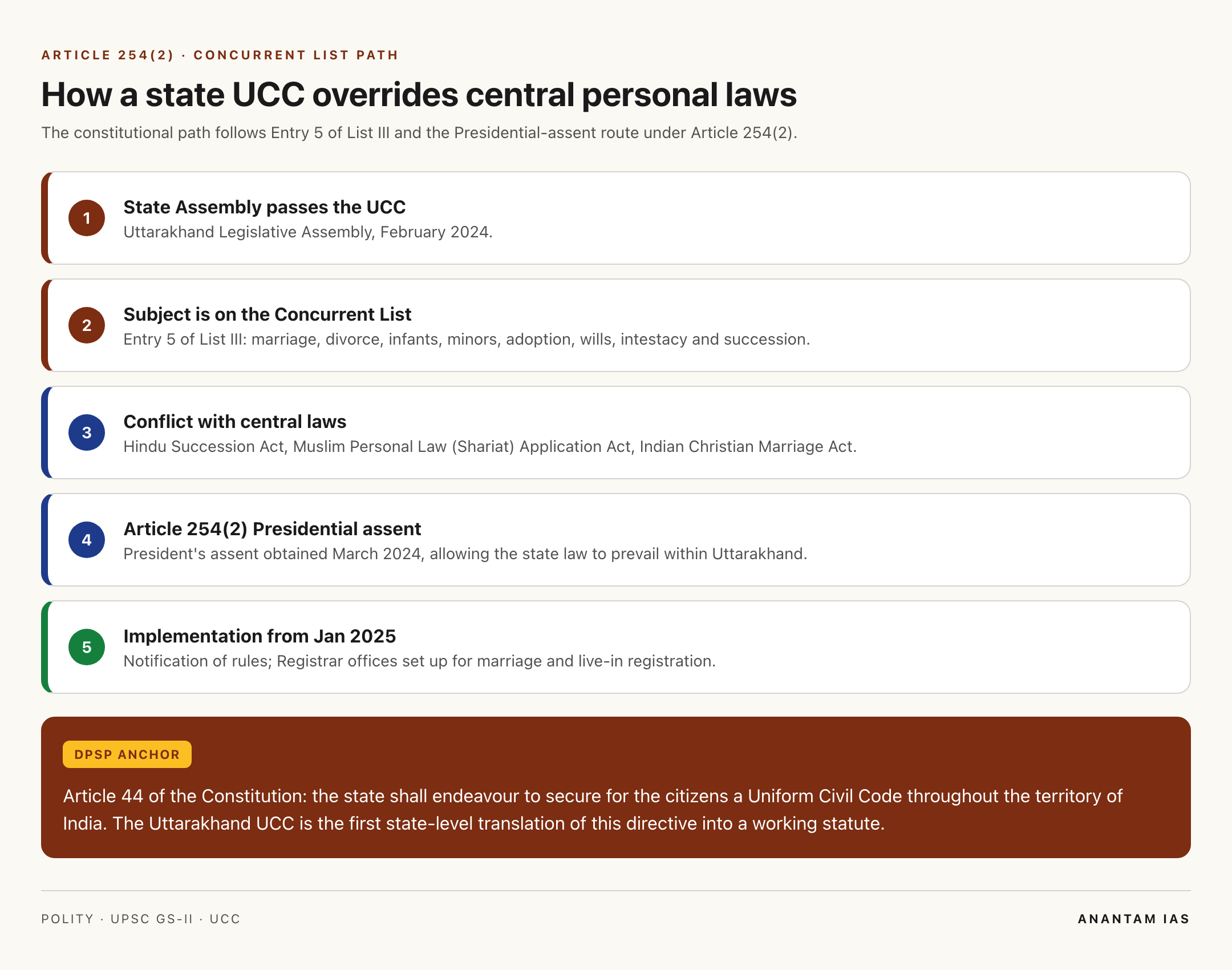
Three constitutional provisions structure the legal basis for the Act. Article 44 of the Directive Principles, in Part IV of the Constitution, requires the state to “endeavour to secure for the citizens a Uniform Civil Code throughout the territory of India.” Entry 5 of List III of the Seventh Schedule covers marriage, divorce, infants, minors, adoption, wills, intestacy and succession, which means the matter falls within the concurrent legislative competence of the Union and the states. Where a state law on a Concurrent List subject conflicts with a central law, Article 254(2) requires the President’s assent for the state law to prevail within the state.
The Sarla Mudgal v. Union of India ruling of 1995 emphasised the need for a UCC to prevent “conversion for bigamy,” where a Hindu married man would convert to Islam to contract a second marriage. In John Vallamattom v. Union of India, 2003, the Court invalidated Section 118 of the Indian Succession Act for discriminating against Christians and reiterated the desirability of a UCC. The K.S. Puttaswamy ruling of 2017 brought the right to privacy into Article 21, which now constrains how UCCs can be designed. For the broader Concurrent List architecture, see our explainer on the Seventh Schedule of the Indian Constitution.
Comparative Approach: Goa Civil Code
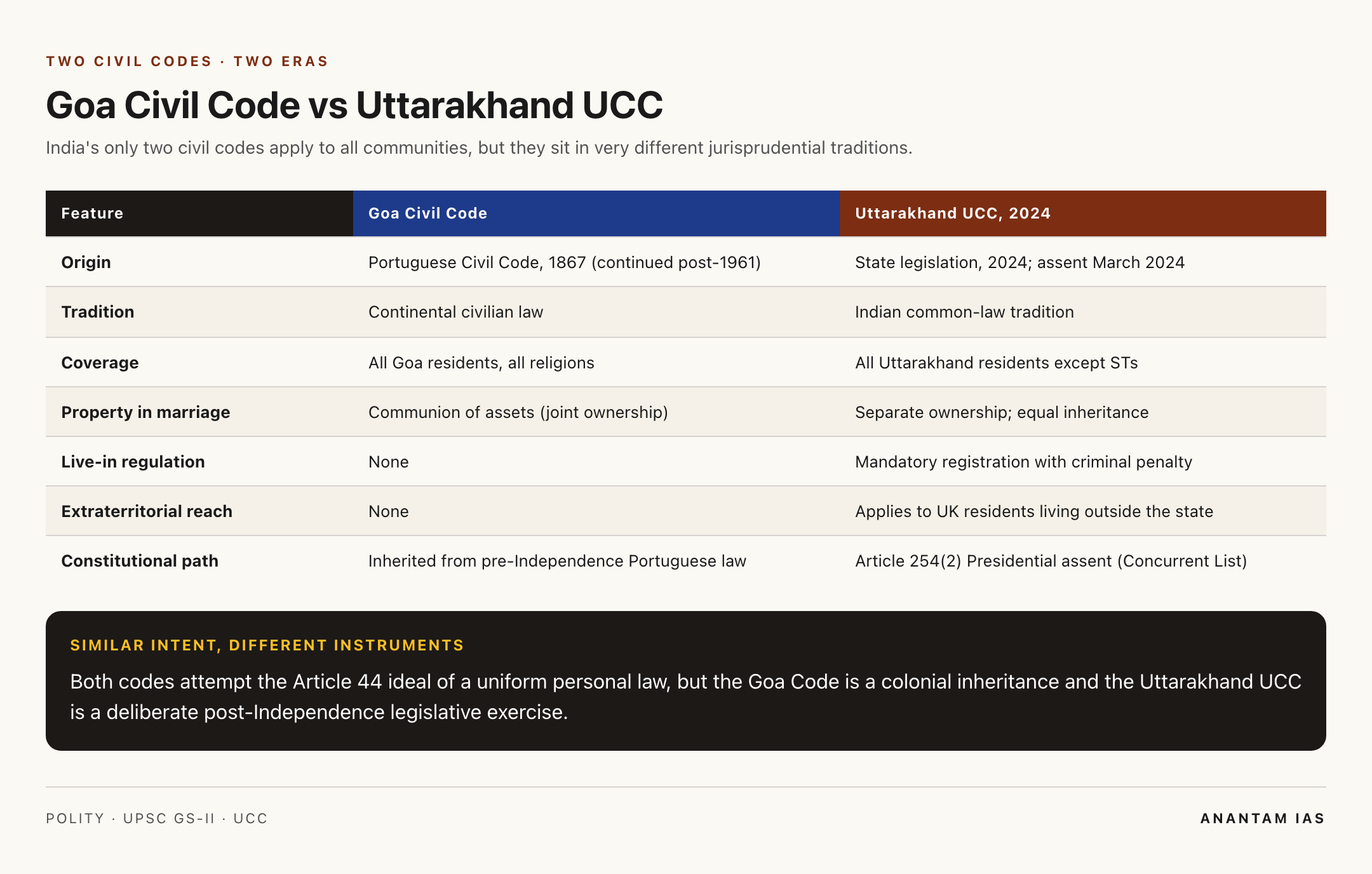
Goa has had a civil code since the Portuguese era, governed by the Portuguese Civil Code of 1867. It applies to all residents of Goa regardless of religion and covers marriage, succession and family property. The Goa Code is sometimes described as India’s “informal UCC.” The differences from the Uttarakhand UCC are structural. The Goa Code is rooted in continental civilian tradition, with concepts like the communion of assets in marriage, where all property acquired during marriage is held jointly by the couple and divides equally on dissolution. The Uttarakhand UCC retains the Indian common-law approach to property, with separate ownership and inheritance based on heirship rather than communion.
The Goa Code does not regulate live-in relationships, has no extraterritorial application, and does not contain the criminal-penalty layer that the Uttarakhand Act adds. The two codes therefore represent very different approaches to the UCC idea. The Uttarakhand approach codifies and reforms personal laws in a single statute; the Goa approach inherits a colonial-era civilian framework that has organically continued.
Challenges and Criticisms
Three constitutional challenges are pending or anticipated. The first concerns the live-in registration regime, with privacy and autonomy arguments under Articles 19 and 21. The second concerns the Scheduled Tribes exemption, with arguments that the exemption violates Article 14 by treating similarly situated citizens differently within the same state. The third concerns the Article 254(2) approach, with arguments that personal law is not sufficiently within the Concurrent List for state-level UCCs to prevail across communities.
Beyond the constitutional questions, three implementation challenges are immediate. Capacity at the Registrar level for live-in registration is uncertain, particularly in rural areas. Awareness of the new succession framework is low, and the customary practice of joint family property is deeply embedded. And the federal precedent question is open: if other states follow with their own UCCs that diverge in significant ways, the country could end up with a patchwork of state-level UCCs rather than a coherent national framework.
Prelims Pointers
The Uttarakhand UCC Act, 2024 was passed by the Uttarakhand Assembly in February 2024. It received the President’s assent in March 2024 under Article 254(2). It was implemented from January 2025. The Act applies to all residents of Uttarakhand except Scheduled Tribes. The marriage age is 18 for women and 21 for men. Polygamy, Nikah Halala and Iddat are banned. The coparcenary system is abolished. Parents are elevated to Class-I heirs. Live-in partners must register within one month, with up to six months of jail or 25,000 rupees fine for non-registration. Article 44 is the relevant DPSP. Entry 5 of the Concurrent List covers marriage and succession. Article 254(2) requires presidential assent for state laws on the Concurrent List that conflict with central laws. The Goa Civil Code derives from the Portuguese Civil Code of 1867. Sarla Mudgal v. Union of India, 1995 emphasised UCC for preventing conversion-bigamy.
Mains Practice Questions
- The Uttarakhand UCC Act, 2024 represents the first state-level translation of Article 44 into operational law. Evaluate its provisions and constitutional implications. (GS Paper 2, 250 words)
- Examine the live-in registration regime under the Uttarakhand UCC Act in light of the right to privacy recognised in K.S. Puttaswamy. (GS Paper 2, 250 words)
- Compare the Uttarakhand UCC Act, 2024 with the Goa Civil Code and bring out their structural differences. (GS Paper 2, 150 words)
- Discuss the federalism implications of state-level UCCs under the Concurrent List framework. (GS Paper 2, 150 words)
Way Forward
Three reforms would strengthen the Uttarakhand framework and make it a more useful national template. First, the live-in registration regime should be redesigned to be confidential by default, with criminal penalties replaced by civil consequences focused on legitimacy of children and inheritance rights, to address privacy and autonomy concerns. Second, the Scheduled Tribes exemption should be revisited through community consultation, with options for opt-in coverage that respects customary practice while extending the protections of the UCC. Third, a national consultation should examine whether a Centre-led model UCC, with state-level adoption, would be a more coherent path than divergent state-level codes.
For students, the Uttarakhand Act is significant beyond its specific provisions. It is the first concrete instance of Article 44 being translated into a working statute, and it forces the larger constitutional debate from the abstract into the concrete. The pending judicial review will define how much further the UCC project can go, and how the right to privacy interacts with state-led personal-law reform.
Frequently Asked Questions
What is the Uttarakhand UCC Act, 2024?
The Uttarakhand Uniform Civil Code Act, 2024 is a state law that creates a unified personal-law framework covering marriage, divorce, succession and live-in relationships for all residents of Uttarakhand other than Scheduled Tribes. It was passed by the State Assembly in February 2024, received the President’s assent in March 2024, and was implemented from January 2025. It is the first comprehensive UCC enacted by an Indian state in the post-Independence period.
Why did the Uttarakhand UCC require the President’s assent?
Marriage, divorce and succession fall under Entry 5 of List III, the Concurrent List, in the Seventh Schedule of the Constitution. Where a state law on a Concurrent List subject conflicts with a central law, Article 254(2) requires the President’s assent for the state law to prevail within the state. Because the Uttarakhand UCC overrides parts of the Hindu Succession Act, the Muslim Personal Law (Shariat) Application Act and the Indian Christian Marriage Act, presidential assent was constitutionally necessary.
How is the Uttarakhand UCC different from the Goa Civil Code?
The Goa Civil Code derives from the Portuguese Civil Code of 1867 and applies to all residents of Goa regardless of religion. It uses civilian-law concepts like the communion of assets in marriage. The Uttarakhand UCC is a post-Independence Indian statute, applies to all residents of Uttarakhand except Scheduled Tribes, retains the Indian common-law approach to property, and adds a live-in registration regime that the Goa Code does not contain.
What are the live-in registration provisions?
Under the Act, live-in partners must register their relationship with the Registrar within one month of starting the relationship. The registration is mandatory regardless of religion or marital status, and applies even to Uttarakhand residents in a live-in relationship outside the state. Non-registration is a criminal offence and attracts up to six months of jail or 25,000 rupees fine or both. Children born from registered live-in relationships are legally legitimate.
Why are Scheduled Tribes exempted from the Act?
The Act explicitly excludes members of Scheduled Tribes as defined under Article 342 read with Article 366(25) of the Constitution. The exemption is intended to protect customary tribal rights and practices that enjoy constitutional protection under the Fifth and Sixth Schedules and the broader carve-out for personal customs. STs in Uttarakhand include the Tharu, Buksa, Bhotia, Jaunsari and Raji communities.
What changes does the Act make to succession?
The Act abolishes the coparcenary system in Hindu joint family property, gives sons and daughters equal shares regardless of whether property is ancestral or self-acquired, and elevates both parents to Class-I heirs. It brings Christian, Muslim and Parsi succession into the same framework, removing community-specific variations. The reforms go significantly beyond the 2005 amendment to the Hindu Succession Act, which had already given daughters equal coparcenary rights.
Does the Act ban Triple Talaq?
Triple Talaq was already banned at the central level by the Muslim Women (Protection of Rights on Marriage) Act, 2019. The Uttarakhand UCC reinforces the ban by codifying uniform divorce grounds across communities. The Act also bans Nikah Halala and Iddat, two practices that were not directly addressed by the central 2019 law.
What is Article 44 of the Constitution?
Article 44 of the Constitution is a Directive Principle of State Policy contained in Part IV. It directs the state to u0022endeavour to secure for the citizens a Uniform Civil Code throughout the territory of India.u0022 Like other Directive Principles, it is not directly enforceable in courts but guides legislative and executive policy. The Uttarakhand UCC is the first comprehensive state-level translation of this directive into a working statute.
Can other states pass their own UCCs?
Yes. Marriage, divorce and succession are on the Concurrent List, so states have legislative competence subject to Article 254. Several states, including Gujarat and Assam, have signalled interest in drafting their own UCCs. The constitutional path requires presidential assent under Article 254(2) for any state-level UCC that conflicts with central laws, and judicial review of any provision affecting fundamental rights remains open.
What is the constitutional challenge to the Act?
Petitions challenging various provisions of the Act are pending before the courts. The principal grounds are privacy and autonomy under Article 21, as developed in K.S. Puttaswamy, particularly with respect to the live-in registration regime; equal protection under Article 14, particularly with respect to the Scheduled Tribes exemption; and federalism, particularly the scope of state legislative competence under the Concurrent List. The eventual rulings will significantly shape the trajectory of UCC legislation across India.
Tell Google you want more of this.
Add Anantam IAS as a preferred sourceOne tap, and this site shows up more often in your own Top Stories, AI Overviews and AI Mode. Remove it any time.