India’s water problem is usually described as scarcity. It is more accurately described as maldistribution. The country supports about 16 percent of the world’s population with roughly 4 percent of its freshwater, and that limited endowment is spread so unevenly that the wettest regions are not always the ones with water to use. Understanding water resources and aquaculture together matters because the second depends entirely on how well India manages the first.
Average annual rainfall is about 125 cm. That national figure conceals almost everything that matters.
Rainfall Is Not the Same as Usable Water
Spatial variation is driven by topography, wind, vegetation and thermal and dynamic conditions. The counter-intuitive part is that high rainfall does not reliably mean high usable water.
- Ganga-Brahmaputra plains, 100 to 200 cm: the largest surface and groundwater availability, helped by alluvium that aids recharge
- North-eastern hills, over 200 cm: paradoxically water-scarce, because steep slopes shed water fast and little is stored
- North-west, Punjab, Haryana and western Uttar Pradesh, 50 to 100 cm: Punjab is water-rich through the perennial Indus system, Haryana is water-poor with limited groundwater
- Interior Deccan, western Rajasthan and Kutch, under 50 cm: the least water, with evaporation exceeding precipitation
The north-eastern case is the one to carry into an answer. It demonstrates that storage, geology and terrain determine availability at least as much as precipitation does.
Why India Needs Integrated Water Resources Management
IWRM coordinates the development and management of water, land and related resources to maximise economic and social welfare equitably, without compromising vital ecosystems. The case for it in India rests on five pressures.
- A widening demand-supply gap set by the 16 percent to 4 percent mismatch
- Climate change, repeated droughts and declining river-basin rainfall
- Pollution degrading the quality of what is available
- Groundwater stress alongside rising industrial and urban demand
- Fragmented institutions managing parts of the same basin in isolation
The last point is the operative one. India’s water is not managed badly for lack of schemes. It is managed badly because a river basin is divided among agencies that do not share a plan.
What the IWRM Approach Requires
- Integrate needs. Domestic, agricultural, industrial and environmental demands assessed as one allocation, not as competing departmental claims.
- Decentralise governance. Local to basin to national, with a real role for women, who bear most of the household water burden.
- Balance objectives. Economic efficiency, ecosystem sustainability and equity held together rather than traded off silently.
- Reform institutions. Merging overlapping central water bodies to create genuinely multidisciplinary water governance.
- Plan by watershed. A watershed is the land draining into one water body, which makes it the natural unit for recharging groundwater, raising productivity and restoring livelihoods.
The programme layer already exists: Jal Jeevan Mission, Jal Shakti Abhiyan, Pradhan Mantri Krishi Sinchayee Yojana with its per drop more crop objective, AMRUT, Atal Bhujal Yojana, and NITI Aayog’s Composite Water Management Index for measurement. What has been missing is basin-scale coordination between them.
The vision that follows is a shift from water development to water security. Building more storage is a supply answer. Water security is a management answer.
Aquaculture: The Second-Largest Producer With Unrealised Potential
Aquaculture is the controlled production of aquatic organisms, fish, crustaceans, molluscs and aquatic plants. India is the second-largest producer globally, contributing over 8 percent of world aquaculture output.
The types practised map onto very different water regimes.
- Freshwater: fish, prawns and mussels in ponds, reservoirs and canals, concentrated in Andhra Pradesh, West Bengal and Odisha
- Brackish and coastal: mullets, milkfish and shrimp in estuaries and lagoons, in Andhra Pradesh, Kerala, Tamil Nadu and West Bengal
- Mariculture: fish, mussels, seaweed and oysters in open seas and bays, in Kerala and Karnataka
- Paddy-cum-fish: fish raised with paddy in the same unit, in Kerala and the North-East
- Integrated multi-trophic: by-products of one species feed another, combining fish, seaweed and shellfish
Where Aquaculture Falls Short, and Why
The constraint is not water availability. It is everything downstream of the pond.
- Disease outbreaks and inconsistent seed and brood stock quality
- Weak cold chain and post-harvest infrastructure, which caps realisable value
- Fragmented small holdings that cannot meet buyer volumes or traceability requirements
- Effluent and water quality management in intensive systems, which is where ecological damage occurs
- Credit and insurance gaps that leave small farmers carrying all the risk
- Export standards compliance, particularly antibiotic residue limits
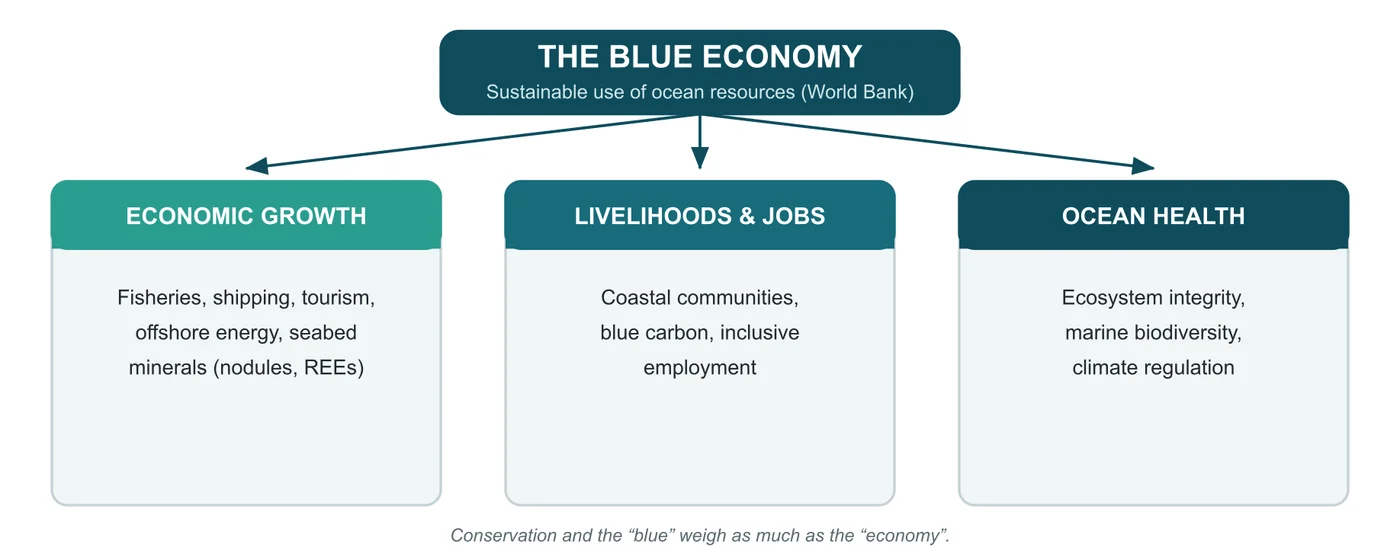
Intensive coastal aquaculture also carries a real ecological cost: mangrove conversion, salinisation of adjoining land, and nutrient loading of coastal waters. Expansion that ignores this converts a Blue Economy gain into a coastal ecosystem loss.
The Way Forward
- Plan water at the basin and watershed scale, and fund the institutions that can actually do it.
- Treat groundwater as a common-pool resource with participatory management, following the Atal Bhujal model.
- Invest in aquaculture cold chain and disease surveillance before subsidising further area expansion.
- Promote integrated multi-trophic and seaweed systems, which raise output without raising effluent load.
- Protect mangroves as a hard constraint on coastal pond expansion, not a negotiable one.
India’s water future will be decided by how well it manages what it already has. Aquaculture is one of the highest-return uses of that water, provided the ecological accounting is done honestly.
Frequently Asked Questions
How much freshwater does India have relative to its population?
India supports about 16 percent of the world’s population with roughly 4 percent of the world’s freshwater resources. Average annual rainfall is around 125 cm, but the spatial variation is extreme.
Why can a high-rainfall region still be water-scarce?
Because rainfall is not the same as usable water. The north-eastern hills receive over 200 cm a year yet remain water-scarce, since steep slopes shed water rapidly and there is little storage or recharge. Usable water depends on terrain, geology, storage capacity and recharge, not on precipitation alone.
Which regions of India have the least usable water?
Interior Deccan, western Rajasthan and Kutch receive under 50 cm and lose more to evaporation than they receive as precipitation. Haryana is water-poor despite moderate rainfall because groundwater is limited, while neighbouring Punjab benefits from the perennial Indus system.
What is Integrated Water Resources Management?
IWRM coordinates the development and management of water, land and related resources to maximise economic and social welfare equitably, without compromising vital ecosystems. In practice it means treating domestic, agricultural, industrial and environmental needs as one allocation problem rather than as separate departmental mandates.
Why does India need IWRM specifically?
Because of a widening demand-supply gap, climate variability and repeated droughts, groundwater stress, rising industrial and urban demand, pollution that degrades available supply, and fragmented institutions that manage pieces of the same basin without coordination.
What is watershed management?
A watershed is all the land draining into a single water body. Managing at that unit allows soil and moisture conservation, groundwater recharge, higher productivity and restored livelihoods, which is why it is the natural planning unit for rainfed India.
What types of aquaculture are practised in India?
Freshwater aquaculture of fish and prawns in ponds, reservoirs and canals; brackish and coastal aquaculture of mullets, milkfish and shrimp in estuaries and lagoons; mariculture of fish, mussels, seaweed and oysters in open seas and bays; paddy-cum-fish culture; and integrated multi-trophic aquaculture where by-products of one species feed another.
Why has India not realised its aquaculture potential?
Despite being among the largest producers globally, India is constrained by disease outbreaks and seed quality, weak cold chain and post-harvest infrastructure, fragmented small holdings, water quality and effluent management in intensive systems, credit and insurance gaps, and export standards compliance.
Practice Questions
Prelims MCQs
- India supports approximately what share of the world's population with what share of its freshwater?
(a) 16 percent population, 4 percent freshwater
(b) 18 percent population, 12 percent freshwater
(c) 10 percent population, 8 percent freshwater
(d) 20 percent population, 20 percent freshwater
Answer: (a) The mismatch between about 16 percent of population and about 4 percent of freshwater is the structural basis of India's water stress. - The north-eastern hills receive over 200 cm of rainfall but remain water-scarce chiefly because
(a) Rainfall is concentrated in winter
(b) Steep slopes cause rapid runoff with little storage or recharge
(c) The region has no rivers
(d) Evaporation exceeds precipitation
Answer: (b) High relief sheds water quickly, so precipitation does not translate into usable stored water. - Integrated Water Resources Management is best described as
(a) Construction of large dams on every major river
(b) Coordinated management of water, land and related resources for equitable welfare without compromising ecosystems
(c) Privatisation of urban water supply
(d) Interlinking of all Indian rivers
Answer: (b) IWRM is a coordination principle across sectors and scales, not a specific infrastructure programme. - Paddy-cum-fish culture is most commonly practised in
(a) Rajasthan and Gujarat
(b) Kerala and the North-East
(c) Punjab and Haryana
(d) Madhya Pradesh and Chhattisgarh
Answer: (b) Paddy-cum-fish systems suit the water regimes and holding patterns of Kerala and the North-Eastern states. - Integrated multi-trophic aquaculture refers to
(a) Farming a single high-value species intensively
(b) Using by-products of one species as inputs for another
(c) Rotating aquaculture with paddy every season
(d) Importing fingerlings from multiple countries
Answer: (b) It combines species at different trophic levels, for example fish with seaweed and shellfish, so waste from one becomes nutrient for another.
Mains Questions
- Explain how the uneven distribution of rainfall affects the availability of water resources in different regions of India. (150 words)
- India faces an impending water crisis. In this context, assess the rationale of Integrated Water Resources Management. (250 words)
- Despite abundant water resources, India has not realised its full aquaculture potential. Highlight the challenges and suggest a way forward. (250 words)
- The watershed, not the administrative district, is the correct unit for water planning in rainfed India. Discuss. (150 words)
- Evaluate the ecological risks of intensive coastal aquaculture and suggest safeguards consistent with Blue Economy goals. (250 words)
Tell Google you want more of this.
Add Anantam IAS as a preferred sourceOne tap, and this site shows up more often in your own Top Stories, AI Overviews and AI Mode. Remove it any time.