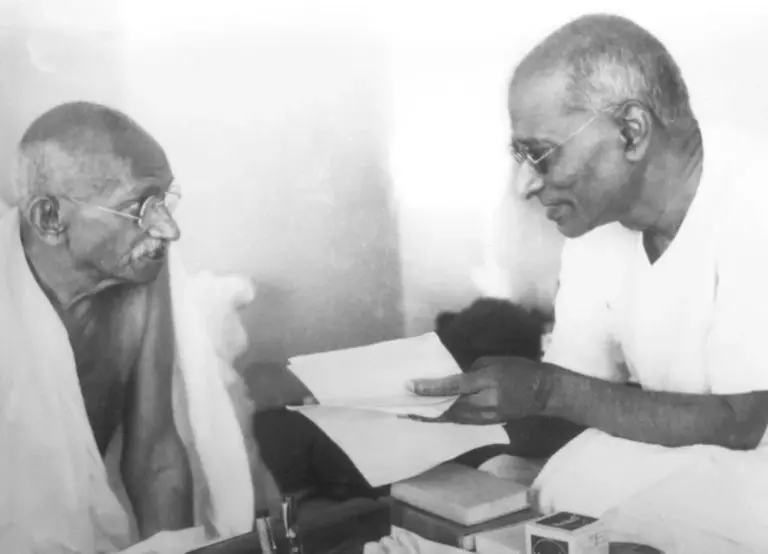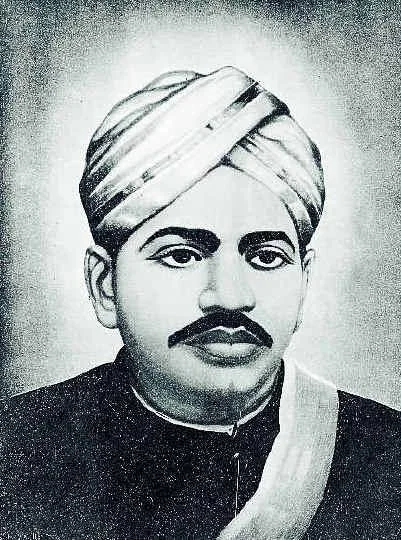
A community of roughly 57,000 people gave India the Tata group, its nuclear programme, the general who won the 1971 war, and one of the great voices in rock music, and it is quietly vanishing. That community is the Parsis, the Indian followers of Zoroastrianism, one of the world’s oldest living religions. Most aspirants meet the topic as a scatter of disconnected facts: a prophet with a hard-to-spell name, fire temples, Towers of Silence, the “sugar in milk” story, and a government scheme to raise the birth rate. The trick is to see it as one thread. A faith born in ancient Persia, carried by refugees to the Gujarat coast, that became one of India’s most influential minorities and now faces its own disappearance. Follow that thread and every fact finds its place.
Who Zarathustra was, and what Zoroastrians actually believe
Zoroastrianism is the religion founded by the prophet Zarathustra (Greek: Zoroaster) in ancient Persia, built around a single supreme God, Ahura Mazda, the “Wise Lord.” Scholars still argue about when Zarathustra lived, with estimates ranging across the second millennium BCE, so treat any precise date with caution. What matters is the idea he preached, which was radical for its time: not a crowd of nature gods, but one uncreated, all-good creator, worshipped through righteous living rather than blood sacrifice.
The faith’s sacred scripture is the Avesta, and its oldest and most revered layer is the Gathas, seventeen hymns believed to be composed by Zarathustra himself. Out of this come the two ideas an examiner will want you to know. The first is ethical dualism: the universe is a battleground between a good spirit, Spenta Mainyu, and a destructive one, Angra Mainyu (later called Ahriman), between truth or cosmic order (Asha) and the lie or chaos (Druj). Crucially, human beings are free agents who choose a side, and their choices decide the outcome. The second is the ethical formula that sums the whole religion up: Humata, Hukhta, Huvarshta, meaning good thoughts, good words, and good deeds. If you remember nothing else, remember those three words, because Parsis themselves treat them as the core of their faith.
Two more concepts round out the picture. Zoroastrian eschatology looks forward to Frashokereti, a final renewal in which good ultimately triumphs and the world is made perfect, an idea many historians see echoing into later Judaism, Christianity and Islam through notions of heaven, hell, judgment and a saviour. And the everyday marker of belonging is the Navjote, the initiation ceremony at which a child formally enters the faith and first wears the sudreh (a sacred white shirt) and the kusti (a sacred cord tied around the waist). Belief, then, is not abstract. It is worn on the body and practised in daily conduct.
The best-known emblem of the faith is the Faravahar, the winged figure of a bearded man that appears on Zoroastrian buildings and jewellery. It is usually read as a reminder of the soul’s journey and of the duty to choose good, the wings themselves often taken to stand for the three-fold ethic of good thoughts, words and deeds. You will recognise it the moment you see it carved above the doorway of an Agiary, and it is a useful visual anchor for a topic that can otherwise feel like a list of unfamiliar terms. Note too that Zoroastrianism does not seek converts and, in its orthodox Indian form, does not accept them, a doctrinal choice that becomes very important when we reach the question of the community’s survival.
Why fire, and what a fire temple really is
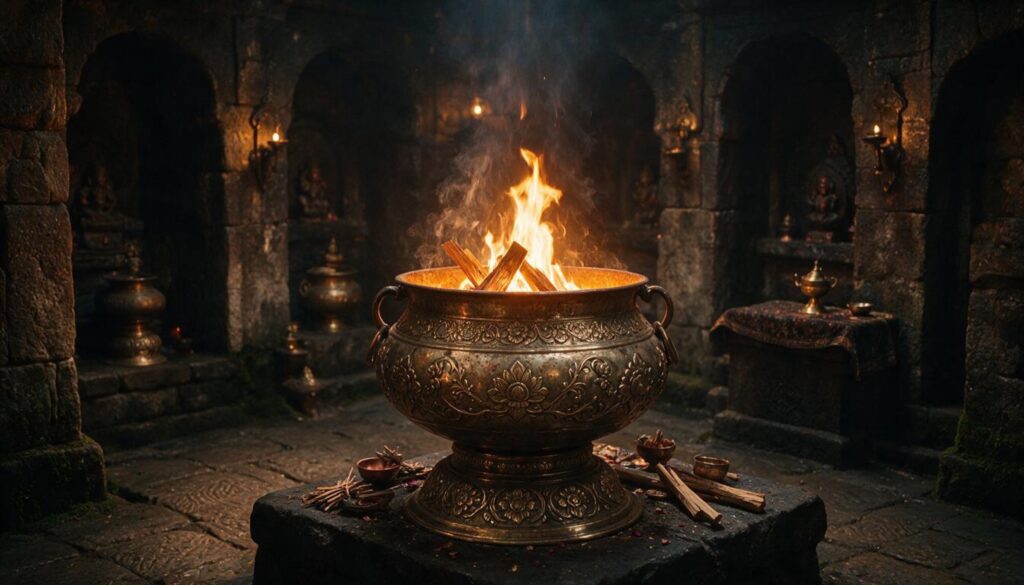
Zoroastrians are often called fire-worshippers, and that label is wrong, which is exactly why it gets tested. Fire, Atar, is not the object of worship. It is a symbol and a medium: the visible sign of Ahura Mazda’s purity, light and truth, the way a lamp on an altar represents the divine without being the divine. Zoroastrians pray in the presence of fire the way others pray facing a shrine. The distinction matters because it separates the faith from the pagan cults it defined itself against.
Where the sacred fire burns is the fire temple, and here the vocabulary has two levels. An ordinary fire temple is called an Agiary (or dar-e-mehr in the Iranian tradition). The highest grade, consecrated with an elaborate ritual and tended with special care, is an Atash Behram, meaning “fire of victory.” There are only nine Atash Behrams in the entire world, and eight of them are in India, in Udvada, Navsari, Surat and Mumbai, with a single one in Yazd, Iran. The very oldest is the Iranshah at Udvada in Gujarat, whose sacred fire is said, by tradition, to have been consecrated by the original migrants and kept continuously burning ever since. That unbroken flame is not a metaphor to the community; it is a living link to the ancestors who carried the faith to India.
This reverence for purity is also what shaped the community’s most misunderstood practice, the way it treats its dead.
The Tower of Silence, and the vulture crisis that broke it
To a Zoroastrian, a corpse is a source of pollution that must not be allowed to defile the sacred elements of earth, fire or water, and the traditional solution is the dakhma, or Tower of Silence. Rather than burying the dead (polluting the earth) or cremating them (polluting fire), the community historically laid bodies on top of a raised circular stone tower, open to the sky, where the sun and vultures would rapidly consume the flesh. It sounds shocking at first hearing, but the logic is consistent: it is the method that protects the elements the faith holds sacred. The best known is the Doongerwadi complex on Malabar Hill in Mumbai.
Here is the modern twist that has turned an ancient rite into a live problem. India’s vulture population collapsed by more than 90 percent from the 1990s onwards, largely because of the veterinary drug diclofenac, which was fatal to birds that fed on treated cattle carcasses. With almost no vultures left, the traditional dakhma no longer works: bodies decompose slowly instead of being consumed within hours. The Bombay Parsi Punchayet has experimented with solar concentrators, arrays of mirrors that focus sunlight to speed up the process, with mixed results. The vulture crisis is a neat example of how an environmental problem can strike at a religious practice, and it shows why Parsi funerary custom now appears in current-affairs discussions rather than only in culture notes.
How the Parsis reached India: Sanjan and the sugar in milk
The Parsis are the descendants of Zoroastrians who fled Persia after the Arab-Muslim conquest and settled on the coast of Gujarat, and their arrival is preserved in a single famous legend. Zoroastrianism had been the state religion of the mighty Achaemenid, Parthian and Sasanian empires of Persia for over a thousand years. When Arab armies conquered Persia in the seventh century CE and Islam gradually became dominant, a group of Zoroastrians chose exile over conversion. After a period in the interior, they set sail and landed at Sanjan, on the Gujarat coast, sometime around the eighth to tenth century CE. The exact year is genuinely disputed; the three dates most often proposed are 716, 765 and 936 CE, and Parsi scholars have argued over them for generations, so quote the range rather than a single year.
The story of that landing comes from the Qissa-i-Sanjan, a Persian narrative poem composed around 1600 CE by a priest named Bahman Kaikobad, and it contains the “sugar in milk” episode that every student should be able to tell. The local Hindu ruler, remembered as Jadi Rana, is said to have sent the refugees a vessel brimming with milk, a gentle way of saying his kingdom was already full and could take no more. The Zoroastrian high priest stirred a spoonful of sugar into the milk and sent it back: we will not overflow your land, he meant, but will dissolve into it and make it sweeter. The king granted asylum on conditions that shaped the community forever: adopt the local Gujarati language, have the women wear the sari, give up their weapons, and hold their wedding processions after dark. It is a founding myth of peaceful assimilation, and it explains why Parsi culture is so thoroughly Gujarati even as its faith remains Persian.
From Sanjan the story fans out. When Sanjan was threatened during a medieval conflict, the priests are said to have carried the sacred Iranshah fire into hiding in the Bahrot caves, then on to Navsari, briefly to Surat, and finally in 1742 to Udvada, where it still burns. The community itself spread to Navsari, Surat and eventually Bombay, and it is in Bombay, under first Portuguese and then British commerce, that a small refugee community would transform into something remarkable. A second, smaller wave of Zoroastrians arrived much later, in the nineteenth century, fleeing persecution in Qajar Iran; their descendants are known as the Iranis, distinct from the older Parsis though sharing the same faith, and they gave Mumbai its beloved Irani cafes. Two migrations, a thousand years apart, from the same homeland to the same shore.
From refugees to nation-builders: the Parsi contribution
For a group that never exceeded a fraction of a percent of India’s population, the Parsis have an influence on modern India that is out of all proportion to their numbers. Their position as a trusted, commercially skilled minority under British rule, combined with a strong ethic of education and philanthropy, placed them at the centre of India’s early industrialisation. This is the part of the story where the “one thread” idea pays off: the same community that arrived as refugees became, within a few centuries, the builders of Indian industry.
The clearest way to hold the contribution is by field:
| Field | Parsi figures and what they built |
|---|---|
| Industry | Jamsetji Tata, founder of the Tata group (steel, hotels, and the vision behind IISc); JRD Tata, pioneer of Indian aviation; the Godrej family, founded by Ardeshir Godrej |
| Shipbuilding and trade | The Wadia family, master shipbuilders who built vessels for the British Royal Navy from the Bombay docks |
| Politics and nationalism | Dadabhai Naoroji, the “Grand Old Man of India,” author of the drain-of-wealth theory and the first Indian elected to the British House of Commons; Pherozeshah Mehta, a founder of moderate Congress politics |
| Science and defence | Homi J. Bhabha, father of India’s nuclear programme; Field Marshal Sam Manekshaw, who led the army to victory in the 1971 war |
| Arts and beyond | Conductor Zubin Mehta; the singer Farrokh Bulsara, better known as Freddie Mercury |
The industrial contribution deserves a moment because it connects to a bigger theme. When India entered the age of factories, steel and organised capital, well after Britain’s own Industrial Revolution, it was often Parsi capital and enterprise that led the way, which is why the community features so heavily in any serious account of entrepreneurship in India. Their philanthropy was just as distinctive: schools, hospitals, libraries and housing colonies funded by Parsi trusts still serve Indians of every faith. This is a community that repaid the “sugar in milk” promise on an industrial scale.
A community that is disappearing, and the scheme trying to stop it
The Parsi population of India has been falling for decades, and by the 2011 Census it stood at just 57,264, a striking fall for a community that numbered close to 114,000 in 1941 and around 69,000 as recently as 2001. That is roughly an 18 percent decline in a single decade. The causes are demographic and social rather than persecution: late marriage and a high proportion never marrying, very low fertility, emigration of the young, and community rules that do not accept converts and traditionally do not count the children of Parsi women who marry outside the faith. A community that will not grow from outside and is not replacing itself from within shrinks with mathematical certainty, which is why Parsi numbers appear whenever India discusses its changing demographics and the census.
The government’s response is the Jiyo Parsi scheme, and it is worth knowing precisely. Launched in 2013-14 by the Ministry of Minority Affairs as a Central Sector Scheme, Jiyo Parsi is the only government programme in India designed to raise the population of a specific community. It funds medical interventions, including advanced fertility and infertility treatment for Parsi couples, alongside financial support for couples with children and for dependent elderly members, plus advocacy and health outreach. By its own account the scheme had helped bring more than 400 Parsi children into the world by 2022-23. Take a clear-eyed view of it: a few hundred births is meaningful for such a tiny community, but it does not reverse a decline driven by deep social patterns. The scheme buys time and signals concern more than it solves the arithmetic, and that honest assessment is exactly what a good answer should offer.
How to study Zoroastrianism and the Parsis for the exam
Organise this topic as a story in three acts, and you will not forget it. Act one is the faith: Zarathustra, Ahura Mazda, the Avesta and Gathas, the good-thoughts-words-deeds triad, and the fire that symbolises but is not worshipped. Act two is the journey: persecution after the Arab conquest, the landing at Sanjan, the Qissa-i-Sanjan and the sugar-in-milk legend, and the sacred fire at Udvada. Act three is the community in India: the industrial and national contribution, the population decline, and the Jiyo Parsi scheme. Three acts, and every fact belongs to one of them.
For prelims, watch the precise hooks: Ahura Mazda as the supreme deity, the Avesta and Gathas as scripture, the Atash Behram as the highest grade of fire temple, the dakhma as the funerary practice, and Jiyo Parsi as a Ministry of Minority Affairs scheme. For mains and interviews, the productive angles are the Parsi model of peaceful assimilation into Indian society, the community’s outsized economic and scientific contribution, and the policy question of whether and how a state should try to sustain a dwindling minority. Link the topic sideways too: Parsi funerary custom connects to the vulture-conservation story, their art and syncretism sit beside other cultural currents you study such as Mughal painting, and their origin ties back to India’s long civilisational conversation with Persia and its modern echo in India-Iran relations. The examiner rewards a candidate who can move between religion, history, society and policy on a single topic, and the Parsis let you do all four.
Frequently Asked Questions
Who founded Zoroastrianism and what is its central belief?
Zoroastrianism was founded by the prophet Zarathustra (Zoroaster) in ancient Persia. Its central belief is worship of one supreme God, Ahura Mazda, and an ethical dualism in which humans freely choose between good and evil. The faith is summed up in the formula of good thoughts, good words and good deeds.
Are Zoroastrians fire-worshippers?
No. Fire is revered as a symbol of Ahura Mazda’s purity, light and truth, and prayers are offered in its presence, but the fire itself is not worshipped as a god. Calling Zoroastrians fire-worshippers is a common but incorrect description.
Who are the Parsis and how did they come to India?
The Parsis are Indian Zoroastrians descended from Persians who fled after the Arab-Muslim conquest of Persia in the seventh century CE. They landed at Sanjan on the Gujarat coast, most likely between the eighth and tenth centuries CE, and were granted asylum by a local ruler, an event preserved in the Qissa-i-Sanjan.
What is the “sugar in milk” legend?
According to the Qissa-i-Sanjan, the ruler Jadi Rana sent the refugees a full vessel of milk to say his land was full. The Zoroastrian priest dissolved sugar into it, meaning the newcomers would blend in and sweeten the land without overflowing it. The king then granted asylum on conditions of cultural assimilation.
What is a Tower of Silence and why is it in the news?
A Tower of Silence, or dakhma, is a raised structure on which Parsis traditionally placed their dead to be consumed by the sun and vultures, avoiding pollution of earth, fire and water. It is in the news because India’s vulture population collapsed after the drug diclofenac, disrupting the practice and forcing experiments with solar concentrators.
Why is the Parsi population declining?
Parsi numbers fell to 57,264 in the 2011 Census from about 114,000 in 1941. The main causes are late or no marriage, very low fertility, emigration, and community rules that bar conversion and traditionally exclude children of Parsi women who marry outside the faith, so the community does not replace itself.
What is the Jiyo Parsi scheme?
Jiyo Parsi is a Central Sector Scheme launched in 2013-14 by the Ministry of Minority Affairs to arrest the decline of the Parsi population in India. It funds fertility and medical treatment, financial support for couples with children and elderly dependents, and advocacy, and it had assisted over 400 births by 2022-23.
Practice Questions
1. In Zoroastrianism, the supreme God is known as:
a) Ahriman
b) Ahura Mazda
c) Mithra
d) Anahita
Answer: b) Ahura Mazda
2. The oldest and most sacred part of the Zoroastrian scripture, the Avesta, is known as the:
a) Gathas
b) Vendidad
c) Yashts
d) Visperad
Answer: a) Gathas
3. The Parsis are traditionally believed to have first landed in India at which place?
a) Surat
b) Navsari
c) Sanjan
d) Udvada
Answer: c) Sanjan
4. The Jiyo Parsi scheme is implemented by which ministry?
a) Ministry of Culture
b) Ministry of Minority Affairs
c) Ministry of Social Justice and Empowerment
d) Ministry of Home Affairs
Answer: b) Ministry of Minority Affairs
5. Consider the following statements about Zoroastrian practices and choose the correct option:
- The Tower of Silence (dakhma) is used to avoid polluting earth, fire and water with the dead.
- An Atash Behram is the highest grade of Zoroastrian fire temple.
a) 1 only
b) 2 only
c) Both 1 and 2
d) Neither 1 nor 2
Answer: c) Both 1 and 2
Mains-style questions
- “The Parsi arrival in India is a model of peaceful assimilation.” Discuss with reference to the Sanjan migration and the conditions attached to their settlement.
- Examine the contribution of the Parsi community to India’s industrial and scientific development.
- Analyse the causes of the decline of the Parsi population in India and evaluate the effectiveness of the Jiyo Parsi scheme in addressing it.
- Zoroastrian funerary practice has been disrupted by an ecological crisis. Discuss the link between vulture conservation and the Tower of Silence.
- Trace the core beliefs of Zoroastrianism and assess its influence on later religious traditions.
The Parsis are worth studying for a reason that goes beyond exam value. They are a rare case of a community that arrived with nothing, kept its faith intact for over a thousand years, assimilated so gracefully that it became more Gujarati than many Gujaratis, and then gave back to its adopted home far more than it ever took, all while numbering fewer people than fill a mid-sized stadium. That they now face disappearance is a genuine loss, and the honest answer to whether a scheme can save them is probably not on the current trajectory. For the aspirant, hold the three acts of the story, keep the population and scheme figures straight, and you will have a topic that lets you speak with equal ease about religion, history, industry and social policy. Few topics on the syllabus reward that range so generously.
Tell Google you want more of this.
Add Anantam IAS as a preferred sourceOne tap, and this site shows up more often in your own Top Stories, AI Overviews and AI Mode. Remove it any time.