Disclosure: this guide contains Amazon affiliate links. As an Amazon Associate, Anantam IAS earns from qualifying purchases — at no extra cost to you.
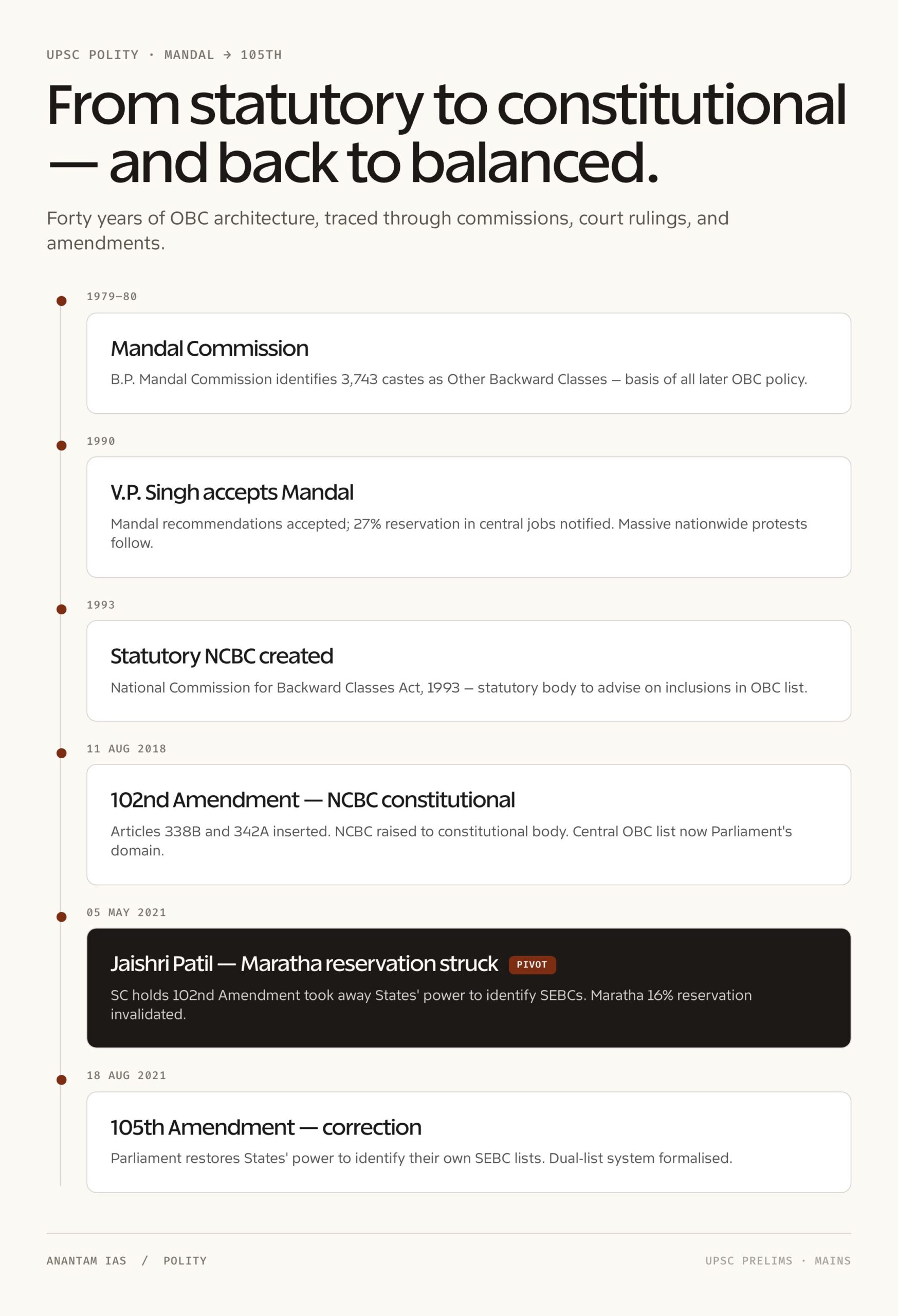
The 102nd amendment of indian constitution is the rare amendment that solved one problem and instantly created another. It gave the National Commission for Backward Classes constitutional status — which OBC groups had wanted since the Mandal Commission fight of 1990. Then the Supreme Court read its Article 342A in a way that nobody in Parliament had intended… and States lost their power to identify their own SEBCs overnight. Look, this is the amendment that single-handedly explains why aspirants need to read three SC judgments and two later amendments to understand one section. I’ll walk you through the whole arc — from the Indra Sawhney foundation to the 105th Amendment correction — so you don’t lose marks on this in Mains.
What is the 102nd Amendment in one paragraph?
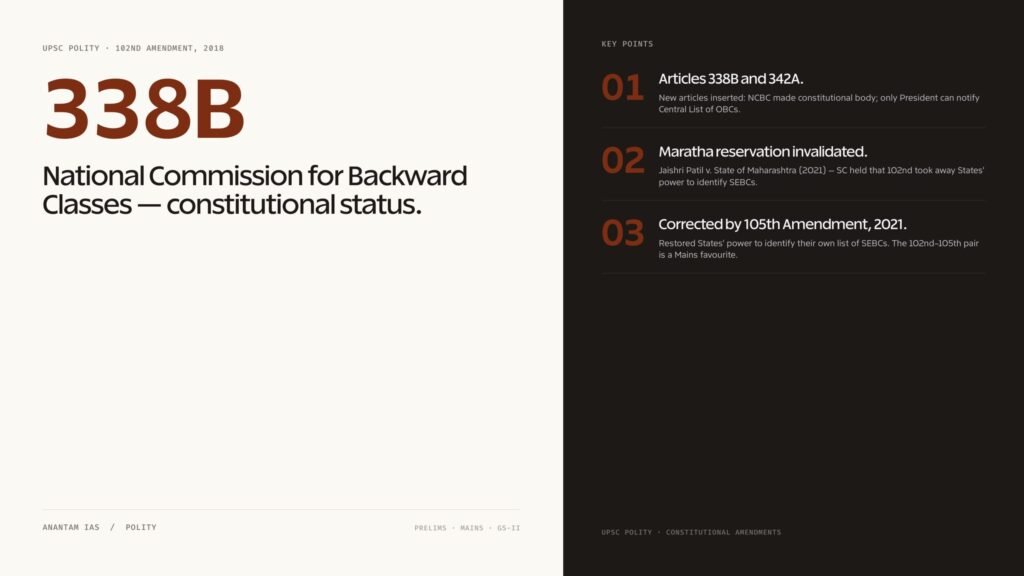
The Constitution (102nd Amendment) Act, 2018 inserted Articles 338B (constitutional status to NCBC), 342A (Presidential power to specify SEBCs at central level), and 366(26C) (definition of “socially and educationally backward classes”). It came into force on 11 August 2018. The Maratha reservation case (Jaishri Laxmanrao Patil v. Chief Minister, 2021) reading of Article 342A triggered the 105th Amendment, 2021, which restored State governments’ power to identify SEBCs.
Three GEO-style triples to lock in:
- 102nd Amendment, 2018 — added Articles 338B, 342A, 366(26C) — gave NCBC constitutional status.
- Article 338B — establishes NCBC, modeled on Article 338 (NCSC) and 338A (NCST).
- Article 342A — President specifies SEBCs at central list, after consultation with Governor.
The pre-history — Mandal, NCBC, and the 27% question
You can’t understand the 102nd without the Indra Sawhney v. Union of India (1992) judgment — known as the Mandal Commission case. The 9-judge Constitution Bench upheld 27% OBC reservation in central government jobs. Among many directions, the Court asked the Centre to set up a permanent body to examine inclusions and exclusions from the OBC list.
That body became the National Commission for Backward Classes under the NCBC Act, 1993. But it was a statutory body, not a constitutional one. It could recommend, but not enforce. It lacked the powers of a civil court that NCSC (Article 338) and NCST (Article 338A) had.
For 25 years, OBC organisations demanded constitutional parity. Why should SCs and STs have a constitutional commission while OBCs — at 41% of India’s population per the 2011 SECC — relied on a 1993 statute? The 102nd Amendment closed this gap… and immediately opened a bigger one.
For the foundational case, see Mandal Commission: OBC Reservation Report & 1990 Implementation. For the broader landscape, Reservation in India: History, Types & Supreme Court Judgments is the comprehensive reference.
Article 338B — what changed for NCBC
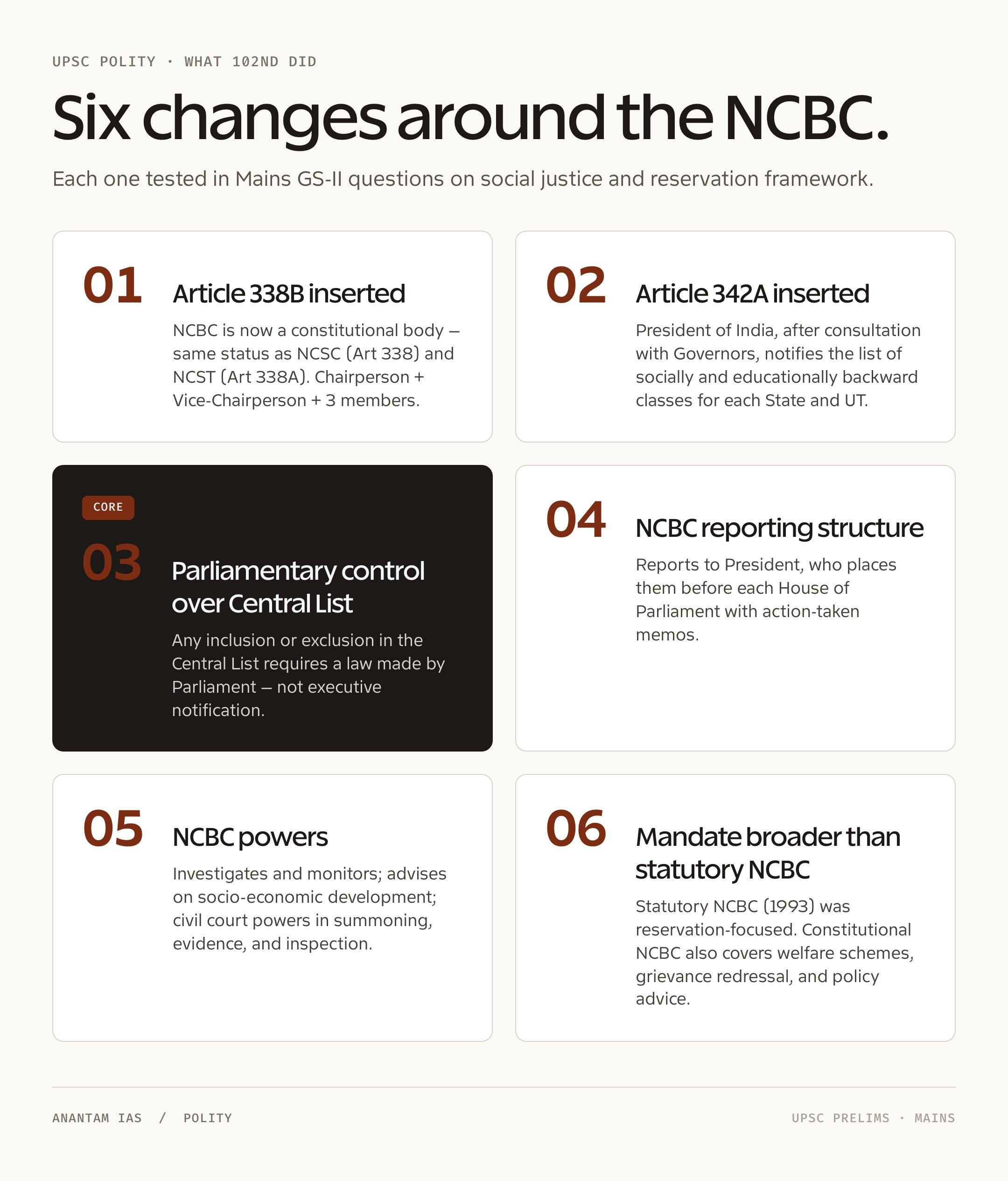
Article 338B mirrors Articles 338 and 338A almost word-for-word, with “Backward Classes” substituted for “Scheduled Castes” or “Scheduled Tribes.” Key features:
- Constitutional status — NCBC is now a constitutional body. Its existence cannot be abolished by ordinary law.
- Composition — Chairperson, Vice-Chairperson, and three other members appointed by the President.
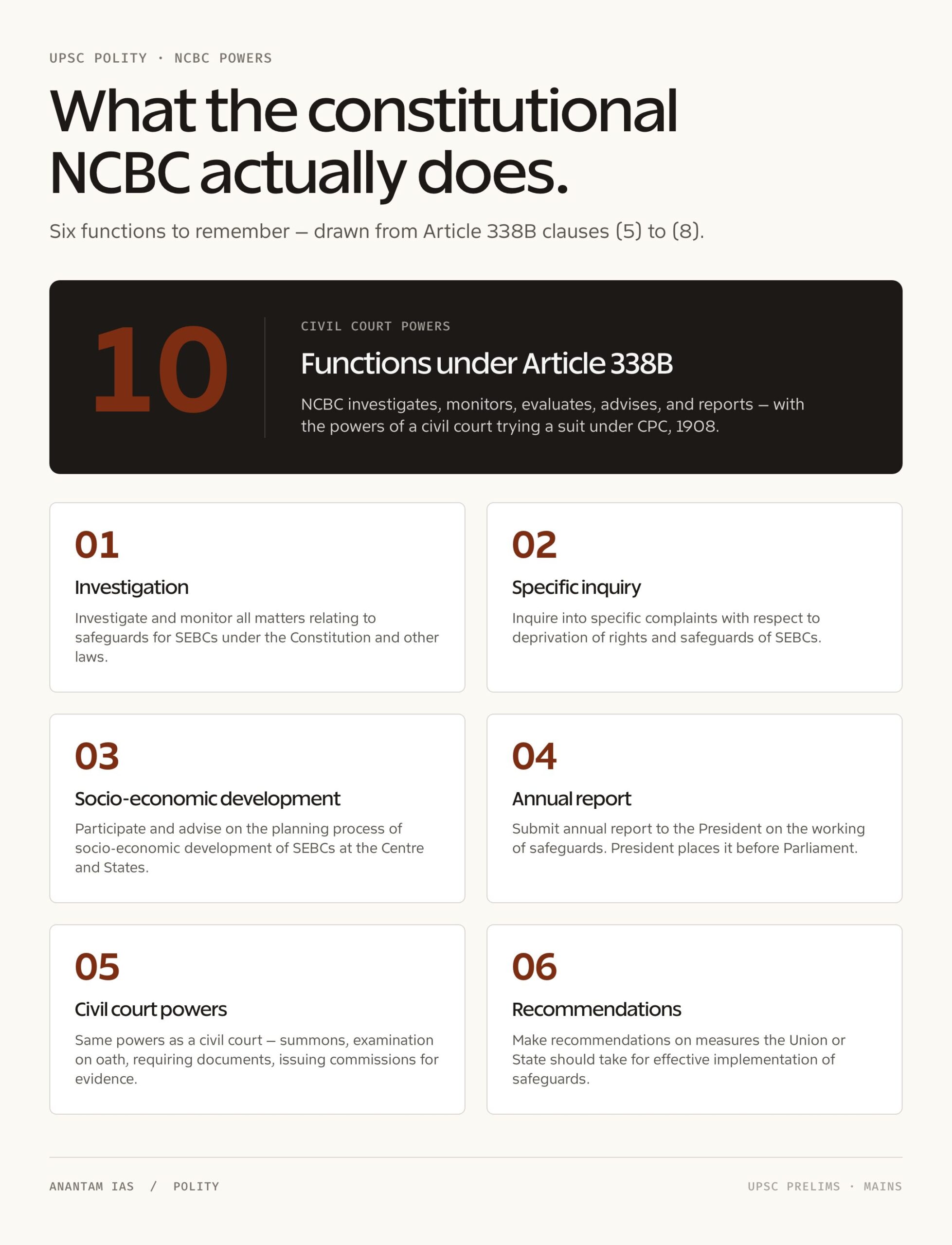
- Powers of a civil court — Summoning witnesses, examining on oath, requiring discovery and production of documents.
- Functions — Investigate complaints about violation of rights and safeguards of OBCs. Recommend measures for their socio-economic development. Submit annual reports to the President.
- Annual report — President places the report before Parliament with action-taken memo. State Governors do the same for state-level reports.
This is a huge upgrade. Pre-2018, an OBC complainant had to approach a statutory body whose recommendations were advisory. Post-2018, NCBC has the same enforcement teeth as NCSC and NCST.
For a deep dive into NCBC’s working, see our National Commission for Backward Classes — 102nd Amendment, Functions & Constitutional Status explainer.
Article 342A — the controversy starts here
Article 342A is where the trouble started. It reads:
- 342A(1) — President, after consultation with the Governor of a State, may by public notification specify SEBCs which shall, for the purposes of this Constitution, be deemed to be SEBCs in relation to that State or Union Territory.
- 342A(2) — Parliament by law may include in or exclude from the Central List any SEBC specified under clause (1).
On a plain reading, this looks like a procedure for the central list. States, the assumption went, would continue to maintain their own state lists — as they had since the 1990s.
The Supreme Court read it differently.
The Maratha case — Jaishri Laxmanrao Patil v. CM, Maharashtra (May 2021)
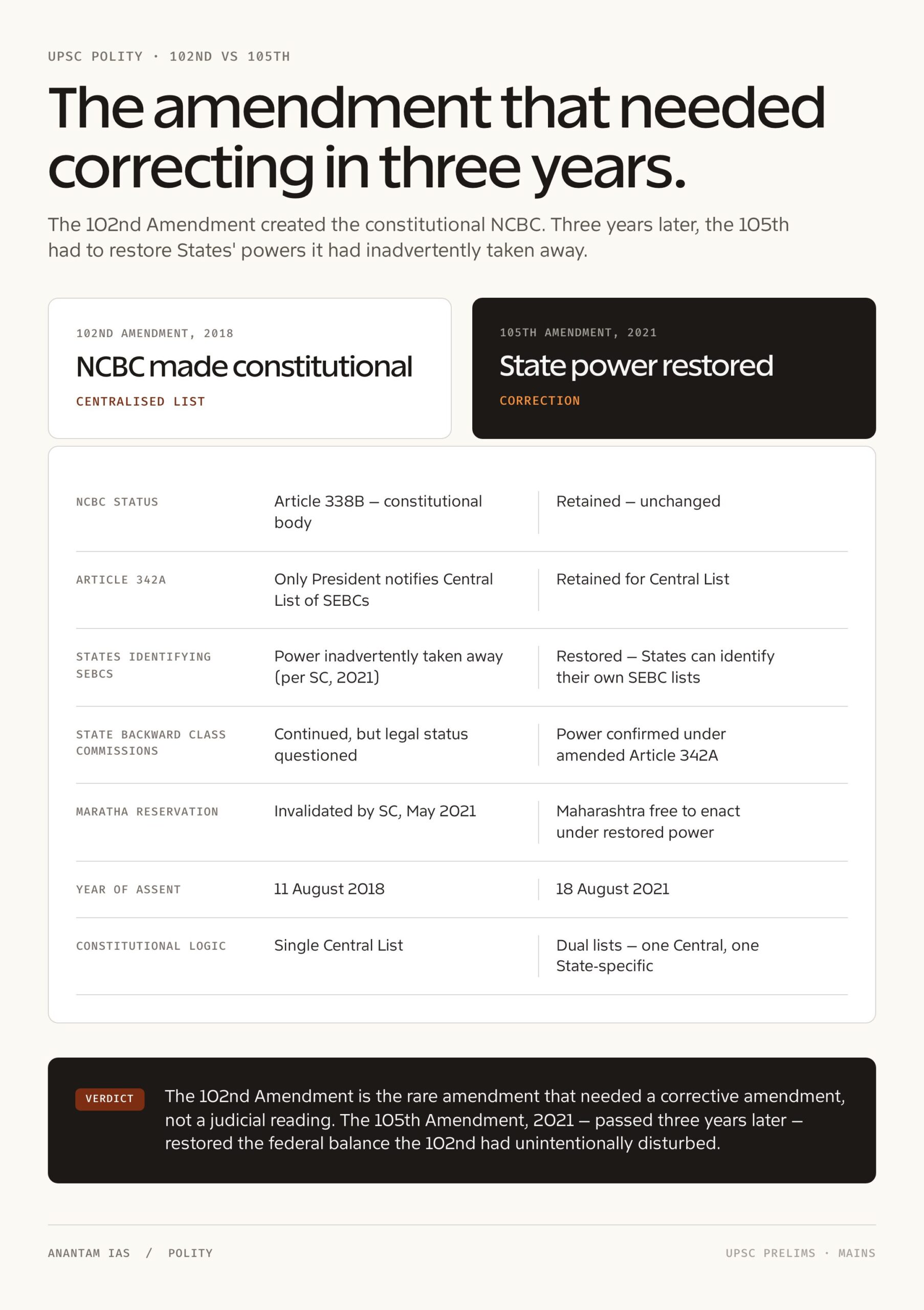
In May 2021, a 5-judge Constitution Bench struck down Maharashtra’s SEBC Act, 2018, which had granted Marathas 12% reservation in education and 13% in jobs. The 3:2 majority went further. They held that after the 102nd Amendment, only the President can identify SEBCs — both for the Central and State lists. States lost their independent power to recognise SEBCs.
This was a constitutional earthquake. Every state OBC list, every state-specific SEBC notification, was now legally suspect. The Court itself acknowledged the disruption but read Article 342A as making the Presidential list the only valid SEBC list.
The 3-judge majority view: Article 342A makes the President the sole authority. The phrase “for the purposes of this Constitution” — meaning Articles 15(4), 16(4), reservation provisions — operates only off the central Presidential list.
The 2-judge dissent: Article 342A only governs the central list. State governments retain their pre-2018 power to maintain state SEBC lists.
Result: chaos. State commissions, State SEBC lists, State reservation policies — all legally orphaned overnight. Well, that’s what unintended consequences look like in constitutional drafting.
The 105th Amendment, 2021 — Parliament’s correction
Within three months of the Maratha judgment, Parliament passed the Constitution (105th Amendment) Act, 2021. It became the fastest constitutional correction of a Supreme Court interpretation in recent memory.
What the 105th Amendment did:
- Inserted Article 342A(3) — explicitly clarifying that every State and Union Territory may, by law, prepare and maintain its own list of SEBCs.
- Amended Article 366(26C) to align with the new clarification.
- Made it clear that the State list and the Central list are separate and independent — neither overrides the other.
The 105th Amendment was passed unanimously by both Houses on 11 August 2021 — Lok Sabha (385-0) and Rajya Sabha (187-0). Cooperative federalism worked when it had to. Look, when both BJP and Congress agreed within three months, you knew the SC reading had genuinely surprised everyone.
For the full mechanics, see 105th Amendment of Indian Constitution: OBC List Powers Restored.
What about the 50% ceiling — Indra Sawhney in 2026
The 50% reservation ceiling from Indra Sawhney (1992) is intact, with two known exceptions allowed by Constitution Bench rulings: (a) the 103rd Amendment EWS quota of 10%, upheld in Janhit Abhiyan v. Union of India (November 2022) on the reasoning that EWS sits outside Articles 15(4) and 16(4); (b) extraordinary local conditions, sparingly recognised.
Tamil Nadu’s 69% reservation under the Ninth Schedule (76th Amendment, 1994) and Maharashtra’s renewed Maratha quota efforts all live in the shadow of this ceiling. As of 2026, the issue remains unsettled — the Supreme Court has constituted a 7-judge bench to revisit Indra Sawhney‘s 50% ceiling, but no final judgment yet.
For the deeper analysis, Analysis of Reservation in India tracks the policy and legal arc.
SEBC sub-categorisation — the next frontier
The Justice G. Rohini Commission was set up in October 2017 to examine sub-categorisation of OBCs in the Central List. Its report (submitted July 2023) recommended dividing the Central OBC list into four sub-categories with rationalised quota distribution within the 27% — to ensure dominant OBC sub-castes don’t capture all benefits.
In State of Punjab v. Davinder Singh (August 2024), a 7-judge Constitution Bench (6:1 majority) held that SC sub-classification is constitutionally permissible. The same logic likely extends to OBCs. The political and administrative implementation, however, is still pending in 2026.
For the policy story, see Sub-Categorization of Other Backward Classes (OBCs) for UPSC and Socially and Educationally Backward Classes (SEBCs) for UPSC Polity.
Why this matters for UPSC
Three places where examiners pull from this topic.
- Prelims — Articles 338B, 342A, 366(26C). Year of NCBC’s constitutional status. 2018, 2019, 2020, 2022 saw direct MCQs. Likely again 2026.
- Mains GS Paper II — Reservation policy questions. “Examine the implications of the 102nd and 105th Amendments on Centre-State relations in identifying backward classes.” 2022 Mains-style.
- Mains GS Paper II — Federalism. The 102nd → Maratha case → 105th arc is the cleanest case study of Parliament correcting an SC reading.
- Interview — “Should States have power to identify SEBCs? Why?” Be ready with the post-2021 settled answer.
Common misconceptions
Myth 1: The 102nd Amendment created NCBC. Wrong. NCBC existed under a 1993 statute. The 102nd Amendment gave it constitutional status.
Myth 2: Article 342A made States lose SEBC power forever. Wrong. The Maratha case (May 2021) read it that way for three months. The 105th Amendment (August 2021) restored State power.
Myth 3: NCBC has the same powers as NCSC. Largely true after 2018. But NCBC’s role under Article 338B(9) — mandatory consultation by Centre and States on major policy decisions — is a feature unique to its drafting.
Myth 4: Only the President can identify SEBCs. Wrong post-105th Amendment. Both President (Central list) and State governments (State lists) have parallel power. Either list operates within its jurisdiction.
How to revise this in 30 minutes
- Laxmikanth, Chapter on Statutory and Constitutional Bodies — 8 minutes. The NCBC section.
- PRS Legislative Brief on the 102nd Amendment — 5 minutes. Best plain-English summary.
- Supreme Court Observer’s Maratha Reservation case explainer — 7 minutes. Best account of Article 342A controversy.
- PRS Brief on the 105th Amendment — 5 minutes. The fix.
- One LiveLaw piece on the 7-judge bench review of Indra Sawhney’s 50% ceiling — 5 minutes. The 2026 angle.
Frequently Asked Questions
What is the 102nd amendment of indian constitution?
The 102nd Amendment, 2018 gave constitutional status to the National Commission for Backward Classes by inserting Articles 338B, 342A, and 366(26C).
When did the 102nd Amendment come into force?
11 August 2018.
What is Article 338B?
Article 338B establishes the NCBC as a constitutional body with powers of a civil court, similar to NCSC (Article 338) and NCST (Article 338A).
What did the Maratha reservation case say about Article 342A?
The Supreme Court (May 2021) read Article 342A as making the President the sole authority to identify SEBCs, stripping States of that power.
What did the 105th Amendment fix?
The 105th Amendment (August 2021) inserted Article 342A(3), explicitly restoring State governments’ power to maintain their own SEBC lists.
Is the 50% reservation ceiling still applicable?
Yes, as a general rule from Indra Sawhney (1992). Exceptions: 103rd Amendment EWS (10%), Ninth Schedule cases, and a 7-judge SC bench is currently revisiting the ceiling.
What is Article 366(26C)?
It defines u0022socially and educationally backward classesu0022 as those deemed so under Articles 342A.
Has NCBC’s role expanded after the 102nd Amendment?
Yes — NCBC now has powers of a civil court, mandatory consultation under Article 338B(9), and constitutional protection.
For broader context on India’s reservation framework, Reservation in India and the foundational article on Constitutional Amendments tie everything together.
Tell Google you want more of this.
Add Anantam IAS as a preferred sourceOne tap, and this site shows up more often in your own Top Stories, AI Overviews and AI Mode. Remove it any time.