
BIMSTEC — the Bay of Bengal Initiative for Multi-Sectoral Technical and Economic Cooperation — is a regional organisation linking seven countries around the Bay of Bengal. Formed in 1997, BIMSTEC bridges South Asia and Southeast Asia and has gained strategic importance as India's preferred platform for regional cooperation, especially after SAARC became dysfunctional due to India-Pakistan tensions. The BIMSTEC Summit is the highest decision-making body of the grouping, convened periodically by heads of state or government.
For UPSC, BIMSTEC is a high-frequency topic in International Relations (GS2), featuring in questions on regional groupings, India’s foreign policy doctrines, and multilateral diplomacy.
Formation and Evolution
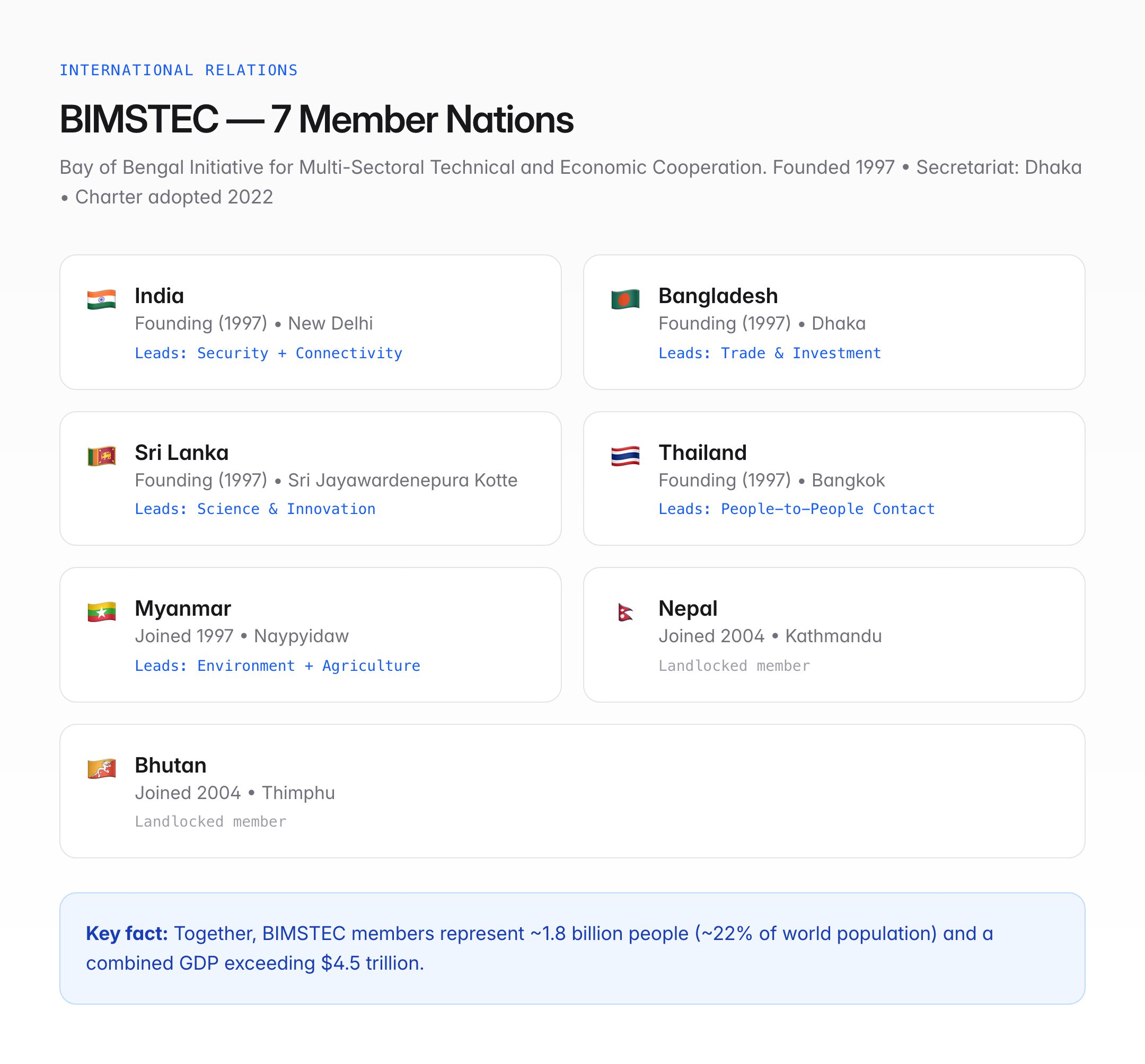
- Founded: June 6, 1997 in Bangkok through the Bangkok Declaration
- Original name: BIST-EC (Bangladesh, India, Sri Lanka, Thailand Economic Cooperation)
- Myanmar joined in December 1997 → renamed BIMST-EC
- Nepal and Bhutan joined in February 2004 → renamed BIMSTEC
- Secretariat: Dhaka, Bangladesh (permanent secretariat established in 2014)
- Charter: Adopted at the 5th Summit in Colombo (2022)
Member States at a Glance
| Member State | Capital | Year of Joining | Bay of Bengal Coastline |
|---|---|---|---|
| Bangladesh | Dhaka | 1997 (founding) | Yes |
| India | New Delhi | 1997 (founding) | Yes |
| Sri Lanka | Sri Jayawardenepura Kotte | 1997 (founding) | Yes |
| Thailand | Bangkok | 1997 (founding) | Yes |
| Myanmar | Naypyidaw | 1997 | Yes |
| Nepal | Kathmandu | 2004 | No (landlocked) |
| Bhutan | Thimphu | 2004 | No (landlocked) |
Key fact: All seven members share the Bay of Bengal basin or are located in its immediate hinterland. Together they represent about 1.8 billion people (~22% of the world's population) and a combined GDP of over $4.5 trillion.
Sectors of Cooperation
BIMSTEC operates through seven sectors, each led by a designated member state:
| Sector | Lead Country |
|---|---|
| Trade, Investment and Development | Bangladesh |
| Environment and Climate Change | Myanmar |
| Security (Counter-terrorism and Transnational Crime) | India |
| Agriculture and Food Security | Myanmar |
| People-to-People Contact | Thailand |
| Science, Technology and Innovation | Sri Lanka |
| Connectivity | India |
India leads two of the seven sectors, reflecting its central role in the grouping.
BIMSTEC Summits — Timeline
| Summit | Year | Venue | Key Outcomes |
|---|---|---|---|
| 1st | 2004 | Bangkok, Thailand | Established the framework for cooperation |
| 2nd | 2008 | New Delhi, India | Focus on connectivity and free trade |
| 3rd | 2014 | Nay Pyi Taw, Myanmar | Emphasis on counter-terrorism cooperation |
| 4th | 2018 | Kathmandu, Nepal | Leaders reaffirmed commitment to BIMSTEC FTA and connectivity |
| 5th | 2022 | Colombo, Sri Lanka | Adopted the BIMSTEC Charter, formalising the grouping's institutional framework |
| 6th | 2025 | Bangkok, Thailand | Focus on digital economy, supply chain resilience, and blue economy |
India's Role in BIMSTEC
India occupies a central geographic and strategic position in BIMSTEC. Its engagement is driven by two overlapping foreign policy doctrines:
Neighbourhood First Policy
India uses BIMSTEC to engage with Bangladesh, Nepal, Bhutan, Sri Lanka, and Myanmar in a multilateral setting that avoids the Pakistan factor inherent in SAARC.
Act East Policy
BIMSTEC is India's bridge to Southeast Asia, with Thailand and Myanmar as gateways. Projects like the India-Myanmar-Thailand Trilateral Highway and the Kaladan Multi-Modal Transit Transport have direct BIMSTEC relevance.
Key Indian Initiatives Within BIMSTEC
- BIMSTEC Grid Interconnection: India is building cross-border electricity transmission links with Bangladesh, Nepal, Bhutan, and Myanmar
- Coastal Shipping Agreement: Signed in 2017 to reduce logistics costs and improve trade connectivity
- BIMSTEC Centre for Weather and Climate proposed for India
- Counter-terrorism cooperation: India has hosted exercises and shared intelligence frameworks under the security pillar
BIMSTEC vs SAARC — A Comparison
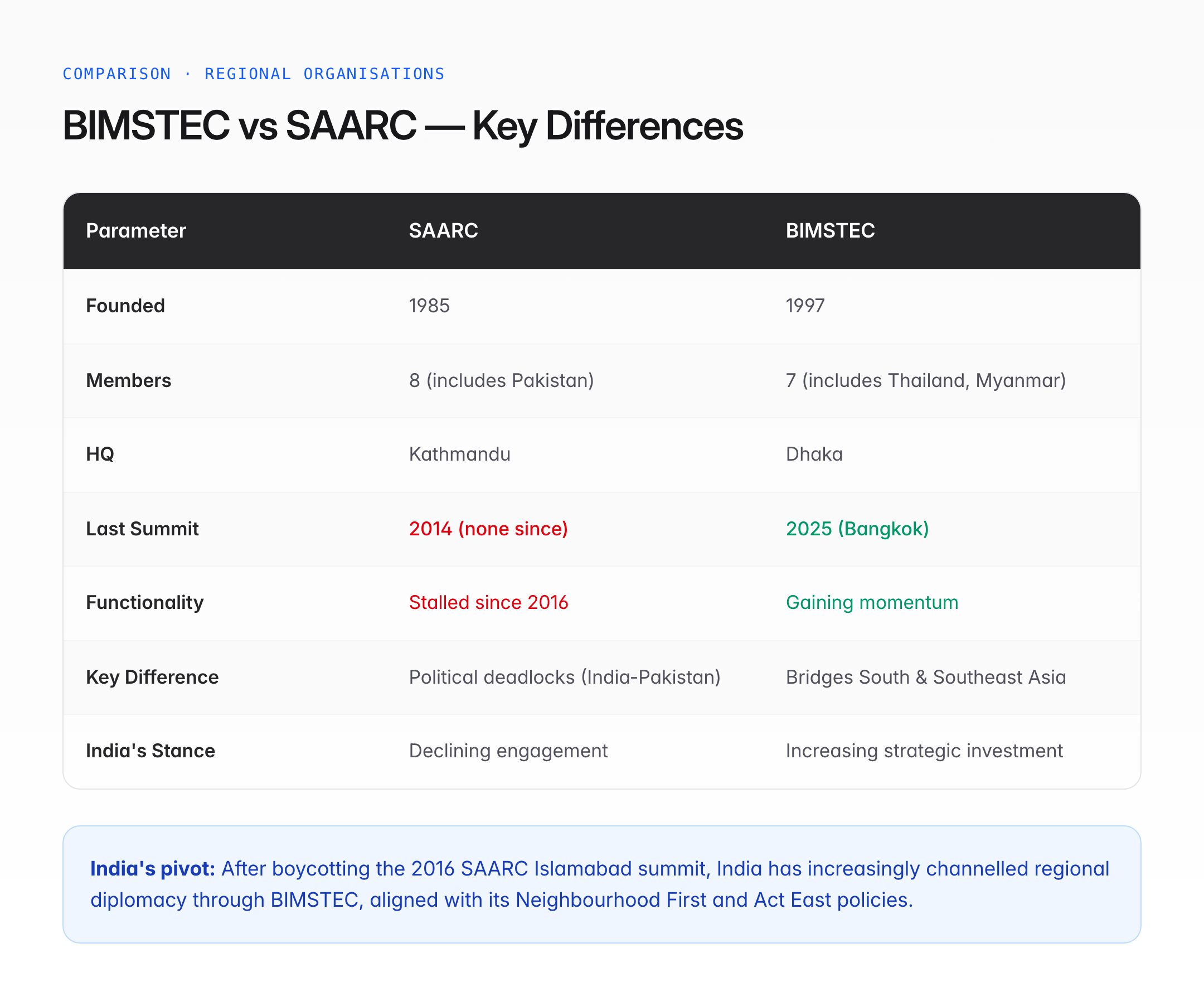
| Parameter | SAARC | BIMSTEC |
|---|---|---|
| Founded | 1985 | 1997 |
| Members | 8 (India, Pakistan, Bangladesh, Sri Lanka, Nepal, Bhutan, Afghanistan, Maldives) | 7 (India, Bangladesh, Sri Lanka, Nepal, Bhutan, Myanmar, Thailand) |
| Headquarters | Kathmandu | Dhaka |
| Key difference | Includes Pakistan; frequent political deadlocks | Excludes Pakistan; includes Thailand and Myanmar |
| FTA status | SAFTA signed 2004, limited progress | BIMSTEC FTA under negotiation since 2004 |
| Last summit | 2014 (Kathmandu); none since | 2025 (Bangkok) |
| Functionality | Largely stalled since 2016 (India boycotted Islamabad summit) | Gaining momentum; Charter adopted 2022 |
| India's preference | Declining engagement | Increasing strategic investment |
The comparison highlights why India has pivoted from SAARC to BIMSTEC as its preferred sub-regional platform.
BIMSTEC Charter (2022)
The adoption of the BIMSTEC Charter at the 5th Summit was a landmark event. Key provisions:
- Established BIMSTEC as a formal international organisation with legal personality
- Codified principles: sovereign equality, territorial integrity, non-interference, peaceful coexistence
- Decision-making by consensus
- Created institutional mechanisms including a Commission (foreign ministers level) and Working Groups
- Provided for an observer and dialogue partner category
Significance for India
- Strategic counter to China's BRI: BIMSTEC offers an alternative connectivity framework in the Bay of Bengal region without Chinese dominance
- Maritime security: The Bay of Bengal is critical for India's maritime interests; BIMSTEC enables coordinated anti-piracy, disaster response, and HADR operations
- Energy cooperation: Cross-border grid connectivity and Myanmar's gas reserves are key energy security assets
- Trade diversification: BIMSTEC members are natural trading partners; intra-BIMSTEC trade has significant growth potential
- Cultural connectivity: Shared Buddhist heritage (India, Sri Lanka, Thailand, Myanmar, Nepal, Bhutan) strengthens people-to-people ties
UPSC Relevance
GS Paper II: International Relations — Regional organisations, India's Neighbourhood First and Act East policies, comparison of SAARC and BIMSTEC, multilateral diplomacy.
GS Paper III: Security — BIMSTEC counter-terrorism framework, maritime security in the Bay of Bengal.
Key Points for Prelims
- BIMSTEC stands for Bay of Bengal Initiative for Multi-Sectoral Technical and Economic Cooperation
- Founded in 1997 through the Bangkok Declaration
- 7 member states: Bangladesh, India, Sri Lanka, Thailand, Myanmar, Nepal, Bhutan
- Secretariat is in Dhaka, Bangladesh
- India leads the Security and Connectivity sectors
- BIMSTEC Charter was adopted in 2022 at the 5th Summit in Colombo
- BIMSTEC bridges South Asia and Southeast Asia via the Bay of Bengal
- Nepal and Bhutan are landlocked members without Bay of Bengal coastline
- India has shifted emphasis from SAARC to BIMSTEC after the 2016 boycott of the Islamabad SAARC summit
Tell Google you want more of this.
Add Anantam IAS as a preferred sourceOne tap, and this site shows up more often in your own Top Stories, AI Overviews and AI Mode. Remove it any time.