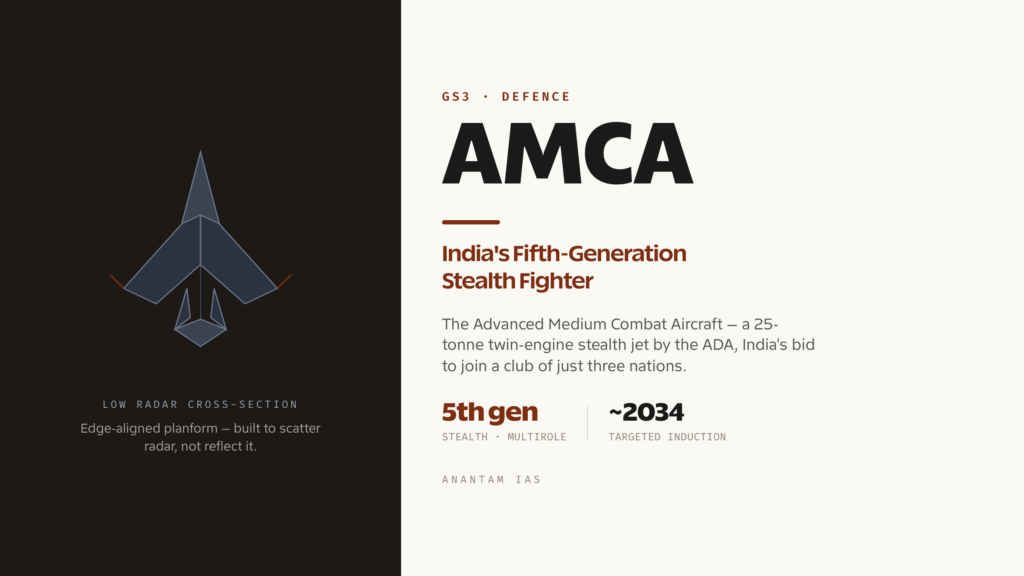
In a hangar somewhere outside Bengaluru, engineers are arguing about the curve of an air intake. That sounds trivial. It isn’t. Bend that intake the right way — into an S-shaped serpentine duct so an enemy radar can never see the spinning blades of the engine fan deep inside — and you have taken one more step toward making a 25-tonne aircraft very hard to find in the sky. This is the kind of problem that defines the Advanced Medium Combat Aircraft, or AMCA, India’s attempt to build something only three countries have ever fielded: a true fifth-generation stealth fighter.
And the reason it landed in the headlines through 2025 and into 2026 is not a maiden flight or a shiny rollout. It’s a decision about who gets to build it. For the first time in a major Indian fighter programme, the government has thrown the doors open to private industry to compete for the prototype contract — a structural shift from the old model where the public-sector Hindustan Aeronautics Limited simply got the job. That matters for India because the AMCA is not just an aircraft. It’s a test of whether the country can design, build and — the hardest part — power a top-tier combat jet on its own, at a moment when the Indian Air Force is shrinking and the world’s air forces are all moving to a new generation of warplanes.
What the AMCA Actually Is
Let’s be precise before we get sweeping. The Advanced Medium Combat Aircraft is a single-seat, twin-engine, multirole stealth fighter being designed by the Aeronautical Development Agency — the ADA, an autonomous design house under the Defence Research and Development Organisation, the DRDO. It sits in the 25-tonne class, meaning a maximum take-off weight of around 27,000 kg, which makes it heavier and more capable than the lighter Tejas and squarely a “medium” fighter in global terms. The “advanced medium” in the name is doing exactly what it says: bigger and more lethal than the Tejas, but not the heavyweight class of a Sukhoi.
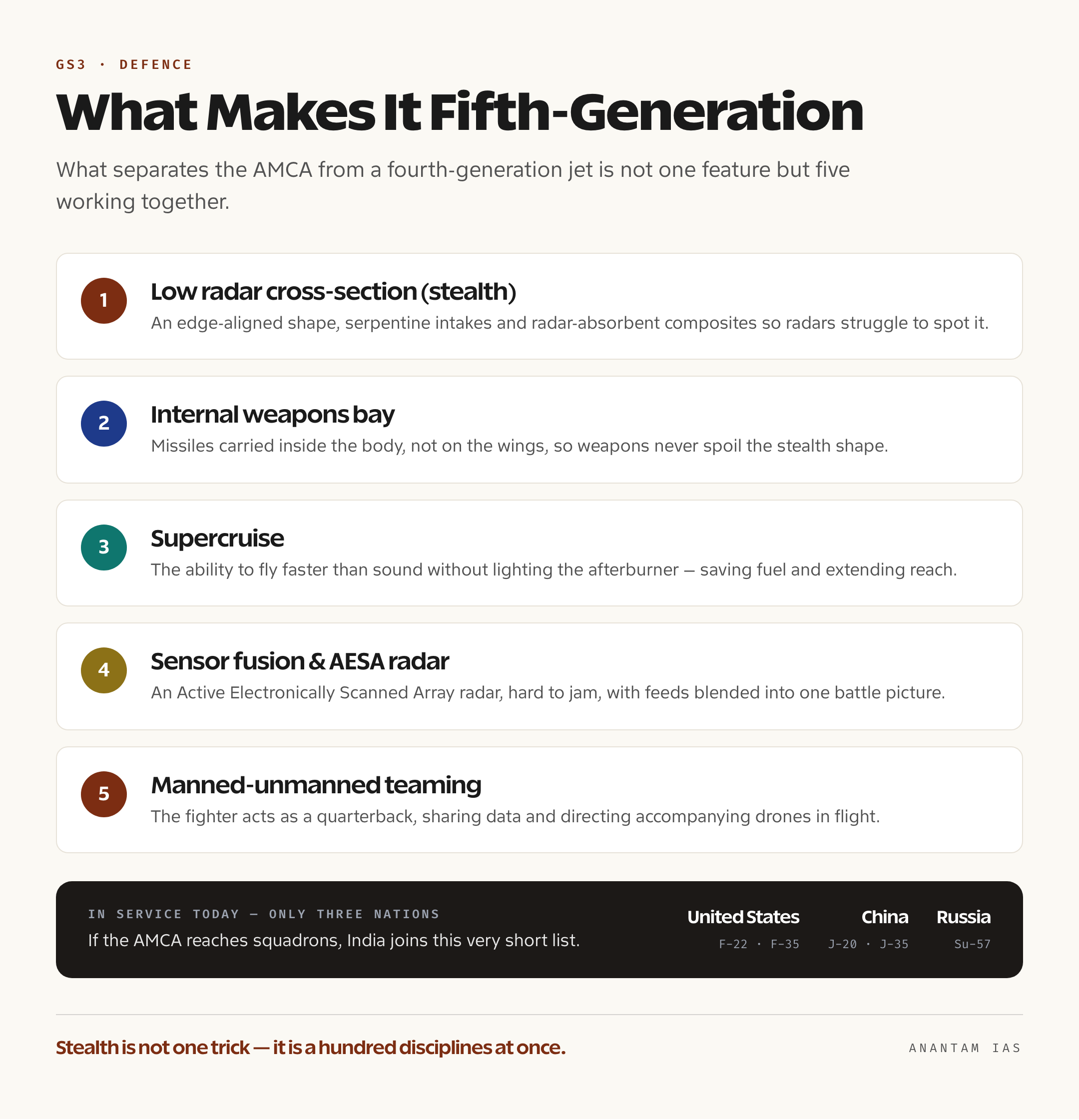
The word that does the heavy lifting, though, is “fifth-generation.” Fighter jets are loosely grouped into generations, and the fifth is the current cutting edge. A fifth-generation fighter is defined by a cluster of traits that work together: very low observability — stealth — so radars struggle to spot it; an internal weapons bay so missiles tucked inside the body don’t ruin that stealth; sensor fusion, where the aircraft’s many sensors are blended by software into one clear picture for the pilot; an Active Electronically Scanned Array, or AESA, radar that’s hard to jam and hard to detect; and the ability to share data and even control drones in flight. Only a handful of aircraft on Earth tick all those boxes — and the AMCA is built to be one of them.
Here’s the strategic point that makes this programme so significant. As of 2026, only three countries operate genuinely fifth-generation fighters in service: the United States with the F-22 Raptor and the F-35 Lightning II, China with the J-20 and the newer J-35, and Russia with the Su-57. If the AMCA reaches squadrons, India joins that very short list of nations that not only fly such aircraft but design and build them. The programme was originally conceived back in 2010 as a 20-tonne machine; over the years it grew into the 25-tonne fighter on the drawing board today, reflecting how much capability the Air Force decided it wanted to pack in.
The Stealth, the Sensors and the Engine Question
So what is the ADA actually trying to build into this thing? Start with stealth, because that is the soul of a fifth-generation design and the part you can’t simply bolt on later. The AMCA’s shape is being sculpted to scatter radar waves away from the sender — that’s what a low radar cross-section means. The design uses platform-edge alignment, where the edges of the wings, tail and other surfaces are all angled in the same few directions so reflections bunch into narrow, predictable spikes rather than spraying everywhere. It uses a diverterless supersonic inlet, or DSI — a smooth bump-shaped air intake with no moving parts — feeding those serpentine ducts that hide the engine face. Weapons go inside an internal bay rather than hanging off the wings. And the airframe leans heavily on composites, lightweight carbon-based materials that make up a large share of the structure, both to save weight and to help absorb radar energy. Stealth isn’t one trick; it’s a hundred small disciplines applied at once.
Layered on top of the shape is the electronic brain. The AMCA is planned to carry an indigenous AESA radar, the kind of radar that steers its beam electronically with no moving dish, and to fuse the feeds from its radar, infrared sensors and electronic-warfare systems into a single battle picture — so the pilot manages the fight rather than juggling instruments. The design also targets supercruise, the prized ability to fly faster than sound without lighting the afterburner, which saves fuel and extends reach. And it’s being built for the next kind of warfare: artificial-intelligence-assisted decision-making and “manned-unmanned teaming,” where the fighter acts as a quarterback directing accompanying drones. On paper, it’s everything a 2030s air force could ask for.
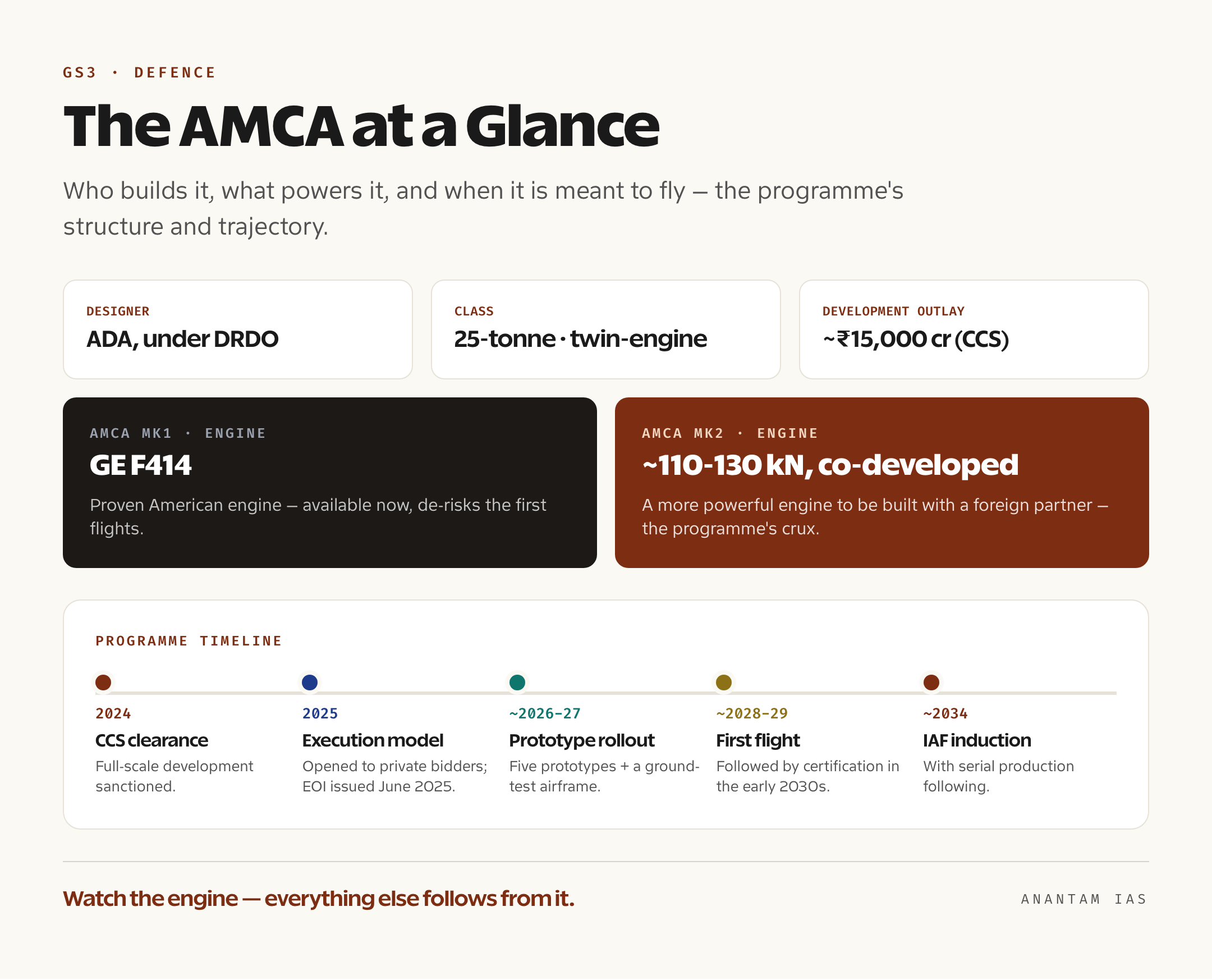
But there’s one component that decides whether any of this flies, and it’s the one India can’t yet make at home: the engine. The plan splits the aircraft into two versions to manage this. The first batch, the AMCA Mk1, will use the American General Electric F414 engine — the same proven engine family chosen for the Tejas Mk2 — because it’s available now and de-risks the first flights. The more ambitious AMCA Mk2 is meant to fly on a far more powerful engine in the 110-to-130-kilonewton thrust class, and here lies the crux of the whole programme. India can’t build that engine alone, so the DRDO’s Gas Turbine Research Establishment is in talks to co-develop it with a foreign partner. Two contenders are pitching hard — France’s Safran, offering a scalable design starting around 120 kN and stretchable to 140 kN, and Britain’s Rolls-Royce, offering a modular 120 kN-class core that can be upgraded later. In February 2026, the Defence Minister announced a National Aero Engine Mission to develop this 120 kN-class engine, signalling how central the engine has become to India’s airpower ambitions. Get the engine right and the AMCA is a world-class fighter. Get it wrong, and it’s a beautiful airframe waiting for a heart.
How the Programme Is Being Built — The 2025 Execution Model
This is where the AMCA story turned, and it’s the bit most worth understanding. In March 2024, the Cabinet Committee on Security — the country’s apex body on defence and strategic decisions, chaired by the Prime Minister — cleared the AMCA’s full-scale engineering development with an outlay of about ₹15,000 crore. That sanction took the AMCA from a design study to a funded national programme. Five prototypes are planned, plus a structural test specimen — an airframe that never flies but is deliberately stressed and fatigued on the ground to certify how much punishment the design can take.
The bigger break with the past came on 27 May 2025, when the Defence Minister approved what’s called the AMCA Programme Execution Model. Under the old way of doing things, a cleared fighter programme would more or less automatically go to Hindustan Aeronautics Limited, the state-owned aerospace giant. The new model does something different: it tells the ADA to issue an Expression of Interest — a formal invitation to bid — and lets any capable Indian company compete to develop and build the prototypes, whether bidding alone, as a consortium, or as a joint venture. The Defence Ministry framed it squarely as an Atmanirbhar Bharat — self-reliant India — move, designed to give the private sector a real seat at the table in cutting-edge fighter development rather than leaving it as a subcontractor. The EOI duly went out in June 2025.
By 2026 the field had narrowed. After technical evaluation, three contenders were in the running for the prototype contract: Tata Advanced Systems bidding on its own, a Larsen & Toubro-led group teamed with Bharat Electronics and Dynamatic Technologies, and a Bharat Forge-led group with BEML and Data Patterns. The Request for Proposal — the detailed tender that follows the EOI — was being finalised, and the terms are demanding: the winning partner must roll out and fly the first prototype within roughly 30 months of signing, and put the fleet of prototypes through a heavy flight-test campaign over the years that follow. So the architecture now is a layered one — the ADA owns the hard design intelligence such as the stealth shape and the flight-control software, while a private or public partner does much of the building and integration. That split is itself a deliberate experiment in growing India’s private defence-aerospace muscle.
The physical infrastructure is moving too. On 15 May 2026, the Defence Minister and the Andhra Pradesh Chief Minister laid the foundation stone for a roughly ₹16,000 crore Aircraft Integration and Flight Testing Centre at Puttaparthi in Andhra Pradesh — a 650-acre facility, to be run by the ADA, meant to handle aircraft integration, testing, validation and certification, and expected to employ around 7,500 people. The Defence Minister noted that such facilities exist in only a few countries. It’s the kind of unglamorous capability — a place to actually assemble and certify advanced aircraft — that turns a programme on paper into metal in the air.
Why India Needs the AMCA Now
None of this is being pursued for prestige alone. The AMCA answers a hard strategic problem the Indian Air Force is staring at right now: it’s running out of fighters. The Air Force is sanctioned for 42 fighter squadrons but is down to roughly 30, and several of those are ageing — including SEPECAT Jaguar squadrons inducted back in the late 1970s that are nearing the end of their lives. India faces a two-front threat from China and Pakistan, and a depleting squadron count against that backdrop is a genuine security gap, not an accounting quibble.
Then there’s the deeper lesson of India’s own fighter history. The Tejas Light Combat Aircraft programme proved India could design and fly an indigenous fighter — but it also exposed how brutal the road is. Tejas took roughly four decades from sanction to a still-modest fleet, and its production is now hostage to a familiar bottleneck: engines. HAL has to import GE F404 engines for the Tejas Mk1A because the indigenous Kaveri engine, sanctioned all the way back in 1989, never produced enough thrust to power the jet and was eventually de-linked from it. The F404 deliveries themselves ran badly late, choking Tejas production. That is the cautionary tale sitting behind every AMCA decision — and the reason the engine co-development effort and the National Aero Engine Mission matter as much as the airframe.
Finally, there’s the money and the message. India is among the world’s largest arms importers, and every imported fighter is a drain of foreign exchange and a strand of strategic dependence — you can’t truly control a weapon whose spares and source code sit in another capital. The AMCA is the centrepiece of the Atmanirbhar Bharat push in aerospace: the idea that India should design and build its own top-tier military hardware, keep the intellectual property, build domestic industry and jobs, and export from a position of strength. A fifth-generation fighter is about the hardest thing an aerospace ecosystem can attempt, which is exactly why succeeding at it would prove the rest.
The Honest Challenges Ahead
A strong case is strengthened by stating its limits, so here they are plainly. The first is the engine — and it can’t be said too often. Until the Mk2 engine is co-developed and proven, the AMCA’s full fifth-generation promise, including reliable supercruise, rests on a partnership not yet finalised, and aero-engine programmes are notorious for slipping. Some analysts already warn the Mk2 engine and aircraft could arrive well into the 2030s, even toward 2040, if the propulsion effort stretches. The engine is the long pole in the tent.
The second is timelines and cost. The current roadmap targets a prototype rollout around 2026-27, a first flight near 2028-29, certification in the early 2030s and induction around 2034, with serial production following. Fighter programmes everywhere — including the American F-35 — have a long history of overrunning both schedule and budget, and the AMCA is India’s most complex aircraft ever attempted. A ₹15,000 crore development figure is the start, not the finish; the real lifetime cost of a fleet runs far higher. The third challenge is the very thing that makes the execution model exciting: handing critical fighter-building work to private consortia is unproven at this scale in India, and integration, quality control and accountability across a public-private partnership will be tested hard.
So the honest verdict is neither hype nor cynicism. The AMCA is a genuinely ambitious, well-structured bid to put India in the top tier of military aerospace, and the 2025 execution model is a smart attempt to broaden the industrial base while it’s at it. But the gap between an approved programme and a stealth fighter in front-line squadrons is measured in a decade of disciplined engineering — and in solving the one problem, the engine, that has dogged Indian aviation for forty years. Watch the engine. Everything else follows from it.
For Your Mains Answer
The AMCA is a high-value case study for GS Paper 3, which covers “achievements of Indians in science and technology; indigenization of technology and developing new technology,” along with defence and security. It’s the perfect concrete example to anchor any answer on defence indigenisation, Atmanirbhar Bharat in the strategic sector, or the role of the private sector in defence manufacturing. It also slots neatly into security questions on India’s combat-capability gap and the two-front threat.
How to Build the Answer
Open with what the AMCA is in one tight line — India’s indigenous twin-engine, fifth-generation stealth multirole fighter by the ADA — then state why it matters now: depleting IAF squadrons and the push for self-reliance. Use the body to move through significance and challenges in balance. Don’t just describe the aircraft; argue. The strongest answers treat the AMCA as evidence for a larger point about whether India can climb the value chain in defence technology, and they use the engine question as the honest fulcrum of that argument.
Common Mistakes to Avoid
Don’t turn the answer into a spec sheet — examiners don’t reward a list of stealth features without analysis. Don’t overclaim that India has “achieved” a fifth-generation fighter; it’s under development, and the first flight hasn’t happened. Don’t ignore the engine dependence, because leaving it out signals you don’t understand the real bottleneck. And don’t forget the institutional angle — the 2025 execution model and the private-sector role are often the freshest, highest-scoring part of an answer.
A Compact Answer Spine
AMCA = indigenous fifth-gen stealth fighter (ADA, 25-tonne class) → why now: IAF down to ~30 of 42 squadrons, two-front threat, Atmanirbhar Bharat → what it brings: stealth, supercruise, sensor fusion, AESA, manned-unmanned teaming → how it’s organised: CCS clearance 2024 (~₹15,000 cr), 2025 execution model opening it to private consortia, EOI/RFP → challenges: the engine gap (Mk2 co-development), timelines and cost, unproven private-sector model → way forward: National Aero Engine Mission, disciplined execution, learning from the Tejas-Kaveri experience.
Diagram or Flowchart Idea
Draw a simple two-column balance: on the left, “Significance” (indigenisation, jobs, strategic autonomy, fills squadron gap, private-sector ecosystem); on the right, “Challenges” (engine dependence, timelines, cost, unproven model). A balance diagram like this visually signals a 360-degree answer and is quick to sketch. Alternatively, a horizontal timeline — 2010 conception, 2024 CCS clearance, 2025 execution model, ~2028-29 first flight, ~2034 induction — earns marks for showing the programme’s trajectory.
A Balanced-Conclusion Line
Close with measured confidence: the AMCA is India’s most credible bid yet for a seat at the table of fifth-generation airpower, but its success — and the strategic autonomy it promises — will be decided less by the airframe than by whether India finally solves its decades-old fighter-engine problem.
How to Use Data Without Cramming
You need only a few anchors, not a flood. Carry these: 25-tonne class; designed by the ADA under DRDO; CCS clearance in 2024 with about ₹15,000 crore for development; the 2025 execution model opening it to private industry; GE F414 on Mk1 and a co-developed 110-130 kN engine on Mk2; first flight around 2028-29 and induction around 2034; and the IAF’s shortfall of roughly 30 squadrons against a sanctioned 42. Drop two or three of those into an answer and you sound current without reciting a brochure.
FAQ
What is the AMCA, in one line? The AMCA, or Advanced Medium Combat Aircraft, is India’s indigenous fifth-generation, twin-engine, multirole stealth fighter, designed by the Aeronautical Development Agency under the DRDO and intended to be built with industry partners for the Indian Air Force. It’s in the 25-tonne weight class and is designed for stealth, supercruise and advanced sensor fusion.
Has the AMCA flown yet, and when will it be inducted? No — as of 2026 the AMCA is in detailed design and prototype development, not flight. The roadmap targets a prototype rollout around 2026-27, a first flight near 2028-29, and induction into the Indian Air Force around 2034, with serial production following. Five prototypes plus a ground-test airframe are planned.
Why is the engine such a big deal for the AMCA? Because India can’t yet build a high-thrust fighter engine on its own. The first version, the AMCA Mk1, will use the imported GE F414 engine, while the more powerful Mk2 needs a 110-to-130-kilonewton engine that the DRDO’s Gas Turbine Research Establishment plans to co-develop with a foreign partner such as Safran or Rolls-Royce. Until that engine is proven, the AMCA’s full capability — and its timeline — carry real risk. This echoes the long failure of the indigenous Kaveri engine.
What changed with the 2025 execution model? The AMCA Programme Execution Model, approved in May 2025, broke from the old practice of automatically handing a fighter programme to the public-sector HAL. Instead, the ADA invited any capable Indian company — bidding alone, in a consortium or as a joint venture — to compete for the prototype contract. By 2026, groups led by Tata Advanced Systems, Larsen & Toubro and Bharat Forge were in the race. It’s a deliberate Atmanirbhar Bharat push to grow India’s private defence-aerospace industry.
Practice Questions
Prelims MCQs
- With reference to the Advanced Medium Combat Aircraft (AMCA), consider the following statements. Which is correct?
(a) It is being designed by Hindustan Aeronautics Limited under the Ministry of Civil Aviation
(b) It is an indigenous fifth-generation stealth fighter designed by the Aeronautical Development Agency under the DRDO
(c) It is a fourth-generation trainer aircraft
(d) It is a transport aircraft for the Indian Navy.
Answer: (b) The AMCA is India’s fifth-generation stealth fighter designed by the ADA, an autonomous body under the DRDO. - The AMCA is best described as which class of fighter aircraft?
(a) Light, single-engine, in the 13-tonne class
(b) Medium, twin-engine, in the 25-tonne class
(c) Heavy, twin-engine, in the 35-tonne class
(d) Light, twin-engine, in the 18-tonne class.
Answer: (b) The AMCA is a twin-engine, multirole fighter in the roughly 25-tonne class, heavier than the Tejas. - Which of the following are features associated with a fifth-generation fighter such as the AMCA? 1. Low radar cross-section (stealth) 2. Internal weapons bay 3. Sensor fusion and AESA radar 4. Manned-unmanned teaming. Select the correct answer:
(a) 1 and 2 only
(b) 1, 2 and 3 only
(c) 2, 3 and 4 only
(d) 1, 2, 3 and 4.
Answer: (d) All four are defining traits of a fifth-generation fighter, and all are planned for the AMCA. - Which engine is planned to power the first version, the AMCA Mk1?
(a) The indigenous Kaveri engine
(b) The General Electric F414 engine
(c) The Russian AL-31FP engine
(d) The Rolls-Royce EJ200 engine.
Answer: (b) The AMCA Mk1 is planned to use the imported GE F414 engine, while a more powerful co-developed engine is intended for the Mk2. - The “AMCA Programme Execution Model,” approved in 2025, is significant primarily because it:
(a) Reduced the aircraft’s weight class from 25 tonnes to 20 tonnes
(b) Opened the prototype-development contract to competition from private Indian companies, not just HAL
(c) Transferred the programme to a foreign manufacturer
(d) Cancelled the requirement for a stealth design.
Answer: (b) The model allows Indian private companies to bid — alone, in consortia or as joint ventures — for the AMCA, a shift from the public-sector-default approach.
Mains Practice Questions
- “The Advanced Medium Combat Aircraft represents India’s most ambitious attempt at defence indigenisation yet.” Discuss the significance of the AMCA programme for India’s strategic autonomy, and examine the key challenges it must overcome. (15 marks, 250 words)
- Critically analyse the 2025 AMCA Programme Execution Model. How does opening fighter development to the private sector reflect the broader goals of Atmanirbhar Bharat in defence manufacturing? (15 marks, 250 words)
- “An advanced fighter is only as capable as the engine that powers it.” In the light of India’s experience with the Kaveri engine and the AMCA’s engine co-development plans, discuss the challenge of achieving self-reliance in aero-engine technology. (15 marks, 250 words)
- The depleting squadron strength of the Indian Air Force poses a serious security challenge in a two-front scenario. Examine how indigenous programmes like the Tejas and the AMCA address this gap, and assess the limitations of relying on them. (10 marks, 150 words)
- Discuss the role of institutions such as the DRDO, the Aeronautical Development Agency and the private sector in India’s pursuit of a fifth-generation fighter capability. What lessons from past programmes should guide the AMCA’s execution? (15 marks, 250 words)
Tell Google you want more of this.
Add Anantam IAS as a preferred sourceOne tap, and this site shows up more often in your own Top Stories, AI Overviews and AI Mode. Remove it any time.