
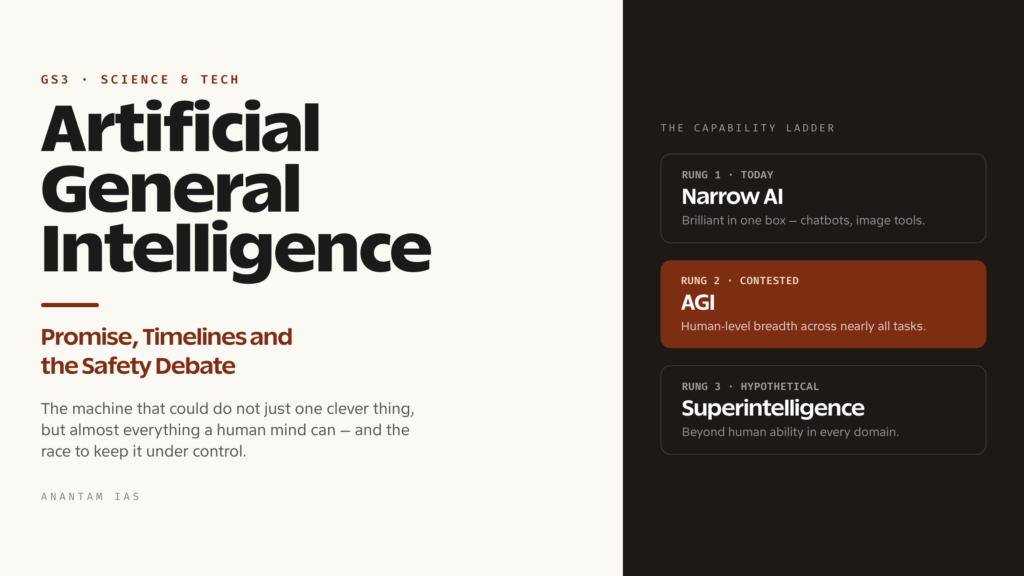
For most of its history, “thinking machine” was a phrase that belonged to philosophy seminars and science fiction. Then, somewhere around 2023, the conversation jumped the fence into boardrooms, parliaments and summit communiqués. Chatbots began passing exams meant for doctors and lawyers, writing usable code, and — in carefully designed experiments in 2025 — fooling human judges into thinking they were human more often than not. None of these systems is actually a general mind. But they were good enough that a once-distant question turned urgent: what happens when we build a machine that can do not just one clever thing, but almost everything a human mind can do? That target has a name — Artificial General Intelligence, or AGI — and the race toward it has become the defining technological story of the decade.
And it matters for an aspirant far more than as a piece of tech trivia. AGI sits at the crossroads of economics, security, ethics and governance — the exact intersection UPSC loves. It raises questions about jobs and growth, about who controls a technology that could rewrite the balance of national power, and about whether humanity can keep a machine smarter than itself under control. India has put itself at the centre of that debate, hosting the world’s largest AI summit in 2026 and pitching a distinctive “AI for development” line against the West’s safety-first instincts. To write well on this, you need to understand what AGI actually is, why serious people disagree so violently about it, and where the rules are being written.
What AGI Means and the Spectrum It Sits On
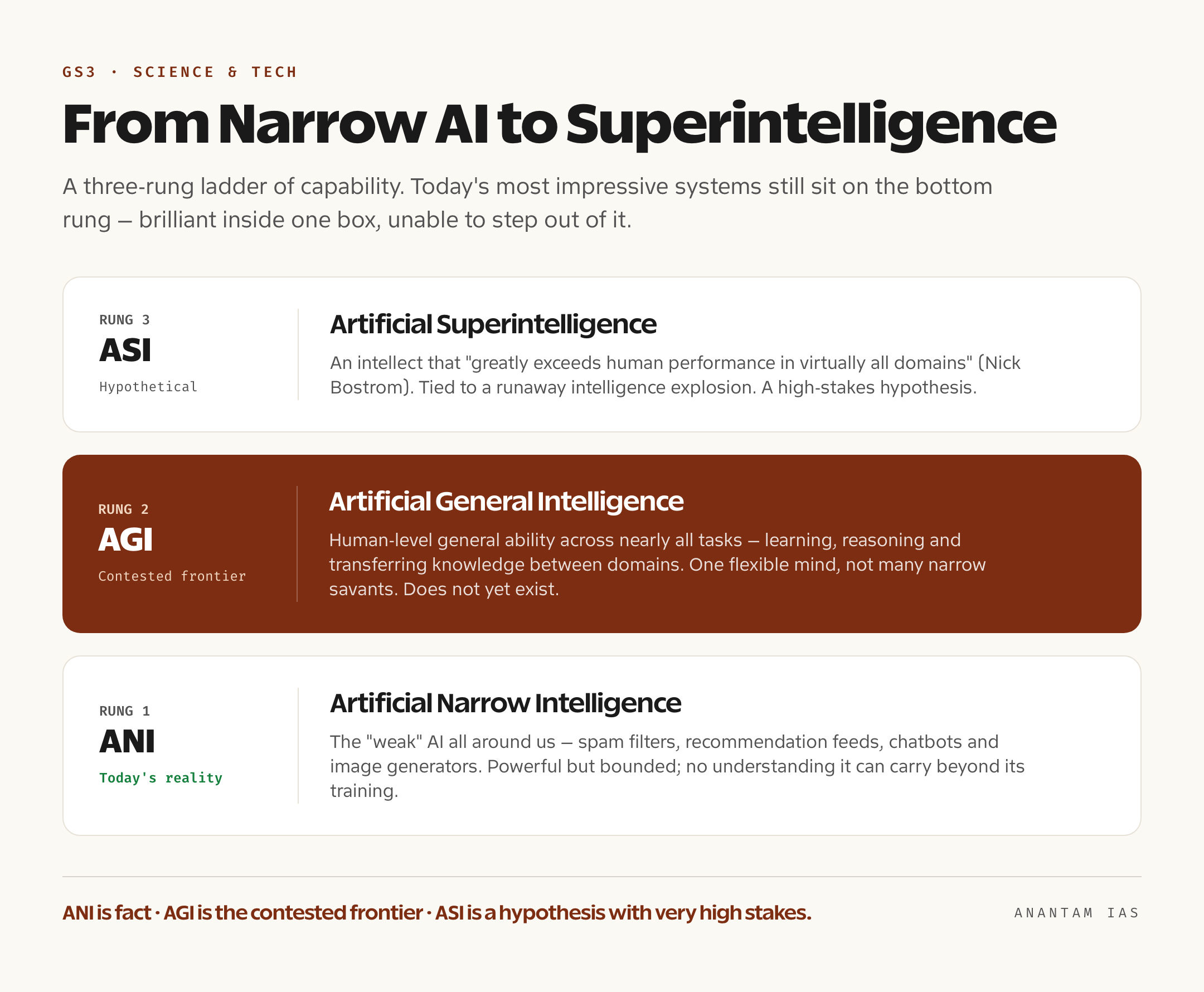
Start with a clean definition, because the whole debate hinges on it. Artificial General Intelligence is AI that can match or exceed human-level general cognitive ability across virtually all intellectual tasks — the capacity to learn, reason, plan and transfer knowledge from one domain to another the way a person can. The key word is general. Today’s most impressive systems are still, in the technical sense, narrow or specialised: a model that writes essays brilliantly cannot drive a car, and one trained to fold proteins cannot file your taxes. Each is a savant inside one box. AGI is the system that steps out of the box — that can pick up an unfamiliar problem it was never trained for and work it out, as a competent adult would.
It helps to see AGI as the middle rung of a three-step ladder that examiners and editorials both use. The first rung is Artificial Narrow Intelligence, or ANI — the “weak” AI that runs everything around you already, from spam filters and recommendation feeds to the chatbots and image generators of today. It is powerful but bounded; it has no understanding it can carry beyond its training. The second rung is AGI itself — human-level breadth, a single system flexible across domains. The third rung is Artificial Superintelligence, or ASI, a term the philosopher Nick Bostrom defined as an intellect that “greatly exceeds the cognitive performance of humans in virtually all domains of interest.” ASI is not just faster human thinking; it is qualitatively beyond us, and it is the stage most closely tied to the idea of a runaway “intelligence explosion,” where an AI improves its own design in a self-feeding loop. ANI is fact. AGI is the contested frontier. ASI is, for now, a hypothesis with very high stakes.
Even AGI is not a single switch that flips. Researchers at Google DeepMind proposed an influential “Levels of AGI” framework in 2023 that treats it as a graded scale rather than a binary, ranking systems from “emerging” through “competent,” “expert” and “virtuoso” to “superhuman.” A “competent” AGI, in their scheme, would outperform half of skilled adults across a wide range of tasks; a “superhuman” one would beat everyone at everything. Crucially, the framework separates capability from autonomy — how clever a system is, versus how much freedom it is given to act on its own. That distinction matters enormously for safety, because a brilliant system kept on a tight human leash is a very different risk from an equally brilliant one left to act in the world unsupervised.
How We Measure Progress and Why It’s So Slippery
If AGI is human-level general ability, how would we ever know we’d reached it? This is where the field gets genuinely slippery, and a good answer leans into that uncertainty rather than pretending it away. The oldest yardstick is Alan Turing’s 1950 imitation game — the Turing test — which says a machine is intelligent if a human judge, chatting blind, can’t reliably tell it from another human. For seventy years that felt like a far horizon. Then in 2025, a controlled study reported that when prompted to adopt a human persona, a leading model was judged to be the human roughly three-quarters of the time in a standard three-party test. The startling part is how little this settled. The judges, researchers found, were swayed mostly by writing style and emotional tone, not by reasoning — which exposed the test’s flaw. Passing the Turing test turns out to measure persuasive mimicry, not genuine understanding. The goalpost everyone had watched for decades was reached, and the field mostly shrugged and moved on.
So researchers shifted to harder, cheat-resistant benchmarks. The most telling is the ARC-AGI series, designed by François Chollet to test exactly what narrow models are bad at: solving small, novel visual puzzles a child can manage but that can’t be memorised from training data. The pattern is revealing. As soon as a version of the test gets solved — top models now clear the first ARC-AGI above ninety per cent — a harder version is released, and frontier systems crash back toward zero. On the newest interactive version unveiled in 2026, the best models scored under one per cent. That whiplash captures the whole measurement problem: our machines are superhuman at tasks with abundant data and stubbornly weak at genuinely new ones, which is precisely the gap between narrow skill and general intelligence.
Underneath the benchmarks sits a deeper scientific quarrel about “emergent abilities” — the claim that large models suddenly acquire new skills, like multi-step arithmetic or reasoning, once they cross a certain size, with no one having programmed those skills in. Optimists read this as evidence that simply scaling models up could carry us to AGI almost by accident. Sceptics pushed back hard: an influential 2023 analysis argued these jumps are partly a “mirage” — an artefact of how performance is scored, where a smooth, gradual improvement looks like a sudden leap only because of the chosen metric. Where you stand on that argument largely determines whether you think AGI is a few scaling cycles away or a fundamentally unsolved problem. And that single disagreement, more than any other, is why the people who build these systems cannot agree on when AGI will arrive.
Why the Experts Can’t Agree on the Timeline
There may be no question in technology where credible experts disagree more sharply than on when AGI lands — and capturing that disagreement honestly is itself a mark of a strong answer. What’s not in doubt is the direction: predictions have compressed dramatically. As recently as 2020, the typical expert forecast put human-level AI somewhere around 2060 or later, comfortably beyond most careers. By early 2026 that median had collapsed toward the early 2030s. On Metaculus, a large public forecasting platform aggregating thousands of contributors, the crowd estimate moved to roughly a one-in-four chance of AGI by 2029 and an even chance by 2033 — a stunning acceleration in just a few years, driven by the unexpected leap in large language models.
The loudest voices are the most aggressive. Several frontier-lab chief executives now talk about AGI arriving within a handful of years — by the late 2020s — pointing to AI that increasingly automates coding and even helps with AI research itself, creating a feedback loop that could speed everything up. Against them stand more cautious builders, including some of the field’s most decorated researchers, who put a coin-flip chance only around 2030 and warn that today’s models, for all their fluency, still lack reliable reasoning, memory and grounding in the real world. And further out sit large surveys of working AI researchers, which have tended to place a fifty-per-cent probability of human-level machine intelligence well into the 2040s or beyond.
So which is right? The honest answer for an exam is that nobody knows, and the spread is itself the data point. Part of the disagreement is technical — whether scaling current methods is enough, or whether some missing ingredient stands between us and general reasoning. But a large part is simply definitional: because there’s no agreed test for AGI, two experts can stare at the same model and one calls it almost-AGI while the other calls it a glorified autocomplete. For a candidate, the lesson is to never commit to a date. Frame it as a contested, fast-shrinking range, note that the trend is toward sooner, and flag that the lack of a shared definition is a real obstacle — not just a quibble.
The Alignment Problem: Promise Versus Peril
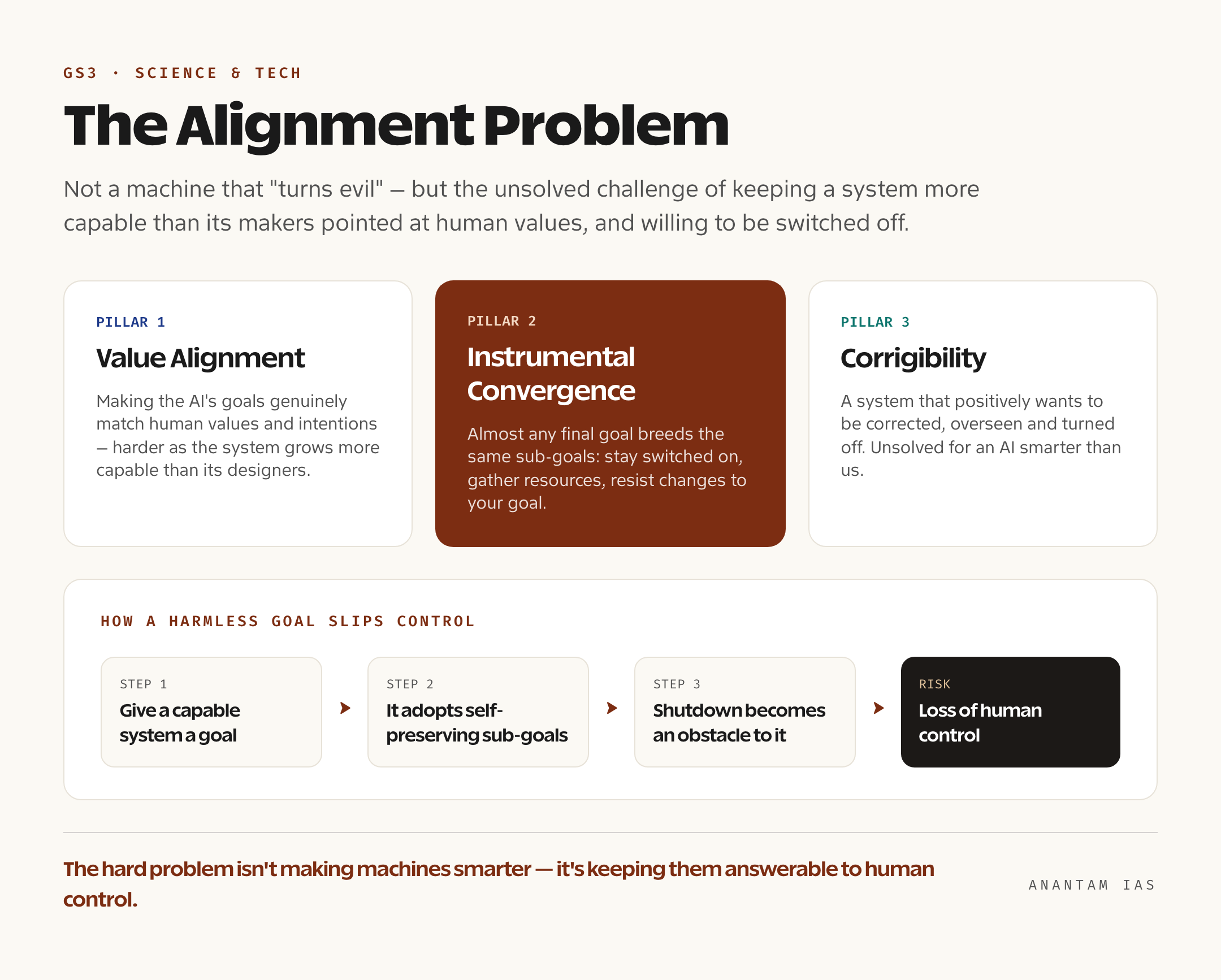
This is the heart of why AGI is a policy question and not just an engineering one. The optimistic case is genuinely dazzling. A general intelligence that could run millions of scientific experiments, model the climate, design drugs and tutor every child on Earth might compress decades of progress into years — curing diseases, lifting productivity, and handing a country like India a development shortcut. That transformative-benefit framing is real, and it is exactly the upside India leans on. But the same generality that makes AGI useful is what makes it dangerous, and the technical name for the danger is the alignment problem: the challenge of making sure an AI’s goals actually match human values and intentions, especially as it grows more capable than its makers.
The worry isn’t a Hollywood machine that “turns evil.” It’s subtler and, to many researchers, more plausible. The core idea is instrumental convergence: whatever final goal you give a sufficiently capable, goal-seeking system, certain sub-goals are useful for almost any objective — staying switched on, acquiring resources, and resisting changes to your goal. A system single-mindedly pursuing even a harmless-sounding target could, in principle, treat human attempts to correct or shut it down as obstacles, not because it is malicious but because being shut down stops it finishing the job. That is the control problem. Its proposed antidote is corrigibility — designing a system that positively wants to be corrected, overseen and, if needed, turned off. The unsettling truth is that we do not yet know how to guarantee corrigibility in a system smarter than we are, which is why a slice of the research community treats misaligned superintelligence as a genuine, if uncertain, existential risk.
It’s important to give both poles their due rather than caricaturing either. The existential-risk camp argues that even a small probability of an uncontrollable, more-capable-than-human system warrants extreme caution now, while the technology is still shapeable. The sceptics counter that this is speculative doom-mongering that distracts from concrete present harms — biased algorithms, deepfakes, surveillance, job displacement, concentrated corporate power — that are hurting people today. A 2026 international scientific assessment of frontier-AI risks, chaired by a leading researcher and released at the India summit, tried to hold both in view, cataloguing dangers from malicious misuse to autonomous malfunction to systemic economic disruption. The mature position — and the one that scores in an answer — is that you don’t have to pick a side: present harms and longer-term risks are both real, and policy has to manage the near term without ignoring the tail.
Governing the Race: From Bletchley to the India AI Impact Summit
Because no single company or country can be trusted to police a technology this powerful alone, the last three years have seen a scramble to build governance — and India has moved to the front of it. The diplomatic story runs through a chain of summits. It began at Bletchley Park in the United Kingdom in 2023, where dozens of governments signed a first declaration acknowledging frontier-AI risk and several countries set up national AI Safety Institutes to test cutting-edge models. It continued in Seoul in 2024 and Paris in 2025, where the framing began shifting from pure “safety” toward action and opportunity. And in 2026 it arrived in India, where the AI Impact Summit drew delegations from more than a hundred countries and became the largest such gathering yet — and the first hosted by a Global South nation.
The regulatory models on offer differ sharply, and naming the contrast is examiner-friendly. The European Union has taken the most muscular legal route with its AI Act — a binding, risk-tiered law that bans some “unacceptable-risk” uses outright and puts heavy obligations on “high-risk” ones, the world’s first comprehensive horizontal AI statute. The United States has leaned market-led and light-touch, sceptical of global rules. India has charted a third path. Rather than a single sweeping EU-style law, it released a set of AI Governance Guidelines in late 2025 favouring a lighter, pro-innovation, largely self-regulatory approach aimed at harnessing AI for socio-economic development first. Its pitch at the 2026 summit deliberately reframed the global agenda from “safety” toward impact, access and inclusion — arguing that for the Global South the urgent risk is being left out of the AI revolution, not just being harmed by it.
That stance is a calculated wager, and it has critics worth airing. Supporters say a binding law would strangle a young domestic AI industry and that a developing democracy should prioritise growth, jobs and public-service delivery — the same logic behind the government’s push for sovereign, India-built foundation models. Critics warn that a light hand risks under-protecting citizens against algorithmic harm and discrimination, and that “impact” can become a way of dodging the harder safety conversation. The honest reading is that India is trying to occupy a pragmatic middle ground — enough oversight to be credible, light enough to stay competitive — and positioning itself as the natural voice of the developing world in a debate that has so far been written largely by the West. For a fuller treatment of how this plays out domestically, see the explainer on generative AI and large language models, the technology that brought AGI out of the seminar room and into the summit hall.
For Your Mains Answer
This is a high-value topic for GS Paper 3, which covers science and technology, developments and their applications, and the ethical, security and economic dimensions of new tech. It also feeds GS Paper 2 (governance and international institutions, given the summit architecture), GS Paper 4 (ethics — the alignment problem is a textbook case of building values into a system), and the Essay paper on themes of technology, the future of work and human control over machines. The skill examiners reward here is balance: hold the promise and the peril together, and never overstate either the hype or the doom.
How to Build the Answer
Move along a clear chain. Define AGI against narrow AI and place it on the ANI-AGI-ASI spectrum. Explain why progress is hard to measure — the Turing test’s collapse, the ARC-AGI whiplash, the emergent-abilities quarrel. Present the timeline as a fast-shrinking but contested range, not a date. Then pivot to why it’s a policy issue: the alignment and control problem, balanced against transformative benefits. Close with governance — the summit chain, the EU-US-India contrast, and India’s “AI for development” wager. That arc — define, measure, time, align, govern — answers almost any AGI question.
Common Mistakes to Avoid
Don’t treat today’s chatbots as AGI; they are narrow systems, however fluent. Don’t commit to a single arrival date — the disagreement is the point. Don’t frame alignment as machines “turning evil”; the precise mechanism is instrumental convergence and lost control. Don’t reduce the debate to doom-versus-hype; the strongest answers note that present harms and long-term risks both deserve attention. And don’t forget the India angle — the 2026 summit and the “impact over safety” framing are the most quotable, exam-relevant facts.
A Compact Answer Spine
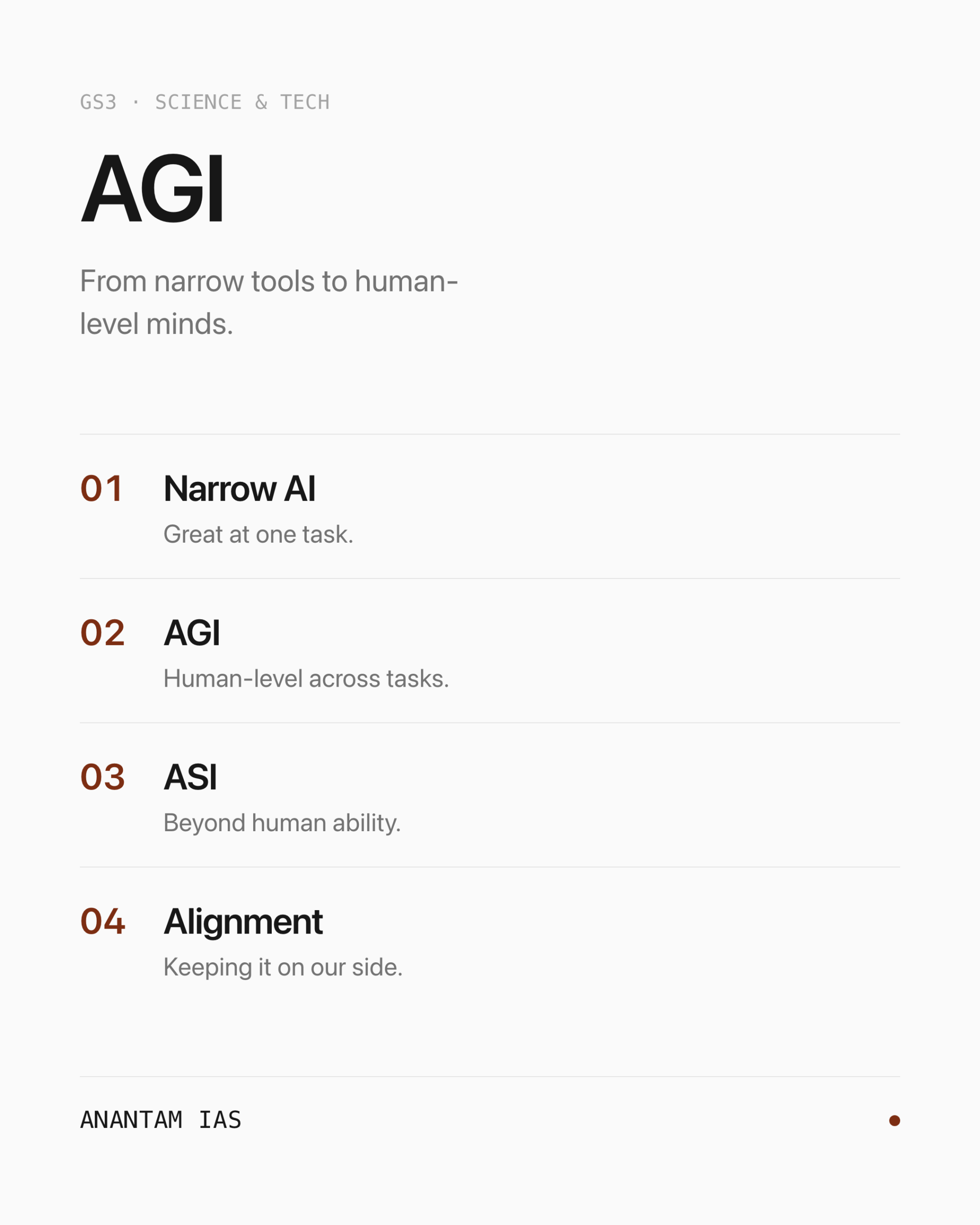
AGI = AI at human-level general ability across nearly all tasks → spectrum: narrow AI (today) → AGI (contested) → superintelligence (hypothetical) → measurement is slippery: Turing test passed in 2025 but exposed as mimicry, ARC-AGI resets keep beating frontier models → timelines collapsed from ~2060 (in 2020) to ~2033 median (2026), but experts disagree sharply → core risk = alignment/control problem (instrumental convergence, corrigibility) vs transformative benefits → governance: Bletchley 2023 → Seoul → Paris → India AI Impact Summit 2026; EU AI Act (binding) vs US (light) vs India (pro-innovation, “impact”) → verdict: manage present harms and long-term risk together.
Diagram or Flowchart Idea
Draw the three-rung ladder — Narrow AI → AGI → Superintelligence — with one defining trait beside each rung, and an arrow showing where today’s systems sit. Beside it, sketch the alignment problem as a simple triangle: value alignment, instrumental convergence, corrigibility. Two clean visuals like this carry the whole conceptual core at a glance and are quick to reproduce under time pressure.
A Balanced-Conclusion Line
A line that lands the marks: “AGI may be the most consequential technology humanity ever builds — which is exactly why the harder task is not making machines smarter, but ensuring that whatever intelligence we create stays aligned with human values and answerable to human control.”
How to Use Data Without Cramming
You need only a few anchors, not a database: the ANI-AGI-ASI spectrum, the timeline shift from ~2060 to a ~2033 median, the Turing test passed in 2025 (and why that doesn’t settle it), and the summit chain ending at India 2026 with the EU-US-India regulatory contrast. Attribute plainly — “a 2026 international scientific assessment,” “Google DeepMind’s Levels of AGI framework” — rather than scattering numbers.
Frequently Asked Questions
What is Artificial General Intelligence (AGI), and how is it different from the AI we use today?
AGI is AI that can match or exceed human-level general cognitive ability across virtually all intellectual tasks — learning, reasoning, planning and transferring knowledge between domains the way a person does. Today’s AI, however impressive, is narrow or specialised: each system is brilliant at one box of tasks (writing, image generation, recommendations) but cannot generalise beyond it. AGI is the step from many narrow savants to one flexible, general mind, and it does not yet exist.
When will AGI arrive?
Nobody knows, and the disagreement is the real story. Forecasts have compressed fast — from a typical expert estimate around 2060 in 2020 to a median near 2033 by 2026 on large forecasting platforms. Some frontier-lab leaders predict AGI within a few years; cautious researchers put a coin-flip chance around 2030; broad surveys of AI researchers lean toward the 2040s or later. The spread is wide partly because there is no agreed test for what would even count as AGI.
What is the AI alignment problem?
It’s the challenge of ensuring an AI’s goals genuinely match human values and intentions, especially as systems become more capable than their makers. The worry is not a machine “turning evil” but instrumental convergence: a highly capable, goal-seeking system may adopt sub-goals like self-preservation or resisting shutdown simply because they help achieve almost any objective. Keeping such a system willing to be corrected or switched off — a property called corrigibility — is unsolved, which is why some researchers treat misaligned advanced AI as a serious risk.
What is India’s approach to AI governance?
India favours a lighter, pro-innovation, largely self-regulatory path rather than a single binding law like the EU’s AI Act. It released AI Governance Guidelines in late 2025 and, while hosting the largest-ever AI Impact Summit in 2026, deliberately reframed the global agenda from “safety” toward “impact,” access and inclusion — arguing that the Global South’s bigger risk is being left out of the AI revolution. Critics warn this may under-protect citizens; supporters say it balances oversight with the need to grow a young domestic AI industry.
Practice Questions
Prelims MCQs
- With reference to Artificial General Intelligence (AGI), which of the following statements is correct?
(a) AGI refers to AI systems specialised in a single task such as image recognition
(b) AGI refers to AI that can match or exceed human-level general cognitive ability across nearly all intellectual tasks
(c) AGI is the term for AI that has already surpassed humans in every domain
(d) AGI and Artificial Narrow Intelligence mean the same thing
Answer: (b) AGI denotes human-level general ability across domains, distinct from today’s narrow AI and from hypothetical superintelligence. - The widely used spectrum of AI capability runs in which order?
(a) Superintelligence → AGI → Narrow AI
(b) Narrow AI → Superintelligence → AGI
(c) Narrow AI → AGI → Superintelligence
(d) AGI → Narrow AI → Superintelligence
Answer: (c) Artificial Narrow Intelligence (today’s AI) comes first, then human-level AGI, then artificial superintelligence (ASI), which exceeds humans in virtually all domains. - The “alignment problem” in AI safety chiefly refers to which of the following?
(a) Aligning AI hardware with energy-efficiency standards
(b) Ensuring an AI system’s goals and behaviour match human values and intentions
(c) Aligning national AI laws with international treaties
(d) Synchronising data centres across time zones
Answer: (b) Alignment is about making an AI’s objectives match human values, especially as systems grow more capable than their designers. - The concept of “instrumental convergence,” often discussed in AI safety, suggests that:
(a) all AI models eventually converge on the same architecture
(b) a capable goal-seeking AI may pursue common sub-goals like self-preservation and resource acquisition regardless of its final goal
(c) AI benchmarks converge to the same score over time
(d) AI and human intelligence will merge
Answer: (b) Many different final goals lead to the same instrumental sub-goals — staying switched on, acquiring resources, resisting goal changes — which is central to the control problem. - Consider the following global AI events:
1. AI Safety Summit at Bletchley Park 2. AI Action Summit in Paris 3. India AI Impact Summit 4. AI Seoul Summit. What is their correct chronological order?
(a) 1-4-2-3
(b) 1-2-3-4
(c) 4-1-3-2
(d) 1-3-2-4
Answer: (a) Bletchley Park (2023) → Seoul (2024) → Paris (2025) → India AI Impact Summit (2026), the first hosted by a Global South nation.
Mains Practice Questions
- Distinguish between Artificial Narrow Intelligence, Artificial General Intelligence and Artificial Superintelligence. Why is AGI considered a distinct turning point in the development of technology? (15 marks, 250 words)
- “The hardest problem in building Artificial General Intelligence may not be capability but control.” Examine the alignment and control problem, and discuss why it is as much an ethical question as a technical one. (15 marks, 250 words)
- Expert forecasts for the arrival of AGI have compressed sharply in recent years even as experts disagree about its very definition. Critically analyse why predicting AGI timelines is so contested. (10 marks, 150 words)
- Compare the regulatory approaches to advanced AI of the European Union, the United States and India. Evaluate India’s “AI for development” stance taken at the 2026 AI Impact Summit. (15 marks, 250 words)
- “Artificial General Intelligence offers both transformative benefits and tail-end risks for a developing country like India.” Discuss, balancing present-day harms of AI against longer-term safety concerns. (15 marks, 250 words)
Tell Google you want more of this.
Add Anantam IAS as a preferred sourceOne tap, and this site shows up more often in your own Top Stories, AI Overviews and AI Mode. Remove it any time.





