The Aryabhata satellite weighed 360 kilograms, looked like a 26-sided polygon wrapped in solar cells, and lived for exactly 60 hours of useful science before a power failure silenced it. By every modern metric, the mission was a flop. By every metric that actually mattered to a country with a per-capita income of 1,400 rupees and no launch vehicle of its own, it was a triumph, the kind a nation only gets once.
April 19, 1975. A Soviet Kosmos-3M rocket lifted off from Kapustin Yar and put India in the orbit club. The Aryabhata satellite was India’s first, named after the 5th-century mathematician-astronomer who calculated pi to four decimals and proposed that the Earth rotates on its axis. The naming was not decoration. It was a deliberate signal: India’s space programme would be Indian, intellectually and culturally, even when its rocket came from somewhere else.
The 51st anniversary in April 2026 lands at a moment when ISRO is preparing for crewed flight, lunar return missions, and a Mars orbiter sequel. The distance from Aryabhata to Gaganyaan is not just five decades of engineering. It is a story of how a developing country built the institutional muscle for science at scale.
Quick Facts at a Glance
- Launch date: April 19, 1975
- Launch vehicle: Soviet Kosmos-3M rocket from Kapustin Yar
- Mass: 360 kg
- Orbit: 619 x 562 km, inclination 50.7 degrees
- Mission objectives: X-ray astronomy, solar neutron and gamma-ray detection, aeronomy (ionosphere research)
- Mission lifespan: 60 hours of usable science before power failure; remained in orbit until atmospheric re-entry on February 11, 1992
- Project director: U.R. Rao
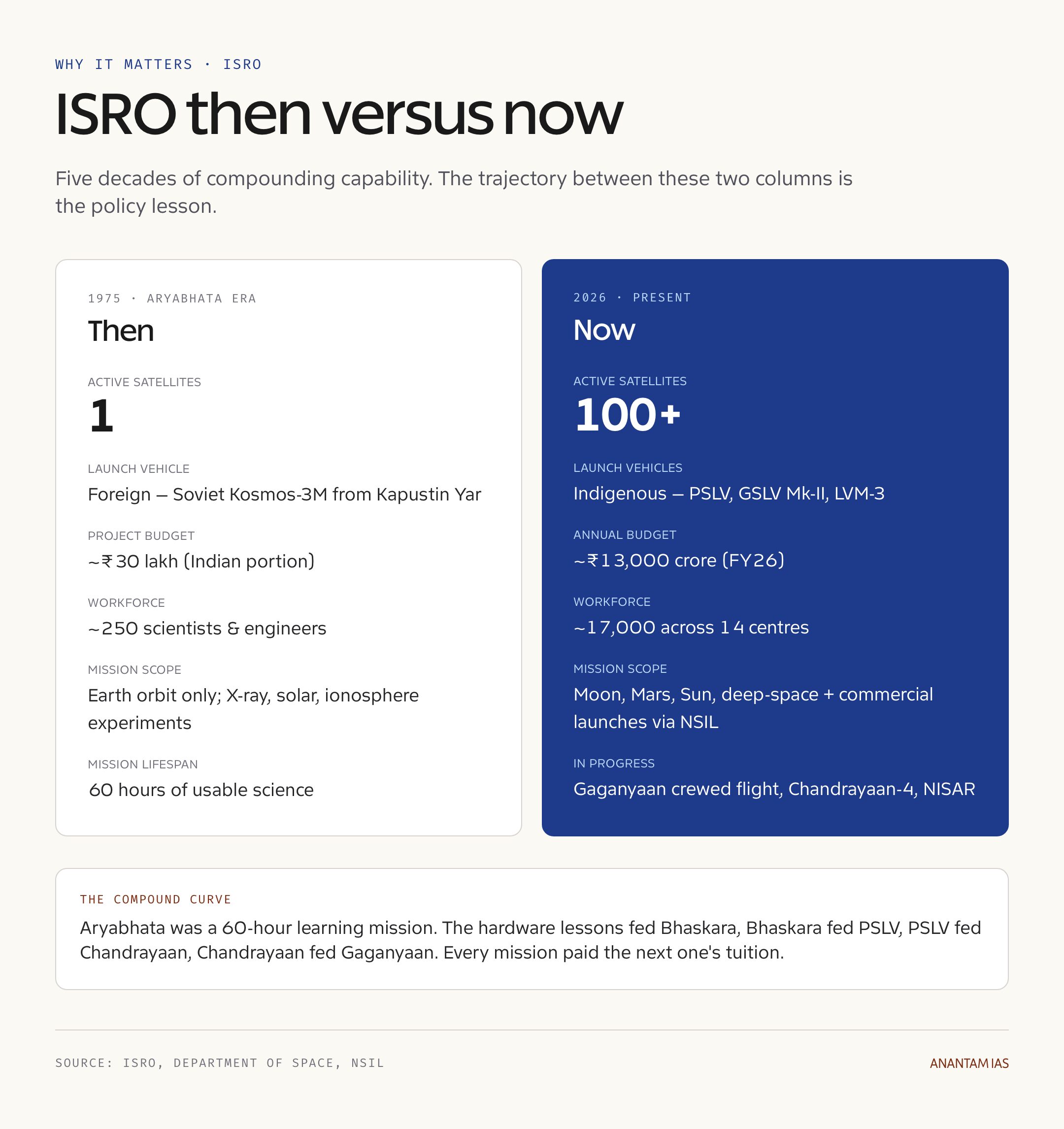
- Cost: Approximately 30 lakh rupees in the Indian portion; Soviets bore launch costs
- Naming: After Aryabhata, the 5th-century Indian astronomer-mathematician
Why the Aryabhata Satellite Is Back in News
The 51st anniversary of the Aryabhata satellite passed quietly on April 19, 2026, but ISRO marked it with an exhibition at U.R. Rao Satellite Centre in Bengaluru, a release of declassified construction photos, and an interview series with surviving members of the original team. National media picked up the thread because the timing aligned with two larger stories: the run-up to Gaganyaan’s first crewed launch later this year, and the 80th anniversary of Indian independence, where the post-colonial scientific build-out is getting fresh attention.
There is a UPSC angle that comes up almost every cycle. Aryabhata is on the Prelims short-list of “firsts” India should know cold, and it shows up in Mains as an example of post-Independence scientific institution-building or Indo-Soviet technology cooperation. The question is rarely “what was Aryabhata” and almost always “what does Aryabhata teach us about how India built capacity.”
Background and Historical Context
The Road to April 19, 1975
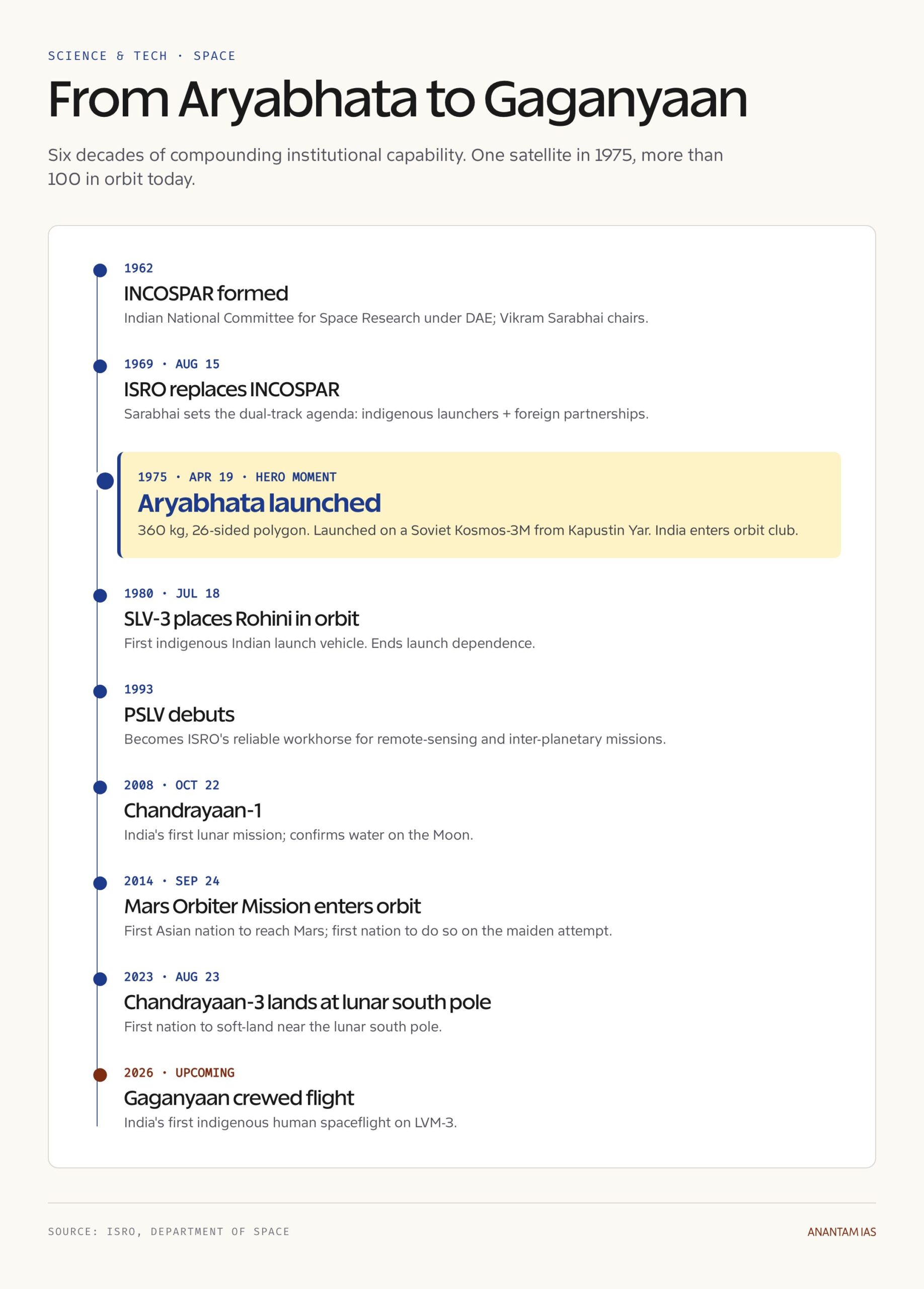
India’s space story does not start with Aryabhata. It starts in 1962, when the Indian National Committee for Space Research (INCOSPAR) was set up under the Department of Atomic Energy, with Vikram Sarabhai as its driving force. The first sounding rocket flew from Thumba on November 21, 1963, a Nike-Apache supplied by the Americans. Sarabhai’s argument, which still reads sharper than most policy papers written today, was that a developing country could not afford the luxury of space research unless space research could earn its keep through tangible benefits in communication, weather forecasting, education, and resource mapping.
ISRO formally replaced INCOSPAR on August 15, 1969. Sarabhai died unexpectedly in December 1971. Satish Dhawan took over and inherited a programme that had two parallel tracks: build sounding rockets and small launch vehicles in-house, and acquire bigger experience by partnering with the Soviets and the Americans. The 1972 Indo-Soviet space cooperation agreement opened the door for what became Aryabhata.
A team of about 250 scientists and engineers, working out of a converted shed in Peenya industrial area near Bengaluru, built the satellite in roughly three years. The project gave India hands-on experience with thermal control, attitude stabilization, telemetry, and command systems. None of these had been built indigenously before. The Aryabhata satellite was, in effect, India’s graduate thesis in spacecraft engineering.
Key Features of the Aryabhata Satellite
The spacecraft was a 26-sided polyhedron, 1.4 meters in diameter, with all but the top and bottom faces covered in solar cells generating about 46 watts of power. The body-stabilized design used spin for attitude control. Three scientific payloads were carried: an X-ray astronomy instrument, a solar gamma-ray and neutron detector, and an aeronomy package for ionospheric research.
A power failure on the fourth day after launch crippled the science programme. Telemetry continued for several more days but the experiments could not return useful data after that point. ISRO has been candid about the failure: it was a learning mission first, a science mission second. The hardware lessons fed directly into Bhaskara-1 (1979) and Bhaskara-2 (1981), which became India’s first earth observation satellites.
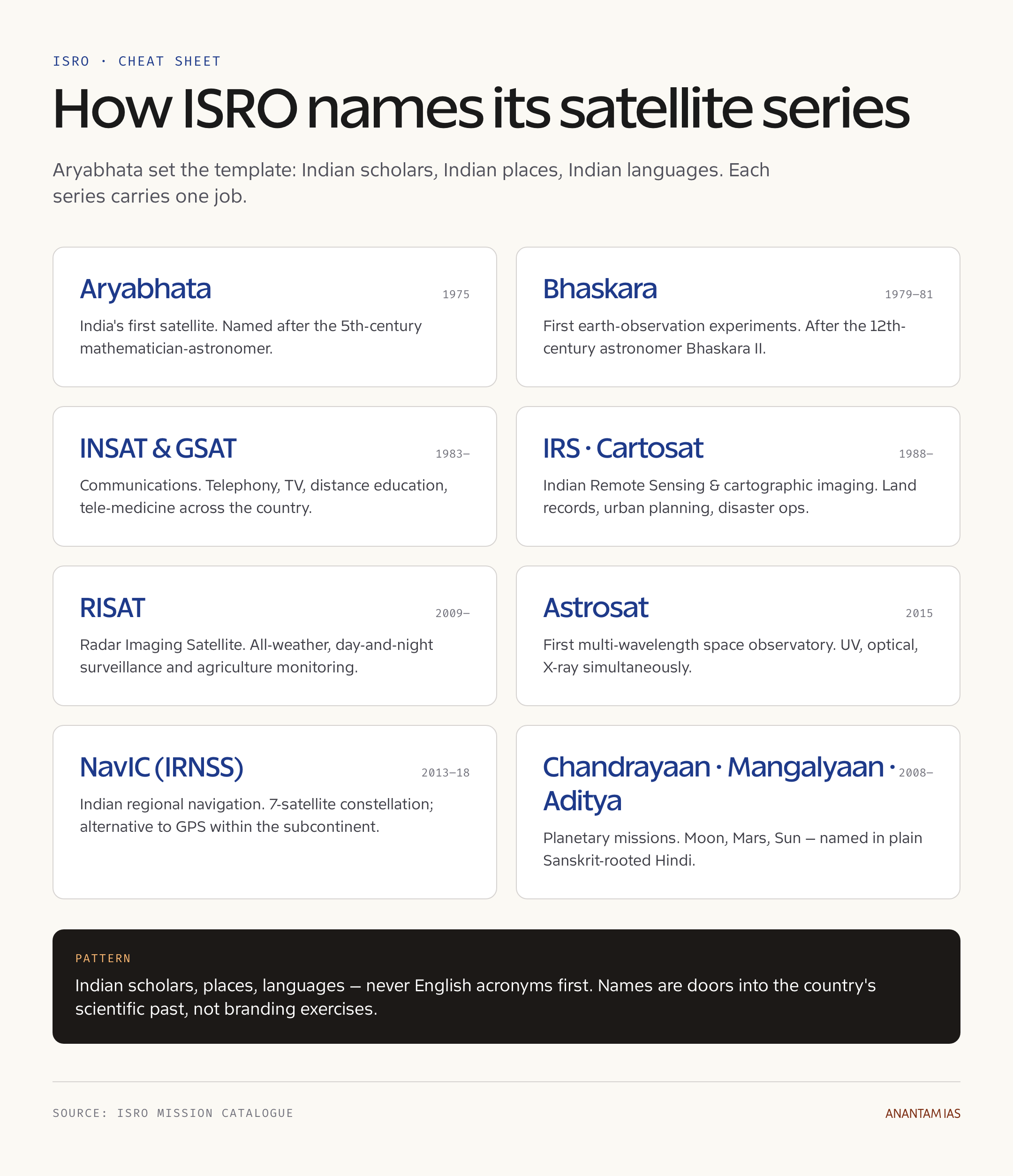
The naming convention started with Aryabhata set a template ISRO has stuck to with discipline. Indian scientific and cultural figures, Indian places, and Indian languages provide the names. Bhaskara (after the medieval astronomer-mathematician), Rohini (a Vedic figure and the name of India’s first SLV-3 launched satellite), Apple (Ariane Passenger Payload Experiment), INSAT (Indian National Satellite), IRS (Indian Remote Sensing), Cartosat, GSAT, RISAT, Astrosat, Chandrayaan, Mangalyaan, Aditya. Each name carries a small story.
Why the Aryabhata Satellite Matters Today
Aryabhata is the origin point of an institutional capability that has compounded for five decades. Treat the date as a benchmark and you can chart a clean trajectory: SLV-3 launching Rohini in 1980 (first Indian launcher), ASLV in 1987, PSLV’s debut in 1993, GSLV in 2001, Chandrayaan-1 in 2008, Mars Orbiter Mission in 2014, Chandrayaan-3’s south-pole landing in August 2023, and Gaganyaan ramping up in 2026. As of April 2026, ISRO has more than 100 active satellites in orbit, runs three operational launchers (PSLV, GSLV Mk-II, LVM-3), and has begun routine commercial launches through NewSpace India Limited.
The civilian dividends are vast. INSAT and GSAT carry television, telephony, distance education, and tele-medicine across the country. Cartosat and RISAT support land records, urban planning, and disaster response. NavIC provides regional navigation. The applied science Sarabhai promised in 1969 has been delivered, in scale and consistency that few other developing-world space programmes can match. Read the related explainer on the current ISRO chairman for context on present leadership.
Detailed Analysis: From One Satellite to a Hundred
The Aryabhata satellite seeded a pattern ISRO has stuck to: build incrementally, retain ownership of critical technologies, partner where useful but never depend. Through the 1980s, ISRO built up earth observation (Bhaskara, IRS series) and communications (INSAT) in parallel. The 1990s were the launcher decade, with PSLV becoming a reliable workhorse after a 1993 failure was fixed. The 2000s and 2010s pushed planetary exploration. The 2020s have been about scale: human spaceflight, reusable launch, commercial market access, and a stronger private-sector ecosystem.
A useful frame is to think of ISRO’s history in four eras. The Sarabhai era (1962-71) built the case for a programme. The Dhawan era (1972-84) built the institution and got Aryabhata flying. The Madhavan Nair and Radhakrishnan eras (mid-1980s through mid-2010s) built the launchers and the planetary missions. The Sivan and Somanath eras (late 2010s onward) built the commercial muscle and pushed for crewed flight.
The cost discipline ISRO is famous for, “Mars on a Hollywood-movie budget” was a cliche during Mangalyaan, has roots in Aryabhata. The team that built it had no choice but to be frugal. That working culture compounded.
Comparative Perspective: Aryabhata in the World Context
Sputnik 1 (USSR, 1957). Explorer 1 (USA, 1958). Vanguard (USA, 1958). Asterix (France, 1965). Wresat (Australia, 1967). Osumi (Japan, 1970). Dong Fang Hong 1 (China, 1970). Prospero (UK, 1971). Aryabhata (India, 1975).
By the time India joined the club, the orbital game had been played for 18 years and over 1,500 spacecraft had been launched. India was late and small. What India did differently was lean hard into applied space services from the start. The Soviet partnership for Aryabhata was a strategic shortcut, similar to how Australia’s Wresat used a US Redstone rocket. Within five years of Aryabhata, India was launching its own satellites with SLV-3.
China and India are now the two large emerging-power space programmes. China started later (Dong Fang Hong was launched five years before Aryabhata, but India’s first satellite came on a foreign rocket while China’s flew on a domestic Long March 1) but caught up faster on launchers and has surged ahead on human spaceflight, lunar sample return, and Mars rover operations. India has held its lead on cost-per-mission and on a particular flavor of frugal engineering.
Challenges and Critiques
Aryabhata’s failure on day four was not a one-off. ISRO has had a string of setbacks: SLV-3’s first flight failure in 1979, the GSLV’s troubled cryogenic engine saga, Chandrayaan-2’s lander crash in 2019, the EOS-3 failure in 2021. The pattern has been to absorb the lessons and recover. Critics argue ISRO has been slow to involve the private sector and slower still to commercialize.
The 2020 space sector reforms, which opened the door to private players through IN-SPACe and NewSpace India, address that critique. The next decade will test whether a Sarabhai-style state-led model can coexist with a Skyroot or Agnikul-style private-launcher ecosystem. Read the primer on Gaganyaan progress for the human spaceflight angle.
A separate critique is opportunity cost. India spends roughly 0.04% of GDP on space, lower than the United States (0.25%) or Russia (0.18%) but in absolute terms still around 13,000 crore rupees a year. Some argue this is too much for a country with the social-sector gaps India still has. The counter-argument, the same one Sarabhai made, is that space is one of the few sectors where Indian science is competitive at the global frontier and where the dividend (telecom, weather, navigation, education) flows back to the social sectors.
UPSC Prelims Pointers
- Aryabhata satellite was launched on April 19, 1975, by a Soviet Kosmos-3M rocket from Kapustin Yar.
- It was named after the 5th-century mathematician-astronomer Aryabhata.
- The mission’s project director was U.R. Rao.
- ISRO was formed on August 15, 1969, replacing INCOSPAR (1962).
- Vikram Sarabhai is regarded as the father of the Indian space programme.
- The first sounding rocket flew from Thumba on November 21, 1963.
- SLV-3 was India’s first indigenous launch vehicle; it placed Rohini RS-1 in orbit on July 18, 1980.
- ISRO is administered by the Department of Space, which reports directly to the Prime Minister.
- NewSpace India Limited (NSIL) is the commercial arm of ISRO.
- IN-SPACe was set up in 2020 to promote the private space sector.
Mains Practice Questions
- “The Aryabhata satellite was a learning mission, not a science mission, and that distinction explains the success of India’s space programme over the next five decades.” Discuss. (GS Paper III, 250 words)
- Trace the evolution of ISRO from INCOSPAR to the present day. How does its institutional design balance state leadership with private participation? (GS Paper II / III, 250 words)
- The Indo-Soviet space cooperation that produced Aryabhata is an early example of strategic technology partnership. Examine its lessons for India’s current technology diplomacy. (GS Paper II, 150 words)
- India’s space programme has been described as “frugal but ambitious.” Critically evaluate the trade-offs implicit in this description. (GS Paper III, 150 words)
Way Forward
Five decades after Aryabhata, India’s space programme stands at an inflection point. Crewed flight is months away. The Bharatiya Antariksh Station is on the drawing board for the late 2030s. A lunar sample return is on the cards. Private launchers are flying their first orbital missions. The agenda is denser than at any previous moment in ISRO’s history.
The right way to honor the Aryabhata satellite’s anniversary is not to dwell on the past but to ask what the next Aryabhata-equivalent looks like. Probably it is not a single hardware milestone. It is the consolidation of a Indian space ecosystem where ISRO does the deep R&D, private players handle scaled commercial launches, academic institutions feed the talent pipeline, and the dividends, in jobs, in services, in soft power, flow back to a country still solving very basic problems on the ground. That ecosystem is what Sarabhai imagined. It is what U.R. Rao’s team prototyped. It is what the next 50 years should deliver.
Frequently Asked Questions
Q1. When was the Aryabhata satellite launched?
The Aryabhata satellite was launched on April 19, 1975, by a Soviet Kosmos-3M rocket from the Kapustin Yar cosmodrome.
Q2. Why was the Aryabhata satellite named Aryabhata?
The satellite was named after the 5th-century Indian mathematician-astronomer Aryabhata, who is credited with early calculations of pi, the concept of zero in advanced positional mathematics, and the proposition that the Earth rotates on its axis.
Q3. What were the scientific objectives of the Aryabhata satellite?
The satellite carried three payloads: an X-ray astronomy experiment, a solar gamma-ray and neutron detector, and an aeronomy instrument for ionospheric research.
Q4. How long did the Aryabhata satellite operate?
A power failure on the fourth day after launch crippled the science programme. Telemetry continued for several more days but no useful science data was returned after that. The satellite remained in orbit until atmospheric re-entry on February 11, 1992.
Q5. Who was the project director of the Aryabhata satellite?
U.R. Rao was the project director. He later became chairman of ISRO from 1984 to 1994.
Q6. Why did India launch its first satellite using a Soviet rocket?
India did not have an indigenous launch vehicle in 1975. SLV-3, India’s first indigenous launcher, was still under development and flew successfully only in 1980. The 1972 Indo-Soviet space cooperation agreement provided a launch slot at no cost to India.
Q7. How many active satellites does ISRO operate today?
As per latest available data, ISRO operates over 100 active satellites, including the INSAT and GSAT communication fleet, IRS and Cartosat earth observation series, NavIC navigation satellites, and several scientific missions.
Q8. What is the significance of the Aryabhata satellite for the UPSC syllabus?
Aryabhata appears regularly in Prelims as part of the “firsts” list and in Mains as an example of post-Independence institution-building, Indo-Soviet technology cooperation, and the role of frugal engineering in Indian science.
Tell Google you want more of this.
Add Anantam IAS as a preferred sourceOne tap, and this site shows up more often in your own Top Stories, AI Overviews and AI Mode. Remove it any time.