Why in News?
On November 20, 2026, Raman Research Institute highlighted a theoretical study showing how network connectivity can shape quantum kinetic magnetism.
- The original study appeared in Physical Review B on July 22, 2026. The November development is its official public explanation.
- The researchers combined numerical and analytical methods to study interacting quantum particles on networks.
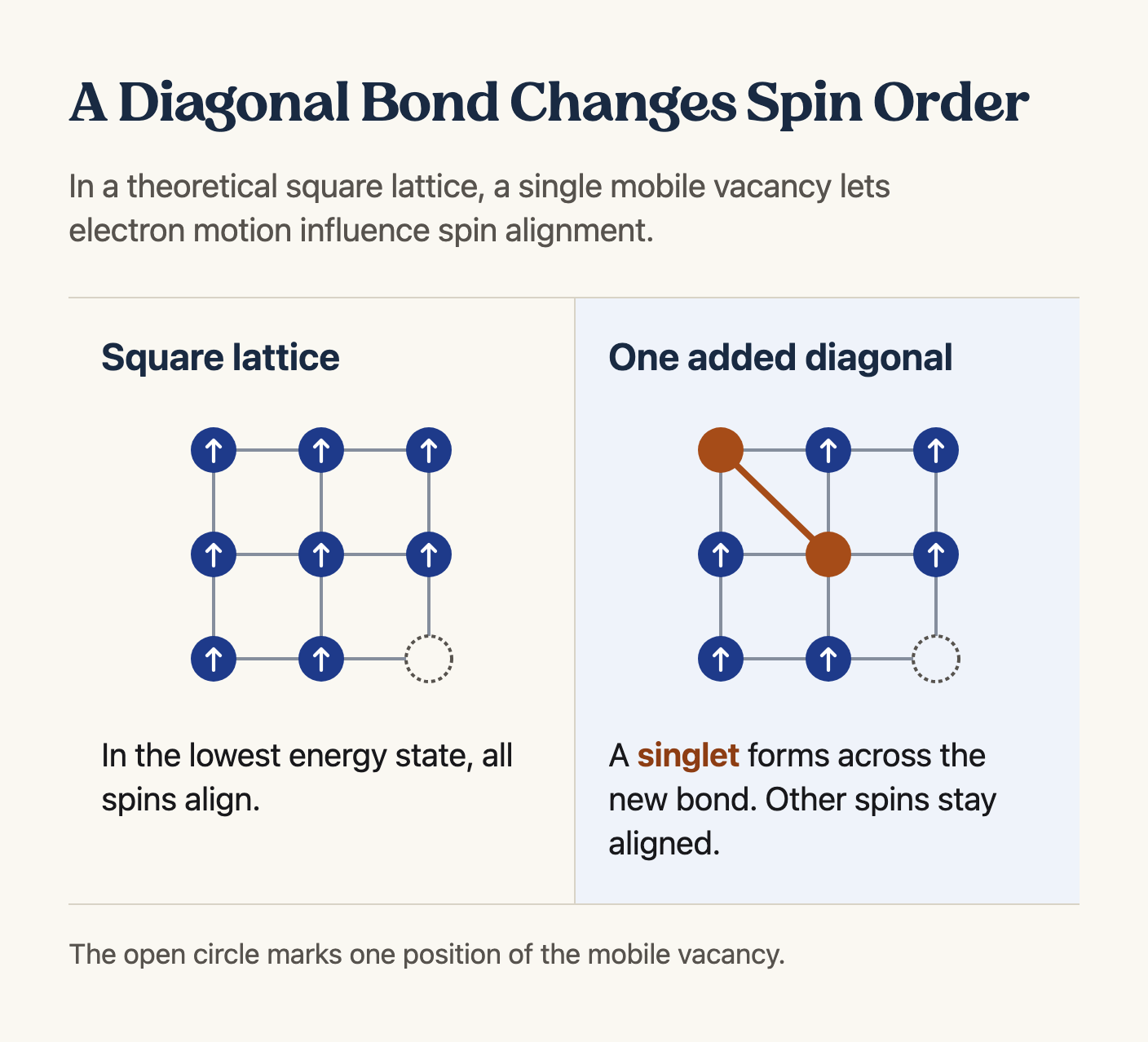
- In a square-lattice example, adding a diagonal bond produces a singlet pair while other spins retain ferromagnetic alignment.
- The work identifies a possible route to quantum-state control. Quantum information storage remains a potential application.
- Connectivity describes which sites are linked. In this model, changing those links changes the magnetic ordering of the quantum system.
- The study connects basic research on collective behavior with questions relevant to future quantum technologies.
UPSC Relevance
Prelims Relevance
- Kinetic magnetism and quantum particle motion.
- Ferromagnetic order and aligned spins.
- Singlet pairs and quantum entanglement.
- Raman Research Institute, an autonomous institute under the Department of Science and Technology.
Mains Relevance
GS Paper 3
- How fundamental research can identify mechanisms relevant to emerging technologies.
- Why experimental validation matters when assessing prospective quantum-device applications.
Background and Context
The Square Lattice and Its Mobile Vacancy
The model starts with interacting electrons arranged on connected sites and one vacant position.
- A lattice is an ordered arrangement of sites. In the example explained by the institute, the sites form a square network, with one electron at each occupied site and one vacancy.
- Electrons carry spin, an intrinsic quantum property associated with magnetic behavior. The way spins organize across many particles determines the collective magnetic order that the researchers seek to understand and control.
- The vacancy is called a hole. As electrons move between allowed sites, the hole can move through the network. A diagram showing it at one location represents only one possible position.
- In kinetic magnetism, quantum particle motion influences spin ordering. The research asks how the available routes through a network affect that collective behavior when the electrons interact strongly with one another.
- For the square-lattice case described in the official explanation, the lowest-energy state has ferromagnetic order. The occupied sites have aligned spins, establishing the reference case for the connectivity change.

How a Diagonal Bond Changes Spin Order
Adding a diagonal changes the available connections and the ordering of a particular spin pair.
- A diagonal bond connects two sites across a square. This alters the network locally and introduces triangular routes, giving the moving particles a different set of possible paths through the system.
- The two connected spins can form a singlet, an entangled quantum state with zero total spin. Its quantum relationship requires more care than depicting two permanently fixed classical arrows pointing in opposite directions.
- In the institute’s example, the remaining spins stay ferromagnetically aligned. The result shows that a local change can create a distinct paired state within a network whose other sites preserve their original ordering.
- The hole remains delocalized across the network. The paired spins and the mobile vacancy belong to one interacting system, so the result concerns collective quantum behavior across connected sites.
- The paper studies local frustration, where network geometry disrupts uniform magnetic alignment. Its analysis connects such locations with singlet formation and examines the relationship across rectangular grids and more general graphs.
What the Theoretical Result Establishes
The finding concerns a mechanism for shaping quantum states under the model’s assumptions.
- The researchers used computation and mathematical analysis to uncover the ordering patterns. Studying many interacting particles is difficult because the number of possible quantum configurations grows rapidly as the system becomes larger.
- The result identifies network connectivity as a control variable. Changing which sites connect can influence where singlet pairs form and how magnetization varies, offering a specific mechanism for further scientific investigation.
- The paper outlines a possible route for examining key predictions in cold-atom setups. Such controlled experimental systems could help assess whether the predicted behavior can be produced and measured under suitable conditions.
- Quantum information storage is a prospective application because singlets are entangled states. A useful device would require evidence that the relevant states can be prepared, maintained and accessed reliably during operation.
- The July research paper and November explainer refer to the same study. Its current significance lies in explaining a theoretical mechanism clearly while leaving experimental performance and practical device capability to further investigation.
Way Forward
Test the Proposed Control Mechanism
- Use suitable experimental platforms to compare measured spin correlations with the model’s predictions.
- Examine how imperfections and operating conditions affect the formation and persistence of the predicted states.
- Report device-relevant evidence before extending a theoretical storage possibility into a practical technology claim.
Conclusion
- Network geometry can shape magnetic order in an interacting quantum model. The diagonal-bond example makes the link between connectivity and singlet formation concrete.
- The study offers a theoretical direction for quantum control. Its value for technology depends on subsequent experimental evidence and reliable manipulation of the relevant states.
UPSC Practice Questions
Prelims MCQ 1
With reference to the RRI study on quantum kinetic magnetism, consider the following statements:
- The motion of a hole can influence the arrangement of electron spins.
- Adding a diagonal bond in the example can produce a singlet pair.
- The study reports a commercially operational quantum memory device.
How many of the above statements are correct?
(a) Only one (b) Only two (c) All three (d) None
Answer: (b) Only two
Explanation:
The first two statements describe the theoretical mechanism. Quantum information storage is a possible future application of the work.
Prelims MCQ 2
What changes when the researchers introduce a diagonal bond into the square network?
(a) The connectivity and available paths of the network (b) The chemical identity of every electron (c) The existence of quantum spin (d) The number of dimensions of physical space
Answer: (a) The connectivity and available paths of the network
Explanation:
The diagonal creates an additional connection. In the model this local change can alter spin ordering and bind a singlet pair.
UPSC Mains Questions
- Explain how network connectivity can influence collective quantum behavior, using the kinetic magnetism study as an example.
- Discuss the role of experimental validation in translating theoretical quantum research into useful technologies.
Sources: PIB, Department of Science and Technology and Raman Research Institute.
Frequently Asked Questions
What is kinetic magnetism?
Kinetic magnetism is magnetic ordering influenced by quantum particle motion. In the model discussed here, the movement of a vacancy through interacting electrons affects how their spins arrange across the network.
What does the diagonal bond do?
The added connection changes the network’s geometry. In the square-lattice example, it produces a singlet pair at the linked sites while the remaining spins retain ferromagnetic alignment.
Is a singlet the same as two classical arrows?
A singlet is an entangled quantum state of the pair with zero total spin. Fixed classical arrows are an incomplete representation of that relationship, even when used to introduce spin alignment.
Has the study produced a quantum memory?
The study develops a theoretical mechanism for shaping magnetic order. Storing quantum information is a prospective application that would require experimental validation and further work on controlled preparation, stability and access.
Tell Google you want more of this.
Add Anantam IAS as a preferred sourceOne tap, and this site shows up more often in your own Top Stories, AI Overviews and AI Mode. Remove it any time.