Why in News?
On November 19, 2026, the Department of Science and Technology highlighted a study using Himalayan marmot droppings to build a modern reference for environmental reconstruction.
- The PLOS ONE study was published on October 28 and examined pollen, fungal spores and elemental composition in recent droppings.
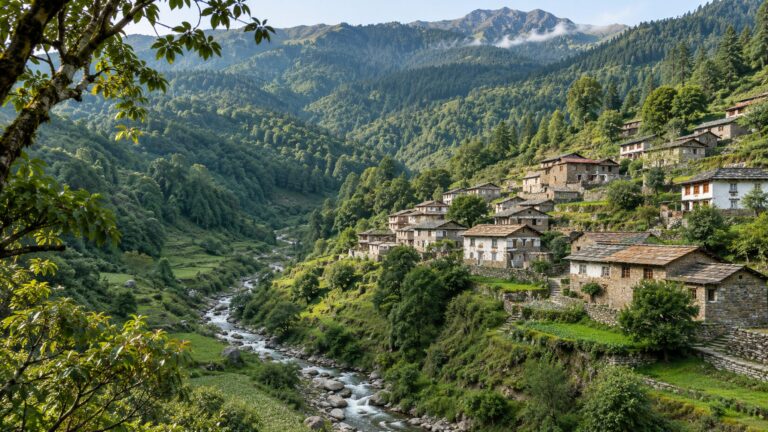
- Researchers from the Birbal Sahni Institute of Palaeosciences and collaborators studied material from Pensila Pass and Rimkhim in the higher Himalaya.
- The findings provide a modern analogue that can inform future interpretation of preserved animal remains.
- Remote alpine terrain can lack accessible lake-sediment or peat records, making additional biological evidence useful.
- An animal links vegetation to its diet, but feeding choices influence which plants enter the resulting sample.
UPSC Relevance
Prelims Relevance
- Palynology studies pollen and spores.
- Coprophilous fungi grow on dung.
- Coprolites are preserved ancient faeces.
- A modern analogue connects a present-day biological signal with known conditions.
Mains Relevance
GS Paper 3
- Use of biological proxies in environmental research and biodiversity monitoring.
- The need to calibrate proxy evidence before drawing conclusions about climate change.
Background and Context
The Animal and Its Ecological Setting
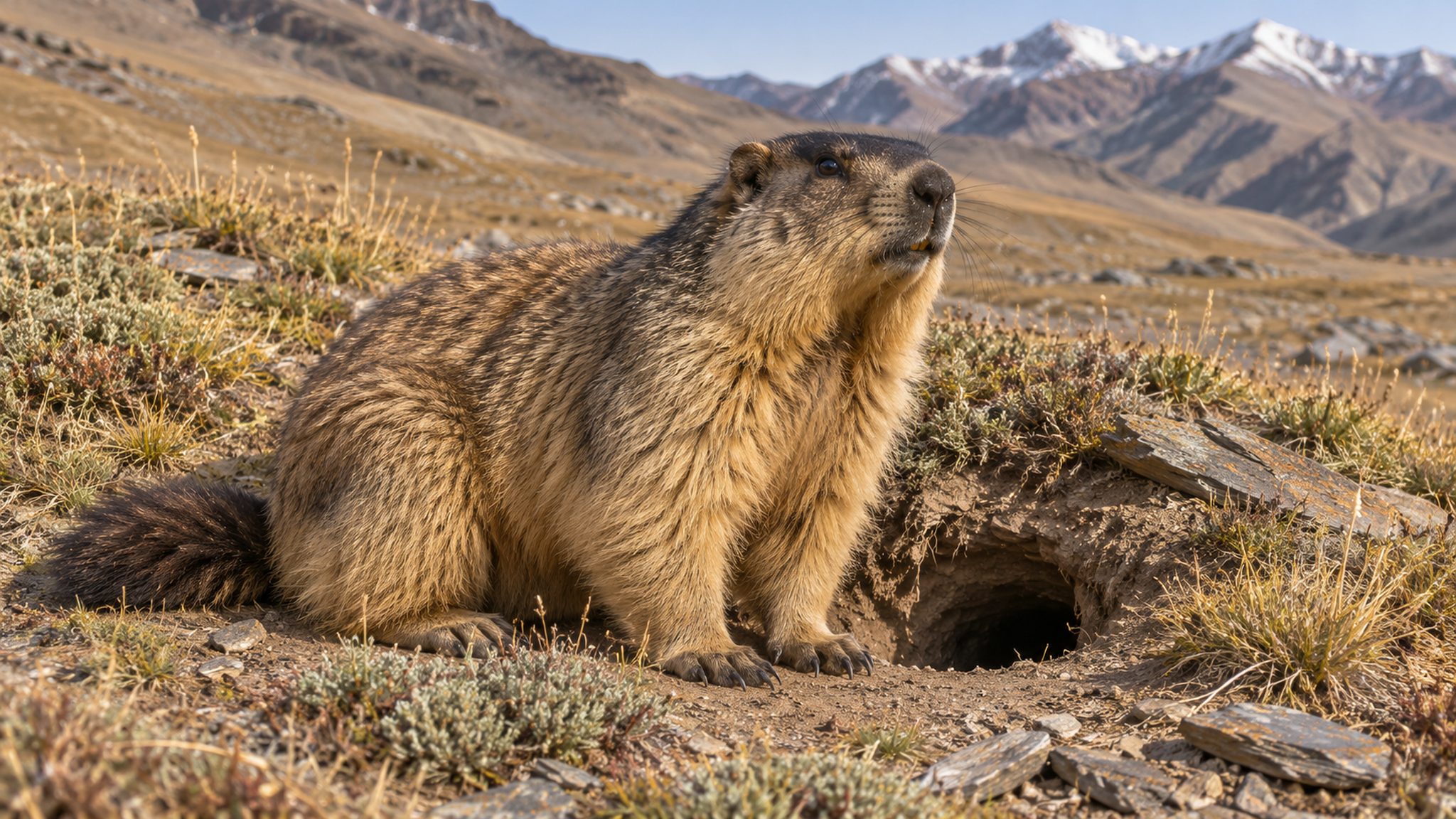
The Himalayan marmot is a herbivore whose food links its droppings to the vegetation of cold, dry alpine habitats.
- Alpine steppe supports low vegetation adapted to demanding mountain conditions. A marmot feeds within this environment, bringing plant material into its digestive system and leaving recoverable traces in its droppings.
- The study compared material from Pensila Pass and Rimkhim. Sampling different localities helps researchers examine whether the biological signal varies between habitats and how consistently it reflects their vegetation.
- Pollen grains have recognizable features that allow identification of plant groups. Those recovered from faeces help describe dietary plants and provide evidence about the vegetation available around the animal.
- The researchers found a mixed plant diet, including sagebrush-related plants, grasses and other alpine groups. The combination supported interpretation of the samples within their known cold and arid environmental setting.
- As in local plant conservation, recognizing vegetation matters. Here, however, the material serves as ecological evidence, with its value depending on how reliably it represents the surrounding habitat.
How the Samples Become Environmental Evidence
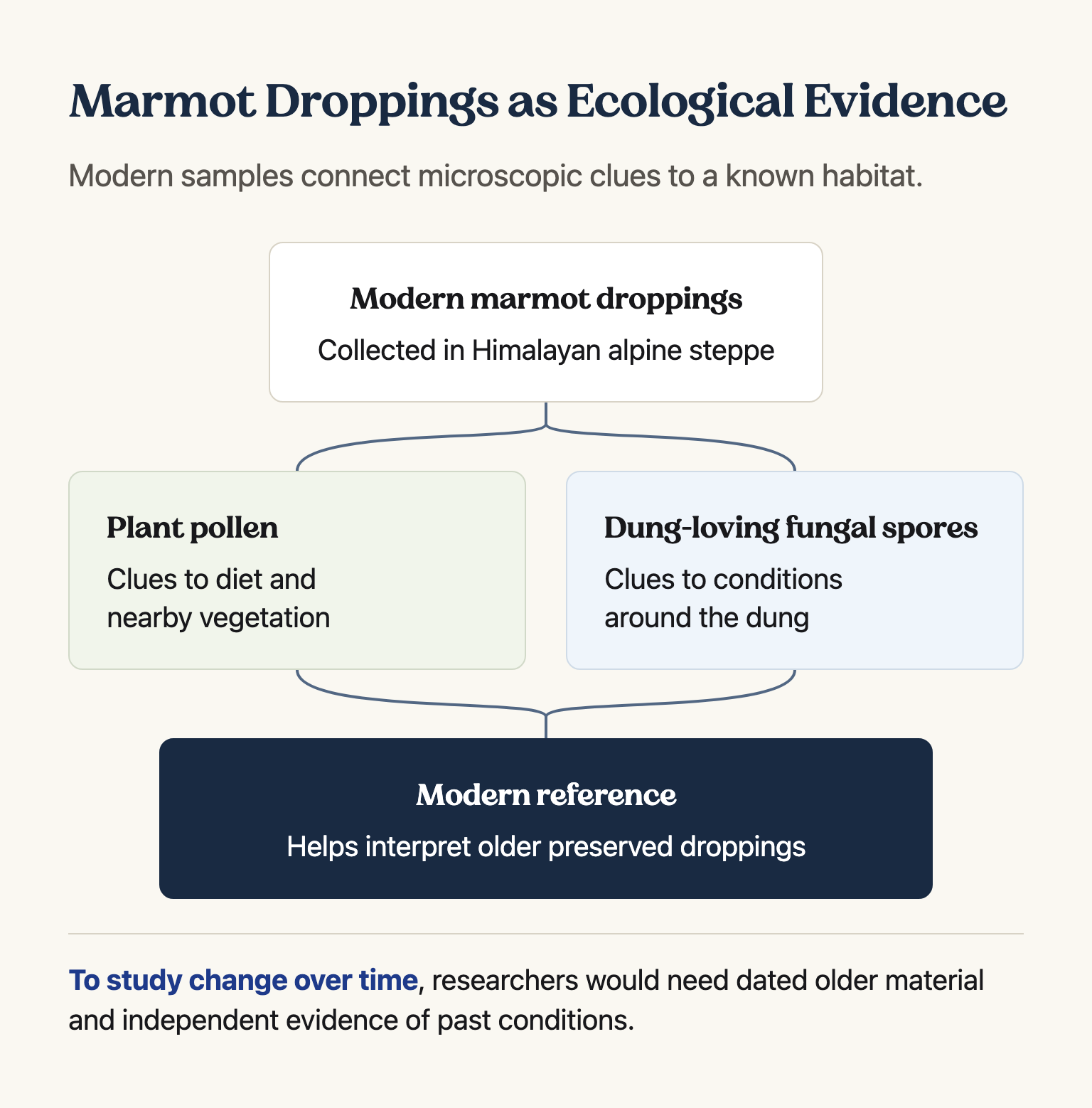
Researchers combine different clues from the same material to build a reference linking biological remains with present-day conditions.
- Palynological analysis identifies pollen and spores under a microscope. Reference collections help match the recovered forms to known groups, giving researchers a basis for interpreting the plant and fungal assemblage.
- Dung-associated fungal spores add information about the animal-linked environment. Their presence complements pollen evidence because fungi record a different biological relationship, including the availability of dung as a growth substrate.
- Elemental analysis identifies constituents of the faecal material. In this study, microscopy coupled with spectroscopy added evidence relevant to dietary composition alongside the pollen and fungal observations from the samples.
- The team examined ratios between selected pollen groups and compared assemblages statistically. Such comparisons can describe differences within the sampled material, while interpretation still depends on knowledge of local vegetation and ecology.
- A modern reference links those observations to an environment researchers can inspect directly. Later investigators may compare preserved droppings with this reference when assessing past diets, vegetation or habitat conditions.
What a Modern Analogue Can Establish
The study provides a baseline for future reconstruction and monitoring, with the strength of each inference depending on additional evidence.
- Fresh droppings describe recent biological inputs. Reconstructing environmental change through time requires older material with a reliable age, sufficient preservation and a defensible basis for comparison with the modern reference.
- Dietary selection affects the signal because animals choose particular foods. A plant frequently eaten by marmots may be prominent in the sample even when its share of surrounding vegetation is smaller.
- Preservation and transport also matter when interpreting pollen. Researchers must consider how grains reached the material and which survived, especially when applying present-day observations to a different deposit or time period.
- The authors propose the marmot as a potential bioindicator for future studies of habitat and vegetation shifts. Repeated observations would be needed to establish the direction, timing and causes of such changes.
- Continuous climate observations can supply independent context. Combining them with biological evidence strengthens interpretation and helps distinguish climate influences from local ecological processes affecting the same habitat.
Way Forward
Build Comparable Evidence
- Repeat sampling across seasons and habitats while recording local vegetation and collection conditions.
- Compare preserved material using reliable dating and preservation checks before inferring environmental change.
- Combine biological signals with independent climate and ecological observations to test alternative explanations.
Conclusion
- Marmot droppings connect animal diet with microscopic environmental clues, creating a useful reference where conventional sedimentary archives may be scarce.
- The study establishes a modern baseline. Its contribution to reconstructing past environments depends on carefully matched older material, reliable dates and independent evidence.
UPSC Practice Questions
Prelims MCQ 1
With reference to biological evidence used in palaeoecology, consider the following statements:
- Palynology includes the study of pollen and spores.
- Coprophilous fungi are associated with dung.
- Fresh droppings alone establish the chronology of ancient climate change.
How many of the above statements are correct?
(a) Only one (b) Only two (c) All three (d) None
Answer: (b) Only two
Explanation:
Statements 1 and 2 are correct. A chronology of past change requires dated older evidence; a modern sample supplies a present-day reference.
Prelims MCQ 2
What is the main purpose of a modern analogue in environmental reconstruction?
(a) To connect biological evidence with known present-day conditions (b) To replace dating of older deposits (c) To determine exact ancient temperatures from any pollen grain (d) To remove the influence of animal feeding choices
Answer: (a) To connect biological evidence with known present-day conditions
Explanation:
Modern observations help calibrate interpretation of similar remains from the past. Dating, ecological context and potential biases still require examination.
UPSC Mains Questions
- Explain how animal-derived biological material can complement conventional records in reconstructing past environments. Discuss the limits of such evidence.
- Assess the value of modern ecological baselines for studying climate-sensitive mountain ecosystems.
Sources: PIB, Department of Science and Technology and PLOS ONE study archived by NIH.
Frequently Asked Questions
What did the Himalayan marmot study examine?
The researchers examined recent droppings for pollen, fungal spores and elemental composition. These observations linked the animal’s diet with its present habitat and created a reference for later ecological studies.
What is a modern analogue?
A modern analogue connects an observable biological signal with known environmental conditions today. Researchers can use it to interpret similar preserved material, provided differences in context and preservation are considered.
Why are fungal spores useful?
Dung-associated fungi provide evidence about animal-linked habitats and the availability of dung. Their spores can complement pollen evidence, helping researchers interpret several biological relationships within the same material.
Does the study reconstruct an ancient climate timeline?
The study supplies a modern reference from recent samples. An ancient timeline would require dated older material, suitable preservation and independent evidence connecting biological changes with past environmental conditions.
Tell Google you want more of this.
Add Anantam IAS as a preferred sourceOne tap, and this site shows up more often in your own Top Stories, AI Overviews and AI Mode. Remove it any time.