
Beyt Dwarka (also spelled Bet Dwarka) is a small island located approximately 30 km north of the city of Dwarka in the Gulf of Kutch, off the coast of Gujarat. The island holds immense archaeological, religious, and historical significance — it is traditionally identified as the original residential area of Lord Krishna while the main Dwarka served as his capital. The site has been a focus of marine archaeological investigations by the Archaeological Survey of India (ASI) and the National Institute of Oceanography (NIO), yielding evidence of ancient habitation dating back to the Harappan period (circa 1600 BCE). Beyt Dwarka is relevant for UPSC Prelims and GS Paper I (Indian Heritage and Culture, History).
Location and Geography
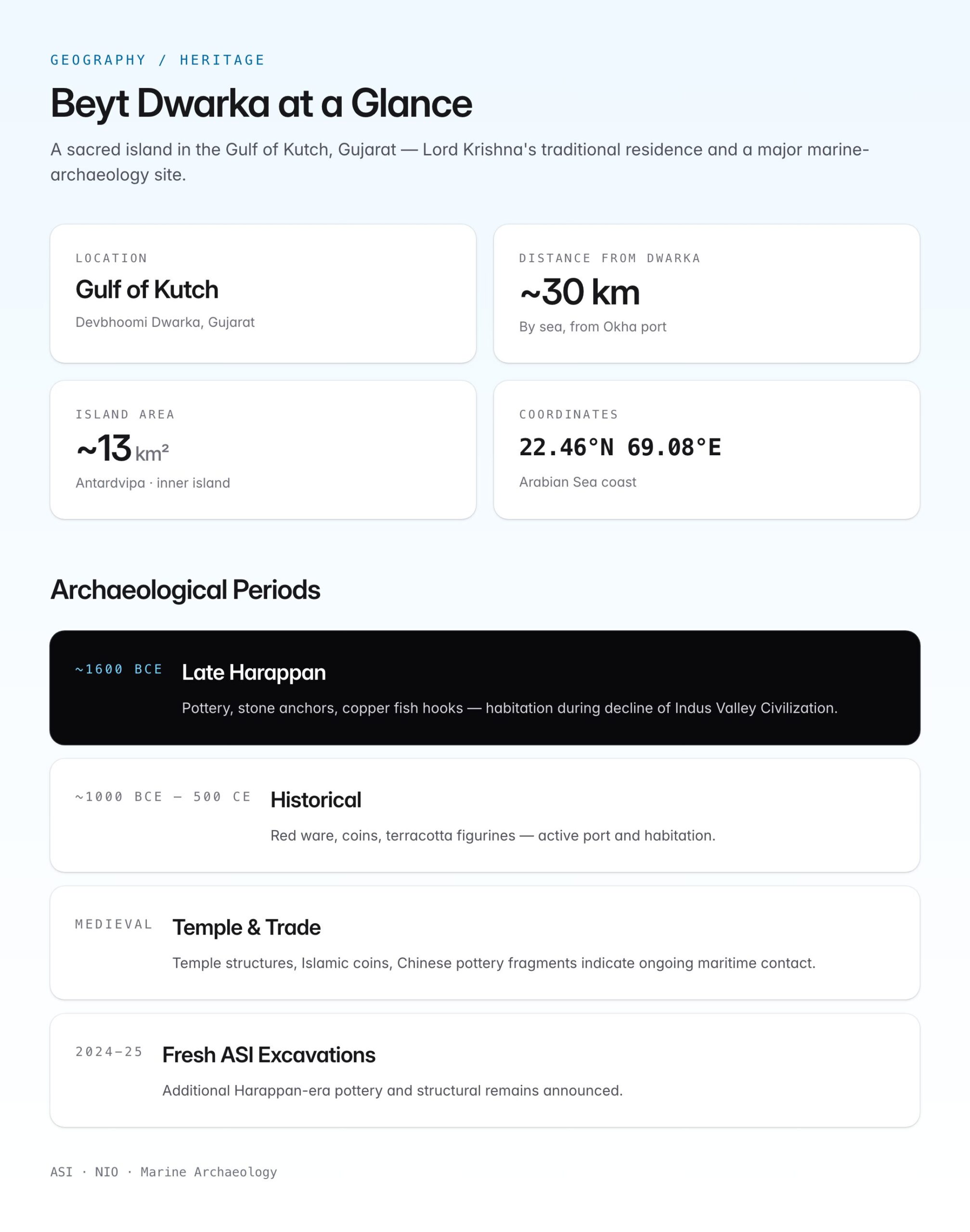
| Parameter | Details |
|---|---|
| Location | Gulf of Kutch, Arabian Sea, Gujarat |
| Distance from Dwarka | ~30 km by sea; accessible from Okha port |
| Coordinates | 22.46°N, 69.08°E |
| Island Area | ~13 sq km |
| Access | Ferry from Okha (about 30 minutes) |
| District | Devbhoomi Dwarka, Gujarat |
| Designation | Part of the proposed Marine National Park, Gulf of Kutch |
The island lies in the Okhamandal region of the Saurashtra coast. The Gulf of Kutch surrounding it is known for coral reefs and is home to India's first Marine National Park (established 1982).
The Krishna Connection
In the Mahabharata and Harivamsha, Dwarka is described as the kingdom built by Lord Krishna after he migrated from Mathura to avoid repeated attacks by Jarasandha, the king of Magadha. The texts describe Dwarka as a golden city that was eventually submerged by the sea after Krishna's departure.
Traditional accounts identify Beyt Dwarka as the "Antardvipa" (inner island) where Krishna actually resided with his family, while the main Dwarka was the administrative capital. The Beyt Dwarka Temple (also called the Dwarkadhish Temple of Beyt) is dedicated to Lord Krishna and is an important pilgrimage site, considered part of the wider Dwarka pilgrimage circuit.
Key temples on the island:
- Beyt Dwarkadhish Temple — main temple with a deity believed to have been worshipped by Rukmini
- Hanuman Dandi Temple
- Sudama Setu — associated with the Krishna-Sudama friendship narrative
Archaeological Significance
Onshore Excavations
Archaeological work on Beyt Dwarka island has revealed multi-period habitation:
| Period | Evidence Found |
|---|---|
| Late Harappan (~1600 BCE) | Pottery, stone anchors, copper fish hooks |
| Historical Period (~1000 BCE – 500 CE) | Red ware, coins, terracotta figurines |
| Medieval Period | Temple structures, Islamic coins, Chinese pottery fragments |
| Modern | Existing temple complex, fishing settlement |
The Late Harappan pottery found at Beyt Dwarka is among the most significant discoveries, establishing that the island was inhabited during the declining phase of the Indus Valley Civilization.
Underwater / Marine Archaeology
The underwater explorations around Dwarka and Beyt Dwarka are among the most important marine archaeological projects in India.
| Year | Agency | Key Finding |
|---|---|---|
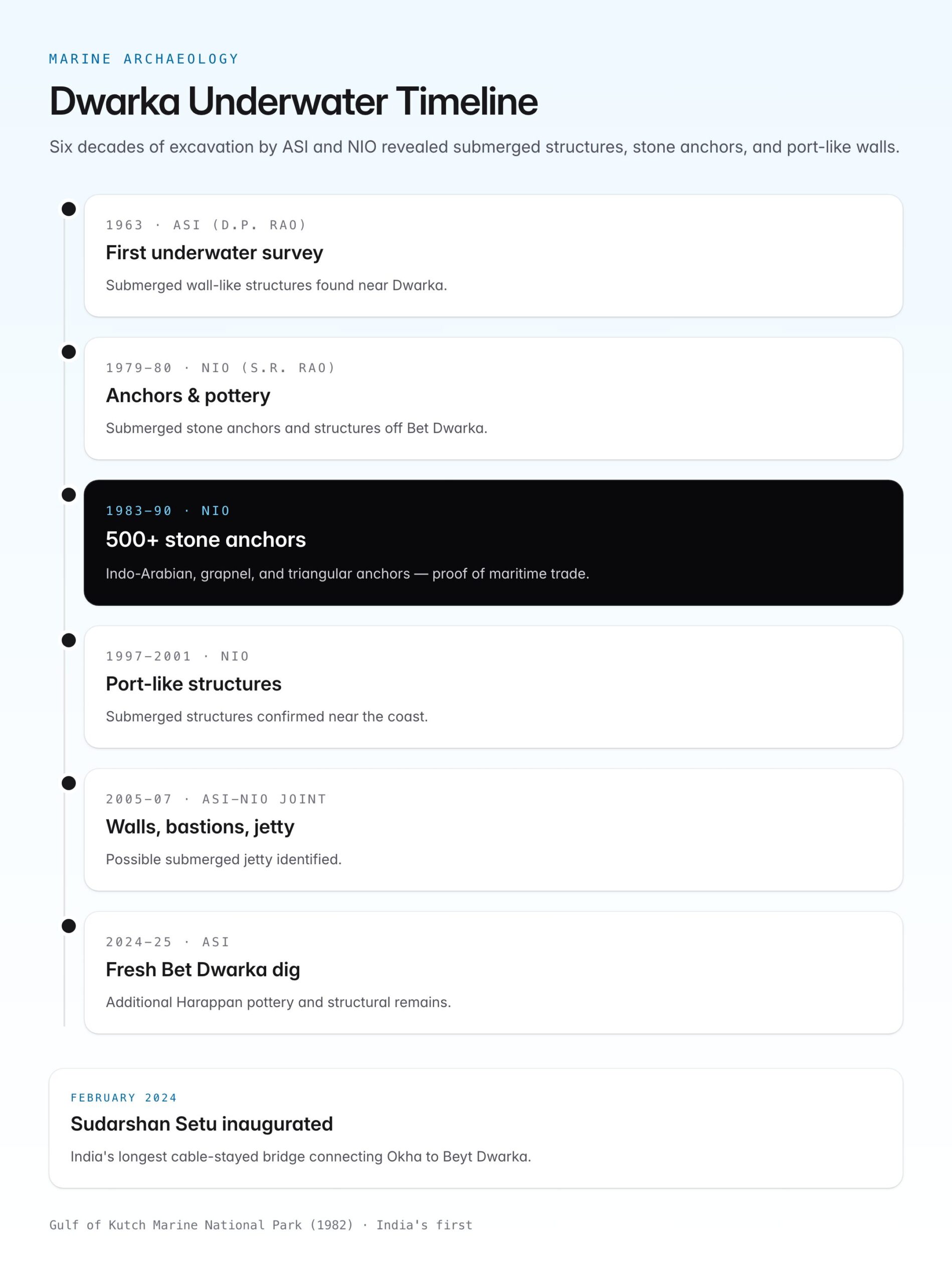
| 1963 | ASI (D.P. Rao) | First underwater survey near Dwarka; submerged wall-like structures |
| 1979-80 | NIO (S.R. Rao) | Discovery of submerged stone anchors, pottery, and structures off Bet Dwarka |
| 1983-90 | NIO | Large-scale excavation; stone anchors of diverse types (Indo-Arabian, grapnel, triangular) indicating maritime trade |
| 1997-2001 | NIO | Further surveys confirming port-like structures submerged near the coast |
| 2005-2007 | ASI-NIO joint | Expanded survey; found walls, bastions, and a possible submerged jetty |
| 2024-25 | ASI | Fresh excavations at Bet Dwarka; additional Harappan-era pottery and structural remains announced |
S.R. Rao, the pioneering marine archaeologist from NIO, was instrumental in identifying over 500 stone anchors of varying designs in the waters around Bet Dwarka. These anchors suggest the site was a major port with connections to Mesopotamia, the Persian Gulf, and the Red Sea region.
Maritime Heritage and Trade Links
The stone anchors found underwater are particularly significant:
| Anchor Type | Origin/Connection |
|---|---|
| Triangular stone anchors | Common in the Indian Ocean region |
| Indo-Arabian anchors | Indicate trade with the Persian Gulf |
| Grapnel anchors | Mediterranean connections |
| Composite anchors | Indigenous Indian design |
This diversity of anchor types demonstrates that Beyt Dwarka was a cosmopolitan port with multi-directional maritime trade spanning from at least the second millennium BCE.
Cultural and Religious Significance
Beyt Dwarka is one of the four sacred dhams in the wider Dwarka circuit and holds importance in:
- Vaishnavism — directly connected to Krishna's life narrative
- Char Dham Yatra — Dwarka is one of the four dhams established by Adi Shankaracharya
- Pilgrimage economy — thousands visit annually; the Gujarat government has developed ferry services and infrastructure
The island also has Jain shrines, reflecting the multi-religious heritage of the Saurashtra coast.
The Dwarka Submersion Debate
The submersion of Dwarka as described in the Mahabharata has been a subject of scholarly debate:
- Textual evidence: The Mahabharata and Vishnu Purana describe Dwarka being swallowed by the sea after Krishna's death.
- Archaeological evidence: Submerged structures found off both mainland Dwarka and Beyt Dwarka support some form of coastal submersion, likely due to tectonic activity and sea-level changes in the post-glacial period.
- Scientific interpretation: Geologists attribute the submersion to coastal erosion, tectonic subsidence, and post-Ice Age sea-level rise rather than a single catastrophic event.
- Controversy: The archaeological findings do not confirm the mythological timeline but do establish that an ancient port settlement existed and was submerged.
Recent Developments
- The ASI announced fresh excavations at Beyt Dwarka in 2024-25, focusing on both onshore and underwater sites.
- Gujarat government has proposed enhanced tourism infrastructure including a ropeway/bridge connecting Okha to Beyt Dwarka.
- The Sudarshan Setu (India's longest cable-stayed bridge connecting Okha to Beyt Dwarka) was inaugurated in February 2024 by PM Modi.
- Beyt Dwarka has been proposed for the UNESCO Tentative List as part of the Dwarka heritage complex.
UPSC Relevance
GS Paper I: Indian Heritage and Culture; Art and Architecture; Ancient Indian History.
GS Paper III: Conservation (Marine National Park, Gulf of Kutch).
Prelims key points:
- Beyt Dwarka is an island in the Gulf of Kutch, Gujarat, associated with Lord Krishna.
- Marine archaeological excavations by ASI and NIO found evidence of habitation from the Late Harappan period (~1600 BCE).
- S.R. Rao (NIO) discovered over 500 stone anchors underwater, indicating ancient maritime trade.
- The Gulf of Kutch Marine National Park (1982) is India's first marine national park.
- Sudarshan Setu (2024) connects Okha to Beyt Dwarka — India's longest cable-stayed bridge.
- Dwarka is one of the Char Dhams established by Adi Shankaracharya.
- The submerged structures support evidence of coastal submersion due to tectonic activity and sea-level changes.
Tell Google you want more of this.
Add Anantam IAS as a preferred sourceOne tap, and this site shows up more often in your own Top Stories, AI Overviews and AI Mode. Remove it any time.





