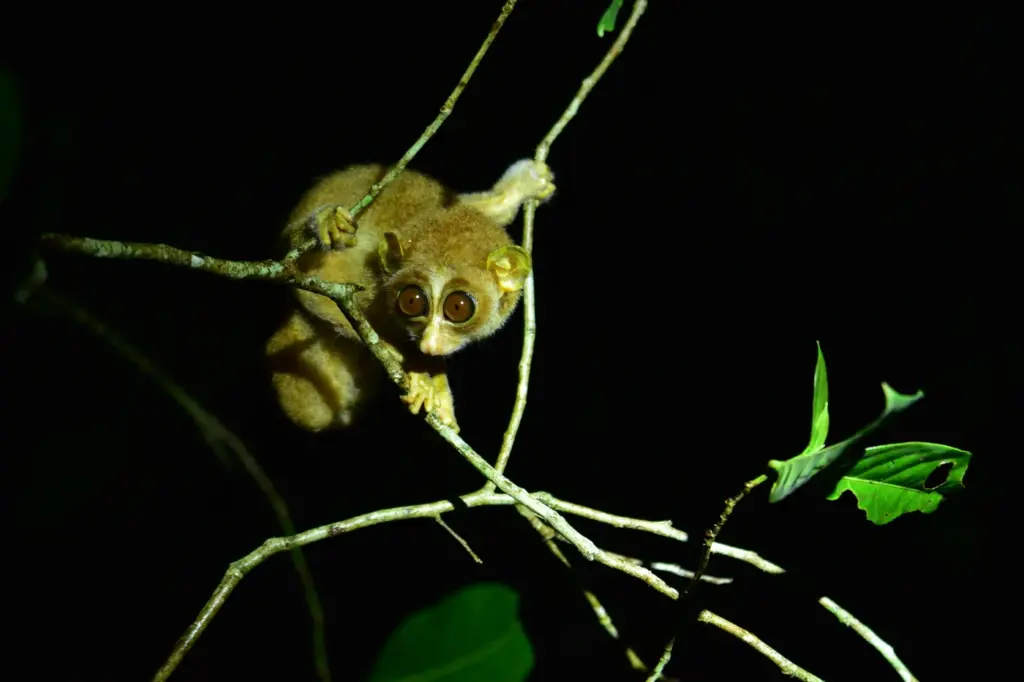
The slender loris is a small, tailless, night-active primate of southern India and Sri Lanka, best known for its huge forward-facing eyes and its slow, deliberate climb through thorny scrub. India has one species, the gray slender loris (Loris lydekkerianus), found in the dry and moist forests of the southern peninsula. It matters for two reasons: it’s one of only two kinds of loris in India, members of the strepsirrhine group that includes lemurs, and in October 2022 Tamil Nadu gave it the country’s first slender loris sanctuary.
Most readers carry one confusion into this topic. They read that the slender loris is “Endangered” and assume the animal in Karnataka or Tamil Nadu carries that IUCN tag. It doesn’t. The Endangered species is the red slender loris, which lives only in Sri Lanka. India’s gray slender loris is Near Threatened on the IUCN Red List, yet it sits in Schedule I, the highest tier of Indian law. This note separates the two species, the two systems of status and the reasons both are worth knowing.
What the slender loris is
The slender loris is a member of the family Lorisidae, small nocturnal primates of tropical Asia and Africa. Two species are recognized in the genus Loris, a split set out by the anthropologist Colin Groves in 1998: the red slender loris (Loris tardigradus) and the gray slender loris (Loris lydekkerianus). Only the second occurs in India.
| Fact | Detail |
|---|---|
| Indian species | Gray slender loris, Loris lydekkerianus |
| Family | Lorisidae, a strepsirrhine primate family |
| Indian subspecies | Mysore slender loris (L. l. lydekkerianus) and Malabar slender loris (L. l. malabaricus) |
| Habits | Nocturnal, tree-dwelling, feeds mainly on insects |
| IUCN, gray slender loris | Near Threatened (2020 assessment, amended version published 2022) |
| IUCN, red slender loris | Endangered; found only in Sri Lanka |
| Wildlife (Protection) Act, 1972 | Schedule I, as amended in 2022 |
| CITES | Appendix II, listed since 1977 |
| Dedicated protected area | Kadavur Slender Loris Sanctuary, Tamil Nadu, notified 12 October 2022 |
The name says what you see. The limbs are thin, the body is light and the tail is reduced to almost nothing. A loris doesn’t leap the way a langur or macaque does. It grips a branch with hands and feet, shifts its weight and moves on, which is why it can cross a thicket of thin twigs that wouldn’t hold a jumping monkey.
Which slender loris lives in India
India’s slender loris is the gray species, split into two subspecies that live in different kinds of forest. The Mysore slender loris lives in the dry forests and scrub of the southern Deccan and the Eastern Ghats side of Karnataka, Tamil Nadu and Andhra Pradesh. The Malabar slender loris lives in the wetter forests of the Western Ghats in Kerala and Karnataka, part of one of India’s biodiversity hotspots. Published field surveys have mapped the species in all four states:
- a 1996 survey in the Dindigul forests of Tamil Nadu by Mewa Singh and colleagues;
- surveys in southern Andhra Pradesh, published in 2000;
- a Karnataka-wide study of distribution and habitat by H.N. Kumara and colleagues, published in 2006;
- later work on the two subspecies in Kerala.
The red slender loris is a different animal. It is smaller and reddish brown, and it lives only in the rainforests of Sri Lanka’s south-western wet zone and central highlands. Sri Lanka also has two subspecies of the gray species, so the island holds both while India holds one.
A useful way to keep this straight is to tie each species to a habitat. Red goes with the wet rainforest of one island. Gray goes with dry thorn scrub and moist ghats forest across two countries. If an exam option places the red slender loris in Kerala, it’s wrong.
How a slender loris lives
The slender loris is built for one job: hunting insects in the dark without being seen. Its eyes face straight forward and sit closer together than in almost any other primate, which gives it precise depth judgment for a slow grab at a moving beetle.
The diet is mostly insects, with occasional fruit, flowers and small animals. In the scrub forests of Tamil Nadu and Karnataka the Mysore subspecies is often found in Acacia and tamarind trees near cultivation. The 1999 Oryx paper from the Dindigul survey recorded high densities in open Euphorbia scrub and in croplands next to it, mostly between 300 and 500 m of altitude.
That last detail carries a lesson. The slender loris isn’t a deep-forest animal that vanishes when trees are cut. It lives in the hedges, scrub patches and farm boundaries of the southern plains. That makes it more visible to people, and it also puts it on roads and under power lines.
The animal is solitary when it forages but not antisocial. Lorises sleep curled in tree hollows or dense tangles during the day, sometimes in small groups, and they keep in touch through calls and scent. Their slowness isn’t laziness. It’s a defense: a predator that hunts by movement has trouble spotting an animal that hardly moves.
Why the slender loris is under pressure
The threats to the slender loris come from people living close to it rather than from one dramatic cause. Field surveys across the south describe the same pattern:
- loss and fragmentation of the scrub and dry forest it depends on, as land goes under cultivation or construction;
- deaths on roads and on electric lines, because it crosses gaps along wires and verges;
- capture for the pet trade and for folk remedies, which is illegal under Schedule I;
- the slow loss of the hedgerows and tree lines that connect one scrub patch to the next.
None of these is unique to lorises, which is why the species is a good teaching case. An animal that lives in “wasteland” scrub has no forest department boundary around most of its home. Its future depends on how revenue land, village commons and farm edges are managed.
This is also why the IUCN category and the Indian legal category differ, and the difference isn’t a contradiction. IUCN assesses extinction risk across the whole global range, so a species spread over two countries with a large population can be Near Threatened. The Wildlife (Protection) Act decides how strictly Indian law treats hunting, trade and possession. Parliament can put a species in Schedule I because it is traded or locally vulnerable, even if its global risk is moderate. Keep the two systems apart and the “why is it Schedule I if it’s only Near Threatened?” puzzle disappears.
Slender loris today: protection and the Kadavur sanctuary
The slender loris today has protection on three levels. Under the Wildlife (Protection) Act, 1972, the gray slender loris is in Schedule I. The Wild Life (Protection) Amendment Act, 2022 cut the old six schedules down to four and kept the species in Schedule I, Part A (mammals), listed alongside the Bengal slow loris. Internationally, all lorises of the genus Loris are in CITES Appendix II, which allows trade only with export permits; the slow lorises (Nycticebus) of the north-east are in Appendix I.
The site-level protection is newer. On 12 October 2022, Tamil Nadu notified 11,806 hectares of forest in Karur and Dindigul districts as the Kadavur Slender Loris Sanctuary under Section 26A(1)(b) of the Act, India’s first sanctuary for the species. The idea isn’t new. The Dindigul survey published in 1999 had already recommended weighing a slender loris sanctuary for this landscape, so the 2022 notification closed a loop that field scientists opened more than two decades earlier.
A sanctuary is a tool of in-situ conservation: protecting a species where it lives rather than in a zoo. For the slender loris that choice suits the biology. The animal is hard to breed and keep, and its survival depends on scrub forest and the connections between patches, which only habitat protection can secure. The difference between a national park and a wildlife sanctuary matters here: a sanctuary permits some regulated human activity, which fits a species that lives at the forest-farm edge.
Kadavur also fits a larger policy frame. Under the Kunming-Montreal Global Biodiversity Framework adopted in December 2022, countries committed to conserving 30% of land and sea by 2030, and that target counts well-managed areas outside classic forests too. A sanctuary carved out of dry scrub in Karur district is exactly the kind of habitat that national park networks, built around large forests and big cats, tend to miss. For a small primate that lives on farm edges, the next step after notification is management: keeping the scrub connected, routing power lines safely and keeping roads from cutting the sanctuary into islands.
The IUCN amended its assessments of both slender loris species in 2022. No later change in either species’ category or schedule was found in official sources up to October 2026.
How to study slender loris for exams
The slender loris sits in the environment and ecology part of GS Paper III and in Prelims, where species questions are common. The site’s Prelims question bank counts 249 of its 1,403 questions from 2013 to 2026 under Environment, and many of those turn on a species’ range or legal status. Mains rarely names a single animal, but it asks about the tools that protect one. Mains 2018 GS Paper III asked “How does biodiversity vary in India? How is the Biological Diversity Act (2002) helpful in the conservation of flora and fauna?“, and the slender loris is a ready example of a species whose habitat lies largely outside forests.
Revise these until they’re automatic:
- Loris lydekkerianus: the gray slender loris, India’s only slender loris species.
- Near Threatened: the gray species on the IUCN Red List; Endangered is the red species of Sri Lanka.
- Schedule I: its tier under the Wildlife (Protection) Act, kept in the 2022 amendment.
- Appendix II: its CITES listing, in force since 1977.
- 12 October 2022: Kadavur Slender Loris Sanctuary notified, 11,806 ha in Karur and Dindigul.
- Two subspecies: Mysore in dry Deccan scrub, Malabar in moist Western Ghats forest.
- Nocturnal insect-eater with forward-facing eyes and a vestigial tail.
Three confusions cost marks. The first is red versus gray: red is Sri Lankan and Endangered, gray is Indian and Near Threatened. The second is slender versus slow loris: the Bengal slow loris (Nycticebus bengalensis) lives in the north-eastern states, is Endangered on the IUCN list and is in CITES Appendix I. The third is IUCN versus Schedule: a global risk category and an Indian legal tier answer different questions, so they can differ without either being wrong.
| Species | Where in India | IUCN | WPA 2022 | CITES |
|---|---|---|---|---|
| Gray slender loris | Southern peninsula: Karnataka, Tamil Nadu, Andhra Pradesh, Kerala | Near Threatened | Schedule I | Appendix II |
| Red slender loris | Not in India; Sri Lanka only | Endangered | Not applicable | Appendix II |
| Bengal slow loris | North-eastern states | Endangered | Schedule I | Appendix I |
The slender loris rewards the aspirant who reads a species note as a lesson in how status systems work. Learn which loris lives where, then learn why a Near Threatened animal can be in Schedule I, and a whole class of trick options stops working on you. Kadavur adds the date and the place that turn the topic into a specific, checkable answer.
Frequently Asked Questions
Is the slender loris endangered in India?
No, not on the IUCN Red List. India’s gray slender loris is Near Threatened, while the Endangered species is the red slender loris, which lives only in Sri Lanka. Indian law still gives the gray slender loris the strongest protection, Schedule I of the Wildlife (Protection) Act.
What is the scientific name of the slender loris found in India?
The species found in India is the gray slender loris, Loris lydekkerianus. It has two Indian subspecies: the Mysore slender loris of the dry Deccan and the Malabar slender loris of the Western Ghats. The red slender loris, Loris tardigradus, is a separate Sri Lankan species.
Where is the Kadavur Slender Loris Sanctuary?
It’s in Tamil Nadu, covering 11,806 hectares in Karur and Dindigul districts. The state notified it on 12 October 2022 under Section 26A(1)(b) of the Wildlife (Protection) Act. It is India’s first sanctuary dedicated to the slender loris.
In which schedule of the Wildlife Protection Act is the slender loris?
The gray slender loris is in Schedule I, the highest level of protection. The Wild Life (Protection) Amendment Act, 2022 reduced the schedules from six to four and kept it in Schedule I, Part A, which covers mammals. Hunting, trade and possession are offences.
What is the difference between a slender loris and a slow loris?
They belong to different genera. Slender lorises (Loris) live in southern India and Sri Lanka, are lightly built and are in CITES Appendix II. Slow lorises (Nycticebus) are heavier, live in north-eastern India and South-East Asia and are in CITES Appendix I.
What does the slender loris eat?
It eats mainly insects, caught with a slow, precise grab at night. It also takes some fruit, flowers and small animals. Its forward-facing eyes give it the depth judgment that this kind of hunting needs.
Why is the slender loris threatened?
Its scrub and dry forest habitat is being cleared and broken up, and many animals die on roads and power lines. Some are caught for the illegal pet trade and for folk remedies. Because much of its habitat lies outside forests, protecting it depends on how farm edges and commons are managed.
Practice Questions
Prelims
1. Consider the following statements about slender lorises: 1. The red slender loris is found in the Western Ghats of Kerala. 2. The gray slender loris is listed as Near Threatened on the IUCN Red List. Which of the statements given above is/are correct?
- (a) 1 only
- (b) 2 only
- (c) Both 1 and 2
- (d) Neither 1 nor 2
Answer: (b) The red slender loris is endemic to Sri Lanka; India has only the gray species.
2. Consider the following statements: 1. The Kadavur Slender Loris Sanctuary lies in Karur and Dindigul districts of Tamil Nadu. 2. The gray slender loris is listed in Schedule I of the Wildlife (Protection) Act, 1972 as amended in 2022. 3. All lorises of the genus Loris are in CITES Appendix I. Which of the statements given above are correct?
- (a) 1 and 2 only
- (b) 2 and 3 only
- (c) 1 and 3 only
- (d) 1, 2 and 3
Answer: (a) Loris species are in CITES Appendix II; the slow lorises (Nycticebus) are in Appendix I.
3. The slender loris belongs to which group of primates?
- (a) Old World monkeys
- (b) Apes
- (c) Strepsirrhine primates
- (d) New World monkeys
Answer: (c) Lorises, like lemurs, are strepsirrhine primates of the family Lorisidae.
4. Which of the following best describes the slender loris?
- (a) A diurnal, fruit-eating, long-tailed tree dweller
- (b) A nocturnal, mainly insect-eating, almost tailless tree dweller
- (c) A ground-dwelling, burrowing insectivore
- (d) A diurnal leaf-eater that lives in troops
Answer: (b) It is nocturnal and arboreal, eats mostly insects and has a vestigial tail.
5. With reference to lorises found in India, which pair is correctly matched?
- (a) Bengal slow loris: southern Western Ghats
- (b) Gray slender loris: north-eastern states
- (c) Bengal slow loris: north-eastern states
- (d) Red slender loris: Eastern Ghats
Answer: (c) The slow loris is north-eastern; the gray slender loris is southern; the red slender loris is not found in India.
Mains
- How does biodiversity vary in India? How is the Biological Diversity Act (2002) helpful in the conservation of flora and fauna? (15 marks, 250 words) Previous year: Mains 2018, GS Paper III.
- A species can be Near Threatened on the IUCN Red List and yet sit in Schedule I of the Wildlife (Protection) Act. Explain why, using the gray slender loris as an example. (10 marks, 150 words)
- Many threatened species in southern India live in scrub and farm-edge habitats outside notified forests. Discuss the conservation challenges this creates, with reference to the slender loris. (15 marks, 250 words)
- Evaluate the creation of species-specific sanctuaries such as the Kadavur Slender Loris Sanctuary as a tool of in-situ conservation. (10 marks, 150 words)
- Examine how roads and power lines affect small nocturnal mammals in India, and suggest measures to reduce wildlife deaths on linear infrastructure. (15 marks, 250 words)
Tell Google you want more of this.
Add Anantam IAS as a preferred sourceOne tap, and this site shows up more often in your own Top Stories, AI Overviews and AI Mode. Remove it any time.