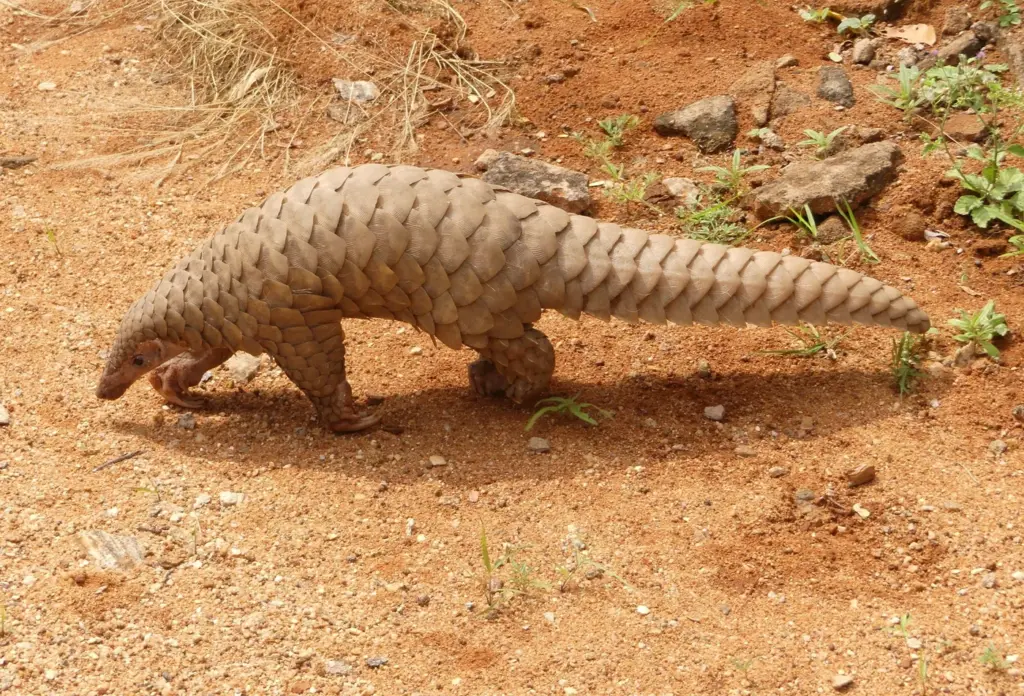
The Indian pangolin (Manis crassicaudata) is a scale-covered, toothless, ant-eating mammal found across most of the Indian subcontinent, and it is among the most trafficked wild mammals in the country. It digs burrows, comes out at night and eats ants and termites, licking them up with a long sticky tongue. Its scales, made of keratin like your fingernails, are what poachers want. That demand is why the Indian pangolin is Endangered on the IUCN Red List, in CITES Appendix I and in Schedule I of the Wildlife (Protection) Act.
Two misunderstandings follow the animal around. The first is that a pangolin is a reptile or an anteater relative because it has scales and eats ants. It is neither; it’s a mammal in its own order, Pholidota. The second is that pangolin trafficking is a Chinese or African problem in which India is a bystander. Seizure data say otherwise: India reports more pangolin seizure cases than any other Asian country in recent years. This note covers the biology, the law and what the trafficking numbers actually measure.
What the Indian pangolin is
The Indian pangolin is one of 8 pangolin species in the world, 4 in Asia and 4 in Africa, and one of 2 found in India. Pangolins are the only mammals in India covered in large keratin scales. They have no teeth, and they curl into a tight ball when threatened, which protects them from leopards and dogs but not from a person who can simply pick them up.
| Fact | Detail |
|---|---|
| Scientific name | Manis crassicaudata |
| Order and family | Pholidota; Manidae |
| Range countries | India, Bangladesh, Nepal, Pakistan and Sri Lanka |
| Diet | Mainly ants and termites |
| Habits | Nocturnal, burrowing, toothless |
| IUCN Red List | Endangered (2019 assessment) |
| CITES | Appendix I, in force since 2 January 2017 |
| Wildlife (Protection) Act, 1972 | Schedule I, as amended in 2022 |
| Other Indian species | Chinese pangolin (Manis pentadactyla), Critically Endangered |
The common name “scaly anteater” is a description, not a family tree. Anteaters of South America are a separate group. Pangolins arrived at a similar diet by a different evolutionary path, which is why they look alike in some ways and aren’t closely related.
Where India’s two pangolins live
India has two pangolin species with mostly separate ranges. The Indian pangolin is the widespread one. TRAFFIC, citing the IUCN assessment, lists records from 17 states, including Rajasthan and Gujarat in the west, Tamil Nadu and Karnataka in the south, Odisha and West Bengal in the east and Uttarakhand in the north. It uses a wide range of habitats, from dry scrub to forest, wherever there are ants, termites and soil it can dig.
The Chinese pangolin is a species of the north-east and east, reported from Arunachal Pradesh, Assam, Manipur, Meghalaya, Mizoram, Nagaland, Sikkim, Tripura, Bihar and West Bengal. The two ranges overlap in Bihar, West Bengal and Assam. That overlap matters for enforcement: a seizure of loose scales often can’t be assigned to a species by eye, so investigators increasingly rely on DNA, as the site’s note on DNA maps that trace pangolin trafficking hubs explains.
The taxonomy in the north-east is still moving. In July 2026, researchers writing in Communications Biology revalidated the Himalayan pangolin (Manis aurita) as a species distinct from the Chinese pangolin, with a range that includes Northeast India, as covered in the note on the Himalayan pangolin. The Indian pangolin of the peninsula isn’t affected, but the number of pangolin species in India may be revised in official lists.
How a pangolin lives and why it matters
A pangolin’s day is spent in a burrow and its night is spent hunting insects. It breaks open ant and termite nests with strong front claws and feeds with its tongue. Because it eats social insects in large numbers, it helps keep their populations in check, and its digging turns and aerates soil.
TRAFFIC describes pangolins as ecosystem engineers. Their burrows mix organic matter into the soil, improve moisture and air flow and are reused by other animals. For the Chinese pangolin, studies have recorded more than 30 species using its burrows, from mammals and birds to reptiles and invertebrates. When a pangolin is removed, the loss isn’t one animal. It’s a burrow system and an insect check that the rest of the habitat used.
The pangolin’s defense also explains why it is easy to poach. Curling into a ball works against a predator that bites. It doesn’t work against a poacher with a sack. An animal that responds to danger by staying still is, for a trafficker, an animal that waits to be collected.
Why the Indian pangolin is trafficked
The Indian pangolin is trafficked for two products. Its scales are sold as an ingredient in traditional medicine, mainly for markets in China and South-East Asia, on the belief that they cure various ailments. Its meat is eaten as a delicacy and for supposed medicinal value. Neither use has scientific support, and scales are chemically keratin, the same protein as hair and nails.
TRAFFIC’s February 2023 factsheet analyzed seizures reported in India from 2018 to 2022:
- 1,203 pangolins in illegal trade, from 342 seizure incidents;
- seizures reported from 24 states and 1 Union Territory;
- about half the incidents involved live pangolins and more than 40% involved scales;
- Odisha reported the most, 154 pangolins in 74 seizures, followed by Maharashtra.
Two older figures give the trend. TRAFFIC’s 2018 analysis estimated nearly 6,000 pangolins poached in India between 2009 and 2017. Across Asia from 2015 to 2021, India recorded the highest number of pangolin seizure cases, 287, although not the largest volumes. The Directorate of Revenue Intelligence alone seized 336.9 kg of scales between 2019 and 2022. Routes run from India to China through Myanmar and Nepal.
Read these numbers with care. TRAFFIC converted seized scales to animals at 1 kg of scales per adult Indian pangolin and attributed all unidentified seizures to the Indian species. Because Chinese pangolins carry fewer scales and some seized animals are juveniles, the real count is likely higher. Seizure counts are also a measure of enforcement effort: a state that catches more traffickers looks worse on a seizure table than one that catches fewer. The figures are a floor, not a census.
That is why pangolin trafficking appears in discussions of transnational organized crime. The animal is caught in a village forest, consolidated by middlemen and moved across borders by networks that also handle other contraband.
Can zoos and breeding centers save the pangolin?
Captive breeding can help, but it can’t carry pangolin conservation on its own. A 2015 study in the journal Taprobanica, describing mating behavior of Indian pangolins at Odisha’s Nandankanan Zoological Park, notes that the species is difficult to keep and rarely breeds in captivity. Births had been reported from very few zoos: Kolkata’s zoo, Oklahoma’s zoo in the United States and Nandankanan.
The reason is the diet and the habits. A pangolin lives on ants and termites, a diet a zoo can’t easily copy, and it is nocturnal and secretive. Nandankanan’s work shows that breeding is possible, which is valuable for research and for rehabilitating seized animals. It doesn’t show that captive numbers could replace the wild ones being taken.
So the main tools remain in-situ conservation and demand reduction. Protecting the scrub and forest where pangolins live, policing the first middleman in a village chain and cutting demand for scales in consumer markets do more than any breeding center could. That order of priorities is the honest answer to give in a Mains question on the species.
Indian pangolin today: legal protection and status
The Indian pangolin today has the strongest protection available at every level. Under the Wildlife (Protection) Act, 1972, both Indian species are in Schedule I, and the 2022 amendment kept them there in Part A (mammals). Hunting, trade and any use of the animal or its parts are banned, and Schedule I offences carry a minimum prison term of 3 years under Section 51.
Internationally, all 8 pangolin species have been in CITES Appendix I since 2 January 2017, which bans commercial international trade. Before that, the Indian pangolin had been in Appendix II since 1975, which allowed permit-based trade on paper even as poaching grew. The move to Appendix I removed any legal route for commercial trade in pangolin parts across borders.
On the global risk scale, the IUCN Red List assessed the Indian pangolin as Endangered in 2019, and the Chinese pangolin as Critically Endangered. The Himalayan pangolin’s revalidation in 2026 means its own status will need a separate assessment, and its authors have argued that it should be named explicitly under CITES Appendix I.
How to study Indian pangolin for exams
The Indian pangolin sits in the environment part of GS Paper III and in Prelims, and it doubles as an internal-security example because trafficking networks are organized crime. The site’s Prelims question bank counts 249 of its 1,403 questions from 2013 to 2026 under Environment. Mains asks about the systems that protect species more than the species themselves. Mains 2018 GS Paper III asked “How does biodiversity vary in India? How is the Biological Diversity Act (2002) helpful in the conservation of flora and fauna?“, and a pangolin example with numbers lifts an answer above a list of Acts.
Revise these until they’re automatic:
- Manis crassicaudata: the Indian pangolin, order Pholidota, family Manidae.
- Endangered: IUCN, 2019; the Chinese pangolin is Critically Endangered.
- Appendix I: all 8 pangolin species, in force from 2 January 2017.
- Schedule I: both Indian species under the Wildlife (Protection) Act, kept in 2022.
- 1,203 pangolins, 342 incidents: TRAFFIC’s 2018-2022 seizure analysis; Odisha highest.
- Keratin scales: the same protein as nails; the main traded part.
- Ants and termites: the diet; toothless, nocturnal, burrowing.
Three confusions cost marks. First, classification: the pangolin is a mammal, not a reptile and not an anteater. Second, the two Indian species: the Indian pangolin is widespread and Endangered, the Chinese pangolin is north-eastern and Critically Endangered. Third, CITES dates: the uplisting to Appendix I was agreed in 2016 and took effect on 2 January 2017, so an option giving 2017 as the year it came into force is right.
| Species | Range in India | IUCN | WPA 2022 | CITES |
|---|---|---|---|---|
| Indian pangolin | Most of the peninsula and plains, 17 states recorded | Endangered | Schedule I | Appendix I |
| Chinese pangolin | North-east and east | Critically Endangered | Schedule I | Appendix I |
| Himalayan pangolin | North-east, revalidated in 2026 | Not yet separately assessed | Listed under the Chinese pangolin until lists are revised (inference) | Authors urge explicit Appendix I listing |
The Indian pangolin rewards the aspirant who can move from an animal to a system. Know the biology in two lines, the three status tags and one set of seizure numbers with their caveat, and you have an example that works in an environment answer, an internal-security answer and an ethics case on enforcement. That range is what makes it worth an hour of revision.
Frequently Asked Questions
Is the Indian pangolin endangered?
Yes. The IUCN Red List assessed the Indian pangolin as Endangered in 2019. In India it is in Schedule I of the Wildlife (Protection) Act, and internationally it is in CITES Appendix I.
Why are pangolins trafficked?
They are trafficked mainly for their scales, which are used in traditional medicine on the belief that they cure ailments, and for their meat. Pangolin scales are made of keratin, the same protein as human nails. Most of the demand comes from markets in China and South-East Asia.
How many pangolin species are found in India?
Official lists recognize two: the Indian pangolin and the Chinese pangolin. In July 2026 researchers revalidated the Himalayan pangolin of the north-east as a distinct species, so the count may be revised in future lists.
Is a pangolin a mammal or a reptile?
A pangolin is a mammal. It belongs to its own order, Pholidota, and its scales are made of keratin rather than the bony or reptilian scales of other animals. It gives birth to live young and suckles them.
What does the Indian pangolin eat?
It eats mainly ants and termites. It has no teeth, so it breaks open nests with its strong front claws and collects insects with a long, sticky tongue.
When were pangolins moved to CITES Appendix I?
All eight pangolin species were moved to CITES Appendix I by a decision taken in 2016, which came into force on 2 January 2017. Appendix I bans commercial international trade in the species and its parts.
Which state reports the most pangolin seizures in India?
In TRAFFIC’s analysis of 2018 to 2022, Odisha reported the most seizure incidents and the most pangolins, 154 animals in 74 seizures. Maharashtra came next. Seizure counts also reflect how active enforcement is in a state.
Practice Questions
Prelims
1. Consider the following statements about the Indian pangolin: 1. It is listed as Endangered on the IUCN Red List. 2. It is listed in CITES Appendix II. Which of the statements given above is/are correct?
- (a) 1 only
- (b) 2 only
- (c) Both 1 and 2
- (d) Neither 1 nor 2
Answer: (a) All pangolin species have been in CITES Appendix I since 2 January 2017.
2. Consider the following statements: 1. India has two officially recognized pangolin species. 2. The Chinese pangolin is found mainly in north-eastern and eastern India. 3. Both Indian pangolin species are in Schedule I of the Wildlife (Protection) Act. Which of the statements given above are correct?
- (a) 1 and 2 only
- (b) 2 and 3 only
- (c) 1 and 3 only
- (d) 1, 2 and 3
Answer: (d) All three statements are correct.
3. Pangolin scales are made mainly of:
- (a) bone
- (b) chitin
- (c) keratin
- (d) calcium carbonate
Answer: (c) Keratin, the protein found in hair and nails.
4. The pangolin belongs to which order of mammals?
- (a) Rodentia
- (b) Pholidota
- (c) Xenarthra
- (d) Insectivora
Answer: (b) Pholidota; South American anteaters belong to a separate group.
5. Which of the following is the main food of the Indian pangolin?
- (a) Fruits and seeds
- (b) Small rodents
- (c) Ants and termites
- (d) Fish and crabs
Answer: (c) It is a specialist feeder on social insects.
Mains
- Discuss the types of organised crimes. Describe the linkages between terrorists and organised crime that exist at the national and transnational levels. (10 marks, 150 words) Previous year: Mains 2022, GS Paper III.
- Pangolins are described as among the most trafficked wild mammals. Examine the drivers of pangolin trafficking in India and the gaps in enforcement. (15 marks, 250 words)
- Seizure data are the main evidence of wildlife trafficking. Critically examine what pangolin seizure figures can and cannot tell policymakers. (10 marks, 150 words)
- Explain how CITES and the Wildlife (Protection) Act, 1972 work together to protect pangolins, and assess the effect of the 2017 uplisting to Appendix I. (15 marks, 250 words)
- Discuss the role of forensic tools such as DNA analysis in combating wildlife crime in India, with reference to pangolins. (10 marks, 150 words)
Tell Google you want more of this.
Add Anantam IAS as a preferred sourceOne tap, and this site shows up more often in your own Top Stories, AI Overviews and AI Mode. Remove it any time.