Keeda jadi is the Hindi name for the Himalayan caterpillar fungus, Ophiocordyceps sinensis, a fungus that grows out of the body of a buried moth caterpillar in alpine meadows between about 3,000 and 5,000 m. In India it is collected mainly in the high valleys of Uttarakhand, such as Pithoragarh and Chamoli, during May and June, and it sells for lakhs of rupees per kilogram because of demand from traditional Chinese medicine. The same thing is called yarsagumba in Nepal and Tibet and cordyceps in the supplement trade. Since 2020, keeda jadi has been listed as Vulnerable on the IUCN Red List.
Two misreadings travel with the name. “Jadi” suggests a herb and “keeda” suggests an insect, so many people picture a plant or a worm. It’s neither: it’s a fungus that has killed and filled a caterpillar. The second misreading is legal. People often assume that collecting keeda jadi is either banned outright or protected like a tiger. In fact, the fungus isn’t in any schedule of the Wildlife (Protection) Act; in Uttarakhand its harvest runs through forest rules and village forest councils. This note explains the biology, the money, the decline and the rules.
What keeda jadi is
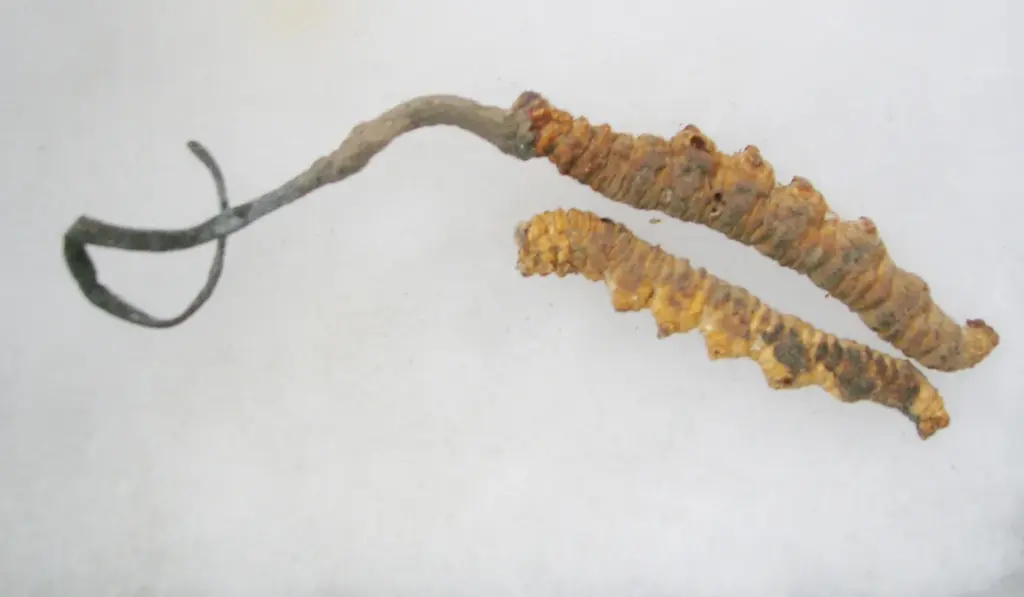
Keeda jadi is an insect-killing fungus: a parasite whose life cycle runs through the larva of a ghost moth, a family of moths whose caterpillars live underground in alpine soil. What collectors dig up is a single object made of two parts, a mummified golden-brown caterpillar and a dark, finger-like fungal stalk growing from its head.
| Fact | Detail |
|---|---|
| Scientific name | Ophiocordyceps sinensis; earlier Cordyceps sinensis |
| What it is | A fungus that parasitizes ghost moth caterpillars underground |
| Common names | Keeda jadi (Hindi), yarsagumba (Nepal, Tibet), caterpillar fungus, cordyceps |
| Where it grows | Moist alpine meadows at about 3,000 to 5,000 m |
| Indian collection areas | High valleys of Uttarakhand, such as Pithoragarh and Chamoli |
| Harvest season | May to June, after snowmelt |
| Price recorded in Uttarakhand | About Rs 12 lakh per kg in 2013-14; about Rs 7 lakh per kg in 2016 |
| IUCN Red List | Vulnerable (2020 assessment) |
| Wildlife (Protection) Act | Not listed in any schedule |
The scientific name has changed, which explains the two spellings in older books. The British mycologist Miles Berkeley described the fungus in 1843. It was known as Cordyceps sinensis for over a century until molecular studies in 2007 moved it to the genus Ophiocordyceps.
How the fungus grows inside a caterpillar
Keeda jadi’s life cycle is a slow takeover that runs across seasons. Here is the sequence, step by step:
- Fungal spores in the alpine soil infect a ghost moth caterpillar living underground.
- The fungus grows inside the living larva, feeding on its tissues, and eventually kills it.
- The fungus fills the body and hardens it, so the dead caterpillar keeps its shape.
- In spring, after the snow melts, a slender fruiting body, the stalk, pushes up from the caterpillar’s head to the surface.
- The stalk releases spores, and the cycle starts again.
The Chinese name captures this in four characters that translate as “winter worm, summer grass”: a caterpillar through the winter, something that looks like a blade of grass in summer. The Tibetan name behind “yarsagumba” carries the same idea.
The biology also explains the harvest. Only the tip of the stalk shows above the meadow, among grass and moss, so collectors have to search the ground closely, one slope at a time. The work is slow, and it is squeezed into the few weeks between snowmelt and the end of the season in June.
Why keeda jadi sells for lakhs per kilogram
Keeda jadi is valuable because of demand, not because its benefits are proven. In traditional Chinese medicine it has long been used for fatigue, sexual weakness, coughs and as a general tonic, which is why the trade calls it “Himalayan Viagra”. The Memorial Sloan Kettering Cancer Center’s review of the evidence finds laboratory and some clinical results, but describes the evidence for several uses as mixed or insufficient, and warns that it can interact with blood sugar and blood-thinning medicines.
For the people who collect it, the money is life-changing. A 2018 study by Laha, Badola and Hussain of the Wildlife Institute of India surveyed villages in the Gori valley of Pithoragarh and found:
- keeda jadi contributed 60 to 78% of household income among collecting families;
- families that didn’t collect earned 15 to 55% less than those that did;
- prices were about Rs 12 lakh per kg in 2013-14 and fell to about Rs 7 lakh per kg in 2016.
That price swing matters. A household whose income depends on one wild product depends on a market it can’t control, set by buyers in another country. The same study found that, two decades after harvesting began in the early 1990s, the fungus was still largely traded through middlemen rather than through official channels.
Why keeda jadi harvests are falling
Keeda jadi harvests are falling across the Himalaya, and two causes reinforce each other. A study by Kelly Hopping and colleagues, published in PNAS in October 2018, combined interviews with collectors in four countries and ecological models. Collectors reported falling production because of habitat degradation, climate change and, above all, overharvesting.
The models added the climate piece. Caterpillar fungus turned out to be more productive in colder places, close to areas likely to have permafrost. As the Himalaya warms, the cold zone the fungus prefers shrinks and shifts upslope. Heavy collection then removes stalks before they can release spores, so fewer new infections follow. Harvesting and warming squeeze the same population from two sides.
The rush also affects the meadows themselves. Collectors camp for weeks in the alpine pastures, known as bugyals in Uttarakhand, and concern over damage to these fragile high-altitude grasslands lay behind the High Court’s 2018 order on overnight stays, described below. The pressure on these grasslands is part of a wider story of stress on the Himalayas, covered in the note on the Himalaya’s ecological crisis.
The IUCN reached a similar conclusion in its own process. Its 2020 assessment placed Ophiocordyceps sinensis in the Vulnerable category, one step below Endangered. For a fungus, that’s a reminder that the Red List isn’t only about animals.
How Uttarakhand regulates keeda jadi
Uttarakhand regulates keeda jadi through its forest administration and village forest councils, not through the Wildlife (Protection) Act. The fungus doesn’t appear in any schedule of the Act as amended in 2022, and it isn’t listed under CITES. Its harvest is treated as the collection of a forest product.
The arrangement has changed over time:
- From 2005: regulation began, with villages allowed to collect within areas controlled by their van panchayats, the village forest councils, except in reserved forests and sanctuaries.
- Until 2012: collectors had to hand their stock to the forest department for auction and pay 5% of their earnings to the van panchayat as royalty.
- After 2012: van panchayats were allowed to hold auctions themselves.
- 21 August 2018: a High Court order banned overnight stays in alpine and subalpine meadows, which cut into the camping that harvests depend on.
- 12 September 2018: a state policy required collectors to register and to sell through the Uttarakhand Forest Development Corporation.
The record of these rules is weak. Reporting in The Caravan in 2014 found that very little keeda jadi had ever been auctioned through official channels and that most of it was smuggled, a finding the 2018 study echoed. The official route offers lower prices and more paperwork than a middleman who pays cash in the village.
That gap is the real policy lesson. A rule that makes legal sale less attractive than illegal sale won’t control harvest; it will only push the trade out of sight. Any workable system has to give collectors a price close to the market rate along with limits on when and where they harvest. Commercial use of biological resources also falls under the Biological Diversity Act, 2002, which requires benefit sharing with local communities.
Keeda jadi today
Keeda jadi today remains IUCN Vulnerable, as assessed in 2020, and outside the schedules of the Wildlife (Protection) Act. The two big pieces of evidence, the 2018 PNAS study on decline and the 2018 Uttarakhand study on livelihoods, are still the main references for its status in India. No later change to the IUCN category or to Uttarakhand’s legal framework was found in official sources up to October 2026.
It also has a place in global commitments. Target 5 of the Kunming-Montreal Global Biodiversity Framework, adopted in December 2022, asks countries to make the use, harvesting and trade of wild species sustainable, safe and legal. A high-value fungus harvested by thousands of people and traded mostly off the books is a direct test of that target.
How to study keeda jadi for exams
Keeda jadi sits at a junction of the syllabus. It belongs to environment and biodiversity in GS Paper III and Prelims, to mountain economies and the Himalaya in GS Paper I geography, and to forest governance. The site’s Prelims question bank counts 249 of its 1,403 questions from 2013 to 2026 under Environment. Mains doesn’t name the fungus, but it asks about the forces that are shrinking it. Mains 2014 GS Paper I asked candidates to “Bring out the relationship between the shrinking Himalayan glaciers and the symptoms of climate change in the Indian sub-continent.“, and a fungus that needs near-permafrost cold is a concrete, unusual symptom to cite.
Revise these until they’re automatic:
- Ophiocordyceps sinensis: the fungus; formerly Cordyceps sinensis, renamed in 2007.
- Ghost moth caterpillar: the host it kills underground.
- 3,000 to 5,000 m: its alpine meadow belt; harvested in May and June.
- Vulnerable: its IUCN category since the 2020 assessment.
- Not in the WPA schedules: harvest is governed by forest rules and van panchayats.
- 60 to 78%: its share of household income for collecting families in Pithoragarh’s Gori valley.
- 2018: PNAS links decline to overharvesting and warming; Uttarakhand High Court bans overnight stays in bugyals.
Three confusions cost marks. First, kingdom: keeda jadi is a fungus, not a plant and not an insect. Second, law: it isn’t a Schedule I species, so an option claiming a total ban under the Wildlife (Protection) Act is wrong. Third, names: keeda jadi, yarsagumba, caterpillar fungus and Cordyceps sinensis all refer to the same organism.
| Himalayan product | What it is | Status or protection | Main pressure |
|---|---|---|---|
| Keeda jadi | Parasitic fungus on ghost moth caterpillars | IUCN Vulnerable; not in WPA schedules | Overharvest and warming |
| Himalayan musk deer | Mammal hunted for its musk pod | Protected under Schedule I | Poaching for musk |
| Alpine meadows (bugyals) | Grassland ecosystem above the treeline | Partly inside protected areas such as the Valley of Flowers | Trampling, grazing, camping |
Keeda jadi rewards the aspirant who can connect one small organism to three big themes: climate change in the Himalaya, livelihoods in remote villages and the limits of regulation. Learn the life cycle, the IUCN tag and the Uttarakhand timeline, and you have an example that lifts an answer on mountain ecology or forest governance above the generic. Few topics give that much reach for so little memorization.
Frequently Asked Questions
What is keeda jadi?
Keeda jadi is the Himalayan caterpillar fungus, Ophiocordyceps sinensis. It infects and kills ghost moth caterpillars underground and grows a stalk from the dead larva’s head. It is collected in alpine meadows of Uttarakhand, Nepal and Tibet and sold for use in traditional Chinese medicine.
Is keeda jadi a plant or an insect?
It is neither. Keeda jadi is a fungus that has taken over the body of a caterpillar, so what collectors dig up is a mummified larva with a fungal stalk growing from it. The names ‘keeda’ and ‘jadi’ describe its look, not its biology.
Why is keeda jadi so expensive?
Demand from traditional Chinese medicine, where it is used as a tonic and for sexual weakness, drives its price. Supply is limited to a short harvest in high mountains and is falling. A 2018 study recorded prices of about Rs 12 lakh per kg in 2013-14 in Uttarakhand.
Is it legal to collect keeda jadi in Uttarakhand?
Collection is allowed under state rules through van panchayats, the village forest councils, but not inside reserved forests and sanctuaries. Since 2018 collectors are required to register and sell through the Uttarakhand Forest Development Corporation. In practice much of the trade still runs through middlemen.
What is the IUCN status of keeda jadi?
Ophiocordyceps sinensis is listed as Vulnerable on the IUCN Red List, based on a 2020 assessment. Overharvesting, habitat degradation and climate change are the main pressures.
What is the difference between keeda jadi, yarsagumba and cordyceps?
They are names for the same fungus. Keeda jadi is the Hindi name used in Uttarakhand, yarsagumba comes from the Tibetan name used in Nepal and Tibet, and cordyceps comes from its old scientific name, Cordyceps sinensis.
Does climate change affect keeda jadi?
Yes. A 2018 study in PNAS found that the fungus is more productive in colder areas close to permafrost, and that warming is contributing to its decline along with overharvesting. As the Himalaya warms, its suitable zone shrinks.
Practice Questions
Prelims
1. Consider the following statements about keeda jadi (Ophiocordyceps sinensis): 1. It is a fungus that parasitizes moth caterpillars. 2. It is listed in Schedule I of the Wildlife (Protection) Act, 1972. Which of the statements given above is/are correct?
- (a) 1 only
- (b) 2 only
- (c) Both 1 and 2
- (d) Neither 1 nor 2
Answer: (a) The fungus is not listed in any schedule of the Act; its harvest is regulated under state forest rules.
2. Consider the following statements: 1. Keeda jadi grows in alpine meadows at roughly 3,000 to 5,000 m. 2. It is listed as Vulnerable on the IUCN Red List. 3. It is harvested mainly in the winter months of December and January. Which of the statements given above are correct?
- (a) 1 and 2 only
- (b) 2 and 3 only
- (c) 1 and 3 only
- (d) 1, 2 and 3
Answer: (a) It is harvested in May and June, after snowmelt.
3. ‘Yarsagumba’, often in the news, is:
- (a) a medicinal plant of the Western Ghats
- (b) a fungus that grows on caterpillars in the Himalaya
- (c) a species of Himalayan moth
- (d) a lichen used as a spice
Answer: (b) Yarsagumba is the caterpillar fungus Ophiocordyceps sinensis.
4. In Uttarakhand, the collection of keeda jadi has been regulated mainly through:
- (a) Gram Sabhas under PESA
- (b) Van panchayats and the forest department
- (c) The Wildlife Crime Control Bureau alone
- (d) The Spices Board
Answer: (b) Van panchayats, the village forest councils, and the forest department run the regime.
5. The host of the caterpillar fungus is the larva of a:
- (a) silk moth
- (b) ghost moth
- (c) honey bee
- (d) locust
Answer: (b) It infects underground ghost moth caterpillars.
Mains
- Discuss the aim and goals of Kunming-Montreal global biodiversity framework. Mention India’s commitments and initiatives to achieve the goals and targets of this framework giving suitable examples. (10 marks, 150 words) Previous year: Mains 2026, GS Paper III.
- Keeda jadi has transformed incomes in remote Himalayan villages while its harvest is declining. Discuss the economic and ecological dimensions of this trade. (15 marks, 250 words)
- Why have attempts to regulate the keeda jadi trade in Uttarakhand had limited success? Suggest a more workable model. (15 marks, 250 words)
- Explain how climate change and overharvesting together threaten high-altitude species, using the caterpillar fungus as an example. (10 marks, 150 words)
- Examine the role of community institutions such as van panchayats in managing non-timber forest products in the Himalaya. (10 marks, 150 words)
Tell Google you want more of this.
Add Anantam IAS as a preferred sourceOne tap, and this site shows up more often in your own Top Stories, AI Overviews and AI Mode. Remove it any time.