The red sand boa (Eryx johnii) is a thick-bodied, harmless, burrowing snake of India’s dry plains, and it is one of the most heavily traded reptiles in the country. It isn’t venomous, it isn’t rare in the way a tiger is rare and it has no proven value as medicine or metal. Yet seizures of the red sand boa turn up every year, because superstition has put a price on it. Since the Wild Life (Protection) Amendment Act, 2022, it has been in Schedule I, the highest tier of protection in Indian law.
The common confusion runs in two directions. Some readers think the snake is dangerous or magical, which is what the trade sells. Others assume that because the sand boas as a family are listed in one schedule, the red sand boa shares that listing. It doesn’t. The 2022 schedules name the red sand boa individually in Schedule I, while most other boas sit in Schedule II. This note explains what the animal is, why the myths took hold and how its legal status reads today.
What the red sand boa is
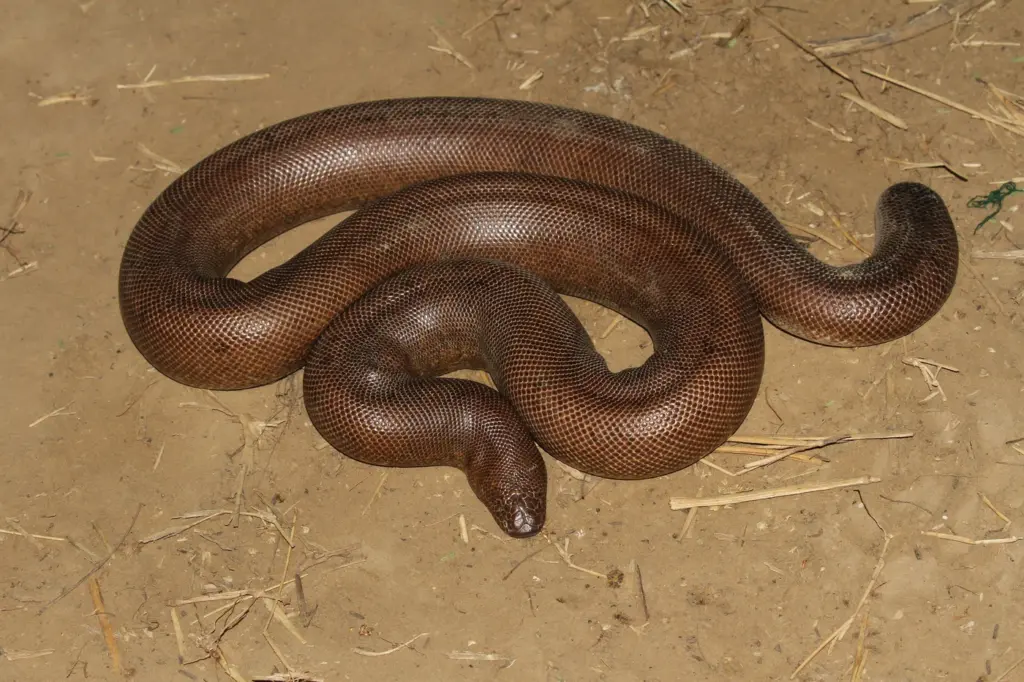
The red sand boa is a non-venomous snake of the family Boidae, the boas, which kill their prey by constriction rather than venom. It belongs to the sand boas (genus Eryx), a group adapted to loose soil and sand. Its body is stout and smooth, reddish brown in adults, with a small head and a short, rounded tail.
| Fact | Detail |
|---|---|
| Scientific name | Eryx johnii (Russell, 1801) |
| Family | Boidae (boas); genus Eryx (sand boas) |
| Venom | None; it kills prey by constriction |
| Habit | Burrowing snake of dry, sandy and scrub habitats |
| Popular names | Double-headed or two-headed snake, from its blunt tail |
| IUCN Red List | Near Threatened (2021 assessment) |
| Wildlife (Protection) Act, 1972 | Schedule I, Part C (reptiles), as amended in 2022 |
| CITES | Appendix II, listed since 1977 |
That rounded tail explains the most famous nickname. Seen from above, the tail looks almost like a second head, so the snake is sold and talked about as “two-headed”. It is an illusion of shape, not a second head, and no buyer has ever been sold a snake that actually has two.
How the red sand boa lives
The red sand boa spends much of its life in loose soil and burrows, which is what its stout body and small head are built for. It feeds on small animals, rodents among them, and kills them by squeezing rather than biting deep. A snake that eats rodents in farmland is useful to farmers rather than a threat to them.
TRAFFIC, the wildlife trade monitoring network, puts the ecological point plainly: the snake helps keep prey and predator populations in balance. A field mouse population with fewer sand boas eating it is a field mouse population eating more grain.
It is also a slow, docile snake that rarely bites, and when it does the bite isn’t dangerous. That temperament is part of the problem. A snake that can be handled easily, kept in a box and shown to buyers is easy to traffic. Contrast it with India’s medically important species in the big four venomous snakes: none of them is traded as a lucky charm, and none of them is harmless.
Why superstition drives the red sand boa trade
The red sand boa trade is driven by belief, not by any use that holds up. TRAFFIC’s 2021 campaign material describes an upsurge in demand in domestic illegal markets, fuelled by what it calls new-age superstitions:
- claims that keeping the snake brings good luck or wealth to its owner;
- claims that the snake contains iridium, one of the rarest and costliest metals, and therefore has supernatural power;
- demand for the snake as an exotic pet, which TRAFFIC’s campaign answered with the message “Owning is Stealing”.
The iridium claim deserves a direct answer because it is the one that sounds scientific. No snake concentrates a precious metal in its body. The story works the way most scams work: a rare-sounding word, a price that seems to promise profit and a buyer who never tests the claim. The animal pays for the story.
A 2023 report by the Wildlife Conservation Society’s India program mapped the trade from 172 seizure incidents reported in online media between 2016 and 2021. Maharashtra recorded the most, 59 cases, with clusters in urban districts:
- Pune, 11 cases;
- Thane, 9 cases;
- Raigad, 7 cases;
- Mumbai Suburban, 5 cases.
Two cautions help you read those numbers. Seizures measure enforcement and reporting as much as trafficking, so a state with active police and press coverage can look worse than a quieter one. And media-based counts miss every deal that was never caught. The real trade is larger than any seizure table, which is why the figure is a floor rather than a total.
The pattern also links wildlife crime to ordinary organized fraud. Sellers promise returns, middlemen take a cut, and the snake moves through cities rather than staying near its habitat. That is why wildlife trafficking appears in discussions of organized crime and not only of conservation.
How the law reaches a red sand boa seller
The law reaches a red sand boa case through the same chain that handles tiger skins and pangolin scales, because the snake is a Schedule I animal. Three agencies usually appear in the record:
- the state forest department, whose officers are empowered under the Act to search, seize and prosecute;
- the police, who often make the first arrest when a sale is set up in a city;
- the Wildlife Crime Control Bureau (WCCB), a statutory body of the environment ministry constituted on 6 June 2007 under Section 38Y of the Act, headquartered in New Delhi with regional offices in Delhi, Kolkata, Mumbai, Chennai and Jabalpur.
The WCCB’s job is coordination and intelligence. It pools information from forest, police and customs officers, which matters for a trade that moves through phone calls and city meeting points rather than through ports.
The penalty follows the schedule. Under Section 51, an offence involving a Schedule I animal carries imprisonment of at least 3 years, extendable to 7 years, plus a fine. The 2022 amendment raised the minimum fine for such offences from Rs 10,000 to Rs 25,000, and raised the general fine for other violations from Rs 25,000 to Rs 1 lakh. A seller who would once have faced a lower-tier charge for a “common” snake now faces the same section as a tiger poacher.
Enforcement still has a limit that the law can’t fix by itself. Most seizures happen after a buyer and seller meet, which means the animal has already been dug out, boxed and moved. Prevention depends on killing the demand, and that’s a job for public awareness as much as for courts.
Red sand boa today: legal protection and status
The red sand boa today is protected at three levels, and each answers a different question.
Under Indian law, the Wildlife (Protection) Act, 1972 as rewritten by the 2022 amendment places the red sand boa in Schedule I, Part C, the reptile section of the highest-protection schedule. The amendment, which received presidential assent on 19 December 2022, cut the old six schedules down to four:
- Schedule I for animals with the highest protection;
- Schedule II for animals with lesser protection;
- Schedule III for protected plants;
- Schedule IV for specimens listed in the CITES appendices.
The detail that matters for this snake is in how the boa family is split. Schedule I names two boas individually: the red sand boa and Whitaker’s boa (Eryx whitakeri). Schedule II then covers “all species of the Family Boidae” except those already in Schedule I. So a statement that “sand boas are in Schedule II” is true for most of them and false for the red sand boa. Hunting, catching, buying, selling or keeping a Schedule I animal is an offence carrying the Act’s heaviest penalties.
Internationally, the red sand boa is in CITES Appendix II, as all boas of the family are. Appendix II doesn’t ban trade outright; it requires export permits that certify the trade won’t harm the species’ survival. India’s national law is stricter than CITES here, and that’s allowed: a country can protect a species more tightly than the convention requires. The site’s note on the CITES report on wildlife imports shows how the convention’s permit system works in practice.
On the global risk scale, the IUCN Red List assessed the red sand boa as Near Threatened in 2021. That means it isn’t yet in a threatened category but is close to qualifying, and the pressure from collection is one reason. The common sand boa (Eryx conicus), its spotted relative, is also Near Threatened.
How to study red sand boa for exams
The red sand boa sits in the environment part of GS Paper III, where species, protected-area law and wildlife crime meet, and in Prelims, where it appears as a species-in-news item. The site’s Prelims question bank counts 249 of its 1,403 questions from 2013 to 2026 under Environment. Mains tests the theme through trafficking and enforcement rather than biology. Mains 2022 GS Paper III asked candidates to “Discuss the types of organised crimes. Describe the linkages between terrorists and organised crime that exist at the national and transnational levels.“, and wildlife trafficking is one of those types, with the red sand boa as a domestic Indian example.
Revise these until they’re automatic:
- Eryx johnii: the red sand boa, a non-venomous constrictor of the family Boidae.
- Schedule I, Part C: its listing under the 2022 amendment, named individually with Whitaker’s boa.
- Schedule II: the listing for all other boas.
- CITES Appendix II: since 1977, like all boas.
- Near Threatened: its IUCN category, assessed in 2021.
- Two-headed myth: the blunt, rounded tail that resembles the head.
- Iridium and luck: the superstitions behind the trade; 172 seizure incidents from 2016 to 2021 in the WCS analysis.
Three confusions cost marks. First, venom: the red sand boa has none, so any option that calls it venomous is wrong. Second, schedules: the family is split, so read whether a question names the red sand boa or boas in general. Third, IUCN versus Indian law: a Near Threatened species can be in Schedule I because Indian law also weighs trade pressure, which is exactly the case here.
| Snake | Venom | IUCN | WPA 2022 | CITES |
|---|---|---|---|---|
| Red sand boa (Eryx johnii) | None | Near Threatened | Schedule I | Appendix II |
| Common sand boa (Eryx conicus) | None | Near Threatened | Schedule II | Appendix II |
| Indian rock python (Python molurus) | None | Near Threatened | Schedule I | Appendix I |
The red sand boa rewards the aspirant who treats a species question as a law question. Know that a harmless snake ended up in Schedule I because belief made it valuable, and you can write a sharper answer on wildlife crime than one built only on tigers and pangolins. It also trains the habit of reading a schedule line by line, which is where most Prelims options are won or lost.
Frequently Asked Questions
Is the red sand boa venomous?
No. The red sand boa is a non-venomous snake that kills its prey by constriction. It is slow and docile, rarely bites and is not dangerous to people.
Why is the red sand boa called a two-headed snake?
Its tail is short and blunt, so from above it looks like a second head. The snake has only one head; the resemblance is a matter of shape. Sellers in the illegal trade use the nickname to make the animal sound magical.
In which schedule is the red sand boa?
It is in Schedule I, Part C of the Wildlife (Protection) Act, 1972 as amended in 2022, the highest level of protection. Most other boas are in Schedule II, because Schedule I names the red sand boa and Whitaker’s boa individually.
What is the IUCN status of the red sand boa?
The IUCN Red List assessed it as Near Threatened in 2021. That category means the species is close to qualifying as threatened. Collection for illegal trade is one of the pressures on it.
Why is the red sand boa smuggled?
It is smuggled because of superstition, not any real use. Sellers claim it brings luck or wealth, or that it contains the metal iridium, and some buyers want it as an exotic pet. None of these claims has any scientific basis.
Is the red sand boa listed in CITES?
Yes. It is in CITES Appendix II, like all boas, which means international trade needs export permits. Indian law goes further and treats it as a Schedule I animal.
Does the red sand boa contain iridium?
No. No snake stores a precious metal in its body, and the iridium story is a sales pitch used in the illegal trade. Believing it only creates demand that harms a protected animal.
Practice Questions
Prelims
1. Consider the following statements about the red sand boa: 1. It is a venomous snake of the family Viperidae. 2. It is listed in Schedule I of the Wildlife (Protection) Act, 1972 as amended in 2022. Which of the statements given above is/are correct?
- (a) 1 only
- (b) 2 only
- (c) Both 1 and 2
- (d) Neither 1 nor 2
Answer: (b) It is a non-venomous boa (family Boidae) and is in Schedule I.
2. Consider the following statements: 1. The red sand boa is listed in CITES Appendix II. 2. The IUCN Red List assesses the red sand boa as Near Threatened. 3. Under the 2022 amendment, all species of the family Boidae are in Schedule II. Which of the statements given above are correct?
- (a) 1 and 2 only
- (b) 2 and 3 only
- (c) 1 and 3 only
- (d) 1, 2 and 3
Answer: (a) Schedule II covers Boidae except those in Schedule I, which names the red sand boa.
3. The red sand boa kills its prey mainly by:
- (a) injecting venom
- (b) constriction
- (c) spitting venom
- (d) drowning it
Answer: (b) Boas are constrictors.
4. The Wild Life (Protection) Amendment Act, 2022 reduced the number of schedules in the Act to:
- (a) three
- (b) four
- (c) five
- (d) six
Answer: (b) Schedules I and II for animals, III for plants and IV for CITES specimens.
5. The nickname ‘two-headed snake’ given to the red sand boa refers to:
- (a) a genetic mutation common in the species
- (b) its blunt tail that resembles its head
- (c) two venom glands on either side of the head
- (d) its habit of living in pairs
Answer: (b) The rounded tail resembles a head; the snake has only one.
Mains
- Discuss the types of organised crimes. Describe the linkages between terrorists and organised crime that exist at the national and transnational levels. (10 marks, 150 words) Previous year: Mains 2022, GS Paper III.
- Superstition rather than medicine or food drives the illegal trade in the red sand boa. Discuss the role of public awareness and enforcement in curbing such demand. (10 marks, 150 words)
- Explain how the Wild Life (Protection) Amendment Act, 2022 restructured the schedules of the 1972 Act, and examine its implications for the protection of reptiles. (15 marks, 250 words)
- Seizure data are often used to measure wildlife trafficking. Critically examine the strengths and limits of such data, with reference to the red sand boa trade. (15 marks, 250 words)
- Why can a species be Near Threatened on the IUCN Red List and still deserve the highest protection under national law? Illustrate with an Indian reptile. (10 marks, 150 words)
Tell Google you want more of this.
Add Anantam IAS as a preferred sourceOne tap, and this site shows up more often in your own Top Stories, AI Overviews and AI Mode. Remove it any time.