The lesser florican (Sypheotides indicus), called kharmor or “grass peacock” in parts of central India, is the smallest of India’s bustards and one of the most threatened birds in the country. It is a grassland bird of the monsoon: males arrive in the grasslands of Rajasthan, Gujarat and Madhya Pradesh to breed and announce themselves by leaping straight up out of the grass, again and again. The IUCN Red List moved the lesser florican to Critically Endangered in 2021, the same category as the Great Indian Bustard.
Most readers confuse the lesser florican with one of two other birds. The first is the Bengal florican, a larger bustard of the Terai and Brahmaputra grasslands. The second is the Great Indian Bustard, which gets the headlines and the breeding centers. All three are Critically Endangered, but they live in different landscapes and have different legal tags. This note sets the lesser florican apart and explains why a bird of farmland edges is so hard to protect.
What the lesser florican is
The lesser florican is a bustard, a family of large, long-legged ground birds of open country. It is the only species in its genus, Sypheotides, and the smallest of the four bustards found in India. It is endemic to the subcontinent, recorded from India, Pakistan and Nepal, and is thought to be possibly extinct in Pakistan, where it once bred in southern Sindh.
| Fact | Detail |
|---|---|
| Scientific name | Sypheotides indicus (Miller, 1782) |
| Family | Otididae (bustards); only species of its genus |
| Local names | Kharmor (“grass peacock”), likh |
| Habitat | Semi-arid grasslands mixed with crop fields |
| Breeding | Monsoon; males perform a leaping display |
| IUCN Red List | Critically Endangered (2021); earlier Endangered |
| Wildlife (Protection) Act, 1972 | Schedule I, as amended in 2022 |
| CITES | Appendix II |
| Protected areas named for it | Sailana and Sardarpur Kharmor Sanctuaries, Madhya Pradesh, protected since 1983 |
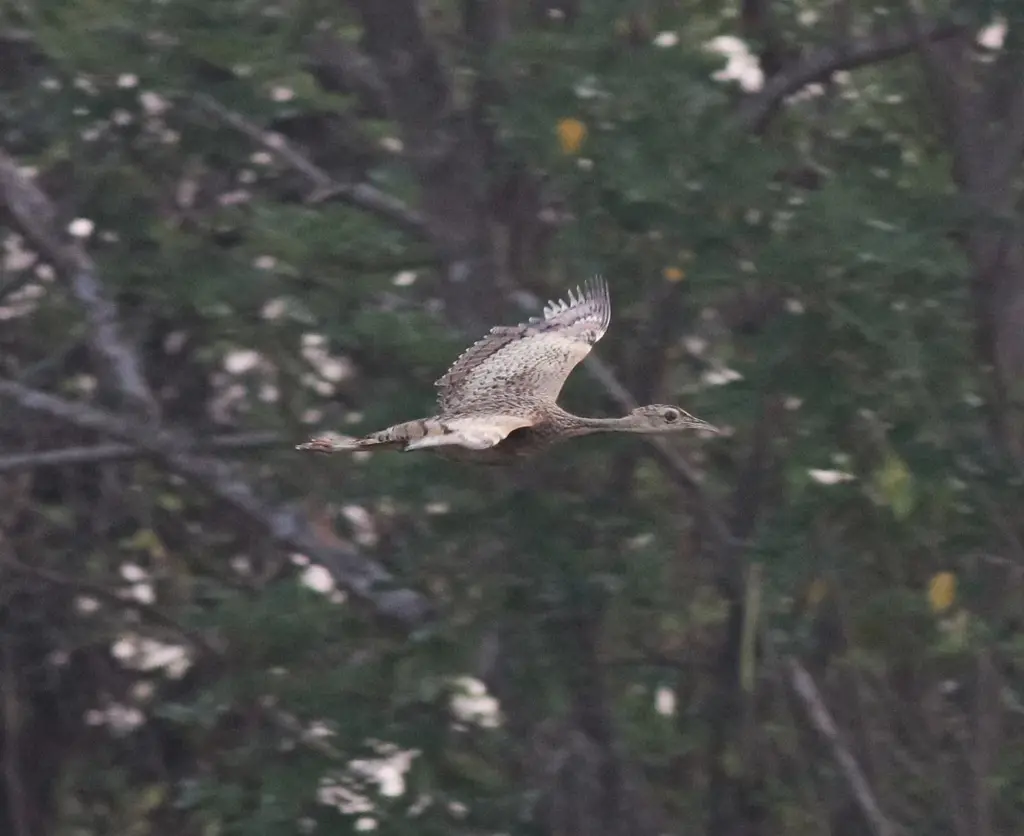
The male in breeding dress is hard to mistake: black head, neck and underparts, a white throat and white wing patches, with long ribbon-like plumes behind the head. Females and non-breeding males are buff and streaked, built to disappear into dry grass. The male changes into this dress only for the monsoon breeding season.
How the lesser florican breeds
The lesser florican breeds with the southwest monsoon, and the display is the thing to remember. A male holds a small patch of ground and, at intervals, leaps up to 2 m into the air, beating his wings and kicking his legs before dropping back into the grass. As he rises, his wing feathers make a frog-like rattle that can be heard up to about 300 m away. The display is a signal to females across tall grass where a bird on the ground can’t be seen.
Like other bustards, the lesser florican nests on the ground, in grass rather than in trees. A nest on the ground in a grazed or harvested field is exposed to livestock, dogs and machinery.
That timing is the bird’s biggest weakness. The lesser florican breeds in exactly the months when farmers sow and weed, when grass is cut for fodder and when livestock graze the commons. Hunting, made easier by such a visible display, was one of the historical causes of decline. A bird whose breeding season and breeding ground overlap with the busiest farm months has very little margin.
Where the lesser florican lives
The lesser florican is a local migrant whose movements are still poorly understood. Its known breeding range is in north-western and central India:
- southern and western Gujarat, including Velavadar Blackbuck National Park;
- southern and eastern Rajasthan, especially the Ajmer landscape around Shokaliya;
- western and southern Madhya Pradesh, including the Sailana and Sardarpur Kharmor Sanctuaries;
- smaller numbers in western Maharashtra, such as Akola district.
Outside the breeding season the birds spread more widely. Satellite telemetry by the Wildlife Institute of India, reported by Mongabay in 2023, followed birds moving from Ajmer through Madhya Pradesh towards Maharashtra after breeding, though researchers said the data were still too short to draw firm conclusions.
The important habitat point is that the lesser florican isn’t a bird of pristine wilderness. It lives in grassland mixed with crops such as cotton and pulses. The best sites have short and tall grass in a mosaic, which is often what a well-managed grazing land or a fallow field looks like. That makes it a bird of revenue land, village commons and private farms, where wildlife law has little reach.
Why the lesser florican is Critically Endangered
The lesser florican is Critically Endangered because its population has fallen fast and its habitat keeps shrinking. A nationwide survey in 2017, led by the Wildlife Institute of India and published by Dutta and colleagues in 2018, estimated 426 breeding males, with a statistical range of 174 to 805, or roughly 800 birds in all. One of the two strongholds was the Ajmer landscape, with an estimated 110 to 136 breeding males.
Local counts show the trend more sharply. In Madhya Pradesh, according to figures reported by Mongabay in 2023, counts fell from 48 birds in 2015 to 11 in 2019. The causes recorded in the scientific literature are:
- conversion of grassland to agriculture, including the shift from pulses to soybean in Madhya Pradesh;
- mismanagement of grasslands and heavy livestock grazing;
- historical hunting and egg collection;
- infrastructure, mining, power lines and invasion by Prosopis juliflora;
- pesticides in the farmland the birds use.
There’s a policy problem behind the list. Indian land records have long classed open grassland as “wasteland”, a category that invites plantation, solar parks or cultivation. The lesser florican lives on exactly that land. India’s first guide to grasslands and open natural ecosystems, launched on 17 August 2026, argues that savannas and scrublands are ecosystems rather than failed forest. For the florican, that shift in category is as important as any single sanctuary.
What recovery of the lesser florican needs
Recovery of the lesser florican needs three things, and only one of them is a breeding center.
The first is the right grass. At the Desert National Park site, the displaying males were in a mosaic of short grass about 30 cm tall and taller grass of 30 to 60 cm, with scattered shrubs. That structure, not just “grassland” in general, is what a florican picks. It comes from moderate, rotated grazing and from leaving some land fallow through the monsoon, which means the bird’s future is decided by how farmers and herders use the land between June and October.
The second is knowledge of where the birds go after breeding. The telemetry work from Ajmer is the first serious attempt to answer that, and until the non-breeding sites are known, protection covers only half of the bird’s year.
The third is a safety net. Mongabay reported in 2023 that Madhya Pradesh’s forest department was planning a conservation breeding facility, estimating Rs 4 crore to run it for five years, and had approached the Salim Ali Centre for Ornithology and Natural History for expertise. Captive birds can buy time, but releasing them only makes sense if the first two problems have been solved. Breeding without habitat produces birds with nowhere to go.
Lesser florican today: protection and recovery
The lesser florican today is protected on paper at every level. It is in Schedule I of the Wildlife (Protection) Act, 1972, kept there by the 2022 amendment alongside the Great Indian Bustard, the Bengal florican, the little bustard and Macqueen’s bustard. Internationally it is in CITES Appendix II, while the other three Indian bustards named above are in Appendix I. On the IUCN Red List, BirdLife International, the Red List authority for birds and the subject of the note on BirdLife International, moved it from Endangered to Critically Endangered in 2021.
Site protection is older than most realize. Madhya Pradesh has protected the Sailana Kharmor Sanctuary in Ratlam district and the Sardarpur Kharmor Sanctuary in Dhar district since 1983. Their record is mixed: the BNHS survey of 2017 reported very few birds in either, which shows that a notification can’t hold a bird whose habitat around the sanctuary is changing.
Two recent developments are worth knowing:
- July 2024: the first records of the lesser florican from Desert National Park in the Thar, where one male and then two were seen displaying in the Sudasari enclosure between 12 and 28 July 2024, as reported in Indian Birds in June 2025. Sudasari is one of the enclosures managed for the Great Indian Bustard.
- 2023 to 2026: conservation breeding and habitat work for bustards has scaled up around the Great Indian Bustard, with captive-bred chicks in Rajasthan and a Gujarat recovery plan released on 13 September 2026, as covered in the note on the Gujarat bustard recovery plan. Mongabay reported in 2023 that lesser florican breeding efforts in Madhya Pradesh were at an early, planning stage.
The Desert National Park record matters for a reason beyond novelty. It suggests that grassland enclosures protected for one bustard can serve another, which is the strongest argument for managing grasslands as a whole rather than species by species.
How to study lesser florican for exams
The lesser florican sits in the environment part of GS Paper III and in Prelims, where bustards are a recurring cluster. The site’s Prelims question bank counts 249 of its 1,403 questions from 2013 to 2026 under Environment. In Mains, the bird is evidence for an argument about land use rather than a topic in itself. Mains 2018 GS Paper II asked candidates to comment on the claim that “Policy contradictions among various competing sectors and stakeholders have resulted in inadequate ‘protection and prevention of degradation’ to environment.“, and the lesser florican, squeezed between agriculture, energy and grazing on land classed as waste, is a clean illustration.
Revise these until they’re automatic:
- Sypheotides indicus: the lesser florican, smallest bustard, only species of its genus.
- Critically Endangered: IUCN since 2021, uplisted from Endangered.
- Schedule I under the Wildlife (Protection) Act; CITES Appendix II, unlike the Appendix I bustards.
- Kharmor: the local name, used in the Sailana and Sardarpur sanctuaries of Madhya Pradesh (1983).
- Leap display: up to 2 m, in the monsoon breeding season.
- 426 breeding males: the 2017 survey estimate, about 800 birds.
- Breeding states: Rajasthan, Gujarat, Madhya Pradesh, with smaller numbers in Maharashtra.
Three confusions cost marks. First, lesser versus Bengal florican: the lesser florican breeds in the semi-arid west and centre in the monsoon, while the Bengal florican lives in the wet Terai and Brahmaputra grasslands. Second, the CITES tags: all three resident Indian bustards are Critically Endangered, but the lesser florican alone is in Appendix II. Third, the sanctuaries: Sailana and Sardarpur are in Madhya Pradesh, not Rajasthan, even though Rajasthan now holds one of the largest breeding populations.
| Bustard | Main landscape in India | IUCN | WPA 2022 | CITES |
|---|---|---|---|---|
| Great Indian Bustard | Thar (Rajasthan), Kachchh (Gujarat) | Critically Endangered | Schedule I | Appendix I |
| Bengal florican | Terai and Brahmaputra floodplain grasslands | Critically Endangered | Schedule I | Appendix I |
| Lesser florican | Semi-arid grasslands of Rajasthan, Gujarat, Madhya Pradesh | Critically Endangered | Schedule I | Appendix II |
| Macqueen’s bustard | Arid north-west, winter visitor | Vulnerable | Schedule I | Appendix I |
The lesser florican rewards the aspirant who reads it as a grassland story rather than a bird fact. Learn the leap, the three status tags and the 1983 sanctuaries, then connect them to the “wasteland” problem, and you have an example that fits answers on biodiversity, land use and policy contradiction alike. That is a lot of marks from one small bird.
Frequently Asked Questions
What is the IUCN status of the lesser florican?
The lesser florican is Critically Endangered on the IUCN Red List. BirdLife International moved it up from Endangered in its 2021 assessment because the population has fallen steeply. A 2017 survey estimated about 426 breeding males.
Why is the lesser florican called kharmor?
Kharmor is usually translated as ‘grass peacock’, a name that compares the grassland bird to the familiar peafowl. It is used in central India, and two Madhya Pradesh sanctuaries for the bird carry it.
Where is the lesser florican found in India?
It breeds mainly in the semi-arid grasslands of Rajasthan, Gujarat and Madhya Pradesh, with smaller numbers in Maharashtra. The Ajmer landscape in Rajasthan is one of its strongholds. Outside the breeding season it moves more widely across the peninsula.
What is the difference between the lesser florican and the Bengal florican?
The lesser florican is smaller and breeds in the semi-arid grasslands of western and central India during the monsoon. The Bengal florican is larger and lives in the wet floodplain grasslands of the Terai and the Brahmaputra valley. Both are Critically Endangered.
Which sanctuaries protect the lesser florican?
Madhya Pradesh has the Sailana Kharmor Sanctuary in Ratlam district and the Sardarpur Kharmor Sanctuary in Dhar district, both protected since 1983. Velavadar Blackbuck National Park in Gujarat is another important site.
Why is the lesser florican declining?
Its grasslands are being turned into farms and other uses, and heavy grazing, pesticides, power lines and invasive Prosopis trees degrade what remains. In the past, hunting and egg collection added to the losses. Because it breeds during the busiest farming months, its nests are especially exposed.
What is the leaping display of the lesser florican?
During the monsoon breeding season, the male jumps up to about 2 meters out of the grass, beating his wings, and drops back down, repeating this through the day. His wing feathers make a rattling sound that carries for a few hundred meters. The display helps females find males in tall grass.
Practice Questions
Prelims
1. Consider the following statements about the lesser florican: 1. It is listed as Critically Endangered on the IUCN Red List. 2. It is listed in CITES Appendix I. Which of the statements given above is/are correct?
- (a) 1 only
- (b) 2 only
- (c) Both 1 and 2
- (d) Neither 1 nor 2
Answer: (a) The lesser florican is in CITES Appendix II.
2. Consider the following statements: 1. The Sailana and Sardarpur Kharmor Sanctuaries are in Madhya Pradesh. 2. The lesser florican breeds during the southwest monsoon. 3. The lesser florican is the largest bustard found in India. Which of the statements given above are correct?
- (a) 1 and 2 only
- (b) 2 and 3 only
- (c) 1 and 3 only
- (d) 1, 2 and 3
Answer: (a) It is the smallest bustard; the Great Indian Bustard is the largest.
3. ‘Kharmor’, a name used in central India, refers to which bird?
- (a) Great Indian Bustard
- (b) Lesser florican
- (c) Bengal florican
- (d) Indian peafowl
Answer: (b) Kharmor, meaning grass peacock, is the lesser florican.
4. Which of the following best describes the habitat of the lesser florican?
- (a) Dense evergreen forest
- (b) High-altitude alpine meadows
- (c) Semi-arid grassland mixed with crop fields
- (d) Coastal mangroves
Answer: (c) It is a specialist of semi-arid agro-grassland.
5. Which one of the following Indian bustards is a winter visitor rather than a resident breeder?
- (a) Great Indian Bustard
- (b) Lesser florican
- (c) Bengal florican
- (d) Macqueen’s bustard
Answer: (d) Macqueen’s bustard visits the arid north-west in winter.
Mains
- “Policy contradictions among various competing sectors and stakeholders have resulted in inadequate ‘protection and prevention of degradation’ to environment.” Comment with relevant illustrations. (10 marks, 150 words) Previous year: Mains 2018, GS Paper II.
- India’s grasslands have long been classed as wasteland. Examine how this classification has affected grassland birds such as the lesser florican. (15 marks, 250 words)
- Species-named sanctuaries like the Sailana and Sardarpur Kharmor Sanctuaries have not stopped the decline of the lesser florican. Analyze why, and suggest a landscape approach. (15 marks, 250 words)
- Compare the conservation challenges of the Great Indian Bustard and the lesser florican. (10 marks, 150 words)
- Discuss the role of farmers and pastoral communities in conserving grassland birds that breed on private and common land. (10 marks, 150 words)
Tell Google you want more of this.
Add Anantam IAS as a preferred sourceOne tap, and this site shows up more often in your own Top Stories, AI Overviews and AI Mode. Remove it any time.