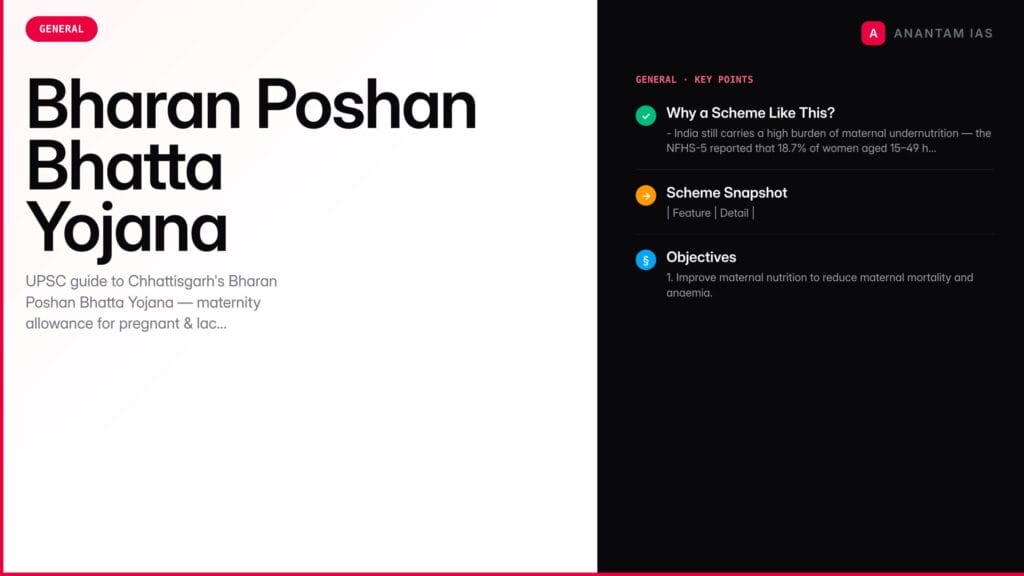
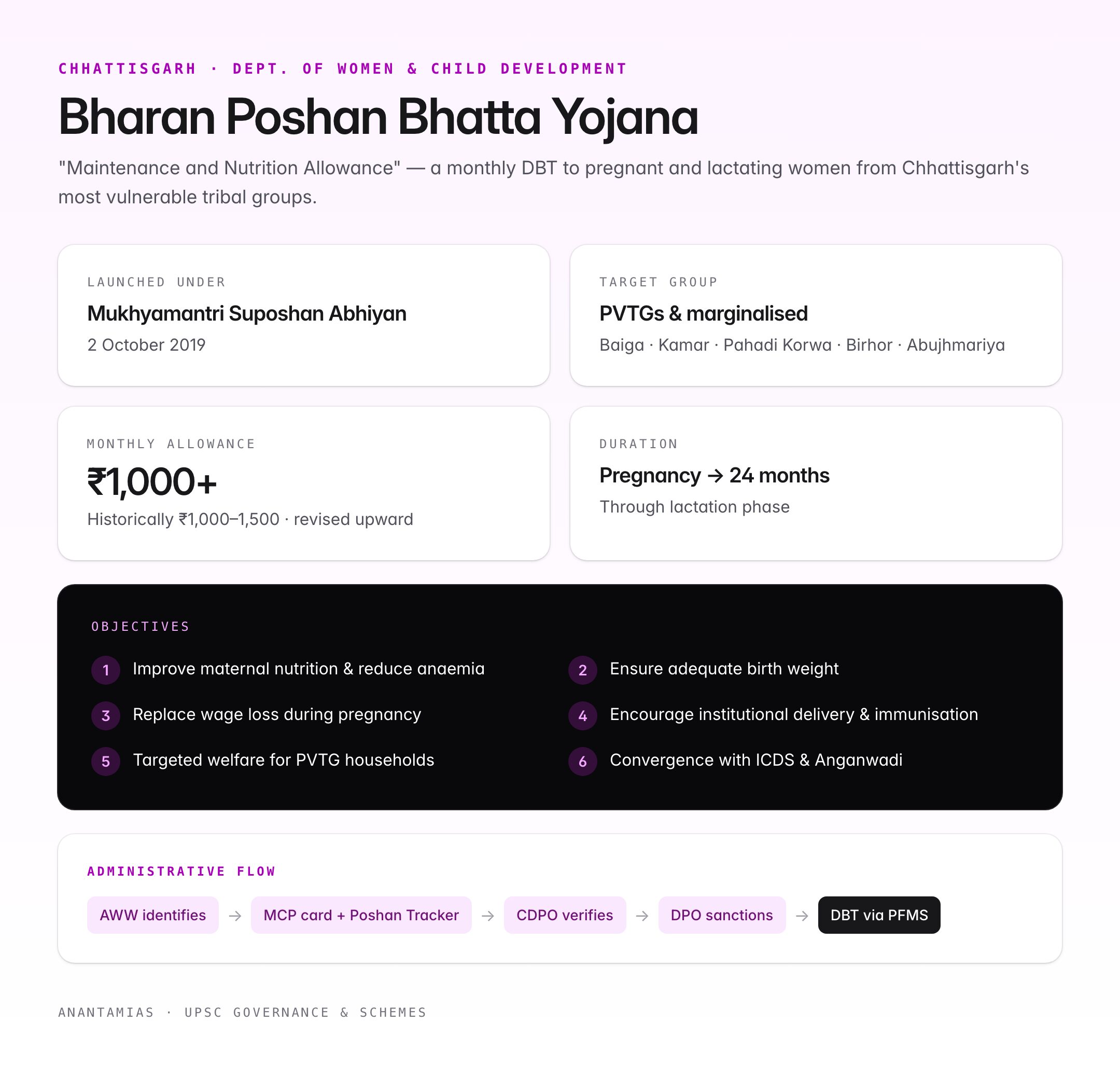
The Bharan Poshan Bhatta Yojana — literally "Maintenance and Nutrition Allowance Scheme" — is a Chhattisgarh state government scheme that provides monthly cash support to pregnant and lactating women from vulnerable communities, especially Particularly Vulnerable Tribal Groups (PVTGs) and resource-poor rural households. Implemented by the state's Department of Women and Child Development (WCD), the scheme plugs a key gap in India's maternity benefit architecture by offering unconditional, longer-duration cash support alongside centrally sponsored schemes like Pradhan Mantri Matru Vandana Yojana (PMMVY).
The scheme is a commonly asked governance-and-society topic for UPSC and Chhattisgarh PSC (CGPSC) because it links maternal nutrition, tribal welfare, direct benefit transfer (DBT), and state-level innovation within India's broader public health and social protection framework.
Why a Scheme Like This?
- India still carries a high burden of maternal undernutrition — the NFHS-5 reported that 18.7% of women aged 15–49 have a BMI below 18.5.
- Low birth-weight rate among Indian infants is around 18%, among the highest globally.
- Tribal and Dalit communities show sharper undernutrition indicators than the national average.
- Central schemes — PMMVY, ICDS, Poshan Abhiyaan — provide partial support but are limited in amount, beneficiaries, and duration.
- Chhattisgarh has one of India's largest PVTG populations (Baiga, Kamar, Pahadi Korwa, Birhor, Abujhmariya), and the state sought a top-up / substitute scheme to address chronic gaps.
Scheme Snapshot
| Feature | Detail |
|---|---|
| Name | Bharan Poshan Bhatta Yojana |
| Implementing State | Chhattisgarh |
| Nodal department | Department of Women and Child Development (WCD), Chhattisgarh |
| Type | State-funded Direct Benefit Transfer (DBT) for pregnant and lactating women |
| Launch | Implemented in phases; expanded under the Mukhyamantri Suposhan Abhiyan launched 2 October 2019 |
| Target group | Pregnant + lactating women from PVTGs and select marginalised groups |
| Benefit | Monthly cash allowance (amount varies by state notification and beneficiary category; historically ₹1,000–₹1,500 per month) |
| Duration | From pregnancy confirmation until the child is 24 months old (exact duration as per state order) |
| Mode | DBT into Aadhaar-linked bank account |
| Convergence | Linked with Anganwadi services, Mukhyamantri Suposhan Abhiyan, ICDS |
Objectives
- Improve maternal nutrition to reduce maternal mortality and anaemia.
- Ensure adequate birth weight and healthy infant growth.
- Replace wage loss during pregnancy and lactation for daily-wage workers.
- Encourage institutional deliveries and immunisation through convergence with Anganwadi services.
- Support PVTG households through targeted welfare.
Eligibility Criteria
- Woman must be a resident of Chhattisgarh.
- Belong to a notified PVTG or other eligible marginalised category as per state notification.
- Pregnant or lactating (up to 24 months of the child's age).
- Must be registered with the local Anganwadi Centre (AWC).
- Must have an Aadhaar-linked bank account in her own name.
- Typically not drawing regular salary (to exclude regular government employees).
Benefits and Delivery
- Monthly cash transfer (historically ₹1,000 per month, revised upward in later notifications; states routinely update the quantum).
- Paid directly via DBT to the woman's own bank account, aligning with the women-as-primary-payee principle of Indian welfare.
- Supplementary nutrition at the Anganwadi — hot cooked meals, take-home rations, and fortified food — is bundled with the scheme.
- Growth monitoring and immunisation of the child tracked through the Anganwadi.
Administrative Flow
- Identification: Anganwadi worker (AWW) identifies eligible pregnant / lactating woman.
- Registration: Mother-and-child protection (MCP) card generated; details entered in the Poshan Tracker app.
- Verification: Supervisor and CDPO (Child Development Project Officer) verify eligibility.
- Sanction: District Programme Officer (DPO) approves.
- Payment: Monthly DBT through the PFMS (Public Financial Management System).
- Monitoring: Dashboards at block, district, and state WCD Directorate.
Comparison with PMMVY
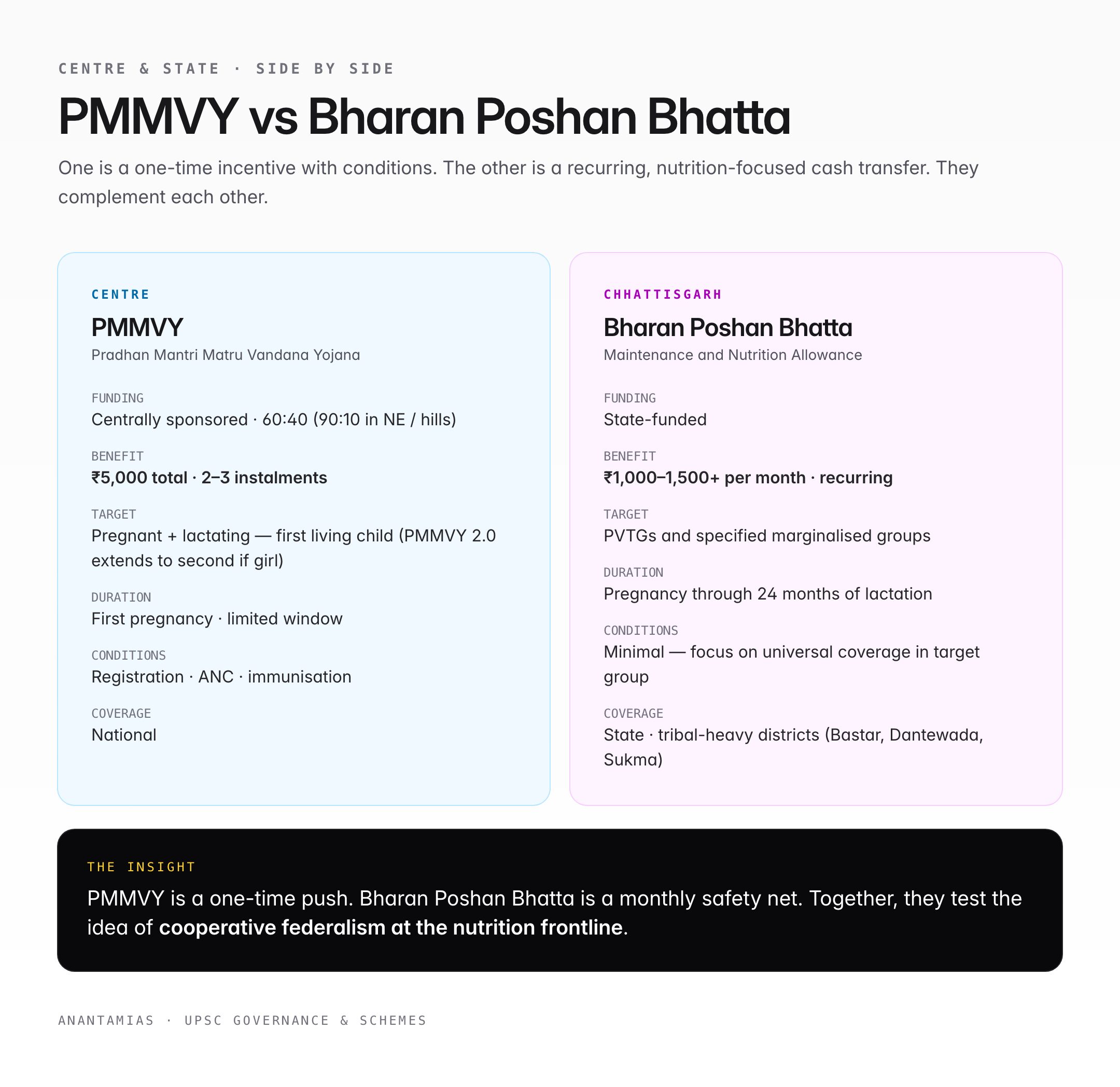
| Parameter | PMMVY (Centre) | Bharan Poshan Bhatta Yojana (Chhattisgarh) |
|---|---|---|
| Funding | Centrally sponsored (60:40; 90:10 in NE and hills) | State-funded |
| Target | Pregnant + lactating women (first living child under earlier rules; extended to second child if girl under PMMVY 2.0) | PVTGs + specified marginalised groups |
| Benefit | ₹5,000 total in 2–3 instalments (₹6,000 with JSY combined) | Monthly recurring allowance (often ₹1,000–₹1,500+) |
| Duration | First pregnancy; limited window | Throughout pregnancy and up to 24 months lactation |
| Conditionalities | Registration, ANC checkups, immunisation | Minimal; focus on universal coverage in target group |
| Coverage focus | National | State — tribal-heavy districts (Bastar, Dantewada, Sukma, Bijapur, Jashpur, Korba) |
Key insight: PMMVY is a one-time incentive with conditions; Bharan Poshan Bhatta is a recurring, nutrition-focused cash transfer — the two complement rather than substitute each other.
Link with Mukhyamantri Suposhan Abhiyan
The Chhattisgarh government launched the Mukhyamantri Suposhan Abhiyan on 2 October 2019 to tackle malnutrition in the state. Its key components:
- Hot cooked meals for pregnant and lactating women at Anganwadis.
- Community nutrition gardens (Poshan Baadi).
- Bharan Poshan Bhatta cash component for PVTGs.
- Regular health checkups and iron-folic-acid supplementation.
- Malnutrition mapping through the Poshan Tracker.
Data released by the state government has reported significant reduction in severe acute malnutrition (SAM) in tribal districts since the programme's launch.
Convergence with Other Schemes
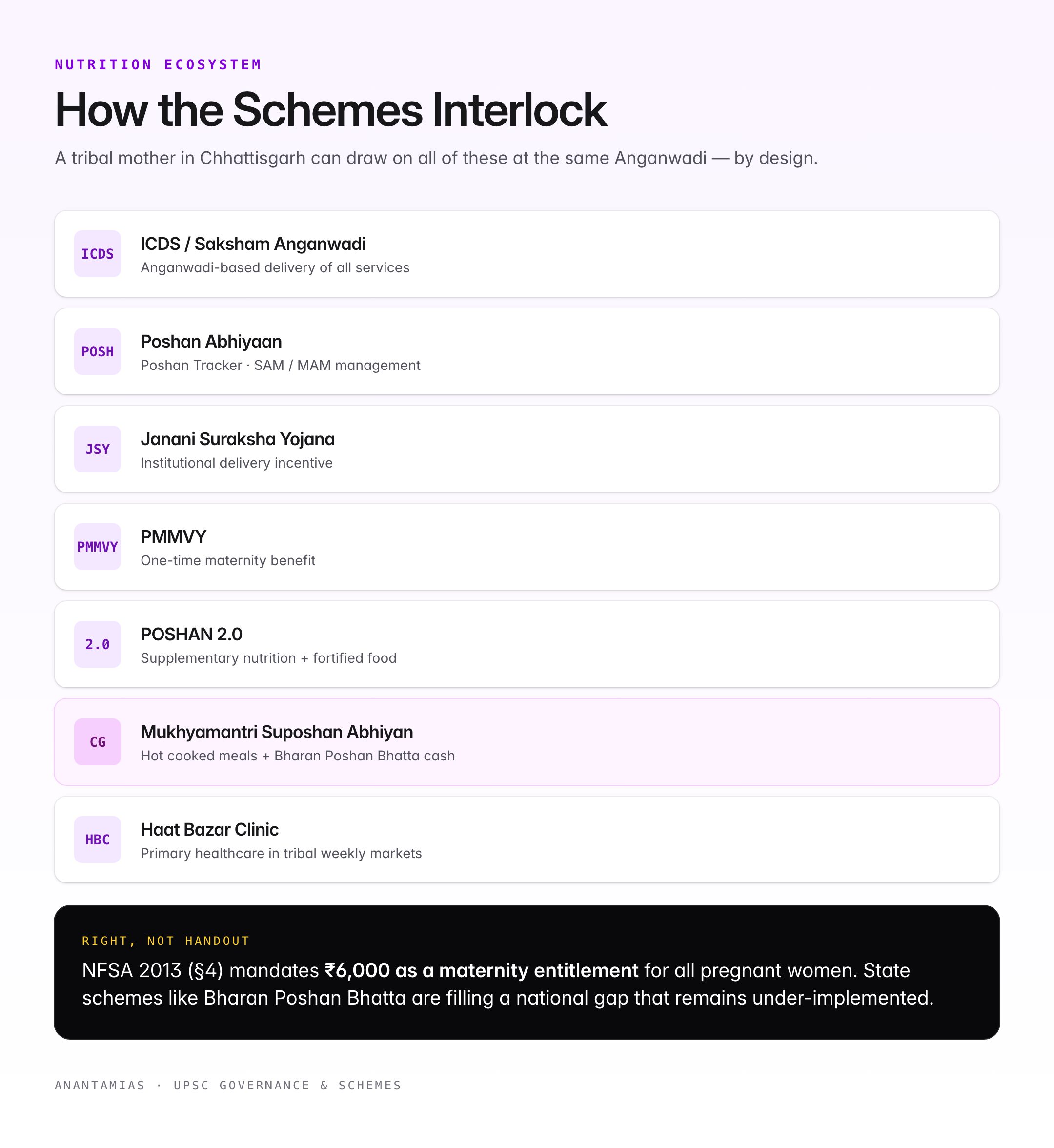
| Scheme | Convergence point |
|---|---|
| ICDS / Saksham Anganwadi | Anganwadi-based delivery |
| Poshan Abhiyaan | Poshan Tracker, SAM/MAM management |
| Janani Suraksha Yojana (JSY) | Institutional delivery incentive |
| PMMVY | One-time maternity benefit |
| POSHAN 2.0 | Supplementary nutrition and fortified food |
| Mukhyamantri Suposhan Abhiyan | Hot cooked meals |
| Haat Bazar Clinic (Chhattisgarh) | Primary healthcare in tribal weekly markets |
Strengths
- Recurring cash support is more nutritionally effective than a one-time payment.
- Direct transfer to women's accounts enhances their bargaining power in the household.
- Integrated with Anganwadi services, avoiding duplication.
- Tribal-focused design addresses the PVTG vulnerability that generic national schemes miss.
- Leverages Poshan Tracker and DBT infrastructure to reduce leakage.
Challenges
- Beneficiary identification in PVTG pockets often incomplete due to poor documentation.
- Bank account access remains a barrier in remote villages; BCs and Aadhaar-enabled payment systems help only partially.
- Anganwadi worker workload is high — more schemes, same workforce.
- Data quality in the Poshan Tracker varies across districts.
- Coverage vs. universalisation debate — should the scheme cover all BPL pregnant women rather than only PVTGs?
- Food inflation erodes the real value of a nominal monthly allowance.
Policy Significance
- Demonstrates state-level innovation building on the centrally sponsored framework — a cooperative federalism example.
- Aligns with recommendations of the Standing Committee on Food, Consumer Affairs and Public Distribution on maternity entitlements.
- Echoes the statutory intent of the National Food Security Act, 2013 (Section 4) which mandates ₹6,000 as maternity benefit — a right still under-implemented nationally.
- Contributes evidence on unconditional cash transfers (UCT) for maternal health, an active area of welfare policy research.
Quick Revision
- State: Chhattisgarh.
- For: Pregnant and lactating women from PVTGs and notified groups.
- Umbrella: Mukhyamantri Suposhan Abhiyan (launched 2 October 2019).
- Mode: DBT into women's bank accounts.
- Partner schemes: ICDS, Poshan Abhiyaan, PMMVY, JSY.
- Goal: Improved maternal nutrition and child birth outcomes in tribal Chhattisgarh.
UPSC Relevance
Prelims (GS Paper II): State-specific schemes like Bharan Poshan Bhatta have surfaced in recent prelims. Paired MCQs on PMMVY, JSY, Poshan Abhiyaan, and PMMVY 2.0 are routine.
Mains (GS Paper II — Governance):
- Discuss how state-level nutrition schemes complement centrally sponsored schemes. Illustrate with Chhattisgarh's Bharan Poshan Bhatta Yojana and Mukhyamantri Suposhan Abhiyan.
- "Maternity benefits are a statutory right, not a welfare handout." Evaluate with reference to the NFSA 2013 and current programmes.
Mains (GS Paper I — Society): Tribal welfare, women's empowerment, and the status of PVTGs.
Mains (GS Paper III — Economy): Direct Benefit Transfer, food and nutrition security, public financial management (PFMS).
Essay: Themes like "nutrition as a public good," "cash transfers and women's agency," and "federalism at the frontline" connect well.
Tell Google you want more of this.
Add Anantam IAS as a preferred sourceOne tap, and this site shows up more often in your own Top Stories, AI Overviews and AI Mode. Remove it any time.