Bharat Chhodo Andolan — the Quit India Movement — was the final mass uprising of the Indian freedom struggle before Independence. Launched by the All India Congress Committee (AICC) in Bombay on 8 August 1942, it was a frontal demand that the British leave India immediately. Mahatma Gandhi gave the country its defining slogan — “Do or Die” — and within 24 hours, almost the entire Congress leadership was behind bars. Yet the movement, leaderless and decentralised, raged for months. It marked the point of no return: after 1942, British rule in India was on borrowed time.
Background — Why 1942?
By mid-1942, the Second World War had turned catastrophic for Britain in Asia. Singapore had fallen (February 1942), Rangoon had fallen (March 1942), and Japanese forces were at India's north-eastern frontier. British prestige was shattered. Indians watched their rulers retreat and asked why they should fight Britain's war without any promise of freedom.
| Factor | Impact |
|---|---|
| Japanese threat | Imminent invasion of eastern India |
| Collapse of British prestige | Fall of Singapore, Malaya, Burma in early 1942 |
| Refugee crisis | Lakhs of Indians fleeing Burma |
| Rice shortages and inflation | War-driven price rise; prelude to Bengal Famine 1943 |
| Failure of Cripps Mission (March 1942) | British offer of post-war dominion status rejected |
| Congress frustration | No guarantee of independence despite Indian war contribution |
The Cripps Mission (March 1942)
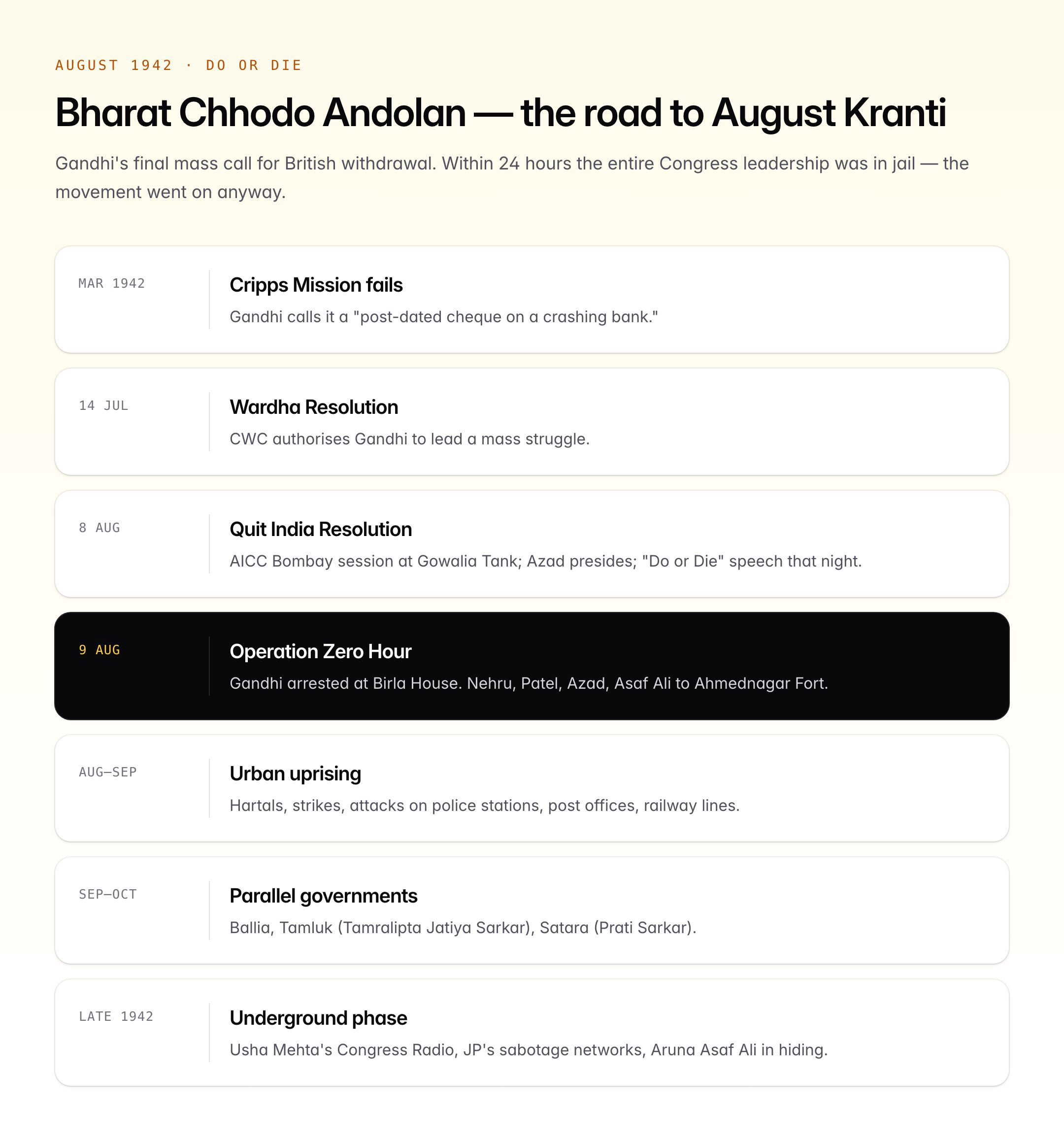
Sent by Churchill under pressure from the US and Labour allies, Sir Stafford Cripps offered dominion status after the war, with the right of provinces and princely states to opt out. Gandhi called it a "post-dated cheque on a crashing bank." The Congress, Muslim League, and Sikhs all rejected it. Its failure cleared the political ground for a final confrontation.
The Wardha Resolution (July 1942)
The Congress Working Committee met at Wardha on 14 July 1942 and passed a resolution demanding an immediate end to British rule. It authorised Gandhi to lead a mass struggle. The resolution was to be formally ratified at the AICC session in Bombay.
The Bombay Session — 8 August 1942
The All India Congress Committee met at Gowalia Tank Maidan, Bombay (now August Kranti Maidan) on 7–8 August 1942.
| Item | Detail |
|---|---|
| Date | 7–8 August 1942 |
| Venue | Gowalia Tank Maidan, Bombay |
| Presiding | Maulana Abul Kalam Azad |
| Key movers | Gandhi, Nehru, Patel, Azad, Asaf Ali |
| Resolution | Quit India Resolution passed on 8 August 1942 |
The resolution demanded:
- Immediate withdrawal of British power from India
- Formation of a provisional national government after withdrawal
- Non-violent mass struggle on widest possible scale if demands were refused
- Sanction for Gandhi to lead the movement
"Do or Die" — Gandhi's Speech
On the night of 8 August 1942, Gandhi addressed the AICC and delivered his most famous exhortation:
"We shall either free India or die in the attempt; we shall not live to see the perpetuation of our slavery. Every true Congressman or woman will join the struggle with inflexible determination not to remain alive to see the country in bondage and slavery. Let that be your pledge. Karo ya Maro — Do or Die."
He gave a Mantra of Action: "Do or Die, but every man should become his own leader."
Operation Zero Hour — The British Response
The British Raj had prepared. In the pre-dawn hours of 9 August 1942, Operation Zero Hour was launched.
- Gandhi arrested from Birla House, Bombay, and moved to Aga Khan Palace, Pune
- Nehru, Patel, Azad, Asaf Ali and most CWC members arrested; lodged in Ahmednagar Fort
- Thousands of provincial leaders arrested across India
- Congress declared an illegal organisation
- Press censorship imposed; many nationalist papers shut down
Within 24 hours, the formal Congress leadership was behind bars. The movement became leaderless — and, contrary to British expectations, became more, not less, disruptive.
August Kranti — The People's Phase
9 August 1942 is remembered as August Kranti — the August Revolution. Without central direction, the movement spread through three broad phases.
Phase 1 — Urban Uprising (Aug–mid-Sep 1942)
- Hartals, strikes, processions in almost all major cities
- Police firing on crowds at multiple venues
- Attacks on government buildings, police stations, post offices, railway stations
- University students led crowds in Bombay, Calcutta, Delhi, Lucknow, Patna
Phase 2 — Rural Uprising (Sep–Oct 1942)
- Peasants took over tehsils, thanas, and railway lines
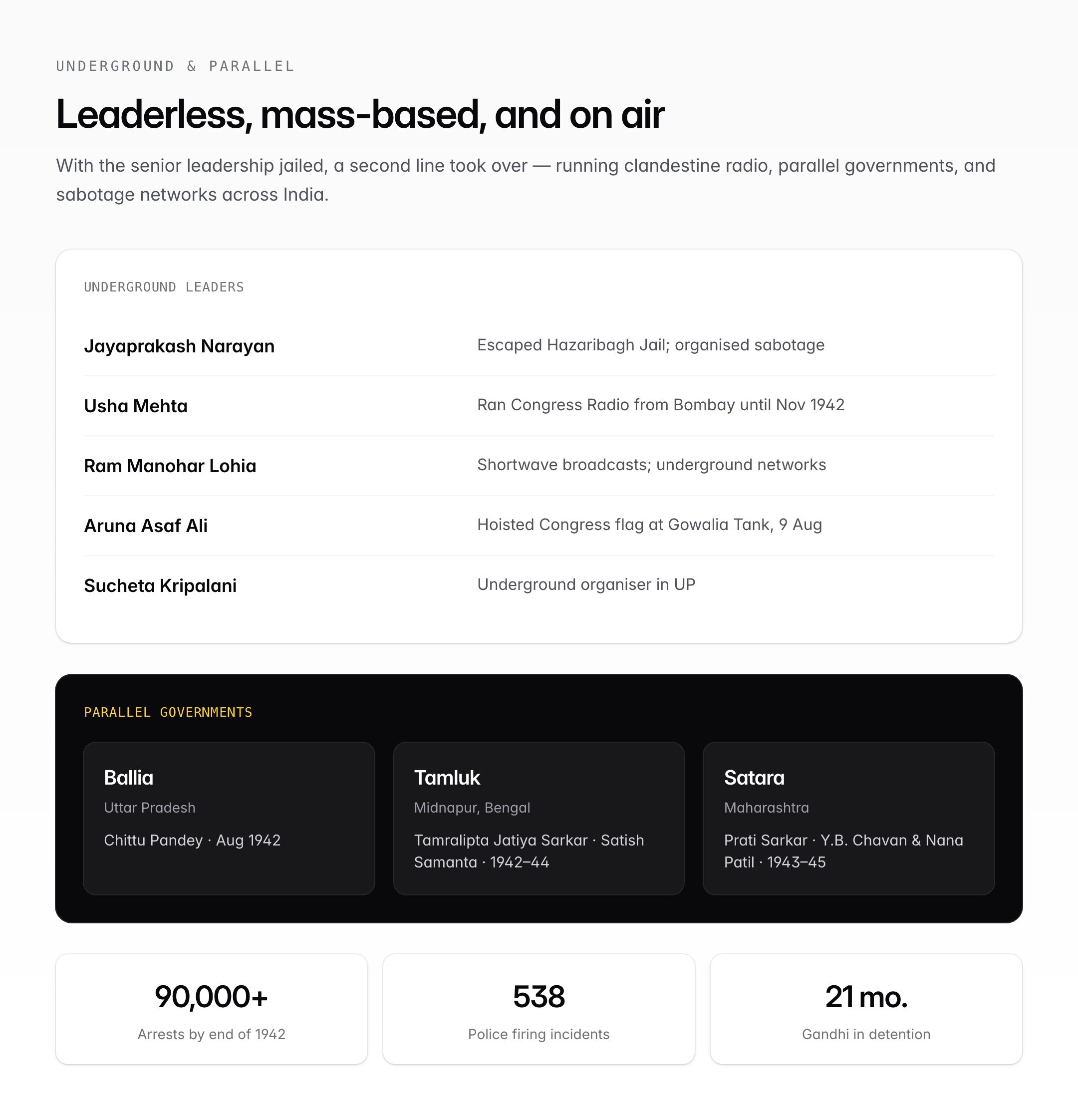
- Parallel governments established in several regions:
- Ballia (UP) under Chittu Pandey — August 1942
- Tamluk (Midnapur, Bengal) — Tamralipta Jatiya Sarkar under Satish Samanta — 1942–44
- Satara (Maharashtra) — Prati Sarkar under Y.B. Chavan and Nana Patil — 1943–45
- Talcher (Odisha), Dharwad (Karnataka), Ballia again
Phase 3 — Underground Movement (late 1942 onwards)
After mass arrests and open protests were crushed, the movement went underground. Young leaders who had escaped arrest continued the fight.
| Underground leader | Role |
|---|---|
| Jayaprakash Narayan | Escaped from Hazaribagh Jail; organised sabotage |
| Ram Manohar Lohia | Radio broadcasts from Congress Radio |
| Usha Mehta | Ran Congress Radio from Bombay — broadcast till November 1942 |
| Aruna Asaf Ali | Hoisted Congress flag at Gowalia Tank on 9 Aug; went underground |
| Achyut Patwardhan | Underground organiser in Maharashtra |
| Sucheta Kripalani | Underground networks in UP |
Congress Radio operated on shortwave frequencies from secret locations in Bombay and became a key source of news for the movement before Usha Mehta was arrested in November 1942.
Repression and Casualties
The British used overwhelming force to suppress the movement.
| Measure | Detail |
|---|---|
| Arrests | Over 90,000 by end of 1942 |
| Police firings | 538 documented incidents |
| Deaths (official) | Around 1,060 |
| Deaths (nationalist estimate) | Up to 10,000 |
| Aerial strafing | Used against crowds in parts of Bihar and Bengal |
| Collective fines | Imposed on villages suspected of supporting rebels |
Why Quit India Did Not "Win"
The movement did not force immediate British withdrawal. Several reasons:
- Leadership vacuum after the 9 August arrests
- Muslim League non-participation — Jinnah called it a "Hindu uprising"; the League grew stronger during Congress's imprisonment
- Communist Party supported British war effort (People's War line after Germany invaded USSR)
- Princely states largely inactive
- Indian Civil Service and army remained loyal
- British wartime emergency powers legitimised mass repression
- Brutal force crushed the organised phase within weeks
Yet the movement transformed the political landscape in ways no single battle could.
Significance — Why It Mattered
| Impact | Explanation |
|---|---|
| End of British confidence | Britain realised it could not hold India by force indefinitely |
| Mass politicisation | Brought peasants, students, and women into active politics |
| Parallel governments | First sustained demonstration of Indian self-rule capacity |
| Leadership training | Produced post-Independence leaders — JP, Lohia, Chavan, Patwardhan |
| International attention | Roosevelt, Chiang Kai-shek pressured Churchill on Indian question |
| Post-war road to independence | Labour government's decision in 1945 to leave rested heavily on 1942 |
Gandhi spent 21 months in detention before being released on 6 May 1944 on health grounds. His wife Kasturba died in custody at Aga Khan Palace on 22 February 1944.
UPSC Relevance
Quit India (Bharat Chhodo Andolan) is an absolute-certainty topic for Prelims and Mains.
- Prelims: Date of Quit India Resolution (8 August 1942), venue (Gowalia Tank/August Kranti Maidan), AICC presiding officer (Maulana Azad), slogan (Do or Die), parallel governments (Ballia, Tamluk — Tamralipta Jatiya Sarkar, Satara — Prati Sarkar), underground figures (Usha Mehta, Aruna Asaf Ali, JP, Lohia)
- Mains GS Paper I: Factors leading to the movement, role of different social groups (peasants, students, women, workers), reasons for its failure to achieve immediate withdrawal, long-term consequences
- Essay: "1942 — the point of no return for British rule in India"
- Linkages: Cripps Mission (1942) → Quit India (1942) → INA Trials (1945) → Cabinet Mission (1946) → Independence (1947)
- Comparison: With Non-Cooperation Movement (1920–22) and Civil Disobedience Movement (1930–34) on scale, leadership, and outcome
Candidates should remember that Quit India is notable for being leaderless yet mass-based, for the rise of underground radio, and for producing multiple parallel governments — features no earlier Congress movement achieved.
Tell Google you want more of this.
Add Anantam IAS as a preferred sourceOne tap, and this site shows up more often in your own Top Stories, AI Overviews and AI Mode. Remove it any time.