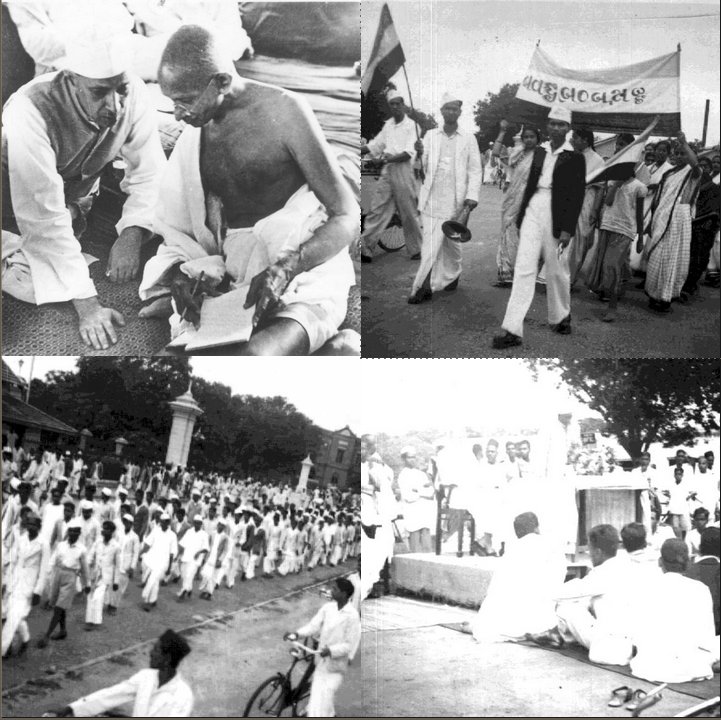
The Quit India Movement 1942, called Bharat Chhodo Andolan in Hindi and August Kranti by the Congress, was the last great mass agitation of the Indian freedom struggle. It was launched by the All India Congress Committee at the Gowalia Tank Maidan in Bombay on 8 August 1942 and was decisively suppressed by the British by the end of 1943. In the eighteen months between launch and collapse, the movement produced more state violence, more arrests, more deaths in police firing, and more parallel governments than any earlier Congress campaign. The Quit India Movement 1942 did not, in itself, force the British out — that took five more years and the Second World War — but it did permanently destroy the British belief that the Indian National Congress could be governed against. After August 1942, the British administration in India ran on borrowed time.
For UPSC and most state PSCs, the Quit India Movement 1942 is examined as a sequence: the wartime political crisis after the fall of Singapore in February 1942; the Cripps Mission and its failure; the AICC resolution of 8 August 1942 and Gandhi’s “Do or Die” speech; the immediate arrests; the popular uprising of August to November 1942; the parallel governments of Ballia, Satara, and Tamluk; the underground network led by Aruna Asaf Ali and Jayaprakash Narayan; and the long aftermath. This article works through each.
Quick Facts
- Date Launched: 8 August 1942, AICC session at Gowalia Tank Maidan, Bombay
- Famous Slogan: “Do or Die” — Gandhi’s instruction to the nation
- First Arrests: Dawn of 9 August 1942, codenamed Operation Zero Hour
- Senior Leaders Detained: Gandhi (Aga Khan Palace, Pune), Nehru, Patel, Azad (Ahmednagar Fort), Kripalani, Asaf Ali
- Duration of Active Phase: August 1942 to November 1942
- Death Toll (British figure): Around 1,028 dead
- Death Toll (Congress estimate): Around 10,000 dead
- Arrests: Around 90,000 across India
- Police Stations Attacked: Around 550
- Railway Stations Damaged: Around 250
- Telegraph Lines Cut: Hundreds of miles in eastern UP and Bihar
- Parallel Governments: Ballia (UP), Tamluk (Bengal), Satara (Maharashtra), Talcher (Odisha), Balasore (Odisha)
- Underground Leadership: Aruna Asaf Ali, Jayaprakash Narayan, Ram Manohar Lohia, Achyut Patwardhan, Sucheta Kripalani
- Congress Radio: Started 27 August 1942 by Usha Mehta, broadcast secretly until 12 November 1942
- Gandhi Released: 6 May 1944, on grounds of health
- Movement Officially Withdrawn: 1944
Background: Wartime Crisis
The Quit India Movement 1942 cannot be understood outside the context of the Second World War.
The Fall of Singapore
In February 1942, Singapore — the strongest British base in Asia — fell to the Japanese army. Burma fell in May 1942. Japanese forces reached the Indo-Burmese border. The British Indian Army had been retreating for six months. The myth of British military invincibility in Asia was finished. Refugees from Burma streamed into eastern India through Manipur and Assam. In Calcutta and Madras, blackouts were enforced and government archives were prepared for evacuation. The British in India looked, for the first time, like a defeated power.
Indian opinion divided. The Congress had been out of office since October 1939, when the Congress ministries in eight provinces had resigned over the British decision to take India into the war without consulting Indian opinion. The Muslim League was cooperating with the war effort. Subhas Chandra Bose had escaped to Germany in 1941 and was preparing the Indian National Army in Southeast Asia. The Communist Party of India, after the Soviet entry into the war in June 1941, had begun to support the war effort. The Hindu Mahasabha and the Princely States were broadly with the British. The Congress was alone in demanding that Britain commit to Indian independence as the price of Indian cooperation in the war.
The Cripps Mission, March-April 1942
The American and Chinese governments pressed Churchill to make a political offer to India to keep the Indian Army loyal and the Indian railways and factories productive. In March 1942, Sir Stafford Cripps — a member of the British War Cabinet — was sent to Delhi.
The Cripps Mission offered the following: India would have dominion status after the war; a Constituent Assembly would be elected by provincial legislatures; any province could opt out and seek its own constitutional arrangement; the Princely States could choose to accede or stay out; in the meantime, the Viceroy’s Executive Council would have a larger Indian element but defence would remain under British control.
The Congress rejected the offer. Gandhi famously described it as “a post-dated cheque on a crashing bank.” The objections were specific. Dominion status, not independence. The right of provinces to opt out — which would allow the Muslim League to extract a separate Pakistan after the war. No Indian control of defence in the interim. The proposals also offered nothing concrete during the war, when concrete action was needed.
The Muslim League rejected the proposals because they did not concede Pakistan in advance. The Cripps Mission collapsed by 12 April 1942.
The Quit India Resolution
The Cripps failure left the Congress with two choices. It could continue cooperating with the war effort in the hope that British promises would be honoured after the war. Or it could launch a final mass agitation while Britain was militarily extended in two theatres.
Wardha and Bombay
The Congress Working Committee met at Wardha on 14 July 1942 and adopted the Quit India Resolution drafted by Jawaharlal Nehru. The resolution was confirmed by the AICC at Gowalia Tank Maidan in Bombay on 8 August 1942.
The text of the resolution declared that “the immediate ending of British rule in India is an urgent necessity, both for the sake of India and for the success of the United Nations.” It authorised Gandhi to lead a non-violent mass movement on the widest possible scale for the achievement of independence.
Do or Die
That evening, 8 August 1942, Gandhi delivered the speech for which the Quit India Movement is most remembered. He said: “Here is a mantra, a short one, that I give you. You may imprint it on your hearts and let every breath of yours give expression to it. The mantra is: Do or Die. We shall either free India or die in the attempt; we shall not live to see the perpetuation of our slavery.”
The phrase Karenge ya Marenge — Do or Die — became the rallying cry of the next four months.
Operation Zero Hour
The British did not wait for the movement to organise. In the early hours of 9 August 1942 — between 3 am and 6 am — every senior Congress leader in the country was arrested. Gandhi was taken to the Aga Khan Palace in Pune. Nehru, Patel, Azad, and other senior leaders were sent to the Ahmednagar Fort. The Congress organisation was banned. Its assets were confiscated. The press was placed under strict censorship.
The decapitation of the Congress was complete by sunrise on 9 August.
Popular Uprising, August-November 1942
The unintended consequence of mass arrests was that the movement, instead of being controlled from the top, became a popular uprising without leadership. Three phases can be distinguished.
First Phase: Urban Protest
For the first week, the movement was an urban one. Students, mill workers, and middle-class professionals organised processions, hartals, and burnings of government property. In Bombay, Aruna Asaf Ali hoisted the Congress flag at Gowalia Tank Maidan on 9 August 1942. In Patna, students attacked the Secretariat. In Cuttack, the railway station was damaged. The state response was firing — at Patna Secretariat the police fired on students and killed seven on 11 August 1942.
Second Phase: Rural Insurrection
By the end of August the movement had shifted to the countryside. Telegraph wires were cut over hundreds of miles in eastern UP and Bihar. Bridges were blown up. Railway tracks were torn up. Police stations were attacked and, in many cases, captured. Government buildings were burned. By Congress estimate, 550 police stations were attacked and 250 railway stations damaged. In Bihar alone, almost the entire province east of the Ganga slipped out of government control for several weeks in August-September 1942.
Third Phase: Repression and Withdrawal
By October the British army was deployed in eastern UP, Bihar, Bengal, and parts of Maharashtra. RAF planes machine-gunned crowds at Gohpur in Assam, Talcher in Odisha, and several places in Bihar. The Congress estimate of 10,000 dead is plausible against the official figure of about 1,028. By November 1942 the open uprising was over. The movement continued in underground form until 1944.
Parallel Governments
The most remarkable feature of the Quit India Movement 1942 was the establishment of parallel governments — Jatiya Sarkar — in five regions where the British administration had collapsed.
Ballia, Uttar Pradesh
Ballia in eastern UP was the first parallel government to be established. From 19 to 22 August 1942, Chittu Pandey — known as the Sher-e-Ballia, the Lion of Ballia — led the takeover of Ballia town. The collector and the police were forced out. Chittu Pandey released political prisoners from Ballia jail and ran the district administration for three days. British troops re-occupied Ballia by 23 August.
Tamluk Jatiya Sarkar, Midnapore, Bengal
In Tamluk subdivision of Midnapore district, eastern Bengal, the longest-running parallel government was set up on 17 December 1942 and continued until September 1944 — almost 21 months. The Tamluk Jatiya Sarkar collected revenue, ran courts, organised a Vidyut Vahini (police force), and even relief operations during the Midnapore cyclone of 1942. Matangini Hazra, a 73-year-old widow, was shot dead by police while leading a procession at Tamluk on 29 September 1942 — a singular act of courage that became one of the most cited images of the Quit India period.
Satara Prati Sarkar, Maharashtra
The Satara Prati Sarkar in southern Maharashtra was established by Nana Patil with a Toofan Sena (Storm Army) of guerrilla fighters. It ran a parallel administration in 600 villages of Satara, Sangli, and Kolhapur from 1943 to early 1945. The Satara government collected revenue, ran people’s courts, and was particularly active in punishing money-lenders and landlords. It was one of the most ideologically radical of the parallel governments.
Talcher and Balasore, Odisha
In Talcher princely state, a parallel government was set up in October 1942 under Pabitra Mohan Pradhan, lasting briefly until British troops moved in. In Balasore, a Chasi Mulia Atmaraksha Samiti was organised by tribal communities.
Significance
The parallel governments demonstrated that the Congress had an administrative base, not just a political one. They also showed that mass uprising could, in some pockets, fully displace the colonial state. The fact that Tamluk and Satara ran for over a year and a half each, in defiance of an empire-wide repression, is a measure of how deep the political base of the Congress had become.
Underground Movement
While the senior leadership was in jail, an underground network operated. Aruna Asaf Ali was the most visible figure, evading capture for years and editing the underground Inquilab. Jayaprakash Narayan escaped from Hazaribagh Central Jail on 9 November 1942 and operated from Nepal. Ram Manohar Lohia, Achyut Patwardhan, Sucheta Kripalani, and Usha Mehta organised relief, communications, and propaganda.
Usha Mehta, a 22-year-old student in Bombay, ran the Congress Radio from a series of hidden locations across Bombay between 27 August and 12 November 1942. The transmitter was moved every few days. Broadcasts began with the slogan “Congress Radio calling on 42.34 metres from somewhere in India.” Mehta and her colleagues were arrested on 12 November 1942 and the transmitter was seized.
Aftermath and Long-Term Consequences
The Quit India Movement 1942 did not directly end British rule. By mid-1943 the open uprising had been suppressed. Gandhi was released only in May 1944 on health grounds. Nehru and other senior leaders were released in June 1945, after the war in Europe had ended.
Political Bargaining Power
Yet the movement decisively shifted the political balance. After Quit India, no British administration could realistically argue that Indian nationalism was a phenomenon of urban elites. Five hundred police stations attacked, parallel governments running for almost two years in some districts, 90,000 arrests — these were the facts on the ground. When Clement Attlee’s Labour government came to power in July 1945, the British exit from India was already, in policy terms, a question of timing rather than of principle.
Communal Consequences
The Congress was out of public life from August 1942 to mid-1945. The Muslim League, which had cooperated with the war effort, used those three years to organise across north and east India. Membership grew. Provincial machinery was built. The 1945-46 elections, when they came, were fought on a political field where the League had three years of organisational advantage. The partition of 1947 has to be read partly against this background.
The INA Connection
Quit India also fed, indirectly, into the second great Indian challenge to the Raj — the Indian National Army campaign in Burma and the INA trials at the Red Fort in 1945-46. The popular reaction to the INA trials, and the Royal Indian Navy mutiny of February 1946, drew on the political memory of August 1942.
For UPSC mains, the Quit India Movement 1942 is best treated as the moment at which Indian nationalism crossed the threshold from a movement that the British could contain to a movement that the British could only repress. After 1942, repression was no longer a policy. It was a holding operation until withdrawal.
Frequently Asked Questions
What was the Quit India Movement 1942?
The Quit India Movement 1942 was the last great mass agitation of the Indian freedom struggle, launched by the All India Congress Committee at Gowalia Tank Maidan, Bombay, on 8 August 1942 with Gandhi’s call of u0022Do or Die.u0022 It demanded the immediate withdrawal of British rule from India and produced a popular uprising of arson, sabotage, and parallel governments through 1942 and 1943.
Why did the Cripps Mission fail in 1942?
The Cripps Mission offered dominion status after the war, a Constituent Assembly, and the right of provinces to opt out of the union. The Congress rejected it as inadequate — Gandhi called it u0022a post-dated cheque on a crashing banku0022 — because it offered dominion status not independence, allowed provinces to opt out (the basis for Pakistan), and gave no Indian control of defence during the war. The Muslim League rejected it because it did not concede Pakistan in advance.
What was Gandhi’s u0022Do or Dieu0022 call?
On 8 August 1942 at Gowalia Tank Maidan, Gandhi said: u0022Here is a mantra, a short one, that I give you. The mantra is: Do or Die. We shall either free India or die in the attempt; we shall not live to see the perpetuation of our slavery.u0022 The phrase Karenge ya Marenge became the slogan of the movement.
Who arrested the Congress leadership in August 1942?
Operation Zero Hour was launched between 3 am and 6 am on 9 August 1942. Gandhi was sent to the Aga Khan Palace in Pune. Nehru, Patel, Azad, and other senior leaders were sent to Ahmednagar Fort. Around 90,000 Congress workers were arrested over the following weeks. The Congress was banned, its assets confiscated, and the press placed under strict censorship.
What were the parallel governments of the Quit India Movement?
Five parallel governments — Jatiya Sarkars — were established. Chittu Pandey ran a brief government in Ballia (UP) for three days in August 1942. The Tamluk Jatiya Sarkar in Midnapore, Bengal, ran from December 1942 to September 1944 under leaders including Sushil Dhara and Satish Samanta. Nana Patil’s Satara Prati Sarkar in Maharashtra ran from 1943 to 1945 with the Toofan Sena. Briefer governments were set up in Talcher and Balasore in Odisha.
Who led the underground movement during Quit India?
Aruna Asaf Ali was the most visible underground leader, hoisting the Congress flag at Gowalia Tank Maidan on 9 August and evading arrest for years. Jayaprakash Narayan escaped from Hazaribagh Jail on 9 November 1942. Ram Manohar Lohia, Achyut Patwardhan, Sucheta Kripalani, and Usha Mehta — who ran the Congress Radio in Bombay for 79 days — were other key underground figures.
Who was Matangini Hazra and what is her significance?
Matangini Hazra was a 73-year-old widow from Tamluk in Midnapore, Bengal. On 29 September 1942 she led a procession of about 6,000 people, mostly women, to capture Tamluk police station. She was shot three times by police but continued to hold the Congress flag aloft, dying with the flag still in her hand. She is one of the most cited symbols of the Quit India Movement.
How does the Quit India Movement connect to Indian independence in 1947?
The Quit India Movement made the British position in India politically untenable. After 90,000 arrests, 550 police station attacks, and parallel governments running for almost two years in some districts, no British administration could argue that nationalism was a fringe phenomenon. When Attlee’s Labour government came to power in July 1945, the British exit was a question of timing. The movement also disrupted Congress organisation during 1942-45, giving the Muslim League three years of relative organisational advantage that shaped the politics of partition.
Tell Google you want more of this.
Add Anantam IAS as a preferred sourceOne tap, and this site shows up more often in your own Top Stories, AI Overviews and AI Mode. Remove it any time.