The Bharatmala Pariyojana is the Government of India's flagship umbrella programme for highway development, approved by the Cabinet Committee on Economic Affairs in October 2017. It aims to build about 34,800 km of roads in Phase I by filling critical gaps in the National Highway network, unlocking economic corridors, strengthening border and coastal connectivity, and reducing freight costs. For UPSC aspirants, Bharatmala is a core GS Paper III (Infrastructure) and GS Paper II (Governance) topic, connecting logistics, trade, security, public finance, and federal cooperation.
Background
India's road network carries around 64% of freight and 90% of passenger traffic, yet National Highways, at just over 2% of the road length, carry nearly 40% of the traffic. Before Bharatmala, the National Highways Development Project (NHDP) launched in 1998 under Prime Minister Atal Bihari Vajpayee built the Golden Quadrilateral and the North-South and East-West Corridors. By 2017, NHDP had largely completed its scope but left gaps in inter-state connectivity, border roads, coastal links, and port access. Bharatmala was designed to replace the remaining NHDP components and to redesign highway planning around economic corridors rather than city-to-city routes.
Objectives of Bharatmala
- Optimise freight movement by connecting major economic nodes.
- Reduce logistics costs, currently around 13–14% of GDP, closer to the global 8–10%.
- Improve inter-state connectivity for backward, tribal, and under-served areas.
- Strengthen border road infrastructure with neighbours including China, Nepal, Bhutan, Myanmar, and Pakistan.
- Develop coastal and port-connectivity roads synergising with the Sagarmala programme.
- Decongest cities through ring roads and bypasses.
- Build greenfield expressways that cut travel time and accident rates.
Components of Phase I
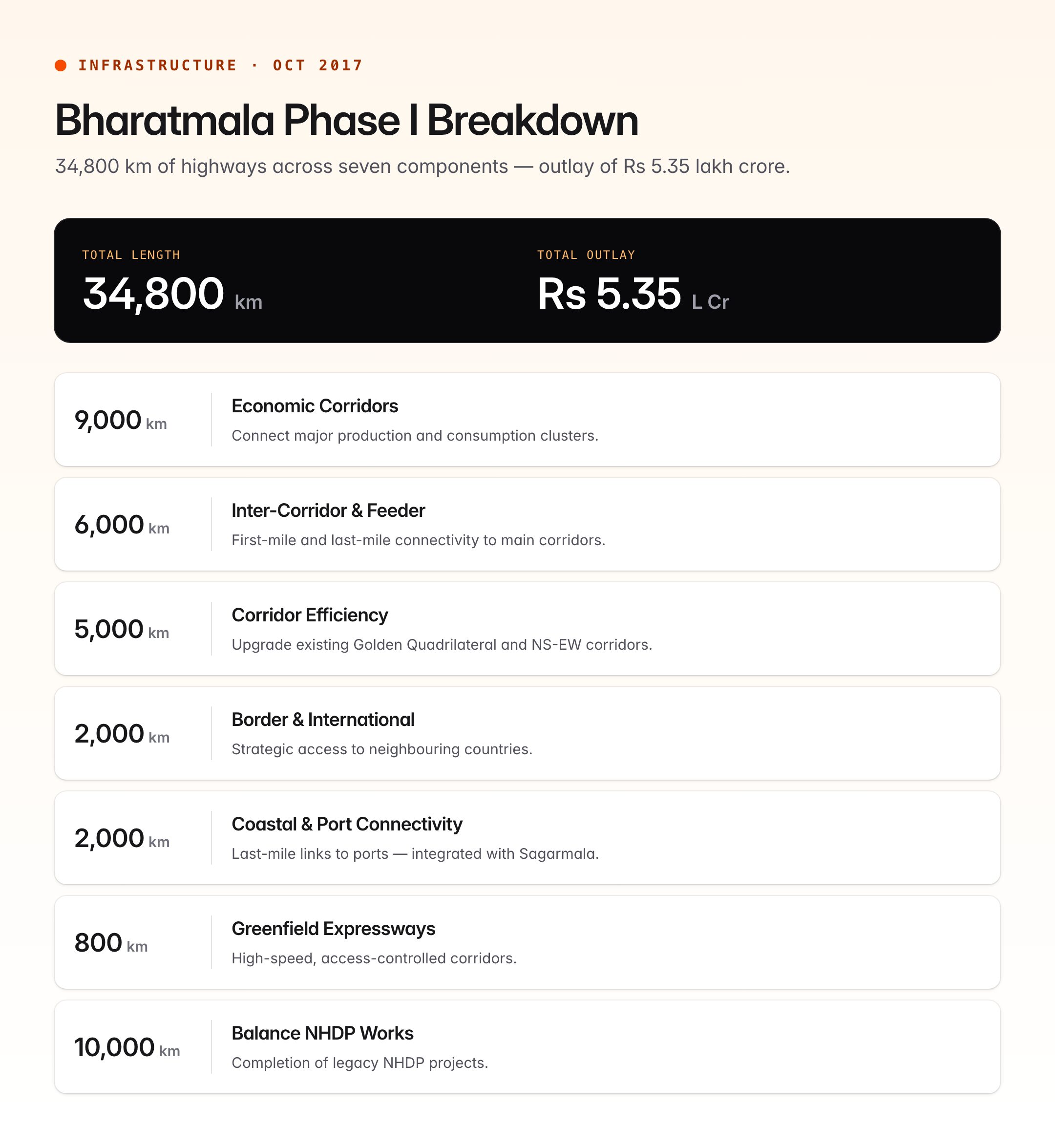
Phase I covers approximately 34,800 km at an estimated outlay of Rs 5.35 lakh crore. It is organised into seven components.
| Component | Length (approx) | Purpose |
|---|---|---|
| Economic Corridors | 9,000 km | Connect major production and consumption clusters. |
| Inter-corridor and Feeder Routes | 6,000 km | Complement economic corridors and first-mile/last-mile connectivity. |
| National Corridor Efficiency Improvement | 5,000 km | Upgrade existing Golden Quadrilateral and NS–EW corridors. |
| Border and International Connectivity Roads | 2,000 km | Strategic access to border regions and neighbouring countries. |
| Coastal and Port Connectivity Roads | 2,000 km | Last-mile links to ports, integrated with Sagarmala. |
| Expressways (Greenfield) | 800 km | High-speed, access-controlled corridors. |
| Balance NHDP works | 10,000 km | Completion of legacy NHDP projects. |
Institutional Framework
| Body | Role |
|---|---|
| Ministry of Road Transport & Highways (MoRTH) | Nodal ministry. |
| National Highways Authority of India (NHAI) | Main implementing agency for most corridors. |
| National Highways and Infrastructure Development Corporation Ltd (NHIDCL) | Executes projects in border and north-eastern areas. |
| State PWDs | Implement state-level portions. |
| Border Roads Organisation (BRO) | Strategic border roads. |
| NITI Aayog and PMG (Project Monitoring Group) | Monitoring and inter-ministerial coordination. |
Funding Mechanism
Bharatmala is funded through a mix of instruments.
- Central Road and Infrastructure Fund (CRIF) — cess on petrol and diesel.
- Toll Operate Transfer (TOT) model — upfront monetisation of completed operational highways.
- Infrastructure Investment Trusts (InvITs) — NHAI launched its InvIT in 2020–21 to raise long-term capital.
- External borrowings from multilateral lenders (World Bank, ADB, JICA).
- Market borrowings by NHAI.
- Private investment under HAM (Hybrid Annuity Model), BOT-Toll, BOT-Annuity, and EPC (Engineering, Procurement, Construction).
Contracting Models
| Model | Feature | Risk Sharing |
|---|---|---|
| EPC | Government funds, contractor builds | Government takes traffic and revenue risk |
| BOT-Toll | Private builds, operates, collects tolls | Private takes traffic risk |
| BOT-Annuity | Private builds, government pays fixed annuities | Government takes traffic risk |
| HAM | 40% funded by government during construction, 60% by developer with annuity recovery | Shared |
HAM has become the dominant Bharatmala model because it balances risks for both sides.
Progress So Far
As of early 2026, Phase I is in its final stretch.
- Of the 34,800 km sanctioned under Phase I, the awardable length was later rationalised to 26,425 km owing to cost escalation; projects for all 26,425 km have been awarded.
- About 22,223 km had been constructed by February 2026, with the balance of roughly 4,200 km targeted for completion in FY 2026–27.
- Rising land acquisition costs and delays have pushed project costs upwards, with the CAG in its 2023 report flagging cost escalation and scope changes.
- Flagship greenfield corridors such as the Delhi–Mumbai Expressway, Delhi–Amritsar–Katra Expressway, Bengaluru–Chennai Expressway, and the Ahmedabad–Dholera Expressway are under construction or partly open.
- The Zojila Tunnel, Atal Tunnel extensions, and various Arunachal and Ladakh connectivity projects feed into Bharatmala's border component.
Phase II and Beyond
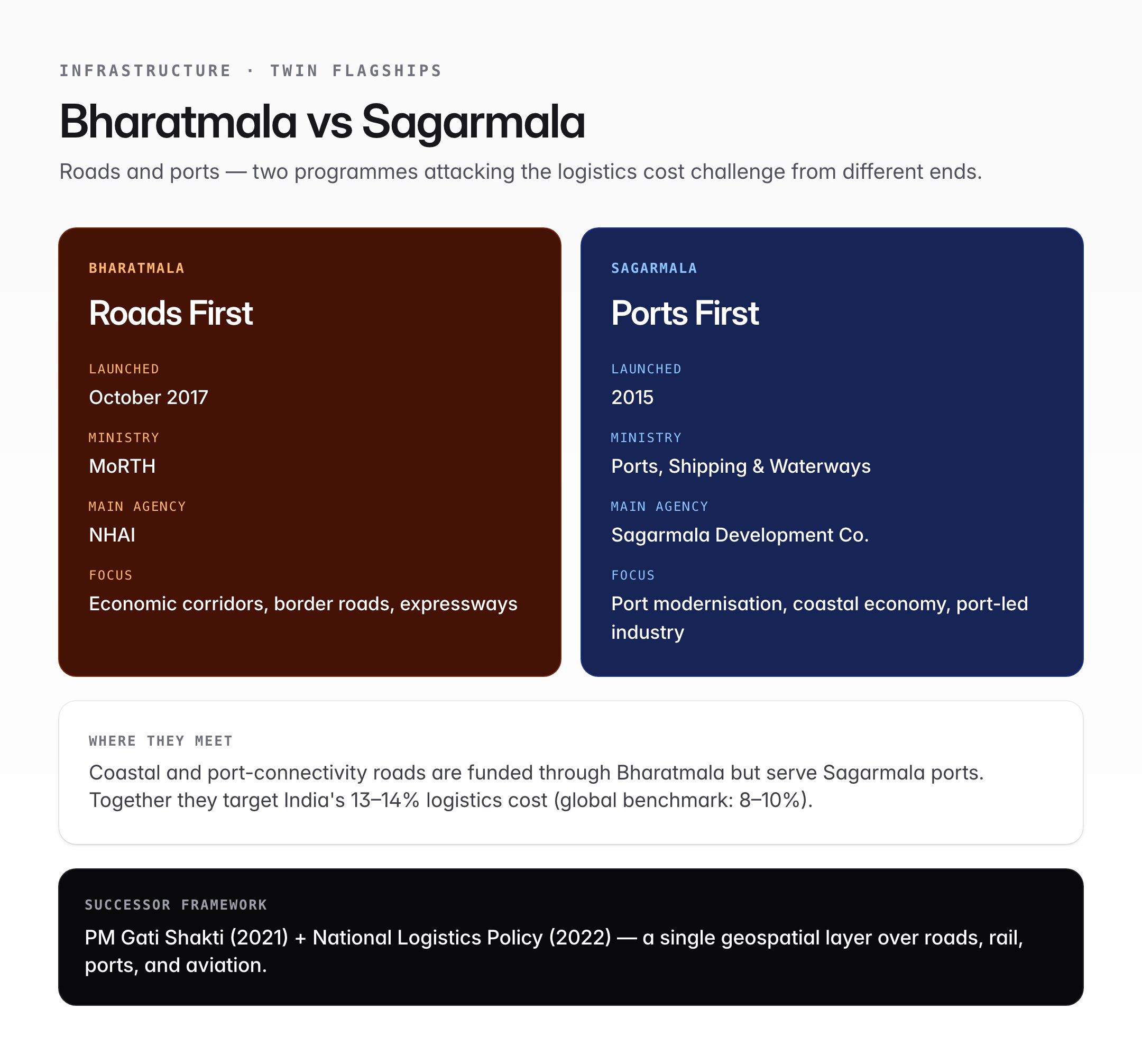
Although the scheme originally envisaged Phase II of about 48,000 km, the government has indicated that Phase II will be re-planned around the PM Gati Shakti National Master Plan (2021) and the National Logistics Policy, 2022, which together integrate roads, rail, ports, aviation, and digital logistics under a single geospatial framework.
Bharatmala and Sagarmala: Complementary Programmes
| Aspect | Bharatmala | Sagarmala |
|---|---|---|
| Focus | Highways and road infrastructure | Port-led development and coastal economy |
| Ministry | MoRTH | Ministry of Ports, Shipping and Waterways |
| Launched | 2017 (Phase I) | 2015 |
| Key objectives | Economic corridors, border roads, expressways | Port modernisation, coastal community development, port-linked industrialisation |
| Convergence | Coastal and port-connectivity roads | Rail, road, and inland waterway linkages to ports |
The two programmes jointly address the logistics cost challenge by improving port–hinterland connectivity.
Significance
- Logistics efficiency. Reduces freight cost, making exports and domestic industry competitive.
- Growth multiplier. Studies suggest every rupee spent on highways generates 2.5–3 rupees of GDP over time.
- Regional balance. Better access to the north-east, border districts, and aspirational districts.
- Strategic security. Fast troop and materiel movement along the Line of Actual Control and Line of Control.
- Employment. Large-scale direct and induced employment in construction and allied trades.
- Tourism. Expressways to religious and tourist destinations (e.g., Delhi–Katra for Vaishno Devi).
Challenges
| Challenge | Description |
|---|---|
| Land acquisition | Delays, higher compensation under the 2013 LARR Act. |
| Financing stress | NHAI debt levels crossed Rs 3 lakh crore by early 2020s. |
| Cost overruns | CAG and PAC reports flag escalation. |
| Environmental clearances | Forest and wildlife clearance bottlenecks in sensitive corridors. |
| Quality and maintenance | Post-construction upkeep remains under-resourced. |
| Coordination | Multi-agency, centre-state friction on alignment and right of way. |
| Safety | Rising expressway-related accidents need integrated ITS and enforcement. |
Quick Revision Table
| Point | Fact |
|---|---|
| Launched (Phase I) | October 2017 |
| Nodal ministry | Ministry of Road Transport and Highways |
| Main agency | NHAI |
| Phase I length | ~34,800 km |
| Phase I outlay | ~Rs 5.35 lakh crore |
| Components | 7 (economic corridors, inter-corridor, national corridor upgrade, border, coastal, expressways, balance NHDP) |
| Dominant contract model | HAM |
| Complementary programme | Sagarmala |
| Successor framework | PM Gati Shakti (2021), National Logistics Policy (2022) |
UPSC Relevance
Bharatmala is a frequently tested topic in Prelims with questions on its phases, components, and implementing agencies. Aspirants should remember that it was approved in 2017, covers about 34,800 km in Phase I, and uses the HAM model predominantly. For Mains GS Paper III, Bharatmala links to infrastructure, logistics, investment models (PPP), public finance, and economic growth. GS Paper II ties it to government policies and interventions for development in various sectors, to centre–state coordination, and to border area development. Linkages include Sagarmala, Bharatmala Phase II, PM Gati Shakti, National Logistics Policy, UDAN, and Dedicated Freight Corridors. In Essay writing, Bharatmala offers a strong example of large-scale public infrastructure as a growth lever, while raising questions of fiscal sustainability, environmental cost, and equitable regional development. Aspirants should also study CAG and Parliamentary Committee reports that flag cost overruns and land acquisition challenges for balanced answer writing.
Tell Google you want more of this.
Add Anantam IAS as a preferred sourceOne tap, and this site shows up more often in your own Top Stories, AI Overviews and AI Mode. Remove it any time.