
On 4 May 2025, India did something no country had done before. It released two genome-edited rice varieties for farmers, “Kamala” and Pusa DST Rice 1, carrying edits that promise more grain, less water, and lower emissions. A few weeks later, a coalition of farm and civil-society groups stood up in Bengaluru and called the same technology “illegal and unsafe.” So the world-first headline and the protest landed almost on top of each other. That gap is the whole topic: India is sprinting on biotech promise while its biosafety-and-trust machinery is still being argued over in courtrooms and press conferences.
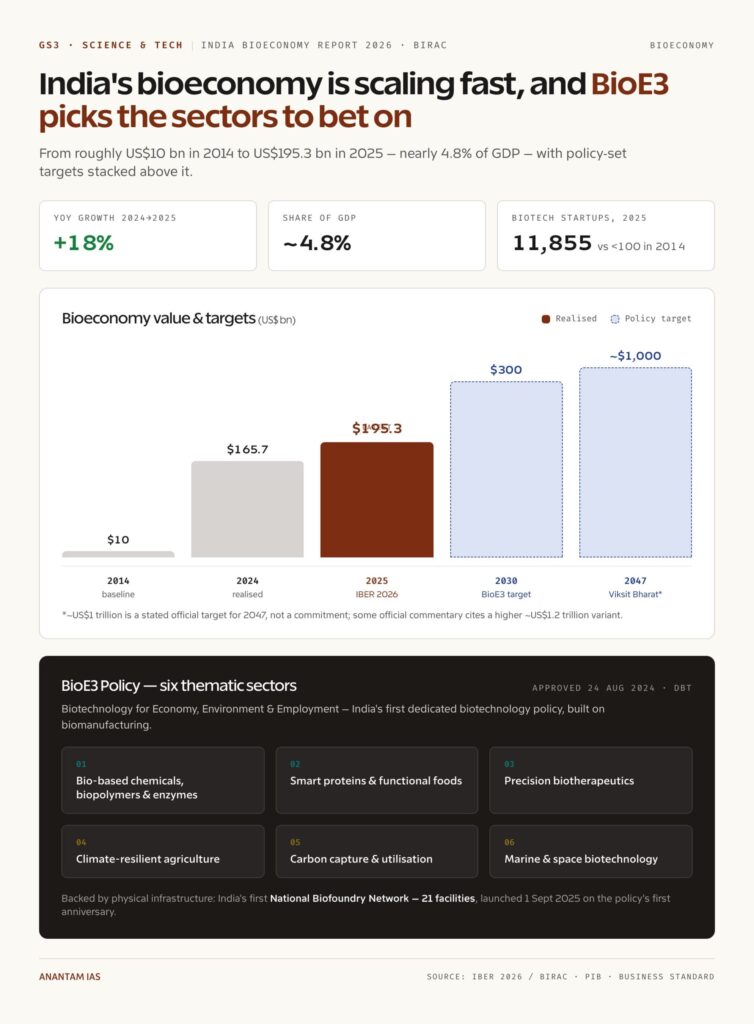
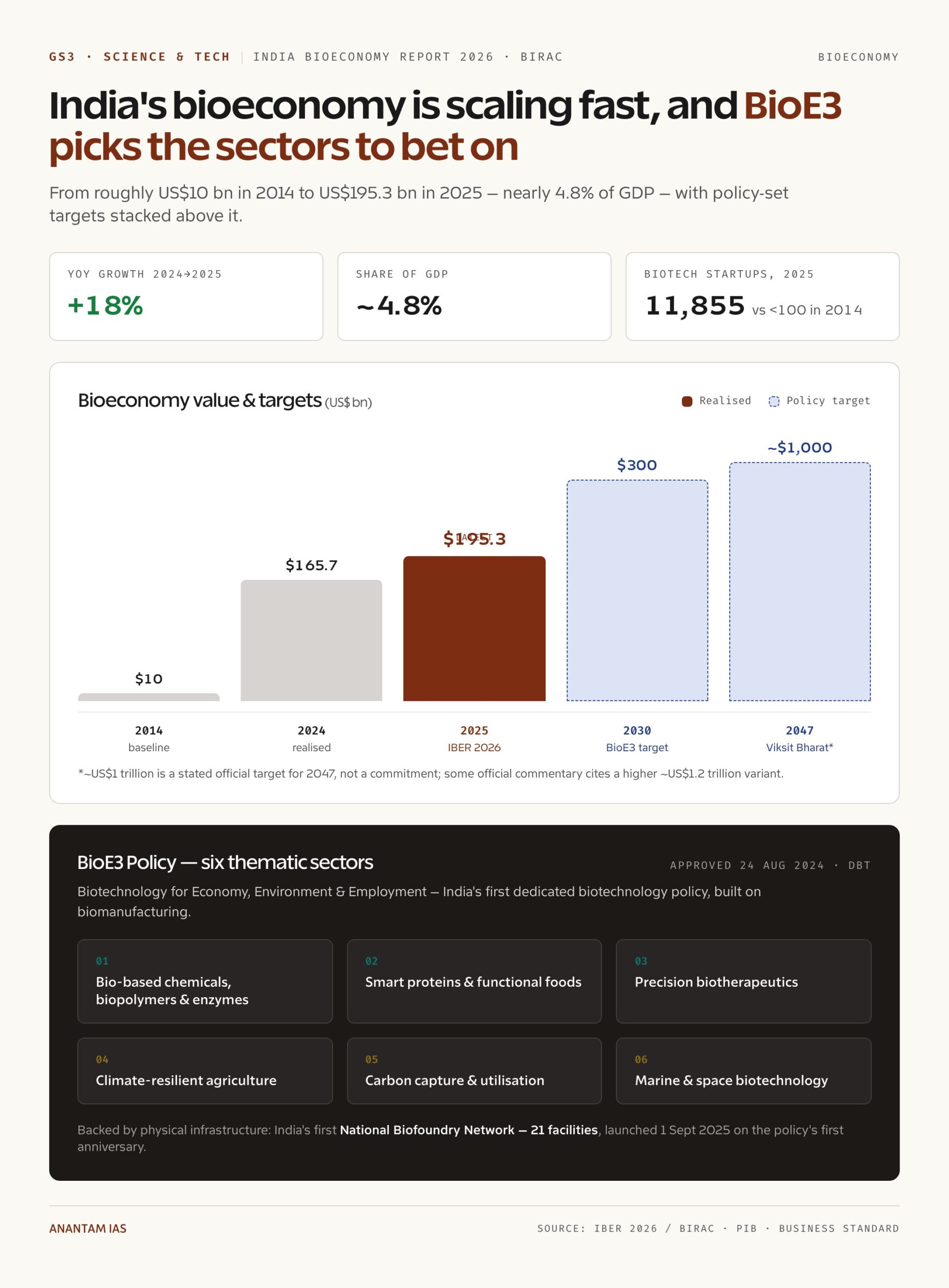
The economic stakes make the sprint hard to ignore. India’s bioeconomy hit US$195.3 billion in 2025, nearly 5% of GDP, with a stated target of US$300 billion by 2030 under the BioE3 Policy. But the question for a serious answer isn’t whether biotechnology is worth backing. Of course it is. The question is how a country builds a trillion-dollar bioeconomy without repeating the trust collapse that froze its GM-crop program for fifteen years. Promise and precaution are both real here, and they aren’t enemies. The mark-scoring move is to hold both at once.
The Issue, Framed
The fight here isn’t about whether biotechnology helps India. It plainly does. The fight is about who decides what’s safe, on what evidence, and whether the public believes the answer.
Let’s fix the vocabulary first, because most of the noise around this topic comes from people blurring very different things. BioE3 is short for “Biotechnology for Economy, Environment and Employment,” India’s first dedicated biotechnology policy, approved by the Union Cabinet on 24 August 2024 and run by the Department of Biotechnology. Its core idea is biomanufacturing, using biological systems like engineered microbes, cells, and enzymes to make products that today come from fossil fuels or chemical factories, things like bio-based plastics, proteins, and medicines. BioE3 picks six sectors to bet on: bio-based chemicals and enzymes, smart proteins and functional foods, precision biotherapeutics, climate-resilient agriculture, carbon capture, and marine and space biotech.
A biofoundry is the factory floor for that idea. Think of it as a shared lab where automation and AI handle the “design, build, test” cycle of engineering biology at scale, so a startup doesn’t have to own millions of rupees of robotics to develop a new enzyme or bio-material. On 1 September 2025, the policy’s first anniversary, the government launched India’s first National Biofoundry Network, 21 facilities spread across the country. So BioE3 isn’t just a target on a slide. It’s policy plus physical infrastructure plus a sector list.
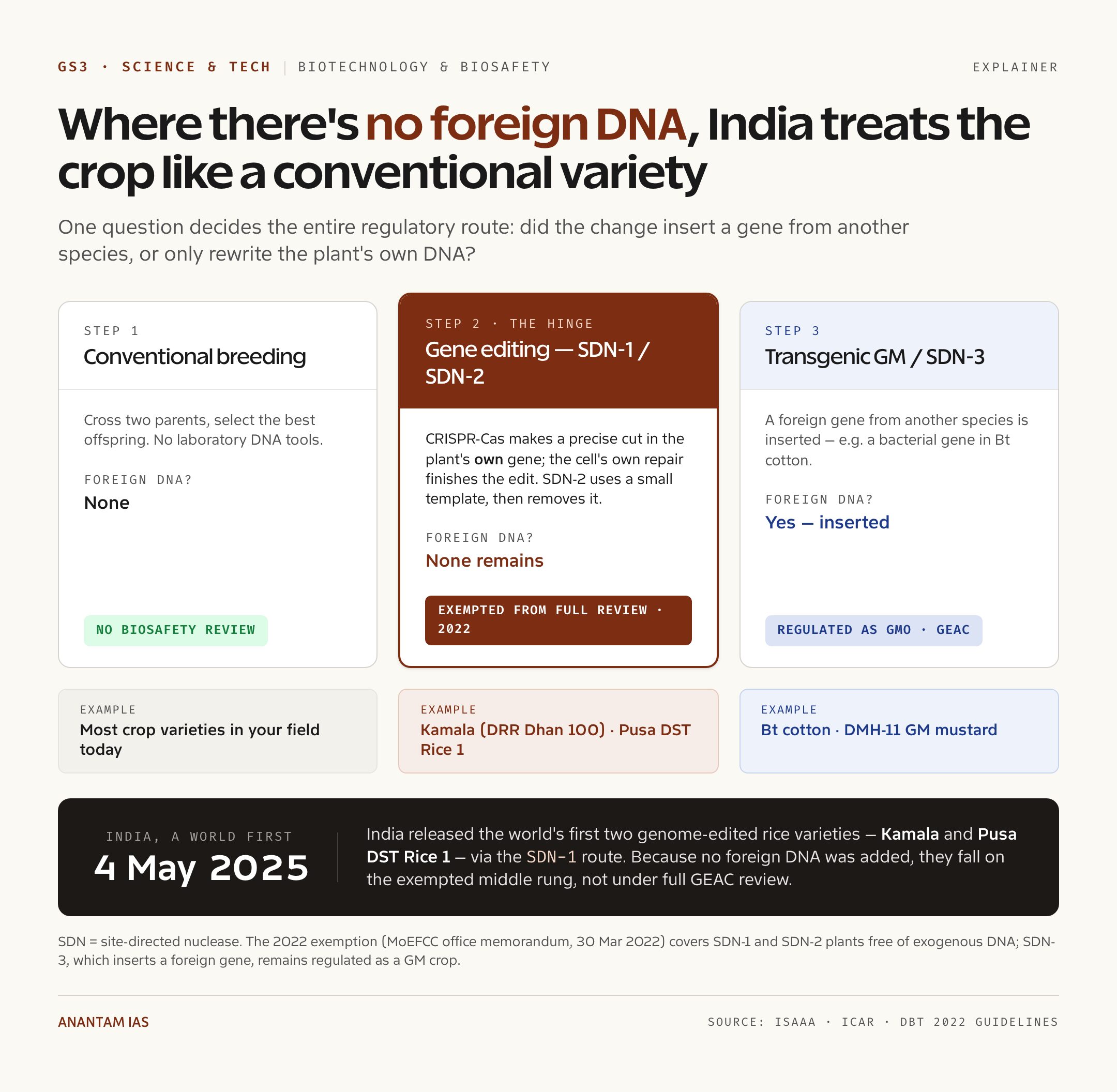
Then there’s the other half of the topic, gene editing. This is the precise rewriting of an organism’s own DNA, most often using CRISPR-Cas, a molecular tool that works like a search-and-replace function for genes. It’s worth keeping gene editing separate from older transgenic GM, where scientists insert a foreign gene from another species. That distinction is the legal hinge of the entire debate, so hold onto it. Bt cotton, India’s only commercial GM crop, carries a bacterial gene. The new rice does not.
India’s regulator for genetically modified organisms is the GEAC, the Genetic Engineering Appraisal Committee, which sits under the environment ministry and clears GMOs under the Environment Protection Act, 1986. But in 2022, the government drew a line through that regime. Gene-edited crops free of any foreign DNA were exempted from the full biosafety review that transgenic crops still face. So the promise and the controversy both trace back to one decision: when you edit a plant’s own genes and leave nothing foreign behind, is it a GMO at all? India has answered “largely no.” Critics say that answer was rushed.
What the Data Says
The numbers are where you slow down, because the bioeconomy story and the gene-editing story carry very different kinds of evidence, and an answer has to handle both. Start with scale. India’s bioeconomy grew from roughly US$10 billion in 2014 to US$165.7 billion in 2024, and then to US$195.3 billion in 2025, about 18% year-on-year growth. That’s nearly 4.8% of GDP. To anchor the pace: the sector roughly doubled in size in a single decade and is now adding more value each year than India’s entire bioeconomy was worth around 2008.
The targets stack on top. BioE3 aims for US$300 billion by 2030, and the science minister has stated a longer goal of about US$1 trillion by 2047, the Viksit Bharat horizon. Treat that 2047 figure as a projection, not a commitment, and note that some official commentary cites a higher US$1.2 trillion variant. The startup base tells the same growth story: fewer than 100 biotech startups in 2014, against 11,855 in 2025. So the engine is real, and it’s accelerating.
The gene-editing evidence is narrower but sharper. India’s two new rice varieties were developed with CRISPR-Cas using the SDN-1 route, which means no foreign DNA was added. Kamala (DRR Dhan 100), bred by ICAR-IIRR from the popular Samba Mahsuri parent, edits a single gene that controls grain number. The reported results: roughly 19% higher yield, maturity about 20 days earlier, around 20% lower greenhouse-gas emissions, and, if adopted widely, an estimated saving of about 7,500 million cubic metres of irrigation water at national scale. The second variety, Pusa DST Rice 1 from ICAR-IARI, edits a drought-and-salt-tolerance gene and reported yield gains of 9.66% to 30.4% on saline and alkaline soils.
Read those numbers against India’s actual farm problem and you see why the government moved. Rice is water-hungry and emissions-heavy, and large stretches of Indian soil are turning saline. A variety that yields more on less water, on land that’s going bad, is not a marginal gain. It’s aimed squarely at the climate-stressed reality of Indian agriculture.
But here’s the number that explains the protest. India already runs a rice surplus and holds buffer stocks well above norms. So critics ask a fair question: if the gap is distribution, not production, why is the flagship public-sector edit a yield booster at all? That’s not a biosafety point. It’s a priorities point, and it lands.
The Case For
The case for backing BioE3 and gene editing is genuinely strong, and pretending it’s weak would make for a lazy answer. So let’s state it at full strength.
Biotechnology is a growth engine India can actually lead in. From about US$10 billion to US$195.3 billion in a decade, at 18% a year, is the kind of curve that turns a sector into a pillar of the economy. Biomanufacturing also fits where India is structurally weak. The country imports a large share of its active pharmaceutical ingredients and many medical devices, and a domestic bio-manufacturing base, seeded by 21 shared biofoundries, is a direct route to cutting that import dependence and building skilled jobs. So BioE3 isn’t only about chasing a headline number. It’s about making things India currently buys.
Gene editing offers the precision that transgenic GM never could. This is the heart of the scientific case. An SDN-1 edit makes a targeted cut in the plant’s own gene and lets the cell’s own repair machinery finish the job, leaving no foreign DNA behind. An SDN-2 edit uses a small template to guide a specific change, then removes the template, again leaving nothing foreign. At the genome level, the result can be indistinguishable from a plant produced by conventional breeding, just reached far faster. That’s the basis for India’s 2022 decision to exempt SDN-1 and SDN-2 crops from full biosafety review, while keeping SDN-3, which does insert a foreign gene, regulated as a GMO. So the regulation tracks the biology: foreign DNA in, full review; no foreign DNA, lighter touch.
The agronomic payoff is real and climate-aligned. Kamala’s roughly 19% yield gain, 20% lower emissions, and earlier maturity aren’t lab curiosities, they target the exact pressures, water and heat, that climate change is loading onto Indian farming. And BioE3 ties the whole biomanufacturing push to Net Zero and circular-economy goals, replacing fossil feedstocks with bio-based ones. So the environmental case isn’t a side benefit bolted on later. It’s built into the policy’s logic.
And the speed advantage matters for food security. Conventional breeding of a new rice variety can take a decade or more. Editing a known gene compresses that. When salinity is spreading and monsoons are getting erratic, the ability to develop a resilient variety in a few seasons rather than a few elections is not a small thing.
The Case Against
Here’s what the promise case walks past. A technology being precise in principle doesn’t make every release safe, fair, or trusted in practice. On those tests, the sprint has real gaps.
The “precision” claim is contested by people who know the science. The Coalition for a GM-Free India, with activist Kavitha Kuruganti, has pointed to published research arguing that CRISPR-Cas9 is not fully precise in rice, that off-target edits can occur, and that gene-edited crops therefore need careful molecular characterisation across many generations before release. Present that as their position, not as settled consensus, because the underlying science is genuinely debated. But the demand itself, prove the edit did only what you intended, over multiple generations, isn’t unreasonable. It’s basic biosafety hygiene.
The exemption shrinks the regulated universe at an awkward moment. By exempting SDN-1 and SDN-2 crops from full GEAC review, India removed a whole category of new organisms from the biosafety net just as the science scales up. India is also a centre of rice diversity, so edited traits crossing into wild relatives or local landraces, what biologists call gene flow, is a real ecological question that “no foreign DNA” doesn’t automatically answer. The trait is still new to the ecosystem, even if the method left nothing foreign behind.
Then there’s consent and the right to know. Because SDN-1 and SDN-2 foods are treated like conventional varieties, they can reach the plate without GMO-style labelling. You can argue that’s scientifically defensible. You can also argue that a consumer’s right to know how their food was made shouldn’t depend on whether the change happens to leave a molecular trace. Both can be true, and a fair answer names the tension rather than waving it away.
The Bt-brinjal-era fear about corporate seed control hasn’t disappeared. When powerful editing tools sit behind patents, the worry that proprietary technology concentrates seed power in a few private hands, at the farmer’s expense, comes straight back. India’s public-sector route, with ICAR breeding the new rice, partly answers this. But the concern is structural, not paranoid, and it shaped the 2010 Bt brinjal decision for exactly this reason.
And the regulatory capacity question is unresolved at the top. In July 2024, the Supreme Court split on GM mustard (DMH-11), India’s would-be first transgenic food crop. One judge quashed the environmental-release approval; the other upheld it. The matter went to a larger bench, with no final ruling. Crucially, both judges directed the Centre to frame a National GM Crop Policy through public consultation. So the country’s apex court itself flagged that India’s biosafety governance is incomplete and that GEAC’s process needs more transparency, even as the exemption route expands. That’s not a comfortable place from which to sprint.
The Deeper Structural Read
Step back from rice and biofoundries and the real fault line shows up. It isn’t “science versus activists.” It’s a trust deficit that good science alone can’t close, and India has fifteen years of evidence for exactly that.
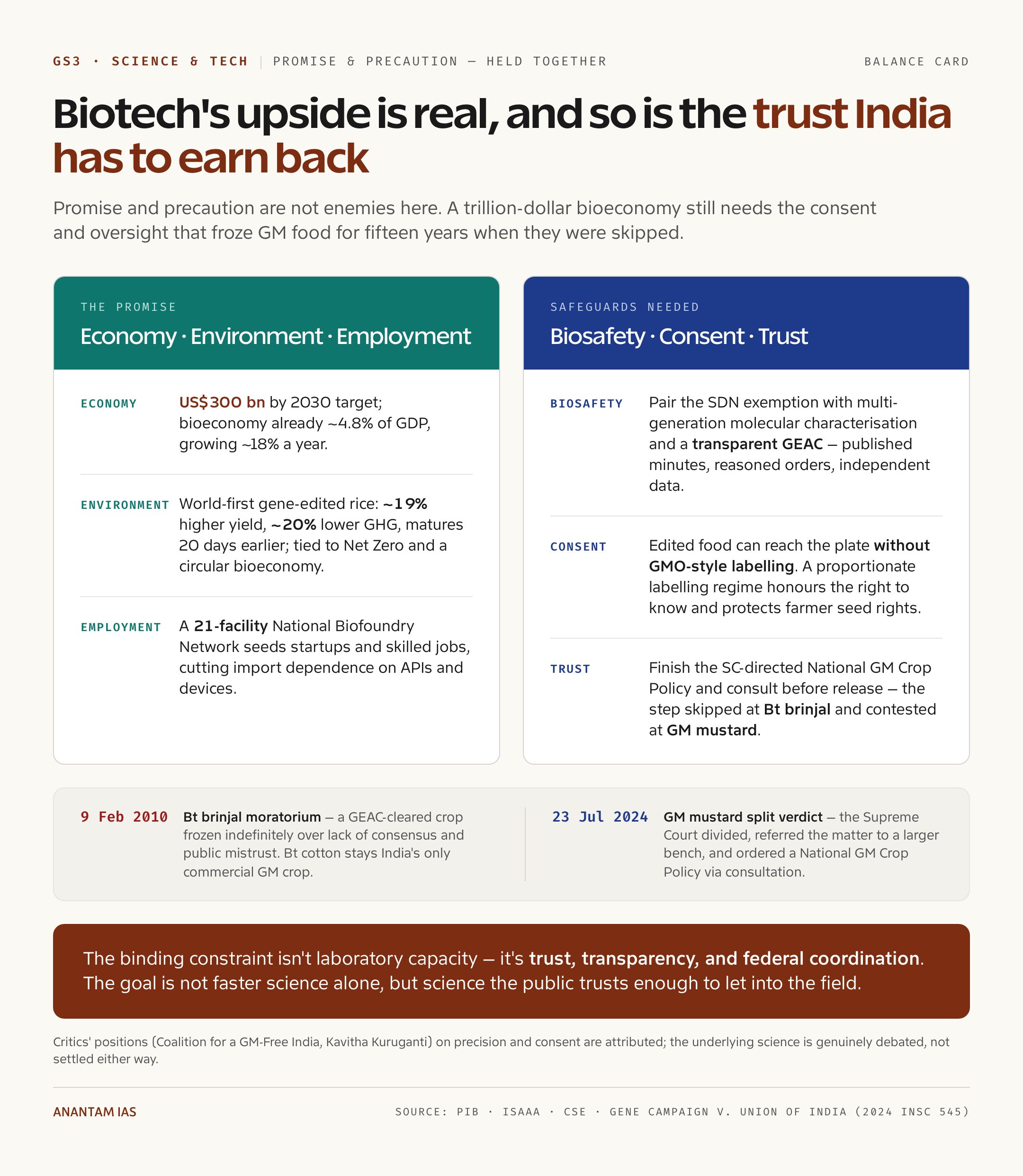
Go back to 9 February 2010. The environment minister imposed an indefinite moratorium on Bt brinjal, overruling GEAC’s own approval from months earlier. His reasons weren’t anti-science slogans. He cited the absence of independent biosafety data, the lack of scientific consensus, opposition from brinjal-growing states, and public mistrust. Bt brinjal would have been India’s first GM food crop. It never happened. Bt cotton remains the only commercial GM crop in the country to this day. So India has already lived the lesson that scientifically “approved” and socially “accepted” are not the same thing. Skip the second and the first gets reversed.
The 2024 GM-mustard split verdict is the same lesson, restated by the Supreme Court. When the apex court divides down the middle on whether a single crop can be released, and then orders the government to go build a national policy through consultation, it’s telling you the governance scaffolding was never finished. Agriculture is a State subject, environment is concurrent, and a centrally cleared GMO lands on fields the states administer. So the friction here is structural, federal, and built into the Constitution, not just partisan noise.
Now hold the gene-editing exemption against that backdrop. The 2022 decision is scientifically coherent, no foreign DNA, lighter regulation. But it was taken largely through an office memorandum and guidelines, the administrative route, not through the kind of visible public process that might have built consent. So even if the science is sound, the method of deciding repeats the old pattern: experts decide, the public is informed afterward, and trust never gets rebuilt. The Bt brinjal reversal happened to a crop GEAC had already cleared. That should worry anyone betting a US$300 billion bioeconomy partly on public acceptance.
And here’s the part that should bother a future administrator most. The strongest case for moving fast, climate-resilient food, import substitution, jobs, is real and urgent. But urgency is exactly the condition under which corners get cut on consent and monitoring. So the deeper read isn’t pro-biotech or anti-biotech. It’s that India’s binding constraint isn’t laboratory capacity. It’s the trust, transparency, and federal coordination that decide whether a brilliant edit ever reaches a field, or gets frozen for a decade like the last one did.
What Should Be Done
So what does a fair, pro-science biosafety regime actually look like? Not a vague plea to “balance innovation and safety,” but a set of guardrails you could hand a policymaker tomorrow. Seven of them, and none weakens the science.
- Keep the SDN distinction, but attach product-level proof. The SDN-1/SDN-2-versus-SDN-3 line is scientifically sound and worth keeping. But pair the lighter-touch route with mandatory molecular characterisation of each released edit, across multiple generations, plus a public registry of every gene-edited variety cleared. The exemption should buy speed, not opacity. India’s broader science and technology policy framework already values indigenisation; transparent characterisation is what makes that indigenisation trustworthy.
- Finish the National GM Crop Policy the Court asked for. The 2024 verdict directed the Centre to frame one through national consultation. Do it, and do it visibly. A settled, published policy is the difference between a regime that survives litigation and one that gets frozen by it.
- Reform GEAC for transparency. Publish minutes, reasoned orders, and the independent biosafety data behind approvals. The proposed transparency reforms should become standing practice. A regulator whose reasoning is visible is far harder to attack as captured or opaque, which is exactly the charge that sank Bt brinjal.
- Build a proportionate labelling and consent regime. Not to stigmatise gene-edited food, but to honour the right to know. Clear, simple labelling treats consumers as adults and removes a grievance that critics will otherwise weaponise.
- Protect farmer seed rights against monopoly. Use the Protection of Plant Varieties and Farmers’ Rights Act, 2001, which guarantees farmers the right to save and reuse seed, and lean on public-sector breeding by ICAR and licensing terms that prevent any single firm cornering the seed market. The Bt brinjal fear was about seed power; answer it directly.
- Institutionalise public engagement before release, not after backlash. The Bt brinjal consultations, whatever their result, gave the decision legitimacy. Build that consultation in by design for major releases, so trust is earned upstream rather than fought over downstream. India’s wider agriculture and food security goals depend on farmers and consumers actually accepting the technology.
- Run independent, published post-release monitoring. Multi-generation field surveillance for gene flow, agronomic stability, and ecological effects, audited by someone other than the developer, and put online. With the bioeconomy heading toward US$300 billion, independent monitoring keeps both the science and the public trust out of the partisan crossfire.
Every one of these strengthens biotechnology rather than slowing it. A bioeconomy built in the open, with edits documented, regulators transparent, and farmers and consumers brought along, is a bioeconomy that doesn’t get frozen the way Bt brinjal did. That’s the entire point of doing the safeguards properly.
For Your Mains Answer
This is a GS3 science-and-technology topic with a strong GS2 governance-and-ethics spine. It touches biotechnology, IPR, environment and biodiversity, food security, the economy, regulatory bodies, and federalism in one frame.
GS paper mapping: GS3: developments in science and technology, biotechnology and biosafety, environment and biodiversity, food security and cropping patterns, indigenisation and IPR, economy and employment. GS2 overlaps: governance and regulatory transparency, statutory and regulatory bodies (GEAC), Centre-State relations, judicial review, and ethics of consent and equity.
Likely question frames:
- BioE3 and gene editing offer India a large economic and food-security opportunity, but biosafety and public trust remain unresolved. Critically examine.
- “Scientifically approved is not the same as socially accepted.” Discuss in the context of India’s gene-edited crops and its GM-crop trust deficit.
- Gene editing exempts crops with no foreign DNA from full biosafety review. Evaluate whether India’s regulatory framework is adequate to the technology it now permits.
Quotable data points:
- India’s bioeconomy: US$10 billion (2014) to US$195.3 billion (2025), about 18% year-on-year, nearly 4.8% of GDP.
- Target of US$300 billion by 2030; a stated goal of about US$1 trillion by 2047 (projection, attribute it).
- BioE3 Policy approved 24 August 2024, India’s first dedicated biotechnology policy, with six thematic sectors.
- National Biofoundry Network: 21 facilities, launched 1 September 2025 on BioE3’s first anniversary.
- World’s first genome-edited rice released 4 May 2025: Kamala (DRR Dhan 100) and Pusa DST Rice 1, via CRISPR SDN-1, no foreign DNA.
- Kamala: about 19% higher yield, 20% lower emissions, 20 days earlier maturity, an estimated 7,500 million cubic metres of water saved at scale.
- SDN-1 and SDN-2 crops exempted from full biosafety review (2022); SDN-3 still regulated as GM.
- Trust backdrop: Bt brinjal moratorium 9 February 2010; GM mustard Supreme Court split verdict 23 July 2024, with a directive to frame a National GM Crop Policy.
Keywords to use: bioeconomy, biomanufacturing, biofoundry, site-directed nuclease, transgenic versus gene-edited, biosafety, gene flow, precautionary principle, regulatory transparency, informed consent, seed sovereignty, circular bioeconomy.
Syllabus linkages: science and technology developments and applications, biotechnology and biosafety, environment and biodiversity, food security, IPR, regulatory bodies, judicial review, federalism, and ethics.
Balanced conclusion line: India’s biotech promise is real and worth backing hard, but a bioeconomy that outruns its own biosafety, transparency, and consent machinery risks another Bt-brinjal-style freeze; the goal is not faster science alone, but science the public can trust enough to let into the field.
How to Build the Answer
Open with the tension, not a textbook definition. The sharpest first line pairs the world-first rice release on 4 May 2025 with the protest that followed it. That single contrast tells the examiner you’ve grasped both the promise and the trust problem in one stroke. The definitions of BioE3 and gene editing can follow in the next sentence. The opening should frame the clash, not recite a glossary.
Bring data in early, but ration it. A strong first body paragraph can carry three numbers: US$195.3 billion bioeconomy, the US$300 billion 2030 target, and Kamala’s 19% yield gain. Then say what those numbers prove, that biotech is both an economic engine and a climate-agriculture tool. UPSC rewards the move from fact to inference. The figure is the anchor; the “this means” is the mark.
The second body paragraph should steelman the other side. If your stance backs the technology, first admit why the precaution case is legitimate, off-target edits, gene flow, consent, the GM trust deficit. If your stance is cautious, first state what real problem gene editing solves, water stress, salinity, food security under climate change. That’s how an answer reads balanced without going vague.
The way forward must be grouped, not scattered. Cluster the reforms: keep the SDN distinction with product-level proof, finish the National GM Crop Policy, reform GEAC transparency, build labelling and consent, protect farmer seed rights, engage the public before release, and monitor independently after. Use the topic’s own vocabulary, biosafety, gene flow, precautionary principle, regulatory transparency, so the answer sounds like governance analysis rather than a news recap.
Close on the syllabus link, biotechnology and biosafety, regulatory bodies, federalism, ethics. The last line should not echo the introduction. It should show judgment. The reliable pattern is “the goal is not X alone, but X with Y,” which lets you balance promise with precaution, speed with trust.
Common Mistakes to Avoid
- Don’t write only the cheerleader’s answer. Listing the bioeconomy numbers and the rice yields without the biosafety and trust side reads as a press release, not analysis.
- Don’t write only the activist’s answer either. Treating all gene editing as dangerous ignores the genuine no-foreign-DNA distinction and the real climate-agriculture payoff.
- Don’t conflate gene editing with transgenic GM. The SDN-1/SDN-2 (no foreign DNA) versus SDN-3 (foreign gene) line is the single most important technical point in the topic. Get it right.
- Don’t claim GM mustard is “approved” or “banned.” The 2024 verdict was a split with no final ruling; it referred the matter and ordered a national policy. State exactly that.
- Don’t forget the human stakes. Name the salinity-hit farmer who could use Pusa DST Rice 1, and the consumer who wants to know what’s on the plate. UPSC rewards answers that say who gains and who’s at risk.
A Compact Answer Spine
- Introduction: Open with the world-first rice release and the protest that followed; define BioE3 and gene editing in the next sentence.
- Evidence: Use two or three attributed data points, the bioeconomy size, the 2030 target, Kamala’s yield gain, and tie each to an implication.
- Arguments: The case for backing biotech, then the case for caution on biosafety, consent, and trust. Keep both fair.
- Structural diagnosis: The binding constraint is trust and transparency, not lab capacity; Bt brinjal and GM mustard are the proof.
- Way forward: Four to five grouped guardrails, each with a clear actor, GEAC, the Centre, ICAR, an independent auditor.
- Conclusion: Adapt the balanced conclusion line to the exact question wording.
Diagram or Flowchart Idea
For a 15-marker, draw one clean comparison, not a decorative mind map. A three-step horizontal flow works best here: conventional breeding (no lab DNA tools) → gene editing SDN-1/SDN-2 (edits the plant’s own genes, no foreign DNA, lighter regulation) → transgenic GM / SDN-3 (foreign gene inserted, full GEAC review). Tag Kamala and Pusa DST Rice 1 on the middle box, Bt cotton and DMH-11 mustard on the right. The examiner reads the whole regulatory logic in five seconds.
For a 10-marker, skip the diagram unless it’s genuinely simple. A two-column table, “Promise” against “Safeguards needed,” does more work and is faster to evaluate under time pressure.
Ethics and Governance Angle
Add one ethical line even in a GS3 answer. The questions under the surface here are about consent (should food be labelled even when no foreign DNA remains?), equity (who controls the seed, the public sector or patent holders?), and inter-generational duty (gene flow into wild relatives is hard to reverse). Naming a concrete stakeholder, the consumer who wants to know, the farmer who can’t afford monopoly seed, sharpens the answer.
Then convert the ethics into design. Don’t merely say “respect public trust.” Say how: transparent GEAC orders, a registry of released edits, proportionate labelling, consultation before release, and independent monitoring after. That’s the move from moral language to administrative maturity.
A useful sentence pattern travels across science-and-tech topics: “The technology is legitimate and valuable, but its social licence depends on transparency, consent, and capacity.” It backs the science without handing the State or the developer a blank cheque, which is exactly what an examiner wants on a balance question.
How to Use Data Without Sounding Mechanical
Use fewer numbers than you know. Three well-explained figures beat ten scattered ones. Lead with one big number (US$195.3 billion, the bioeconomy’s scale), use a second for the climate-agriculture payoff (Kamala’s roughly 19% yield gain), and use a third for the trust backdrop (the 2010 Bt brinjal moratorium, fifteen years of frozen GM food). One scale figure, one outcome figure, one cautionary date is usually enough.
Never leave a statistic standing alone. Follow it with “this means” or “the policy implication is.” That tiny move turns a fact sheet into analysis. In Mains, facts are raw material; judgment is the finished answer.
Finish by asking one question: can a tired examiner follow this in a single pass? If it needs rereading, simplify. Short introduction, data early, two sides marked cleanly, grouped way forward. Clarity isn’t a lower standard than depth. For UPSC, clarity is how depth becomes visible. Cut any line that sounds impressive but does no work, and replace it with a fact, a cause, a consequence, or a reform.
FAQ
What is the difference between gene editing and transgenic GM crops?
Transgenic GM crops carry a foreign gene inserted from another species, like the bacterial gene in Bt cotton. Gene editing rewrites the plant’s own DNA, and in the SDN-1 and SDN-2 routes it leaves no foreign DNA behind, so the result can be indistinguishable from a conventionally bred plant. That’s why India exempted SDN-1 and SDN-2 crops from full biosafety review in 2022, while SDN-3, which does add a foreign gene, is still regulated as a GMO.
What is the BioE3 Policy and what is its target?
BioE3 stands for “Biotechnology for Economy, Environment and Employment,” India’s first dedicated biotechnology policy, approved on 24 August 2024 and run by the Department of Biotechnology. It backs biomanufacturing across six sectors and aims to grow India’s bioeconomy from US$195.3 billion in 2025 to US$300 billion by 2030, with a longer stated goal of about US$1 trillion by 2047.
Why was India’s gene-edited rice controversial?
The Coalition for a GM-Free India called the release “illegal and unsafe,” arguing that CRISPR is not fully precise in rice and that edits need multi-generation testing before release. Critics also asked why a yield-boosting edit is a priority when India already runs a rice surplus, and raised the lack of labelling and consent. These are attributed positions, and the underlying science is contested, but they reflect a real trust deficit from the Bt brinjal and GM mustard episodes.
What did the Supreme Court decide on GM mustard?
On 23 July 2024, a two-judge bench split on GM mustard (DMH-11): one judge quashed the environmental-release approval, the other upheld it, so there was no final ruling and the matter went to a larger bench. Both judges directed the Centre to frame a National GM Crop Policy through national consultation, which is why India’s GM-crop governance remains formally unsettled.
Tell Google you want more of this.
Add Anantam IAS as a preferred sourceOne tap, and this site shows up more often in your own Top Stories, AI Overviews and AI Mode. Remove it any time.





