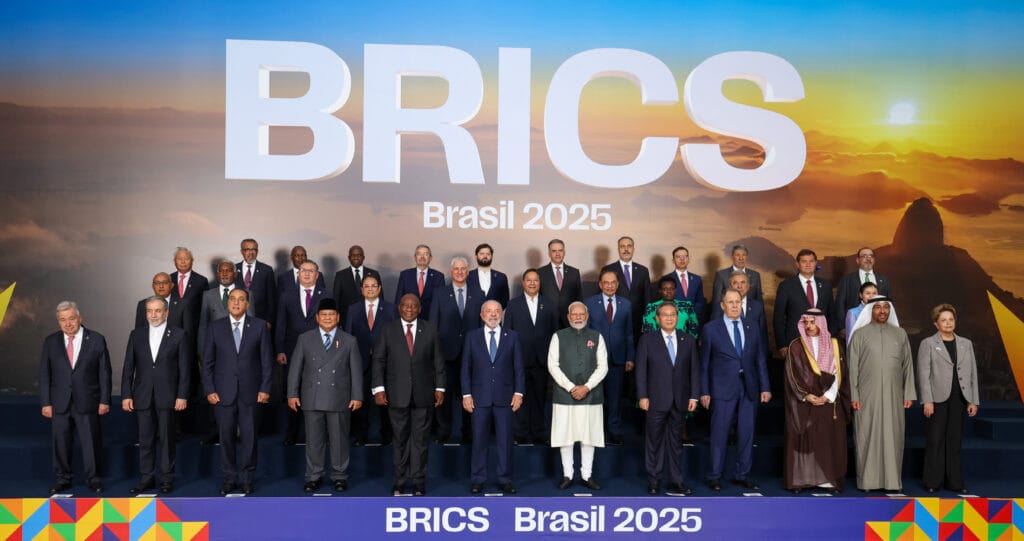
The 17th BRICS Summit was held on July 6-7, 2025 in Rio de Janeiro, Brazil, under Brazil's presidency. The summit was a landmark — the first BRICS Summit after the group's expansion in 2024 to include Egypt, Ethiopia, Iran, UAE, Indonesia, and (observer status) Saudi Arabia. The summit adopted the Rio Declaration and focused on themes of Global South solidarity, multilateralism, financial reform, and sustainable development.
For UPSC, the BRICS Summit 2025 is an important contemporary International Relations topic — covering India’s strategic positioning, global South initiatives, and the evolving world order.
BRICS Background
The Acronym
BRICS originally stood for:
- Brazil
- Russia
- India
- China
- South Africa
The acronym was coined by Jim O'Neill (Goldman Sachs economist) in 2001 as "BRIC" — with South Africa added in 2010 to make it "BRICS."
Foundation
- First BRICS Summit: 2009, Yekaterinburg, Russia
- South Africa joined: 2010 (after the 3rd summit)
- 17th Summit: 2025 (Rio de Janeiro)
BRICS Expansion (2024)
New Members
In January 2024, BRICS expanded to include five new members (Saudi Arabia was invited but has observer status pending formal acceptance):
| New Member | Region | Rationale |
|---|---|---|
| Egypt | Africa/Middle East | Large economy; Suez Canal gateway |
| Ethiopia | Africa (Horn) | Fast-growing African economy |
| Iran | Middle East | Strategic regional power |
| UAE | Middle East | Major financial hub |
| Indonesia | Southeast Asia | Largest SEA economy; G20 member |
Current Status
As of 2025, BRICS has:
- Original 5 members: Brazil, Russia, India, China, South Africa
- 5 new members: Egypt, Ethiopia, Iran, UAE, Indonesia
- Saudi Arabia: Invited but has not formally confirmed membership
- Possible future: Kazakhstan, Nigeria, Senegal, Argentina, Türkiye, Algeria, Vietnam, Cuba
Strategic Significance of Expansion
The expansion aims to:
- Increase BRICS's share of world GDP (from ~26% to ~30%+)
- Expand population representation (to ~45% of world)
- Diversify regional coverage
- Strengthen Global South solidarity
- Counter Western-led global institutions
17th BRICS Summit: Rio 2025
Key Details
| Attribute | Detail |
|---|---|
| Dates | July 6-7, 2025 |
| Venue | Rio de Janeiro, Brazil |
| Brazilian President | Luiz Inácio Lula da Silva |
| Indian representation | PM Narendra Modi |
| Expanded BRICS | First summit with all new members participating |
| Theme | "Strengthening Multilateralism for Just and Sustainable Development" |
Key Absentees
- President Vladimir Putin (Russia) did not attend in person — attended virtually due to ICC arrest warrant (relating to Ukraine war)
- President Xi Jinping (China) attended — major presence given China's leadership role
- All other heads of state attended
Agenda Focus Areas
Three Pillars of Brazilian presidency:
- Peace, security and global governance reform
- Inclusive and sustainable development
- Institutional strengthening of BRICS
Key Outcomes: The Rio Declaration
The Rio Declaration was adopted with significant provisions:
On Global Governance
- Reform of UN Security Council — support for expanded permanent membership including India and Brazil
- IMF and World Bank reform — increase Global South representation
- WTO strengthening — Brazil's priority agenda
- Multilateralism over unilateralism
On Economic Cooperation
BRICS Common Currency Discussion:
- Discussion of local currency trade settlement among members
- Long-term goal of de-dollarisation in BRICS trade
- Work on BRICS payments system (CIPS, SPFS, UPI integration)
- No immediate "BRICS currency" but steps toward it
New Development Bank (NDB):
- NDB's expanded lending capacity
- Focus on Africa and other Global South regions
- Increased lending in local currencies
- New members contributing capital
On Global South Solidarity
- Climate finance — developed nations' commitments
- Debt relief for developing nations
- Vaccine and technology transfer
- Food security support for Africa
- SDG financing initiatives
On Technology and Innovation
- AI cooperation among BRICS
- Digital public goods (like India's UPI)
- Joint research on emerging technologies
- Space cooperation (coordinated activities)
On Peace and Security
- Ukraine crisis — calls for dialogue and negotiated settlement
- Middle East — support for Palestinian statehood
- Africa — support for African Union initiatives
- Sanctions reform — protect Global South from unilateral sanctions
India's Role at the 2025 Summit
PM Modi's Key Contributions
At the 2025 summit, PM Modi emphasised:
- Indian economic transformation — India as fastest-growing major economy
- Democratic Global South — multi-party democracy as India's contribution
- Reforms to multilateral system — UNSC reform
- Technology initiatives — UPI, Aadhaar, India Stack for developing countries
- Climate leadership — International Solar Alliance
- Terrorism — call for zero-tolerance approach
India's BRICS Agenda
India continues to prioritise:
- UNSC permanent seat as major goal
- Terrorism designation reforms
- Multilateral reform (IMF, WB)
- Global South leadership
- Balance with the West — not anti-Western, but autonomous
India-Brazil Relations
Brazil hosting 2025 was significant:
- India-Brazil strategic partnership strong
- Food security cooperation
- Joint climate leadership
- BRICS mutual support
New Development Bank (NDB)
Role in BRICS
The New Development Bank (NDB), established in 2015, has become a major BRICS institution:
| Parameter | Detail |
|---|---|
| Headquarters | Shanghai, China |
| President | Dilma Rousseff (Brazil) — since 2023 |
| Authorised capital | $100 billion |
| Subscribed capital | $50 billion |
| Lending so far | Over $35 billion in projects |
| New members | UAE, Bangladesh, Egypt (2022-23); more expected |
NDB Focus
- Sustainable infrastructure projects
- Clean energy
- Transportation
- Water and sanitation
- Urban development
- Bridging infrastructure gaps in BRICS countries
Indian Projects
NDB has financed major Indian infrastructure projects:
- Mumbai Metro
- Madhya Pradesh rural infrastructure
- Andhra Pradesh roads
- Tamil Nadu urban infrastructure
- Pandemic response support (COVID-19 era)
BRICS Contingent Reserve Arrangement (CRA)
The CRA (established 2014) is another financial instrument:
- $100 billion pool for emergency financial support
- Alternative to IMF for BRICS members
- Each country's contribution:
- China: $41 billion
- Brazil, India, Russia: $18 billion each
- South Africa: $5 billion
BRICS vs. Other Groupings
BRICS vs. G7
| BRICS | G7 |
|---|---|
| Emerging economies | Developed economies |
| Population: ~45% of world | ~10% of world |
| GDP: ~30% of world | ~45% of world (still higher) |
| Global South focus | Western-led |
| No permanent UNSC member blocs | USA, UK, France have veto |
BRICS vs. G20
G20 includes:
- All 5 original BRICS + new BRICS members
- Plus US, UK, EU, Japan, Australia, etc.
- More comprehensive
BRICS vs. SCO
SCO (Shanghai Cooperation Organisation) overlaps but is distinct:
- Different focus (security-oriented)
- Different membership (Central Asia, India, China, Russia, Pakistan, Iran)
- BRICS more economic-focused
Challenges Facing BRICS
Internal Differences
Even original BRICS members have disagreements:
- India-China — border tensions
- Russia-China — growing dominance imbalance
- Brazil-India — occasional trade disputes
With New Members
Adding 5 new members (plus observer) creates:
- Decision-making complexity
- Different strategic interests (e.g., Iran's sanctions)
- Varying economic sizes
- Need for consensus
External Pressures
- US sanctions on Russia and Iran
- Technology export controls
- Chinese influence sometimes problematic for other members
Controversies
Russia-Ukraine War
BRICS's approach to Ukraine has been:
- Not condemning Russia's invasion
- Pressing for negotiations (neutral-seeming)
- Trade continues — India and China buy Russian oil
- Criticised as pro-Russian by the West
Iran Membership
Iran's BRICS membership is controversial:
- US opposition
- Middle East tensions (Iran vs. Israel, Saudi Arabia)
- Sanctions complications for BRICS financial cooperation
UPSC Relevance
GS2 (International Relations): BRICS, Global South diplomacy, multilateral institutions, India's foreign policy.
GS3 (Economy): NDB, CRA, international trade, de-dollarisation debate.
Key Prelims facts:
- 17th BRICS Summit: July 6-7, 2025
- Venue: Rio de Janeiro, Brazil
- Host: Brazilian President Lula da Silva
- Theme: Strengthening Multilateralism for Just and Sustainable Development
- First summit: 2009 Yekaterinburg, Russia
- S. Africa joined: 2010
- 2024 Expansion: Egypt, Ethiopia, Iran, UAE, Indonesia
- Saudi Arabia: Observer (invited but not formally accepted)
- Declaration: Rio Declaration
- NDB President: Dilma Rousseff (Brazil)
- NDB HQ: Shanghai
- CRA pool: $100 billion
- Acronym coined by: Jim O'Neill (2001)
- India's priorities: UNSC reform, terrorism, multilateral reforms
- Brazilian presidency's pillars: Peace/governance, sustainable development, institutional strengthening
Tell Google you want more of this.
Add Anantam IAS as a preferred sourceOne tap, and this site shows up more often in your own Top Stories, AI Overviews and AI Mode. Remove it any time.