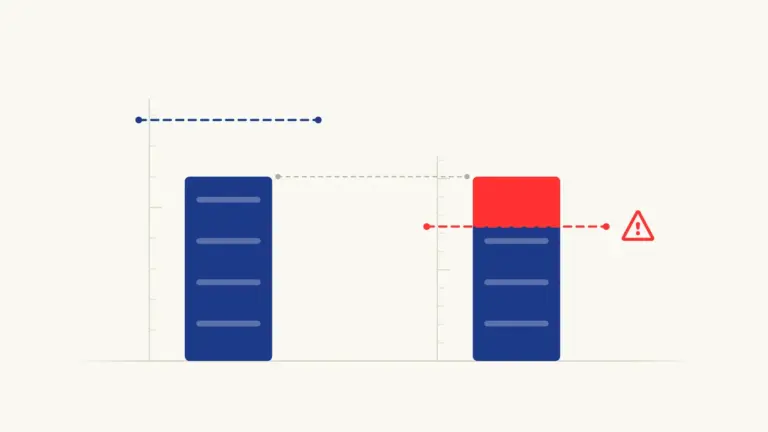
An Indian infrastructure company that needs twenty-year money has essentially one place to go: a bank whose own funding is largely short-term deposits. That mismatch is the practical form of India’s biggest capital market problem. Among the capital market issues India faces, the shallowness of the corporate bond market is the one that constrains everything else.
The size comparison is stark. India’s corporate bond market is about 15 to 18 percent of GDP. South Korea’s is roughly 80 percent, China’s about 36 percent.
Why the Bond Market Stays Shallow
Dominance of private placements. Nearly 98 percent of corporate bond issuance in India is through private placement. It is faster and cheaper for the issuer, but it excludes retail investors and concentrates holdings with a handful of institutions, so the market never develops depth.
Rating concentration. Issuance clusters in AAA and AA-rated securities. Lower-rated firms, particularly MSMEs and infrastructure companies, find it difficult to access long-term finance at all. The market therefore serves the borrowers with the least need for it, and is closed to those with the most.
Crowding out by government securities. Institutional investors prefer risk-free government securities, and large government borrowing absorbs a substantial share of institutional demand. Corporate issuers are left competing for what remains, at higher yields.
Policy restrictions on institutional investors. This is the constraint most often overlooked.
- Insurance investment norms set by IRDAI limit how much and what credit grade of corporate bonds insurers may hold
- EPFO and pension fund investment guidelines similarly restrict exposure to lower-rated corporate paper
Insurers and pension funds are the natural buyers of long-dated corporate debt, because their liabilities are long-dated too. Regulation keeps that pool largely out of the market it was built to serve.
Absence of liquidity. The main holders buy bonds to match long-term liabilities and hold to maturity, so they rarely trade. With private placement to a few institutions on the issuance side and buy-and-hold behaviour on the demand side, secondary market activity is minimal and price discovery is poor.
Each of these five reinforces the others. Illiquidity discourages retail entry, which sustains private placement, which deepens illiquidity.
Volatile Portfolio Flows
Foreign portfolio investment is highly sensitive to global interest rates and risk sentiment, which produces frequent inflows and outflows. That raises stock market volatility and exposes the economy to external financial shocks.
The mitigating development is genuine: rising domestic institutional investment, particularly through systematic investment plans, has partly offset the volatility by supplying a steady domestic bid. That is one of the clearest structural improvements in Indian markets over the past decade.
Why Net FDI Declined
The decline has both external and domestic drivers, and it is worth keeping them separate.
Global push factors.
- High US interest rates. Developed market bonds began offering strong returns at low risk, so global capital had little reason to take emerging market risk.
- Geo-economic fragmentation. Trade and investment splitting along geopolitical lines through tariffs, sanctions and supply chain realignment made firms cautious about long-term commitments abroad.
- Tighter global liquidity. As major central banks withdrew cheap money, the surplus pool that once spilled into emerging markets shrank.
- China plus one bypassing India. Firms did move capacity out of China, but most of it went to Vietnam, Indonesia and Mexico.
Domestic constraints.
- Residual tax policy risk. The legacy of unpredictable retrospective tax action left a lingering perception of policy risk.
- Slow contract enforcement. Disputes take years, which raises the cost of exit when a venture goes wrong, and investors price exit risk at entry.
- Regulatory and compliance burden. Multiple approvals, shifting compliance requirements and regulatory uncertainty raise the cost of establishing and operating a business.
The domestic list is the actionable one. India cannot set US interest rates. It can shorten a commercial dispute.
The Way Forward
- Recalibrate institutional investment norms. Allow insurers and pension funds graded, risk-weighted exposure to A-rated paper rather than a near-blanket restriction.
- Push issuance onto public platforms. Reduce the cost and time gap between a public issue and a private placement, so that depth becomes the cheaper route.
- Build a credible credit enhancement mechanism so that infrastructure and MSME issuers can reach investment grade rather than being excluded.
- Deepen secondary market infrastructure, including market making and repo in corporate bonds, which is what converts a holding into a tradable instrument.
- Shorten contract enforcement timelines, the single domestic reform that most improves both FDI and domestic investment appetite.
A bank-dependent economy can grow. It cannot easily finance twenty-year assets. That is why bond market depth is not a technical market issue but an infrastructure issue.
Frequently Asked Questions
How large is India’s corporate bond market?
About 15 to 18 percent of GDP. For comparison, South Korea’s is roughly 80 percent and China’s about 36 percent. The consequence is that Indian firms depend heavily on banks for long-term financing, which is a maturity mismatch for banks funded by short-term deposits.
Why do private placements dominate corporate bond issuance in India?
Nearly 98 percent of corporate bond issuance happens through private placement, because it is faster, cheaper and involves lighter disclosure than a public issue. The cost is market depth: retail investors are effectively excluded, and the bonds sit with a small number of institutional holders.
What is rating concentration in the bond market?
Issuance is concentrated in AAA and AA-rated securities. Lower-rated issuers, particularly MSMEs and infrastructure companies, struggle to access long-term finance at all, so the market serves the borrowers who least need it.
How do government securities crowd out corporate bonds?
Institutional investors prefer risk-free government securities, and large government borrowing absorbs a big share of available institutional demand. That reduces demand for corporate debt and raises the yield corporate issuers must offer.
How do regulatory norms restrict demand for corporate bonds?
Insurance investment norms set by IRDAI limit how much and what grade of corporate bond insurers may hold, and EPFO and pension fund investment guidelines similarly restrict exposure to lower-rated paper. Since insurers and pension funds are the natural long-term buyers, these norms keep a large pool of long-term savings out of the market.
Why is the corporate bond market illiquid?
The main holders are insurers, pension funds and provident funds that buy bonds to match long-term liabilities and hold them to maturity, so they rarely trade. Combined with private placement to a few institutions, this leaves very little secondary market activity and poor price discovery.
Why did net foreign direct investment decline?
Global push factors included high US interest rates that made developed market assets attractive at low risk, geo-economic fragmentation that made firms cautious about long-term commitments, tighter global liquidity as central banks withdrew cheap money, and the China plus one relocation going largely to Vietnam, Indonesia and Mexico rather than India.
What domestic constraints affect capital inflows?
Residual tax policy risk from earlier unpredictable tax action, slow contract enforcement that makes exit costly when a venture fails, and a regulatory and compliance burden of approvals and shifting requirements that raises the cost of establishing and operating a business.
Practice Questions
Prelims MCQs
- India's corporate bond market is approximately what share of GDP?
(a) 5 to 8 percent
(b) 15 to 18 percent
(c) 35 to 40 percent
(d) 75 to 80 percent
Answer: (b) At about 15 to 18 percent of GDP, it is far below South Korea at roughly 80 percent and China at about 36 percent. - Nearly what proportion of Indian corporate bond issuance is through private placement?
(a) 45 percent
(b) 70 percent
(c) 85 percent
(d) 98 percent
Answer: (d) Around 98 percent of issuance is privately placed, which limits retail participation and market depth. - Crowding out in the corporate bond market refers to
(a) Foreign investors displacing domestic ones
(b) Government securities absorbing institutional demand
(c) Banks refusing to lend to MSMEs
(d) Rating agencies downgrading issuers
Answer: (b) Institutional preference for risk-free G-Secs, combined with large government borrowing, reduces demand for corporate debt and raises corporate borrowing costs. - Which of the following most directly limits insurers' participation in lower-rated corporate bonds?
(a) SEBI listing requirements
(b) IRDAI investment norms
(c) RBI's repo rate
(d) Companies Act disclosure rules
Answer: (b) IRDAI investment regulations cap both the quantum and the credit grade of corporate bonds insurers may hold. - The China plus one relocation benefited India less than expected because most relocation went to
(a) Japan and South Korea
(b) Vietnam, Indonesia and Mexico
(c) Brazil and South Africa
(d) Germany and Poland
Answer: (b) Firms moving capacity out of China largely chose Vietnam, Indonesia and Mexico.
Mains Questions
- A shallow corporate bond market forces Indian banks into a maturity mismatch they are not designed to carry. Examine. (250 words)
- Discuss the regulatory constraints on institutional demand for corporate bonds in India and suggest calibrated reforms. (250 words)
- Examine the global and domestic factors behind the decline in net foreign direct investment into India. (250 words)
- Rating concentration means the corporate bond market serves the borrowers who need it least. Discuss. (150 words)
- Suggest measures to improve secondary market liquidity in Indian corporate bonds. (150 words)
Tell Google you want more of this.
Add Anantam IAS as a preferred sourceOne tap, and this site shows up more often in your own Top Stories, AI Overviews and AI Mode. Remove it any time.