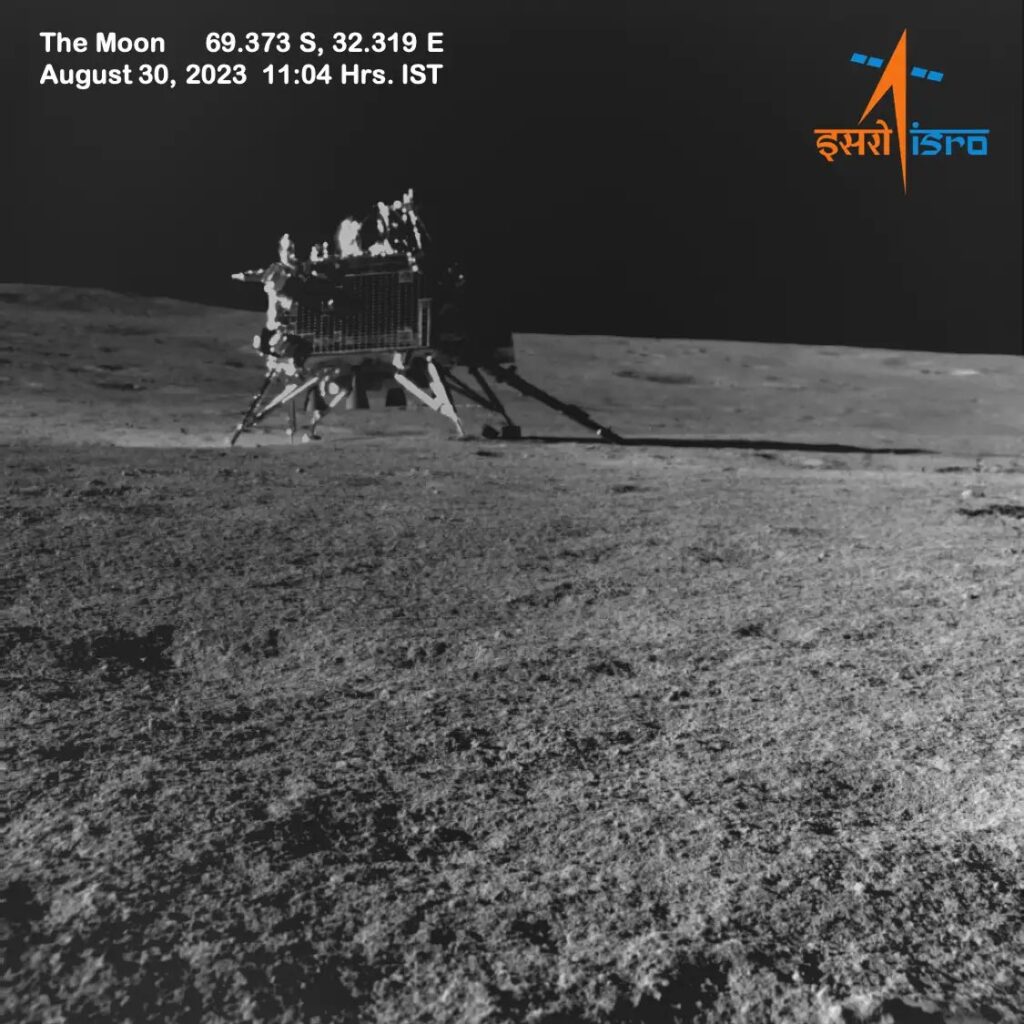
The Chandrayaan mission is the most successful chapter in India’s space story. On 23 August 2023, the Chandrayaan-3 lander Vikram touched down softly near the lunar south pole, making India the first country to land in that unexplored region and the fourth country ever to soft-land on the Moon. The Chandrayaan mission is not a single flight — it is a four-step ladder that began in 2008 with an orbiter that confirmed water on the Moon, stumbled in 2019 with a crash landing, redeemed itself in 2023 with a textbook touchdown, and now reaches for sample return through Chandrayaan-4 and a joint Indo-Japanese polar mission called LUPEX. Together, these flights have rewritten what an Asian space programme on a modest budget can achieve.
For a UPSC aspirant, the Chandrayaan mission matters across three syllabus areas at once — GS-III science and technology, GS-II international cooperation, and current affairs. The mission demonstrates India’s indigenous capability in cryogenic propulsion, autonomous navigation, terrain-mapping, and miniaturised scientific payloads, while also serving as soft-power leverage in the Artemis Accords and the Asian space race.
Background: From Vision to Vikram
India’s lunar dream is older than the Chandrayaan mission itself. In 1999, the Indian Academy of Sciences first floated a Moon flight; by 2003 the Vajpayee government cleared Chandrayaan-1, and ISRO chairman Dr K Kasturirangan led the early design. The word chandrayaan simply means “moon-craft” in Sanskrit, signalling the cultural framing ISRO has always given its planetary fleet. The Chandrayaan mission was approved on a shoestring — roughly ₹386 crore for the first flight — and built around a single proposition: prove that India can reach the Moon with a homegrown launcher and a science-grade payload list.
Strategic Rationale
The Chandrayaan mission has four strategic drivers — scientific (lunar water, mineralogy, helium-3 prospects), technological (deep-space tracking, autonomous landing, throttleable engines), economic (a stepping stone to a domestic space-industrial base now worth over $8 billion), and geopolitical (Artemis Accords signatory in 2023, balancing the Chinese Chang’e programme). Every Chandrayaan flight has answered one of these.
Lunar Geography Quick Recap
The Moon’s south polar region — where Chandrayaan-3 landed — is permanently shadowed inside its craters. Temperatures plunge to minus 230 degrees Celsius, allowing water ice to remain stable for billions of years. That ice is the future propellant depot for human missions to Mars, which is why every spacefaring country is now racing to map it.
Chandrayaan-1 (2008): The Water Discovery
Launched on 22 October 2008 from Sriharikota aboard a PSLV-XL, Chandrayaan-1 was India’s first deep-space flight. The orbiter carried 11 scientific payloads — five Indian, six international — and reached lunar orbit on 8 November 2008. On 14 November 2008, the Moon Impact Probe was deliberately crashed near the Shackleton crater, planting the Indian tricolour on the lunar surface.
What Chandrayaan-1 Discovered
The headline finding of the Chandrayaan mission came from NASA’s Moon Mineralogy Mapper (M3) flying as a guest payload on Chandrayaan-1. In September 2009, M3 data confirmed hydroxyl and water molecules on the Moon’s surface, especially at higher latitudes. India’s own Mini-SAR radar independently confirmed water ice in permanently shadowed craters. This single result rewrote the lunar science textbook — the Moon was no longer the bone-dry world Apollo had described.
Chandrayaan-1 also mapped magnesium, aluminium, silicon, calcium, iron and titanium across the lunar surface, detected past tectonic activity, and discovered a 1.7-kilometre underground lava tube near the equator that could one day shelter a lunar base.
Mission End
Contact with Chandrayaan-1 was lost on 28 August 2009, ten months into its planned two-year mission. Even so, NASA’s ground radar relocated the dormant orbiter in 2016, still circling the Moon — proof that ISRO’s orbit insertion had been textbook-precise.
Chandrayaan-2 (2019): The Hard Lesson
The second Chandrayaan mission was India’s most ambitious to date — an orbiter, the Vikram lander, and the Pragyan rover together on a single GSLV Mk III launch. It lifted off on 22 July 2019 and entered lunar orbit on 20 August 2019. The lander separated on 2 September.
Why Vikram Crashed
On 7 September 2019, Vikram began its descent. The first two phases — rough braking and fine braking — went according to plan. But during the camera-coasting phase, a software glitch in the throttle command caused excess velocity and a hard impact 500 metres from the planned site. ISRO Chairman K Sivan’s tearful image went viral across the country.
The orbiter, however, was a triumph. It carries eight instruments including the Terrain Mapping Camera 2, the Imaging Infrared Spectrometer and Chandra’s Atmospheric Compositional Explorer 2, and remains operational in lunar orbit — it later served as the communication relay for Chandrayaan-3.
Lessons That Shaped Chandrayaan-3
The post-mortem reshaped India’s lunar engineering. ISRO redesigned the lander with stronger legs, more fuel, a larger landing ellipse (4 km x 2.5 km instead of 500 m x 500 m), faster throttleable engines, and crucially, a software architecture that could autonomously abort and retarget mid-descent. Failure became the blueprint.
Chandrayaan-3 (2023): The Soft Landing
The Chandrayaan mission’s most celebrated chapter began with a launch from Sriharikota at 14:35 IST on 14 July 2023 aboard a Launch Vehicle Mark-3 (LVM-3). It carried a propulsion module, the redesigned Vikram lander and the six-wheeled Pragyan rover, weighing 3,900 kg in total.
Timeline of the Landing
After lunar orbit insertion on 5 August 2023 and several de-boost manoeuvres, Vikram separated from the propulsion module on 17 August. Powered descent began at 17:44 IST on 23 August 2023. Eighteen minutes later, at 18:04 IST, Vikram landed softly at 69.37 South latitude, 32.35 East longitude — closer to the lunar south pole than any spacecraft in history. India became the fourth country to soft-land on the Moon after the Soviet Union, the United States and China, and the very first to reach the south polar region.
What Vikram and Pragyan Found
Pragyan rolled out four hours after touchdown and operated for one lunar day (about 14 Earth days). Among its key findings:
- Sulphur on the surface — the Laser Induced Breakdown Spectroscope (LIBS) on Pragyan made the first in-situ confirmation of sulphur near the south pole, along with aluminium, calcium, iron, chromium, titanium, manganese, silicon and oxygen.
- No hydrogen detected at that exact site — surprising, because trapped hydrogen would have indicated water ice. Future missions will sample inside permanently shadowed craters.
- A seismic event — Vikram’s ILSA instrument recorded a natural event on 26 August 2023, the first seismic measurement on the Moon since the Apollo era.
- Temperature profile — ChaSTE thermometer recorded a 70-degree-Celsius surface temperature dropping to minus 10 degrees at just 8 cm depth, far steeper than expected.
On 3 September 2023, Vikram performed a small “hop” — firing engines, lifting 40 cm and landing again — proving in-flight propulsion that will be essential for Chandrayaan-4 sample return. The lander and rover went to sleep when lunar night fell on 4 September and did not wake up on 22 September as hoped, but the mission had already returned every objective.
Chandrayaan-4 and LUPEX: What Comes Next
The next leg of the Chandrayaan mission is a two-launch architecture announced by Prime Minister Narendra Modi as part of the Amrit Kaal vision for space.
Chandrayaan-4 — Sample Return
Approved by the Union Cabinet in September 2024 with a budget of ₹2,104 crore, Chandrayaan-4 will be India’s first lunar sample-return mission. It consists of five modules — Propulsion Module, Descender Module, Ascender Module, Transfer Module and Re-entry Module — which will be launched in two stacks on two separate LVM-3 rockets, dock in Earth orbit, travel together to the Moon, land near the south pole, collect 2-3 kg of lunar soil, and return the sample to Earth around 2027. The mission validates docking, lunar ascent, and Earth re-entry technologies that India will need for Gaganyaan-class human missions to the Moon.
LUPEX — The Indo-Japanese Polar Mission
The Lunar Polar Exploration Mission (LUPEX) is a joint flight with the Japan Aerospace Exploration Agency (JAXA). JAXA provides the lander and the H3 rocket; ISRO provides a 350-kg rover that will operate inside permanently shadowed craters and dig up to 1.5 metres deep to sample water ice directly. The launch is targeted for around 2027-28. LUPEX gives India its first crack at confirming exploitable lunar water — a strategic asset for any future Moon economy.
Bharatiya Antariksh Yatri — Crewed Moon by 2040
The Prime Minister has set a national target of landing an Indian astronaut on the Moon by 2040. The roadmap stacks logically: Gaganyaan crewed flight by 2026, Bharatiya Antariksh Station by 2035, Chandrayaan-4 sample return demonstrating ascent and docking, and finally an LVM-3 successor — the Next Generation Launch Vehicle — carrying a crewed lunar module.
Why the Chandrayaan Mission Matters for UPSC
The Chandrayaan mission is a high-frequency Prelims and Mains topic. Past questions have asked about Chandrayaan-2 payloads, the significance of the south polar landing site, the role of the LVM-3, and the geopolitical dimensions of India joining the Artemis Accords in 2023.
GS-III Science and Technology Angles
- Indigenous cryogenic engine development on LVM-3
- Autonomous hazard detection and avoidance (Lander Hazard Detection and Avoidance Camera)
- Throttleable liquid engines (800 N class) developed by Liquid Propulsion Systems Centre
- Cost-effective space engineering — Chandrayaan-3 total cost ₹615 crore, less than several Hollywood films
GS-II International Relations Angles
- Artemis Accords signed by India in June 2023
- ISRO-JAXA cooperation through LUPEX
- Earlier ISRO-NASA cooperation on Chandrayaan-1 (M3 payload)
- The new India-US Initiative on Critical and Emerging Technology (iCET) covers space
GS-I Geography Angle
The lunar south polar geography — permanently shadowed regions, low solar elevation, cold traps and the geological history of impact basins — is now examinable.
Frequently Asked Questions
When did Chandrayaan-3 land on the Moon?
Chandrayaan-3 soft-landed on 23 August 2023 at 18:04 IST near the lunar south pole, at coordinates 69.37 degrees South and 32.35 degrees East — the closest landing to the south pole ever attempted by any country. The day is now observed as National Space Day in India.
Which countries have soft-landed on the Moon before India?
Before India, only three nations had soft-landed spacecraft on the Moon — the Soviet Union (Luna 9 in 1966), the United States (Surveyor 1, also in 1966), and China (Chang’e-3 in 2013). India became the fourth, and the first to reach the south polar region.
Why did Chandrayaan-2 fail to land?
Chandrayaan-2’s Vikram lander crashed on 7 September 2019 due to a software anomaly during the camera-coasting phase of descent. Excess velocity caused a hard impact about 500 metres from the planned site. However, the Chandrayaan-2 orbiter is still operational and served as the communications relay for Chandrayaan-3.
What did Chandrayaan-3 discover on the Moon?
Pragyan rover made the first in-situ confirmation of sulphur near the lunar south pole and detected aluminium, calcium, iron, chromium, titanium, manganese, silicon and oxygen. The ChaSTE probe found a steep temperature gradient — 70 degrees Celsius at the surface to minus 10 just 8 cm deep — and the ILSA instrument recorded a natural seismic event on 26 August 2023.
What is Chandrayaan-4?
Chandrayaan-4 is India’s first lunar sample-return mission, approved by the Cabinet in September 2024 with a ₹2,104 crore budget. It uses a five-module architecture launched on two LVM-3 rockets, will dock in Earth orbit, land near the south pole, collect 2-3 kg of regolith, and return the sample to Earth by around 2027.
What is the LUPEX mission?
LUPEX (Lunar Polar Exploration Mission) is a joint mission between ISRO and JAXA. JAXA provides the lander and the H3 launch vehicle; ISRO provides a 350-kg rover designed to operate inside permanently shadowed craters and drill up to 1.5 metres to directly sample lunar water ice. Launch is targeted around 2027-28.
How much did Chandrayaan-3 cost?
Chandrayaan-3 cost approximately ₹615 crore, roughly $75 million — less than the production budget of several major Hollywood films. The mission underscored ISRO’s reputation as the most cost-effective space agency in the world and made the Chandrayaan mission a global case study in frugal engineering.
What is the significance of landing near the lunar south pole?
The lunar south pole hosts permanently shadowed craters where temperatures stay below minus 230 degrees Celsius, allowing water ice to remain stable for billions of years. This ice can be mined for drinking water, oxygen and rocket propellant, making the south pole the most strategically valuable real estate on the Moon for any future human exploration. India’s Chandrayaan-3 was the first spacecraft to land in this region.
Tell Google you want more of this.
Add Anantam IAS as a preferred sourceOne tap, and this site shows up more often in your own Top Stories, AI Overviews and AI Mode. Remove it any time.