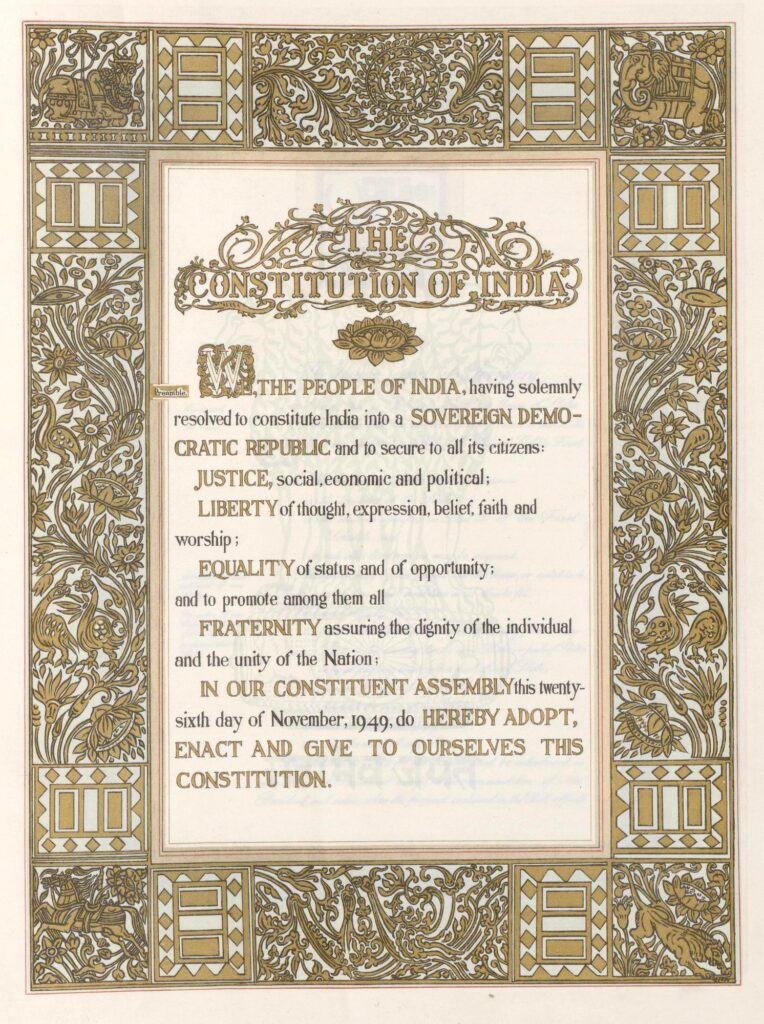
The commencement of the Indian Constitution is often reduced to a single date — 26 January 1950 — but the actual mechanics are spread across three short articles at the very end of Part XXII: Articles 393, 394, and 395. These provisions did the unglamorous but essential work of giving the Constitution its name, fixing the date it came into force, and clearing the legal field by repealing the older statutes that had governed British India.
These three articles are technical, but they answer practical questions: When exactly did the Constitution take effect? What happened to the Government of India Acts? Why is 26 January chosen, when the document was adopted on 26 November 1949? Understanding the commencement clauses is the cleanest way to see how the Constitution moved from a Constituent Assembly draft into the supreme law of a republic.
Article 393: Short Title
Article 393 gives the document its name: “This Constitution may be called the Constitution of India.” That is the entire content of the article. Its purpose is purely formal — every statute needs a short title for citation, and the Constitution is no exception.
The article is the first of the three commencement clauses in Part XXII and sets up the textual identity of the document. Whenever a court, a statute, or a notification refers to “the Constitution,” it is the entity created by Article 393 that is being invoked.
Article 394: Commencement of the Constitution
Article 394 is the heart of the commencement story. It provides that certain articles — namely 5, 6, 7, 8, 9, 60, 324, 366, 367, 379, 380, 388, 391, 392, and 393 — shall come into force at once, that is, on 26 November 1949, the date the Constituent Assembly adopted the Constitution. The remaining provisions shall come into force on 26 January 1950, which Article 394 calls “the date of commencement of this Constitution.”
Why two dates
The articles brought into force immediately on 26 November 1949 dealt with citizenship (Articles 5 to 9), election of the President (Article 60), the Election Commission (Article 324), definitions (Articles 366, 367), and the provisions concerning provisional Parliament and the transitional period (Articles 379, 380, 388, 391, 392). These needed to operate before 26 January 1950 to make the transition possible — voter rolls had to be drawn, the first President had to be elected, citizenship had to be settled.
The bulk of the Constitution, including fundamental rights, the structure of the Union and States, and the judicial system, came into force on 26 January 1950. This date was chosen to commemorate 26 January 1930, when the Indian National Congress, at its Lahore session, declared Purna Swaraj — complete independence — as the goal of the national movement.
The republic begins
From 26 January 1950, India ceased to be a Dominion under the Crown and became a sovereign democratic republic. The office of Governor-General disappeared. The Government of India Act, 1935, ceased to be the working constitution. The President, an elected head of state, replaced the Crown’s representative.
Article 395: Repeals
Article 395 cleared the older legal furniture. It repealed two principal enactments: the Indian Independence Act, 1947, and the Government of India Act, 1935, along with all enactments amending or supplementing the latter (but not laws then in force in the territories within India by virtue of those Acts).
Indian Independence Act 1947
This UK statute had partitioned British India into the Dominions of India and Pakistan and transferred legislative powers to the Constituent Assemblies of the two new states. With independence achieved and the Constitution adopted, the statute had served its purpose.
Government of India Act 1935
The 1935 Act had been the operative constitutional document for British India and continued, with adaptations, to govern the Dominion of India between 1947 and 1950. Many features of the Indian Constitution — the division of powers between Union and States, the office of Governor, the structure of the bureaucracy — were borrowed from this Act. Article 395 repealed it as a working constitution while preserving laws made under it that were still in force.
The repeal under Article 395 is one reason the Indian Constitution is often described as a continuation rather than a clean break. The legal fabric of British India was not erased; it was constitutionally re-anchored.
The Sequence: From Drafting to Commencement
The Constituent Assembly first met on 9 December 1946. The Drafting Committee, chaired by Dr B.R. Ambedkar, was appointed in August 1947. The Assembly adopted the Constitution on 26 November 1949 — a day now observed as Constitution Day of India. Articles needed for the transition came into force on that very day. The remainder came into force on 26 January 1950, the date the republic was formally inaugurated.
For deeper context on the document’s overall structure, see Important Articles of Indian Constitution and the broader comparison in Comparison of Constitution.
Why Commencement Clauses Matter
Commencement clauses are usually treated as administrative detail, but they carry substantive consequences. The two-stage commencement allowed transitional arrangements without legal vacuum. The repeal under Article 395 ensured the new Constitution was the only constitutional document in force. The choice of 26 January linked the republic to the freedom movement’s most ambitious declaration. Together, these three articles do the legal carpentry that lets every other provision of the Constitution operate.
FAQs
When did the Indian Constitution come into force?
The bulk of the Constitution came into force on 26 January 1950. A few provisions necessary for the transition came into force earlier, on 26 November 1949.
What does Article 394 of the Constitution provide?
Article 394 names 26 January 1950 as the date of commencement of the Constitution and lists specific articles that came into force on 26 November 1949 — including citizenship, elections, and transitional provisions.
Why was 26 January chosen as the date of commencement?
It commemorates 26 January 1930, when the Indian National Congress’s Lahore session declared Purna Swaraj — complete independence — as the national goal.
What does Article 395 repeal?
Article 395 repeals the Indian Independence Act, 1947, and the Government of India Act, 1935, along with its amending enactments, while preserving laws then in force under those Acts.
What is the short title of the Constitution under Article 393?
Article 393 provides that the document may be called “the Constitution of India.”
Did the Constitution replace the Government of India Act 1935 completely?
The 1935 Act was repealed as a working constitution, but laws and arrangements made under it that were in force on 26 January 1950 continued, suitably adapted to the new constitutional framework.
Which articles came into force on 26 November 1949?
Articles 5 to 9 (citizenship), 60 (election of President), 324 (Election Commission), 366 and 367 (definitions and interpretation), and Articles 379, 380, 388, 391, 392, 393 (transitional and short title), along with related provisions.
Is 26 November observed officially?
Yes. 26 November is observed as Constitution Day (Samvidhan Divas) since 2015, marking the adoption of the Constitution by the Constituent Assembly.
Tell Google you want more of this.
Add Anantam IAS as a preferred sourceOne tap, and this site shows up more often in your own Top Stories, AI Overviews and AI Mode. Remove it any time.