Disclosure: this guide contains Amazon affiliate links. As an Amazon Associate, Anantam IAS earns from qualifying purchases — at no extra cost to you.
Number series questions test your ability to recognize patterns. CSAT asks 1 to 3 number series questions almost every year, worth 2.5 to 7.5 marks. Though few in number, these questions can be solved in 30 to 60 seconds each, making them high-yield if you know the patterns.
Types of Number Series
- Arithmetic progression (AP): Constant difference.
- Geometric progression (GP): Constant ratio.
- Squares and cubes: n², n³, or variations.
- Prime numbers: 2, 3, 5, 7, 11, 13…
- Fibonacci-type: Each term = sum of previous two.
- Alternating series: Two interleaved patterns.
- Difference-of-differences: Second-level pattern.
- Mixed operations: +, -, ×, ÷ applied in sequence.
Standard Sequences to Memorize
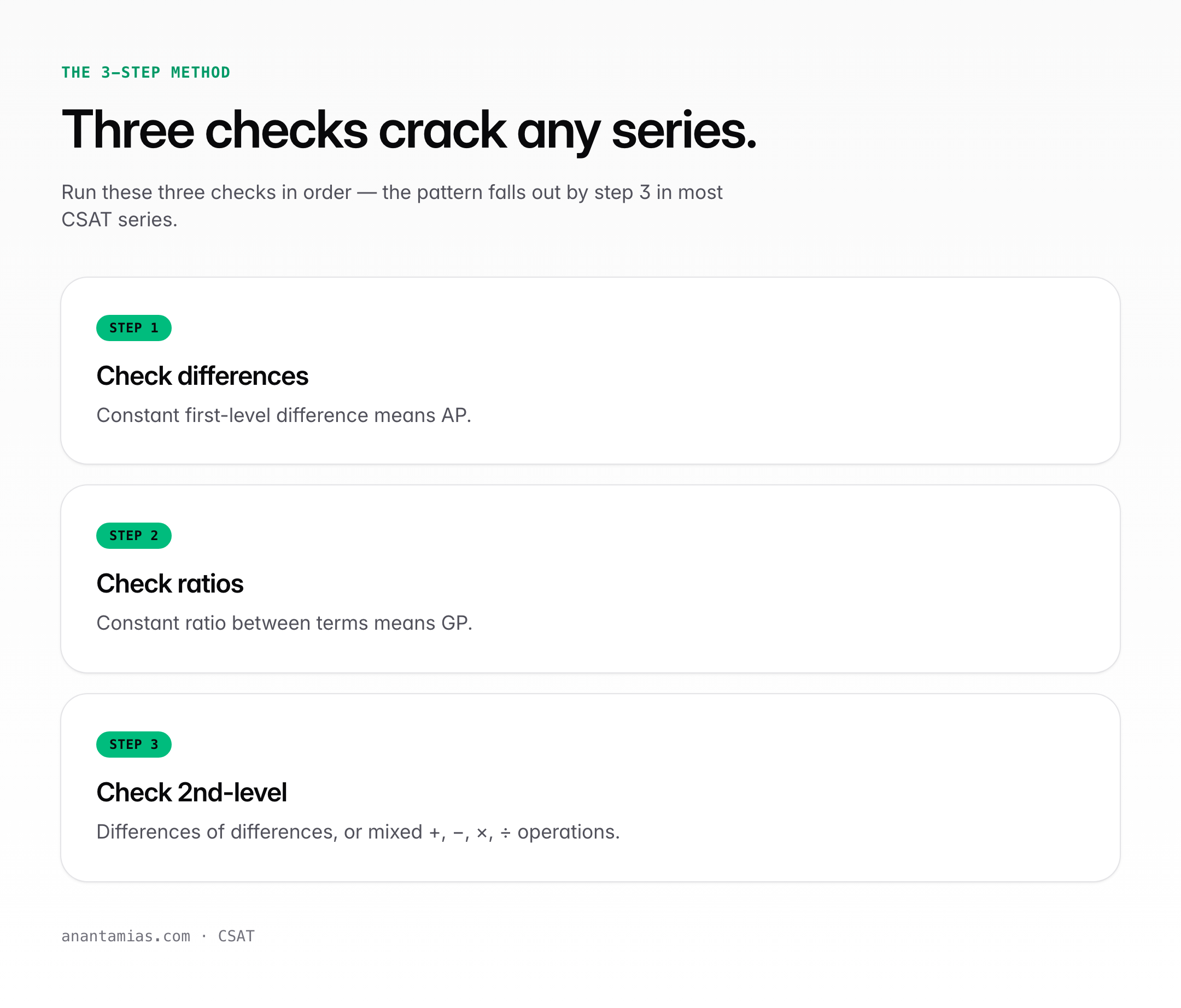
| Sequence | First Few Terms |
|---|---|
| Squares | 1, 4, 9, 16, 25, 36, 49, 64, 81, 100 |
| Cubes | 1, 8, 27, 64, 125, 216, 343, 512 |
| Primes | 2, 3, 5, 7, 11, 13, 17, 19, 23, 29 |
| Fibonacci | 1, 1, 2, 3, 5, 8, 13, 21, 34 |
| Factorials | 1, 2, 6, 24, 120, 720 |
| Triangular | 1, 3, 6, 10, 15, 21, 28 |
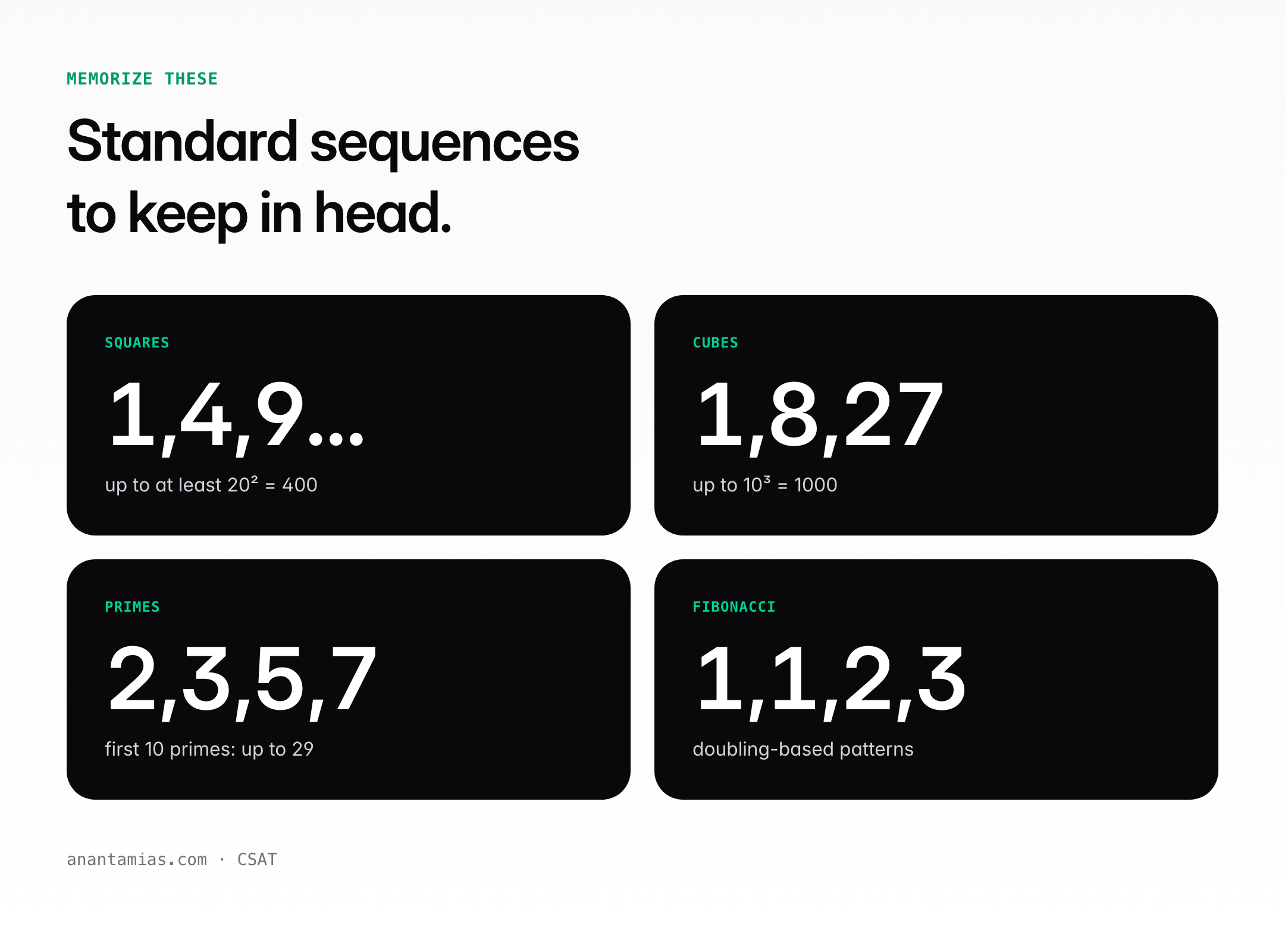
The 3-Step Pattern Recognition Method
- Check differences between consecutive terms. Constant difference = AP.
- Check ratios. Constant ratio = GP.
- Check second-level differences or patterns in +/-/×/÷ sequences.
Solved Examples
Example 1: Arithmetic
Series: 5, 9, 13, 17, 21, __?
Difference = 4. Next term = 21 + 4 = 25.
Example 2: Geometric
Series: 3, 6, 12, 24, 48, __?
Ratio = 2. Next term = 48 × 2 = 96.
Example 3: Squares
Series: 2, 5, 10, 17, 26, __?
Differences: 3, 5, 7, 9. These are odd numbers. Next difference = 11. Next term = 26 + 11 = 37. (Also recognizable as n² + 1 → 36 + 1 = 37.)
Example 4: Fibonacci-like
Series: 1, 1, 2, 3, 5, 8, __?
Each term = sum of previous two. Next = 5 + 8 = 13.
Example 5: Alternating
Series: 2, 5, 4, 10, 8, 20, 16, __?
Odd positions: 2, 4, 8, 16 (×2). Even positions: 5, 10, 20 (×2). Next (odd position): 16 × 2 = 32… but this is even position, so next is 16 × 2 → wait, position 8 is even, next even = 20 × 2 = 40.
Example 6: Mixed Operations
Series: 7, 8, 16, 19, 57, 62, __?
Operations: +1, ×2, +3, ×3, +5, ×? — next operation should be ×4 (pattern: +1, ×2, +3, ×3, +5, ×4). Next = 62 × 4 = 248.
Wrong-Term Series
UPSC sometimes asks: ‘Which term does not belong?’ Process each term and find the odd one. Example: 4, 9, 16, 24, 36 — pattern is squares (2², 3², 4², 6²), but 24 breaks the rule (should be 25). Answer: 24.
Common Traps
- Assuming AP when a GP is more likely (check ratios always).
- Missing that operations alternate (×2, +3, ×2, +3).
- Ignoring prime or composite patterns.
- Not checking if the pattern is on differences rather than terms.
Speed Drills

A Modern Approach to Verbal & Non-Verbal Reasoning — R.S. Aggarwal
- 932 pages across verbal and non-verbal reasoning
- Pattern-based practice for the reasoning half of CSAT
- Solutions worked out rather than just answer keys
- Memorize squares up to 30² (= 900) and cubes up to 15³ (= 3375).
- Practice 10 series problems daily for 30 days.
- Target 30 seconds per question.
- Keep a log: note what pattern fooled you, and revise weekly.
When to Skip
If no pattern emerges in 60 seconds, mark and move on. Number series reward quick insight. Forcing it wastes time better spent on RC or DI.
Key Takeaway
Number series is a small but reliable section. Master 8 standard patterns and you will crack 90% of questions asked. Memorize squares, cubes, primes, and Fibonacci — these cover most CSAT patterns.
Frequently Asked Questions
How many number series questions come in CSAT?
Usually 1 to 3 questions per year, worth 2.5 to 7.5 marks. Though few, they are high-accuracy questions when patterns are recognized quickly.
What is the most common pattern in CSAT number series?
Differences forming a sequence (often +2, +4, +6 or 1, 3, 5) and square/cube-based patterns are the most frequent. Fibonacci-type and alternating patterns come up occasionally.
How much time should I spend on a number series question?
Target 30 to 45 seconds. If no pattern is visible after 60 seconds, mark and return. Forcing a solution wastes time better invested in RC or DI.
Do I need to memorize long lists of numbers?
Yes: squares up to 30², cubes up to 15³, primes up to 50, and Fibonacci up to 10 terms. These cover 80%+ of UPSC number series patterns.
Are number series and letter series asked?
Number series almost every year. Letter series less frequently, but similar logic: shifts by position, alphabet position arithmetic, or alternating patterns.
Tell Google you want more of this.
Add Anantam IAS as a preferred sourceOne tap, and this site shows up more often in your own Top Stories, AI Overviews and AI Mode. Remove it any time.