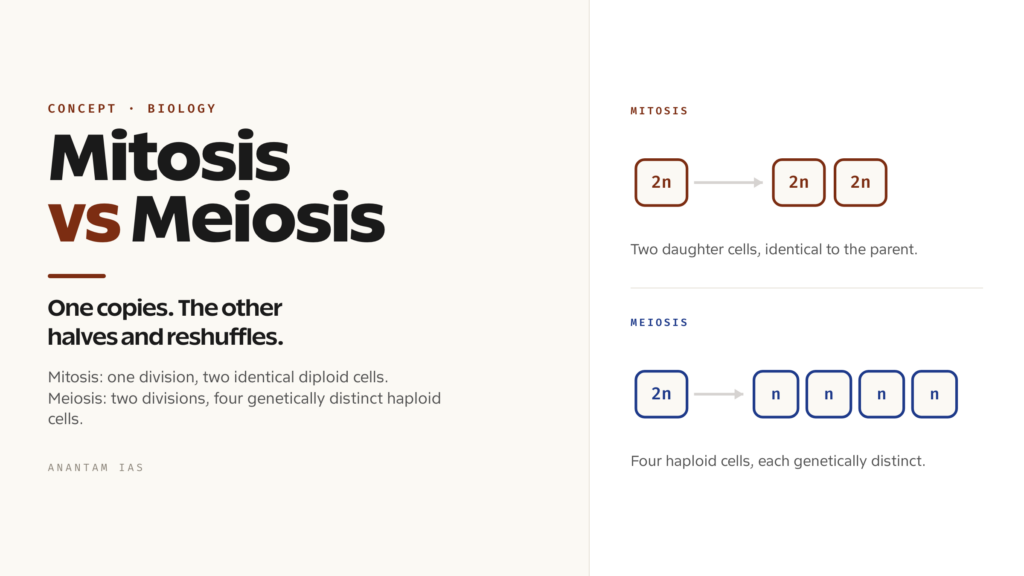
Mitosis is a single nuclear division that turns one cell into two genetically identical daughter cells with the same chromosome number as the parent. Meiosis is a pair of successive divisions that turns one cell into four genetically distinct daughter cells with half the chromosome number. That is the whole difference in two sentences — one copies, the other halves and reshuffles.
The distinction matters because the two processes serve opposite jobs. Mitosis keeps an organism the same: it builds tissue, replaces skin cells, heals a cut, and lets a single-celled organism reproduce without a partner. Meiosis makes an organism different: it produces eggs, sperm and spores, and in doing so generates the genetic variation that sexual reproduction depends on. Get the purposes right and the mechanics stop feeling arbitrary.
Defining Each Term
Mitosis is the division of a nucleus in which the replicated chromosomes are separated so that each daughter nucleus receives a complete, identical chromosome set. It follows interphase — the G1, S and G2 phases during which the cell grows and copies its DNA — and is conventionally split into four stages: prophase, metaphase, anaphase and telophase. Nuclear division is usually followed by cytokinesis, the physical splitting of the cytoplasm. In a human somatic cell, a 46-chromosome parent gives two 46-chromosome daughters.
The NCERT Class 11 biology treatment of the cell cycle adds a useful proportion: in a typical 24-hour human cell cycle, interphase occupies roughly 23 hours and mitosis itself under an hour. Division is the short, dramatic part of a long, quiet process.
Meiosis is a specialised division confined to germ-line cells, in which one round of DNA replication is followed by two rounds of chromosome segregation. Meiosis I separates homologous chromosomes — the maternal and paternal copies of each chromosome pair — and halves the chromosome number, which is why it is called the reductional division. Meiosis II separates sister chromatids without any further change in chromosome number, which is why it is called the equational division and why it looks so much like mitosis.
Two words worth fixing early. Diploid (2n) means two sets of chromosomes, one from each parent; human somatic cells are diploid at 46. Haploid (n) means one set; human gametes are haploid at 23. Meiosis is the only mechanism that takes a cell from 2n to n, and fertilisation is what restores 2n in the next generation.
The Key Differences at a Glance
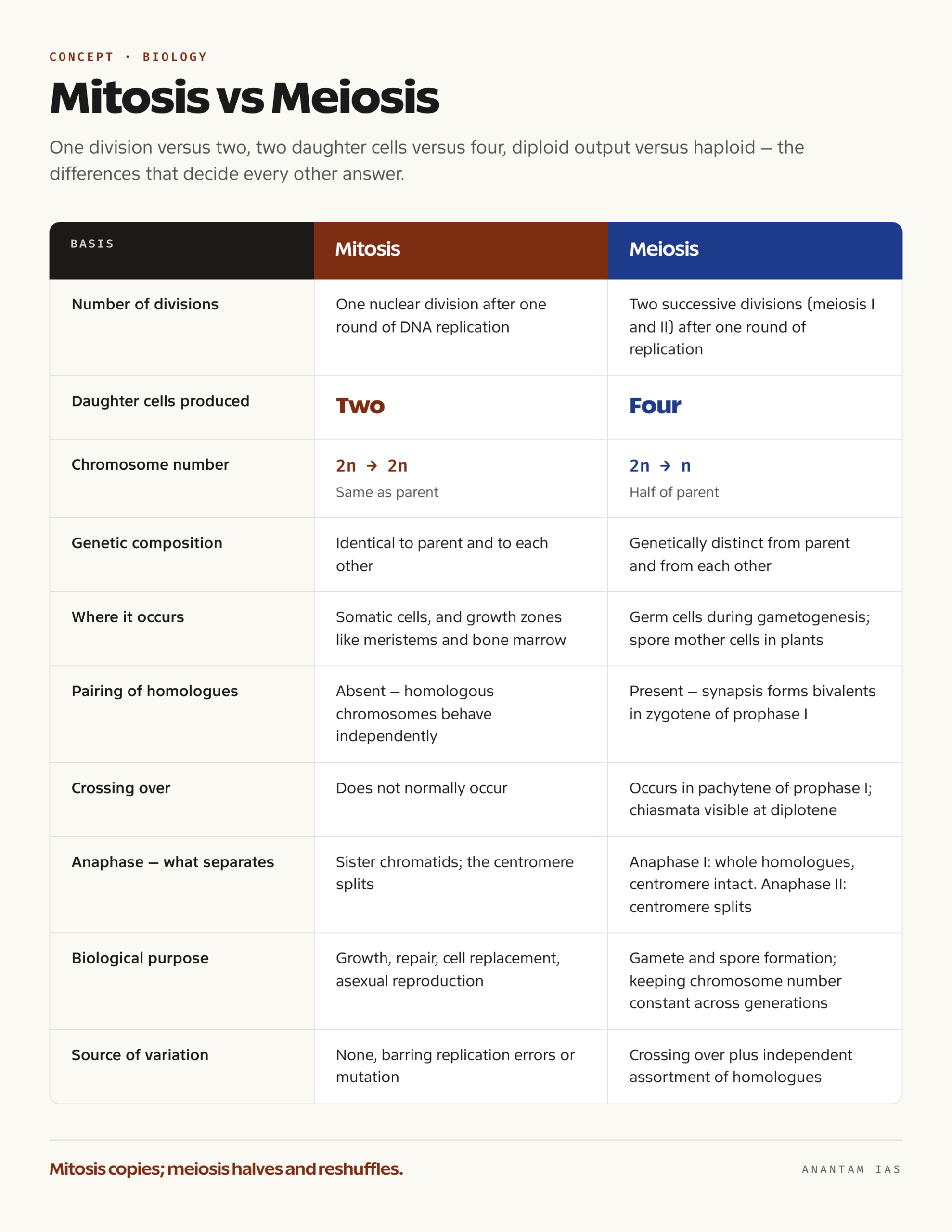
| Basis of Comparison | Mitosis | Meiosis |
|---|---|---|
| Number of divisions | One nuclear division after one round of DNA replication | Two successive divisions (meiosis I and II) after one round of DNA replication |
| Daughter cells produced | Two | Four |
| Chromosome number in daughters | Same as parent (2n → 2n) | Half of parent (2n → n) |
| Genetic composition | Identical to parent and to each other | Genetically distinct from parent and from each other |
| Where it occurs | Somatic (body) cells, and in growth zones like meristems and bone marrow | Germ cells during gametogenesis; spore mother cells in plants |
| Pairing of homologues | Absent — homologous chromosomes behave independently | Present — synapsis forms bivalents in zygotene of prophase I |
| Crossing over | Does not normally occur | Occurs in pachytene of prophase I; chiasmata visible at diplotene |
| Prophase | Short and simple, no substages | Prophase I is long and has five substages: leptotene, zygotene, pachytene, diplotene, diakinesis |
| Metaphase alignment | Individual chromosomes form a single plate at the equator | Metaphase I: bivalents align with homologues on opposite sides. Metaphase II: single plate, as in mitosis |
| What separates at anaphase | Sister chromatids; the centromere splits | Anaphase I: whole homologues move apart and the centromere does not split. Anaphase II: centromere splits and chromatids separate |
| Biological purpose | Growth, repair, cell replacement, asexual reproduction | Gamete and spore formation; maintaining chromosome number across generations; generating variation |
| Source of variation | None, barring replication errors or mutation | Crossing over plus independent assortment of homologues |
Mitosis Explained in Detail
Mitosis begins only after the S phase has duplicated every chromosome, so each chromosome entering prophase consists of two sister chromatids joined at a centromere. The cell is still diploid at this point — 46 chromosomes, but 92 chromatids. Counting chromatids as chromosomes is the single most common arithmetic slip in this topic.
Prophase. Chromatin condenses into visible chromosomes. The centrosomes move to opposite poles and the mitotic spindle starts to assemble. The nucleolus shrinks and the nuclear envelope begins to break down; by the end of prophase, in animal cells, it has gone.
Metaphase. Spindle fibres attach to kinetochores on either side of each centromere, and the chromosomes are pulled into a single plane at the cell’s equator — the metaphase plate. This is the stage where chromosome morphology is clearest, which is why karyotypes are prepared from metaphase-arrested cells.
Anaphase. The centromere of each chromosome splits, and the two sister chromatids — now full-fledged daughter chromosomes — are dragged to opposite poles. Because each pole receives one chromatid from every chromosome, both poles end up with a complete, identical set.
Telophase. Chromosomes reach the poles and decondense, the nuclear envelope reassembles around each set, and nucleoli reappear. Cytokinesis follows: animal cells pinch inward through a contractile ring to form a cleavage furrow, while plant cells build a cell plate outward from the centre because a rigid cell wall cannot be constricted.
The output is two cells that are, mutation aside, exact copies. That fidelity is what makes mitosis suitable for wound healing and for the continuous replacement of gut lining and blood cells, and it is also why failures of mitotic control — checkpoints that should halt a damaged cell — sit at the heart of cancer biology.
Meiosis Explained in Detail
Meiosis starts the same way, with a single S phase producing sister chromatids. What follows is two divisions with no replication in between, and that arithmetic alone forces the chromosome number down.
Meiosis I — the Reductional Division
Prophase I is long, and its five substages are worth learning by name because most of the genetics happens here.
- Leptotene — chromosomes condense and become visible as thin threads.
- Zygotene — homologous chromosomes pair lengthwise in a process called synapsis, held together by a protein scaffold, the synaptonemal complex. A paired set of two homologues (four chromatids) is a bivalent or tetrad.
- Pachytene — crossing over occurs. Non-sister chromatids of the paired homologues exchange corresponding segments at sites marked by recombination nodules, with the enzyme recombinase catalysing the exchange. This is where new combinations of alleles are physically created.
- Diplotene — the synaptonemal complex dissolves and the homologues start to separate, remaining joined at X-shaped points called chiasmata, the visible evidence of crossovers. Human oocytes stall in an extended diplotene, sometimes for decades, resuming only after puberty.
- Diakinesis — chiasmata terminalise, the nucleolus disappears, the nuclear envelope breaks down and the spindle completes.
Metaphase I. Bivalents line up at the equator, with the two homologues of each pair facing opposite poles. Which member of each pair faces which pole is random and independent for every pair — this is Mendel’s independent assortment, and with 23 human pairs it alone yields 2²³ possible combinations.
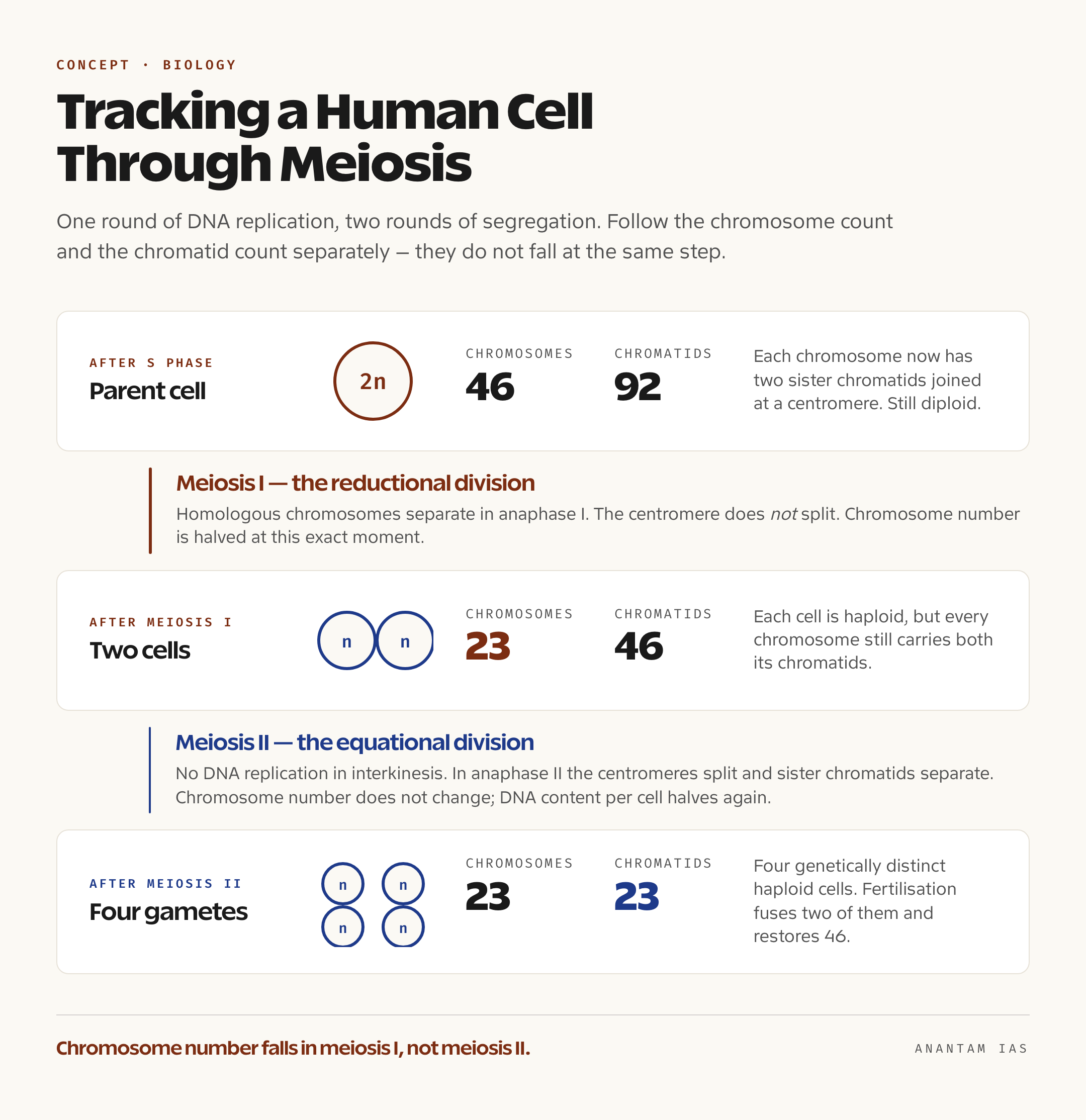
Anaphase I. Homologous chromosomes are pulled to opposite poles. The centromere does not split, so each chromosome still carries both its sister chromatids. Chromosome number is halved at this exact moment.
Telophase I and interkinesis. Nuclei may partly reform, and a short interphase-like gap called interkinesis follows. No DNA replication happens in it.
Meiosis II — the Equational Division
Meiosis II proceeds through prophase II, metaphase II, anaphase II and telophase II and is mechanically a mitosis performed on a haploid cell. In anaphase II the centromeres finally split and sister chromatids separate. Chromosome number does not change — it was already halved — but DNA content per cell halves again, because each daughter now gets one chromatid where the parent had two.
Track a human cell all the way through: 46 chromosomes with 92 chromatids at the start, then two cells of 23 chromosomes and 46 chromatids after meiosis I, then four cells of 23 chromosomes and 23 chromatids after meiosis II. Fertilisation fuses two such gametes and restores 46.
Where Students Get Confused
“Meiosis II halves the chromosome number again.” It does not. The reduction from 2n to n happens once, in anaphase I, when homologues separate. Meiosis II halves the DNA content per cell by separating chromatids, and leaves the chromosome count untouched at n.
Counting chromatids as chromosomes. A chromosome remains one chromosome whether it has one chromatid or two. The count is governed by the number of centromeres, not the number of strands. A human cell in metaphase of mitosis has 46 chromosomes and 92 chromatids, not 92 chromosomes.
Mixing up which stage splits the centromere. Mitotic anaphase splits it. Anaphase I does not. Anaphase II does. If the centromere splits, sister chromatids are separating; if it holds, whole homologues are moving.
Assuming meiosis alone creates variation. Two mechanisms operate together — crossing over in pachytene, which shuffles alleles within a chromosome, and independent assortment in metaphase I, which shuffles whole chromosomes between poles. Random fertilisation then multiplies the combinations again.
Thinking meiosis happens in all reproductive tissue. In flowering plants, meiosis occurs in the spore mother cells of the anther and ovule to make spores, and the gametes themselves are then produced by mitosis in the gametophyte. In animals, meiosis directly yields gametes. Assuming the animal pattern is universal produces wrong answers in plant reproduction.
Ignoring what happens when segregation fails. If homologues fail to separate in anaphase I or chromatids fail to separate in anaphase II — non-disjunction — a gamete ends up with an extra or missing chromosome. Trisomy 21, which causes Down syndrome, is the best-known outcome, and it links the mechanics of meiosis directly to clinical genetics.
Forgetting that mitosis also runs in haploid cells. Ploidy and division type are independent. Haploid cells in moss gametophytes and in fungal mycelia divide happily by mitosis. Mitosis preserves whatever ploidy it starts with; it does not require a diploid input.
FAQ
Q1. What is the single biggest difference between mitosis and meiosis? Mitosis is one division producing two identical cells of unchanged ploidy; meiosis is two divisions producing four genetically distinct cells of halved ploidy. Everything else follows from that.
Q2. Why is meiosis I called reductional and meiosis II equational? Meiosis I separates homologous chromosomes, so the chromosome number drops from 2n to n — a reduction. Meiosis II separates sister chromatids, so the number stays at n — an equal, or equational, split.
Q3. Does crossing over ever happen in mitosis? Not as a normal part of the process. Homologous chromosomes do not pair up in mitotic prophase, so there is no synaptonemal complex and no programmed exchange. Rare mitotic recombination does occur but it is an exception, not a stage.
Q4. How many cells and chromosomes does a human cell produce through each process? Mitosis of a human somatic cell gives two cells with 46 chromosomes each. Meiosis of a germ cell gives four cells with 23 chromosomes each, though in human females only one of the four becomes a functional egg and the rest are discarded as polar bodies.
Q5. Where does each process actually take place in the body? Mitosis runs in somatic tissue with active turnover — bone marrow, skin, the gut lining, and the growing tips of plant roots and shoots. Meiosis is restricted to the testes and ovaries in humans, and to the anther and ovule in flowering plants.
Practice Questions
Practice MCQs
- During which stage of meiosis does the chromosome number of the cell get halved? (a) Prophase I (b) Anaphase I (c) Anaphase II (d) Telophase II — Answer: (b) Homologous chromosomes separate in anaphase I, taking the cell from 2n to n.
- Crossing over between non-sister chromatids of homologous chromosomes occurs in which substage of prophase I? (a) Leptotene (b) Zygotene (c) Pachytene (d) Diakinesis — Answer: (c) Recombination nodules appear and segments are exchanged during pachytene; the resulting chiasmata become visible later, at diplotene.
- A diploid cell with 2n = 12 undergoes meiosis. How many chromosomes will each of the four daughter cells contain? (a) 12 (b) 6 (c) 24 (d) 3 — Answer: (b) Meiosis halves the chromosome number once, giving four cells of n = 6.
- Which of the following is true of anaphase I of meiosis but not of mitotic anaphase? (a) Spindle fibres shorten (b) Chromosomes move towards opposite poles (c) The centromere does not split (d) The nuclear envelope is absent — Answer: (c) Whole homologues migrate in anaphase I with sister chromatids still joined at an intact centromere.
- Synapsis, the pairing of homologous chromosomes accompanied by formation of the synaptonemal complex, takes place during (a) zygotene (b) pachytene (c) diplotene (d) metaphase I — Answer: (a) Synapsis defines zygotene; the paired homologues then form bivalents that persist into metaphase I.
Tell Google you want more of this.
Add Anantam IAS as a preferred sourceOne tap, and this site shows up more often in your own Top Stories, AI Overviews and AI Mode. Remove it any time.