Disclosure: this guide contains Amazon affiliate links. As an Amazon Associate, Anantam IAS earns from qualifying purchases — at no extra cost to you.
An Arihant CSAT book can help you build missing skills or practice previous questions, but those are two different jobs. Buying the solved-paper title when you need explanations leaves the basic gap untouched. Buying a complete manual when you already solve accurately may add reading time you don’t need.
I recommend Cracking the CSAT Paper II if you struggle to set up arithmetic problems or explain why a comprehension option is wrong. Choose the topicwise solved-paper book if your fundamentals are usable and you need systematic practice. Keep an older manual if its explanations work for you, and get recent official papers separately.
Choose The Right Arihant Title
Arihant publishes a complete manual and a separate collection of previous years’ questions. The verified English editions have different authors, ISBNs and coverage; a similar cover doesn’t make them interchangeable.
| Book | Verified Identity | Best Use | Main Boundary |
|---|---|---|---|
| Cracking the CSAT Paper II 2027 | Arihant; Mansi Gupta, Annu Vishwakarma, Mohit Sagar, Radhika Sharma and Dr. Rajesh Rajan; ISBN 9788169711067 | Concept study followed by exercises | Its listed solved papers cover 2025 and 2026, not the entire PYQ history |
| UPSC IAS Prelims CSAT 2027 (General Studies Paper II) Solved Papers | Arihant; Varun Bali and Santosh Dutt Pandey; ISBN 9788169711913 | Topicwise practice using papers from 2011 through 2026 | A solution collection isn’t a substitute for learning a method |
The English manual listing advertises 10 Crack Sets. Treat those as publisher-created practice sets, separate from official UPSC papers. The English solved-paper listing corresponds to the 16-year topicwise collection.
Arihant also lists a Hindi-medium 2027 manual, ISBN 9789378166730, credited to Rajesh Priyadershi, Mohit Sagar, Varun Bali, Devesh Sonakar and Dr. Rajesh Rajan. Check the language and ISBN before buying. The Hindi manual and the English solved-paper collection are separate products.
If you’re choosing across publishers, use our CSAT booklist. Here, your decision is narrower: which Arihant format fixes your present difficulty?
Diagnose Your Starting Point
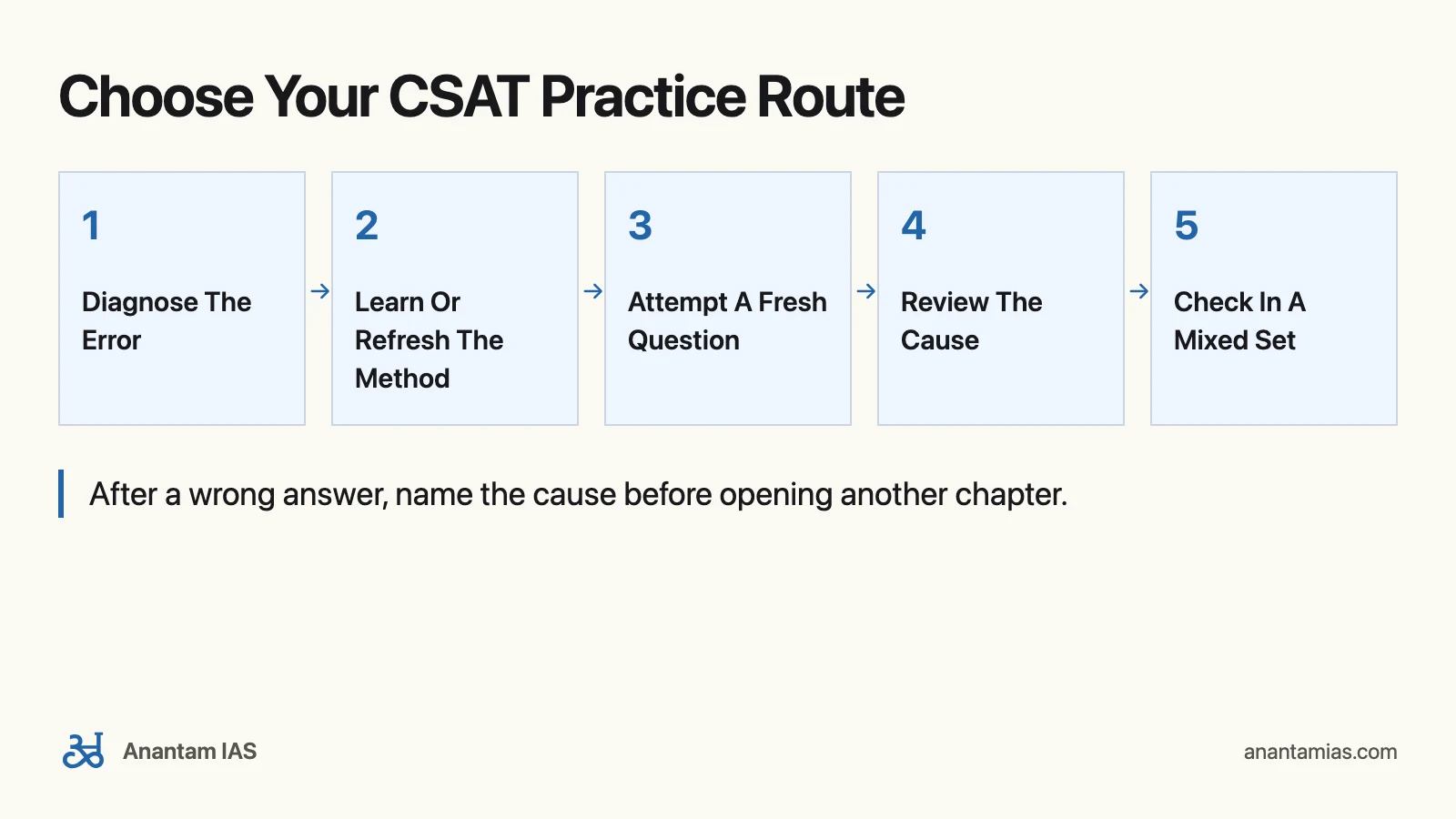
Start with a short diagnostic before opening every chapter. Your error pattern should decide the reading order.
Take an untouched selection of 12 questions: four arithmetic or data-interpretation items, four reasoning items and four comprehension items. Attempt them in 30 minutes, then revisit unfinished questions without a timer. These are suggested study settings, not an official benchmark.
- Wrong even without a timer: read the relevant explanation and rebuild the method.
- Correct untimed, wrong or unfinished timed: practice recognition and calculation, then repeat timed work.
- Correct answer with unclear reasoning: count it as uncertain, especially if it was a guess.
- Comprehension errors despite understanding the passage: compare each option with the exact claim the passage supports.
CSAT is a qualifying paper, so aim for reliable performance with a margin rather than finishing a book for its own sake. Confirm the examination scheme in the notification for your attempt. A small diagnostic cannot establish that you’re ready for a full paper.
Turn Topics Into Practice Tasks
Each reading session should end with an observable skill. Use the contents and index in your copy to locate these topics; chapter numbers can differ across editions.
| Topic | Study Task | Evidence You Understood |
|---|---|---|
| Percentages and ratios | Write the starting quantity before calculating a change | You can explain why successive percentage changes don’t simply cancel |
| Averages and data interpretation | Identify the denominator, units and whether groups differ in size | You choose a weighted average when required |
| Time, work and speed | Convert the situation into rates before substituting numbers | Your answer has the right units and a sensible size |
| Logical reasoning | Separate given statements from conclusions | You can show which conclusion follows without adding assumptions |
| Comprehension | State the passage’s central claim, then test each option | You reject an attractive claim that goes beyond the passage |
If arithmetic itself is slow, use the targeted approach in our R.S. Aggarwal Quantitative Aptitude guide. Add a supporting source only for an identified gap. Alternating between whole manuals makes it harder to see whether the gap is improving.
Work Through A Percentage Problem
This is an original practice example, not a UPSC question. A library’s monthly membership charge is ₹500. It rises by 20%, then the new charge receives a 20% discount. What is the final charge?
The tempting answer is ₹500 because the two percentages look equal. But their bases differ.
- The increase is 20% of ₹500: ₹100.
- The new charge is ₹500 + ₹100 = ₹600.
- The discount is 20% of ₹600: ₹120.
- The final charge is ₹600 – ₹120 = ₹480.
- The net reduction is ₹20 on the original ₹500, or 4%.
Now generalize the method: the two multipliers are 1.20 × 0.80 = 0.96. That’s why the final charge is 96% of the original. Check the answer against the intermediate quantities before looking at a solution.
Your error-log entry should say “used the original base for the second change,” not merely “percentage mistake.” On your next session, solve a fresh problem with different changes. Repeating the same numbers mainly checks memory.
Read Comprehension With Boundaries
For comprehension, practice separating what a passage says from what you think is sensible. Consider this original miniature passage:
“A town extended library hours after evening attendance rose. The change may help working readers, but access also depends on transport and neighborhood distance.”
Suppose the options are:
- A. Longer opening hours remove every barrier to library use.
- B. Longer opening hours may help some readers, while other barriers remain.
- C. Transport is the only reason people cannot use libraries.
- D. Every working reader now visits the library.
B is supported. The passage permits a limited benefit and names remaining barriers. A removes the qualification, C adds “only,” and D turns a possible benefit into a universal outcome. You don’t need outside knowledge about libraries to decide.
In a real passage, an extreme word isn’t automatically wrong. It is wrong when the passage doesn’t justify it. Write the supporting sentence beside your chosen option before reviewing the book’s explanation.
Build An Adjustable Routine
Use a six-week cycle if you have that time available. Repeat a stage when errors remain, or combine stages if your diagnostic shows strong fundamentals.
| Stage | Main Work | Output |
|---|---|---|
| Week 1 | Diagnose skills and repair the weakest basic topic | Error log with cause labels |
| Week 2 | Ratios, percentages, averages and data interpretation | Fresh problems solved with written setup |
| Week 3 | Rates and reasoning, plus regular comprehension | Short mixed practice sets |
| Week 4 | Topicwise PYQs, attempted before solutions | Corrected methods and unresolved questions |
| Week 5 | Timed mixed sets and selective revision | Record of accuracy, skips and time loss |
| Week 6 | Full-paper practice with detailed review | Personal order of attempt and realistic skip decisions |
A 45-minute session can use 10 minutes for a method, 20 for independent attempts and 15 for review. If you have only 25 minutes, reduce the number of questions rather than removing review. Include comprehension regularly instead of saving it for the final week.
Track question source, topic, attempted answer, time, error cause and next action. Revisit the cause after two or three days using an unfamiliar problem. If a full-paper result is unstable, return to the topic causing the instability. A qualifying target doesn’t make shaky fundamentals safe.
Frequently Asked Questions
Which Arihant CSAT book should a beginner choose?
Choose the complete manual if you need conceptual explanations. Diagnose your weak topics first, and attempt exercises independently before reviewing solutions.
Is the complete manual the same as the solved-paper book?
No. The verified 2027 English manual has ISBN 9788169711067. The separate 2011-2026 topicwise solved-paper collection has ISBN 9788169711913.
Does Arihant offer a Hindi CSAT manual?
Yes. The publisher lists a Hindi-medium 2027 manual with ISBN 9789378166730 and a different author team. Check the language and ISBN of the copy before buying.
Should I replace an older Arihant CSAT book?
Keep it if its explanations meet your needs. Add recent official papers, and replace the manual only when a missing feature or content gap justifies it.
Can the six-week routine guarantee qualification?
No. It is an adjustable study framework. Full-paper practice and review are needed to assess performance; a short diagnostic alone cannot establish readiness.
Tell Google you want more of this.
Add Anantam IAS as a preferred sourceOne tap, and this site shows up more often in your own Top Stories, AI Overviews and AI Mode. Remove it any time.