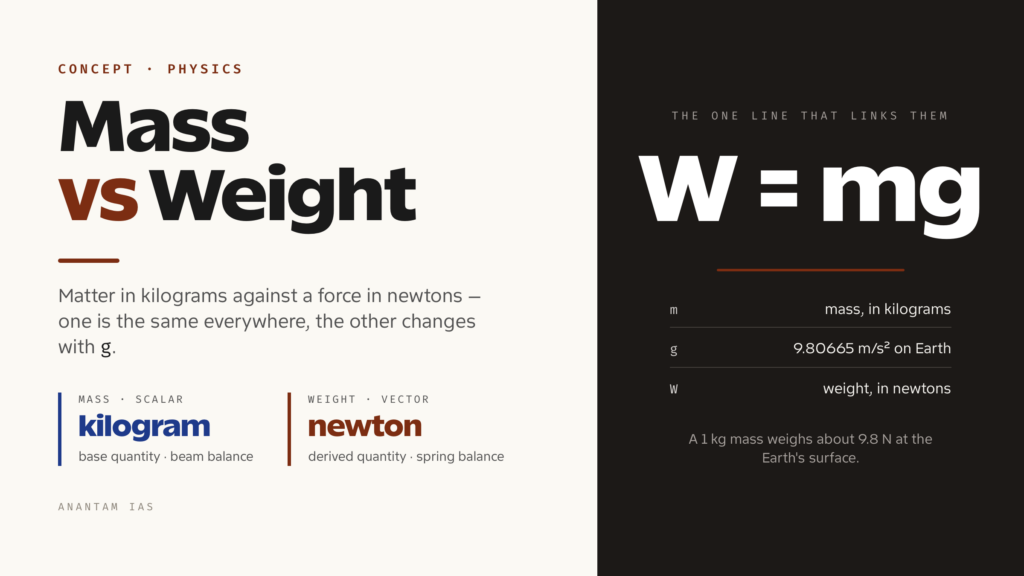
Mass is the quantity of matter in a body — a scalar, measured in kilograms, and identical whether you are in Delhi, on the Moon or drifting in deep space. Weight is the force gravity exerts on that body — a vector, measured in newtons, and it changes the moment gravity changes. The link between them is one line: W = mg, where g is the acceleration due to gravity at that place.
The confusion is built into everyday language. A shopkeeper “weighs” rice and reports 2 kg, which is a mass. A gym plate stamped 10 kg is a mass. Physics keeps the two apart because they behave differently: mass resists acceleration and never becomes zero, while weight can vanish entirely — an astronaut in free fall around the Earth still has all her mass but effectively no weight.
Defining Each Term
Mass (m) is a measure of the quantity of matter a body contains, and equivalently of its inertia — how strongly it resists a change in its state of motion. It is a scalar quantity, so it has magnitude but no direction. Mass is one of the seven base quantities of the International System of Units, with dimensional formula [M] and the kilogram (kg) as its SI unit. Since the redefinition that took effect on 20 May 2019, the kilogram is no longer tied to a platinum-iridium cylinder kept near Paris; the International Bureau of Weights and Measures now fixes it through an exact numerical value of the Planck constant, 6.62607015 × 10⁻³⁴ joule second. Mass is measured with a beam balance or a physical balance, which compares an unknown mass against standard masses and gives the same reading anywhere in the universe.
Weight (W) is the force with which a celestial body attracts an object towards its centre. It is a derived quantity and a vector, always directed towards the centre of the attracting body. Its SI unit is the newton (N), with dimensional formula [MLT⁻²], and it is measured with a spring balance, which reads the stretch of a spring under the applied force. The magnitude follows from Newton’s second law applied to gravitational attraction:
W = m × g
where g is the acceleration due to gravity. The standard value adopted for Earth’s surface is 9.80665 m/s², usually rounded to 9.8 m/s² in school work. A body of mass 1 kg has a weight of about 9.8 N on Earth.
An older practical unit still turns up in engineering: the kilogram-weight or kilogram-force (kgf), defined as the weight of a 1 kg mass under standard gravity, so 1 kgf = 9.80665 N. When a problem says a body “weighs 5 kg”, it means either a mass of 5 kg or a weight of 5 kgf — read the context before you compute.
The Key Differences at a Glance
| Basis of comparison | Mass | Weight |
|---|---|---|
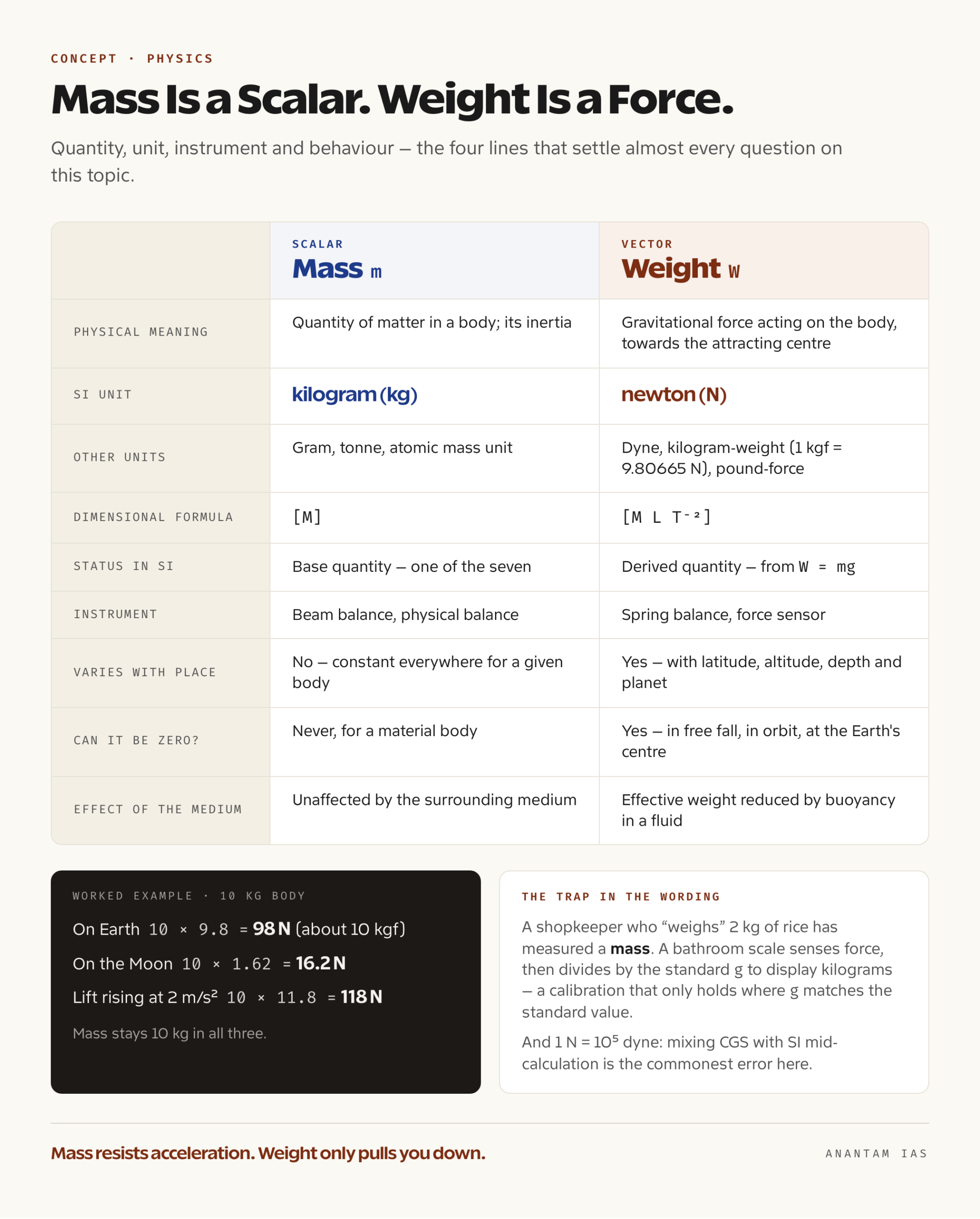
| Physical meaning | Quantity of matter in a body; measure of inertia | Gravitational force acting on the body |
| Type of quantity | Scalar — magnitude only | Vector — magnitude and direction (towards the centre of the attracting body) |
| SI unit | Kilogram (kg) | Newton (N) |
| Other units | Gram, tonne, atomic mass unit | Dyne, kilogram-weight (1 kgf = 9.80665 N), pound-force |
| Dimensional formula | [M] | [M L T⁻²] |
| Status in SI | Base quantity | Derived quantity |
| Formula | Fundamental; m = F/a from Newton’s second law | W = mg |
| Variation with place | Constant everywhere for a given body | Varies with g — with latitude, altitude, depth and the planet |
| Can it be zero? | Never zero for a material body | Yes — in free fall, in orbit, at the centre of the Earth, or far from any mass |
| Measuring instrument | Beam balance, physical balance | Spring balance, force sensor |
| Effect of the medium | Unaffected by the surrounding medium | Effective weight is reduced by buoyancy in a fluid |
| Value on the Moon | Same as on Earth | About one-sixth of the Earth value (g ≈ 1.62 m/s²) |
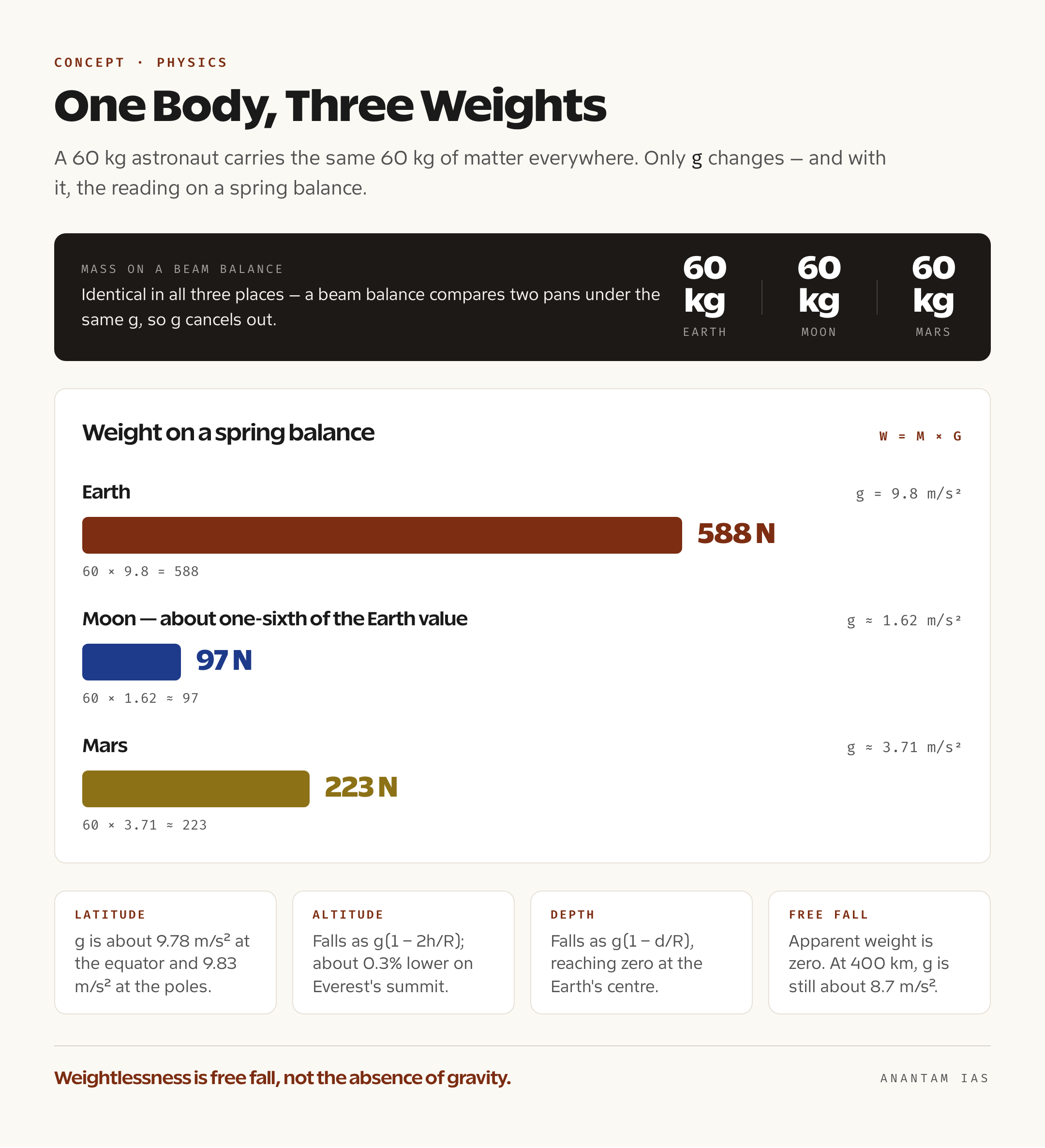
Two lines of the table carry most of the exam value. First, mass is a base quantity and weight is derived from it — you can never define mass as “weight divided by g” in a physical sense, even though the arithmetic works. Second, only weight responds to location, which is why the same body reads 60 kg on a beam balance everywhere but pulls on a spring balance with 588 N on Earth and roughly 97 N on the Moon.
Mass Explained in Detail
Mass shows up in physics in two apparently different roles, and the fact that they agree is one of the deep results of the subject.
Inertial mass appears in Newton’s second law, F = ma. Push two trolleys with the same force and the one that accelerates less has the greater inertial mass. This role has nothing to do with gravity at all — it would be measurable in deep space, where a heavy flywheel is still hard to spin up even though nothing weighs anything.
Gravitational mass appears in Newton’s law of universal gravitation, F = Gm₁m₂/r², where G is the universal gravitational constant, 6.674 × 10⁻¹¹ N m² kg⁻². It measures how strongly a body attracts and is attracted by other bodies.
Every experiment to date finds the two equal to extraordinary precision. That equivalence is why all objects, whatever their mass, fall with the same acceleration in a vacuum — the larger gravitational pull on a heavier body is exactly cancelled by its larger resistance to being accelerated. Galileo’s leaning-tower reasoning and the Apollo 15 hammer-and-feather drop on the airless Moon both illustrate the same point.
Mass is conserved in ordinary chemical and mechanical processes. Burn a candle in a sealed jar and the total mass of the jar and contents does not change, even though a solid has become gases. At relativistic speeds and in nuclear reactions the picture widens — mass and energy are related by E = mc², and a nucleus weighs slightly less than the sum of its separate nucleons, the deficit appearing as binding energy. For everything in a school laboratory, treating mass as fixed and conserved is exact enough.
Weight Explained in Detail
Because weight depends on g, it varies in four systematic ways.
With latitude. The Earth is not a perfect sphere and it rotates. The polar radius is about 21 km shorter than the equatorial radius, and rotation supplies a small centrifugal effect that is largest at the equator. Measured g is roughly 9.78 m/s² at the equator and about 9.83 m/s² at the poles, so the same body weighs about half a percent more at the pole.
With altitude. Going up a height h above the surface, g falls off roughly as g(1 − 2h/R), where R is the Earth’s radius of about 6,371 km. On the summit of Everest, g is around 0.3% lower than at sea level.
With depth. Below the surface, g falls approximately as g(1 − d/R) for a uniform Earth, reaching zero at the centre. A body at the Earth’s centre has its full mass and zero weight.
With the astronomical body. The Moon’s surface gravity is about 1.62 m/s², roughly one-sixth of Earth’s; Mars is about 3.71 m/s². A 60 kg astronaut weighs about 588 N on Earth, 97 N on the Moon and 223 N on Mars, with mass unchanged at 60 kg throughout.
Apparent weight is what a spring balance or a bathroom scale actually reads, and it equals the normal reaction from the supporting surface. In a lift accelerating upward with acceleration a, the reading is m(g + a) — you feel heavier. Accelerating downward, it is m(g − a). If the cable snaps and the lift falls freely, a = g and the reading is zero: this is weightlessness, and it is exactly the condition of an astronaut in orbit, who is not beyond gravity but is falling around the Earth continuously along with the spacecraft.
A body immersed in a fluid also reads less on a spring balance, because the upthrust described by Archimedes’ principle acts against gravity. Its true weight is unchanged; the effective or apparent weight is what has dropped.
Where Students Get Confused
“The SI unit of weight is the kilogram.” It is the newton. The kilogram is the unit of mass. A commercial weighing machine measures force but is calibrated to display the mass that would produce that force under standard Earth gravity — which is why the same machine would misreport on the Moon.
“Weightlessness means no gravity.” The International Space Station orbits at roughly 400 km, where g is still about 8.7 m/s², close to 89% of its surface value. Astronauts float because the station and everything in it are in continuous free fall, so there is no normal reaction to press against. Free fall, not the absence of gravity, produces weightlessness.
“Mass and weight are proportional, so it does not matter which you use.” They are proportional only at a fixed location. Any problem that crosses locations — Earth to Moon, sea level to orbit, surface to mine shaft — breaks the shortcut immediately.
“A balance and a scale do the same job.” A beam balance compares two gravitational forces, and since g affects both pans equally it cancels out, giving a true mass reading anywhere. A spring balance measures one force against a spring, so its reading tracks g and changes with location.
Worked example. A body has a mass of 10 kg. On Earth (g = 9.8 m/s²) its weight is 10 × 9.8 = 98 N, or about 10 kgf. On the Moon (g = 1.62 m/s²) its weight is 10 × 1.62 = 16.2 N. Its mass stays 10 kg in both places. If the same body is placed on a scale inside a lift accelerating upward at 2 m/s², the apparent weight becomes 10 × (9.8 + 2) = 118 N.
Unit-conversion slip. 1 newton = 10⁵ dyne, and 1 kgf = 9.8 N ≈ 9.8 × 10⁵ dyne. Mixing the CGS and SI systems mid-calculation is the most common arithmetic error in this topic.
FAQ
Is weight a force? Yes. Weight is the gravitational force a planet or other body exerts on an object, directed towards that body’s centre, and it is measured in newtons like any other force.
Why does a bathroom scale show kilograms if it measures force? The scale senses the compression of a spring or a load cell, which responds to force. Its display is calibrated by dividing that force by the standard value of g, so it reports the equivalent mass. The calibration is only valid where g matches the standard value used.
Can an object have mass but no weight? Yes. An object in deep space far from any star or planet, an object at the centre of the Earth, and an object in free fall all have their full mass with zero or effectively zero weight.
What is 1 kg weight in newtons? One kilogram-weight, or kilogram-force, equals 9.80665 N — usually taken as 9.8 N. It is the weight of a 1 kg mass under standard gravity.
Does mass change with speed? In everyday mechanics, no. In special relativity the energy and momentum of a fast-moving body increase sharply as it approaches the speed of light, and older textbooks describe this as increasing “relativistic mass”. Modern usage keeps mass as the invariant rest mass and puts the change into energy and momentum instead.
Practice Questions
Practice MCQs
- The SI unit of weight is (a) kilogram (b) newton (c) dyne (d) kilogram-weight Answer: (b) Weight is a force, so its SI unit is the newton; the kilogram is the SI unit of mass.
- A body of mass 5 kg is taken from the Earth to the Moon. Which of the following is correct? (a) Both mass and weight decrease (b) Mass stays 5 kg, weight becomes about one-sixth (c) Mass becomes one-sixth, weight stays the same (d) Both remain unchanged Answer: (b) Mass is independent of location; weight follows g, which on the Moon is about one-sixth of the Earth value.
- The dimensional formula of weight is (a) [M] (b) [M L T⁻¹] (c) [M L T⁻²] (d) [M L² T⁻²] Answer: (c) Weight is a force, mass times acceleration, giving [M][L T⁻²] = [M L T⁻²].
- A spring balance in a lift falling freely under gravity will read the weight of a suspended body as (a) mg (b) 2mg (c) zero (d) mg/2 Answer: (c) In free fall the lift and the body accelerate together at g, the normal reaction vanishes and the apparent weight is zero.
- Which instrument gives the same reading for a given body at the equator and at the poles? (a) Spring balance (b) Beam balance (c) Bathroom scale (d) Load cell Answer: (b) A beam balance compares two masses under the same g, so the variation cancels; force-measuring devices track the local value of g.
Tell Google you want more of this.
Add Anantam IAS as a preferred sourceOne tap, and this site shows up more often in your own Top Stories, AI Overviews and AI Mode. Remove it any time.