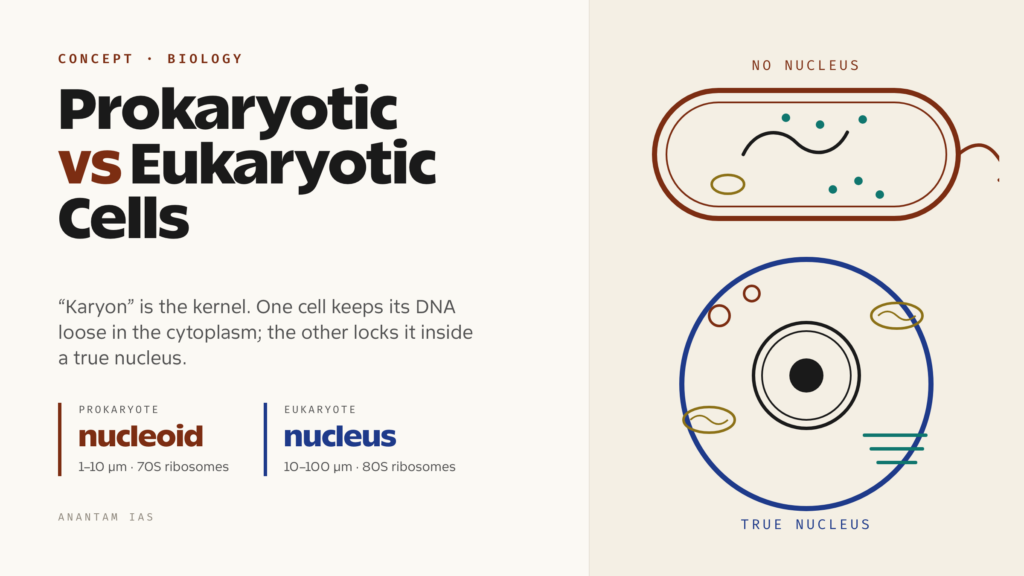
A prokaryotic cell has no true nucleus and no membrane-bound organelles — its single circular DNA molecule lies naked in the cytoplasm in a region called the nucleoid, and its ribosomes are of the smaller 70S type. A eukaryotic cell keeps its DNA as multiple linear chromosomes wrapped around histone proteins inside a nucleus bounded by a double membrane, runs its chemistry in compartments such as mitochondria, endoplasmic reticulum and Golgi, and uses larger 80S ribosomes. Bacteria and archaea are prokaryotes; protists, fungi, plants and animals are eukaryotes.
The word itself carries the definition. “Karyon” is Greek for kernel or nut, standing for the nucleus: pro-karyote means “before the nucleus”, eu-karyote means “true nucleus”. Compartmentalisation is the whole story — once a cell can wall off separate reaction spaces, it can grow larger, run incompatible reactions side by side, and build the multicellular bodies that prokaryotes never managed.
Defining Each Term
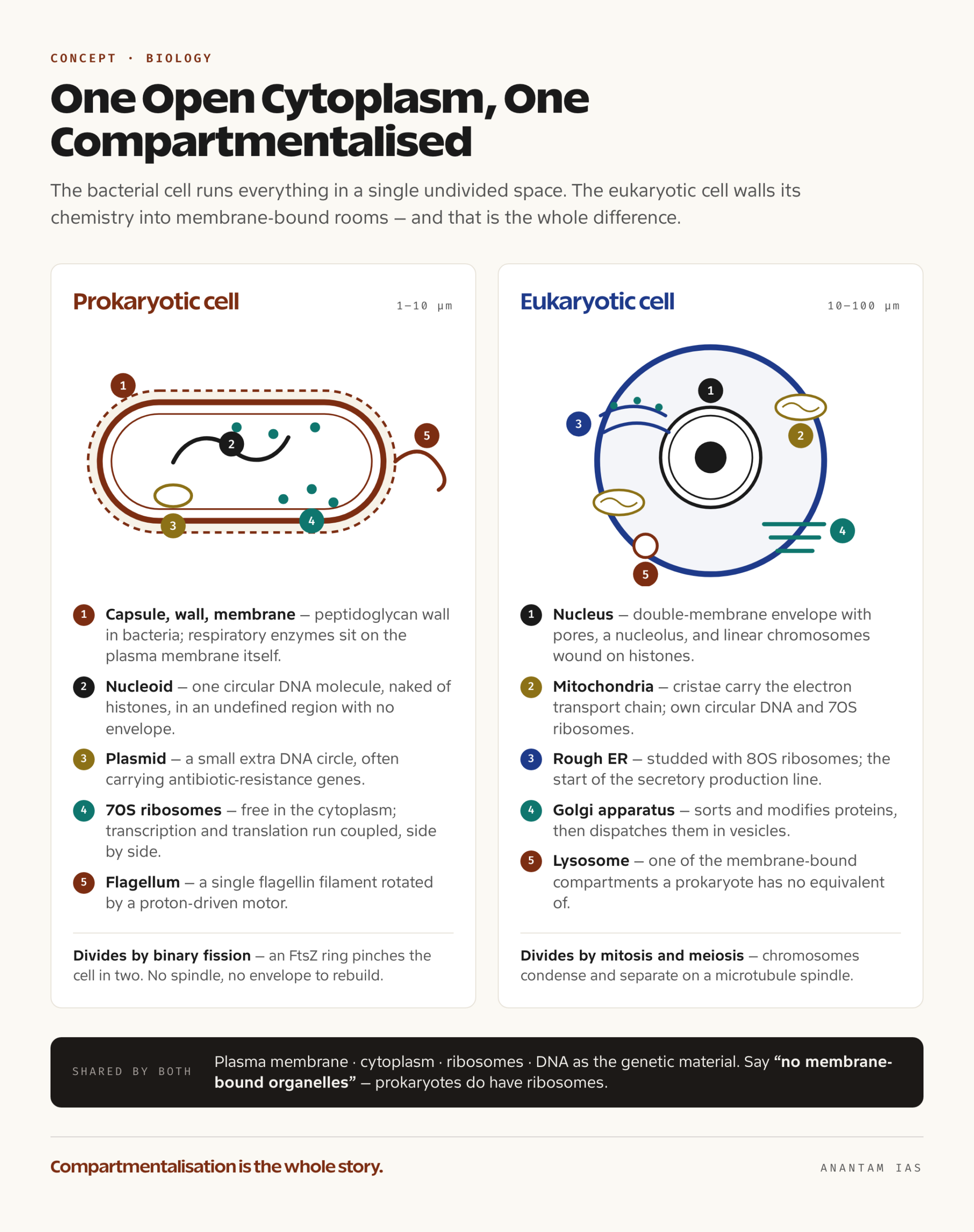
A prokaryotic cell is a cell without a membrane-bound nucleus or membrane-bound organelles. Its genetic material is a single, circular, double-stranded DNA molecule, usually described as naked because it lacks the histone packaging of eukaryotes, although it is organised by nucleoid-associated proteins (and archaea do carry histone-like proteins). Many prokaryotes also hold small extra circles of DNA called plasmids, which often carry antibiotic-resistance genes. Typical size is 1-10 micrometres, often less. Outside the plasma membrane sits a cell wall — peptidoglycan (murein) in bacteria, and pseudopeptidoglycan or protein S-layers in archaea — and many species add a slimy capsule outside that. Some bacteria show infoldings of the plasma membrane called mesosomes, and respiratory enzymes sit on the plasma membrane because there are no mitochondria. Bacteria, archaea, cyanobacteria (blue-green algae), mycoplasmas and actinomycetes are all prokaryotes.
A eukaryotic cell is a cell whose genetic material is enclosed in a true nucleus, bounded by a double membrane called the nuclear envelope, perforated by nuclear pores and containing one or more nucleoli where ribosomal RNA is made. DNA is linear, present as several chromosomes, and wound around histone octamers to form nucleosomes. The cytoplasm is divided by membranes into organelles: mitochondria for aerobic respiration, rough and smooth endoplasmic reticulum, Golgi apparatus, lysosomes, peroxisomes, and in plants and algae, plastids. An elaborate cytoskeleton of microtubules, microfilaments and intermediate filaments gives shape, moves cargo and drives division. Typical size is 10-100 micrometres, so a eukaryotic cell is commonly a thousand or more times larger in volume than a bacterium.
Both types share four essentials: a plasma membrane, cytoplasm, ribosomes and DNA as the genetic material.
The Key Differences at a Glance
| Basis of comparison | Prokaryotic cell | Eukaryotic cell |
|---|---|---|
| Nucleus | Absent; DNA lies in an undefined region called the nucleoid, with no nuclear envelope or nucleolus | True nucleus with a double-membrane nuclear envelope, nuclear pores and one or more nucleoli |
| Genetic material | Single circular double-stranded DNA, naked (no histones in bacteria); plasmids often present | Multiple linear chromosomes complexed with histones; plasmids rare |
| Membrane-bound organelles | Absent — no mitochondria, ER, Golgi, lysosomes or plastids | Present — mitochondria, ER, Golgi, lysosomes, peroxisomes, plastids in plants |
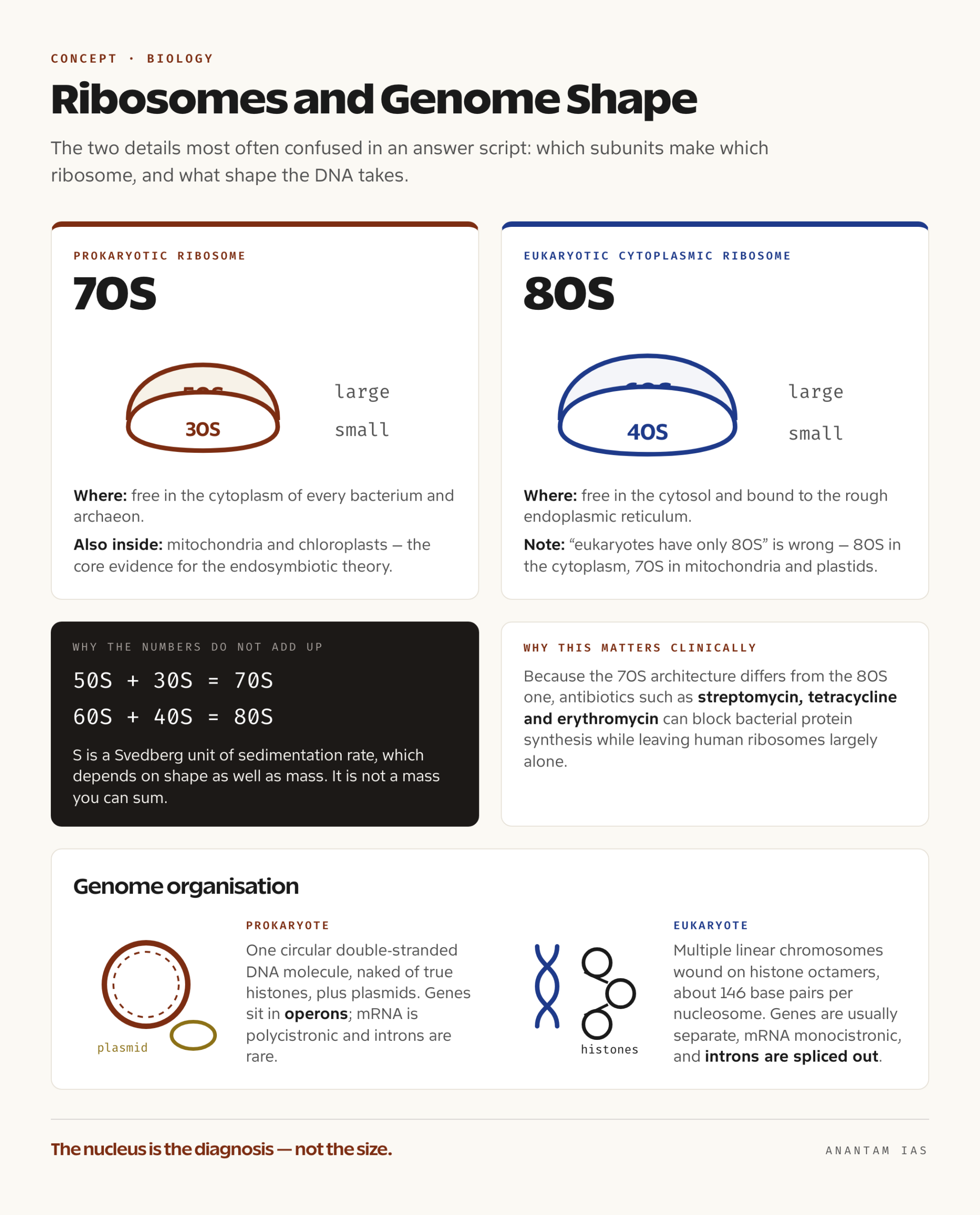
| Ribosomes | 70S (50S large + 30S small subunits) | 80S (60S + 40S) in the cytoplasm; 70S inside mitochondria and chloroplasts |
| Cell size | Usually 1-10 µm | Usually 10-100 µm |
| Cell wall | Present in most; peptidoglycan in bacteria, pseudopeptidoglycan or S-layers in archaea | Absent in animals; cellulose in plants, chitin in fungi |
| Cell division | Binary fission; no spindle apparatus | Mitosis and meiosis using a microtubule spindle |
| Genetic recombination | By conjugation, transformation and transduction; no gamete fusion | By meiosis followed by fusion of gametes |
| Transcription and translation | Coupled — both occur in the cytoplasm, often simultaneously | Separated — transcription in the nucleus, translation in the cytoplasm |
| Gene organisation | Genes grouped in operons; mRNA is polycistronic; introns rare | Genes usually separate; mRNA monocistronic; introns common and removed by splicing |
| Respiratory site | Plasma membrane and its mesosome infoldings | Inner mitochondrial membrane and cristae |
| Flagellum | Single filament of flagellin, rotated by a motor driven by proton flow | Bundle of microtubules in a 9+2 pattern, bent by dynein motors, enclosed in plasma membrane |
| Cytoskeleton | Simple; homologues such as FtsZ and MreB, no elaborate network | Extensive network of microtubules, microfilaments and intermediate filaments |
| Examples | Bacteria, archaea, cyanobacteria, mycoplasma | Protists, fungi, plants, animals |
The single most quoted row is the ribosome. Prokaryotic ribosomes are 70S; eukaryotic cytoplasmic ribosomes are 80S. The S is a Svedberg unit of sedimentation rate, not mass, which is why 50S and 30S subunits combine into a 70S particle rather than an 80S one. That difference in ribosome architecture is what lets antibiotics such as streptomycin, tetracycline and erythromycin block bacterial protein synthesis while leaving human ribosomes largely alone.
The Prokaryotic Cell Explained in Detail
Work inward from the outside. Many bacteria secrete a glycocalyx — a thick, firm capsule or a loose slime layer of polysaccharide — that resists drying, blocks phagocytosis by immune cells and helps the cell stick to surfaces in biofilms. Beneath it lies the cell wall of peptidoglycan, a mesh of sugar chains cross-linked by short peptides. The thickness of that layer decides the Gram stain result: Gram-positive bacteria have a thick peptidoglycan wall that retains crystal violet, while Gram-negative bacteria have a thin layer plus an outer membrane containing lipopolysaccharide, and lose the stain. Penicillin works by blocking the enzymes that cross-link peptidoglycan, so it attacks a structure human cells do not have. Mycoplasmas, the smallest known free-living cells, have no wall at all.
The plasma membrane does double duty. As well as controlling transport, it houses the electron transport chain, so the cell’s aerobic respiration happens right at the surface. Photosynthetic prokaryotes such as cyanobacteria carry internal thylakoid membranes derived from it, but these are not chloroplasts.
The nucleoid is a densely coiled loop of DNA, roughly 1 mm of DNA in an Escherichia coli cell about 2 µm long, supercoiled into a compact region with no surrounding membrane. Replication starts at a single origin and the two copies separate as the cell elongates. Division is binary fission: the protein FtsZ forms a contractile ring at midcell and the wall grows inward. There is no spindle, no chromosome condensation into visible chromatids, and no nuclear envelope to break down and rebuild — one reason a bacterium can divide in as little as twenty minutes under good conditions.
Because there is no nuclear envelope, transcription and translation are coupled: ribosomes attach to a messenger RNA and begin making protein while the RNA is still being copied from the DNA. Related genes are grouped into operons under a single promoter, as in the classic lac operon, giving a single mRNA that codes for several proteins.
Prokaryotes do not undergo meiosis, but they shuffle genes in three ways: conjugation (DNA passed through a pilus from one cell to another), transformation (uptake of naked DNA from the surroundings) and transduction (DNA carried across by a bacteriophage). These routes spread antibiotic resistance quickly. Many bacteria also carry inclusion bodies of stored glycogen, polyphosphate or gas vacuoles, which are not bounded by unit membranes.
The Eukaryotic Cell Explained in Detail
The defining structure is the nucleus. Its envelope is two lipid bilayers, the outer one continuous with the rough endoplasmic reticulum, pierced by nuclear pore complexes that gate the traffic of RNA outward and proteins inward. Inside, chromatin is DNA wound around histone octamers — about 146 base pairs per nucleosome — which condenses into visible chromosomes during division. The nucleolus, a dense unbounded region, is where ribosomal RNA is transcribed and ribosomal subunits are assembled before export.
That physical separation of nucleus from cytoplasm buys the eukaryotic cell a processing step prokaryotes do not have. A primary transcript is capped, tailed and spliced — non-coding introns cut out, coding exons joined — before it reaches a ribosome. Alternative splicing lets one gene yield several proteins, which is a large part of how a cell with roughly 20,000 protein-coding genes builds a human body.
The endomembrane system works as a production line. Proteins destined for secretion are made on the rough ER, folded and glycosylated, packaged into vesicles, sorted and further modified in the Golgi apparatus, and dispatched to lysosomes, to the membrane or out of the cell. Smooth ER handles lipid and steroid synthesis and, in muscle, calcium storage.
Mitochondria are double-membraned, with the inner membrane folded into cristae that carry the electron transport chain and ATP synthase. They hold their own circular DNA and their own 70S ribosomes, divide independently of the cell, and are inherited maternally in humans. Chloroplasts share the same profile. This is the evidence base for the endosymbiotic theory — that mitochondria and plastids descend from free-living prokaryotes engulfed by an ancestral host cell and retained rather than digested. It is also why “eukaryotes have only 80S ribosomes” is wrong: 80S in the cytoplasm, 70S in the two organelles of bacterial ancestry.
Division uses a spindle of microtubules organised from centrosomes in animal cells or from the nuclear envelope region in plants. Mitosis produces two genetically identical diploid cells; meiosis halves the chromosome number and shuffles alleles by crossing over, producing the genetic variety on which sexual reproduction depends.
Where Students Get Confused
“Prokaryotes have no organelles.” They have ribosomes, which are organelles in the broad sense — just not membrane-bound ones. Write “no membrane-bound organelles”, which is the precise claim.
“Prokaryotes have no DNA-organising proteins.” Bacterial DNA is described as naked because it lacks true histones, but nucleoid-associated proteins such as HU and H-NS do fold and organise it, and archaea carry histone-like proteins that wrap DNA much as eukaryotic histones do. Archaea sit structurally with prokaryotes and molecularly closer to eukaryotes in several respects.
“Eukaryotic cells are always larger, so bigger means eukaryotic.” The size ranges overlap at the edges. Thiomargarita namibiensis, a sulphur bacterium, reaches several hundred micrometres and is visible to the naked eye, while a human red blood cell is about 7-8 µm. Size is a useful generalisation, not a diagnosis. The nucleus is the diagnosis.
“Cyanobacteria are algae, so they are eukaryotic.” The old name blue-green algae is misleading. Cyanobacteria photosynthesise with chlorophyll a and release oxygen, but they have no nucleus, no chloroplasts and 70S ribosomes. They are prokaryotes.
“Mesosomes are the bacterial mitochondrion.” Mesosomes are infoldings of the plasma membrane associated with respiration, DNA replication and wall formation, and many microbiologists regard much of the classic mesosome image as an artefact of chemical fixation. They are not organelles and they are not homologous to mitochondria.
“A 50S and a 30S subunit should make an 80S ribosome.” Svedberg units measure sedimentation rate, which depends on both mass and shape, so they do not add up arithmetically. 50S + 30S = 70S, and 60S + 40S = 80S.
FAQ
What is the main difference between prokaryotic and eukaryotic cells? Prokaryotic cells have no nucleus bounded by a membrane and no membrane-bound organelles; their DNA sits free in the cytoplasm as a nucleoid. Eukaryotic cells enclose their DNA in a true nucleus and divide their cytoplasm into membrane-bound compartments.
Do prokaryotic cells have ribosomes? Yes. Every living cell needs ribosomes to make protein. Prokaryotic ribosomes are of the 70S type, built from a 50S and a 30S subunit, compared with the 80S ribosomes in eukaryotic cytoplasm.
Are all bacteria prokaryotes, and are all prokaryotes bacteria? All bacteria are prokaryotes, but not all prokaryotes are bacteria. Archaea are the second prokaryotic domain, distinguished by different membrane lipids, a wall without peptidoglycan and a transcription machinery closer to that of eukaryotes.
Why do mitochondria and chloroplasts have 70S ribosomes? Because they descend from free-living prokaryotes taken up by an ancestral eukaryotic cell. Their circular DNA, double membranes, independent division and 70S ribosomes are the core evidence for the endosymbiotic theory.
How does prokaryotic cell division differ from mitosis? Prokaryotes divide by binary fission — the DNA replicates from a single origin, the copies separate as the cell grows, and an FtsZ ring pinches it in two, with no spindle. Eukaryotic mitosis condenses chromosomes, breaks down the nuclear envelope and pulls sister chromatids apart on a microtubule spindle.
Practice Questions
Practice MCQs
- The genetic material of a prokaryotic cell is located in a region called the (a) nucleolus (b) nucleoid (c) nuclear envelope (d) centromere Answer: (b) The nucleoid is the irregular cytoplasmic region holding the circular DNA; it has no bounding membrane.
- Ribosomes found in the cytoplasm of a eukaryotic cell are of the type (a) 70S (b) 80S (c) 50S (d) 30S Answer: (b) Eukaryotic cytoplasmic ribosomes are 80S (60S + 40S), while mitochondria and chloroplasts contain 70S ribosomes.
- Peptidoglycan is a characteristic component of the cell wall of (a) fungi (b) higher plants (c) bacteria (d) animals Answer: (c) Bacterial walls are made of peptidoglycan; fungal walls contain chitin and plant walls cellulose.
- Which of the following processes does NOT occur in prokaryotes? (a) Binary fission (b) Conjugation (c) Meiosis (d) Transduction Answer: (c) Prokaryotes have no meiosis; they recombine genes through conjugation, transformation and transduction.
- Evidence for the endosymbiotic origin of mitochondria includes (a) their single membrane (b) their 80S ribosomes (c) their circular DNA and 70S ribosomes (d) their absence in plant cells Answer: (c) Mitochondria have a double membrane, their own circular DNA and 70S ribosomes, and they divide independently — all consistent with a prokaryotic ancestry.
Tell Google you want more of this.
Add Anantam IAS as a preferred sourceOne tap, and this site shows up more often in your own Top Stories, AI Overviews and AI Mode. Remove it any time.