Disclosure: this guide contains Amazon affiliate links. As an Amazon Associate, Anantam IAS earns from qualifying purchases — at no extra cost to you.
RS Aggarwal Quantitative Aptitude is the maths book most CSAT aspirants already own, and the question you came with is the right one: how much of it does a qualifying paper actually need? Less than half. Quantitative Aptitude for Competitive Examinations was built for bank, SSC and railway papers, where speed on a direct question decides the result. CSAT, Paper II of UPSC Prelims, asks you to clear 33%, and the syllabus pegs its numeracy at Class X level.
Aspirants generally handle the book in one of three ways. The first group starts at chapter one, works every exercise and reaches Stocks and Shares in month three without having opened a single CSAT paper. The second group skips it because CSAT is only qualifying, and learns on exam day that 66 marks out of 200 is not a formality.
The third way is smaller than either. It is wise to treat the book as a repair kit for school arithmetic: read 17 chapters properly, give 14 a quick pass, leave 8 alone and let the previous-year papers decide how far each exercise goes. Before the chapter map, I want to settle which copy to buy, because that question is simpler here than it looks.
What the book is, and which edition to buy
Quantitative Aptitude for Competitive Examinations is Dr. R.S. Aggarwal’s arithmetic and data-interpretation book from S Chand, in print since 1989. The current S Chand print is the 2024-25 revised edition, which Amazon.in sells as the 2026 edition. There is also an official Hindi-medium edition from S Chand.
- Pages: S Chand lists 788; the Amazon.in listing says 824. Call it about 800.
- Structure: Section I, Arithmetical Ability, runs 35 chapters. Section II, Data Interpretation, runs 4.
- Practice volume: more than 2,000 solved examples, more than 10,000 practice questions and 40 videos.
- Hindi edition: Quantitative Aptitude for Competitive Examinations in Hindi medium, 628 pages, S Chand.
Arithmetic doesn’t date the way a GK book does. A percentage worked out in an older print is still a percentage, so the edition question matters less here than anywhere else on a Prelims shelf. If you’re buying new, buy the current print. If a copy from a few years back is already on your shelf, keep it and spend the money on previous-year papers instead.
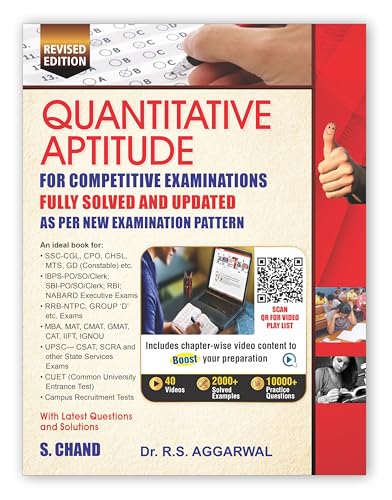
Quantitative Aptitude for Competitive Examinations, R.S. Aggarwal (S Chand, 2024-25 Revised Edition)
- About 800 pages from S Chand: 35 arithmetic chapters and 4 data-interpretation chapters
- More than 2,000 solved examples, 10,000+ practice questions and 40 videos
- Dr. R.S. Aggarwal's standard quant book, in print since 1989
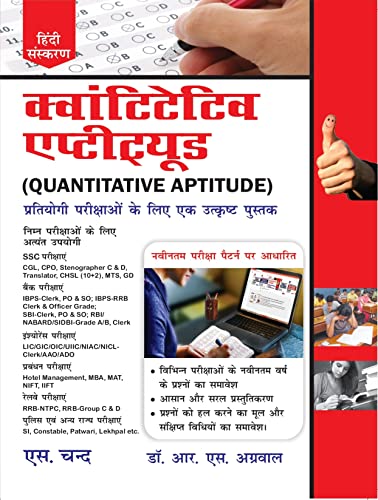
Quantitative Aptitude (संख्यात्मक अभियोग्यता), डॉ. आर.एस. अग्रवाल, हिंदी माध्यम (S Chand)
- लगभग 628 पेज, S Chand का आधिकारिक हिंदी माध्यम संस्करण
- अंकगणित और आँकड़ा निर्वचन की तैयारी हिंदी शब्दावली में
- CSAT हिंदी में देने वालों के लिए, अंग्रेज़ी संस्करण की जगह
If you’ll write CSAT in Hindi, buy the Hindi edition and not the English one. The question paper’s terms (लाभ और हानि, चक्रवृद्धि ब्याज) are the ones you should be solving in from day one.
Who should buy it, and who can skip it
RS Aggarwal quantitative aptitude is a core book for anyone whose school maths has gone rusty, and an optional one for anyone whose mocks already clear the cut-off with room to spare. The test is simple: if a successive-percentage or a time-and-work question sends you looking for a formula sheet, you need the book.
The stakes are specific. UPSC ranks candidates on GS Paper I only after Paper II clears the 33% bar, so a strong GS score with a failed CSAT counts for nothing. The CSAT paper guide sets out the pattern, and the cut-off trends show why the paper stopped being a formality.
Buy it and treat it as a core book if:
- You haven’t done school maths since Class X and it shows in your mocks.
- Your numeracy and data-interpretation score is the weakest part of your CSAT diagnostic.
- You’re also writing the SSC CGL or a bank PO paper, where this book is the standard.
Skip it, or keep it only for lookups, if:
- You already score above the cut-off in timed CSAT mocks and your losses come from comprehension.
- You studied maths beyond Class XII and the chapters would be revision you don’t need.
- You have a CSAT manual and haven’t finished its numeracy section yet. Finish that first.
For a UPSC-only aspirant, it’s a supplement to the previous-year papers, not a replacement for them. For an aspirant also sitting SSC or bank exams, it becomes the main maths book, and most of the skip list below turns into a read list.
The chapter map: what CSAT needs and what it doesn’t
The book has 39 chapters and they aren’t equal for CSAT. The syllabus names basic numeracy (numbers and their relations, orders of magnitude) and data interpretation (charts, graphs, tables, data sufficiency), both at Class X level. That sorts the chapters into three piles.
| Chapters | What they cover | CSAT | SSC, bank, railway |
|---|---|---|---|
| 1, 2, 6, 7, 8 | Number System, HCF and LCM, Average, Problems on Numbers, Problems on Ages | Core, read properly | Core |
| 3, 4, 5 | Decimal Fractions, Simplification, Square and Cube Roots | Quick pass | Core |
| 9, 10 | Surds and Indices, Logarithms | Skip | Read for SSC |
| 11, 12, 13 | Percentage, Profit and Loss, Ratio and Proportion | Core, the highest-yield block | Core |
| 14, 21 | Partnership, Alligation or Mixture | Quick pass | Core |
| 15 | Chain Rule | Skip; ratio covers it | Read |
| 16, 19 | Pipes and Cisterns, Boats and Streams | Quick pass | Core |
| 17, 18, 20 | Time and Work, Time and Distance, Problems on Trains | Core | Core |
| 22, 23 | Simple Interest, Compound Interest | Core | Core |
| 24, 25 | Area, Volume and Surface Area | Quick pass | Core |
| 26 | Races and Games of Skill | Skip | Read for bank |
| 27, 28 | Calendar, Clocks | Quick pass | Core |
| 29, 32, 33 | Stocks and Shares, True Discount, Banker’s Discount | Skip | Bank-specific |
| 30, 31 | Permutations and Combinations, Probability | Quick pass, basics only | Core |
| 34 | Heights and Distances | Skip | Read for SSC |
| 35 | Odd Man Out and Series | Quick pass | Core |
| 36 to 39 | Tabulation, Bar Graphs, Pie Chart, Line Graphs | Core | Core |
That leaves 17 chapters to read properly, 14 for a quick pass and 8 to leave alone. The skip pile is mostly commercial arithmetic written for bank papers. The effort is better spent on the percentage and ratio block, because those two ideas run underneath profit and loss, interest, mixtures and most data-interpretation sets.
One gap is worth knowing about. Data sufficiency, which the CSAT syllabus names outright, has no chapter of its own in this book. Practise it from the previous-year papers.
How to read it: a five-week plan
The method is concept first, a slice of the exercise second and the matching previous-year questions third. Sixty to seventy-five minutes a day for five weeks covers the 31 chapters that matter.
- Week 1, numbers. Chapters 1, 2, 6, 7 and 8, then a quick pass through 3 to 5. Number sense feeds every later chapter, so don’t rush this week.
- Week 2, percentage and ratio. Chapters 11, 12 and 13 properly, then 14 and 21. This is the week that pays most.
- Week 3, rates. Chapters 17, 18 and 20, then 16 and 19. Draw the situation before you pick a formula.
- Week 4, interest, mensuration and counting. Chapters 22 and 23, then a quick pass through 24, 25, 27, 28, 30, 31 and 35.
- Week 5, data interpretation and timed practice. Chapters 36 to 39, then full numeracy sets from the CSAT previous year papers on a timer.
The stopping rule matters more than the plan. Read the theory and the solved examples, then work the exercise until you get eight of ten right without looking at the solution. Stop there. The remaining hundred questions in that exercise are drilling bank-exam speed, and CSAT doesn’t pay for it.
If you are getting fewer than six of ten, the problem is the concept, not practice. Go back to the solved examples and work two of them on paper before you try the exercise again. The CSAT quantitative aptitude guide on this site has the formulas in one place, and the number series note covers the one pattern chapter that CSAT keeps returning to.
What to skip, and what to cross-check
For CSAT, skip these eight chapters of RS Aggarwal quantitative aptitude: Surds and Indices, Logarithms, Chain Rule, Races and Games of Skill, Stocks and Shares, True Discount, Banker’s Discount and Heights and Distances. If SSC or a bank paper is also on your plan, bring them back.
Be careful with the shortcuts. The book teaches a fast method for each question type because bank papers reward seconds. UPSC sets its numeracy as worded problems, and a shortcut memorized without the idea behind it fails the moment the wording changes. Learn the long method first, then the shortcut.
Cross-check your sense of difficulty, not the book’s answers:
- Every few days, solve a CSAT question on the topic you just finished. If it feels harder than the book’s exercise, the gap is in reading the question, not in arithmetic.
- Data sufficiency and multi-step data sets come from the previous-year papers, not from this book.
- Any exam-pattern claim on the cover or in the preface is about bank and SSC papers. Your pattern comes from the UPSC notification.
What RS Aggarwal will not do
It won’t teach comprehension, which is the first area in the CSAT syllabus, and it won’t touch decision-making, interpersonal skills or most of logical reasoning. It holds no UPSC previous-year questions. It covers the numeracy and data-interpretation half of the paper, and it covers that half at a volume no CSAT candidate needs.
For reasoning, his other book is A Modern Approach to Verbal & Non-Verbal Reasoning, 996 pages in the 2022 print sold on Amazon.in, with 46 videos and more than 5,000 practice questions. The verbal chapters are useful for CSAT; the figure-based non-verbal half matters far more for SSC and bank papers. The logical reasoning note on this site covers the CSAT side, and the best books for CSAT page puts both Aggarwal books against the alternatives.
Coaching shelves sell it as the CSAT book. It’s the maths book you open when your CSAT diagnostic says maths is the problem.
RS Aggarwal vs McGraw Hill CSAT Manual vs Verbal and Non-Verbal Reasoning
Three books get bought for CSAT numeracy and reasoning, and they do three different jobs.
| Book | Pages and edition | What it is | Verdict |
|---|---|---|---|
| Quantitative Aptitude for Competitive Examinations, R.S. Aggarwal | About 800, 2024-25 revised | Arithmetic and data interpretation with 10,000+ practice questions | The pick for rebuilding numeracy |
| UPSC Prelims 2026-27 CSAT Manual, McGraw Hill | 500, 2026-27 | The whole CSAT syllabus with chapter-wise solved PYQs from 2017 to 2026 and 15 full-length mocks | The pick if you want one CSAT book |
| A Modern Approach to Verbal and Non-Verbal Reasoning, R.S. Aggarwal | 996, 2022 print | A broad reasoning problem bank | Only if reasoning is your weak section |
For most UPSC-only aspirants the order is the Manual first, previous-year papers second and RS Aggarwal only when the diagnostic points at numbers. For an aspirant sitting SSC or bank papers too, flip it: Aggarwal becomes the spine and the Manual becomes the CSAT-specific layer. The three-month CSAT strategy shows where each fits in a timetable.
Is there an RS Aggarwal Quantitative Aptitude PDF?
No official free one. S Chand sells the book as a paperback, in English and in Hindi, and does not give it away as a PDF. The files that circulate are scans of old reprints, and they’re pirated copies. For a book you have to work through with a pencil, a scan is also the worse format.
RS Aggarwal quantitative aptitude is a good book that most CSAT aspirants use for the wrong job. Buy the current print or keep the one you have, read the 17 core chapters properly, give 14 a quick pass and stop each exercise at eight out of ten. Then move to the previous-year papers, because that’s where the paper you will actually sit lives. Start with the percentage chapter this week; it runs underneath half of what follows.
Frequently Asked Questions
Is RS Aggarwal Quantitative Aptitude enough for CSAT?
No. It covers the numeracy and data-interpretation half of the paper and nothing else, so comprehension, reasoning and decision-making need other practice. Use it to rebuild school arithmetic, then move to the CSAT previous-year papers for the question style.
Which edition of RS Aggarwal Quantitative Aptitude should I buy?
The current S Chand print is the 2024-25 revised edition, which Amazon.in sells as the 2026 edition. Arithmetic does not date, so an older copy you already own is fine for CSAT; spend the money on previous-year papers instead.
Which chapters of RS Aggarwal are important for CSAT?
Seventeen chapters deserve a proper read: Number System, HCF and LCM, Average, Problems on Numbers, Problems on Ages, Percentage, Profit and Loss, Ratio and Proportion, Time and Work, Time and Distance, Problems on Trains, Simple Interest, Compound Interest and the four data-interpretation chapters. Another fourteen need only a quick pass.
Which chapters of RS Aggarwal can I skip for CSAT?
Surds and Indices, Logarithms, Chain Rule, Races and Games of Skill, Stocks and Shares, True Discount, Banker’s Discount and Heights and Distances. Bring them back if you are also writing SSC or bank papers.
How long does it take to finish RS Aggarwal for CSAT?
About five weeks at sixty to seventy-five minutes a day, if you stop each exercise once you get eight of ten right without help. Working every question in every exercise is what turns it into a six-month book.
Is there a Hindi edition of RS Aggarwal Quantitative Aptitude?
Yes. S Chand publishes a Hindi-medium edition of Quantitative Aptitude for Competitive Examinations, listed at 628 pages on Amazon.in. If you will write CSAT in Hindi, buy that one rather than the English edition.
RS Aggarwal or the McGraw Hill CSAT Manual, which is better for UPSC?
For a UPSC-only aspirant, the CSAT Manual comes first because it covers the whole syllabus and carries solved previous-year questions. Add RS Aggarwal only if your diagnostic shows numeracy is the weak section.
Is there a free RS Aggarwal Quantitative Aptitude PDF?
There is no official free PDF. S Chand sells the book as a paperback in English and Hindi, and the scans that circulate online are pirated copies of old reprints.
Tell Google you want more of this.
Add Anantam IAS as a preferred sourceOne tap, and this site shows up more often in your own Top Stories, AI Overviews and AI Mode. Remove it any time.