Disclosure: this guide contains Amazon affiliate links. As an Amazon Associate, Anantam IAS earns from qualifying purchases — at no extra cost to you.
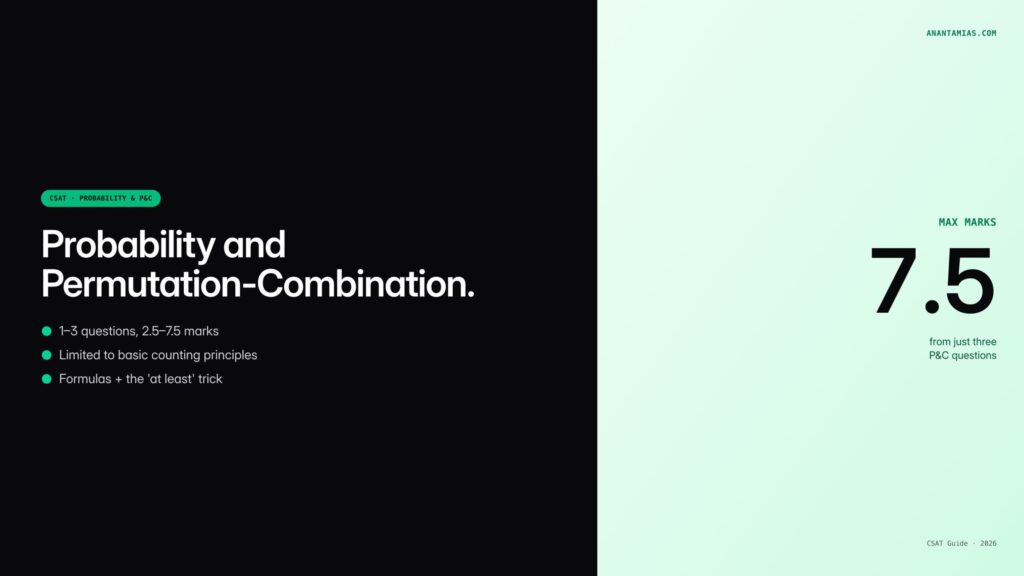
Probability and permutation-combination (P&C) together contribute 1 to 3 questions in CSAT most years, worth 2.5 to 7.5 marks. These questions intimidate many aspirants, but CSAT limits difficulty to basic counting principles and simple probability. This guide covers the must-know concepts, formulas, and worked examples.
Fundamental Principle of Counting
If one event can happen in ‘m’ ways and a second event in ‘n’ ways, the two events together happen in m × n ways (AND rule). If either event happens, it is m + n ways (OR rule).
Example
A restaurant has 4 starters, 6 mains, and 3 desserts. How many 3-course meals are possible?
Solution: 4 × 6 × 3 = 72 meals.
Permutations: Arrangements Matter
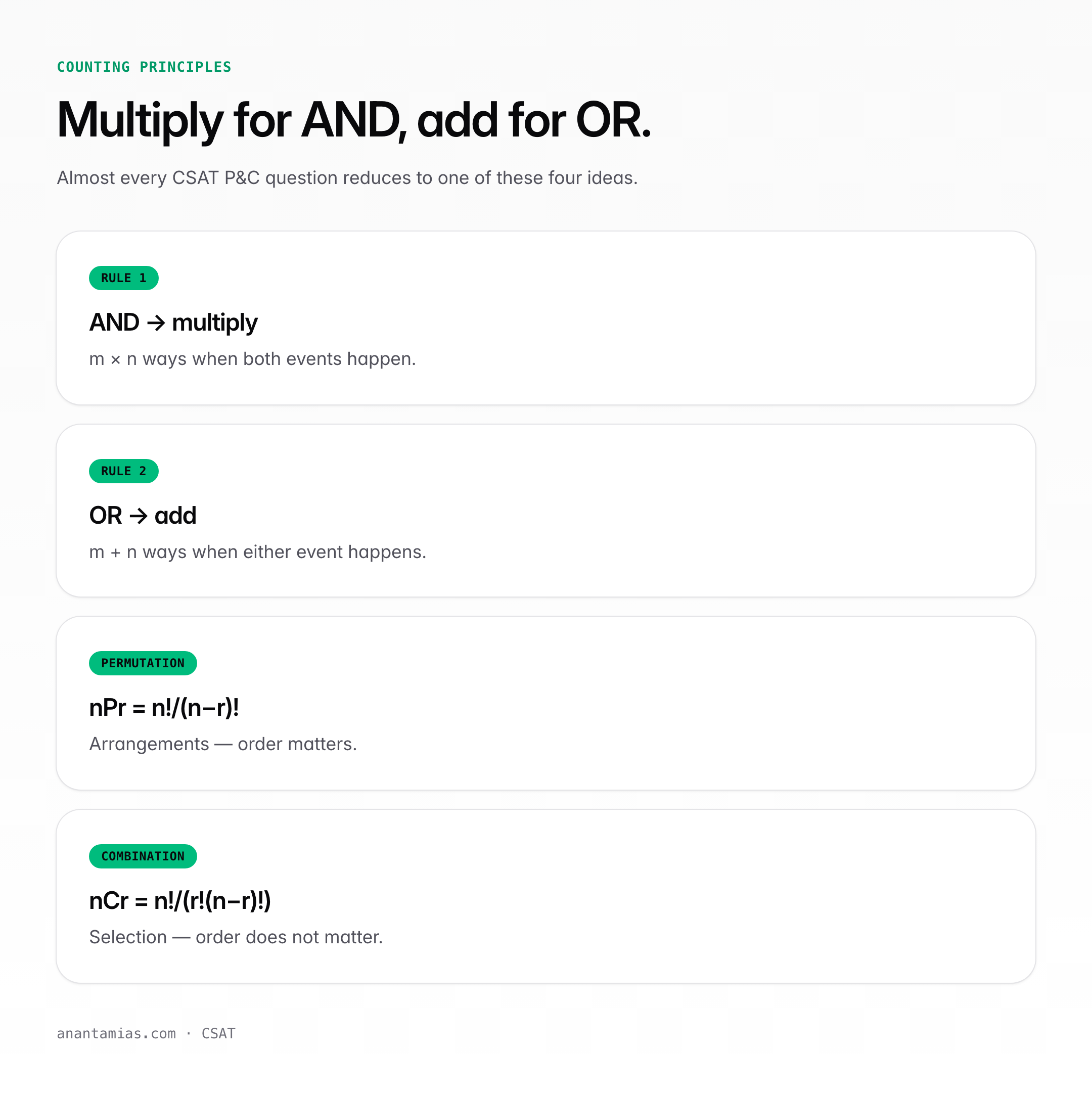
nPr = n! / (n-r)! — number of ways to arrange r items from n distinct items.
- 5P3 = 5! / 2! = 5 × 4 × 3 = 60.
- Arranging all n items: n! (e.g., 5! = 120).
- Circular arrangement of n items: (n-1)!.
- If items repeat: n! / (p! × q! × …), where p, q are counts of repeated items.
Example
How many different arrangements can be made with the letters of the word ‘INDIA’?
Solution: Total letters = 5 (I, N, D, I, A). Letter I repeats twice. Arrangements = 5! / 2! = 120 / 2 = 60.
Combinations: Selection Without Order
nCr = n! / (r! × (n-r)!) — number of ways to select r items from n.
- 5C3 = 10.
- nC0 = nCn = 1.
- nCr = nC(n-r) — symmetry.
- Sum of all combinations: 2^n.
Example
A committee of 3 is to be chosen from 8 men and 4 women, with at least 1 woman. How many committees are possible?
Solution: Total = 12C3 – (committees with 0 women) = 220 – 8C3 = 220 – 56 = 164 committees.
Probability Basics
P(event) = Favorable outcomes / Total outcomes. Probability is always between 0 and 1.
Key Rules
- P(A or B) = P(A) + P(B) – P(A and B).
- For mutually exclusive events, P(A and B) = 0.
- For independent events, P(A and B) = P(A) × P(B).
- P(complement) = 1 – P(event).
Example 1: Dice
Two dice are thrown. What is the probability that the sum is 7?
Solution: Total outcomes = 36. Favorable pairs for sum 7: (1,6), (2,5), (3,4), (4,3), (5,2), (6,1) = 6 outcomes. P = 6/36 = 1/6.
Example 2: Cards
A card is drawn from a pack of 52. Find the probability that it is a king or a red card.
Solution: P(King) = 4/52. P(Red) = 26/52. P(Red King) = 2/52. P(King or Red) = 4/52 + 26/52 – 2/52 = 28/52 = 7/13.
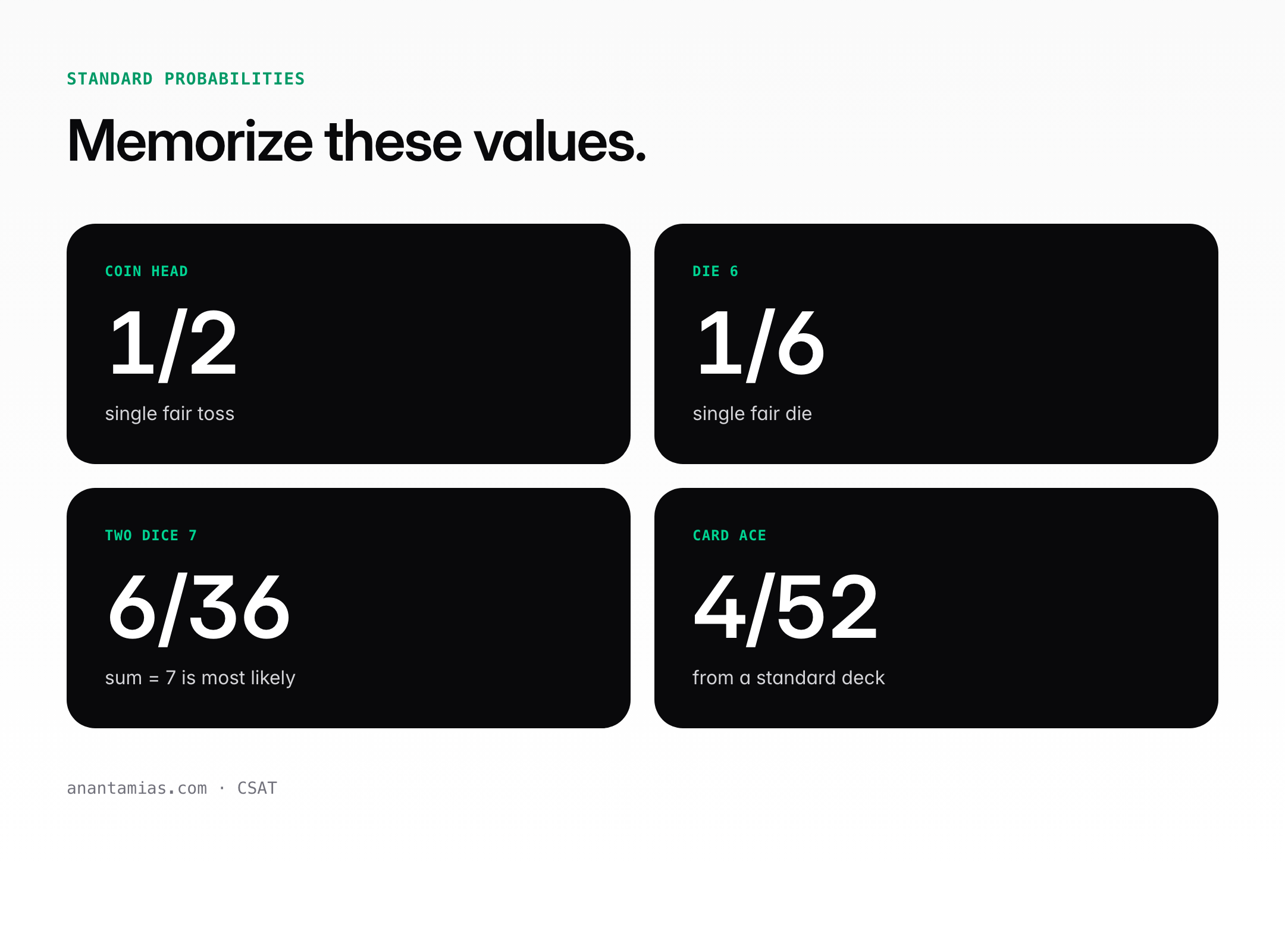
Standard Probability Values to Memorize
| Event | Probability |
|---|---|
| Getting a head on a coin | 1/2 |
| Getting a 6 on a die | 1/6 |
| Drawing an ace from a deck | 4/52 = 1/13 |
| Drawing a red card | 26/52 = 1/2 |
| Drawing a heart | 13/52 = 1/4 |
| Two dice sum of 7 | 6/36 = 1/6 |
| Two dice sum of 12 | 1/36 |
Common P&C Traps
- Confusing permutations (order matters) with combinations (order doesn’t).
- Forgetting the ‘at least one’ = 1 – P(none) shortcut.
- Missing repetition in arrangements (INDIA → divide by 2!).
- Counting the same event twice (violating mutual exclusivity).
The ‘At Least’ Shortcut
When a question asks ‘at least 1,’ ‘at least 2,’ compute the complement (i.e., ‘none’ or ‘less than k’) and subtract from 1. This is almost always faster.
Example
Three dice are rolled. Find the probability of getting at least one 6.
Solution: P(no 6) = (5/6)³ = 125/216. P(at least one 6) = 1 – 125/216 = 91/216.
Practice Routine

Quantitative Aptitude — R.S. Aggarwal (Revised 2026–27)
- The standard drill book for arithmetic and data interpretation
- Graded exercises from basics to exam level
- Far more questions than a CSAT candidate needs
- Week 1: Counting principle, factorials, basic nPr and nCr.
- Week 2: Probability basics, dice, coins, cards.
- Week 3: Mixed word problems.
- Week 4: Previous year CSAT P&C questions.
Exam Strategy
P&C questions are either straightforward (30-second solve) or trap-laden (2+ minutes). If you do not see a clear path within 45 seconds, mark and move on. Never guess — 1/3 negative marking punishes guesses heavily.
Key Takeaway
Master the counting principle and the ‘at least’ shortcut. With just these two tools, you can crack 60% of CSAT P&C questions. Do not over-prepare — P&C is a small-weightage section and time is better spent on RC and QA.
Frequently Asked Questions
How many probability questions come in CSAT?
Usually 1 to 2 probability or permutation-combination questions per year, worth 2.5 to 5 marks. Not high-weightage but often the simplest quant questions if you know the basics.
What is the difference between permutation and combination?
Permutation involves arrangement where order matters (e.g., seating positions). Combination is about selection without order (e.g., choosing a committee). nPr arranges; nCr selects.
How difficult is CSAT probability?
Class X level. UPSC does not ask conditional probability, Bayes’ theorem, or complex distributions. Focus on dice, coins, cards, balls in a bag, and basic counting.
Do I need to memorize probability formulas?
A few: P(A or B) = P(A) + P(B) – P(A and B); P(independent events) = P(A) × P(B); P(at least 1) = 1 – P(none). Combined with nCr and nPr, these handle 90% of questions.
Should I spend a lot of time on P&C?
No. P&C contributes at most 7.5 marks. Spend 8 to 10 hours learning the basics and solving 40 questions. Beyond that, you get diminishing returns; shift time to RC and percentage.
Tell Google you want more of this.
Add Anantam IAS as a preferred sourceOne tap, and this site shows up more often in your own Top Stories, AI Overviews and AI Mode. Remove it any time.