Opens in a new tab
Join Anantam IAS Channel on Telegram

Daily Digest · Monday

13 April 2026 Current Affairs for UPSC

3 current affairs published on Monday, 13 April 2026

13 April 2026 Current Affairs for UPSC — every Why-in-News article AnantamIAS published on Monday, 13 April 2026, broken down with Why in News?, the exact GS paper it feeds, sub-topic mapping, MCQ-ready facts and a UPSC-style practice question. 3 articles in total, covering Polity, Economy, Environment, S&T, IR, Geography, History, Society and Internal Security — the same Why-in-News + GS-paper-mapping + practice-question format the Compass uses across every daily digest on the site.

Daily current affairs for UPSC is where new material enters your prep stream. Read this 13 April 2026 digest end-to-end in 25–35 minutes, attempt the practice question at the foot of each article (it's MCQ for some, 10/15-marker for others), then bookmark the entries that fall inside your active revision window. Everything stays cross-linked: tap any subject pill to jump to that subject's hub, or use the table of contents above to skip straight to a specific story.

Use this page three ways. Read sequentially for a one-sitting scan of everything that mattered on 13 April 2026. Download the 13 April 2026 PDF below for offline study or print revision. Or use the April 2026 Current Affairs compilation to see this day in the month's full context. For the previous day's reading, see 12 April 2026 Current Affairs; the next day's is 14 April 2026 Current Affairs.

Why we publish daily current affairs separately from the monthly compilation: daily is learning, monthly is revision. Use the daily page to add fresh material to your notes the day it breaks; come back to the April 2026 compilation 60 days before Prelims when the noise has settled and only the lasting takeaway is worth re-reading.

Central Armed Police Forces (General Administration) Act, 2026

Open article →Download PDF

Why in News?

The Government of India has officially notified the Central Armed Police Forces (General Administration) Act, 2026. The Act establishes a uniform legal framework for recruitment and service conditions across major CAPFs – CRPF, BSF, CISF, ITBP and SSB.

UPSC Relevance: GS-3 Internal Security: Security forces and agencies. 

Prelims & Mains: Central Armed Police Forces: Components, role & associated challenges. 

About Central Armed Police Forces: 

  • Central Armed Police Forces (CAPF) are seven primary security forces responsible for border guarding, internal security, and counter-insurgency. It is under the administrative control of the Ministry of Home Affairs (MHA). 
  • Core Components and Functions: 
    • Border Guarding: Border Security Force (BSF), Indo-Tibetan Border Police (ITBP), Sashastra Seema Bal (SSB), and Assam Rifles.
    • Internal Security:
      • The Central Reserve Police Force (CRPF) handles internal security and counter-insurgency.
      • The Central Industrial Security Force (CISF) protects critical infrastructure.
    • Special Task Force: National Security Guard (NSG) acts as a specialised counter-terrorism unit.

Central Armed Police Forces (General Administration) Act, 2026: 

  • Aim: To establish a comprehensive and uniform system governing the recruitment and service conditions of Group A General Duty officers and other personnel across major CAPFs – CRPF, BSF, CISF, ITBP and SSB.
  • Major Provisions of the CAPF Act: 
    • The Act provides a clear legal framework for Indian Police Service (IPS) officers in senior positions in CAPF. These officers are typically appointed on deputation to head CAPFs.
      • 50% of the posts will be filled through deputation from the IPS in the rank of Inspector General (IG). 
      • A minimum of 67% of the posts will be filled through deputation from the IPS in the rank of Additional Director General (ADG). 
      • 100% of posts at the Special DG and Director General (DG) ranks.
    • The Act empowers the Central Government to frame rules governing recruitment and service conditions, overriding any conflicting laws.

In recent years, due to the absence of an umbrella law, regulatory provisions have evolved in a fragmented manner. This has resulted in several litigations on service-related matters, leading to some functional and administrative difficulties. 
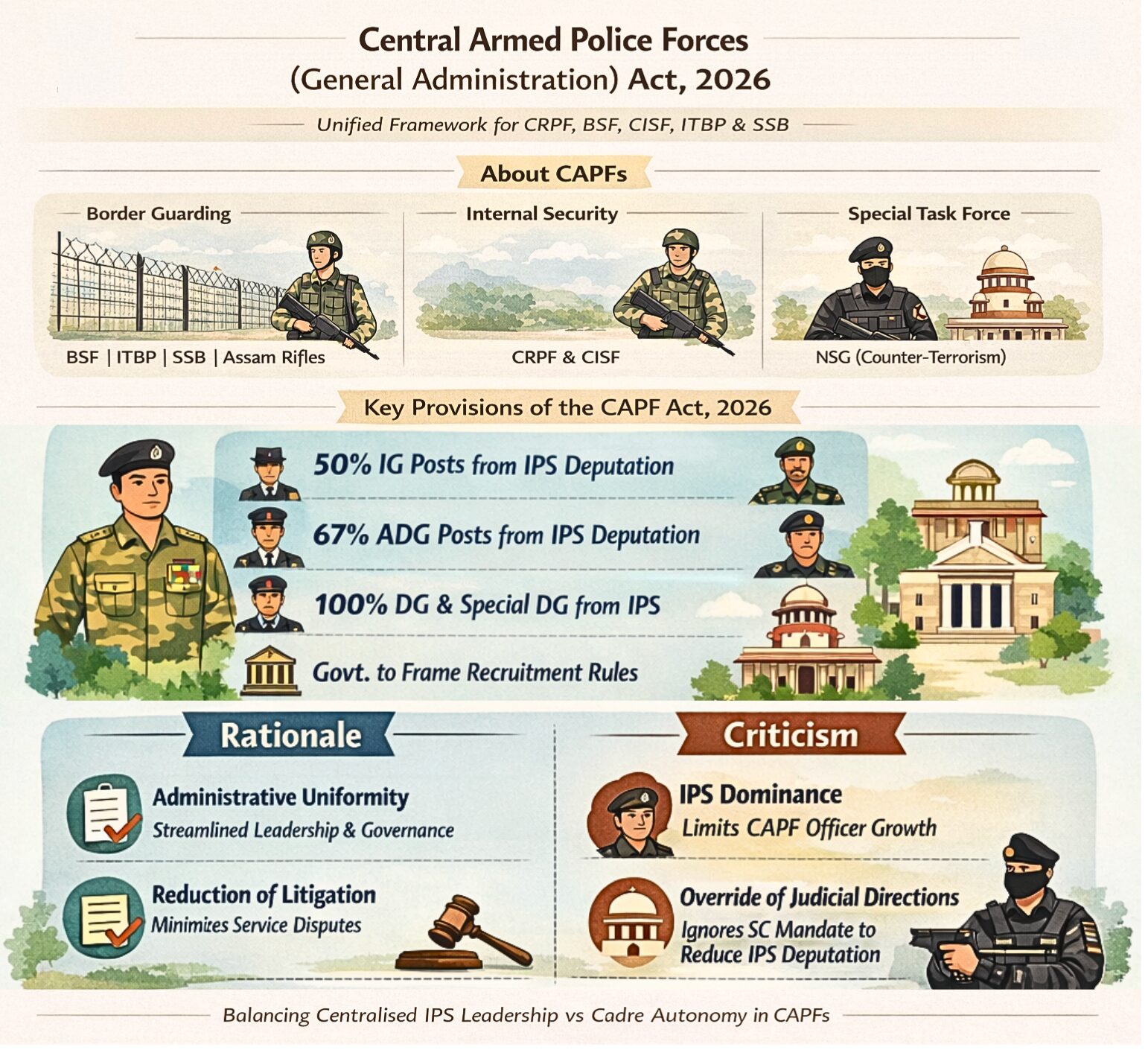
image 40

Rationale of the CAPF Act: 

  • Administrative Uniformity: Creates a common governance structure and removes fragmentation across different CAPFs. The Act streamlines leadership hierarchy, cadre and strengthens centralised control and uniform leadership.
  • Reduction of Litigation: Aims to reduce service disputes and ambiguity in promotions, postings and cadre management.

Criticism of the CAPF Act: 

  • IPS dominance and impact on CAPF morale: The 2026 Act faces criticism from retired personnel for codifying high percentages of IPS officers in top positions (up to 100% for ADG/DG ranks) and limiting the career progression and morale of CAPF cadre officers. Weakens recognition of CAPF officers as an independent cadre.
  • Override of Judicial Directions: In 2025, the Supreme Court of India directed the government to gradually reduce the deputation of IPS officers to CAPFs. It aimed to promote internal cadre officers to top positions, and to place emphasis on fair career progression and autonomy for CAPF personnel. The new Act overrides these directions by reinforcing IPS dominance.

The Act represents a major structural reform in internal security governance and is expected to improve administrative efficiency and coordination. However, it exposes a deep institutional conflict between centralised leadership (IPS model) vs Cadre-based autonomy (CAPF officers). The long-term success will depend on balancing efficiency with fairness. 

UPSC PYQ 2023

Q. With reference to Home Guards, consider the following statements:

1.     Home Guards are raised under the Home Guards Act and Rules of the Central Government.

2.     The role of the Home Guards is to serve as an auxiliary force to the police in the maintenance of internal security.

3.     To prevent infiltration on the international border/coastal areas, the Border Wing Home Guards Battalions have been raised in some States.

How many of the above statements are correct?

(a)     Only one

(b)    Only two

(c)     All three

(d)     None

Answer: (b) (Statement 1 is incorrect)
What is Keytruda and how does it work?

Open article →Download PDF

Why in News?

A major investigation has uncovered a widespread counterfeit market for Keytruda (a high-cost immunotherapy cancer drug) in India.

UPSC Relevance: GS-3 Science and Technology: Biology and Biotechnology

Prelims: Cancer treatment- key terminologies. 
Back to Basics: Key Concepts
Cancer:Cancer is defined as a group of diseases involving abnormal, uncontrolled cell growth and division. This occurs due to DNA damage or mutations that interfere with the cell’s ability to regulate cell division.
Immunotherapy: A type of cancer treatment (or biological therapy) that empowers a person’s own immune system to recognise, target, and destroy cancer cells. While chemotherapy and radiotherapy directly kill cancer cells (and some healthy cells too), immunotherapy pushes the body’s own immune system to recognise and kill cancer cells. As immunotherapy is highly targeted, it spares healthy cells. 
Antibody: Proteins produced by the immune system to neutralise any foreign substance entering the human body.An antibody attaches itself to an antigen (a foreign substance- usually a disease-causing molecule) and helps the immune system eliminate it from the body.
99adb524 7d4a 45b3 8b7e 69ed23d10044
T-cells: T-cells are special cells (type of White Blood Cells) whose primary function is to attack and kill pathogens and foreign cells. 
Monoclonal Antibodies: Laboratory-made molecules designed to bind with specific targets. 

    What is Keytruda?

    • Keytruda (pembrolizumab) is an immunotherapy drug manufactured by a US-based global pharma major for treating several cancers. It is used globally for skin cancer, lung cancer, cervical cancer, renal cell cancer and aggressive breast cancer.
    • It belongs to the category of monoclonal antibodies, enabling the immune system to identify and destroy cancerous cells.

    Working Mechanism: 

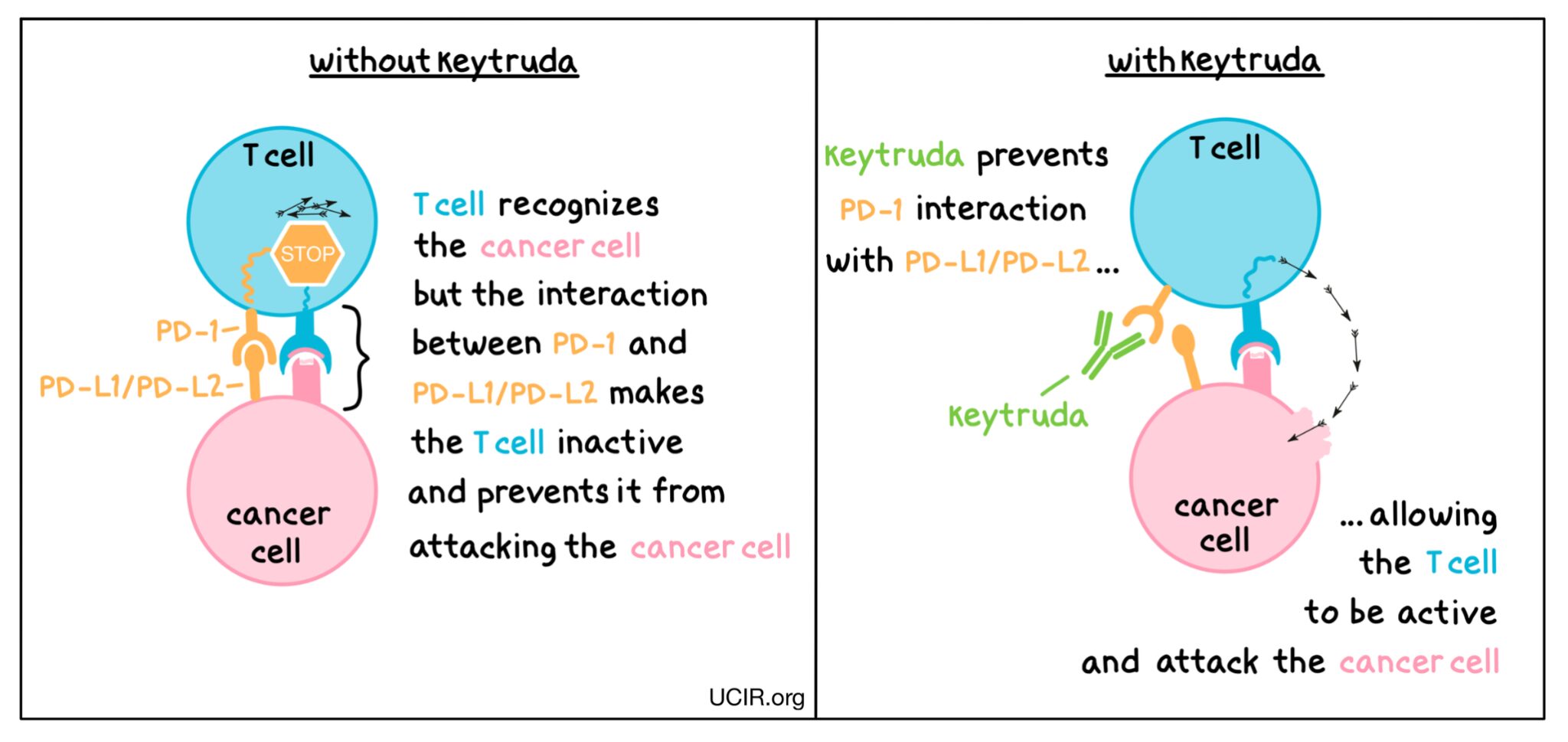
    • It belongs to a class called checkpoint inhibitors — drugs that remove the brakes which were preventing the body’s T-cells from attacking cancerous cells. 
    • Pembrolizumab works by attaching to receptors called PD-1 on T-cells. This prevents the T-cells from binding to corresponding PD-L1 receptors on cancer cells. This lets the T-cells identify the abnormal cells and trigger an immune response.
    image 41

    Important Immunotherapy-based Cancer treatments:

    • CAR-T cell therapy: Involves collecting a patient’s own T cells, engineering them to create chimeric receptors, multiplying these modified cells, and returning them to the patient. These engineered T-cells can then identify, attach to, and destroy cancer cells that would normally evade immune detection.
    • mRNA vaccines for cancer are currently under development. Unlike vaccines for infections given to healthy individuals, cancer vaccines are administered to patients who already have certain cancers to prevent relapse. These vaccines train the immune system to identify proteins called neoantigens found only in cancer cells. Once recognised, the immune system remembers these markers for years, continuing to fight cancer and prevent recurrence.

    UPSC PYQ 2022

    Q. Which one of the following statements best describes the role of B-cells and T-cells in the human body?

    (a) They protect the body from environmental allergens.

    (b) They alleviate the body’s pain and inflammation.

    (c) They act as immunosuppressants in the body.

    (d) They protect the body from the diseases caused by pathogens.

    Answer: (d) 

    Oak Trees & Himalayan Ecology

    Open article →Download PDF

    Why in News?

    Recently, the Uttarakhand High Court has stayed the felling of Oak trees in Mussoorie for construction by the Municipal Council. Oak holds immense social and ecological importance in the Indian Himalayan regions. 

    UPSC Relevance: GS-3 Environment and Biodiversity: Conservation

    Prelims: Species in News: Oak 

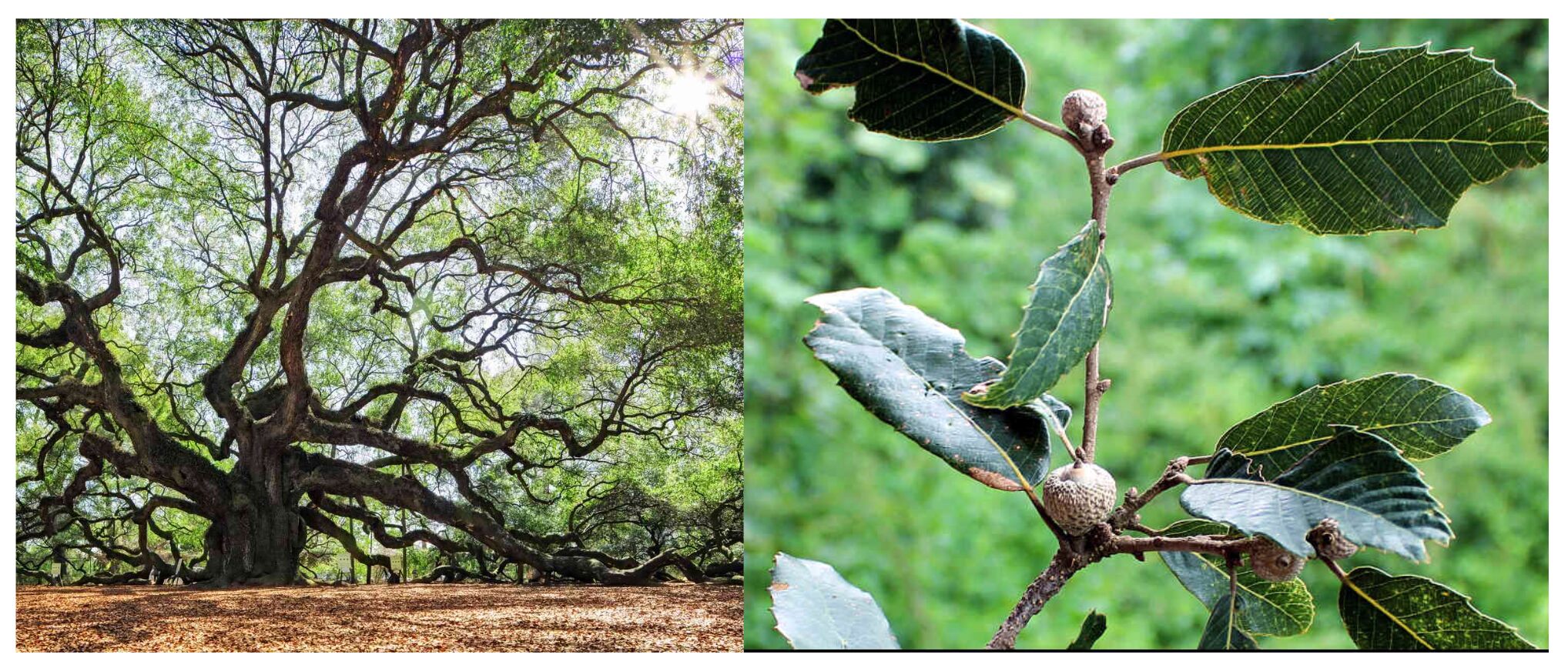
    Oak Tree: 

    • An oak is a hardwood tree widely distributed in the Northern Hemisphere, with both deciduous and evergreen species.
    • Lifespan: avg. 100-300 years. Some Oak species can live for over 1000 years.  
    • Diversity: ~35 species in the Indian Himalayan Region (~500 species globally)
    • Habitat: Found between 800 and 3000 m altitude in the Himalayas. Major species in Uttarakhand: Banj oak, Moru oak, etc. 
    image 42

    Ecological Importance of the Oak Tree:

    • Soil and Water Conservation: The deep root systems of Oak prevent soil erosion and stabilise fragile mountain slopes. These roots create channels in the soil that allow water to percolate deeper, thereby recharging groundwater. The thick mat of leaves (litter) and the organic humus produced by oak trees act like a natural sponge, absorbing heavy rainfall and preventing rapid runoff and soil erosion.
    • Biodiversity Hotspots:
      • Flora: Oak trees host lichens, bryophytes, pteridophytes (all three being moss-like plants), orchids, and other flowering plants, creating layered microhabitats.
      • Fauna: Birds and mammals such as jays, Himalayan langurs, red giant flying squirrels, and Asiatic black bears feed on oak leaves and acorns.
      • They live in association with many kinds of fungi (oaks provide starch to the underground fungi network, and the fungi help the oaks access nutrients), and support various insects. 
    • Livelihood Support: Oak is used as fuel wood and fodder by locals from the forests near their settlements. Most preferred fuel species due to its sustained burning.
    • Climate Regulation & Carbon Sink: Dense canopy leads to high carbon sequestration. Maintain microclimatic stability- Lower temperatures & Higher humidity. 

    Associated Threats: 

    • Invasion by Alien species: Oak forests are undergoing rapid transformation due to invasion by alien invasive species, such as Eupatorium adenophorum, Lantana camara, and Chir Pine.
    • Forest Fire: Due to forest fire, the damaged stems are highly susceptible to pathogens, which weaken the tree and result in wind throw and breakage.
    • Anthropogenic disturbances such as forest disturbance (indiscriminate grazing, lopping, surface burning), deforestation and other developmental activities.