Why in News?
The National Productivity Council (NPC) has been officially designated as the Environmental Audit Designated Agency by the Ministry of Environment, Forest and Climate Change (MoEF&CC).
| UPSC Relevance: GS-3 Environment and Biodiversity: Environmental Impact Assessment Prelims: Key facts about the National Productivity Council |
About National Productivity Council:
- NPC is an autonomous organisation under the Department for Promotion of Industry and Internal Trade (DPIIT), Ministry of Commerce & Industry.
- It is a think tank for the government and private sectors which focuses on improving efficiency, sustainability, and quality across agriculture, industry, and the service sector.
- NPC is a member of the Asian Productivity Organisation headquartered in Tokyo.
- Headquarters: New Delhi
National Productivity Council to lead Environmental Audits:
- NPC has signed an agreement with the MoEF&CC to act as the Environment Audit Designated Agency (EADA) under the Environment Audit Rules, 2025.
- Aim: To strengthen environmental compliance mechanisms, enhance transparency and institutionalise standardised environmental auditing practices across the country.
- NPC will operate in accordance with the provisions of the Environment Audit Rules, 2025, ensuring adherence to prescribed standards, timelines and reporting requirements.
Key responsibilities of NPC as EADA:
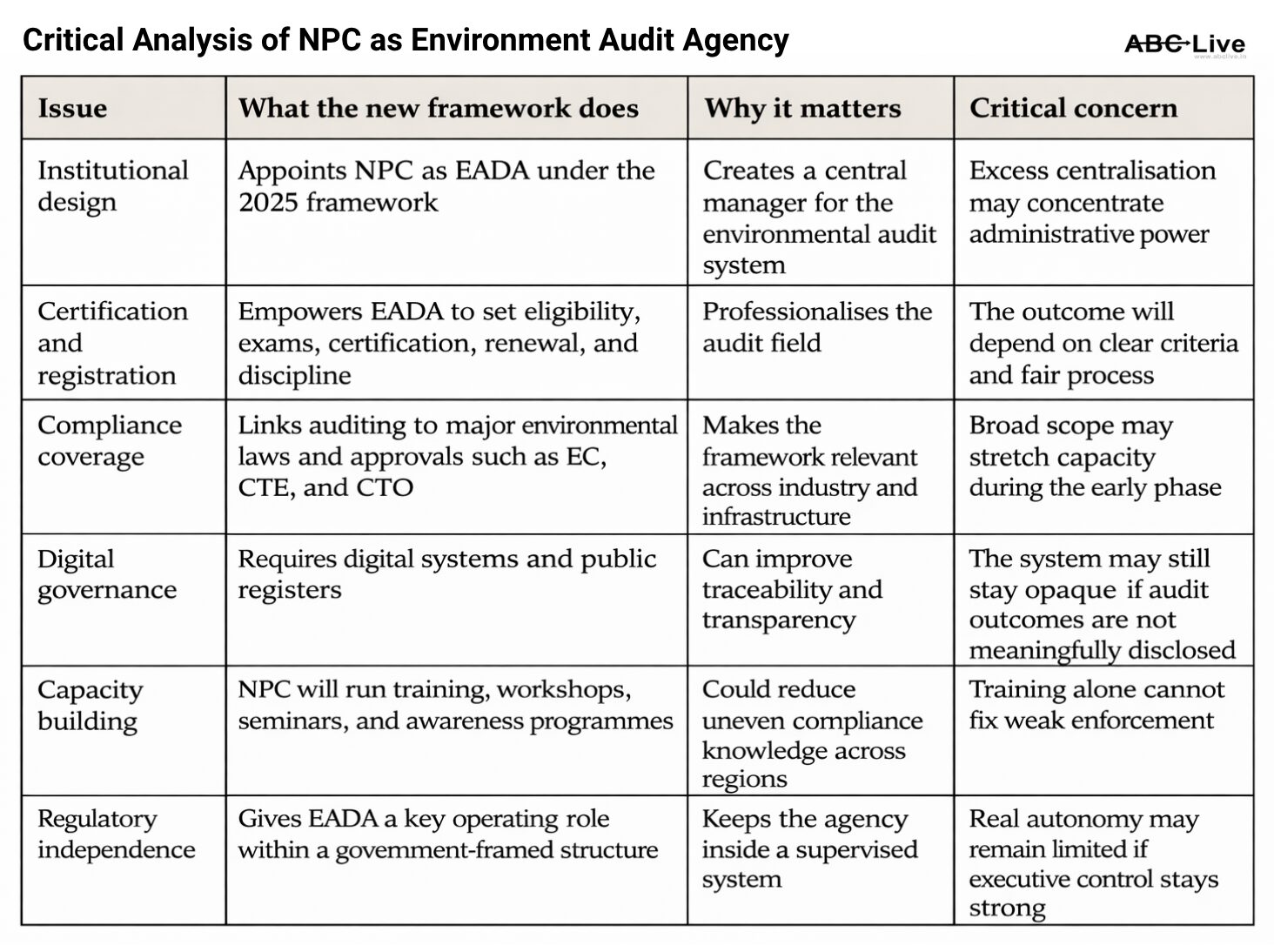
- Management of the Environmental Audit Framework, including the development of eligibility criteria, the conduct of examinations for certification, the registration of auditors, monitoring of their performance and capacity building.
- Certification and registration of Certified Environmental Auditors (CEA) and Registered Environmental Auditors (REA).
- Development and management of digital systems for environmental audit processes.
- Support compliance with regulatory approvals such as Environmental Clearance (EC), Consent to Establish (CTE) and Consent to Operate (CTO) issued by the competent authorities.
| Environment Audit Framework: The Environment Audit Framework is envisaged as a key instrument to strengthen compliance with major environmental legislations, including: • Environment (Protection) Act, 1986 • Water (Prevention and Control of Pollution) Act, 1974 • Air (Prevention and Control of Pollution) Act, 1981 • Forest Conservation Act, 1980 • Wild Life (Protection) Act, 1972, and rules framed thereunder. Environmental Impact Assessment: • Environmental Impact Assessment (EIA) is the process of examining the environmental, social and health effects of a proposed development. • Environmental Clearance is mandatory for certain developmental projects listed under the Environment Impact Assessment (EIA) Notification of 2006, which is issued under the Environment (Protection) Act, 1986. |
Significance:
The establishment of a dedicated agency for environmental audits is expected to improve monitoring, reporting accuracy and regulatory compliance, thereby contributing to better environmental outcomes.
Critical Analysis of NPC as Environment Audit Agency:
Practice MCQ:
Q. With reference to the National Productivity Council (NPC), consider the following statements:
1. It is an autonomous organisation under the Ministry of Environment, Forest and Climate Change.
2. It has been designated as the Environmental Audit Designated Agency under the Environment Audit Rules, 2025.
3. It is a member of the Asian Productivity Organisation.
Which of the statements given above are correct?
(a) 1 and 2 only
(b) 2 and 3 only
(c) 1 and 3 only
(d) 1, 2, and 3
Answer: (b)
Tell Google you want more of this.
Add Anantam IAS as a preferred sourceOne tap, and this site shows up more often in your own Top Stories, AI Overviews and AI Mode. Remove it any time.