Context: At least 40 people, including two CISF jawans, have died and more than 100 are missing after a massive cloudburst struck Chositi village in Jammu and Kashmir’s Kishtwar district on August 14, 2025, triggering flash floods and large-scale destruction.

UPSC Relevance:
GS 1, Important Geophysical Phenomena such as earthquakes, Tsunami, Volcanic activity, cyclone etc., geographical features and their location-changes in critical geographical features (including water-bodies and ice-caps) and in flora and fauna and the effects of such changes.
PYQ:
Question: What is the phenomenon of ‘Cloudbursts’? Explain. (2024)
Cloudburst:
- This term is a misnomer actually. The term “cloudburst” originated from the outdated belief that clouds were like water balloons that “burst,” releasing all their contents at once. However, this is not the case.
- A cloudburst is an extreme weather event characterized by a sudden, intense downpour of rain over a small geographical area.
- According to the Indian Meteorological Department (IMD), when 10 cm or 100 mm rainfall is received at a station in one hour, the rain event is termed as cloud burst.
Causes of Cloudbursts:
- Orographic Lift – When warm, moist air from low-lying areas is forced to rise up a mountain slope, it cools and condenses rapidly. This process forms cumulonimbus clouds. Strong updrafts within these clouds prevent raindrops from falling, allowing a massive amount of water to accumulate. When these updrafts weaken, the entire accumulated water volume is released suddenly, leading to a cloudburst.
- This is the most common cause, especially in mountainous regions like the Himalayas and western Ghats.


2. Atmospheric Instability – Rapid changes in temperature and pressure can create conditions that lead to the quick formation and growth of convective clouds. The collision of warm, moist air with cooler, denser air can also trigger the rapid upward movement of the warm air, resulting in intense rainfall.
Can cloudburst be predicted?
- According to IMD, it is very difficult to predict the cloud bursts due to its very small scale in space and time.
- To monitor or nowcast (forecasting next few hours lead time) the cloud burst, we need to have a dense radar network over the cloud burst prone areas or one need to have very high resolution weather forecasting models to resolve the scale of cloud burst.
- Mountainous regions are more prone to cloud bursts due to orography.
- Cloud bursts can also occur at plains.
- High-risk zones: IMD
- Uttarakhand, Himachal, Northeast states
- Western Ghats (Goa to Gujarat)

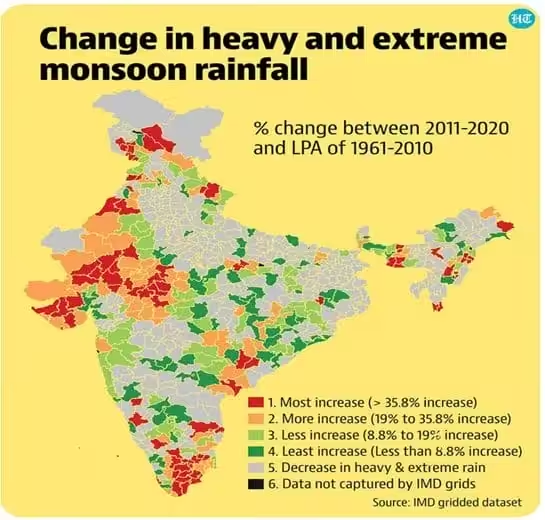
Why are cloudburst events increasing in India?
Increased Atmospheric Temperature due to Global Warming
- According to experts, increase in temperature is the primary cause of increasing cloudbursts in Himalayan states like Himachal Pradesh, Uttarakhand and Jammu and Kashmir. The average temperature in Himachal was the highest in the last 25 years. When hot and moist air rises rapidly and condenses on reaching cold heights, it causes sudden and heavy rain. This process is more intense in the Himalayan valleys, as the hot air rises up along the mountains.
- Warmer air holds more water which in turn feeds the monsoon winds with more moisture. When these moisture-laden winds encounter a geographical barrier like the Himalayas, they release a massive amount of water in a short time, leading to a cloudburst.
- Higher temperatures can destabilize the atmosphere, leading to increased convective activity and more frequent and intense thunderstorms, which are the precursors to cloudbursts.
Changing Monsoon Patterns due to Climate Change
- India is now experiencing longer dry periods and very short and intense spells of heavy rainfall in between. This means that a large volume of rain that would have fallen over several days is now being dumped in a few hours, increasing the likelihood of cloudbursts.
- They have become increasingly common from May-September when the southwest monsoon season prevails in much of the country.
Increased Cloud condensation nuclei (CCN) due to Pollution
- CCN are tiny particles in the atmosphere (like dust, pollen, soot, and sea salt) that act as a surface for water vapor to condense on, forming cloud droplets. Without them, clouds wouldn’t form.
- When the updraft weakens or the cloud becomes too heavy, the entire volume of water is released suddenly, leading to a catastrophic downpour cloudburst.
- When the atmosphere is rich in CCN (due to pollution, for example), the available moisture is distributed among a very large number of condensation nuclei. This results in a cloud made of numerous tiny, lightweight droplets. They can remain suspended in the air by a cloud’s updraft for a longer time, preventing precipitation from occurring.
Man made factors – Human Activities and Land Degradation significantly increase vulnerability to these extreme weather events and associated destruction.
- Unplanned Development – Unchecked construction of roads, buildings, mining and hydropower projects in ecologically fragile zones like the Himalayas destabilizes the soil and slopes. When a cloudburst occurs, the flash floods and landslides that follow are far more devastating because the land is unable to absorb the sudden influx of water.
- The catastrophic Uttarakhand floods of 2013 were exacerbated by rampant, unregulated construction in the region.
- Deforestation – The removal of trees in mountainous areas leads to soil erosion and loss of a natural buffer that would otherwise hold the soil in place and absorb rainwater. This makes the region more vulnerable to landslides and flash floods during cloudbursts.
Impacts of Cloudbursts:
- Flash floods are the most immediate and destructive impact of cloudburst. The immense volume of rain in a short period swells up small streams and rivers, causing them to overflow their banks and wash away everything in their path.
- Landslides and Mudslides are caused as the sudden and heavy rain saturates the soil on steep slopes, reducing its stability.
- Widespread destruction of infrastructure is caused. Roads, bridges, power lines, and communication networks are often washed away or severely damaged, cutting off affected areas and hindering rescue and relief efforts.
- Recent cloudbursts in Himachal Pradesh have led to the closure of hundreds of roads, including major national highways, and the washing away of several bridges, isolating remote communities.
- Leads to significant loss of human and animal life and the destruction of homes, agricultural land, standing crops and personal belongings. This causes immense economic and social hardship for the affected communities.
Case Study – Uttarakhand Floods of 2013
The catastrophic floods in Uttarakhand in June 2013 were triggered by a series of cloudbursts. Continuous, torrential rainfall over a three-day period, combined with the rapid melting of a glacier, caused major rivers like the Mandakini and Alaknanda to swell. The disaster led to widespread destruction, with flash floods and landslides washing away entire villages, bridges, and roads. The calamity was a grim reminder of how extreme weather events, exacerbated by human activities, can have a devastating impact on fragile mountain ecosystems.
Measures to Mitigate Destruction:
- While cloudbursts cannot be prevented, their destructive impact can be significantly reduced through a combination of preparedness, mitigation, and policy measures.
- Early Warning Systems – The deployment of Doppler radars and other meteorological monitoring systems is crucial for detecting intense rainfall and issuing timely, localized warnings. Mission Mausam 2.0 can further develop these capabilities.
- Disaster-Resilient Infrastructure – Implementing stricter building codes to prevent construction in flood-prone and landslide-prone areas is essential. Infrastructure like roads, bridges, and drainage systems should be designed to withstand heavy rainfall and flash floods.
- Afforestation and Watershed Management – Reforestation efforts and soil conservation practices in catchment areas help to absorb excess water, stabilize slopes, and reduce surface runoff, thereby mitigating the risk of landslides and floods.
- Community Preparedness – Educating and training local communities on emergency response, including evacuation routes and safe locations, is vital. Community-based disaster management plans, which leverage local resources and expertise, can make mitigation efforts more successful.
- Sustainable Land-Use Planning – Enforcing regulations that prevent illegal mining, hill-cutting, and encroachment on riverbeds can help maintain the ecological balance of vulnerable regions.