3 current affairs published on Tuesday, 19 August 2025
19 August 2025 Current Affairs for UPSC — every
Why-in-News article AnantamIAS published on Tuesday, 19 August 2025, broken down with
Why in News?, the exact GS paper it feeds, sub-topic mapping, MCQ-ready facts and a
UPSC-style practice question. 3 articles in total, covering Polity, Economy, Environment, S&T, IR, Geography, History, Society and Internal
Security — the same Why-in-News + GS-paper-mapping + practice-question format the Compass uses across
every daily digest on the site.
Daily current affairs for UPSC is where new material enters your prep stream. Read this
19 August 2025 digest end-to-end in 25–35 minutes, attempt the practice question
at the foot of each article (it's MCQ for some, 10/15-marker for others), then bookmark the entries
that fall inside your active revision window. Everything stays cross-linked: tap any subject pill to jump
to that subject's hub, or use the table of contents above to skip straight to a specific story.
Use this page three ways. Read sequentially for a one-sitting scan of everything that
mattered on 19 August 2025. Download the
19 August 2025 PDF below for offline study or print revision. Or use
the August 2025 Current Affairs compilation
to see this day in the month's full context. For the previous day's reading, see
18 August 2025 Current Affairs;
the next day's is 20 August 2025 Current Affairs.
Why we publish daily current affairs separately from the monthly compilation: daily is learning,
monthly is revision. Use the daily page to add fresh material to your notes the day it breaks;
come back to the August 2025 compilation 60 days before Prelims when the
noise has settled and only the lasting takeaway is worth re-reading.
UPSC has been continuously asking questions based on various Govt. scheme in news. for example-
PYQ 2014:
Consider the following pairs:
Programme/Project:
Ministry
1. Drought-Prone Area Programme
Ministry of Agriculture
2. Desert Development Programme
Ministry of Environment and Forests
3. National Watershed Project Development for Rainfed Areas
Ministry of Rural Development
Which of the above pairs is/are correctly matched?
(a) 1 and 2 only (b) 3 only (c) 1, 2 and 3 (d) None
PYQ 2015:
Q.‘Pradhan Mantri Jan-Dhan Yojana’ has been launched for
(a) providing housing loan to poor people at cheaper interest rates
(b) promoting women’s Self-Help Groups in backward areas
(c) promoting financial inclusion in the country
(d) providing financial help to the marginalised communities
UPSC Mains PYQ 2016:
Q. Pradhan Mantri Jan-Dhan Yojana (PMJDY) is necessary for bringing unbanked to the institutional finance fold. Do you agree with this for financial inclusion of the poorer section of the Indian society? Give arguments to justify your option. (150 words, 10 marks)
About PM Jan Dhan Yojana:
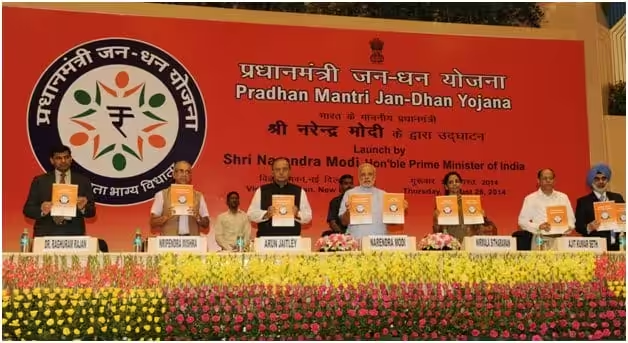
Pradhan Mantri Jan Dhan Yojana (PMJDY) was announced by Prime Minister, Shri Narendra Modi on 15th August 2014 from the ramparts of the Red Fort and launched by him on 28th August 2014 across the country.
Pradhan Mantri Jan-Dhan Yojana (PMJDY) is National Mission for Financial Inclusion to ensure access to financial services, namely, a basic savings & deposit accounts, remittance, credit, insurance, pension in an affordable manner.
Under the scheme, a basic savings bank deposit (BSBD) account can be opened in any bank branch or Business Correspondent (Bank Mitra) outlet, by persons not having any other account.
. The Mission also envisages extension of Direct Benefit Transfer (DBT) under various Government Schemes through bank accounts of the recipients
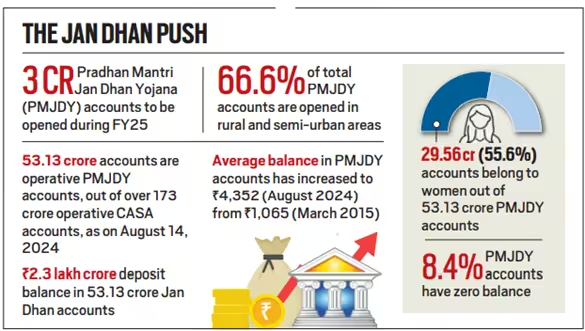
Achievements:
Eligibility:
The applicant should be an Indian National.
The applicant should be aged between 18 and 59 years.
If minors above ten years apply, they will require support from their legal guardians to administer their PMJDY account.
Benefits under PMJDY:
One basic savings bank account is opened for unbanked person.
There is no requirement to maintain any minimum balance in PMJDY accounts.
Interest is earned on the deposit in PMJDY accounts.
Rupay Debit card is provided to PMJDY account holder.
Accident Insurance Cover of Rs.1 lakh (enhanced to Rs. 2 lakh to new PMJDY accounts opened after 28.8.2018) is available with RuPay card issued to the PMJDY account holders.
An overdraft (OD) facility up to Rs. 10,000 to eligible account holders is available.
PMJDY accounts are eligible for Direct Benefit Transfer (DBT), Pradhan Mantri Jeevan Jyoti Bima Yojana (PMJJBY), Pradhan Mantri Suraksha Bima Yojana (PMSBY), Atal Pension Yojana (APY), Micro Units Development & Refinance Agency Bank (MUDRA) scheme.
Challenges:
Many cases have been detected that, where an individual has opened more than one account in various banks.
Budgetary provisions has not been made by the government to provide incentives, otherwise the financial status of the banks may be ruined.
Insurance companies have to fix a nominal premium to cover the risk of the account holders in case it is not done the state owned LIC may batter with financial losses.
Overdraft facility needs to be properly regulated, as the same is the discretionary of the concerned banks.
Many banks may decline to extend the overdraft facility therefore defeating the purpose.
Bank correspondence i.e. bank mitra is the idea before the finance ministry whereas creating infrastructure mitra for business mitra, including computers, micro ATM biometric scanners, and internet connectivity may be a major concern.
Private Banks levy hidden charges on the beneficiary which may become a deterrent for the financial inclusion.
Financial Inclusion:
According to world bank:-Financial inclusion means that individuals and businesses have access to and use affordable financial products and services that meet their needs.
The Union Home Ministry (MHA) has filed an affidavit before the Jammu & Kashmir and Ladakh High Court. It stated that the Lieutenant Governor (LG) of J&K has the power to nominate five members (two women, two Kashmiri migrants, and one displaced person from Pakistan-occupied Kashmir) to the J&K Legislative Assembly without the aid and advice of the Council of Ministers. This raises constitutional and democratic accountability concerns.
UPSC Relevance:
Functions and responsibilities of the Union and the States, Parliament and State legislatures—structure, functioning, conduct of business, powers & privileges and issues arising out of these.
UPSC PYQ 2022:
Consider the following statements:
The Constitution of India classifies the ministers into four ranks viz. Cabinet Minister, Minister of State with Independent Charge, Minister of State and Deputy Minister.
The total number of ministers in the Union Government, including the Prime Minister, shall not exceed 15 percent of the total number of members in the Lok Sabha.
Which of the statements given above is/are correct?
A) 1 only
B) 2 only
C) Both 1 and 2
D) Neither 1 nor 2
UPSC Mains PYQ 2018:
Q: Whether the Supreme Court Judgement (July 2018) can settle the political tussle between the Lt. Governor and elected government of Delhi? Examine.
Constitution Provisions:
Article 80:
The Constitution lays down the maximum strength of Rajya Sabha as 250, out of which 12 members are nominated by the President and 238 are representatives of the States and of the three Union Territories.
By 104th constitution amendment act 2020 the provision for nominating Anglo-Indians to the lok sabha and state sssemblies was abolished.
Article 80(3):
The members to be nominated by the President under sub-clause (a) of clause (1) shall consist of persons having special knowledge or practical experience in respect of such matters as the following, namely:- Literature, science, art and social service.
Article 171:
for states that have legislative council one-sixth of their members nominated by the Governor based on ministerial advice.
Union Territory(s):
Delhi Assembly: 70 elected members, no nominated members.
J&K Reorganisation Act, 2019 (amended 2023): 90 elected members + up to 5 nominated by the LG (2 women, 2 Kashmiri migrants, 1 PoK displaced).
Puducherry Assembly: 30 elected members + up to 3 nominated by Union Government.
SC Judgement:
Puducherry Case (K. Lakshminarayanan vs Union of India, 2018):
Madras HC upheld Union Government’s power to nominate 3 members to Puducherry Assembly without ministerial advice.
Issues:
UTs have elected governments accountable to the people.
When the same party rules at the Centre and the UT, nominations don’t cause tension. But when different parties are in power, nominated MLAs can shift the balance — turning a majority into a minority or vice versa.
This will undermines federal-democratic norms.
Way forward:
J&K is a case sui generis for it was a State till 2019 with even more autonomy than other States. While the conversion of J&K into a UT has been upheld by the Supreme Court, the Union government has informed the court that it would restore statehood to J&K at the earliest. Considering these factors, it is appropriate that the nomination of five members to the J&K Assembly is made by the LG based on the advice of its Council of Ministers. This would uphold the democratic principle.
Context: The United Nations’ newly released The State of Food Security and Nutrition in the World 2025 reports that 673 million people (8.2% of the world’s population) were undernourished in 2024. India has played a decisive role in this global progress according to some experts.
UPSC Relevance and PYQ :
GS2 – Issues relating to Poverty and Hunger
2018
How far do you agree with the view that the focus on lack or availability of food as the main cause of hunger takes the attention away from ineffective human development policies in India?
GS 3 – Public Distribution System – Objectives, Functioning, Limitations, Revamping; Issues of Buffer Stocks and Food Security
2021
What are the salient features of the National Food Security Act, 2013? How has the Food Security Bill helped in eliminating hunger and malnutrition in India?
Hunger is discomfort or pain caused by a lack of food. It is different from food insecurity, which means lack of regular access to safe and nutritious food for proper development and an active and healthy life.
According to the Food and Agriculture Organization (FAO),food security exists when all people, at all times, have physical and economic access to sufficient, safe, and nutritious food to meet their dietary needs and food preferences for an active and healthy life.
Present Status of India
Global Hunger Index (GHI) 2024 – India was ranked 105th out of 127 countries with a score of 27.3, which is considered a “serious” level of hunger. While this is an improvement from its 2023 ranking of 111, it is still a low rank compared to its neighboring countries.
UN’s State of Food Security and Nutrition in the World (SOFI) 2025 Report
The prevalence of undernourishment in India declined to 12% in 2022-24 from 21% in 2004-06. However, India still has the highest absolute number of undernourished people in the world.
India ranks 48th globally and 7th highest in Asia for undernourishment.
Malnutrition: While hunger has been reduced, India faces a “double burden” of malnutrition.
Child Wasting (acute undernutrition): India has the highest child wasting rate in the world at 18.7%.
Child Stunting(chronic undernutrition): The rate of stunting has improved but remains high. The SOFI 2025 report indicates that 37.4 million children under five are stunted.
Anaemia: Over 53.7% of women aged 15-49 in India suffer from anemia, placing the country fourth globally in anemia prevalence.
Obesity: Alongside undernutrition, overnutrition is a growing concern. The number of overweight children and obese adults has been rising, highlighting a “nutritional paradox” where hunger and obesity coexist.
Diet Affordability: Report notes that a healthy diet remains unaffordable for over 60% of the Indian population, primarily due to the high prices of nutrient-dense foods like pulses, fruits, and vegetables.
Note : The SOFI report is released jointly by the Food and Agriculture Organization of the United Nations (FAO), the International Fund for Agricultural Development (IFAD), the United Nations Children’s Fund (UNICEF), the World Food Programme (WFP), and the World Health Organization (WHO) to monitor progress on SDG 2 targets.
National Sample Survey data on household consumption
Also shows that the prevalence of undernourishment in India declined from 14.3% in 2020-22 to 12% in 2022-24.
In absolute terms, this means 30 million fewer people living with hunger- an impressive achievement considering the scale of the population and the depth of disruption caused by the COVID-19 pandemic.
What has helped India to combat Hunger and Malnutrition?
The transformation of the PDS via Digitalisation – highlighted by author
Aadhaar-enabled targeting
real-time inventory tracking and biometric authentication.
The rollout of electronic point-of-sale systems
The One Nation One Ration Card platform has made entitlements portable across the country, which is particularly crucial for internal migrants and vulnerable households.
These innovations allowed India to rapidly scale up food support during the pandemic and to continue to ensure access to subsidised staples formore than 800 million people.
Continued Social Security Support by Government
The Pradhan Mantri Garib Kalyan Anna Yojana (PMGKAY) was launched with the specific purpose of ameliorating the hardships faced by the poor and needy due to economic disruptions caused by the COVID-19 pandemic in the country delivering free ration.
The Central Government has decided to extend the PMGKAY for an additional 5 years, starting from January 1, 2024. This initiative will provide free food grains to approximately 81.35 crore beneficiaries.
The National Food Security Act, 2013legally entitles up to 75% of the rural population and 50% of the urban population to receive subsidized food grains through the Targeted Public Distribution System. NFSA covers approximately 81 crore beneficiaries across India, including 16 crore women, reflecting its commitment to empowering women. This broad coverage encompasses both Priority Households (PHH) and Antyodaya Anna Yojana (AAY) categories, ensuring subsidized food grains are accessible to a substantial portion of the population.
Focus on Inclusion
Schemes focusing on various vulnerable groups ranging from Tribals via PM JANMAN, to Street Vendors via PM Street Vendor’s AtmaNirbhar Nidhi (PM SVANidhi) to marginalized artisans via PM Vishwakarma to farmers via PM KISAN.
These interventions are significant to reduce poverty, improve economic well being of vulnerable groups that is a prerequisite for ensuring food security, affordability and quality of diet and consumption.
Focus on nutrition
India has begun investing in improving the quality of calories. For example, the Pradhan Mantri Poshan Shakti Nirman (PM POSHAN) school-feeding scheme, launched in 2021, and the Integrated Child Development Services are now focusing on dietary diversity and nutrition sensitivity, laying the foundation for long-term improvements in child development and public health.
The POSHAN Tracker has been praised by SOFI Report as well.
Focus on Biofortification – ICRA has developed 87 biofortified varieties of 16 different crops with improved nutrient content. Biofortified crops are integrated into various government programs like POSHAN Abhiyaan, aiming to improve nutritional outcomes.
Since the 2019-20 fiscal year through March 31, 2024, approximately 406 lakh metric tonnes of fortified rice have been distributed through the Public Distribution System (PDS).
Checking Food Inflation
New data in the UN report also shows progress the country has made in making healthy diets more affordable despite food inflation via various interventions like:
Reduced or zero import dutieson pulses and vegetable oils ensures abundant supply of the same in the domestic market.
The Government has utilized the Price Stabilization Fund (PSF) to manage price volatility in essential agri-horticultural commodities, ensuring that individuals,especially those from lower-income groups, do not face difficulties due to fluctuating prices.
Bharat Dal was launched in July 2023, converting Chana stock into subsidized Chana dal priced at Rs.60 per kg for 1 kg packs and Rs.55 per kg for 30 kg packs. Additionally, Bharat Atta and Bharat Rice are available at subsidized rates of Rs.27.50 per kg and Rs.29 per kg, respectively, through NAFED, NCCF, and Kendriya Bhandar.
Subsidy support on fertilisers
Open Market operations– release of Buffer Stocks in market
Ban on export of rice, wheat, onion, as and when required etc.
Investment in Infrastructure and agricultural marketing
Agriculture Infrastructure Fund (AIF) – A financing facility that provides medium-to-long-term debt for post-harvest management projects and community farming assets. It offers interest subvention and credit guarantees for loans to build infrastructure like warehouses, cold storage facilities, and processing units, which helps reduce food wastage.
Pradhan Mantri Kisan SAMPADA Yojana (PMKSY) – A comprehensive scheme to create modern infrastructure for food processing. It includes sub-schemes for Mega Food Parks and Integrated Cold Chains, aiming to establish a seamless supply chain from the farm to the consumer.
Agricultural Marketing Infrastructure (AMI) Scheme – This program provides financial assistance for the construction and renovation of godowns and warehouses in rural areas. It helps farmers store their produce and sell it when market prices are more favorable.
e-National Agriculture Market (e-NAM)– This is a pan-India electronic trading portal that networks existing Agricultural Produce Market Committee (APMC) markets. It allows farmers to sell their produce to a wider range of buyers online, leading to better price discovery and greater transparency by reducing the role of intermediaries.
Pradhan Mantri Annadata Aay Sanrakshan Abhiyan (PM-AASHA) – It aims to ensure farmers receive remunerative prices for their produce. It specifically focuses on pulses and oilseeds. Ensuring remuneration prices of these crops helps incentivise more productions of pulses and oilseeds.
Challenges Remain
The cost of a healthy diet in India still remains unaffordable for over 60% of the population, driven by
high prices of nutrient-dense food
inadequate cold chains
inefficient market linkages.
As the Government aims for fiscal consolidation down the line, the Social sector spending and subsidy support to the agriculture sector may be reduced. It may threaten the gains made so far.
The production of Oilseeds and Pulses still remains low despite the huge demand due to lack of Fork to Farm strategy for cropping i.e. deciding the cropping pattern based on market demand.
Digital Gap and poor financial inclusion may prevent vulnerable and marginalized section from availing benefits of targeted social security programmes like NFSA.
The government interventions while helping tame prices and affordability, may have adverse structural effects. For Example – MSP has distorted market prices and supplies many times and led to skewed cropping patterns dominated by wheat and rice. It often causes artificial inflation affecting affordability.
A larger structural challenge remains as even as hunger falls, malnutrition, obesity, and micronutrient deficiencies are rising. This is especially so among poor urban and rural populations.
Way Ahead – given by Author
Transforming India’s agrifood system
This means boosting the production and the affordability of nutrient-rich foods such as pulses, fruits, vegetables, and animal-source products, which are often out of reach for low-income families.
It also means investing in post-harvest infrastructure such as cold storage and digital logistics systems, to reduce the estimated 13% of food lost between farm and market. These losses directly affect food availability and affordability.
In addition, India should further strengthen support for women-led food enterprises and local cooperatives, including Farmer Producer Organizations (FPOs), especially those cultivating climate-resilient crops, as these can enhance both nutrition and livelihoods.
India must continue to invest in its digital advantage and expand its reach to marginalized farmers to drive the transformation of its agrifood systems. Platforms such as AgriStack, e-NAM, and geospatial data tools can strengthen market access, improve agricultural planning, and enhance the delivery of nutrition-sensitive interventions.
Suggestions of SOFI Report 2025
Improve monetary–fiscal policy coordination
➔ Sound fiscal policies that complement credible monetary policies are crucial for stabilizing domestic markets, including agrifood markets.
➔ Effective public debt management and well-targeted government spending on nutritious food for all can bolster economic resilience while maintaining long-term fiscal sustainability.
➔ Central banks should uphold a credible, independent and transparent monetary policy stance to anchor inflation expectations and prevent major currency devaluations. A clear commitment to price stability strengthens investor confidence and mitigates financial volatility, also in agricultural markets.
Enhance structural and trade-related measures to address food price inflation
➔ While price policies can address high food prices in the short term, their effects are temporary; moreover, they often distort markets and are an inefficient solution to food price inflation.
➔ While export taxes can offer short-term relief by lowering domestic prices, they often come at a high cost – distorting global markets, straining importing countries, and ultimately hurting domestic producers through reduced competitiveness and investment.
➔ Governments should opt for a stable, coordinated and transparent approach against long-term food price increases. This approach should consider policy measures to reduce the likelihood of prolonged high food price episodes while supporting both producers and consumers by, for example: i) managing food reserve systems adequately; ii) enhancing market transparency; iii) improving food price monitoring systems and data collection; iv) investing in trade-related infrastructure; and v) reducing non-tariff barriers to trade.
Build resilience through data, information and investments
➔ Transparent and functioning agricultural market information systems (MIS) may help ensure price stability. Given the increasing complexity of global agrifood systems, investing in data collection and strengthening MIS is essential to mitigate food supply chain disruptions, prevent speculation-driven price hikes and support smallholder farmers in accessing fair and competitive markets.
➔ Reducing the probability of future food price inflation events requires sustained investment in improved infrastructure of agriculture, including research and development, trade routes, and storage to improve market access and resilience against shocks and disruptions, enhance productivity sustainably, and strengthen food supply chains.
A symbol of hope – India has helped reduce global hunger
The Food and Agriculture Organization of the United Nations (FAO) notes that the progress of India in agrifood system transformation is not just national imperatives; they are global contributions.
As a leader among developing countries, India is well-positioned to share its innovations in digital governance, social protection, and data-driven agriculture with others across the Global South.
India’s experience shows that reducing hunger is not only possible but that it can be scaled when backed by political will, smart investment, and inclusion.
With just five years left to meet the Sustainable Development Goals (SDG), including SDG 2 (Zero Hunger) on ending hunger, India’s recent performance gives hope. But sustaining this momentum will require a shift from delivering sustenance to delivering nutrition, resilience, and opportunity.