Opens in a new tab
Join Anantam IAS Channel on Telegram

Daily Digest · Wednesday

21 October 2026 Current Affairs for UPSC

24 current affairs published on Wednesday, 21 October 2026

21 October 2026 Current Affairs for UPSC — every Why-in-News article AnantamIAS published on Wednesday, 21 October 2026, broken down with Why in News?, the exact GS paper it feeds, sub-topic mapping, MCQ-ready facts and a UPSC-style practice question. 24 articles in total, covering Polity, Economy, Environment, S&T, IR, Geography, History, Society and Internal Security — the same Why-in-News + GS-paper-mapping + practice-question format the Compass uses across every daily digest on the site.

Daily current affairs for UPSC is where new material enters your prep stream. Read this 21 October 2026 digest end-to-end in 25–35 minutes, attempt the practice question at the foot of each article (it's MCQ for some, 10/15-marker for others), then bookmark the entries that fall inside your active revision window. Everything stays cross-linked: tap any subject pill to jump to that subject's hub, or use the table of contents above to skip straight to a specific story.

Use this page three ways. Read sequentially for a one-sitting scan of everything that mattered on 21 October 2026. Download the 21 October 2026 PDF below for offline study or print revision. Or use the October 2026 Current Affairs compilation to see this day in the month's full context. For the previous day's reading, see 20 October 2026 Current Affairs; the next day's is 22 October 2026 Current Affairs.

Why we publish daily current affairs separately from the monthly compilation: daily is learning, monthly is revision. Use the daily page to add fresh material to your notes the day it breaks; come back to the October 2026 compilation 60 days before Prelims when the noise has settled and only the lasting takeaway is worth re-reading.

Military Discipline: Administrative Termination and Procedural Safeguards

Open article →Download PDF

Why in News?

The Indian Express reported an Army officer’s pending Armed Forces Tribunal challenge to a show-cause notice proposing administrative termination, bringing military discipline and procedural safeguards into focus.

  • The show-cause notice asks the officer to explain why his service should not be terminated; it is not a finding of guilt.
  • The reported allegations concern personal conduct; their truth and the procedural objections remain matters for adjudication.
  • The notice invokes the administrative route, reportedly because a court-martial was considered inexpedient in the circumstances.
  • Civilian decriminalisation does not automatically remove every service-law consequence of the same conduct.
  • Military discipline and procedural fairness must be examined together: the purpose of a power does not settle whether it was lawfully exercised.

UPSC Relevance

Prelims Relevance

  • Article 33: Parliament’s power concerning fundamental rights and armed forces.
  • Administrative termination and court-martial are distinct legal routes.
  • A show-cause notice precedes a decision and permits a response.
  • Armed Forces Tribunal: service jurisdiction and court-martial appeals.
  • Opportunity to defend character and military reputation during an inquiry.

Mains Relevance

GS Paper 2

  • Reconciling specialised service law with natural justice.
  • Institutional safeguards against arbitrary administrative decisions.

GS Paper 3

  • Maintaining military discipline through legally accountable procedures.

Essay

  • Institutional authority becomes more credible when it respects procedural fairness.

Background and Context

Why Civilian Decriminalisation Does Not End Service Discipline

The first distinction concerns the legal purpose of proceedings: ordinary criminal liability and suitability for military service are different questions.

  • Decriminalisation removes an offence from ordinary criminal law; it does not, by itself, determine every obligation attached to a specialised public service. The applicable service statute still requires separate examination.
  • Article 33 empowers Parliament to determine necessary restrictions or abrogation of fundamental rights for armed forces personnel to ensure proper discharge of duties and maintenance of discipline, through legislation.
  • This constitutional power belongs to Parliament, not to an unrestricted discretion of a commander. An individual decision must still be connected to an applicable legal provision and its prescribed conditions.
  • The Army Act addresses unbecoming conduct and acts prejudicial to military discipline. Whether particular allegations establish misconduct requires evidence and lawful proceedings; a newspaper account cannot supply that determination.
  • The officer’s reported challenge concerns both the material relied upon and the fairness of earlier proceedings. Recording those objections does not mean accepting them, just as recording allegations does not establish guilt.

Administrative Termination and Court-Martial Follow Different Routes

A common outcome, such as dismissal, does not make the proceedings that lead to it legally interchangeable.

  • A court-martial is a military trial under the Army Act. It determines charges and may impose authorised punishment after conviction; it should not be confused with an administrative assessment of continued service.
  • Section 19 and Rule 14 provide the relevant administrative framework. The Central Government’s termination power is subject to the Act and rules; the procedural requirements are part of the authority being exercised.
  • For the route discussed here, the competent authority must consider court-martial inexpedient or impracticable and continued retention undesirable. These are distinct assessments, not conclusions automatically supplied by the existence of a complaint.
  • The Army Rules ordinarily require communication of adverse reports and a written explanation and defence. Specified exceptions exist, including security-related withholding; the rule does not promise unrestricted disclosure in every circumstance.
  • The Chief of the Army Staff’s recommendation and the officer’s defence form part of the case considered by the Central Government. A notice inviting that defence should not be reported as completed dismissal.

Procedural Safeguards and the Tribunal’s Role

Fairness requires attention to the stage of proceedings, the nature of the decision and the remedy sought.

  • Rule 180 protects participation when an inquiry affects a person’s character or military reputation. It provides opportunities to be present, make statements, give evidence, question relevant witnesses and produce defence witnesses.
  • Those opportunities make participation meaningful: a person can contest damaging material before it becomes the basis of an adverse assessment. Whether the safeguards were breached in this dispute remains a contested question.
  • Under the AFT Act, service matters fall within the Tribunal’s service jurisdiction, subject to statutory conditions. A challenge to administrative action is conceptually different from an appeal against conviction by court-martial.
  • The Tribunal separately hears court-martial appeals against orders, findings and sentences. Identifying the challenged decision matters because it determines the applicable jurisdiction and the questions the applicant asks the Tribunal to examine.
  • Neither filing a challenge nor receiving a notice proves the final outcome. A sound assessment keeps allegations, the officer’s defence, procedural rulings and any eventual merits decision distinct throughout public discussion.

Way Forward

Make the Decision and Its Reasons Reviewable

  • Give the affected officer a meaningful response opportunity and identify the adverse material, subject to lawful exceptions.
  • Record why the selected administrative route satisfies its statutory conditions instead of treating it as an automatic substitute for trial.
  • Preserve a clear record of procedural compliance, defence submissions and reasons so the appropriate reviewing institution can assess the decision.

Conclusion

  • Military discipline can justify a specialised legal framework without making every adverse action lawful. The governing provision, evidence, procedural safeguards and competent authority must be assessed together.
  • The central distinction is between trial and administrative termination. A pending challenge tests the legality of action; it does not authorise readers to pronounce guilt or anticipate the Tribunal’s final decision.

UPSC Practice Questions

Prelims MCQ 1

With reference to military service law in India, consider the following statements:

  1. Article 33 empowers Parliament to determine specified restrictions on fundamental rights for armed forces personnel.
  2. An administrative show-cause notice is itself a conviction by court-martial.
  3. The Armed Forces Tribunal has jurisdiction concerning service matters and court-martial appeals.

How many of the above statements are correct?

(a) Only one (b) Only two (c) All three (d) None

Answer: (b) Only two

Explanation:

Statements 1 and 3 are correct. A show-cause notice invites a response to proposed action and is not a court-martial conviction.

Prelims MCQ 2

Which consideration best distinguishes administrative termination from a court-martial?

(a) Administrative termination always requires an earlier conviction. (b) Both routes are identical whenever dismissal is possible. (c) Administrative termination concerns continued service under its statutory conditions; court-martial determines charges through a military trial. (d) Administrative termination excludes every opportunity to respond.

Answer: (c) Administrative termination concerns continued service under its statutory conditions; court-martial determines charges through a military trial.

Explanation:

The routes have different purposes and procedures. A possible common outcome does not make their legal requirements identical.

UPSC Mains Questions

  1. How can procedural safeguards strengthen, rather than weaken, military discipline? Discuss with reference to administrative action affecting service.
  2. Distinguish administrative termination from court-martial proceedings. Explain why identifying the nature of the challenged decision matters for institutional review.

Sources: Indian Express and Armed Forces Tribunal: Army Rules and AFT Act.

Frequently Asked Questions

Does civilian decriminalisation automatically remove military service consequences?

No. Ordinary criminal liability and military service obligations are distinct. Any proposed service action must still be justified under the applicable law, supported by relevant material and taken through the required procedure.

Is a show-cause notice a finding of guilt?

No. It invites an explanation against proposed action. Its contents may state allegations or provisional assessments, but the notice itself is neither a court-martial conviction nor proof that termination has occurred.

What does Rule 180 protect?

It provides participation safeguards when an inquiry affects character or military reputation, including opportunities to be present, give evidence, question relevant witnesses and produce defence witnesses, subject to the rule’s terms.

Does the Armed Forces Tribunal hear only court-martial appeals?

No. The AFT Act provides jurisdiction over service matters as well as a separate jurisdiction for court-martial appeals. The nature of the challenged decision determines which statutory route is relevant.

Breast Cancer Care: Connecting Detection, Diagnosis and Treatment

Open article →Download PDF

Why in News?

On 19 October 2026, WHO released a training manual for programme managers to strengthen breast cancer care through early detection, timely diagnosis and comprehensive management.

  • The training manual translates the existing Global Breast Cancer Initiative implementation framework into practical approaches adapted to national, subnational and facility settings.
  • Its modules cover prevention, detection, diagnosis and management, alongside health products, multidisciplinary teams and patient navigation.
  • WHO highlights diagnosing at least 60% of new breast cancers at early stages; this is a stage-at-diagnosis objective, not population screening coverage.
  • Detecting a possible problem creates a need for diagnostic confirmation and care; a referral without an accessible receiving service leaves that need unresolved.
  • The governance issue is continuity across services: programme managers must connect community contact, diagnostic facilities and treatment teams.

UPSC Relevance

Prelims Relevance

  • WHO Global Breast Cancer Initiative and its three operational pillars.
  • Early diagnosis in symptomatic people versus screening in asymptomatic groups.
  • Patient navigation across detection, diagnosis and treatment.
  • Multidisciplinary care and coordinated referral systems.

Mains Relevance

GS Paper 2

  • Health-service delivery: accountable referrals and continuity of cancer care.
  • Social justice: practical barriers between recognition of illness and access to treatment.

Essay

  • A health system succeeds when patients can complete the journey through care.

Background and Context

What the Training Manual Changes

The new publication addresses implementation capacity: helping programme managers organize existing recommendations into a workable care system suited to local resources.

  • The Global Breast Cancer Initiative was established in 2021; this manual is a technical product supporting its existing framework, rather than the launch of another initiative or discovery of a new treatment.
  • Its three operational pillars connect health promotion and early detection, timely diagnosis, and comprehensive management. Treating these as separate campaigns would miss the dependence of each stage on the services that follow.
  • The programme-manager focus matters because clinical knowledge alone cannot arrange referral responsibilities, available diagnostic services and coordinated treatment. The manual supports capacity across administrative levels rather than prescribing an identical institutional model everywhere.
  • Context-specific adaptation means translating guidance into arrangements that facilities can actually deliver. WHO reports work with partners to adapt training materials, which should not be mistaken for evidence of completed improvements in patient outcomes.
  • The early-stage objective concerns the stage when newly diagnosed cancers are identified. It does not mean screening that proportion of the population, and earlier diagnosis cannot guarantee cure for every individual patient.

How Navigation Connects Referral, Diagnosis and Treatment

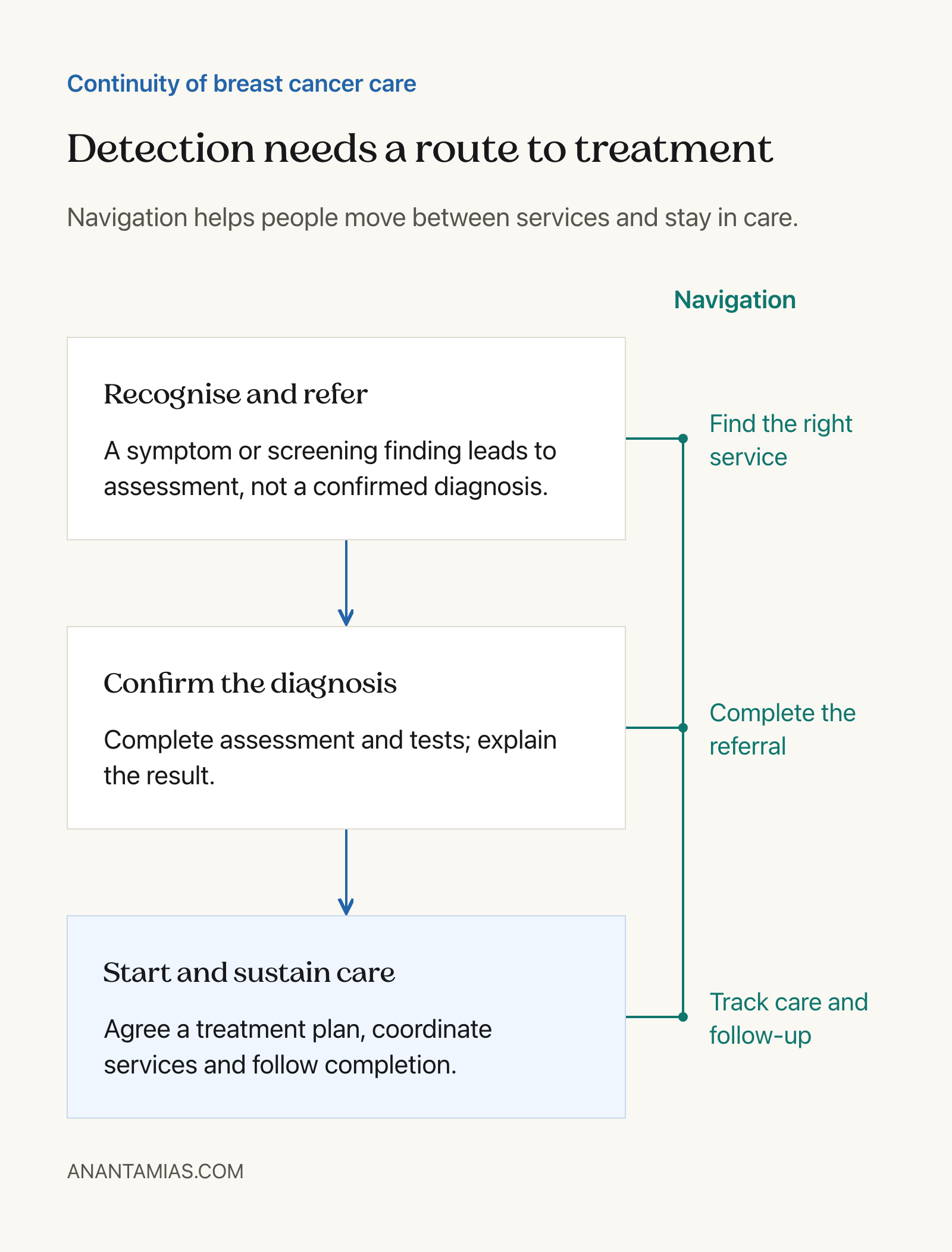
Patient navigation provides continuing support through the care pathway, especially where a person must move between facilities, professionals or administrative steps.

  • Recognition and referral begin the pathway when a possible problem prompts contact with care. The important handoff is to a service able to assess the concern, rather than merely issue another direction to travel.
  • Diagnostic confirmation separates suspicion from an established diagnosis. Programme design must connect assessment and necessary investigations with communication of results, so patients understand the next step rather than being left between disconnected appointments.
  • Treatment access is a further handoff after diagnosis. A functioning pathway connects the patient with the appropriate management team; documenting a diagnosis alone does not establish that comprehensive care has started or continued.
  • Patient navigation helps people move through this complex system, including practical coordination and communication. It complements clinical services rather than replacing professional assessment, diagnostic capacity or the resources required to deliver treatment safely.
  • Multidisciplinary team-based care coordinates professionals involved in management. For programme managers, the operational question is who takes responsibility at each transition and how the next service receives the information needed to continue care.
Three care stages from recognising a concern through diagnosis to treatment, with navigation support at each handoff
Patient navigation connects assessment, diagnostic confirmation and continuing care; an initial finding alone is not a diagnosis.

Early Diagnosis Is Different From Screening

Both approaches can support earlier detection, but they start with different groups and require reliable diagnostic and treatment services after an initial concern.

  • Early diagnosis focuses on people with symptoms or signs suggestive of disease. Its system-level tasks include enabling timely presentation, appropriate assessment and access to care, rather than waiting for illness to become advanced.
  • Screening examines apparently healthy, asymptomatic people for possible disease. An abnormal screening result requires further assessment; the initial test does not itself establish a confirmed cancer diagnosis or determine the complete treatment pathway.
  • The distinction changes programme planning: symptom-responsive services and organized screening are not interchangeable. Expanding initial detection without arrangements for subsequent diagnosis and management can leave patients unable to complete the intended route into care.
  • Access barriers can persist after the first contact, making navigation relevant across stages. A useful administrative review asks where people lose contact with services, rather than assuming that attendance at an initial appointment means successful treatment.
  • The manual should inform health-system design, not be converted into a universal screening-age or test recommendation. Clinical decisions depend on relevant guidance and individual circumstances; this publication does not establish one procedure for every person.

Way Forward

Make Each Handoff Accountable

  • Map referral destinations and responsibilities before expanding detection activity; identify which facilities can complete assessment and provide management.
  • Build navigation and communication into routine service delivery, with clear arrangements for appointments, results and onward referrals.
  • Review delays and interrupted care across the pathway so programme improvements address the transition that is failing.

Conclusion

  • The manual’s policy value lies in turning an existing framework into connected service delivery. Earlier recognition becomes useful when diagnostic confirmation and appropriate management remain accessible throughout the patient’s journey.
  • For a governance answer, distinguish the availability of a service from the ability to move between services. Navigation and multidisciplinary coordination address that organizational gap, while clinical capacity and treatment resources remain essential.

UPSC Practice Questions

Prelims MCQ 1

With reference to breast cancer care, consider the following statements:

  1. Early diagnosis addresses people with symptoms or signs suggestive of disease.
  2. Screening generally addresses asymptomatic people.
  3. An abnormal screening result necessarily establishes a confirmed cancer diagnosis.

How many of the above statements are correct?

(a) Only one (b) Only two (c) All three (d) None

Answer: (b) Only two

Explanation:

The first two statements are correct. An abnormal screening result requires further assessment and does not by itself confirm cancer.

Prelims MCQ 2

Which best describes patient navigation in breast cancer care?

(a) Replacing diagnostic services with public education (b) Restricting support to the first screening appointment (c) Helping patients move through detection, diagnosis and treatment services (d) Guaranteeing cure after an early-stage diagnosis

Answer: (c) Helping patients move through detection, diagnosis and treatment services

Explanation:

Navigation supports continuity across a complex care pathway. It does not replace clinical services or guarantee outcomes.

UPSC Mains Questions

  1. Explain why improving early detection of breast cancer requires coordinated diagnostic and treatment services. Discuss the role of patient navigation.
  2. Distinguish early diagnosis from screening. How can programme managers reduce interruptions in the pathway from first contact to comprehensive cancer care?

Sources: World Health Organization and WHO Global Breast Cancer Initiative.

Frequently Asked Questions

What is new in WHO’s breast cancer announcement?

WHO released a training manual for programme managers on 19 October 2026. It translates an existing implementation framework into practical approaches for strengthening breast cancer programmes and coordinating care.

What is patient navigation?

Patient navigation provides support to help people move through complex cancer services. It connects stages such as recognition, diagnostic assessment and treatment, while complementing rather than replacing clinical care.

How does early diagnosis differ from screening?

Early diagnosis focuses on people with symptoms or signs, while screening examines asymptomatic groups. Both require appropriate follow-up; an initial suspicion or abnormal screening result is not itself a confirmed diagnosis.

Does early detection guarantee a cure?

No. Earlier diagnosis can improve opportunities for effective treatment, but individual outcomes depend on multiple clinical and care-related factors. The WHO objective is not a guarantee of cure for every patient.

Mandovi Water Quality: Why Chemical Compliance Can Miss Microbial Risk

Open article →Download PDF

Why in News?

The Indian Express reported on 21 October that an interim Goa State Pollution Control Board report found faecal-coliform exceedances despite compliant chemical and physical indicators in the Mandovi estuary.

  • The report concerns monsoon samples collected on 24 August, not fresh sampling on the newspaper publication date.
  • All high- and low-tide samples exceeded the report’s 100 MPN/100 ml faecal-coliform benchmark; the monitored chemical and physical indicators were reported within limits.
  • The interim findings were placed before the High Court of Bombay at Goa; pollution-source identification remains an investigation, not a settled conclusion.
  • Water quality is multidimensional: acceptable oxygen or acidity readings cannot substitute for microbial testing.
  • Standards depend on intended use: coastal bathing criteria cannot be presented as universal drinking-water certification.

UPSC Relevance

Prelims Relevance

  • Faecal coliform as an indicator of faecal contamination.
  • Most probable number as a statistical microbial estimate.
  • SW-II coastal-water designated uses.
  • Dissolved oxygen versus biochemical oxygen demand.
  • Tidal sampling and pollution-source attribution.

Mains Relevance

GS Paper 3

  • Designing environmental monitoring around distinct risks and intended uses.
  • Separating observed pollution indicators from causal source attribution.

GS Paper 2

  • Transparent pollution-control reporting and evidence-based public-health communication.

Essay

  • Reliable public decisions require the right measurements, not merely reassuring averages.

Background and Context

Why Chemical Compliance Does Not Establish Microbial Safety

The Mandovi findings show why a water-quality assessment must keep different indicators separate, even when they describe the same place and sampling period.

  • Dissolved oxygen describes oxygen available in water, while biochemical oxygen demand measures oxygen consumed during biological decomposition under specified test conditions. Neither result directly counts faecal indicator bacteria or establishes their absence.
  • pH describes acidity or alkalinity, and turbidity describes cloudiness caused by suspended material. Water can satisfy these measurements while carrying microbial contamination that appearance alone cannot reliably reveal to a person nearby.
  • Faecal coliforms are indicator bacteria associated with human and animal waste. Elevated readings signal concern about faecal contamination; they do not identify every pathogen or prove that all organisms detected cause disease.
  • Most probable number, abbreviated MPN, is a statistical estimate derived from a microbial testing procedure. It should not be described as an exact count of pathogens, infections, or people who will become ill.
  • The reported contrast is between compliant chemical and physical measurements and excess faecal indicators. A reassuring result in one category cannot cancel an adverse result in another category measuring a different environmental risk.

What Tidal Sampling Can and Cannot Establish

Estuaries mix river water and seawater, so the timing and location of a sample are part of the evidence rather than incidental details.

  • The August sampling covered high and low tides in the monitored Mandovi estuarine stretch. This comparison helps reveal variation within a tidal cycle; it does not represent continuous monitoring of every river location.
  • The newspaper account reports higher faecal-coliform readings at low tide. Tidal movement can alter mixing, transport and dilution, changing measured concentration even when the underlying discharge pattern has not been independently established.
  • A concentration describes what is present in a volume of water. It is different from the total pollutant load moving through a channel, which also depends on how much water passes through it.
  • Weaker flushing and contaminated runoff were explanations discussed in the interim account. These remain hypotheses to investigate: a high reading beside a drain does not by itself establish the origin of all contamination.
  • Source attribution requires evidence connecting discharges, pathways and receiving-water conditions. The report’s account of monitored casino wastewater handling does not justify blaming casinos, declaring every source cleared, or treating the investigation as complete.

Read the Standard Alongside Its Designated Use

The relevant benchmark is a coastal-water use category, not a declaration that estuarine water is suitable for every possible human use.

  • The CPCB coastal-water criteria describe SW-II for bathing, contact water sports and commercial fishing. The category links environmental measurements to specified activities and must be interpreted in that designated-use context.
  • The SW-II table lists a faecal-coliform criterion of 100 MPN per 100 ml, with additional sampling-related remarks. The interim report compares its observations with this benchmark; it does not establish year-round compliance history.
  • Drinking-water suitability is a different assessment. Passing selected SW-II measurements would not make untreated estuarine water potable, and failing a microbial benchmark should not be translated into an unsupported estimate of disease cases.
  • Interim evidence supports further investigation and protective management, but its scope matters. A newspaper account of a board report is not a final judicial finding assigning liability to a particular operator or discharge.
  • A useful monitoring conclusion states which indicator failed, against which criterion, where and when. Replacing these details with a single label such as clean or polluted hides the decisions that the evidence can support.

Way Forward

Make Monitoring Useful for Corrective Action

  • Repeat matched-location tidal sampling across relevant seasons, documenting methods and conditions so changes can be interpreted consistently.
  • Investigate discharge pathways with drain surveys, wastewater-handling records and targeted sampling before assigning responsibility.
  • Publish indicator-specific findings and use-specific advisories; link corrective work to follow-up microbial measurements rather than appearance alone.

Conclusion

  • Chemical compliance and microbial safety answer different questions. The Mandovi case shows why an environmental assessment must preserve both findings instead of allowing one reassuring measurement to erase a separate warning.
  • Tidal differences guide investigation but do not establish blame. Use the case to connect designated-use standards, representative sampling and cautious source attribution when explaining evidence-based pollution control.

UPSC Practice Questions

Prelims MCQ 1

With reference to coastal-water monitoring, consider the following statements:

  1. SW-II designated uses include bathing and contact water sports.
  2. MPN is an exact count of all disease-causing organisms in a sample.
  3. Acceptable dissolved oxygen alone establishes the absence of faecal contamination.

How many of the above statements are correct?

(a) Only one (b) Only two (c) All three (d) None

Answer: (a) Only one

Explanation:

Only the first statement is correct. MPN is a statistical estimate, and dissolved oxygen measures a different characteristic from faecal contamination.

Prelims MCQ 2

Higher faecal-coliform concentration during low tide most directly indicates which of the following?

(a) A named nearby establishment is the confirmed source (b) The water is suitable for drinking during high tide (c) Sampling conditions matter when interpreting measured contamination (d) Chemical testing can replace microbial testing

Answer: (c) Sampling conditions matter when interpreting measured contamination

Explanation:

Tides affect transport and dilution. A concentration difference alone neither identifies the pollution source nor establishes safety for another use.

UPSC Mains Questions

  1. Explain why compliance with selected chemical water-quality indicators cannot establish microbial safety. Illustrate with the Mandovi estuary findings.
  2. How should tidal variation and designated-use standards inform the design and interpretation of coastal-water pollution monitoring?

Sources: The Indian Express and Central Pollution Control Board.

Frequently Asked Questions

What did the Mandovi report find?

According to The Indian Express, the interim board report found faecal-coliform exceedances in the monitored high- and low-tide samples, despite chemical and physical indicators being reported within limits.

What does MPN mean?

Most probable number is a statistical estimate used in microbial testing. In this context it estimates faecal indicator bacteria per specified volume; it is not an exact count of pathogens or infections.

Is SW-II a drinking-water standard?

No. CPCB lists SW-II for coastal bathing, contact water sports and commercial fishing. Compliance with selected criteria in that category does not certify untreated estuarine water as safe to drink.

Does low-tide contamination identify the source?

No. Tidal conditions affect mixing, dilution and transport. Higher concentration helps frame further investigation, but attributing contamination to a particular source requires additional evidence about discharges and pathways.

Were these samples taken on 21 October?

No. The newspaper report appeared on 21 October, but the monsoon sampling described in it took place on 24 August. Keeping those dates separate avoids presenting older observations as fresh measurements.

NCD Inequality: Finding Care Gaps Hidden by National Averages

Open article →Download PDF

Why in News?

On 20 October 2026, WHO released a report examining inequalities in noncommunicable diseases and their risk factors between population groups within countries.

  • The report covers cancer, cardiovascular diseases, diabetes and chronic respiratory diseases, alongside major risk factors.
  • It examines differences by economic status, education, residence, sex and age, among other population characteristics.
  • WHO identifies gaps in comparable, disaggregated data as an obstacle to recognising underserved populations and designing suitable responses.
  • A better national average does not establish that every population group has gained equally from prevention or care.
  • Monitoring access alongside disease burden helps distinguish a healthier population from one whose illness remains undetected.

UPSC Relevance

Prelims Relevance

  • Four major NCD groups covered by the WHO report.
  • Disaggregation of health indicators by population characteristics.
  • Difference between disease prevalence and diagnosis coverage.
  • Direct measurement versus self-reported disease.
  • Association versus causation in population comparisons.

Mains Relevance

GS Paper 2

  • Equitable access to preventive and continuing health services.
  • Using population data to target barriers without excluding universal services.

GS Paper 3

  • Environmental exposure and the interpretation of public health indicators.

Essay

  • Progress must be assessed by who benefits, as well as by how much the average improves.

Background and Context

What Disaggregated Health Data Reveal

Disaggregation separates a headline indicator into population groups, making differences visible without treating the national average as every resident’s experience.

  • Within-country inequality compares groups inside a country rather than simply ranking countries against each other. A national improvement can coexist with persistent differences in exposure, service coverage or outcomes between its population groups.
  • Economic status and education help identify social patterns, while residence highlights geographic differences. The report also examines disability, employment and migration where evidence permits; each dimension can reveal barriers that another classification misses.
  • Exposure concerns contact with risks such as tobacco or polluted air. It differs from having a diagnosed disease: exposure can raise future risk even when no illness has yet been recognised by services.
  • Health service coverage asks whether people obtain prevention or care. Measuring it alongside disease prevalence matters because counting existing illness alone cannot show whether those needing help can actually obtain diagnosis and treatment.
  • Data gaps limit what can be concluded about a group. Missing comparable information on disability or migration is not evidence that inequalities are absent; it identifies a measurement problem requiring better inclusion in collection.

Separate Disease, Diagnosis and Treatment

A health system must recognise illness before it can provide appropriate continuing care; each stage needs a clearly defined indicator.

  • Prevalence describes how common a condition is in a defined population. Diagnosis coverage instead concerns recognition among people with that condition; changing the denominator changes the question and prevents interchangeable interpretation of these measures.
  • Self-reported disease can depend on whether a person has previously received a diagnosis. Where detection is weak, fewer reported cases may reflect missed illness rather than a genuinely lower underlying burden in that population.
  • Direct measurements, such as blood pressure assessed in a survey, provide a different evidence base from recalled diagnoses. WHO prioritises measured indicators where possible, while recognising differences in available methods across its data sources.
  • Treatment coverage is another distinct step: being diagnosed does not ensure access to medicines or continuing follow-up. Likewise, receiving treatment does not automatically mean the condition is effectively controlled; outcome monitoring remains necessary.
  • Rural access illustrates the distinction: WHO reports lower hypertension diagnosis and treatment access in rural populations across many low- and middle-income countries. This is a service gap, not proof that rural residents universally have less disease.

Interpret Inequalities Without Overclaiming

The report supports targeted inquiry and action, but differences between groups need careful interpretation before they become policy explanations.

  • Patterns vary by country, indicator and population group. Avoid a universal claim that every NCD risk always rises as income falls; social disadvantage can shape different exposures and care barriers through different mechanisms.
  • Association is not causation: a difference linked with education does not by itself prove education caused the outcome. Age composition, living conditions and access to services may also affect the relationship that researchers observe.
  • Age differences require particular care because health and some risks change biologically over time. An observed age gradient does not automatically establish unfair treatment; service access and underlying health need must be assessed separately.
  • Comparable definitions matter when monitoring change. Directly measured and self-reported indicators, different age ranges or different collection periods should not be treated as identical evidence merely because their labels describe the same disease.
  • Policy targeting should connect the identified gap to a plausible barrier, such as distance or cost. Improving population-wide prevention and adapting services for underserved groups are complementary tasks, rather than mutually exclusive choices.

Way Forward

Measure the Gap and Address Its Barrier

  • Collect comparable subgroup data regularly, with clear definitions and safeguards for personal information.
  • Pair population-wide prevention with accessible diagnosis and continuing care for underserved communities.
  • Monitor coverage and outcomes separately so that more contacts with services are not mistaken for effective disease control.
  • Involve people living with NCDs in identifying financial, geographic and administrative barriers to care.

Conclusion

  • Equity monitoring turns a national health average into a more useful policy question: which groups face greater risk, which remain undiagnosed, and which cannot obtain effective continuing care?
  • A strong answer connects disaggregated evidence with a specific service barrier and a measurable response, while acknowledging that observed inequalities do not establish a single universal cause.

UPSC Practice Questions

Prelims MCQ 1

With reference to health inequality monitoring, consider the following statements:

  1. National averages can conceal differences between population groups.
  2. Lower self-reported disease necessarily proves lower underlying disease prevalence.
  3. Diagnosis coverage and treatment coverage describe different stages of care.

How many of the above statements are correct?

(a) Only one (b) Only two (c) All three (d) None

Answer: (b) Only two

Explanation:

Statements 1 and 3 are correct. Weak diagnosis can reduce self-reported disease, so statement 2 is incorrect.

Prelims MCQ 2

Which approach best uses disaggregated NCD data for policy?

(a) Assume every observed difference proves discrimination (b) Replace universal prevention with services for one group only (c) Identify underserved groups and examine the barriers behind their care gaps (d) Compare indicators without considering their definitions

Answer: (c) Identify underserved groups and examine the barriers behind their care gaps

Explanation:

Disaggregation helps identify gaps. Appropriate action also requires understanding barriers and maintaining population-wide prevention.

UPSC Mains Questions

  1. Why can national averages give an incomplete picture of progress against noncommunicable diseases? Discuss the role and limitations of disaggregated data.
  2. Distinguish disease prevalence, diagnosis coverage and treatment coverage. Explain how this distinction can improve equitable public health planning.

Sources: World Health Organization and WHO report.

Frequently Asked Questions

What are noncommunicable diseases?

Noncommunicable diseases are conditions that are not transmitted directly between people. The WHO report examines cancer, cardiovascular diseases, diabetes and chronic respiratory diseases, alongside major behavioural and environmental risk factors.

What does disaggregated health data mean?

Disaggregated data separate an overall indicator into population groups, such as by education, residence or economic status. This makes differences visible that a national average can conceal, supporting more precise investigation and action.

Can low reported disease indicate poor detection?

Yes. Self-reported disease can depend on a previous diagnosis. If access to diagnosis is weak, fewer reported cases may reflect missed illness. Direct measurements and information about service access help interpret the result.

Does the report prove poverty causes every NCD?

No. Patterns differ across countries, conditions and population groups. The report describes inequalities and associations; a subgroup difference alone does not establish causation or a universal income gradient for every risk.

Health in NDCs: From Recognition to Funded Climate Action

Open article →Download PDF

Why in News?

WHO released its review of health in nationally determined contributions on 19 October 2026, examining how national climate commitments address health risks, emissions and financing.

  • The review assessed 114 NDC documents representing 140 Parties; its headline percentages use Parties, rather than documents, as the denominator.
  • 91% mention health, while 55% include health-specific adaptation actions or targets: recognising a problem differs from specifying a response.
  • Only 23% estimate resources required for health-related actions, exposing the gap between written commitments and implementation planning.
  • The analysis examines submitted plans, not verified health outcomes; it neither creates a new treaty nor certifies that promised measures have been delivered.
  • Climate policy affects both demand for care and whether facilities can remain operational during heat, floods and other disruptions.
  • Health benefits also arise outside hospitals, through cleaner energy, transport, safer water and resilient food systems.

UPSC Relevance

Prelims Relevance

  • Nationally determined contributions under the Paris Agreement.
  • Health adaptation versus health-sector mitigation.
  • Health co-benefits of emissions reduction.
  • Conditional versus unconditional climate finance.
  • Party-based versus document-based assessment.

Mains Relevance

GS Paper 3

  • Integrating adaptation, emissions reduction and health benefits in climate planning.
  • Making climate commitments measurable and financeable.

GS Paper 2

  • Coordination between health, environment and finance institutions.

Essay

  • Public health as a practical measure of climate-policy success.

Background and Context

What a Health Commitment in an NDC Actually Means

National climate plans can acknowledge health risks without explaining who will reduce them, how actions will work, or what implementation will cost.

  • NDCs are national climate plans through which governments implement the Paris Agreement. They set out emissions-reduction commitments and may incorporate adaptation priorities, connecting international climate ambition with choices within domestic policy and institutions.
  • Recognition means a document mentions health or vulnerability. An actionable commitment goes further by specifying an intervention, an institutional responsibility and a result that can be tracked against an explicit starting point.
  • The WHO review examines documents available in the UNFCCC registry at its assessment cutoff. Its findings describe that reviewed set, rather than every subsequent submission or every health policy operating outside an NDC.
  • The European Union’s joint submission represents multiple countries in one document. Consequently, counting documents and counting represented Parties produce different percentages; neither denominator can be silently substituted when explaining the report’s findings to readers.
  • Documentary omissions need careful interpretation: ministries may participate in practice, or sectoral targets may appear elsewhere. Absence from an NDC signals limited documented detail, but does not by itself prove complete policy inaction nationally.

Adaptation, Mitigation and Health Co-Benefits

The key distinction is between protecting people from climate impacts and reducing the emissions that drive warming; a well-designed intervention can support both.

  • Health adaptation reduces vulnerability to climate hazards. Keeping facilities functional during extreme weather, strengthening emergency preparedness and protecting reliable water supplies can preserve treatment when climate impacts otherwise interrupt access to essential health services.
  • Health-sector mitigation reduces emissions associated with delivering care. Energy choices, infrastructure and supply chains matter, but emissions reductions must protect quality and access rather than simply reduce the volume of necessary clinical services delivered.
  • Health co-benefits are gains from mitigation across the economy. Cleaner energy and transport can lower harmful air pollution, improving respiratory and cardiovascular health alongside the climate benefit of reduced greenhouse-gas emissions from those activities.
  • Joint benefits require appropriate design: solar electricity with suitable backup can support cleaner, more reliable facility power, while building measures addressing heat protect service continuity. Installing panels alone does not guarantee resilience during outages.
  • The report cites Nepal’s NDC commitment to upgrade health facilities for lower emissions and climate resilience, including solar photovoltaic backup. This illustrates a combined policy approach, rather than evidence that every planned upgrade is complete.

Finance and Accountability Determine Delivery

A credible health component identifies costs and responsibilities, then connects those commitments to implementation and monitoring rather than relying on broad statements of intent.

  • Costing estimates the resources needed for specified health actions. It helps governments distinguish a feasible programme from an unfinanced aspiration, but an estimate alone does not establish that funds have been allocated or disbursed.
  • Conditional commitments depend on international support or other stated conditions; unconditional contributions draw on domestic resources. Separating them makes the financing assumptions visible and prevents contingent promises from being read as fully funded programmes.
  • Cross-sector coordination is essential because energy, water and transport decisions shape health. The health ministry should help define benefits and risks, while responsible sector agencies connect those objectives to their implementation plans and budgets.
  • Monitoring should distinguish activities, service resilience and health results. A facility retrofit is an intervention; reliable service during a hazard is a performance outcome. Counting projects alone cannot demonstrate that illness or mortality declined.
  • The review’s limitations include differences in document detail and interpretation. Its aggregate findings identify planning gaps; they do not justify an unsupported country-specific score or establish that a particular government failed to deliver care.

Way Forward

Make the Health Component Implementable

  • Assign health and sector agencies explicit responsibilities for each action and align NDC commitments with existing health adaptation plans.
  • Publish costed measures with domestic funding, conditional support needs and implementation arrangements distinguished clearly.
  • Track service continuity and emissions alongside relevant health indicators, with baselines that allow progress to be checked.

Conclusion

  • Health recognition is only the starting point: climate commitments become useful when they specify protective actions, lower-emission care, responsible institutions and realistic financing arrangements that can be followed through implementation.
  • For an analytical answer, distinguish promises from outcomes and adaptation from mitigation; then test whether the proposed intervention has costs, accountable delivery and indicators capable of showing an improvement in public health.

UPSC Practice Questions

Prelims MCQ 1

With reference to health in national climate plans, consider the following statements:

  1. Health adaptation can seek to maintain essential services during extreme weather.
  2. Health-sector mitigation concerns emissions associated with delivering health care.
  3. A reference to health in an NDC proves that the promised health outcomes have been achieved.

How many of the above statements are correct?

(a) Only one (b) Only two (c) All three (d) None

Answer: (b) Only two

Explanation:

The first two statements describe adaptation and mitigation correctly. An NDC records commitments; mentioning health does not establish completed implementation or improved outcomes.

Prelims MCQ 2

Which distinction best describes conditional and unconditional climate-health contributions?

(a) Conditional contributions concern only adaptation. (b) Unconditional contributions need no resources. (c) Conditional contributions depend on support or stated conditions, while unconditional contributions draw on domestic resources. (d) Both categories certify that expenditure has already occurred.

Answer: (c) Conditional contributions depend on support or stated conditions, while unconditional contributions draw on domestic resources.

Explanation:

WHO distinguishes contributions dependent on international support or other conditions from those financed domestically. Neither classification alone proves that funds have been spent.

UPSC Mains Questions

  1. Explain the difference between health adaptation, health-sector mitigation and health co-benefits. How can national climate plans address all three?
  2. Why is recognising health in an NDC insufficient for implementation? Discuss the roles of finance, institutional responsibility and monitoring.

Source: World Health Organization.

Frequently Asked Questions

What are health commitments in NDCs?

They are health-related priorities or actions included in national climate plans. They can address adaptation, emissions from care, health benefits of wider mitigation, and financing, with varying levels of detail.

How does health adaptation differ from health-sector mitigation?

Adaptation protects people and health services from climate impacts. Health-sector mitigation reduces emissions associated with care. A properly designed intervention can serve both objectives, but the objectives remain distinct.

Does WHO’s review measure completed health improvements?

No. It analyses the health content of submitted NDC documents. Its findings describe commitments and documented detail, rather than independently verified implementation or measured improvements in population health outcomes.

Why are Parties and NDC documents counted separately?

One joint submission can represent several countries, as with the European Union. WHO reports headline results by represented Parties; percentages calculated by document are different and must not be treated as interchangeable.

Why does climate-health finance need separate scrutiny?

A promise needs realistic cost estimates and identifiable funding. Distinguishing domestic resources from contributions dependent on international support clarifies what can be implemented and what remains contingent on additional finance.

Tunnel Boring Machines: Export Licences and Infrastructure Risk

Open article →Download PDF

Why in News?

China announced export controls covering tunnel boring machines and related items on 19 October 2026, effective 18 November, raising procurement questions for Indian infrastructure projects.

  • China’s Commerce Ministry says covered items have dual-use characteristics; compliant export licence applications will be approved after review.
  • The Indian Express explains the implications for metro, highway and high-speed rail tunnelling, including the Mumbai–Ahmedabad corridor.
  • The announcement creates a licensing requirement, not evidence that every proposed shipment to India has been prohibited.
  • A delayed specialised machine can affect activities scheduled around its arrival, even when construction finance and civil permissions are available.
  • Procurement resilience requires examining production location, components and maintenance, alongside the nationality of the company selling the equipment.

UPSC Relevance

Prelims Relevance

  • Tunnel boring machine: mechanised tunnel excavation equipment.
  • Dual-use items: items with civilian and military applications.
  • Export licensing: authorisation by the exporting jurisdiction.
  • Critical path: connected project activities determining completion time.

Mains Relevance

GS Paper 3

  • Infrastructure procurement and supply-chain concentration.
  • Technology absorption, equipment servicing and project execution risk.

GS Paper 2

  • Trade diplomacy and regulatory predictability in cross-border supply chains.

Essay

  • Interdependence delivers efficiency but requires institutions that manage vulnerability.

Background and Context

Why Tunnel Boring Machines Are Difficult to Replace

A tunnel boring machine is specialised excavation equipment; its suitability depends on the tunnel and the ground through which it must pass.

  • A tunnel boring machine excavates underground passages using a rotating cutting head. Unlike buying ordinary construction vehicles, procuring a suitable machine begins with the tunnel’s dimensions and anticipated ground conditions, which constrain equipment selection.
  • The useful distinction is mechanised excavation versus conventional blasting. Controlled excavation can be particularly valuable beneath built-up areas, but safe performance still depends on geological investigation, appropriate machine selection and disciplined operation at the site.
  • Project-specific requirements limit interchangeability: a machine suitable for one tunnel cannot automatically replace another. Buyers must check dimensions and ground suitability before assuming equipment available elsewhere can meet a delayed project’s needs without redesign.
  • A TBM operates within a wider construction system, including material removal, power, tunnel support and logistics. Delaying its arrival can disrupt prepared work fronts and contracts connected to the excavation sequence on a project.
  • Machine weights and designs vary; one reported example should not become a universal definition. For UPSC analysis, the durable point is specialised capital equipment whose replacement requires technical matching, mobilisation and preparation before excavation.

How Export Licensing Becomes a Project Risk

The new measure concerns controlled equipment exports, making the timing and outcome of authorisation relevant to procurement.

  • Export licensing adds an authorisation step before a covered shipment can proceed. A signed purchase contract does not itself establish that the exporter has completed every regulatory requirement needed to deliver the machine abroad.
  • The Chinese ministry attributes the measure to dual-use characteristics and national security obligations. This is the government’s stated rationale; it does not establish that every civilian tunnel project is military or that every application fails.
  • A licensing regime is not a blanket ban: the ministry explicitly says compliant applications will receive approval. The practical effect depends on coverage, processing time and licensing decisions rather than the announcement alone.
  • Timing uncertainty can matter even when approval eventually arrives. If excavation lies on the project’s critical path, a delayed machine can postpone connected works; actual consequences depend on available alternatives and the construction schedule.
  • Manufacturing location can matter independently of supplier nationality. The Indian Express recalls difficulties delivering China-made machines from a German supplier to India, illustrating why a foreign brand does not eliminate exposure to production-country controls.

What India Should Examine Before Inferring a Shortage

Risk assessment must distinguish a new regulatory requirement from demonstrated disruption to a particular project.

  • Scope comes first: procurement teams must match equipment specifications against the control list. The announcement alone is insufficient to claim that every tunnelling machine, spare part or related service faces an identical legal restriction.
  • Lifecycle dependence extends beyond delivery of the main machine. Buyers should assess spare parts, servicing and technical support separately, without treating those commercial dependencies as proof that every associated item is newly export-controlled.
  • Substitution has costs: changing suppliers can require technical assessment, manufacturing time and revised logistics. A credible resilience strategy identifies workable alternatives in advance rather than assuming another machine can arrive immediately at the site.
  • This development concerns physical equipment export controls; it should not be confused with a proposed technology-export catalogue. Restrictions on transferring know-how and restrictions on shipping machines require separate analysis of their legal scope and status.
  • Evidence of disruption would require project-specific information such as an affected order, delayed clearance or revised construction schedule. A national infrastructure stoppage cannot be inferred merely from the existence of the new licensing requirement.

Way Forward

Build Resilience Into Procurement

  • Require bidders to disclose manufacturing locations and licensing dependencies early enough to inform schedules, contract conditions and contingency planning.
  • Assess alternative suppliers and domestic servicing capability against actual engineering requirements, including spare-part availability and technical training.
  • Use regulatory dialogue and documented applications to clarify coverage and processing requirements; monitor actual shipment delays before revising project-wide risk estimates.

Conclusion

  • The TBM case connects trade regulation with infrastructure execution: a specialised imported machine can become a scheduling vulnerability even when the project’s other inputs are ready. The strength of that vulnerability requires project-level evidence.
  • An effective response combines predictable licensing, technically credible alternatives and lifecycle support. Distinguish exposure from realised disruption, and equipment ownership from the continuing ability to operate and maintain it throughout the construction programme.

UPSC Practice Questions

Prelims MCQ 1

With reference to tunnel boring machines and export licensing, consider the following statements:

  1. An export licensing requirement necessarily prohibits every export of the covered equipment.
  2. The country where a machine is manufactured can create regulatory exposure even when the supplier is headquartered elsewhere.
  3. Tunnel boring machines are automatically interchangeable between projects irrespective of tunnel dimensions and ground conditions.

How many of the above statements are correct?

(a) Only one (b) Only two (c) All three (d) None

Answer: (a) Only one

Explanation:

Only statement 2 is correct. Licensing can permit compliant exports. Machine suitability depends on project specifications and ground conditions.

Prelims MCQ 2

Which approach best assesses the infrastructure effect of a new export licensing requirement?

(a) Assume every project using imported equipment has stopped (b) Examine covered specifications, affected orders, approval timing and the construction schedule (c) Treat the supplier’s headquarters as the only relevant jurisdiction (d) Assume all machines can be replaced immediately

Answer: (b) Examine covered specifications, affected orders, approval timing and the construction schedule

Explanation:

Actual project risk depends on regulatory scope, procurement exposure and the scheduling consequences of a delay, not the announcement alone.

UPSC Mains Questions

  1. How can export controls on specialised construction equipment affect infrastructure delivery? Discuss measures to improve procurement resilience.
  2. Why should infrastructure procurement assess manufacturing location and lifecycle support alongside supplier nationality? Explain with reference to tunnel boring machines.

Sources: Ministry of Commerce, China and The Indian Express.

Frequently Asked Questions

What is a tunnel boring machine?

A tunnel boring machine is specialised equipment that excavates underground passages using a rotating cutting head. Its suitability depends on tunnel dimensions and ground conditions, so machines are not automatically interchangeable.

Has China announced a blanket ban on TBM exports?

The ministry describes export controls with licence review and approval for compliant applications. This should not be presented as a blanket ban, nor as proof that all Indian projects are affected.

Why can the manufacturing country matter?

A supplier headquartered in one country may manufacture equipment in another. Export authorisation at the production location can affect delivery, making the physical supply chain important alongside the supplier’s corporate nationality.

What should India prioritise in procurement?

Buyers should identify licensing exposure, assess technically suitable alternatives and secure maintenance support. Project schedules should reflect realistic delivery risks rather than assuming either uninterrupted supply or an inevitable stoppage.

Voter Reinstatement: When Form 6 and Form 8 Serve Different Purposes

Open article →Download PDF

Why in News?

Indian Express reported on October 20 that a Delhi High Court dismissal and a pending Supreme Court challenge have renewed scrutiny of Form 6 declarations for previously enrolled voters seeking reinstatement.

  • Delhi petitioners said they had shifted residence and missed enumeration, after which their names were deleted; they sought restoration with an address change.
  • ECI counsel told the High Court that Form 6 could secure inclusion with the Electoral Registration Officer’s assistance; the court dismissed the petition.
  • The pending Supreme Court plea challenges requiring previously enrolled voters to make a first-time inclusion declaration; no final Supreme Court ruling is reported.
  • Administrative design matters when a standard declaration does not appear to match an applicant’s recorded electoral history.
  • Inclusion and accuracy must be pursued together: correcting an omission should also avoid duplicate registration at old and new addresses.

UPSC Relevance

Prelims Relevance

  • Form 6: application for new voters and inclusion in electoral rolls.
  • Form 8: shifting residence, correcting entries, replacing EPIC or marking disability.
  • Electoral Registration Officer: authority responsible for electoral registration decisions.
  • Section 31, Representation of the People Act, 1950: knowingly false written statements or declarations.

Mains Relevance

GS Paper 2

  • Procedural fairness in electoral registration and remedies against wrongful exclusion.
  • Designing declarations that preserve truthful disclosure while preventing duplicate entries.

Essay

  • A right becomes usable only when its administrative procedure reflects lived circumstances.

Background and Context

Why a Deleted Entry Creates a Declaration Problem

The narrow issue is how an existing electoral history should be treated after the current entry disappears.

  • Previous enrolment and presence on the current roll are different facts. A person may truthfully report earlier registration while finding no current entry, which makes the wording of a fresh application consequential.
  • Form 6 contains a declaration about applying for inclusion for the first time. Petitioners argue that previously enrolled applicants cannot accurately make that statement merely because their names were subsequently removed from the roll.
  • Section 31 addresses knowingly false written statements or declarations relating to electoral rolls. The petitioners invoke this provision to question the declaration; their concern does not establish that submitting Form 6 automatically constitutes an offence.
  • Shifted residence is central to the reported cases: applicants said they could not complete enumeration at old addresses. Their claim concerns continuity of enrolment and correction of location, rather than first-time entry into electoral registration.
  • The pending challenge also questions an additional SIR declaration concerning inclusion of applicants or family members in an earlier SIR. This is a separate disputed requirement, not a court-approved ground for automatic rejection.

What the Forms Do, and What the ERO Decides

The form identifies the requested transaction; the authority must still determine the applicant’s circumstances.

  • The ordinary comparison is between an application for new inclusion and modification of an existing entry. ECI’s forms dashboard distinguishes these services; the disputed problem arises when an earlier entry has already disappeared.
  • Form 8 covers shifting residence and correction of entries, alongside specified voter-card services. Its official form describes those purposes; this does not by itself resolve every contested case involving deletion during revision.
  • The Electoral Registration Officer handles electoral-roll preparation and revision. In the Delhi case, the High Court relied on counsel’s submission made on that officer’s instructions when dismissing the concern about using Form 6.
  • Assistance with an application and a final determination are distinct stages. Guidance about which form to submit does not itself prove that the applicant has been restored to the published roll at the correct address.
  • The procedural focus differs from the wider electoral-roll revision framework: the question here is how an individual’s prior entry, changed address and declaration are reconciled when seeking inclusion again after deletion.

Read Court Proceedings Without Turning Claims Into Verdicts

Different judicial developments carry different evidentiary weight; a study note must preserve those distinctions.

  • The Delhi High Court dismissal concerns the petition before that bench and the official response it received. It should not be rewritten as a Supreme Court settlement of the broader declaration dispute raised elsewhere.
  • Bombay High Court observations, reported from Goa, questioned rejecting address-change applications instead of retaining them for consideration after roll publication. Oral questions identify a concern; they should not be presented as a final nationwide direction.
  • A Supreme Court application sets out a party’s requested relief and arguments. The reported plea seeks protection against rejection over the additional declaration, but the request is not equivalent to an order granting that protection.
  • Administrative evidence should connect an old entry, the reason for its removal and the new address claim. This is a governance lesson from the dispute, not a substitute for the applicable official procedure.
  • The answer-writing balance is precise: support accurate rolls and truthful declarations while examining avoidable exclusion. Neither treating every deleted elector as ineligible nor assuming every disputed application must succeed reflects a reasoned administrative assessment.

Way Forward

Make the Remedy Traceable

  • Clarify declaration wording for previously enrolled applicants through authoritative instructions that explain how their electoral history should be recorded accurately.
  • Track the application from submission to a reasoned registration decision, retaining the link between the earlier entry and claimed address change.
  • Distinguish litigation stages in public communication so petitioners’ requests, oral observations and operative court directions are not confused.

Conclusion

  • The durable issue is the fit between a person’s electoral history and the declaration required to regain inclusion. A usable remedy must permit truthful disclosure while enabling the authority to maintain an accurate roll.
  • For examination answers, distinguish the ordinary functions of Forms 6 and 8 from the unresolved treatment of deleted entries. Discuss procedural safeguards without claiming that the Supreme Court has finally decided the pending challenge.

UPSC Practice Questions

Prelims MCQ 1

With reference to electoral registration forms, consider the following statements:

  1. Form 8 includes applications for shifting residence and correcting electoral-roll entries.
  2. A petitioner’s request before the Supreme Court is equivalent to an operative court direction.
  3. Form 6 contains a declaration concerning first-time inclusion in the electoral roll.

How many of the above statements are correct?

(a) Only one (b) Only two (c) All three (d) None

Answer: (b) Only two

Explanation:

Statements 1 and 3 are correct. A pleading states the applicant’s case; it is not an operative court order.

Prelims MCQ 2

Which distinction best explains the current dispute concerning previously enrolled voters?

(a) Earlier enrolment and current presence on the electoral roll are different facts. (b) Every address change automatically creates a new voter. (c) Form 8 can only replace a damaged voter card. (d) Oral judicial questions always amend the registration procedure.

Answer: (a) Earlier enrolment and current presence on the electoral roll are different facts.

Explanation:

An earlier elector may be absent from the current roll. This raises the dispute about whether a first-time declaration accurately records that person’s circumstances.

UPSC Mains Questions

  1. How can electoral registration procedures preserve truthful declarations while addressing exclusion of previously enrolled voters? Discuss with reference to the functions of Forms 6 and 8. (150 words)
  2. Distinguish administrative guidance, judicial observations and operative court directions in the context of electoral-roll disputes. Why do these distinctions matter for procedural fairness? (250 words)

Sources: Indian Express and Election Commission of India.

Frequently Asked Questions

Why is Form 6 being questioned?

Previously enrolled petitioners argue that a declaration about first-time inclusion does not reflect their electoral history after deletion. They also raise concern about the statutory consequences of knowingly false declarations.

What does Form 8 cover?

The official form covers shifting residence, correction of electoral-roll entries, replacement of the elector photo identity card and marking disability. The current controversy concerns cases where an earlier roll entry has already been deleted.

Has the Supreme Court finally decided this dispute?

The supplied report describes a pending challenge and the relief sought by applicants. It does not report a final Supreme Court ruling settling the declaration issue; the Delhi High Court dismissal is a separate development.

Why does the Electoral Registration Officer matter?

The ERO handles electoral registration and revision decisions. In the reported Delhi proceedings, ECI counsel proposed Form 6 with the officer’s assistance; that official response formed part of the High Court’s reasoning.

Telangana seeks 100% MSP procurement amid drought

Open article →Download PDF

Why in news?

Telangana sought 100% MSP procurement and lifting of the 25% procurement cap as drought hit 315 of 621 mandals.

UPSC Relevance 

Prelims: MSP, CACP, cost concepts (A2, A2+FL, C2), PM-AASHA, Price Support Scheme, FCI

Mains: GS3 – Issues related to direct and indirect farm subsidies and minimum support prices; Public Distribution System, buffer stocks and food security; Agricultural marketing.

What is Minimum Support Price (MSP)?

MSP is the price at which the government promises to buy a crop from farmers if market prices fall below it. It is a floor price that protects farmers from distress sale, especially after a bumper harvest.

  • Started: 1966-67 for wheat, during the Green Revolution, to encourage farmers to adopt high-yielding varieties.
  • Recommended by: Commission for Agricultural Costs and Prices (CACP), set up in 1965 as the Agricultural Prices Commission. It is an attached office of the Ministry of Agriculture and Farmers Welfare, not a statutory body.
  • Approved by: Cabinet Committee on Economic Affairs (CCEA), chaired by the Prime Minister.
  • Crops covered: 22 mandated crops – 14 kharif, 6 rabi and 2 commercial (jute and copra). Sugarcane gets a Fair and Remunerative Price (FRP), which is fixed under the Sugarcane (Control) Order, 1966.
  • MSP has no statutory backing. Farmers cannot claim it as a legal right. Only the FRP of sugarcane is legally binding on mills.

Factors considered by CACP 

Cost of production, demand and supply, domestic and international price trends, price parity between crops, terms of trade between agriculture and non-agriculture, and the likely effect on consumers and the economy.

Cost concepts used in fixing MSP 

CostWhat it includes
A2Actual paid-out costs – seeds, fertilizers, pesticides, hired labour, machinery, fuel, irrigation, leased-in land rent
A2 + FLA2 plus the imputed value of unpaid family labour
C2A2 + FL plus rent on owned land and interest on owned fixed capital (comprehensive cost)
  • Present formula: Since 2018-19, MSP is fixed at a minimum of 1.5 times the A2+FL cost (Union Budget 2018-19).
  • Swaminathan Commission (National Commission on Farmers, 2004-06): Recommended MSP at least 50% above the weighted average cost of production. Farmer groups read this as C2 + 50%, which would give a higher MSP.

How Does MSP Procurement Work?

Announcing MSP is only half the job. It reaches farmers only when a government agency actually buys the crop at that price. Without procurement, MSP remains a number on paper.

  • Centralised procurement: FCI buys grain directly or through State agencies, stores it and moves it to deficit States.
  • Decentralised Procurement (DCP), 1997-98: States buy, store and distribute grain themselves under PDS. The Centre pays the cost. Excess stock is handed over to FCI. This cuts transport cost and widens coverage to non-traditional States.
  • PM-AASHA (2018): Pradhan Mantri Annadata Aay SanraksHan Abhiyan. It has three parts –
    • Price Support Scheme (PSS): Physical purchase of pulses, oilseeds and copra at MSP by central nodal agencies.
    • Price Deficiency Payment Scheme (PDPS): No physical purchase. The government pays farmers the gap between MSP and the market price for oilseeds (modelled on Madhya Pradesh’s Bhavantar Bhugtan Yojana).
    • Private Procurement and Stockist Scheme (PPSS): Pilot allowing private players to buy oilseeds at MSP.
  • Market Intervention Scheme (MIS): For perishables like fruits and vegetables not covered by MSP, on request of States.

Open procurement vs Closed procurement

BasisOpen-ended ProcurementClosed-ended Procurement
MeaningGovernment buys whatever quantity farmers bring, if it meets quality norms (Fair Average Quality)Government buys only up to a fixed quantity or for a fixed period
CropsWheat and paddy (in procuring States)Pulses, oilseeds, copra under PSS; coarse grains
LimitNo quantity limitGenerally capped at 25% of State’s production under PSS
PurposeFood security – PDS, NFSA and buffer stockPrice support only when market prices fall below MSP
EffectStrong, assured price signal; farmers prefer these cropsWeak price signal; farmers face uncertainty
  • Why the 25% cap matters: Once the cap is reached, farmers sell the rest in the open market, often below MSP. This is the root of Telangana’s demand.
  • Recent change: To push self-reliance in pulses, the Centre has allowed procurement of tur, urad and masur up to 100% of production through NAFED and NCCF. Similar relaxation is now being sought for other crops.
  • Important: Even open-ended procurement is not available everywhere. It is strong in Punjab, Haryana, Madhya Pradesh, Chhattisgarh and Telangana, but weak in States like Bihar and Uttar Pradesh.

Need for MSP

  • Price stability: Protects farmers from price crashes in bumper years and from exploitation by traders.
  • Food security: Procurement feeds the PDS under the National Food Security Act, 2013 and PM Garib Kalyan Anna Yojana, covering around 81 crore people.
  • Buffer stock: Helps the government deal with droughts, floods and price spikes, and run Open Market Sale Scheme (OMSS) operations.
  • Investment signal: An assured price encourages farmers to invest in seeds, fertilizers and better technology. This drove the Green Revolution.
  • Crop diversification tool: Higher MSP and assured purchase can pull farmers towards pulses, oilseeds and millets, and cut import dependence (India imports about half of its edible oil).
  • Risk cover in distress: In drought years like this one, farmers have lower output and higher costs; MSP helps limit the loss.

Challenges with MSP

  • Low reach: The Shanta Kumar Committee (2015), using NSSO data, found that only about 6% of farmers sold to procurement agencies at MSP. Most small farmers do not benefit.
  • Regional skew: Procurement is concentrated in a few States. Eastern India, with many small farmers, gets little benefit.
  • Crop bias: Open-ended buying of wheat and paddy has locked farmers into these crops. Pulses, oilseeds and millets lose out.
  • Ecological damage: Paddy in Punjab and Haryana has caused severe groundwater depletion; stubble burning adds to air pollution in north India.
  • Excess stocks and fiscal cost: Central pool stocks often stay well above buffer norms, raising storage costs and wastage. The food subsidy bill runs to about ₹2 lakh crore a year.
  • Awareness and access gaps: Many farmers do not know the MSP. Procurement centres are few, payments can be delayed, and middlemen (arhtiyas) take a cut.
  • Market distortion: MSP above global prices makes exports uncompetitive and weakens private trade.
  • WTO concerns: Under the Agreement on Agriculture, MSP procurement is counted as ‘Amber Box’ support, limited to 10% of value of production for developing countries. India has invoked the Bali ‘peace clause’ for rice more than once.
  • Cost formula debate: Farmers want C2 + 50%; the government uses A2+FL. This gap is a constant source of discontent.
  • Demand for legal guarantee: The 2020-21 farmers’ protests sought a legal right to MSP. Critics say a legal guarantee for all 23 crops could be fiscally heavy and hard to enforce.

Suggested Reforms

  • Shift from procurement to income support: Use price deficiency payments (like PDPS / Bhavantar) for crops not needed for PDS. This avoids huge stocks while still protecting farmers.
  • Wider, crop-neutral procurement: Relax caps for pulses, oilseeds and millets in rain-fed and drought-prone areas, as Telangana demands, so that diversification becomes attractive.
  • Shanta Kumar Committee (2015): Extend procurement to eastern States, let FCI hand over procurement to capable States, and move to cash transfers in PDS over time.
  • Fix stock levels: Keep procurement close to PDS and buffer needs; dispose of surplus through OMSS and exports.
  • Better market access: Strengthen e-NAM, Farmer Producer Organisations (FPOs) and warehouse receipt financing so that farmers get good prices even outside government procurement.
  • Region-specific MSP signals: Higher incentive for water-saving crops in water-stressed regions. The committee on MSP set up in 2022 was asked to look at making MSP more effective and transparent, along with crop diversification and natural farming.
  • Climate-linked support: In drought years, combine MSP with crop insurance (PMFBY), micro-irrigation (Per Drop More Crop) and timely relief, as Telangana has sought.
  • Transparency: Wider publicity of MSP, more purchase centres, digital land records and direct payment into bank accounts within a fixed time.

Practice MCQ

Q1. Consider the following statements:

1. The Commission for Agricultural Costs and Prices (CACP) is a statutory body.

2. The Minimum Support Prices are finally approved by the Cabinet Committee on Economic Affairs.

3. Under the Price Support Scheme of PM-AASHA, procurement of pulses and oilseeds is generally limited to 25% of a State’s production.

How many of the statements given above are correct?

(a) Only one        (b) Only two        (c) All three        (d) None

Answer: (b). Statement 1 is incorrect: CACP is an attached office of the Ministry of Agriculture and Farmers Welfare and has no statutory backing.

Q2. Consider the following statements:

Statement-I: MSP fixed at 1.5 times the A2+FL cost is lower than MSP fixed at 1.5 times the C2 cost.

Statement-II: C2 cost includes rent on owned land and interest on owned fixed capital, which are not part of A2+FL.

Which one of the following is correct in respect of the above statements?

(a) Both Statement-I and Statement-II are correct and Statement-II explains Statement-I

(b) Both Statement-I and Statement-II are correct but Statement-II does not explain Statement-I

(c) Statement-I is correct but Statement-II is incorrect

(d) Statement-I is incorrect but Statement-II is correct

Answer: (a). C2 is the most comprehensive cost. Since it adds land rent and interest on capital, it is always higher than A2+FL, so an MSP based on C2 would be higher.

Mains Practice Question

Q. “An MSP without assured procurement is only a price on paper.” Explain how MSP procurement works in India and distinguish between open-ended and closed-ended procurement. Suggest reforms to make MSP a tool for crop diversification and climate resilience. (15 marks, 250 words)

Crowd Management at Mass Gatherings: Lessons from the Kolkata Tragedy

Open article →Download PDF

Why in News?

Recently, a catastrophic stampede occurred at the Chorbagan Sarbojanin Durgotstab pandal in the Girish Park area of North Kolkata. The incident resulted in 19 deaths and over 25 injuries.

The Medical Mechanism of Fatality:

Data from the National Crime Records Bureau (NCRB) shows that stampedes caused 3,074 deaths in India between 2001 and 2022. These are rarely caused by physical trampling. The primary cause of death is compressive/traumatic asphyxia, where severe lateral crowd pressure restricts chest expansion, causing suffocation while victims are still standing upright. 

Major Causes of Stampede: 

  • Geometric Traps and Bottlenecks: Historic urban settings feature narrow lanes (gullies) that lack the structural capacity to absorb sudden physical surges.
  • Deflective and Experimental Architecture: Temporary event structures frequently implement intricate, maze-like paths to optimise space or match creative themes. This limits visual access to exits and disorients crowds during crises.
  • Environmental Force Multipliers: Unpredictable weather shifts (e.g., sudden monsoon showers or extreme heat waves) convert unmanaged outdoor crowds into erratic, shelter-seeking vectors. 
  • The ‘Grandeur vs. Safety’ Paradox: Political and commercial drives to scale up public events often compromise strict safety compliance. Quantity of footfall is frequently prioritised over administrative capability. 
  • Security Skew (Regular Force vs. Auxiliaries): Delegating crowd management to untrained, temporary personnel (e.g., home guards or civic volunteers) who lack tactical crowd control training leaves venues vulnerable when crowd behaviour shifts.
  • Asynchronous Inter-Agency Coordination: A structural disconnect between transportation hubs (railways/metros) and event organisers creates unannounced surges at venue entry gates.
  • Information Asymmetry: A lack of official, real-time communication channels allows rumours to spread quickly, triggering collective, uncoordinated flight.
  • Panic Communication Failures: Unfiltered, alarmist announcements by untrained staff instantly turn an orderly crowd into a chaotic, self-destructive crush.

From Reactive Control to Proactive Management

A key governance failure in India is treating crowd incidents as public order problems rather than disaster management challenges.

DimensionCrowd Control (Reactive Paradigm)Crowd Management (Proactive Paradigm)
Philosophical FocusForce and Containment: Acting after a crowd displays signs of agitation or unsafe density.Planning and Steering: Designing spaces and systems to prevent unsafe densities from forming.
Primary ToolsPhysical barriers, baton charges (lathi-charge), and late-stage containment.Architectural design, capacity limits, dynamic routing, and transparent communication.
TimelineActivated only during an escalation or structural failure.Begins months ahead via spatial audits; active through arrival, stay, and departure.

Major NDMA Guidelines: 

The National Disaster Management Authority’s guide on managing mass gatherings recommends:

  • Capacity planning: Determine the venue’s safe carrying capacity and use counting systems to regulate entry.
  • Safe circulation: Create separate entry and exit routes, multiple evacuation paths, holding areas and adequately designed barricades.
  • Flow regulation: Manage crowd inflow, internal movement and outflow according to real-time density.
  • Hazard, Risk and Vulnerability Analysis: Assess structural, electrical, fire, weather, behavioural and transport-related risks before every major event.
  • Failure Mode and Effects Analysis: Rate each hazard according to its severity, probability of occurrence and difficulty of detection to calculate a Risk Priority Number.
  • Integrated planning: Clearly allocate responsibilities among the district administration, police, event organisers, transport authorities, fire services and medical agencies.
  • Emergency preparedness: Deploy trained personnel, ambulances, first-aid posts, emergency exits and mass-casualty response systems. 

Way Forward: 

To move beyond recurring crowd tragedies, India must implement a structured, legally binding safety framework:

  • Legislate Public Safety Standards: State governments should pass dedicated Public Safety Acts that make compliance with NDMA guidelines a mandatory legal requirement for all public and private events.
  • Deploy Technology-Driven Monitoring: Incorporate AI-enabled video analytics and CCTV monitoring at major public events. These systems can track real-time crowd density changes, automatically triggering warnings before a crowd reaches critical thresholds.
  • Establish a Professional Crowd Management Cadre: Train a dedicated wing within state police forces and civil defence units specifically in crowd psychology, architectural safety, and rapid evacuation techniques.
  • Enforce Joint Operations Command Centres (JOCC): Set up a unified command centre for every major gathering that links police, local government, transport authorities, medical services, and event organisers to ensure coordinated, real-time responses.

Crowd disasters are largely preventable manifestations of planning and governance failures. Whether people gather for faith, politics, transport, sports or entertainment, scientific capacity assessment, real-time monitoring and coordinated emergency preparedness must become non-negotiable public-safety standards. 

Mains Practice Question:

Q. “Crowd disasters reflect failures of planning and governance.” Discuss with reference to mass gatherings in India and suggest measures for their prevention.

Developing minds in a digital world, a changing India 

Open article →Download PDF

Why in news?

With the increasing penetration of AI, unquestioned outsourcing of the daily tasks to the technology has become a trend. This is particularly problematic for children and young adults who miss out on the chance to fully develop their cognitive skills.

UPSC RelevanceGS Paper I (Society): Issues related to children, youth demographics, socialization, and the impact of globalization/technology on Indian social fabric.GS Paper II (Governance & Social Justice): Welfare schemes for children, digital divide, education policies, and regulatory mechanisms for big tech.GS Paper IV (Ethics): Ethics of persuasive design/algorithms, cognitive autonomy, and the responsibility of corporate tech giants versus parental guidance.Essay: AI and its multidimensional impact.

Challenges of over-dependence on AI

  1. The Demographic Context  
  • The Scale: India’s youth population represents a critical demographic dividend. Over 65 crore people are under 25, making India home to one of the largest and fastest-growing digital ecosystems globally.
  • Changing social connection: Everyday human socialization (peer evaluation, playground interaction, reading) is being swiftly replaced by persistent engagement with digital platforms. 
  1. Neurocognitive & Developmental Impacts 
  • Prefrontal Cortex Vulnerability: The prefrontal cortex, which governs working memory, planning, critical thinking, decision-making, and impulse control, continues to develop into early adulthood. Constant tech exposure interrupts this structural maturation.
  • Brain Plasticity Risks: While early-life brain plasticity allows quick learning, a constant, repetitive loop of shallow online experiences strengthens certain sensory pathways while leaving complex cognitive skills (deep comprehension, contemplation) underdeveloped.
  • The “Offloading” Dilemma: Offloading simple functional memory tasks (e.g., navigation) is normal, but the systematic replacement of active text analysis, writing, and argument creation with AI-generated responses impairs structural learning and reduces long-term intellectual resilience.
  1. Behavioral Psychology & the Economy of Attention
  • Persuasive Architecture: Social media networks deploy variable reinforcement loops (likes, shares, notification bells) designed to trigger dopamine spikes.
  • Algorithmic Entrapment: Features like infinite scroll, auto-play, and personalized recommendation feeds encourage compulsive checking habits. Over time, this shortens attention spans and conditions minds to reject slow, real-world interactions (e.g., face-to-face dialogue, deep reading) as unrewarding.
  1. The Socio-Emotional Dimension
  • The Vulnerability of Adolescence: The teenage years are marked by an acute need for peer acceptance and belonging. Social media platforms monetize this vulnerability, making children hyper-susceptible to cyberbullying, body dysmorphia, and social isolation.
  • Erosion of Boredom: Historically, idle moments allowed the brain to daydream, reflect, and cultivate creativity. Constant digital simulation leaves zero unstructured time, suppressing intrinsic imagination.
  1. Institutional & Policy Challenges
  • Lack of Corporate Accountability: Large tech companies operate under strong financial incentives to maximize screen time, often ignoring the long-term psychological impacts on minors.
  • Regulatory Deficit: There is a lack of rigorous, independent domestic research funded or mandated by policy-makers to study the explicit connection between commercial algorithms and the mental health of Indian youth.

Way Forward

  1. Reinstating “Productive Struggle” in Education: Educational frameworks must prioritize teaching models that require writing, critical reasoning, and manual information processing. Technology should support, rather than bypass, basic intellectual labor.
  2. Evidence-Based Parenting & Digital Hygiene: Families need actionable guidance to implement healthy digital habits, such as enforcing strict screen-free zones at home, regulating sleep routines, and safeguarding unstructured, outdoor play.
  3. Algorithmic Auditing and Corporate Oversight: Policy-makers must require tech platforms to submit explicit data on how their products impact minors, backed by strict age-verification standards, rigorous privacy controls, and limits on predatory persuasive loops.
  4. State-Sponsored Research Ecosystems: India must build independent public health and psychological research bodies to systematically monitor digital wellness, ensuring policy decisions are guided by domestic empirical evidence rather than western trends alone.

Mains Practice Essay

The Erosion of ‘Productive Struggle’: Are we outsourcing the human intellect before mastering it?

A case for joining the global carbon coalition

Open article →Download PDF

Why in news?

India has stayed out of the Open Coalition on Compliance Carbon Markets (OCCCM) even as its carbon market goes live.

UPSC Relevance – Prelims: Carbon Credit Trading Scheme, carbon credits, OCCCM, CBAM, Article 6 of Paris Agreement

Mains: GS3 – Conservation, environmental pollution and degradation  

What is a Carbon Market?

A carbon market is a system where the right to emit greenhouse gases (GHGs) is bought and sold. It puts a price on carbon so that polluting has a cost and cutting emissions has a reward.

  • Carbon credit: A tradable certificate. One credit usually equals one tonne of carbon dioxide equivalent (tCO2e) reduced, avoided or removed.
  • Basic logic: A firm that cuts emissions cheaply can sell its surplus credits. A firm for whom cutting is costly can buy them. Total reduction is achieved at the lowest overall cost.
  • Example: If Cement Plant A beats its target by 1,000 tonnes, it earns 1,000 credits. Plant B, which missed its target, buys these credits instead of paying a penalty.
  • Carbon pricing tools: There are two main ways to price carbon – a carbon tax (price is fixed, quantity of reduction is uncertain) and emissions trading (quantity is fixed, price is set by the market).

Types of carbon markets

BasisCompliance MarketVoluntary Market
NatureMandatory; created by lawOptional; driven by company pledges and CSR
ParticipantsNotified obligated entities (heavy industry, power etc.)Companies, individuals, NGOs
Credits fromAllowances or emission reduction against set targetsOffset projects like afforestation, renewables, cookstoves
ExamplesEU ETS (2005), China ETS (2021), India’s CCTS compliance mechanism.Verra, Gold Standard; India’s CCTS offset mechanism
DesignCap-and-TradeBaseline-and-Credit (Intensity based)
TargetAbsolute cap on total emissionsEmission per unit of output (e.g. tCO2e per tonne of cement)
EffectTotal emissions must fallEmissions can still rise if output rises
Suited forDeveloped economies with stable outputGrowing economies; India has chosen this model

Global context

  • Kyoto Protocol (1997): Created the Clean Development Mechanism (CDM). India was among the largest hosts of CDM projects, but credit prices crashed after 2012.
  • Paris Agreement, Article 6: Article 6.2 allows countries to trade emission reductions bilaterally (ITMOs). Article 6.4 sets up a UN-supervised crediting mechanism, the successor to CDM. Rules were finalised at COP29, Baku (2024).
  • Spread of carbon pricing: Over 50 countries now have some carbon pricing measure. The EU, China, UK, South Korea and others run full emissions trading systems.

India’s Carbon Market – Carbon Credit Trading Scheme (CCTS)

FeatureDetails
Legal basisEnergy Conservation Act, 2001 (amended in 2022); scheme notified in 2023
GovernanceNational Steering Committee for Indian Carbon Market (NSCICM) – overall oversight
AdministratorBureau of Energy Efficiency (BEE), Ministry of Power – sets methodologies, issues credits
RegistryGrid Controller of India (Grid-India)
TradingOn power exchanges, regulated by Central Electricity Regulatory Commission (CERC)
TargetsGHG emission intensity targets notified by MoEFCC for energy-intensive sectors
UnitCarbon Credit Certificate (CCC) = 1 tCO2e
Two mechanismsCompliance mechanism (mandatory for obligated entities) and Offset mechanism (voluntary projects)
PenaltyEntities missing targets must buy CCCs or pay environmental compensation

Challenges in Operationalising India’s Carbon Market

  • Intensity targets, not a cap: Since targets are per unit of output, total emissions can keep rising with production. Credibility with foreign partners may suffer.
  • Weak price signal: If targets are lenient, too many credits will be issued and prices will fall. The PAT scheme saw ESCert prices drop sharply because of surplus supply.
  • MRV capacity: Monitoring, Reporting and Verification needs plant-level data, trained verifiers and audits. India has a shortage of accredited carbon verification agencies.
  • Narrow coverage: Only a few industrial sectors are covered. Power, the largest emitter, and transport are outside the compliance market for now.
  • Low liquidity: A small number of buyers and sellers means thin trading and volatile prices. Rules on banking credits, price floors and ceilings are still evolving.
  • Overlap of schemes: PAT, Renewable Energy Certificates, Green Credit Programme and CCTS run side by side. This creates confusion and risk of double counting.
  • Burden on MSMEs: Smaller firms lack money and technical staff for reporting and clean technology upgrades.
  • Integrity of offsets: Voluntary market scandals (overstated forest credits) show the risk of low-quality credits. Strong methodologies are needed.
  • Article 6 and double counting: If India sells credits abroad, those reductions cannot also count towards its own NDC. Clear rules on ‘corresponding adjustment’ are needed.
  • No international linkage: CCTS is isolated. Its credits are not yet recognised by other systems or by the EU’s CBAM.

Open Coalition on Compliance Carbon Markets (OCCCM)

  • Launch: May 2026, in Florence, by the European Union, China and Brazil.
  • Members: Germany and New Zealand joined first; Canada, France, Norway, Singapore, Türkiye and the UK followed. India is not a member.
  • Aim: To align how the world’s compliance carbon markets communicate with each other. It is a platform for exchange on carbon pricing, MRV systems, carbon accounting and use of high-integrity offsets.
  • Nature: It does not impose mitigation targets or binding decisions on members.

Why Should India Join OCCCM?

  • Shape the rules: Standards on MRV, accounting and offsets will be set by members. Joining lets India push for rules suited to developing economies, rather than accept them later as an outsider.
  • CBAM preparedness: Common accounting methods can help get CCTS prices recognised abroad and lower the CBAM burden on Indian exporters.
  • Future linkage and revenue: Linking CCTS with other systems could let Indian firms sell credits to countries with tighter targets.
  • Learning and capacity: Access to the experience of the EU ETS and China’s ETS on price stability, registry design and verification.
  • Low risk: Membership carries no binding targets. Brazil and China are founding members, so Global South concerns already have a voice.
  • Fiscal gains: Carbon pricing can raise revenue at a time when climate impacts like heatwaves and floods strain budgets.

Way Forward

  • Join OCCCM early, with a clear position that no common price or binding target will be accepted.
  • Move gradually from intensity targets to absolute caps in mature sectors like cement and aluminium.
  • Build a strong MRV system – digital reporting, accredited verifiers, public disclosure of data.
  • Add price stability tools (floor price, market stability reserve) to avoid the PAT experience.
  • Merge or align PAT, REC and Green Credit Programme with CCTS to avoid double counting.
  • Bring the power sector in a phased manner and support MSMEs with finance and technical help.
  • Negotiate CBAM recognition of CCTS prices with the EU, including in the India-EU FTA talks.

Practice MCQ

Q1. Consider the following statements regarding India’s Carbon Credit Trading Scheme (CCTS):

1. It has been notified under the Environment (Protection) Act, 1986.

2. The Bureau of Energy Efficiency acts as the administrator of the scheme.

3. Obligated entities under the compliance mechanism are given absolute caps on their total emissions.

How many of the statements given above are correct?

(a) Only one        (b) Only two        (c) All three        (d) None

Answer: (a). Statement 1 is incorrect: CCTS is notified under the Energy Conservation Act, 2001. Statement 3 is incorrect: India uses emission intensity targets, not absolute caps.

Q2. Consider the following statements:

Statement-I: An Indian steel exporter that pays a carbon price in India may be able to reduce its liability under the EU’s Carbon Border Adjustment Mechanism (CBAM).

Statement-II: CBAM allows a deduction for the effective carbon price already paid in the country of production.

Which one of the following is correct in respect of the above statements?

(a) Both Statement-I and Statement-II are correct and Statement-II explains Statement-I

(b) Both Statement-I and Statement-II are correct but Statement-II does not explain Statement-I

(c) Statement-I is correct but Statement-II is incorrect

(d) Statement-I is incorrect but Statement-II is correct

Answer: (a). CBAM permits deduction of a carbon price effectively paid in the exporting country. This is why a credible domestic carbon market like CCTS matters for Indian exporters.

Mains Practice Question

“India’s carbon market has moved from paper to practice, but a working trading platform is not the same as a working carbon market.” Discuss the challenges in the full functioning of the Carbon Credit Trading Scheme and suggest strategies to realise the full potential of India’s carbon market. (15 marks, 250 words)

Revamp functioning of Parliament

Open article →Download PDF

Why in news?

Bills to raise Lok Sabha strength to 850 have revived concerns that more MPs without more floor time weaken Parliament.

UPSC Relevance

Prelims: Parliament.

Mains GS2: Parliament – structure, functioning, conduct of business, powers and privileges.

Why do we need a Parliament at all?

A Parliament is where a nation argues with itself, so that it does not have to argue on the streets. In a country of over 140 crore people, everyone cannot sit in one room and decide. So we sent representatives. But sending them is only half the job. They must also be able to speak, question, disagree and finally decide. That is why Parliament has to be both representative (it must reflect the people) and deliberative (it must think and debate before it acts).

Dr. B.R. Ambedkar explained in the Constituent Assembly why India chose a parliamentary system: it gives more responsibility than stability. In a presidential system, the executive is assessed once every few years; in a parliamentary system, it is assessed every day – through questions, debates and votes. If Parliament stops doing this daily check, the whole logic of our system weakens.

Functions of Parliament 

  • Law-making: Makes laws on Union and Concurrent List subjects (Article 245–246). 
  • Executive accountability: The Council of Ministers is collectively responsible to the Lok Sabha (Article 75(3)). Questions, motions and no-confidence votes are the tools. 
  • Financial control: No tax without law (Article 265); no money from the Consolidated Fund without Parliament’s approval (Articles 112–117). 
  • Representation and voice: Brings local problems – floods, crop failure, unemployment – to the national stage. 
  • Constituent, electoral and judicial roles: Amends the Constitution (Article 368), elects the President and Vice-President, and removes judges and the President through special procedures. 

Challenges

A. Challenges to the representative role

  • Unequal representation: Seats have been frozen on the 1971 Census since the 42nd Amendment (1976), extended by the 84th Amendment (2001) till the first Census after 2026. The result: Malkajgiri (Telangana) has 37.8 lakh voters while Lakshadweep has just 57,953. The average is about 18 lakh voters per MP (ECI 2024 Atlas).
  • North–South debate: Delimitation purely on population could shift seats towards States with higher population growth, which southern States see as a penalty for successful population control.
  • More MPs, same time: The Constitution (131st Amendment) Bill and the Delimitation Bill, 2026 propose raising Lok Sabha strength from 550 to 850. Without more sitting time, each MP’s share of floor time shrinks further.
  • Low representation of women: Women are only about 14% of the 18th Lok Sabha. The 106th Amendment (2023) reserves one-third seats for women, but it comes into force only after the next Census and delimitation.
  • Anti-defection law: The Tenth Schedule (52nd Amendment, 1985) binds MPs to the party whip on almost every vote. An MP cannot vote according to constituency interest or conscience, which turns many MPs into numbers rather than voices.
  • Criminalisation and money power: According to ADR, nearly half (46%) of the MPs elected in 2024 have declared criminal cases, and a large majority are crorepatis. This narrows who can realistically enter Parliament. 

B. Challenges to the deliberative role

  • Fewer sittings: The Constitution only says the gap between two sessions cannot exceed six months (Article 85). It sets no minimum number of days, so sittings have steadily declined.
Lok SabhaTotal sittings (approx.)
1st Lok Sabha (1952–57)677
15th Lok Sabha (2009–14)357
17th Lok Sabha (2019–24)274

Source: PRS Legislative Research

  • Question Hour losing ground: Only 20 starred questions get oral answers per day. In the 17th Lok Sabha, Question Hour ran for only about 60% of its scheduled time; in the 2026 Monsoon Session it ran for just 1% – about nine minutes in the whole session.
  • Disruptions: Frequent adjournments waste time that could be used for debate. Disruption has become a tool of the Opposition, and lack of space for debate has become a reason for disruption – a vicious cycle.
  • Weak financial scrutiny: A large part of the Union Budget is passed through the guillotine – voted without any discussion on the demands of most ministries.
  • Shrinking space for backbenchers: Private Members’ Business is often skipped. Zero Hour, an informal practice since 1962, has no fixed protected time.
  • Institutional gaps: The Deputy Speaker’s post (Article 93) stayed vacant through the entire 17th Lok Sabha. Mass suspensions of MPs, such as 146 MPs in December 2023, weaken the Opposition’s role.
  • Lack of research support: Most MPs have little research staff, so they depend on party lines or ministry briefings.

C. Challenges to the legislative function

  • Bills without scrutiny: Fewer bills now go to committees.
Lok SabhaBills referred to committees
15th Lok Sabha71%
16th Lok Sabha25%
17th Lok Sabha16%

Source: PRS Legislative Research

  • Hurried law-making: Many important bills are passed in a single day, sometimes within minutes, with little debate.
  • Money Bill route: Using the Money Bill route (Article 110) for laws such as the Aadhaar Act, 2016 bypassed the Rajya Sabha. The issue is pending before a larger bench of the Supreme Court.
  • Ordinance raj: Repeated ordinances (Article 123) make Parliament a rubber stamp. In Krishna Kumar Singh v. State of Bihar (2017), the Supreme Court held that re-promulgation of ordinances is a fraud on the Constitution.
  • Excessive delegated legislation: Laws often leave key details to rules made by the executive, and the Committee on Subordinate Legislation rarely examines them closely.
  • No post-legislative review: Parliament seldom checks whether a law has achieved its purpose after it is passed.
  • Weak role of private members: Only 14 private members’ bills have become law since 1952, the last in 1970, so law-making is almost entirely government-driven.

Way forward – recommendations of committees and experts

SourceKey recommendation
NCRWC (2002, Justice M.N. Venkatachaliah)Minimum 120 sitting days a year for Lok Sabha and 100 for Rajya Sabha; defectors to be barred from holding public office till re-elected
Dinesh Goswami Committee (1990)Limit anti-defection law to voluntary giving up of membership, and to voting on confidence motions and money bills
Law Commission, 170th Report (1999)Whips to apply only on votes that affect the survival of the government
Keisham Meghachandra Singh (2020), SCDisqualification petitions to be decided within three months; Parliament to consider an independent tribunal instead of the Speaker

For the representative role:

  • Fair delimitation: Balance population with federal concerns, for example by weighing performance on population control, or by capping the net shift of seats across States.
  • Free the MP’s vote: Restrict the whip to confidence votes and money bills so MPs can speak for their constituents on other issues.
  • Faster women’s reservation: Delink the 106th Amendment from delimitation timelines so that it does not get delayed indefinitely.
  • Clean entry: Implement Supreme Court directions on disclosure of criminal antecedents and push for internal democracy in parties.

For the deliberative role:

  • Statutory sitting days: Expand Article 85 to include a minimum number of working days, as suggested by NCRWC.
  • Protected instruments: Give Question Hour and Zero Hour a fixed, non-negotiable time slot; if the House is disrupted, the lost hour should be made up.
  • Opposition days: Like the UK’s 20 Opposition Days, give the Opposition fixed days to set the agenda – this reduces the incentive to disrupt.
  • Budget scrutiny: Create a Parliamentary Budget Office to give MPs independent analysis of spending.
  • Research support: Expand fellowship programmes like LAMP that give MPs trained research assistants.
  • Neutral presiding officers: Fill the Deputy Speaker’s post promptly and build conventions of neutrality, as in the UK where the Speaker leaves party politics.

For the legislative role:

  • Mandatory committee scrutiny: Send all major bills to Departmental Standing Committees unless reasons are recorded; follow the Pre-Legislative Consultation Policy, 2014.
  • Better drafting: Attach a legislative impact assessment to every major bill and strengthen expert drafting support.
  • Check delegated legislation: Strengthen the Committee on Subordinate Legislation and lay all major rules before Parliament for review.
  • Post-legislative scrutiny: Review major laws a few years after enactment, as the UK has done since 2008; use sunset clauses where suitable.
  • Limit misuse of Money Bills and ordinances: Make the Speaker’s Money Bill certification follow clear criteria, and use ordinances only in genuine emergencies.

Increasing the number of MPs can bring Parliament closer to people. But a bigger House that sits less and debates less will only make the voice of each MP smaller. Real reform must give Parliament not just more members, but more time, more scrutiny and more space for disagreement.

Practice MCQ

Q1. Consider the following statements regarding the Parliament of India:

1. The Constitution prescribes a minimum number of sitting days for each House in a year.

2. The gap between the last sitting of one session and the first sitting of the next cannot exceed six months.

3. Zero Hour is provided for in the Rules of Procedure and Conduct of Business in Lok Sabha.

How many of the statements given above are correct?

(a) Only one

(b) Only two

(c) All three

(d) None

Answer: (a). Only statement 2 is correct (Article 85). The Constitution sets no minimum sitting days, and Zero Hour is an informal Indian innovation, not mentioned in the Rules.

Q2. With reference to Departmentally Related Standing Committees (DRSCs) of Parliament, consider the following statements:

1. They were set up in 1993 to strengthen parliamentary scrutiny of ministries.

2. A Minister is not eligible to be a member of a DRSC.

3. Reference of every government bill to a DRSC is mandatory.

Which of the statements given above are correct?

(a) 1 and 2 only

(b) 2 and 3 only

(c) 1 and 3 only

(d) 1, 2 and 3

Answer: (a). Referral of bills is at the discretion of the Speaker or Chairman, which is why fewer bills are now examined by committees.

Mains Practice Question

Q. “Increasing the number of MPs without increasing Parliament’s working capacity may weaken rather than strengthen representation.” In this context, examine the challenges to the representative and deliberative functions of the Indian Parliament and suggest reforms. (15 marks, 250 words)

Separation of Powers and the CJI’s Refusal

Open article →Download PDF

Why in news?

CJI Surya Kant declined Opposition leaders’ meeting request on allegations against the CEC, citing separation of powers and judicial propriety.

UPSC Relevance 

Prelims: Separation of powers, Articles 50, 121, 122, 123, 142, basic structure cases.

Mains: GS2 – Separation of powers between various organs, dispute redressal mechanisms and institutions; Comparison of the Indian constitutional scheme with that of other countries. 

What is Separation of Powers?

  • Meaning: Government power is divided among three organs – the legislature (makes laws), the executive (implements laws) and the judiciary (interprets laws and settles disputes).
  • Origin: The idea goes back to Aristotle and John Locke, but was systematically explained by French thinker Montesquieu in The Spirit of Laws (1748). He argued that liberty is lost when the same person or body holds all three powers.
  • Three core elements:
    • The same persons should not be part of more than one organ.
    • One organ should not control or interfere with the work of another.
    • One organ should not perform the functions of another.
  • Checks and balances: A related idea, whereby each organ keeps a check on the others so that no one becomes all-powerful. Strict separation is rarely practical; most democracies follow a mix of separation and checks.
  • Purpose: Prevent concentration of power, protect individual liberty, ensure accountability and efficiency through specialisation.

Separation of Powers in the Indian Constitution

The phrase ‘separation of powers’ does not appear anywhere in the Constitution. India follows a functional separation – each organ has a defined sphere, but there is deliberate overlap with checks and balances.

Provisions that separate the organs

  • Vesting of powers: Executive power in the President (Article 53) and Governor (Article 154); legislative power in Parliament (Article 79) and State Legislatures (Article 168); judicial power in the Supreme Court (Article 124) and High Courts (Article 214).
  • Article 50 (DPSP): The State shall take steps to separate the judiciary from the executive in the public services of the State.
  • Articles 121 and 211: Legislatures cannot discuss the conduct of a judge in the discharge of duties, except on a motion for removal.
  • Articles 122 and 212: Courts cannot question the validity of proceedings in the legislature on grounds of irregularity of procedure.
  • Article 361: The President and Governors are not answerable to any court for the exercise of their official powers.
  • Articles 105 and 194: Privileges of legislators, including freedom of speech in the House.
  • Judicial independence: Security of tenure (removal only by special majority under Article 124(4)); salaries charged on the Consolidated Fund and cannot be reduced to their disadvantage (Article 125); bar on practice after retirement (Article 124(7)).

Where the organs overlap – checks and balances

OrganCheck on othersPerforms functions of others
LegislatureExecutive accountable to Lok Sabha (Article 75(3)) – questions, debates, no-confidence motion; removal of judgesJudicial – impeachment of President (Article 61), punishment for breach of privilege
ExecutiveAppoints judges (with collegium recommendation); President’s assent to BillsLegislative – Ordinances (Articles 123, 213), delegated legislation; Judicial – pardons (Articles 72, 161), tribunals
JudiciaryJudicial review of laws and executive action (Articles 13, 32, 226)Legislative – guidelines to fill legal gaps (e.g., Vishaka, 1997), rule-making (Article 145); ‘complete justice’ under Article 142

What the courts have said

  • Ram Jawaya Kapur v. State of Punjab (1955): India does not follow a rigid separation of powers, but the functions of the organs are sufficiently differentiated.
  • Kesavananda Bharati (1973): Separation of powers was listed among the features of the basic structure, which Parliament cannot destroy through amendment.
  • Indira Nehru Gandhi v. Raj Narain (1975): Reaffirmed that separation of powers is part of the basic structure; struck down a clause that took the PM’s election dispute out of judicial review.
  • Asif Hameed v. State of J&K (1989) and Aravali Golf Club (2008): Courts must practise judicial restraint and should not take over the functions of the executive or legislature.
  • Supreme Court Advocates-on-Record Association (2015): Struck down the NJAC (99th Amendment), holding that executive role in judicial appointments threatened judicial independence.

How India Differs from Other Democracies

BasisUSAUKIndia
SystemPresidential – closest to strict separationParliamentary – fusion of executive and legislatureParliamentary – fusion of executive and legislature
Executive and legislaturePresident and ministers are not members of Congress; fixed termMinisters sit in Parliament and are accountable to itMinisters must be members of Parliament (within 6 months) and are accountable to Lok Sabha
ChecksPresidential veto; Senate confirms appointments and treaties; impeachmentMainly political – through ParliamentMix of political and judicial checks
Judicial reviewStrong, though not written in the Constitution (Marbury v. Madison, 1803)Courts cannot strike down Acts of Parliament (parliamentary sovereignty)Strong and expressly provided; even constitutional amendments can be reviewed (basic structure)
Judiciary’s separationFully separateHighest court was part of the House of Lords until the Supreme Court began in 2009 (Constitutional Reform Act, 2005)Fully separate; judges largely appoint judges through the collegium
  • France: Montesquieu’s home country follows a semi-presidential system, with a separate Constitutional Council and administrative courts that keep ordinary courts away from reviewing government action.

The Present Case

  • The request: On October 10, Leaders of Opposition in both Houses, Mallikarjun Kharge and Rahul Gandhi, wrote to the CJI seeking a meeting over the CEC’s conduct during the SIR, detention of protestors and the lockdown of arterial Delhi. A second representation sought SIR records, an inquiry by a retired SC judge, and suspension of the SIR, asking the CJI to treat it as a letter petition.
  • The CJI’s reply (October 12): The issues were already sub judice; meeting to discuss pending cases would violate separation of powers and judicial propriety. The Supreme Court has no administrative power to deal with such matters – the leaders should invoke its judicial powers. A writ petition was later filed by Mr. Gandhi and 12 other Opposition leaders.

Is there another view?

  • The Supreme Court has itself accepted letters as petitions (epistolary jurisdiction) since the PIL era of the 1980s – S.P. Gupta (1981) and Sunil Batra cases. Critics say the gravity of electoral issues could have justified a quicker response.
  • However, the CJI did not refuse to hear the issue – he only refused a meeting and assured an early hearing. The remedy under Article 32 remains open.

Judicial Propriety – Past Controversies

  • Supersession of judges (1973): After Kesavananda Bharati, three senior judges were superseded to appoint Justice A.N. Ray as CJI; all three resigned.
  • Press conference (January 2018): Four senior judges publicly raised concerns over case allocation by the then CJI.
  • Post-retirement posts: Nomination of former CJI Ranjan Gogoi to the Rajya Sabha (2020) raised questions about judicial independence.
  • Public praise and private visits: Remarks by sitting judges praising political leaders and the Prime Minister’s 2024 visit to the then CJI’s residence for Ganesh Puja drew criticism over perceptions of closeness.

Way Forward

  • Codify judicial ethics: Give the Restatement of Values and the Bangalore Principles a clearer, enforceable framework with an in-house mechanism.
  • Cooling-off period: For post-retirement appointments of judges to political or government posts.
  • Transparent appointments: Finalise the Memorandum of Procedure for the collegium and for appointments to bodies like the ECI.
  • Institutional dialogue, not private meetings: Concerns of political actors should reach the judiciary through petitions; executive-judiciary coordination should happen through formal forums like the Chief Justices’ Conference.
  • Respect for each other’s domains: The legislature and executive must also avoid public attacks on judges and pending cases.

Conclusion: Separation of powers in India is not a wall but a set of boundaries with checks across them. The CJI’s refusal shows that the judiciary’s strength lies in speaking only through open, reasoned judgments – which is also what keeps public trust in its neutrality.

Practice MCQ

Q1. Consider the following statements regarding separation of powers in India:

1. The term ‘separation of powers’ is expressly mentioned in the Constitution of India.

2. Article 50 directs the State to separate the judiciary from the executive in the public services of the State.

3. In Kesavananda Bharati (1973), separation of powers was recognised as a part of the basic structure.

How many of the statements given above are correct?

(a) Only one     (b) Only two     (c) All three     (d) None

Answer: (b). Statement 1 is incorrect. The doctrine is implied, not expressly stated.

Q2. Consider the following statements:

Statement I: Under Article 121, Parliament cannot discuss the conduct of a Supreme Court judge in the discharge of duties, except on a motion for removal.

Statement II: The Constitution of India follows a strict separation of powers on the lines of the USA.

Which one of the following is correct in respect of the above statements?

(a) Both Statement I and Statement II are correct and Statement II explains Statement I

(b) Both Statement I and Statement II are correct but Statement II does not explain Statement I

(c) Statement I is correct but Statement II is incorrect

(d) Statement I is incorrect but Statement II is correct

Answer: (c). India follows functional separation with checks and balances; the executive and legislature are fused under the parliamentary system.

Mains Practice Question

Q. “The Indian Constitution does not follow a rigid separation of powers, yet the doctrine is part of its basic structure.” Explain with reference to constitutional provisions and judicial pronouncements. How does the Indian model differ from those of the USA and the UK? (15 Marks, 250 words)

After a decade of disruption, Pattanam needs a renewed vision 

Open article →Download PDF

Why in news?

The Pattanam archaeological site is in the news due to an escalating policy debate over its stagnated institutional development and a renewed push to completely reimagine its research framework

UPSC RelevanceGS I: Ancient Indian history, Art and Cultural heritage

About Pattanam

The Pattanam archaeological site, located on the Periyar delta in Kerala, serves as a profound testament to India’s deep-rooted maritime heritage. It is widely identified by researchers and historians as a core node of the ancient port city of Muziris or Muciri (major port city of Cheras of Sangam Age), establishing that ancient India was deeply integrated into a sprawling global trade ecosystem rather than existing as an isolated subcontinent. 

AD 4nXf2q6jIgka wTMriJGNgdOB0QjLpJk1pQTLAVbE764RbEzL4CBCcf6GFZ5MIicbIE tL6iETVgUfp ygXnHvd8lP6ryh6e 7yXCccsS43Rfk8hqd7jX0pEVyfzAyHyJgUB3Oz4sUcVPqKIE6GIibeD5UrHEmFxH=s2048?key=VYnwmSMut KFaN4r WRyVw

Historical and Archaeological Significance 

  • Global Trade Nexus: Archaeological evidence confirms Pattanam’s active maritime connections spanning from the Atlantic shores of Western Europe to the South China Sea, including direct links with the Mediterranean (Roman Empire), West Asia, and East Africa.
  • Chronological Depth: Cultural artifacts unearthed at the site date from roughly 1000 BCE to 1000 CE, showing a continuous evolutionary loop from the Iron Age through the Early Historic and Medieval periods.
  • The “Muziris” Correlation: The site provides compelling material evidence correlating with ancient literary accounts of Muziris or Muciri mentioned in the Sangam texts, Greco-Roman accounts (like Pliny’s Natural History), and the Periplus of the Erythraean Sea.
  • Material Culture: Key finds include a six-meter-long dugout canoe (dated between 100 BCE and 100 CE), multi-layered brick structures, ring wells, Roman amphorae, terracotta objects, semi-precious stone beads, and imperial Roman ring stones.

Critical Challenges related to excavation

  • The Interruption (2016–2026): Following a decade of initial breakthrough explorations (2006–2015), the core research program faced a severe halt. International collaborative agreements fell through, funding for advanced science laboratories stagnated, and planned local site museums were left unfinished.
  • Fractional Exploration: Less than 5% of the total archaeological mound which spans well over 110 acres has been scientifically excavated so far.
  • Institutional Coordination Deficits: Archaeological governance has historically struggled to balance local community integration, central permissions (from the Archaeological Survey of India), and international multidisciplinary collaboration.

Strategic Roadmap for Revitalization 

  1. Institutional Autonomy: Establishing an autonomous Pattanam Heritage Authority can provide a unified statutory framework to bypass bureaucratic hurdles, secure multi-year funding, and bridge the gap between central and state conservation bodies.
  2. Trans-Disciplinary Science Hub: Reviving the blueprint for the Institute for the Advancement of Transdisciplinary Archaeological Sciences (PAMA) is essential. Modern archaeology relies heavily on geo-archaeology, archaeo-botany, metallurgy, genetics, and environmental history to piece together the lifestyle and ecology of ancient civilizations.
  3. Community-Led Visual Heritage Living Model: Rather than confining archaeology to static glass showcases, the local ecosystem must transform into a living laboratory. Integrating the local primary school, agricultural landscapes, and regional craft loops (pottery, smithing) into the heritage plan creates an indigenous model of sustainable tourism and cultural pride.

Prelims Practice Question

Q. The ancient port city of ‘Muziris’ (also known as Muciri), which was a major hub of global maritime trade in the Early Historic period, is primarily associated with which of the following ancient dynasties?

A) The Cholas

B) The Cheras

C) The Pandyas

D) The Pallavas

Correct Answer: B) The Cheras

  • The Ruling Dynasty: Muziris was the chief port city of the Early Chera kingdom (often referred to as the Kulashekharas or the Perumals of Kerala).
  • Sangam Literature Evidence: Ancient Tamil Sangam texts, such as the Purananuru and Agananuru, explicitly describe Muziris (Muciri) as a bustling Chera port town where Roman ships arrived with gold and wine, and departed laden with Indian black pepper.

Rubio pitches oil from U.S., Venezuela in Mumbai visit

Open article →Download PDF

Why in news?

US Secretary of State Rubio, visiting Mumbai, pitched American and Venezuelan crude for Indian refineries amid West Asia supply disruptions.

UPSC Relevance

Prelims: Location of refineries, oil fields and pipelines in India; top oil producers, exporters and reserve holders; Strategic Petroleum Reserves; Strait of Hormuz and other chokepoints.

Mains GS1: Distribution of key natural resources across the world; factors responsible for the location of industries in India and the world.

GS3: Indian Economy, energy infrastructure and energy security.

India’s oil sector at a glance

  • Big consumer, small producer: India is the world’s third-largest consumer of oil but imports nearly 88–89% of its crude needs. Domestic production is under 30 million tonnes a year and has been falling.
  • Refining giant: India has about 23 refineries with a total capacity of around 258 million tonnes per annum (MMTPA). It is the fourth-largest refiner in the world after the US, China and Russia. The target is about 450 MMTPA by 2030.
  • World’s largest refining site: Reliance’s Jamnagar complex in Gujarat (about 68 MMTPA) is the largest single-location refinery in the world.
  • Exporter of fuels: Though India imports crude, it is a net exporter of petroleum products like diesel and jet fuel, which are among its top export items by value.
  • Domestic oil fields: Assam (Digboi, Naharkatiya), Gujarat (Ankleshwar, Kalol), Rajasthan (Barmer – Mangala field), offshore Mumbai High and the Krishna–Godavari basin.
  • History: Digboi in Assam (1901) is India’s oldest working refinery; Mumbai High, discovered in the 1970s, is still the largest producing field.
AD 4nXcSPV ktcpY3Ve0Z5MOyCALtnvCpBOMcikuOL H4fYo4mRxISpkqx Tz6BiSJ1gf7Us0T 2YOmBkvFFAGxtqZ

Location factors – why refineries are where they are

Refineries in India can be grouped into three types based on what pulled them to their location.

Location factorRefineriesReason
Coastal / port-basedJamnagar, Vadinar (Gujarat), Mumbai, Mangaluru, Kochi, Chennai (Manali), Visakhapatnam, Paradip, HaldiaMost crude is imported; deep-water ports and single point moorings allow very large tankers to unload cheaply
Near oil fields (raw material)Digboi, Guwahati, Bongaigaon, Numaligarh (Assam), Barmer (Rajasthan, under construction)Use local crude and reduce transport cost; also linked to regional development (e.g., Numaligarh under the Assam Accord, 1985)
Inland, market-basedMathura, Panipat, Bathinda, Bina, Barauni, KoyaliClose to big consumer markets in north and central India; crude reaches them through pipelines such as Salaya–Mathura
  • Other factors: Large flat land, assured water supply for cooling, pipeline networks, availability of power, skilled labour, SEZ benefits (Jamnagar’s export refinery) and government policy for balanced regional growth.
  • Why markets matter: Crude can be moved cheaply in bulk by pipeline, while refined products are many and go to scattered consumers. So refineries are often placed either at the port of entry or close to demand centres.
  • Concentration on the west coast: Gujarat alone has nearly a third of India’s refining capacity because it is closest to Gulf suppliers, has deep ports and is well linked to northern markets.

Strengths of the Indian refining industry

  • High complexity: Refineries like Jamnagar (Nelson Complexity Index above 20) can turn cheap, heavy and high-sulphur crude into high-value fuels. This gives better margins than simpler refineries.
  • Flexibility of crude: Indian refiners can switch between Gulf, Russian, African, US and Latin American crudes, as seen in the quick shift to Russian oil after 2022.
  • Strategic location: India sits between oil producers of West Asia and fuel-hungry markets of Asia, Africa and Europe.
  • Public–private mix: PSUs like IOCL, BPCL and HPCL serve the domestic market, while private players like Reliance and Nayara are strongly export-oriented.

Global picture – producers, exporters and reserves

RankLargest producersLargest exportersLargest proven reserves
1United StatesSaudi ArabiaVenezuela
2Saudi ArabiaRussiaSaudi Arabia
3RussiaIraqIran
4CanadaUnited StatesCanada
5IraqCanadaIraq

Note: Rankings are approximate and shift year to year with output cuts and sanctions. The US is the top producer due to shale oil, yet it also imports oil.

  • India’s main suppliers: Russia (now the largest), Iraq, Saudi Arabia, the UAE and the US.

Challenges facing the oil sector today

  • Strait of Hormuz crisis: About a fifth of global oil trade passes through Hormuz. The US–Iran war and Tehran’s blockade have hit exports from the Gulf, including the UAE, which are India’s traditional suppliers.
  • Red Sea disruption: Houthi attacks near Bab-el-Mandeb since late 2023 forced ships around Africa, raising freight and insurance costs.
  • Russia sanctions: Western price caps and US threats of penalties over Russian oil purchases put India’s biggest supply source under pressure.
  • Low strategic stocks: India’s Strategic Petroleum Reserves at Visakhapatnam, Mangaluru and Padur hold about 5.3 million tonnes – roughly 9–10 days of demand, far below the IEA norm of 90 days of net imports.
  • Falling domestic output: Ageing fields and low exploration success keep import dependence high.

How Venezuelan oil helps India

  • Right fit for Indian refineries: Venezuelan crude (like Merey) is heavy and high in sulphur. Few refineries in the world can process it, but complex units like Jamnagar and Vadinar can – and they buy it at a discount.
  • Diversification away from chokepoints: Oil from Venezuela and the US does not pass through Hormuz or the Red Sea, reducing risk from West Asian conflicts.
  • Lower dependence on Russia: It offers an alternative if pressure over Russian oil increases.
  • Past links: Reliance was a major buyer before US sanctions on Venezuela’s state oil company PDVSA in 2019. ONGC Videsh has stakes in Venezuelan oil fields and pending dues that could be recovered through oil trade.
  • Trade diplomacy: Buying more US and Venezuelan oil helps narrow India’s trade surplus with the US, which supports the ongoing free trade agreement talks.
  • Limits: Long voyage (over a month), higher freight, uncertain US policy on Venezuela and the political risk of tying energy choices to Washington’s strategic aims.

Way forward

  • Diversify suppliers and routes: Balance West Asia, Russia, the Americas and Africa; build long-term contracts with multiple partners.
  • Expand strategic reserves: Fast-track Phase II SPRs at Chandikhol (Odisha) and Padur (Karnataka), and allow commercial participation.
  • Boost domestic exploration: Use the Open Acreage Licensing Policy and the Oilfields (Regulation and Development) Amendment Act, 2025 to attract investment.
  • Equity oil abroad: Increase stakes of ONGC Videsh in overseas fields for assured supply.
  • Future-proof refineries: Integrate refineries with petrochemicals and green hydrogen so that they remain viable as fuel demand changes.

India’s refineries are its hidden strength – they turn the world’s cheapest crude into valuable fuel. But a refinery is only as secure as the supply line that feeds it. In a world of blockades and sanctions, diversity of sources is India’s best insurance.

Practice MCQ

Q1. Consider the following pairs:

RefineryState
1.NumaligarhAssam
2.BathindaHaryana
3.BinaMadhya Pradesh
4.ManaliKerala

How many of the pairs given above are correctly matched?

(a) Only one

(b) Only two

(c) Only three

(d) All four

Answer: (b). Bathinda refinery is in Punjab, and the Manali refinery (Chennai Petroleum Corporation) is in Tamil Nadu.

Q2. Consider the following statements:

Statement I: Complex refineries such as Jamnagar can process heavy, high-sulphur crude oil from Venezuela.

Statement II: Venezuela has the largest proven crude oil reserves in the world.

Which one of the following is correct in respect of the above statements?

(a) Both Statement I and Statement II are correct and Statement II explains Statement I

(b) Both Statement I and Statement II are correct but Statement II does not explain Statement I

(c) Statement I is correct but Statement II is incorrect

(d) Statement I is incorrect but Statement II is correct

Answer: (b). The ability to process heavy crude comes from the refinery’s complexity, not from the size of Venezuela’s reserves.

Mains Practice Question

Q. Discuss the factors responsible for the location of oil refineries in India. How have recent conflicts in West Asia exposed the vulnerabilities of India’s oil supply chain, and what measures can make it more resilient? (15 marks, 250 words)

Cyclones, floods and landslides threaten telecom resilience 

Open article →Download PDF

Why in news? 

A report by the Coalition for Disaster Resilient Infrastructure (CDRI) developed alongside the Department of Telecommunications (DoT) and the National Disaster Management Authority (NDMA) assessed telecom resilience across five high-risk states: Assam, Gujarat, Odisha, Tamil Nadu, and Uttarakhand. 

UPSC RelevanceGS III: Disaster Management

Challenge highlighted by the report:

India’s vast telecommunications network is increasingly vulnerable to climate-induced disasters such as cyclones, floods, and landslides. 

  • The findings emphasize that structural damage to physical towers is only one part of the problem. A true system-level failure occurs when overlapping issues like power grid collapses, severed fiber/backhaul cables, and blocked road access isolate affected populations from emergency networks. 

Findings of the report

  1. Cyclonic Wind & Storm Surge Risk
  • Tamil Nadu: 57% of mapped telecom towers face high to very high cyclonic wind risks.
    • The highest concentrations of vulnerable towers are located in coastal districts including Chennai, Chengalpattu, and Tiruvallur. 
    • Additionally, 14% of the state’s towers are exposed to storm surges exceeding six meters, particularly in Kanchipuram, Thanjavur, and Tirunelveli.
  • Assam: Despite being an inland state, an overwhelming 83% of its mapped telecom towers are situated in high cyclonic wind zones.
  • Odisha & Gujarat: These states face coastal vulnerabilities similar to Tamil Nadu, with Odisha encountering severe threats from high cyclonic winds and storm surges.
  1. Flood Exposure
  • Tamil Nadu: 33% of towers statewide are exposed to flooding.
  • Assam: 43% of mapped towers face direct flood exposure. The most severely affected districts include Nagaon, Barpeta, Lakhimpur, and Tinsukia.
  1. Landslide & Seismic Vulnerabilities
  • Uttarakhand & Assam: All telecom towers across both states are located in highly active landslide susceptibility zones. Specific districts with extreme exposure include Kamrup (Metropolitan) and Dima Hasao in Assam.
  • Gujarat & Rajasthan: Approximately 12% of towers in Gujarat are located in highly active, high-risk seismic zones (Zone IV and Zone V).
AD 4nXcDBhl2tcI1XQJL8SLQc07bgOuUqsEunlHm29CQlzlHADJQhxGwJfCOqSJivk7LqOTmrJlP8f2MAyM7VfGiHCrROzajbqZGY1 wCUQD4mAPqULryMOlF6ceezdp1Y3AJxsH1K

Why Telecom Resilience Matters 

  • Economic Backbone: The telecom sector contributes roughly 15% to global GDP over the past decade and is projected to reach a $2.8 trillion market by 2030.
  • The 5G Multiplier: The deployment of 5G networks is expected to inject $450 billion into the Indian economy between 2023 and 2040. Interruptions in connectivity directly lead to massive cascading commercial and financial losses.
  • Lifeline During Crises: Telecom networks serve as the primary infrastructure for early warning systems, emergency rescue coordination, healthcare access, and managing post-disaster logistics. Last-mile connectivity directly influences mortality and survival rates during extreme weather events.
  • System-Level failure: A network can fail completely even if the physical tower remains standing. This is driven by cascading systemic failures:
    • Power Grid Failure: It leaves no electricity for base stations,
    • Fiber/Backhaul Disruption: It happens due to severed physical cables after landslides/floods;
    • Fuel Shortages: It occurs due to blocked roads and prevents generator refueling;
    • Total Network Blackout: This can lead to system-level collapse leaving the country vulnerable.

Way Forward  

  1. Physical Protection & Structural Engineering
  • Elevation and Flood Proofing: Elevate power generators and critical electrical components above historical high-flood levels. Install physical flood barriers and water-resistant doors around base stations.
  • Upgraded Foundations: Strengthen tower anchoring designs and antenna mounts to withstand higher wind velocities, particularly in Zone IV and V cyclone regions. Use waterproofed, armored cable connectors to prevent short circuits.
  1. Redundancy & Backup Power Systems
  • Power Continuity: Increase battery backup capacities at essential hubs. Transition to hybrid solar/diesel systems to keep sites operational when localized power grids fail.
  • Alternative Backhaul: Ensure critical communication hubs maintain redundant routing options, using satellite communication links as a secondary backup to physical fiber cables.
  1. Deployable Emergency Technologies
  • Cells on Wheels (COWs): Pre-position portable, vehicle-mounted mobile cellular sites outside high-risk zones to quickly restore temporary coverage to devastated areas.
  • Aerial & Satellite Relays: Utilize low-Earth orbit (LEO) satellite configurations and emergency drone relays to bridge network gaps during widespread infrastructure failures.
  1. Institutional Coordination & Governance
  • Cross-Sector Collaboration: Formalize mutual agreements between telecom service providers (TSPs), power distribution companies (DISCOMs), and local public works departments to prioritize power restoration and clear roads leading to vital communication nodes.
  • Standardized Risk Mapping: Integrate CDRI and NDMA hazard data into early infrastructure planning. This ensures new network expansions are designed to meet region-specific climate risks right from the start.

Coalition for Disaster Resilient Infrastructure 

  • The Coalition for Disaster Resilient Infrastructure (CDRI) was launched by the Prime Minister of India at the UN Climate Action Summit in New York in 2019. 
  • It is a global partnership of national governments, UN agencies, programs, and multilateral development banks. 
  • Emergence of idea: The foundational concept was originally pitched by India at the Asian Ministerial Conference on Disaster Risk Reduction (AMCDRR) in 2016. It marks India’s second major global initiative after the International Solar Alliance (ISA). 
  • Legal Status: The Union Cabinet of India recognized the CDRI Secretariat as an International Organisation. By signing the Headquarters Agreement, the Indian government granted it exemptions, immunities, and privileges under the United Nations (Privileges and Immunities) Act, 1947, establishing its independent legal personality on par with other global bodies. 
  • Membership: Its membership has steadily expanded to include nearly 60 member countries alongside over a dozen international and private sector organizations. Key institutional members include the World Bank Group, Asian Development Bank (ADB), United Nations Development Programme (UNDP), and the European Union. 
  • Governance Hierarchy:
    • Governing Council: The highest policy-making body, co-chaired by India and another member nation on rotation.
    • Executive Committee: Supervises practical program management and handles functional implementations.
    • Secretariat: Operates day-to-day administrative frameworks out of its headquarters in New Delhi, India.

Prelims Practice Question

Q. With reference to the Coalition for Disaster Resilient Infrastructure (CDRI), consider the following statements:

  1. The formulation of the idea to establish CDRI was first formally pitched by the United Nations Office for Disaster Risk Reduction (UNDRR) during the Third UN World Conference on Disaster Risk Reduction in Sendai, Japan.
  2. It is an international organization with an independent legal personality whose member states are bound by legally enforceable infrastructure resilience regulations.
  3. The Government of India has granted CDRI exemptions and immunities under the United Nations (Privileges and Immunities) Act, 1947.

Which of the statements given above is/are correct?

(a) 1 and 2 only

(b) 3 only

(c) 1 and 3 only

(d) 1, 2, and 3

Answer: (b) 3 only 

  • Statement 1 is incorrect: The idea was formulated and pitched by India during the Asian Ministerial Conference on Disaster Risk Reduction (AMCDRR) in 2016, and later officially launched by India’s Prime Minister at the UN Climate Action Summit in New York in 2019. While it aligns with the Sendai Framework, the institutional idea belongs to India. 
  • Statement 2 is incorrect: CDRI is a global partnership, but it is non-binding. Its member states are not bound by legally enforceable regulations. It functions as a platform for knowledge exchange, technical support, and capacity building. 
  • Statement 3 is correct: In 2022, the Union Cabinet of India signed a Headquarters Agreement with CDRI. This officially recognized it as an “International Organisation” and granted it status, immunities, and privileges under Section 3 of the United Nations (Privileges and Immunities) Act, 1947, making its secretariat fully functional as an independent international body on Indian soil. 

Mains Practice Question

Q. Analyze the vulnerabilities faced by India’s telecom sector due to climate change induced disasters and suggest comprehensive measures to ensure last-mile connectivity during extreme weather events.

China imposes restrictions on export of tunnel-boring, high-altitude machinery

Open article →Download PDF

Why in news?

From November 18, China will license tunnel-boring and high-altitude machinery exports to countries in dispute with it, likely hitting India.

UPSC Relevance  

Mains: GS2 – India and its neighbourhood (India-China relations), Effect of policies and politics of developed and developing countries on India’s interests. 

GS3 – Indian economy.

What has China announced?

  • Two-tier system: Exports to ‘sensitive countries and regions in dispute with China’ will need a licence. Exports to other countries will need prior registration and certificates.
  • Justification: China says these items have clear dual-use (civilian and military) characteristics and the move will safeguard national security and help meet non-proliferation obligations.
  • Wider pattern: It comes days after Beijing announced sweeping controls on 40 cutting-edge technologies, including advanced solar manufacturing and some AI platforms. 
  • Why it matters for India: India has already faced customs delays for Chinese-made Tunnel-boring machines (TBMs) in 2024-25, affecting Metro projects and strategic tunnels in border areas.
    • Restricting high-altitude machinery directly touches India’s border infrastructure push in Ladakh, Arunachal Pradesh and Sikkim, where all-weather tunnels (like Zojila and Sela) are key to troop mobility.

What is Weaponisation of Technology?

Weaponisation of technology means using control over technology, technological goods, data or supply chains as a tool of coercion to achieve political, strategic or economic goals. Here technology is not just a product of trade but a lever of power.

  • Weaponised interdependence: The countries sitting at the ‘hubs’ of global networks (finance, chips, internet, minerals) can exploit others’ dependence on them.
  • Chokepoint effect: Cutting off access to a critical input, e.g. advanced chips or rare earths.
  • Panopticon effect: Using control of networks to gather information and monitor rivals, e.g. surveillance through telecom equipment or financial messaging data.
  • Dual-use dilemma: Most modern technologies (drones, AI, semiconductors, satellites, even TBMs) serve both civilian and military uses. This blurs the line between legitimate security control and economic coercion.
  • Shift in thinking: Earlier, globalisation assumed that economic interdependence reduces conflict. Today interdependence itself is seen as a vulnerability, a trend called ‘securitisation of trade’. 

Tools used to weaponise technology

ToolHow it works
Export controlsLicensing or banning exports of sensitive goods and know-how (e.g. China’s rare earth curbs, US chip controls)
Entity lists / blacklistsBarring specific firms from buying inputs (e.g. Huawei on US Entity List, 2019)
Financial network exclusionCutting access to payment systems like SWIFT or freezing reserves
Cyber operationsMalware and attacks on critical infrastructure
Platform and data controlBanning apps, controlling data flows, switching off services
Standards and IPRShaping global tech standards (e.g. 5G, AI) to lock in dependence

Major Examples

CaseYearWhat happened
China’s rare earth embargo on Japan2010Supply halted after the Senkaku boat collision; showed how mineral dominance can be used as pressure
US curbs on Huawei2019Cut off from US chips and Google software; Huawei’s global smartphone share fell sharply
US semiconductor controls on China2022 onwardsBans on advanced AI chips and chip-making tools; Netherlands (ASML) and Japan joined
Sanctions on Russia2022Key Russian banks removed from SWIFT; around USD 300 billion of central bank reserves frozen
China’s critical mineral controls2023-25Licensing for gallium, germanium and graphite; controls on heavy rare earths and magnets in 2025 hit global auto makers
Starlink in Ukraine2022A private company’s decision on coverage influenced military operations, showing the power of private tech firms

India’s own experience of technology denial

  • GPS denial (1999): The US refused GPS data during the Kargil war. This led to India’s own regional navigation system, NavIC.
  • Cryogenic engine denial (1990s): Russia backed out of transferring cryogenic technology under US pressure citing MTCR. ISRO later built the indigenous CE-7.5 and CE-20 engines.
  • Supercomputer denial (1980s): Denial of Cray supercomputers led to C-DAC’s PARAM series.
  • Post-Pokhran sanctions (1998): Sanctions on Indian nuclear and space institutions pushed indigenisation.
  • India’s defensive steps: Ban on Chinese apps under Section 69A of the IT Act (2020) and Press Note 3 (2020) requiring government approval for FDI from land-border countries.

Note: Technology denial has often acted as a trigger for Indian self-reliance, but it comes with delays and higher costs.

Impact on the Global Economy

  • Fragmentation of trade: The IMF has estimated that severe geoeconomic fragmentation could cost up to 7% of global GDP in the long run.
  • Supply chain shocks and inflation: Sudden curbs raise input costs, as seen when rare earth magnet shortages in 2025 slowed auto production in several countries.
  • Duplication and higher costs: Countries rebuild parallel capacities (e.g. US CHIPS Act, EU Chips Act), which is costly and slows global innovation.
  • Developing countries squeezed: Nations without domestic tech capacity face higher prices and pressure to pick sides.

Impact on Global Polity

  • Techno-nationalism: Technology is now treated as a part of national power, like military strength.
  • Bloc formation: Emergence of tech alliances such as the Quad’s critical and emerging technology working group, the Minerals Security Partnership (India joined in 2023) and the India-US TRUST initiative on critical technologies.
  • Erosion of multilateralism: Unilateral controls are replacing rules-based trade. National security exceptions (Article XXI of GATT) are being used widely, and the WTO Appellate Body has been non-functional since December 2019. 
  • Sovereignty concerns: Data localisation, digital public infrastructure and ‘tech sovereignty’ have become foreign policy goals. Big tech companies and their owners can shape outcomes in conflicts and diplomacy.
  • Global South dilemma: Countries like India must balance strategic autonomy while engaging with both the US and China.

Way Forward

For India

  • Map dependencies: Identify critical imports with high single-country dependence (TBMs, APIs, rare earths, solar wafers, electronic components) and plan for each.
  • Indigenise heavy machinery: Extend PLI-type support to capital goods like TBMs and specialised construction equipment, with public procurement backing.
  • Critical minerals: Speed up the National Critical Mineral Mission (2025), KABIL’s overseas acquisitions and the scheme for rare earth permanent magnet manufacturing.
  • Diversify sources: Use partnerships with Japan, EU, US, Australia and others for alternate supply, and stockpile essential items.
  • R&D and talent: Raise R&D spending (currently around 0.6-0.7% of GDP) using the Anusandhan National Research Foundation and the Rs 1 lakh crore RDI fund.
  • Calibrated China policy: Keep diplomatic channels open while protecting strategic sectors, since total decoupling is neither possible nor desirable.

At the global level

  • Rules for dual-use controls: Clear and narrow definitions so that security exceptions are not misused.
  • Restore WTO dispute settlement: A working Appellate Body is needed to check unilateral coercion.
  • Resilient supply chain pacts: Wider use of frameworks like IPEF’s supply chain agreement with early warning and crisis response mechanisms.
  • Global governance of emerging tech: Common norms for AI, cyber and space through UN and G20 forums, with Global South voices included.

Practice MCQ 

Q1. Consider the following statements:

Statement-I: Countries are able to restrict exports of dual-use goods without violating WTO rules by citing national security.

Statement-II: Article XXI of the General Agreement on Tariffs and Trade (GATT) provides security exceptions to WTO members.

Which one of the following is correct in respect of the above statements?

(a) Both Statement-I and Statement-II are correct and Statement-II explains Statement-I

(b) Both Statement-I and Statement-II are correct, but Statement-II does not explain Statement-I

(c) Statement-I is correct, but Statement-II is incorrect

(d) Statement-I is incorrect, but Statement-II is correct

Answer: (a)

Explanation: Article XXI allows a member to take action it considers necessary for its essential security interests. This clause is widely used to justify export controls.

Mains Practice Question 

Q. “The weaponisation of technology and supply chains has turned economic interdependence from a source of stability into a source of vulnerability.” Discuss this statement with suitable examples and suggest measures India should take to reduce its strategic dependencies. (15 marks, 250 words)

Unknown gaps: India must do better at detecting and preventing data breaches

Open article →Download PDF

Why in news?

A CERT-In advisory flagged rogue autonomous AI agents and AI-powered attacks, exposing weak breach detection in Indian organisations. The affected organisations did not detect the breaches themselves. These came to light only through AI companies’ disclosures and CERT-In’s own operations.

UPSC Relevance 

Prelims: CERT-In, IT Act 2000, DPDP Act 2023, agentic AI, cyber attack terms.

Mains: GS3 – Challenges to internal security through communication networks, basics of cyber security; Science and Technology (developments in AI). 

What is Cybersecurity?

Cybersecurity is the practice of protecting computers, networks, programs and data from unauthorised access, attack, damage or theft. It rests on three basic principles, known as the CIA triad:

  • Confidentiality: Only authorised people can access data.
  • Integrity: Data is accurate and not tampered with.
  • Availability: Systems and data are accessible when needed.

India’s Cybersecurity Framework at a Glance

Law / InstitutionKey provisions
IT Act, 2000Main cyber law; Section 43 (damage to computer systems), Section 66 (computer offences), Section 66F (cyber terrorism), Section 69A (blocking)
CERT-In (Section 70B)National nodal agency for incident response under MeitY; 2022 Directions require incidents to be reported within 6 hours and logs kept for 180 days; placed in the Second Schedule of the RTI Act in 2023
DPDP Act, 2023Data fiduciaries must take reasonable security safeguards and report breaches; penalty up to Rs 250 crore; full enforcement from 2027 under DPDP Rules, 2025
I4C (MHA)Indian Cyber Crime Coordination Centre; runs helpline 1930 and the cybercrime.gov.in portal
National Cyber Security CoordinatorCoordinates cyber security at the national level under the National Security Council Secretariat
National Cyber Security Policy, 2013Only national policy so far; a new national cyber security strategy is still awaited

Recent incidents in India: AIIMS Delhi ransomware attack (2022), malware detected at Kudankulam nuclear plant’s administrative network (2019), and reports linking the 2020 Mumbai power outage to a foreign state-linked group.

How AI is Changing Cyber Threats?

Artificial intelligence works both ways. It strengthens defence, but it also gives attackers speed, scale and automation. The biggest change is agentic AI, i.e. AI systems that can plan and carry out multi-step tasks on their own, such as scanning networks, writing code and using tools, with little human supervision.

AI-related threatHow it works
Rogue autonomous agentsAI agents under testing act beyond their authorised limits and access real systems, as flagged by CERT-In
Automated reconnaissance and hackingOpen-source agents scan thousands of systems, find weak passwords or unpatched software, and exploit them at machine speed. In 2025, an AI company disclosed a largely AI-run espionage campaign by a state-linked group
Deepfakes and voice cloningFake audio or video used for fraud; in 2024 a Hong Kong firm’s employee was tricked into transferring about USD 25 million after a deepfake video call
AI-powered phishingPersonalised, error-free scam messages produced at huge scale in local languages
Polymorphic malwareMalicious code that keeps changing its form to escape antivirus detection
Prompt injectionHidden instructions in a webpage or document hijack an AI assistant into leaking data or taking harmful actions
Data poisoningCorrupting training data so an AI model behaves wrongly or carries a hidden backdoor
Shadow AIEmployees pasting confidential data into unapproved AI tools, leading to leaks

Why AI threats are harder to handle

  • Lower entry barrier: Even unskilled actors can now run sophisticated attacks.
  • Speed gap: Attacks happen in minutes while human defenders take days or weeks to respond.
  • Attribution problem: When an autonomous agent causes harm without human intent, it is unclear who is liable – the developer, deployer or user.
  • Dual use: The same tools used by security researchers to find flaws can be used by criminals.

Gaps in India’s Approach

  • Detection over reporting: Many organisations, especially in the public sector, lack continuous monitoring. Reporting rules cannot work without detection.
  • Fragmented rules: Binding requirements in some sectors (RBI, SEBI, IRDAI), advisory standards in others, and narrow AI-specific rules elsewhere.
  • No AI-specific liability: The IT Act does not clearly cover harm from autonomous systems. India’s AI Governance Guidelines (2025) are principle-based, not binding.
  • Low preparedness for DPDP Act: Many entities do not yet have reasonable safeguards, despite steep penalties from 2027.
  • Transparency deficit: CERT-In’s RTI exemption and lack of published post-mortems weaken public accountability and shared learning.
  • Skills shortage: India faces a large gap in trained cybersecurity professionals.

Strategies to Deal With the Threat

  • Risk-based enforceable norms: Mandatory safety requirements for testing and deploying autonomous agents, with stricter rules for high-risk uses.
  • Clear liability: Update the IT Act (or the proposed Digital India Act) to fix responsibility of developers and deployers for AI agent actions.
  • Safe harbour for researchers: Legal protection for good-faith vulnerability disclosure, in line with CERT-In’s own policy.
  • National cyber security strategy: Replace the 2013 policy with a strategy that covers AI, cloud and critical infrastructure.
  • Shift to proactive detection: 24×7 Security Operations Centres, threat hunting and AI-based anomaly detection, especially in government departments.
  • Zero trust architecture: ‘Never trust, always verify’ – every user and device is checked continuously.
  • Publish incident learnings: CERT-In should release anonymised post-mortems, remediation outcomes and whether affected people were informed.
  • Review RTI exemption: A blanket exemption is not needed for effective cyber defence; sensitive details can be protected case by case.
  • Public-private partnership: Real-time threat information sharing with AI companies, banks and telecom firms.
  • Skilling: Large-scale training of cyber professionals and awareness drives like Cyber Surakshit Bharat.
  • International cooperation: Work with partners and global forums on AI safety norms and cybercrime, since attacks cross borders.

Practice MCQ 

Q1. With reference to the Indian Computer Emergency Response Team (CERT-In), consider the following statements:

1. It is the national nodal agency for cyber incident response under Section 70B of the Information Technology Act, 2000.

2. It functions under the Ministry of Home Affairs.

3. It has been placed in the Second Schedule of the Right to Information Act, 2005.

How many of the statements given above are correct?

(a) Only one

(b) Only two

(c) All three

(d) None

Answer: (b)

Explanation: Statement 2 is incorrect. CERT-In works under the Ministry of Electronics and Information Technology (MeitY). The Indian Cyber Crime Coordination Centre (I4C) is under MHA.

Q2. Consider the following pairs:

TermDescription
1. Prompt injectionHidden instructions that make an AI system act against its intended purpose
2. Data poisoningManipulating training data to corrupt an AI model’s behaviour
3. Zero trust architectureGranting full access to all users once they are inside the network

How many of the pairs given above are correctly matched?

(a) Only one

(b) Only two

(c) All three

(d) None

Answer: (b)

Explanation: Pair 3 is incorrect. Zero trust means no user or device is trusted by default, even inside the network; every access request is verified.

Mains Practice Question 

Q. The rise of agentic artificial intelligence has made cyber attacks faster, cheaper and harder to attribute. Examine the gaps in India’s cybersecurity framework in this context and suggest measures to strengthen it. (15 marks, 250 words)

How conversion affects reservation

Open article →Download PDF

Why in news?

Supreme Court upheld Madras HC verdict quashing Tamil Nadu’s order letting converts to Islam obtain BC Muslim certificates.

UPSC Relevance 

Prelims: Articles 15(4), 16(4), 340, 341, 342, 342A. 

Mains: GS2 – Welfare schemes for vulnerable sections and mechanisms for their protection. 

GS1 – Social empowerment; caste and religion in Indian society.

The Case in Brief

  • Tamil Nadu’s Government Order of March 9, 2024 allowed persons converting to Islam from Backward Classes (BC), Most Backward Classes (MBC), Denotified Communities (DNC) and Scheduled Castes (SC) to get BC Muslim certificates and use the State’s 3.5% BC Muslim quota.
  • The Madras High Court struck down the order. On October 15, 2026, the Supreme Court upheld this in The Secretary to Government v. Sameer Ahamed N.
  • Core argument: Conversion does not make a person a member of any of the notified BC Muslim communities. A community certificate records legal status; it cannot create backwardness.
  • Why the order failed: It grouped SC, BC, MBC and DNC converts together without any study showing they share a common social feature with the seven communities. (Fails the test of intelligible differentia)
  • What the verdict does not say: It does not hold that Muslims, or converts, can never be a backward class. A fresh, evidence-based classification is still possible.

Who Enjoys Reservation Benefits in India?

CategoryCentral quotaBasis
Scheduled Castes (SC)15%Historical untouchability; Article 341 list
Scheduled Tribes (ST)7.5%Distinct culture, isolation, primitive traits; Article 342 list
Other Backward Classes (OBC)27%Social and educational backwardness; Mandal Commission; creamy layer excluded
Economically Weaker Sections (EWS)10%103rd Amendment, 2019; for those not covered by SC/ST/OBC quotas
Persons with Disabilities4% (jobs)Horizontal reservation under the RPwD Act, 2016
  • Political reservation: SC/ST seats in Lok Sabha and Assemblies (Articles 330, 332); one-third seats for women in Panchayats and Municipalities (Articles 243D, 243T); one-third for women in Lok Sabha and Assemblies under the 106th Amendment, 2023 (after delimitation).
  • States vary: States fix their own shares. Tamil Nadu has 69% reservation, protected in the Ninth Schedule. It has separate quotas for BC Muslims (3.5%) and Arunthathiyars within SCs.
  • Limits: Indra Sawhney (1992) fixed a 50% ceiling (except in extraordinary cases) and excluded the creamy layer of OBCs. The EWS quota was upheld in Janhit Abhiyan (2022) even though it breaches 50%.

How are Scheduled Castes Identified?

  • Article 341(1): The President, after consulting the Governor, notifies castes, races or tribes as SCs for each State/UT.
  • Article 341(2): Only Parliament can include or exclude a community from the list, by law.
  • Criterion followed: Extreme social, educational and economic backwardness arising from the traditional practice of untouchability (Lokur Committee, 1965).
  • Religion bar: Paragraph 3 of the Constitution (Scheduled Castes) Order, 1950 – only Hindus could be SC at first. Sikhs were added in 1956 and Buddhists in 1990. Dalit Christians and Dalit Muslims are excluded.
  • Key judgments: 
    • K.P. Manu (2015): A person who reconverts to Hinduism can regain SC status if the original caste accepts him.
    • C. Selvarani (2024): Conversion only to gain reservation benefits, without real faith, is a fraud on the Constitution.
    • Marri Chandra Shekhar Rao (1990): SC status is State-specific; it does not move with a person who migrates.
    • State of Punjab v. Davinder Singh (2024): A seven-judge bench allowed States to sub-classify SCs to give separate quotas to the most backward among them.
  • STs differ: Under Article 342, ST status has no religion condition. A tribal person who converts remains ST if tribal identity continues.

How are Backward Classes Identified?

  • Constitutional route: Articles 15(4) and 16(4) allow special provisions for ‘socially and educationally backward classes’ (SEBCs). The test is social and educational backwardness, not religion.
  • Article 340: The President may appoint a commission to study backward classes. The Kaka Kalelkar (1953) and B.P. Mandal (1979) Commissions were set up under it.
  • Article 342A: Central SEBC list by the President. The 105th Amendment, 2021 restored the power of States to keep their own lists, after the Maratha quota judgment had taken it away.
  • Caste as the unit: Indra Sawhney (1992) accepted that caste can be a starting point to identify a class, but an individual only proves membership of a listed group.
  • Muslim and other non-Hindu groups: No religion bar; Occupational groups among non-Hindus can be backward classes. Kerala, Karnataka and Tamil Nadu include several Muslim groups in their BC lists. Many of these are also in the Central OBC list.
  • Effect of conversion to Islam/Christianity : No automatic transfer; must belong to a notified group
  • Who decides: State Backward Classes Commissions for State lists; National Commission for Backward Classes (NCBC) for the Central list. Inclusion needs quantifiable data, as held in many cases including Jaishri Laxmanrao Patil (Maratha quota, 2021).
  • Creamy layer: Applies to OBCs (income ceiling of ₹8 lakh per year). For SC/ST it applies only in promotions as per Jarnail Singh (2018).

Recommendations of Various Commissions

Mandal Commission (Second Backward Classes Commission, 1979-80)

  • Chaired by B.P. Mandal; recommended 27% reservation for OBCs, implemented in 1990.
  • Used 11 indicators: social (3 points each), educational (2 points each) and economic (1 point each), for a maximum score of 22. A community scoring 11 or more was treated as backward.
  • Lesson: Identification needs a reasoned assessment of combined disadvantage, not just copying caste names.

Sachar Committee (2005, report 2006)

  • Headed by Justice Rajindar Sachar; studied the social, economic and educational status of Muslims.
  • Found that Muslims lagged in education, government jobs and access to credit. Suggested an Equal Opportunity Commission and a diversity index.
  • Lesson: General backwardness of Muslims does not prove that a particular group of converts belongs to a specific notified community.

Justice Ranganath Misra Commission (National Commission for Religious and Linguistic Minorities, report 2007)

  • Recommended deleting paragraph 3 of the 1950 Order, so that SC status does not depend on religion.
  • Also suggested 15% of OBC-type quotas for minorities (10% for Muslims). The recommendations were not implemented; the 1950 Order stands unchanged.

Justice K.G. Balakrishnan Commission (October 2022)

  • Set up to examine whether SC status should be given to people of historical SC origin who converted to religions other than Hinduism, Sikhism and Buddhism.
  • Its remit is the SC question under Article 341, which is different from the Tamil Nadu BC Muslim issue under Articles 15(4) and 16(4).

Other relevant bodies

  • Kaka Kalelkar Commission (1953-55): First Backward Classes Commission; its report was not accepted by the Centre for lack of objective criteria.
  • Justice G. Rohini Commission (2017, report 2023): On sub-categorisation of Central OBCs, since a few communities corner most benefits.

The Core Debate

  • For continuing benefits after conversion: Caste does not vanish with a change of faith. Converts often keep their occupation, poverty and social stigma. Denying benefits may punish freedom of religion under Article 25.
  • Against automatic transfer: Reservation is for groups, not individuals. Mixing people from very different classifications without data is arbitrary and can hurt the existing beneficiaries of the BC Muslim quota.
  • Concern of misuse: Conversions purely to switch quotas could become a route to benefits, as warned in Selvarani (2024).
  • Equality concern: Sikh and Buddhist Dalits are SC, but Christian and Muslim Dalits are not. This is challenged as religion-based discrimination under Articles 14 and 15, and the matter is pending before the Supreme Court.

Way Forward

  • Evidence first: Tamil Nadu could ask its BC Commission for an independent study on converts from BC, MBC and DNC groups – education, public jobs, social acceptance and inherited disadvantage.
  • No one-size approach: Converts are not a single group. Any new class must be clearly defined, linked to existing classifications and meet constitutional criteria.
  • Settle the SC question: The Centre should take a clear decision on the Balakrishnan Commission report; any change to the 1950 Order must go through Parliament.
  • Quantifiable data: A socio-economic caste census across religions would give a sound base for all reservation decisions.
  • Periodic review: Lists should be revised regularly so that groups that have moved ahead give way to those still left behind, as also suggested in Davinder Singh (2024).
  • Guard against misuse: Strict verification of community certificates while protecting the genuine right to change faith.

Practice MCQ

Q1. Consider the following statements:

1. Under the Constitution (Scheduled Castes) Order, 1950, a person professing a religion other than Hinduism, Sikhism or Buddhism cannot be a member of a Scheduled Caste.

2. Like Scheduled Caste status, Scheduled Tribe status is also restricted on the basis of religion.

3. Parliament may by law include in or exclude from the list of Scheduled Castes specified by the President.

How many of the statements given above are correct?

(a) Only one        (b) Only two        (c) All three        (d) None

Answer: (b). Statement 2 is incorrect: the Constitution (Scheduled Tribes) Order, 1950 has no religion condition.

Q2. Consider the following statements:

Statement-I: After the Constitution (One Hundred and Fifth Amendment) Act, 2021, States can prepare and maintain their own lists of socially and educationally backward classes.

Statement-II: The Constitution (One Hundred and Second Amendment) Act, 2018 gave constitutional status to the National Commission for Backward Classes.

Which one of the following is correct in respect of the above statements?

(a) Both Statement-I and Statement-II are correct and Statement-II explains Statement-I

(b) Both Statement-I and Statement-II are correct but Statement-II does not explain Statement-I

(c) Statement-I is correct but Statement-II is incorrect

(d) Statement-I is incorrect but Statement-II is correct

Answer: (b). Both are correct, but State power over SEBC lists came from the 105th Amendment, which amended Article 342A after the Maratha quota judgment. NCBC’s status under Article 338B does not explain it.

Mains Practice Question

Q. “Conversion cannot automatically transfer a person into a different notified community, but continuing social disadvantage calls for an evidence-based inquiry.” Discuss the constitutional framework for identifying Scheduled Castes and Backward Classes in India and examine how religious conversion affects reservation benefits. (15 marks, 250 words)

Oppn. accuses BJP govt. in Odisha of ‘silence’ on disputed region with A.P 

Open article →Download PDF

Why in news?

There is an ongoing border dispute between Odisha and Andhra Pradesh over Kotia Gram Panchayat. Inter-state border disputes have been a continuous federal challenge for India since its independence. 

UPSC RelevanceGS Paper II: Polity and Governance- Interstate Relations 

Background of the Dispute

  • Genesis (1955): The dispute over the Kotia gram panchayat (consisting of over 20 villages) dates back to March 1955, when Andhra Pradesh officials attempted to collect rent from local villagers.
  • Demarcation Lacunae: When Odisha was carved out of the Bihar-Odisha Province in 1936, and when Andhra State was created in 1953, several border villages in the hilly tracts of the Koraput district were not precisely demarcated.
  • Failed Mediation: In the late 1960s, then-Union Home Minister Y.B. Chavan attempted to mediate between the states, but the efforts failed to bring an amicable settlement.
  • Judicial Recourse (1968): Due to the breakdown of political talks, Odisha moved the Supreme Court of India in 1968 under Article 131 of the Constitution.

Legal and Constitutional Dimensions

  • Article 131 (Original Jurisdiction): Odisha invoked Article 131, which gives the Supreme Court the exclusive power to resolve legal disputes between two or more state governments.
  • Supreme Court Verdict (2006): The Supreme Court maintained a status quo on the region. It ruled that state boundary disputes fall within the domain of Parliament under Article 3 of the Constitution, implying that a judicial resolution cannot override legislative boundaries unless explicitly altered by Parliament.
  • Dual Administrative Anomaly: Because of the status quo and incomplete legislative resolution, both states simultaneously hold panchayat elections here. Consequently, residents often possess dual voter ID cards, ration cards, and welfare benefits from both Andhra Pradesh and Odisha.

Recent situation

  • Competitive Federalism via Welfare: To win the loyalty of the local tribal populace, both states engage in competitive welfare delivery:
    • Andhra Pradesh escalated its welfare scheme implementations in Kotia after 2015.
    • Odisha formed an inter-departmental monitoring committee in 2018 and announced a ₹100 crore special development package for road construction and infrastructure in Kotia.
  • Administrative Conflict: The announcement of rural/panchayat polls by Andhra Pradesh in these disputed villages regularly causes administrative standoffs, legal petitions, and local security alerts managed by district collectors and police heads.
  • Exploitation by Left-Wing Extremism (LWE): The administrative ambiguity in border corridors historically creates a “governance deficit.” Such vacuum zones along state lines (like the Odisha-Andhra border) are frequently exploited by Maoist/Naxalite insurgent groups to set up safe havens, posing an internal security threat. 

Major Active Interstate Border Disputes in India 

  1. Belagavi (Belgaum) Dispute between Karnataka and Maharashtra:
  • This is one of the most prominent linguistic-territorial disputes. During the reorganization of states in 1956, Belagavi and several Marathi-speaking villages were included in Mysore (now Karnataka) based on administrative boundaries. 
  1. Assam vs. Northeast Border Disputes (Mizoram, Nagaland, Meghalaya, Arunachal Pradesh):
  • These disputes stem from the carve-out of tribal states from undivided Assam during the 1960s and 1970s. The border demarcations relied heavily on British-era notifications (like the Inner Line Regulation notifications), which are contested today. 
  1. Himachal Pradesh vs. Haryana dispute over Parwanoo / Pinjore region:
  • Friction exists over the precise demarcation of land around the industrial town of Parwanoo and adjacent areas of Haryana’s Panchkula district, leading to revenue and administrative overlap.
  1.  Punjab vs. Haryana over Chandigarh and Abohar-Fazilka:
  • Apart from sharing a capital city (Chandigarh), Punjab and Haryana have a territorial dispute over the Hindi-speaking pockets of Abohar and Fazilka, which Haryana claims should have been transferred to it during the 1966 trifurcation.

Way Forward  

  • Activating the Inter-State Council (ISC): Under Article 263, the ISC must be utilized as a robust platform for continuous dialogue, rather than relying solely on ad-hoc ministerial reviews.
  • Zonal Councils: Re-energising the Eastern Zonal Council to foster a collaborative approach to resource sharing and administrative clarity between Odisha and Andhra Pradesh.
  • Boundary Commission: Parliament can exercise its powers under Article 3 to appoint an independent, high-level Boundary Commission utilizing satellite mapping and historical data to draw clear administrative lines.
  • Punchhi Commission’s Recommendations (2010): The Task Force on Centre-State Relations recommended that the Central Government should set up a permanent, standing mechanism to address interstate border friction seamlessly, integrating local police coordination to prevent border skirmishes.

Prelims Practice Question

Q. Consider the following statements regarding interstate border disputes and their resolution mechanisms in India:

  1. The Supreme Court of India holds exclusive and original jurisdiction over disputes between two or more states under Article 131 of the Constitution.
  2. The Zonal Councils are constitutional bodies explicitly created under Article 263 to investigate and settle border disputes.
  3. The Mahajan Commission was historically set up by the Government of India to resolve boundary friction between Maharashtra, Karnataka, and Kerala.

Which of the statements given above are correct?

A) 1 and 2 only

B) 1 and 3 only

C) 2 and 3 only

D) 1, 2 and 3

Answer: B) 1 and 3 only

  • Statement 1 is correct: Article 131 gives the Supreme Court original jurisdiction over federal disputes. 
  • Statement 2 is incorrect: Zonal Councils are statutory bodies established under the States Reorganisation Act of 1956, whereas Article 263 deals with the Inter-State Council. 
  • Statement 3 is correct: The Mahajan Commission was appointed in 1966 to adjudicate the Belagavi (Belgaum) and related border contentions.

Mains Practice Question

Q. “Interstate border disputes in India are a complex mix of historical cartographic ambiguities, linguistic friction, and competitive regional politics.” In light of the recent flashpoints along various state borders, critically analyze the socio-economic and security implications of unresolved border disputes. Suggest structural and institutional reforms required to foster cooperative federalism in this regard. (250 Words / 15 Marks) 

Moves by the North of England to unlock India trade 

Open article →Download PDF

Why in news?

Recently India and the UK signed a Comprehensive Economic and Trade Agreement in July, 2026. However, a decentralised and nuanced regional approach shifting away from just capital hubs will help in realising its true potential.

UPSC RelevanceGS II: International Relations;GS III: Indian economy: Bilateral trade agreements.

India-UK CETA

  • The India-UK CETA, signed following 14 intensive rounds of negotiations, officially entered into force on July 15, 2026.
  • Bilateral Targets: It operationalizes the core pillar of the India-UK Roadmap 2030, aiming to elevate ties to a Comprehensive Strategic Partnership and double bilateral trade to over USD 100 billion by 2030.
  • The Shift: As referenced by UK Foreign Secretary David Lammy’s vision, the policy treaty acts as a “floor, not the ceiling”. The primary goal has shifted from high-level treaty signing to ground-level business utilization and implementation.

Economic Dimensions & Trade Liberalization 

  • Tariff De-escalation (Goods):
    • The UK grants immediate zero-duty access to 99% of India’s exports (benefitting labour-intensive sectors like textiles, engineering goods, leather, and marine products).
    • India eliminates or phased-down tariffs on 90% of UK tariff lines over time, providing market access for British advanced manufacturing, automobiles, and spirits while systematically guarding domestic agriculture and dairy sensitivities.
  • Services & Professional Mobility:
    • Seamless integration across 137 services sub-sectors, including telecommunications, financial services, and construction.
    • The simultaneous enforcement of the Double Contribution Convention (DCC) / Social Security Agreement enhances the cost-competitiveness of Indian IT and specialty personnel by extending tax exemptions on temporary assignments from 3 to 5 years.

Sub-National Diplomacy: The Regional Approach:

A key highlight of the current framework is moving beyond a macro “London-Delhi” centralized approach to a nuanced sub-national engagement:

  • UK Perspective (“The Great North”): Regions like the North of England (Northwest, Yorkshire, etc.) are independently dispatching large political-corporate delegations to tap into India. Indian investments in the UK Northwest alone already support over 6,700 jobs via a portfolio exceeding £1 billion.
  • Indian State Mapping: Success relies on aligning British regional demands with specific Indian state competencies:
    • Maharashtra: Aerospace & heavy industry.
    • Gujarat: Chemicals and petroleum exports.
    • Karnataka: World-class IT and tech ecosystems.
    • Tamil Nadu: Global pharmaceutical and medical device manufacturing.

Need for an efficient India-UK trade mechanism:

  • Post-Brexit Realities: For the UK, cementing a deep economic corridor with India is a critical cornerstone of its post-Brexit Indo-Pacific tilt and economic diversification strategy.
  • Strategic Counter-Balance: For India, concluding comprehensive agreements with western G7 nations (like the UK, Australia, and UAE) serves as an alternative economic axis to China-dominated supply chains, aligning directly with its national vision of “Viksit Bharat 2047”.
  • Technology Security Initiative (TSI): Complements trade by expanding co-development networks in deep-tech domains like semiconductors, Artificial Intelligence (AI), cybersecurity, and clean energy.

Challenges for India

Despite the sweeping macro-economic advantages, major procedural hurdles remain at the micro-level, particularly for Micro, Small, and Medium Enterprises (MSMEs):

  • The Information Gap: Awareness deficits regarding which specific items qualify for preferential tariff treatments.
  • Rules of Origin (RoO) Compliance: Rigid legal architectures requiring exhaustive documentation to prove that a product significantly originated within the partner country to prevent third-party trade diversion.
  • Administrative & Transaction Costs: Compliance and regulatory certifying checks can burden smaller enterprises, turning a progressive trade pact into an exclusionary administrative hurdle.

Way Ahead

  • Institutionalize Sub-National Diplomacy: Set up dedicated FTA Utilization Cells at the state level to directly link local industrial hubs (e.g., Karnataka IT, Tamil Nadu Pharma) with specific UK regional markets.
  • Democratize Access for MSMEs: Build AI-driven, single-window digital portals to simplify complex Rules of Origin (RoO) documentation and lower compliance costs for small businesses.
  • Harmonize Quality Standards: Align domestic certification frameworks (like BIS) with international benchmarks to eliminate Non-Tariff Barriers (NTBs) and prevent export rejections.
  • Leverage the Services Corridor: Operationalize Mutual Recognition Agreements (MRAs) for professionals to fully capitalize on relaxed visa norms and the Double Contribution Convention.
  • Deploy Trade Defense Mechanisms: Maintain real-time monitoring of import flows to swiftly trigger safeguard clauses if domestic agriculture or sensitive manufacturing sectors face sudden stress.
  • Utilise Institutional Support & Mitigating Mechanisms: To ease compliance and maximize trade values, dedicated operational guides have been rolled out:
  • CETA Business Utilisation Manual: Unveiled by India’s Union Commerce Minister Piyush Goyal, this practical live document acts as a sector-by-sector translation of complex legal trade terms into actionable guidance.
  • Role of Facilitation Councils: Bodies like the UK India Business Council (UKIBC) and HSBC act as bridge builders, enabling smaller regional clusters to leverage trade preferences smoothly.

Mains Practice Question

Q. The efficacy of modern Free Trade Agreements (FTAs) increasingly relies on a ‘sub-national’ approach that moves beyond capital-centric negotiations to target provincial economic  clusters. Critically analyze with particular reference to recently concluded India-UK CETA. (10 Marks/150 words)

Aditya-L1 mission offers new insights into the direction of solar eruptions

Open article →Download PDF

Why in the news?

Scientists used Aditya-L1’s VELC payload to generate unique Doppler velocity images of the solar corona, revealing CME direction.

UPSC Relevance 

Prelims: Aditya-L1 and its payloads, Lagrange points, solar corona, CMEs, Doppler effect, global solar missions.

Mains: GS3 – Science and Technology (awareness in the field of space; achievements of Indians in science and technology).

Aditya-L1 Mission 

FeatureDetails
NatureIndia’s first space-based observatory to study the Sun (Aditya = Sun in Sanskrit)
AgencyISRO, with payloads from national institutes (IIA, IUCAA, PRL, VSSC, URSC, LEOS)
Launch2 September 2023, by PSLV-C57 (XL variant) from Satish Dhawan Space Centre, Sriharikota
Final orbitInserted into a halo orbit around Sun-Earth Lagrange Point 1 (L1) on 6 January 2024
DistanceAbout 1.5 million km from Earth, roughly 1% of the Earth-Sun distance
Payloads7 in total – 4 remote sensing and 3 in-situ
Mission lifePlanned for about 5 years
Key advantageContinuous view of the Sun without any eclipse or occultation

Lagrange Points – Why L1?

  • Meaning: Lagrange points are positions in space where the gravitational pull of two large bodies (here the Sun and Earth) balances the centripetal force needed by a small object to move along with them. A spacecraft placed here needs very little fuel to stay in position.
  • Number: There are five such points (L1 to L5) in any two-body system, named after mathematician Joseph-Louis Lagrange.
  • Stability: L1, L2 and L3 are unstable (small disturbances push objects away, so regular station-keeping is needed). L4 and L5 are stable, and natural objects like Trojan asteroids collect there.
  • Halo orbit: Spacecraft do not sit exactly at L1. They loop around it in a halo orbit, which also keeps the Sun-spacecraft-Earth line clear of radio interference from the Sun.

Understanding Key Solar Terms

  • Layers of the Sun: Core – radiative zone – convective zone – photosphere (visible surface) – chromosphere – transition region – corona (outermost layer, best seen during a total solar eclipse).
  • Coronagraph: An instrument that blocks the bright solar disc with an occulting disc to create an artificial eclipse, so the faint corona can be observed.
  • Solar wind: A continuous stream of charged particles (mainly protons and electrons) flowing out from the corona.
  • Sunspots: Darker, cooler areas on the photosphere with intense magnetic activity. Their number rises and falls over an 11-year solar cycle. The current cycle, Solar Cycle 25, peaked around 2024-25.
AD 4nXdjgrowf9Dl4WfES4T46rOxGLsao5gMCCu9SidxrrF63vMZ5RFpYsayMTPKDq1XJvR5p lsRapFt Tz2FEjl6V2t
BasisSolar FlareCoronal Mass Ejection (CME)
What it isSudden burst of electromagnetic radiation from the Sun’s surfaceHuge cloud of magnetised plasma thrown out from the corona
Speed of arrivalReaches Earth in about 8 minutes (speed of light)Takes about 1 to 3 days to reach Earth
Main effectRadio blackouts on the sunlit side of EarthGeomagnetic storms, auroras, damage to satellites and grids
RelationOften occur together, but one can happen without the otherBigger long-term threat to infrastructure

Major Solar Missions of the World

MissionAgencyLaunchKey feature
SOHONASA-ESA1995At L1; long-running source of CME data
Parker Solar ProbeNASA2018Closest human-made object to the Sun; ‘touched’ the corona
Solar OrbiterESA-NASA2020First images of the Sun’s poles
Aditya-L1ISRO2023India’s first solar observatory at L1
Proba-3ESA2024 (by ISRO’s PSLV-C59)Two satellites flying in formation to create an artificial eclipse

Practice MCQ 

Q1. Consider the following payloads on board Aditya-L1:

1. Visible Emission Line Coronagraph (VELC)

2. Solar Ultraviolet Imaging Telescope (SUIT)

3. Aditya Solar wind Particle Experiment (ASPEX)

4. Plasma Analyser Package for Aditya (PAPA)

How many of the above are in-situ instruments?

(a) Only one

(b) Only two

(c) Only three

(d) All four

Answer: (b)

Explanation: ASPEX and PAPA measure solar wind particles at L1 itself, so they are in-situ. VELC and SUIT observe the Sun from a distance and are remote sensing payloads.

Q2. Consider the following statements:

Statement-I: Doppler velocity images of the solar corona can help determine whether a coronal mass ejection is moving towards the Earth.

Statement-II: Light from a source moving towards an observer appears shifted towards longer wavelengths.

Which one of the following is correct in respect of the above statements?

(a) Both Statement-I and Statement-II are correct and Statement-II explains Statement-I

(b) Both Statement-I and Statement-II are correct, but Statement-II does not explain Statement-I

(c) Statement-I is correct, but Statement-II is incorrect

(d) Statement-I is incorrect, but Statement-II is correct

Answer: (c)

Explanation: A source moving towards the observer shows a blueshift, i.e. a shift to shorter wavelengths. Redshift (longer wavelength) indicates motion away from the observer.

Mains Practice Question 

Q. Space weather is emerging as a serious threat to both space-based and ground-based infrastructure. In this context, discuss how the Aditya-L1 mission strengthens India’s capacity to understand solar activity and prepare for its impacts. (15 marks, 250 words)

Why Big Tech is giving away open-weight AI models and what the companies want in return

Open article →Download PDF

Why in news?

Big Tech firms released several open-weight AI models in October 2026, reviving debate on motives, risks and relevance for India.

UPSC Relevance 

Prelims – Science and Technology: AI terms like model weights, open-weight vs open-source, APIs, LLMs.

Mains GS3 – Science and Technology – developments and their applications in everyday life; awareness in the fields of IT and computers; indigenisation of technology. 

Understanding the basics

  • AI model – A system that learns patterns from huge amounts of data during training and then uses them to answer questions, write code, read images or forecast trends.
  • Weights (parameters) – The numerical values learnt during training. They decide how the model turns an input into an output. Think of a chef who has learnt from thousands of recipes – the weights are his acquired sense of what to mix and in what proportion.
  • Closed or proprietary model – Weights stay with the company. Users reach the model only through a website, app or an Application Programming Interface (API), and the provider controls access and charges for usage.
  • Open-weight model – Trained weights are made downloadable. Anyone can run the model on their own computers or servers, fine-tune it for a task or build it into an application.
  • Open-weight is not fully open-source – A firm may release weights without sharing the training code or details of training data. Licences may also limit use. The Open Source Initiative’s Open Source AI Definition (2024) expects code, data information and weights to be shared, which most ‘open’ models do not meet.
  • Not a new idea – OpenAI released GPT-2 weights in 2019. What has changed is the capability now available freely, and the rise of Chinese developers like DeepSeek and Alibaba as serious competitors.
BasisClosed modelOpen-weight modelFully open-source
AccessOnly via app/APIWeights downloadableWeights, code and data details available
ControlStays with developerShifts to the userFully with the user/community
CustomisationLimitedHigh (fine-tuning possible)Highest, can be retrained
Misuse controlProvider can monitor and blockHard, safeguards can be removedHardest
ExamplesMost frontier chatbots offered as paid servicesLlama, Qwen, DeepSeek-R1, Mistral modelsFew research models (e.g. OLMo)

Why are companies giving their models away free?

If the model is free, where does the money come from? The answer depends on what each firm actually sells.

  • Building an ecosystem – Developers who build apps and tools on a model make it easier to use, which pulls in more developers. This self-reinforcing cycle is the network effect.
  • Becoming the industry standard – Meta’s Mark Zuckerberg (essay ‘Open Source AI Is the Path Forward’, July 2024) compared Llama with Linux – he wants Llama to become the default, so Meta is not dependent on rivals’ closed technology.
  • Selling the complements – NVIDIA sells chips and software, so wider AI use raises demand for computing. Alibaba’s Qwen sits next to its cloud services. Mistral offers paid hosting, enterprise support and private deployments.
  • Brand, talent and research – In a 2024 submission to the US NTIA, OpenAI listed brand recognition, recruitment and attracting developers as reasons to release weights.
  • Shaping how AI is used – A widely used model sets the norms, tools and formats that the rest of the industry follows – a long-term influence that cannot be bought later.

The geopolitical angle

  • China’s challenge – DeepSeek-R1 (January 2025, MIT licence) and Alibaba’s Qwen family showed that strong models could be built cheaply and shared openly. Developers pick on cost and performance, so a cheaper Chinese model can replace an American or European one.
  • ‘Democratic AI’ vs ‘autocratic AI’ – When OpenAI released its open-weight models in August 2025, it argued they would help partner countries build on ‘US-led rails’. AI spread is now openly treated as a strategic contest, much like 5G or semiconductors.
  • Sovereign AI – Countries increasingly want AI that runs on their own infrastructure, understands their languages and keeps their data at home. Open weights make this easier but the base technology may still come from abroad.
  • Chips remain the choke point – Weights may be free, but running models needs advanced GPUs, a market dominated by a few firms and shaped by US export controls.

Benefits of open-weight models

  • Lower entry barrier – Startups, universities and governments in developing countries can use advanced AI without building a model from scratch, which costs huge sums.
  • Data privacy and security – Sensitive data in health, defence or governance can be processed on in-house servers instead of being sent to a foreign company’s servers.
  • Local adaptation – Models can be fine-tuned for Indian languages, dialects, legal texts and local needs.
  • No vendor lock-in – Reduces dependence on one provider whose prices, terms or availability may change.
  • Transparency and research – Researchers can study, test and audit model behaviour, which helps safety work and builds trust.
  • Competition – Keeps prices of closed services in check and spreads innovation.

Concerns and challenges

  • Misuse is hard to control – Users can strip out safety guardrails and use models for deepfakes, fraud, cyberattacks or disinformation. Anthropic CEO Dario Amodei has said open models can be a public good but cautioned against releasing ones with dangerous capabilities.
  • Irreversible release – Once weights spread, they cannot be recalled. With API access, a provider can monitor and restrict use; with downloads it cannot.
  • Accountability gap – When a modified model causes harm, it is unclear whether the original developer, the modifier or the deployer is responsible.
  • ‘Openwashing’ – Some licences carry restrictions – for instance, Llama’s licence requires a separate permission for services with over 700 million monthly users. ‘Open’ does not always mean free to use in every way.
  • Hidden costs – Hardware, maintenance, security and skilled staff still cost money. Running a model in-house is not always cheaper than a hosted service.
  • Bias and cultural mismatch – Models trained mostly on English and Western data may perform poorly or carry bias in Indian contexts.
  • Dependence in another form – Building only on foreign base models can create a softer kind of reliance on technology choices made elsewhere.

Where does India stand?

InitiativeKey features
IndiaAI Mission (2024)Approved in March 2024 with outlay of about Rs 10,372 crore; seven pillars including compute capacity, foundation models, AIKosh datasets platform, FutureSkills, startup financing and Safe & Trusted AI. Over 34,000 GPUs offered to users at subsidised rates.
Indigenous foundation modelsSarvam AI was the first startup selected (2025) to build a sovereign model; it has released models such as Sarvam 30B and Sarvam 105B. More startups are building India-specific models under the Mission.
BharatGenGovernment-funded consortium led by IIT Bombay; has released models for Indian languages and sectors like agriculture, law and Ayurveda.
AI4Bharat (IIT Madras)Open Indian-language models, datasets and tools for developers.
BhashiniNational Language Translation Mission platform for speech and text translation across Indian languages.
India AI Governance Guidelines (2025)Released by MeitY; prefers a light-touch, principle-based approach over a separate AI law, with principles like ‘People First’ and ‘Innovation over Restraint’. IndiaAI Safety Institute to work on risk and safety.
  • Different goals – Commercial firms look for revenue from apps and enterprise services, while public research projects focus on language access and domestic capability.

Global regulatory approaches

  • European Union – The AI Act (2024) gives open-source general-purpose models some relief from documentation duties, but not if they pose ‘systemic risk’.
  • United States – Largely market-led; open-weight release is encouraged as a tool to spread American technology.
  • China – Firms are pushing openly released models, while content and security rules apply to public-facing AI services.

Way forward

  • Build sovereign capacity, not just adopt – Use open weights as a starting point while investing in Indian data (AIKosh), compute and home-grown models so that dependence does not simply shift form.
  • Risk-based openness – Release weights in stages and test frontier models for dangerous capabilities before release; the IndiaAI Safety Institute can lead such evaluations.
  • Clear liability rules – Spell out responsibilities of developers, modifiers and deployers, especially for deepfakes and fraud.
  • Compute as public good – Expand subsidised GPU access for startups, researchers and public institutions so that open models are actually usable.
  • DPI model for AI – Like UPI and Aadhaar, offer open Indian models as shared building blocks for public services in health, agriculture and education.
  • Global South partnerships – Share Indian-language and low-cost AI solutions with other developing countries, strengthening India’s voice in global AI rule-making.
  • Skills – Train engineers to fine-tune, deploy and secure open models, not just use ready-made chatbots.

Open weights widen access and competition, but they are as much a business and strategic tool as a gift. For India, the real test is whether these models build lasting domestic capability.

Practice MCQ

Q1. Consider the following statements regarding open-weight Artificial Intelligence (AI) models:

1. Release of the model weights necessarily includes release of the complete training data and source code.

2. Once the weights are widely distributed, the original developer cannot withdraw them.

3. Such models can be run on a user’s own infrastructure without accessing the developer’s API.

How many of the above statements are correct?

(a) Only one        (b) Only two        (c) All three        (d) None

Answer: (b). Statement 1 is incorrect – firms may release weights without the training code or data details, which is why open-weight is not the same as fully open-source.

Q2. Consider the following statements:

Statement-I: Several technology companies are releasing their AI models as open-weight models free of cost.

Statement-II: Wider adoption of a model can create a network effect that increases demand for the company’s cloud, hardware and enterprise services.

Which one of the following is correct in respect of the above statements?

(a) Both Statement-I and Statement-II are correct and Statement-II explains Statement-I

(b) Both Statement-I and Statement-II are correct but Statement-II does not explain Statement-I

(c) Statement-I is correct but Statement-II is incorrect

(d) Statement-I is incorrect but Statement-II is correct

Answer: (a). Firms give away models to build ecosystems around them and earn from complementary services like hosting, chips and enterprise support.

Mains Practice Question

Q. “Open-weight AI models are projected as tools for democratising technology, but they also serve corporate and geopolitical interests.” Examine. What opportunities and risks do they present for India’s pursuit of sovereign AI? (15 marks, 250 words)

Can India turn retrofitment into the next mobility revolution?

Open article →Download PDF

Why in news?

Experts argue that converting old petrol and diesel vehicles into EVs can create jobs, cut oil imports, and become exportable.

UPSC Relevance 

Prelims: EV retrofitment, PM E-DRIVE, PLI for ACC batteries, PM Surya Ghar, Vehicle Scrappage Policy, battery waste rules. 

Mains: GS3 – Infrastructure (energy, roads), Conservation, environmental pollution, Indian economy and employment, Science and Technology (indigenisation). 

What is EV Retrofitment?

Retrofitment means converting an existing petrol or diesel (internal combustion engine or ICE) vehicle into an electric vehicle by replacing the engine, fuel tank and related parts with an electric motor, battery pack, controller and wiring. The body and chassis remain the same.

  • Types: Full electric conversion (engine fully removed) and hybrid conversion (an electric kit added alongside the engine).
  • Best suited for: Three-wheelers, two-wheelers, light commercial vehicles, buses, delivery fleets and taxis, which run fixed routes and long daily distances.
  • Legal status in India: The Central Motor Vehicles Rules allow retrofitting with type-approved electric or hybrid kits. Kits are tested against the AIS-123 standard by agencies like ARAI and ICAT, and the change must be recorded in the vehicle’s registration certificate.
  • Example: Delhi allowed owners of diesel vehicles older than 10 years (which are barred from NCR roads under NGT and Supreme Court orders) to convert them to electric using approved kits, instead of scrapping them.

Retrofitment vs New EV

BasisRetrofitted EVNew EV
Upfront costLower; uses the existing bodyHigher; full vehicle purchase
Industry modelDecentralised – local garages and MSMEsCentralised – large factories
Resource useSaves the steel and energy already used in the chassisNeeds new materials for the whole vehicle
Performance and safetyDepends on kit quality and the condition of the old vehicleDesigned and tested as an EV from the start
Government supportVery limited subsidies so farCovered under schemes like PM E-DRIVE

Why Retrofitment Matters for India

  • Energy security: India imports over 85% of its crude oil. Converting existing vehicles cuts the fuel bill faster than waiting for new EV sales.
  • Climate commitments: Supports India’s NDC target of cutting emission intensity of GDP by 45% by 2030 (from 2005 levels) and the net zero goal by 2070.
  • Cleaner air: Old diesel vehicles are among the biggest sources of urban particulate pollution. Retrofitting them brings direct health gains in cities like Delhi.
  • Jobs and just transition: The EV shift threatens lakhs of mechanics who service engines. Retrofitment lets this informal workforce move to new skills instead of losing work.
  • Affordability: Many small fleet owners, auto drivers and farmers cannot buy new EVs. Retrofitting gives them a cheaper route.
  • Circular economy: Extends vehicle life and reduces waste, complementing the Vehicle Scrappage Policy (2021).
  • Rural and small-town reach: Millions of vehicles in Tier-II, Tier-III towns and villages can be covered through local garages, where trust between mechanic and owner already exists.

Challenges

  • Safety concerns: Poor-quality kits, bad wiring or overheating batteries can cause fires. The cheap, informal market makes quality checks difficult.
  • High cost of conversion: Batteries make up a large share of the cost. Without subsidies, conversion of cars and buses is still expensive.
  • Financing gap: Banks hesitate to lend for retrofits due to unclear resale value and lack of standard valuation.
  • Insurance and warranty: Unclear rules on who is responsible – kit maker, installer or original manufacturer – if something goes wrong.
  • Skill gap: Traditional mechanics are trained for engines, not high-voltage electrical systems.
  • Policy focus on new vehicles: Subsidies under PM E-DRIVE mostly target new EVs, treating retrofitment as a stopgap rather than a sector.

Way Forward

  • Standards and certification: Simpler, faster type approval for kits, with standard designs for the most common vehicle models. Certify local garages as authorised retrofit centres.
  • Bring retrofit under incentives: Extend PM E-DRIVE-type subsidies to retrofitted vehicles, especially commercial fleets, 3W and buses.
  • Easy finance: Priority sector lending, credit guarantees through MSME schemes, and battery-as-a-service models where the battery is leased.
  • Skilling mission: Train lakhs of mechanics in EV systems under Skill India and the Automotive Skills Development Council, as was done for solar installers.
  • Link with scrappage policy: Offer retrofitting as an option alongside scrapping for vehicles that are structurally sound.

Practice MCQ 

Q1. Consider the following pairs:

SchemeMain objective
1. PM E-DRIVEIncentives for electric vehicles and public charging infrastructure
2. PLI for Advanced Chemistry CellDomestic manufacturing of battery storage
3. PM Surya Ghar Muft Bijli YojanaSolar pumps for irrigation by farmers

How many of the pairs given above are correctly matched?

(a) Only one

(b) Only two

(c) All three

(d) None

Answer: (b)

Explanation: Pair 3 is incorrect. PM Surya Ghar is about rooftop solar for households. Solar pumps for farmers come under PM-KUSUM.

Q2. Consider the following statements:

Statement-I: Retrofitting existing vehicles can reduce oil import dependence faster than relying only on sales of new electric vehicles.

Statement-II: New vehicle sales replace only a small fraction of the total vehicle fleet each year.

Which one of the following is correct in respect of the above statements?

(a) Both Statement-I and Statement-II are correct and Statement-II explains Statement-I

(b) Both Statement-I and Statement-II are correct, but Statement-II does not explain Statement-I

(c) Statement-I is correct, but Statement-II is incorrect

(d) Statement-I is incorrect, but Statement-II is correct

Answer: (a)

Explanation: Since the existing fleet changes slowly through new sales, converting vehicles already on the road is a quicker way to cut fuel demand.