Opens in a new tab
Join Anantam IAS Channel on Telegram

Daily Digest · Tuesday

20 October 2026 Current Affairs for UPSC

8 current affairs published on Tuesday, 20 October 2026

20 October 2026 Current Affairs for UPSC — every Why-in-News article AnantamIAS published on Tuesday, 20 October 2026, broken down with Why in News?, the exact GS paper it feeds, sub-topic mapping, MCQ-ready facts and a UPSC-style practice question. 8 articles in total, covering Polity, Economy, Environment, S&T, IR, Geography, History, Society and Internal Security — the same Why-in-News + GS-paper-mapping + practice-question format the Compass uses across every daily digest on the site.

Daily current affairs for UPSC is where new material enters your prep stream. Read this 20 October 2026 digest end-to-end in 25–35 minutes, attempt the practice question at the foot of each article (it's MCQ for some, 10/15-marker for others), then bookmark the entries that fall inside your active revision window. Everything stays cross-linked: tap any subject pill to jump to that subject's hub, or use the table of contents above to skip straight to a specific story.

Use this page three ways. Read sequentially for a one-sitting scan of everything that mattered on 20 October 2026. Download the 20 October 2026 PDF below for offline study or print revision. Or use the October 2026 Current Affairs compilation to see this day in the month's full context. For the previous day's reading, see 19 October 2026 Current Affairs; the next day's is 21 October 2026 Current Affairs.

Why we publish daily current affairs separately from the monthly compilation: daily is learning, monthly is revision. Use the daily page to add fresh material to your notes the day it breaks; come back to the October 2026 compilation 60 days before Prelims when the noise has settled and only the lasting takeaway is worth re-reading.

Explosive Listings: Licence Checks and Platform Accountability

Open article →Download PDF

Why in News?

On 19 October, the Central Consumer Protection Authority reported enforcement action over unauthorised online explosive listings, highlighting licence verification and differing procedural stages across seven platforms.

  • The CCPA addressed listing, hosting, advertising and facilitation of regulated explosive sales, rather than examining only completed purchases.
  • The release reports 3,940 sellers and listing entries delisted across the platforms; its detailed accounting should not be read as a uniform count of unique offenders.
  • Dial4Trade lost its appeal against a CCPA order, while ExportersIndia appeals remained pending; other platforms were at investigation or hearing stages.
  • Online accessibility can widen access to hazardous goods; a visible listing does not establish that either party holds the necessary authorisation.
  • Consumer protection and public security overlap when commercial interfaces facilitate access to substances whose lawful trade requires specific permissions.

UPSC Relevance

Prelims Relevance

  • CCPA: Central Consumer Protection Authority.
  • PESO: Petroleum and Explosives Safety Organisation.
  • NCDRC: National Consumer Disputes Redressal Commission.
  • Consumer Protection Act, 2019: consumer-law basis cited in this action.
  • Explosives Act, 1884: sectoral legal framework cited for regulated substances.

Mains Relevance

GS Paper 2

  • Regulatory coordination between consumer protection and specialist safety authorities.
  • Due process in platform enforcement and administrative appeals.

GS Paper 3

  • Preventing unauthorised access to hazardous goods through digital marketplaces.

Essay

  • Digital convenience depends on credible safeguards where commercial access carries physical risk.

Background and Context

Consumer Protection and Explosives Licensing Have Different Jobs

The same online transaction can raise both consumer-law concerns and specialised safety requirements, without making the responsible authorities interchangeable.

  • CCPA is acting against misleading advertisements and unfair trade practices connected with these listings. Its consumer-law intervention addresses marketplace conduct; it does not replace the separate authorisation required for lawful explosive transactions.
  • PESO licence details concern the regulated trade itself. The release expects platforms to disclose valid seller licences and verify buyers, linking the commercial interface to the permissions required for the hazardous substance concerned.
  • Licensed trade remains possible within applicable law. This enforcement update does not announce a universal prohibition on all industrial chemicals, every online chemical listing, or every lawful use of the substances discussed.
  • Misleading availability is the central consumer-law issue: presenting regulated goods as readily purchasable can obscure restrictions. A seller appearing on a familiar website is not proof that the proposed transaction is legally authorised.
  • Platform design matters because discovery, advertising and purchase facilitation are connected stages. Restricting scrutiny to payment completion would miss the earlier commercial steps explicitly covered by the enforcement described in the release.

Verification Must Cover Both Sides of the Transaction

The practical distinction is between displaying a product and establishing that the specific seller and buyer may lawfully transact in it.

  • Seller checks should establish that the disclosed permission is valid and relevant to the proposed regulated transaction. Merely collecting a document or displaying a licence number cannot demonstrate that the underlying authorisation remains applicable.
  • Buyer verification adds a separate safeguard: the release expressly identifies identity and licensed status before purchase. Seller compliance alone cannot establish whether the person seeking access is authorised to acquire the regulated goods.
  • Delisting removes an accessible entry, but does not by itself demonstrate a completed illegal sale, identify every affected transaction, or establish criminal guilt. Enforcement outcomes require evidence beyond the number of entries removed.
  • Marketplace and direct seller models differ. The release describes some entities hosting third-party sellers and others offering their own products; accountability must be assessed against the actual commercial role and conduct of each entity.
  • Preventive compliance means building permission checks into access to regulated goods. For governance analysis, the useful question is whether restrictions shape the transaction before harm, rather than whether a platform reacts after notice.

An Investigation Is Not a Final Finding

The official update describes several procedural positions; combining them into a single finding would misrepresent both the evidence and the available remedies.

  • Dial4Trade faced a final CCPA order directing discontinuance of the relevant listings and facilitation. The NCDRC dismissed its appeal on 9 October, distinguishing this case from matters still awaiting determination or appellate consideration.
  • ExportersIndia also faced final CCPA orders, but its appeals before the NCDRC were pending according to the release. A reported administrative order and an unresolved appeal must both remain visible in any account.
  • IndiaMART had replied to an investigation report and presented submissions at hearings; it also challenged the show-cause notices in the Delhi High Court. The release does not report a final CCPA order against it.
  • Justdial had replied to its investigation report and awaited another hearing. TradeIndia, Sigma-Aldrich and Ibuychemikals remained under investigation; none should be presented as having the same concluded procedural status as Dial4Trade.
  • Due process requires separating notice, investigation, response, hearing, order and appeal. For an exam answer, this sequence explains how authorities can address public risk while retaining opportunities to contest evidence and regulatory conclusions.

Way Forward

Make Authorisation Checks Traceable

  • Platforms should document seller licence verification and buyer authorisation checks so a later review can establish what was checked before access was facilitated.
  • Regulators should communicate case-specific orders and procedural status clearly, helping lawful businesses comply without treating every investigation as an established violation.
  • Compliance reviews should assess repeat listings and failed verification attempts, rather than treating a one-time delisting total as sufficient proof of durable risk reduction.

Conclusion

  • Consumer law and specialised licensing reinforce each other: one scrutinises commercial conduct, while the other conditions lawful access. Effective platform accountability connects these requirements to the actual seller, buyer and transaction.
  • Procedural precision is essential. Use this case to explain preventive regulation and due process together, distinguishing removal of a listing from a final finding and a final order from the outcome of an appeal.

UPSC Practice Questions

Prelims MCQ 1

With reference to the CCPA action on online explosive listings, consider the following statements:

  1. The release expects disclosure of valid seller PESO licence details.
  2. The release identifies buyer identity and licensed-status verification before purchase.
  3. Delisting alone proves criminal guilt of every affected seller.

How many of the above statements are correct?

(a) Only one (b) Only two (c) All three (d) None

Answer: (b) Only two

Explanation:

The first two statements reflect the verification requirements in the release. Delisting is not equivalent to a criminal conviction.

Prelims MCQ 2

Which statement best describes the procedural position reported in the CCPA release?

(a) Every named platform received a final penalty order. (b) Every appeal had been dismissed. (c) Dial4Trade’s appeal was dismissed, while ExportersIndia’s appeals were pending. (d) Every investigation had been closed.

Answer: (c) Dial4Trade’s appeal was dismissed, while ExportersIndia’s appeals were pending.

Explanation:

The release distinguishes these appellate positions and separately describes platforms at investigation, response and hearing stages.

UPSC Mains Questions

  1. Explain how consumer protection and specialised licensing can jointly prevent unauthorised online access to hazardous goods. (150 words)
  2. Discuss why platform enforcement should combine preventive verification with procedural fairness. Illustrate using the CCPA action on explosive listings. (250 words)

Source: PIB, Ministry of Consumer Affairs, Food and Public Distribution.

Frequently Asked Questions

Does this action create a universal ban on online chemical sales?

No. The release addresses unauthorised listing and facilitation involving regulated explosive substances. It describes prescribed licences for lawful transactions, rather than announcing a universal ban on every chemical or all licensed uses.

Are CCPA and PESO performing the same role?

No. CCPA addresses consumer-law concerns such as misleading advertisements and unfair trade practices. PESO licence details relate to the specialised permissions cited for regulated trade; consumer enforcement does not substitute for those permissions.

Why must buyers be verified if sellers hold licences?

A seller’s permission does not establish a buyer’s identity or entitlement to obtain regulated goods. The release identifies both seller licence disclosure and buyer identity and licensed-status checks before purchase.

Were all seven platforms found guilty?

The release reports different stages, including final CCPA orders, pending appeals, investigations and hearings. It does not establish a criminal conviction of every named platform, and delisting totals cannot be interpreted that way.

Dental Amalgam Transition: Keeping Mercury Out of Wastewater

Open article →Download PDF

Why in News?

A WHO-reported meeting in Dakar from 19–22 October 2026 is reviewing practical lessons from the GEF-7 dental-amalgam project on mercury-free care and mercury-containing waste management.

  • Senegal, Thailand and Uruguay are the pilot countries; the Dakar event combines an African workshop with the project’s global closing meeting.
  • Senegal tested amalgam separators, trained oral-health professionals and improved collection and storage of mercury-containing waste.
  • The 2034 phase-out decision predates this meeting: parties adopted it at Minamata COP-6 in 2025. Dakar is reviewing implementation, not announcing a new ban.
  • Dental services connect health policy with pollution control: changing materials does not automatically solve waste from existing amalgam use.
  • The policy challenge is to protect affordable oral care while reducing mercury releases through prevention, suitable alternatives and reliable waste management.

UPSC Relevance

Prelims Relevance

  • Dental amalgam contains elemental mercury mixed with other metals.
  • The Minamata Convention addresses human-caused mercury emissions and releases.
  • Amalgam separators intercept mercury-containing dental waste before sewer discharge.
  • GEF funds the project, UNEP implements it and WHO executes it.
  • The WHO oral-health target and Minamata phase-out deadline are distinct commitments.

Mains Relevance

GS Paper 2

  • Coordinating health and environment institutions while maintaining access to affordable dental care.

GS Paper 3

  • Pollution prevention at source, hazardous-waste handling and the limits of end-of-pipe treatment.

Essay

  • Healthcare sustainability requires attention to what happens after treatment as well as during it.

Background and Context

Why Dental Materials Become an Environmental Issue

Dental amalgam is a filling material; its environmental significance comes from mercury moving through the material’s life cycle.

  • Dental amalgam contains about half its weight as elemental mercury, combined with other metals. The concern extends beyond the finished filling to material handling, clinical waste and what happens after disposal.
  • Mercury releases can occur when fillings are placed or removed and when waste is managed poorly. Waste entering water or soil links an individual dental practice to a wider environmental problem.
  • Life-cycle control matters because mercury cannot be destroyed. WHO describes pathways through wastewater, air emissions and landfill leachate; moving waste into another stream does not eliminate the substance or its pollution potential.
  • Prevention reduces the need for restorative treatment, while suitable mercury-free materials reduce new amalgam use. These measures address future demand; they do not make mercury-containing waste already generated disappear from the system.
  • Mercury-free does not mean environmentally impact-free. WHO also identifies plastic waste, energy use and chemical releases associated with oral care, so procurement must consider material suitability and waste consequences together.

How Separators Interrupt the Wastewater Route

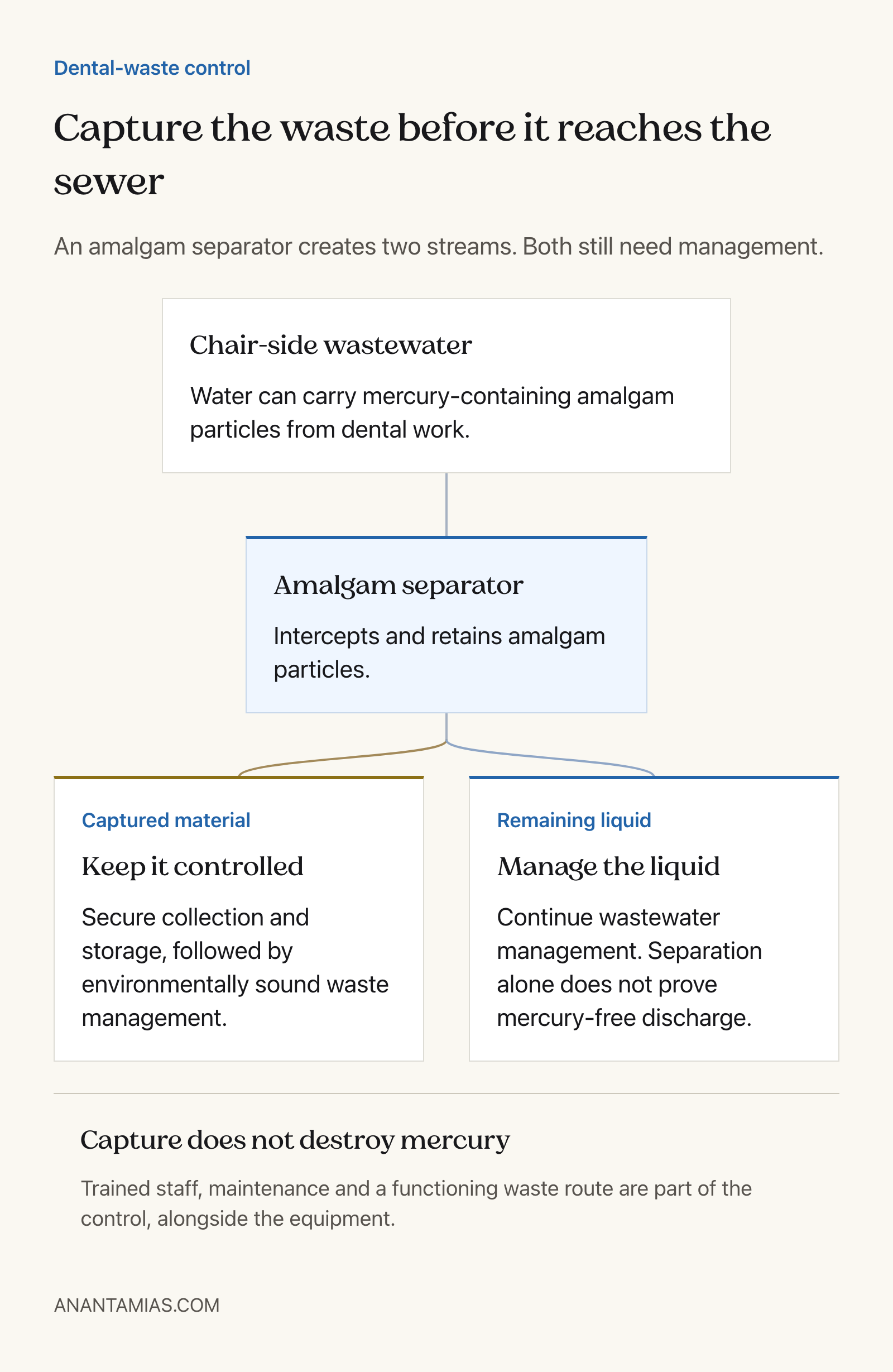
A separator provides an interception point before dental wastewater reaches the sewer, but the captured material still requires controlled handling.

  • Chair-side drains can receive amalgam particles during placement or removal procedures. Without interception, this mercury-containing waste travels with wastewater towards sewage treatment, extending the pollution-control task beyond the clinic that generated it.
  • The US Environmental Protection Agency explains that amalgam separators capture mercury and other metals before sewer discharge. This illustrates a control mechanism; American dental-effluent requirements are not Indian law.
  • Capture is not destruction: separation creates a retained waste stream that must be collected and managed. The liquid continues along its wastewater route; neither stream becomes automatically safe merely because separation occurred.
  • Sewage treatment can transfer mercury into sludge. EPA identifies subsequent pathways through sludge incineration, landfilling or land application, as well as water discharge; this is why upstream interception has an environmental purpose.
  • Collection, storage and downstream management must accompany the device. Senegal’s pilot combined these steps, illustrating that equipment installation alone cannot substitute for trained personnel, maintenance and a functioning route for captured waste.
Amalgam separator branching into captured waste requiring controlled management and liquid requiring wastewater management
Capturing amalgam separates a waste stream; it does not destroy mercury or establish complete wastewater treatment.

What the Dakar Meeting Changes—and What It Does Not

The current development is an implementation review, offering practical lessons for translating an existing international commitment into routine dental services.

  • The Minamata Convention protects health and the environment from human-caused mercury emissions and releases. WHO places dental-amalgam provisions in Annex A and reports the COP-6 decision to phase out amalgam by 2034.
  • The WHO 2030 target is different: 90% of countries should have implemented measures to phase down dental amalgam or phased it out. It measures country action, not a universal clinical deadline.
  • Phase-down reduces use, whereas phase-out moves towards ending it. Confusing these terms obscures whether a country is improving practice, reducing demand or implementing the later endpoint agreed through the treaty process.
  • Senegal’s experience linked a national assessment, coordination between health and environment authorities, professional training and waste controls. The lesson is institutional: material substitution works better when service delivery and environmental management develop together.
  • Domestic implementation still needs applicable national measures and workable services. The Dakar report establishes neither a newly enacted Indian ban nor a reason to remove sound fillings; individual treatment decisions require professional clinical assessment.

Way Forward

Make the Entire Waste Route Accountable

  • Pair professional training and suitable alternatives with prevention, so the transition protects treatment quality and affordability.
  • Assess waste routes before buying equipment: identify who maintains separators, collects captured material and manages it downstream.
  • Track implementation through functioning practices and waste handling, rather than counting devices installed or commitments announced.

Conclusion

  • Dental mercury control requires both reduced use and control of waste already produced. A separator intercepts one pathway; safe collection and downstream management determine whether that interception delivers an environmental benefit.
  • For an answer on sustainable healthcare, connect international commitments with everyday service capacity: trained professionals, affordable alternatives and waste accountability must operate together, with treaty deadlines distinguished from domestic legal measures.

UPSC Practice Questions

Prelims MCQ 1

With reference to dental amalgam and mercury control, consider the following statements:

  1. Amalgam separators destroy the mercury present in dental wastewater.
  2. Captured amalgam waste requires further management.
  3. The WHO 2030 country-action target is identical to the Minamata 2034 phase-out deadline.

How many of the above statements are correct?

(a) Only one (b) Only two (c) All three (d) None

Answer: (a) Only one

Explanation:

Only statement 2 is correct. Separators capture waste; they do not destroy mercury. The WHO target measures country action, while the Minamata decision concerns a phase-out endpoint.

Prelims MCQ 2

Why is interception of amalgam waste before it enters a sewer environmentally useful?

(a) It converts mercury into a harmless element. (b) It prevents the need for all wastewater treatment. (c) It reduces mercury entering sewage treatment and potentially transferring into sludge. (d) It makes captured waste suitable for unrestricted disposal.

Answer: (c) It reduces mercury entering sewage treatment and potentially transferring into sludge.

Explanation:

EPA describes mercury partitioning into sewage sludge and later environmental pathways. Interception reduces that input but does not replace wastewater treatment or controlled waste management.

UPSC Mains Questions

  1. Explain how dental-amalgam waste management illustrates the need for coordination between health and environmental regulators.
  2. Distinguish material substitution from pollution prevention at source. Discuss their complementary roles in sustainable oral healthcare.

Sources: WHO Regional Office for Africa and WHO.

Frequently Asked Questions

What is dental amalgam?

Dental amalgam is a filling material containing elemental mercury combined with other metals. Its environmental significance includes releases during handling, placement, removal and waste disposal, which require controls throughout the material’s life cycle.

What does an amalgam separator do?

It captures mercury-containing amalgam waste before it enters the sewer. It does not destroy mercury or complete wastewater treatment; the captured material still requires collection and environmentally sound management.

Did the Dakar meeting announce a new dental-amalgam ban?

No. It reviews implementation lessons from the GEF-7 project. WHO attributes the 2034 phase-out decision to Minamata COP-6 in 2025; the Dakar meeting itself does not establish a new Indian ban.

How does the WHO 2030 target differ from the 2034 phase-out?

WHO’s target concerns countries implementing phase-down measures or completing phase-out by 2030. The Minamata decision establishes a later phase-out endpoint. These are related but different measures of progress.

Heat Storms: Measuring Extreme Heat Across Space and Time

Open article →Download PDF

Why in News?

On 20 October 2026, Reuters, also reported by The Hindu, introduced heat storms as an analytical label for exceptionally widespread heatwaves measured across space and time.

  • Reuters defines an ordinary heatwave for its analysis as five or more consecutive days of abnormally high temperatures.
  • Its heat storm threshold is a heatwave covering at least 1% of the globe at its peak.
  • The investigation reports that Vera lasted 367 days across 2023–2024 and swept over nearly 85% of the globe across its lifetime.
  • These are Reuters analytical definitions, not a newly announced WMO or India Meteorological Department warning category.
  • A headline about global heat can combine duration, geographical extent and local exposure; treating them as interchangeable produces misleading conclusions.
  • Heat cascades describe consecutive or overlapping events, helping explain prolonged global activity without claiming uninterrupted heat at every location.

UPSC Relevance

Prelims Relevance

  • Reuters heat-storm definition: peak coverage of at least 1% of the globe.
  • Peak simultaneous area versus cumulative lifetime footprint.
  • Heat cascade: consecutive events, simultaneous events, or both.
  • Local climatic thresholds and the absence of one universal heatwave definition.
  • Thermal heat stress depends on temperature and other environmental conditions.

Mains Relevance

GS Paper 3

  • Choosing appropriate indicators for climate-risk assessment.
  • Distinguishing the extent of a hazard from population exposure and vulnerability.

GS Paper 1

  • Spatial and temporal interpretation of extreme weather events.

Essay

  • How scientific language shapes public understanding of environmental change.

Background and Context

What the New Label Measures

Heat storms add a spatial scale to a heatwave definition, but the label must be read alongside its stated methodology.

  • Duration comes first: Reuters uses five or more consecutive days of abnormally high temperatures to identify ordinary heatwaves. Its additional heat-storm threshold selects the largest events by peak geographical coverage.
  • Local conditions matter: the World Meteorological Organization explains that heatwave thresholds generally reflect local climate and adaptation. A temperature unusual in a cool region may be ordinary in a tropical climate.
  • Not a windstorm: the word storm here describes an analytical category of widespread heat. It does not itself imply a cyclone, rainfall, lightning, or a rotating atmospheric circulation associated with the event.
  • Definition limits: the Reuters summary identifies duration and peak-area thresholds but does not fully specify its abnormal-temperature calculation or spatial linking procedure. Those details cannot be inferred from the label alone.
  • Classification is not a warning: an analytical name can aid communication, but it does not automatically change national meteorological thresholds. An Indian heat alert must still be interpreted using the responsible official service.

Peak Area, Lifetime Footprint and Cascades

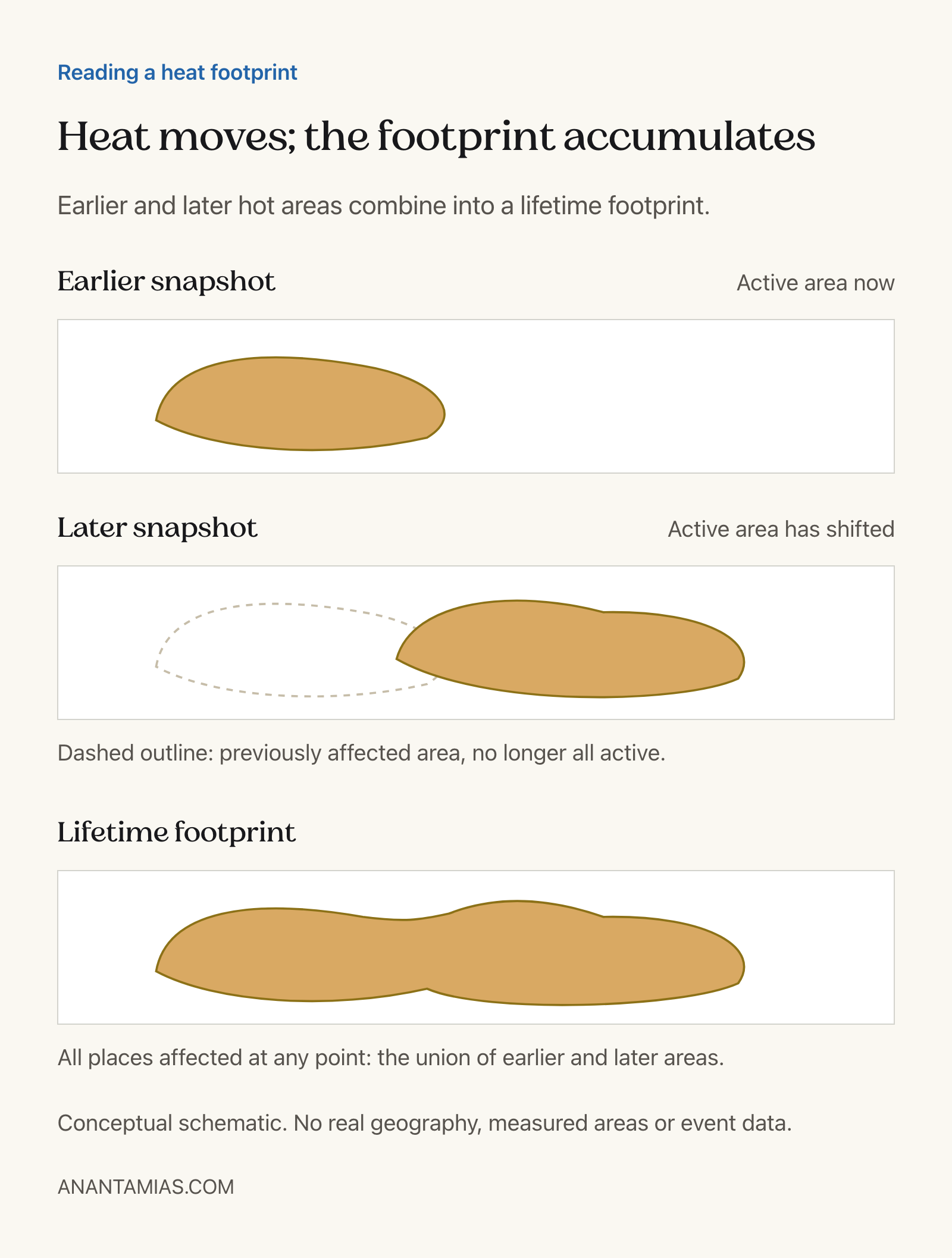
The same event can have a modest simultaneous extent and a much larger footprint accumulated as different places experience heat.

  • Peak area is the largest area affected at the same time during an event. It answers how widespread conditions became simultaneously, rather than how many different locations were affected across its entire lifetime.
  • Cumulative footprint covers the union of places affected at any point during an event. Locations counted earlier remain part of that footprint even after their own episode of abnormal heat has ended.
  • The Vera example: Reuters reports nearly 85% global coverage across a 367-day event. Reading this as 85% experiencing abnormal heat simultaneously, or every location remaining hot throughout, would misrepresent the reported measure.
  • A heat cascade is a succession or overlap of heat storms. Continuity means at least one event remains active somewhere; it does not mean that one individual storm or one local heatwave never ends.
  • Keep the unit explicit: distinguish a location, an event and a cascade when describing duration. Each measures a different phenomenon, so substituting one for another changes the meaning of a climate headline.
Conceptual earlier and later active heat areas and their combined lifetime footprint
A conceptual schematic distinguishes simultaneous extent from the places affected across an event; shapes are not measured geography.

Why Area Alone Cannot Measure Human Risk

A global heat footprint describes geographical extent; health and livelihood consequences also depend on who is exposed and under what conditions.

  • Area is not population: a fraction of the globe cannot be read as the same fraction of humanity. Population distribution and the location of exposure must be considered separately before estimating people affected.
  • Temperature is not the whole exposure: WMO identifies humidity, solar radiation and wind among the factors shaping thermal heat stress. Equally hot air can impose different burdens under different environmental conditions.
  • Warm nights reduce recovery: when nighttime temperatures remain unusually high, people, buildings and the environment release less accumulated heat. Daytime maxima alone can miss this continuing thermal burden between successive hot days.
  • Vulnerability varies: outdoor work, age, underlying health conditions and poorly adapted housing influence harm. A broad geographical metric cannot replace information about these differences when interpreting the consequences of an event.
  • Compare like with like: assess a trend using consistent thresholds, time windows and geographical coverage. A change in measurement rules can alter counted events, so a new label alone does not establish a trend.

Way Forward

Report the Metric With the Claim

  • State whether a reported area means simultaneous extent or cumulative footprint, and identify the relevant observation period.
  • Publish the temperature baseline and event-tracking method alongside results so readers can understand what the category includes.
  • Pair geographical event tracking with local exposure and vulnerability indicators before drawing conclusions about health or livelihood losses.

Conclusion

  • Heat storms are useful as an explicitly attributed analytical label for widespread heat, provided the definition stays visible and is not confused with an official warning category.
  • Space, time and exposure answer different questions: peak area measures simultaneous extent, cumulative footprint tracks places touched, and local conditions determine how dangerous the heat becomes for people.

UPSC Practice Questions

Prelims MCQ 1

With reference to the Reuters heat-storm analysis, consider the following statements:

  1. A heat storm reaches at least 1% of global area at its peak.
  2. A cumulative footprint necessarily represents the area heated simultaneously.
  3. A cascade may involve consecutive or simultaneous heat storms.

How many of the above statements are correct?

(a) Only one (b) Only two (c) All three (d) None

Answer: (b) Only two

Explanation:

Statements 1 and 3 are correct. Cumulative footprint includes places affected at any time during the event and need not represent simultaneous coverage.

Prelims MCQ 2

Which observation best explains why daytime maximum temperature alone can understate the burden of a heatwave?

(a) Warm nights can prevent the release of accumulated heat. (b) Cumulative footprint always equals the population affected. (c) Heat storms necessarily generate cyclonic winds. (d) All locations within an event remain hot for its full lifetime.

Answer: (a) Warm nights can prevent the release of accumulated heat.

Explanation:

Unusually warm nights reduce recovery by limiting heat loss from people, buildings and the environment. Geographical extent does not by itself quantify human exposure.

UPSC Mains Questions

  1. Distinguish peak simultaneous area, cumulative footprint and heat-storm cascades. Explain how confusing these measures can distort the interpretation of extreme-heat reports.
  2. Why is geographical extent insufficient to assess the human consequences of extreme heat? Discuss the additional environmental and social factors required.

Sources: Reuters investigation, reported by The Hindu and World Meteorological Organization.

Frequently Asked Questions

What is a heat storm?

In the Reuters analysis, a heat storm is an exceptionally large heatwave reaching at least 1% of the globe at its peak. The label is an analytical definition, not an official WMO warning category.

Does cumulative coverage mean all places were hot simultaneously?

No. Cumulative coverage includes places affected at any point across an event’s lifetime. Peak simultaneous coverage counts the area affected at the same time; the two measures answer different questions.

What is a heat-storm cascade?

A heat-storm cascade involves storms occurring consecutively, simultaneously, or both. Continuous global activity does not establish that a single storm lasts throughout, or that every location remains continuously hot.

Why do warm nights matter during extreme heat?

Cooler nights normally help people, buildings and the environment release heat accumulated during the day. Unusually warm nights interrupt that recovery, adding a burden that daytime maximum temperature alone can miss.

Does heat-storm area measure the number of people affected?

No. Area measures geographical extent. Estimating people affected also requires population and exposure information, while the severity of harm depends on environmental conditions, health, work and access to suitable housing.

India–New Zealand FTA: How Asymmetric Market Access Works

Open article →Download PDF

Why in News?

The India–New Zealand Free Trade Agreement entered into force on 20 October 2026, with New Zealand confirming implementation and India highlighting duty-free export access alongside protection for sensitive agricultural products.

  • New Zealand has eliminated customs duties on all tariff lines covering Indian exports, according to the Ministry of Commerce and Industry.
  • India’s concessions include immediate and phased access; sensitive products such as dairy, sugar and edible oils remain excluded from concessions.
  • Tariff-rate quotas for apples, kiwifruit and Mānuka honey are linked to agricultural productivity action plans under a joint council.
  • The agreement illustrates asymmetric liberalisation: reciprocal benefits can coexist with different product coverage, implementation periods and protections.
  • The central policy question is whether export opportunities and agricultural cooperation can deliver benefits while managing adjustment costs for vulnerable producers.

UPSC Relevance

Prelims Relevance

  • Entry into force: commencement of treaty operation, distinct from signature and domestic approval.
  • Tariff line: a product category in a customs tariff schedule.
  • Tariff-rate quota: different tariff treatment within and beyond a specified import quantity.
  • Rules of origin: conditions determining whether a product qualifies as originating under the agreement.
  • Exclusion: withholding a negotiated tariff concession for a product.

Mains Relevance

GS Paper 3

  • Balancing export competitiveness with agricultural sensitivity in trade negotiations.
  • Distinguishing negotiated market access from realised economic benefits.

GS Paper 2

  • Economic partnerships as instruments of bilateral engagement.

Background and Context

What Changes When an FTA Takes Effect?

Entry into force activates the agreement, but the timing and reach of each concession still depend on its negotiated terms.

  • Signature records agreement on the negotiated text, while domestic approval prepares each country to implement it. Entry into force is the separate operational milestone; MFAT confirms that today’s development concerns that final transition.
  • New Zealand’s commitment removes customs duties across tariff lines covering Indian exports. Textiles, footwear and engineering goods are among the sectors identified by India as potential beneficiaries, rather than sectors with guaranteed sales gains.
  • India’s offer follows a different structure, combining tariff elimination, reductions, staged implementation and exclusions. Reciprocal agreement does not mean every product receives identical treatment in both directions, or that every concession starts immediately.
  • A tariff line is a customs classification, whereas export value measures actual trade. Claims about coverage of tariff lines and shares of exports describe different denominators and should not be treated as interchangeable indicators.
  • Zero customs duty addresses one border cost. It does not establish that transport, documentation or product-compliance costs disappear; exporters still need commercially viable prices and buyers before legal access becomes an actual trade flow.

How Exclusions and Agricultural Quotas Work

Agricultural access is differentiated by product and linked to cooperation intended to improve Indian farm productivity.

  • Exclusion means a product does not receive the negotiated concession. India’s official release identifies dairy, sugar and edible oils among sensitive exclusions; this is different from a complete prohibition on importing those products.
  • A tariff-rate quota gives specified tariff treatment within a defined import quantity and different treatment beyond it. It is distinct from both unlimited duty-free entry and a simple absolute limit on all imports.
  • For apples, kiwifruit and Mānuka honey, India says the quotas are formally linked to delivery of agricultural action plans. The relevant question is how implementation connects access conditions with promised improvements for domestic producers.
  • The Agricultural Productivity Partnership covers technology, training and cultivation practices. Better orchard management and reduced post-harvest losses are intended outcomes; announced cooperation should not be described as productivity gains already achieved in Indian farms.
  • A Joint Agriculture Productivity Council oversees the linkage. This institutional arrangement matters because concessions and cooperation are interdependent commitments, requiring follow-through rather than an assumption that agricultural benefits arise automatically from signing an FTA.

Reading Protection and Benefits Correctly

The agreement combines opening with conditions; assessment should follow the commitments actually implemented and the outcomes subsequently observed.

  • Rules of origin determine which goods qualify for preferential treatment. They help prevent goods from outside the partnership from receiving concessions merely because they are routed through a partner country without meeting origin requirements.
  • India’s release also identifies a bilateral safeguard mechanism and anti-circumvention provisions. Their existence does not imply automatic protection against every import increase; invoking a safeguard depends on the agreement’s applicable conditions and procedures.
  • Asymmetry accommodates differences in economic structure and domestic sensitivity. India can pursue wider access for its manufacturers while reserving agricultural protections; this combination is consistent with negotiation rather than evidence that reciprocity is absent.
  • Investment facilitation is a commitment to support investment, not evidence that money has already arrived. Similarly, announced services or mobility opportunities should not be converted into claims of guaranteed employment or automatic visa entitlement.
  • For evaluation, separate policy design from economic results: first identify the product concession and its timing, then examine trade and producer outcomes. A positive announcement alone cannot establish gains for every firm or household.

Way Forward

Make the Terms Usable and Accountable

  • Publish clear product-level guidance distinguishing immediate concessions, phased reductions, quotas and exclusions so firms do not mistake headline access for universal treatment.
  • Track agricultural action-plan delivery alongside quota administration, with evidence on extension services and post-harvest improvements reaching farmers.
  • Report realised outcomes separately from investment announcements and export projections, including the experience of smaller producers facing adjustment costs.

Conclusion

  • The India–New Zealand FTA demonstrates that reciprocal liberalisation can be asymmetric: broad export access can coexist with product exclusions, phased commitments and conditional agricultural preferences.
  • A sound assessment distinguishes legal opportunity from realised benefit, and treats origin rules, quota administration and delivery of agricultural cooperation as integral parts of the agreement’s economic effect.

UPSC Practice Questions

Prelims MCQ 1

With reference to the India–New Zealand FTA, consider the following statements:

  1. New Zealand has eliminated customs duties on tariff lines covering Indian exports.
  2. India has granted identical, immediate duty-free treatment to every New Zealand product.
  3. Agricultural tariff-rate quotas can coexist with exclusions for sensitive products.

How many of the above statements are correct?

(a) Only one (b) Only two (c) All three (d) None

Answer: (b) Only two

Explanation:

Statements 1 and 3 are correct. India’s concessions are differentiated and retain sensitive exclusions; the two countries have not made identical universal commitments.

Prelims MCQ 2

Which description best explains a tariff-rate quota?

(a) A complete ban on imports after a licensing deadline (b) An identical customs duty on every imported product (c) Different tariff treatment within and beyond a specified import quantity (d) An exemption from rules of origin for all imports

Answer: (c) Different tariff treatment within and beyond a specified import quantity

Explanation:

A tariff-rate quota distinguishes imports within the specified quantity from imports beyond it through tariff treatment. It is not the same as an absolute import prohibition.

UPSC Mains Questions

  1. How can asymmetric market-access commitments reconcile export promotion with agricultural sensitivity? Discuss using the India–New Zealand FTA.
  2. Explain why entry into force is only the beginning of evaluating a trade agreement’s economic benefits.

Sources: PIB, Ministry of Commerce and Industry and New Zealand Ministry of Foreign Affairs and Trade.

Frequently Asked Questions

When did the India–New Zealand FTA enter into force?

New Zealand’s Ministry of Foreign Affairs and Trade confirms that the agreement entered into force on 20 October 2026. This operational milestone is distinct from signing the agreement or completing domestic approval.

Does the agreement make all bilateral trade duty-free immediately?

No. New Zealand has eliminated duties on tariff lines covering Indian exports, while India’s concessions are differentiated. Phased access, agricultural quotas and sensitive exclusions mean the commitments are not identical.

Does exclusion of dairy mean dairy imports are banned?

No. Exclusion from a trade agreement’s tariff concessions means the product does not receive that negotiated preference. It does not, by itself, create a prohibition on importing the product.

Why are agricultural action plans relevant?

India says quotas for apples, kiwifruit and Mānuka honey are linked to action-plan delivery under joint oversight. The arrangement connects market access with cooperation intended to improve cultivation practices and farm productivity.

MMX Launch: Using Phobos Samples to Test Moon Origins

Open article →Download PDF

Why in News?

JAXA announced on October 20, 2026, that Martian Moons eXploration (MMX) had launched aboard H3, separated successfully and entered its predetermined orbit.

  • The launch took place from Japan’s Tanegashima Space Center; spacecraft separation and orbital injection were confirmed.
  • MMX plans to collect at least 10 grams of surface material from Phobos, one of Mars’s two moons.
  • The mission overview schedules Earth return in 2031; arrival, landing, sampling and capsule recovery remain future operations.
  • The scientific question concerns moon formation: whether Martian moons came from captured asteroids or debris produced by a giant impact.
  • Returned grains would connect laboratory analysis with observations of their original setting, strengthening interpretation of material moving through the Solar System.

UPSC Relevance

Prelims Relevance

  • MMX: JAXA mission targeting sample return from Phobos.
  • Phobos and Deimos: the two Martian moons.
  • Quasi-satellite orbit: an orbital path around Mars similar to Phobos’s, permitting nearby observations.
  • Origin hypotheses: captured asteroid versus giant-impact debris.
  • Sample return: collection outside Earth followed by delivery to terrestrial laboratories.

Mains Relevance

GS Paper 3

  • How robotic sample return complements remote sensing in planetary science.
  • Scientific uncertainty and staged technological validation in deep-space missions.

Essay

  • Scientific progress depends on testing competing explanations against material evidence.

Background and Context

Why Phobos Can Reveal How Martian Moons Formed

Phobos is both the sampling destination and a test case for competing explanations of how small bodies became moons.

  • The capture hypothesis treats the moons as asteroids originating in the outer Solar System that were subsequently captured by Mars’s gravity. Their material would preserve clues to that earlier history.
  • The giant-impact hypothesis instead proposes that a massive collision with Mars scattered debris into orbit. That material then assembled into moons, connecting their origin directly to an episode in the planet’s evolution.
  • Composition matters because the hypotheses describe different source materials and formation processes. JAXA plans to combine observations from the spacecraft with detailed examination of returned grains to investigate which explanation fits the evidence.
  • A small-body target offers access to the Martian system without retrieving material directly from Mars’s surface. JAXA identifies the planet’s stronger gravity as a significant technical obstacle for landing and sample return.
  • Preservation is a scientific expectation, not a result already established by MMX. Phobos is thought to have changed relatively little, making its material potentially informative about the history of the wider Martian system.

How the Planned Sampling Sequence Works

The mission separates reconnaissance, surface investigation and return so that observations can guide the next operation.

  • Quasi-satellite operations begin after arrival near Mars: the spacecraft follows an orbital path similar to Phobos’s. This geometry supports close observations of the moon while the mission operates within the Martian system.
  • Landing-site selection relies on observations of Phobos’s shape and candidate locations. Terrain, spectroscopy and chemical composition help connect the choice of sampling location with both operational feasibility and the scientific questions being investigated.
  • The rover precedes the main spacecraft in the planned surface sequence. It investigates the Phobos surface before the main spacecraft lands to collect material, making these distinct operations rather than a single completed touchdown.
  • Sample collection is intended to bring surface grains and rock material into the return chain. Success requires more than reaching Phobos: the spacecraft must perform the landing, secure material and carry it away.
  • The return capsule is planned to separate near Earth and enter the atmosphere, with recovery in Australia. Launch confirmation establishes departure success; it cannot establish successful sampling, capsule entry or recovery in advance.

What Returned Samples Could Establish

Remote observations describe the larger setting; returned material lets researchers examine parts of that setting in greater detail.

  • Remote sensing surveys Phobos and helps identify where material comes from. Laboratory study of returned samples adds detailed analysis of the physical material, making the two approaches complementary rather than interchangeable scientific methods.
  • Context remains essential: a sample must be interpreted alongside observations of its collection site and the moon as a whole. A grain’s properties alone do not automatically explain every feature of planetary history.
  • Deimos observations provide a wider view of the Martian moons, but the planned material collection targets Phobos. Observing another moon does not mean the mission intends to return samples from both moons.
  • Habitability research includes investigating how water and organic material moved through the Solar System. Such work concerns the conditions for prebiotic chemistry; it is not equivalent to finding organisms or proving past Martian life.
  • Technology development is a separate mission outcome: round-trip travel, landing, sampling and long-distance communication extend small-body exploration capabilities. These engineering objectives can be assessed independently of which moon-origin hypothesis the eventual evidence supports.

Way Forward

Judge Each Milestone Against Its Evidence

  • Report launch, arrival, sampling and return separately, using agency confirmation for completed operations and conditional language for planned ones.
  • Interpret sample results with collection-site observations and competing origin hypotheses, rather than treating an isolated finding as a complete history.
  • Separate research on water and organics from claims of life detection; the evidentiary questions are different.

Conclusion

  • MMX links a concrete target to a testable question: Phobos samples could help distinguish capture from impact origins when assessed with remote observations. The launch begins that investigation; the decisive material evidence has not yet returned.
  • For planetary exploration, mission stage determines the claim. A successful launch is an engineering milestone, planned sample return is a future operation, and a conclusion about moon origins must await observations and analysis.

UPSC Practice Questions

Prelims MCQ 1

With reference to the Martian Moons eXploration mission, consider the following statements:

  1. Its planned sample collection targets Phobos.
  2. Its quasi-satellite operations involve an orbital path around Mars similar to that of Phobos.
  3. Successful launch confirms that samples have been recovered on Earth.

How many of the above statements are correct?

(a) Only one (b) Only two (c) All three (d) None

Answer: (b) Only two

Explanation:

Statements 1 and 2 are correct. Launch is distinct from the later planned landing, collection and Earth recovery stages.

Prelims MCQ 2

Which explanation corresponds to the giant-impact hypothesis for the origin of the Martian moons?

(a) Asteroids were captured intact by Earth and transferred to Mars. (b) Solar radiation condensed directly into solid moons. (c) Debris from a massive collision with Mars accumulated into moons. (d) Material returned from Phobos has already proved the presence of life.

Answer: (c) Debris from a massive collision with Mars accumulated into moons.

Explanation:

The giant-impact hypothesis proposes a collision with Mars followed by assembly of orbiting debris into moons. It is distinct from the captured-asteroid hypothesis.

UPSC Mains Questions

  1. Explain how sample-return missions complement remote sensing in investigating planetary origins. Illustrate with the objectives of MMX.
  2. Distinguish the scientific objectives and technological milestones of a deep-space mission. Why should launch success be assessed separately from sample recovery?

Sources: JAXA launch result and JAXA MMX mission overview.

Frequently Asked Questions

What is the MMX mission?

MMX is JAXA’s Martian Moons eXploration mission. It aims to observe the Martian system, collect material from Phobos and return that material to Earth for detailed analysis of the moons’ origins.

Is MMX collecting samples from the surface of Mars?

No. The planned collection site is Phobos, a moon of Mars. Observations of Mars and Deimos support wider scientific objectives, but they should not be confused with surface sampling on the planet.

Why are Phobos samples useful?

The samples could help distinguish whether the Martian moons formed from impact debris or were captured asteroids. Their interpretation requires laboratory analysis together with remote observations of Phobos and the sampling location.

Has MMX already returned samples?

No. JAXA confirmed launch, separation and orbital injection on October 20, 2026. Arrival, surface operations and sample recovery remain planned; the mission overview schedules return to Earth in 2031.

SCO Action Plan: Turning Consensus Into Economic Cooperation

Open article →Download PDF

Why in News?

The SCO Council of Heads of Government adopted the Multilateral Trade and Economic Cooperation Programme Action Plan for 2026–2030 at its Dushanbe meeting on October 20, according to PIB.

  • The adopted outcome included a joint communiqué and the economic action plan; this was more than an expression of support in a speech.
  • India advocated simpler customs procedures, digital documentation and interoperable systems alongside transport infrastructure.
  • India also stressed sovereignty and territorial integrity as conditions for sustainable connectivity initiatives.
  • Regional trade depends on both usable transport routes and border processes that let goods move predictably between jurisdictions.
  • A collective action plan identifies a cooperation framework; its adoption alone does not establish that national procedures have already changed.

UPSC Relevance

Prelims Relevance

  • SCO: Shanghai Cooperation Organisation.
  • CHG: Council of Heads of Government, a mechanism for economic and practical cooperation.
  • PMTEC: Programme for Multilateral Trade and Economic Cooperation.
  • Dushanbe: the capital of Tajikistan and venue of this meeting.
  • Digital interoperability: systems being able to exchange and use information.

Mains Relevance

GS Paper 2

  • Consensus, sovereign equality and implementation in regional organisations.
  • India’s connectivity approach towards Central Asia.

GS Paper 3

  • Transport infrastructure, trade facilitation and transaction costs.

Essay

  • Cooperation succeeds when shared commitments become usable public institutions.

Background and Context

What the Council Adopted

The immediate development is an agreed economic cooperation framework; the next question is how that framework becomes practical work among participating governments.

  • The Council of Heads of Government promotes economic and other practical cooperation within the SCO. The meeting reviewed multilateral trade cooperation and discussed transport, finance, the digital economy and social development.
  • The PIB release explicitly records adoption of the PMTEC Action Plan for 2026–2030. Its confirmation matters because earlier passages describe India supporting adoption, which alone would not prove collective agreement.
  • The available release does not reproduce the full action-plan text. Specific obligations, deadlines or enforcement arrangements cannot be inferred from the meeting’s broad themes or from proposals made by one delegation.
  • Adoption and implementation are separate stages. Agreeing on a programme does not itself show that customs agencies have revised procedures, digital systems can exchange records, or businesses can already use new arrangements.
  • The release also recalls earlier summit decisions on SCO centres. Their mention in this meeting is not evidence that those bodies were newly created here; keep today’s economic outcome distinct from earlier institutional decisions.

Why Consensus Needs an Implementation Mechanism

India’s statement links cooperation to sovereign equality and practical results, while warning that additional institutions do not automatically produce additional benefits.

  • Consensus seeks an outcome that participating governments can accept. Its practical value is shared ownership; its limitation is that agreement on broad language may leave difficult operational choices unresolved until subsequent work.
  • Sovereign equality means treating countries as participants whose consent matters. In India’s stated approach, regional cooperation should respect national choices rather than assume that a shared programme overrides territorial concerns or domestic authority.
  • Consultation matters for connectivity because routes depend on cooperation across territories. India argued that projects must respect sovereignty and territorial integrity; the release does not establish universal approval of every route mentioned.
  • India’s call to avoid institutional duplication is an argument about delivery. A new mechanism should address an identified gap and coordinate existing responsibilities, rather than merely add meetings without improving services for users.
  • Practical outcomes can be assessed through predictable transactions and usable market connections. This is an analytical test of implementation, not a claim that the adopted plan specifies these indicators or has already achieved them.

Physical Links and Border Formalities

A railway, road or port carries goods; the procedures at borders determine whether those goods can continue their journey without avoidable administrative friction.

  • Physical connectivity supplies the transport route and handling capacity. India cited the International North-South Transport Corridor and Chabahar Port as initiatives that can connect Central Asia with broader markets, rather than announcing new completed links.
  • Trade facilitation addresses procedures around movement. Even where a road exists, repeated paperwork and uncertain clearance requirements can delay consignments; infrastructure alone cannot resolve a documentary problem at a border agency.
  • Digital documentation can reduce repeated entry of shipment information. Its usefulness depends on whether receiving agencies can recognise and process the record; converting paper into a file does not automatically secure acceptance across jurisdictions.
  • Interoperability concerns systems working together. Shared data formats and workable exchange arrangements can help information travel with goods, while decisions on permissions, checks and accountability still require cooperation between the responsible authorities.
  • These customs and digital measures were India’s advocated priorities. They should not be reported as an adopted common customs regime, automatic document recognition or removal of national border controls without the corresponding agreed text.

Way Forward

Make Cooperation Usable

  • Publish the agreed plan and implementation arrangements so businesses can distinguish collective commitments from proposals and identify the responsible agencies.
  • Begin with a defined document-exchange problem, agree data requirements and acceptance rules, and test whether users actually avoid repeated submissions.
  • Assess delivery through predictable clearance and accessible procedures, while preserving consultation and each participating country’s regulatory responsibilities.

Conclusion

  • The SCO action plan is a collective economic outcome, but its adoption is not proof of completed integration. Separate what was agreed from what India advocated and what agencies must still implement.
  • For an answer on regional connectivity, pair transport capacity with workable border procedures. Sovereignty and consensus shape political acceptance; implementation determines whether firms and communities gain usable connections.

UPSC Practice Questions

Prelims MCQ 1

With reference to the SCO meeting in Dushanbe, consider the following statements:

  1. The Council of Heads of Government promotes economic and practical cooperation.
  2. PIB confirmed adoption of the PMTEC Action Plan for 2026–2030.
  3. The announcement established automatic recognition of all digital customs documents across SCO members.

How many of the above statements are correct?

(a) Only one (b) Only two (c) All three (d) None

Answer: (b) Only two

Explanation:

The release confirms the first two statements. Digital documentation and interoperability were advocated by India; automatic recognition across members was not established by the announcement.

Prelims MCQ 2

A transport corridor is operational, but consignments face repeated submission of the same information to border agencies. Which measure most directly addresses this problem?

(a) Increasing the number of regional summits (b) Adding a parallel road without changing procedures (c) Agreeing interoperable documentation and acceptance procedures (d) Treating an action plan as automatic exemption from customs checks

Answer: (c) Agreeing interoperable documentation and acceptance procedures

Explanation:

The bottleneck is procedural and informational. Interoperable documentation and agreed acceptance can address it; physical capacity or meeting frequency alone cannot.

UPSC Mains Questions

  1. Regional connectivity requires more than transport infrastructure. Discuss with reference to India’s priorities at the SCO Council of Heads of Government meeting. (150 words)
  2. Examine how consensus and sovereign equality can support regional economic cooperation while complicating implementation. Suggest practical safeguards against institutional duplication. (250 words)

Source: PIB, Ministry of Defence.

Frequently Asked Questions

What was the fresh SCO economic outcome?

PIB confirmed adoption of the PMTEC Action Plan for 2026–2030 at the Dushanbe meeting. The announcement establishes agreement on the plan, but does not reproduce its detailed implementation provisions.

What does the Council of Heads of Government do?

The SCO Council of Heads of Government promotes economic and other practical cooperation among members. This meeting reviewed trade cooperation and discussed areas including transport, finance, the digital economy and social development.

Did the meeting create a common customs regime?

The available release does not establish a common customs regime. India advocated simpler customs procedures, digital documentation and interoperable solutions; these priorities must be distinguished from verified provisions of the adopted plan.

Why is physical connectivity insufficient?

A transport route provides movement capacity, but goods also face documentation and clearance requirements. Predictable procedures and usable information exchange help make infrastructure effective without implying that national regulatory checks disappear.

UN Liquidity: Why Approved Budgets Can Lack Cash

Open article →Download PDF

Why in News?

PTI reported on October 20 that India had raised concerns about UN liquidity and unpaid assessed contributions at the General Assembly’s Fifth Committee on October 19, 2026.

  • According to India’s statement reported by PTI, collection uncertainties and low cash balances continued to strain the organisation’s finances.
  • India reported regular-budget unpaid assessments of $1.46 billion, compared with $1.87 billion a year earlier; a lower outstanding balance does not itself establish adequate operating cash.
  • The statement also described peacekeeping finances as more worrying and called for full, timely and unconditional payment of assessed contributions.
  • A multilateral organisation needs both authority to spend and money received in time to implement its mandates; an approved budget supplies only the first.
  • For troop-contributing countries, predictable reimbursements matter alongside diplomatic representation, making financial discipline a practical issue for participation in peacekeeping.

UPSC Relevance

Prelims Relevance

  • Assessed contributions versus voluntary contributions
  • General Assembly and its Fifth Committee
  • Article 17: budget approval and apportionment of expenses
  • Article 19: arrears threshold and voting exception
  • Separate peacekeeping budgets and accounts

Mains Relevance

GS Paper 2

  • Financing constraints on multilateral institutions and mandate delivery
  • India’s interest in reliable UN financing and peacekeeping reimbursements

Essay

  • Collective promises require dependable collective financing.

Background and Context

Budget Approval, Assessment and Cash Are Different

The financing chain separates a collective spending decision from each member’s obligation and the money actually available for operations.

  • Under Article 17 of the UN Charter, the General Assembly considers and approves the organisation’s budget and apportions expenses among members; the approved total is not proof of payment.
  • An assessed contribution is a member’s allocated financial obligation. It differs from a voluntary donation: the member cannot treat its assessed share as an optional pledge simply because payment is politically inconvenient.
  • Cash receipts arise when members actually transfer funds. The organisation may have authorised activities and contributions legally due while lacking sufficient liquid money to meet payments falling due now.
  • Arrears describe unpaid obligations, while liquidity describes immediately available funds. A reduction in accumulated arrears can coexist with cash pressure if receipts remain uncertain or arrive after expenditure needs.
  • The Fifth Committee handles administrative and budgetary questions within the General Assembly. Its deliberations connect spending scrutiny with financing, but committee discussion alone cannot substitute for member states paying their assessments.

Why Peacekeeping Needs Its Own Financial Reading

Peacekeeping finances cannot be read as a single extension of the regular budget or as evidence that all UN activities share one account.

  • The UN’s peacekeeping financing explanation states that each operation has its own budget and account. Mission resources cover operational costs and personnel needs linked to the authorised mandate.
  • Regular-budget and peacekeeping assessments are distinct financing streams. Payment into one does not establish that another account has received sufficient cash; examine the relevant contribution obligation and account separately.
  • Budget authority also differs from operational authority: peacekeeping budgets reflect mission mandates, while the General Assembly approves financial resources. A mandate to perform a task does not itself supply the funds.
  • Troop-contributing governments pay their soldiers under national arrangements and receive UN reimbursements under agreed rules. The UN also reimburses specified equipment and support, linking institutional finances to contributors’ own planning.
  • As a general mechanism, cash shortages can delay reimbursements and constrain implementation. This explains the stakes for contributors; it does not establish a new, verified amount currently overdue to India.

Article 19 Has a Precise Threshold and Exception

The Charter links serious contribution arrears to General Assembly voting, with a defined safeguard for circumstances outside a member’s control.

  • Article 19 removes a member’s General Assembly vote when its arrears equal or exceed contributions due from it for the preceding two full years; any late payment alone does not meet this test.
  • The threshold compares an amount outstanding with an amount due over a specified period. Avoid reducing the rule to a loose claim that a country must miss exactly two consecutive annual payments.
  • The General Assembly may permit voting if satisfied that non-payment results from conditions beyond the member’s control. This exception matters when distinguishing inability to pay from deliberate withholding of assessed contributions.
  • The specified consequence concerns voting in the General Assembly. Article 19 does not itself expel a state from UN membership or remove a Security Council vote merely because contribution arrears exist.
  • Financial accountability and operational continuity must be considered together. Voting restrictions address member obligations, while timely collections determine whether previously approved activities can proceed without disruptive cash-management measures.

Way Forward

Connect Mandates With Predictable Payments

  • Members should publish credible payment schedules and clear overdue assessed contributions, allowing the organisation to plan expenditure against receipts rather than uncertain expectations.
  • Financial reporting should distinguish approved budgets, assessments, collections and cash balances, with regular-budget and peacekeeping accounts identified clearly.
  • Budget scrutiny should connect resource requirements to mandates and protect transparency over reimbursement delays, rather than assuming expenditure restraint alone resolves unpaid obligations.

Conclusion

  • The UN liquidity debate turns on a basic distinction: permission to spend is not cash in hand. Assessed obligations support collective financing only when payments arrive in time for authorised work.
  • For an answer on multilateral reform, connect member compliance with mandate delivery and contributor confidence. Apply Article 19’s exact threshold and exception without confusing voting consequences with membership or Security Council powers.

UPSC Practice Questions

Prelims MCQ 1

With reference to Article 19 of the UN Charter, consider the following statements:

  1. Its arrears threshold is the amount of contributions due from the member for the preceding two full years.
  2. The General Assembly may permit voting when non-payment is due to conditions beyond the member’s control.
  3. Crossing the threshold automatically expels the member from the United Nations.

How many of the above statements are correct?

(a) Only one (b) Only two (c) All three (d) None

Answer: (b) Only two

Explanation:

The first two statements reflect Article 19. Its consequence concerns the General Assembly vote, subject to the stated exception; it does not provide for automatic expulsion.

Prelims MCQ 2

Which situation best illustrates a liquidity problem despite an approved UN budget?

(a) Authorised expenditure is due before assessed contributions are received. (b) All due payments are covered by available cash. (c) Member states debate a proposal that has not received budget approval. (d) A mission submits its performance report after a financial cycle.

Answer: (a) Authorised expenditure is due before assessed contributions are received.

Explanation:

Budget approval authorises spending. Liquidity depends on available cash, so delayed receipts can obstruct implementation even when expenditure has already been authorised.

UPSC Mains Questions

  1. Explain why an approved UN budget may coexist with a liquidity crisis. Discuss the implications for multilateral mandate delivery. (150 words)
  2. Assess the relationship between member-state payment obligations, peacekeeping reimbursements and accountability under Article 19 of the UN Charter. (250 words)

Sources: The Hindu, PTI and United Nations Charter.

Frequently Asked Questions

What is UN liquidity?

UN liquidity refers to cash available to meet payments as they fall due. It differs from an approved budget, which authorises expenditure, and from assessed contributions, which members owe.

Are assessed contributions voluntary?

Assessed contributions are allocated financial obligations of member states. Article 17 provides that members bear the organisation’s expenses as apportioned by the General Assembly; these payments differ from voluntary funding.

When does Article 19 affect voting?

It affects the General Assembly vote when arrears equal or exceed contributions due for the preceding two full years. The Assembly may permit voting if non-payment results from conditions beyond the member’s control.

Does regular-budget payment settle peacekeeping dues?

Regular-budget and peacekeeping obligations are distinct. A payment into one financing stream does not demonstrate that another has been paid or has adequate cash; the relevant assessment and account must be checked.

Why do cash shortages matter to troop contributors?

Troop-contributing governments pay their soldiers and receive UN reimbursements under agreed arrangements. Cash shortages can delay reimbursements and complicate planning, although specific current arrears require separate evidence.

Cross-Border Services Tax: Looking Beyond Physical Presence

Open article →Download PDF

Why in News?

UN DESA announced that the UN Tax Committee’s Geneva session beginning on 20 October would review an evaluation report on taxing cross-border services supplied without physical presence.

  • The 20–23 October session reviews the first technical outputs of the current membership, including the services evaluation report.
  • The Committee is an ECOSOC body of 25 tax experts; its work supports practical tax policy and administration, especially in developing countries.
  • The report is under review: the announcement does not establish an adopted global services tax or a change in Indian law.
  • Remote supply can connect an overseas service provider with customers in another country without a local office or staff.
  • The policy challenge combines revenue allocation, enforceable collection and protection against taxing the same income twice.

UPSC Relevance

Prelims Relevance

  • Source jurisdiction: jurisdiction connected to the origin of income under the applicable rules.
  • Residence jurisdiction: jurisdiction where the provider is treated as resident for tax purposes.
  • Permanent establishment: a treaty concept connecting business activity with taxing rights.
  • Double-taxation relief: mechanisms such as a foreign tax credit or exemption.
  • UN Tax Committee: an expert body under ECOSOC, distinct from intergovernmental tax-convention negotiations.

Mains Relevance

GS Paper 3

  • Taxing services when economic participation and physical presence diverge.
  • Balancing domestic revenue mobilisation with predictable cross-border business rules.

GS Paper 2

  • Expert guidance, treaty negotiation and national implementation as distinct stages of international cooperation.

Essay

  • Economic activity crosses borders more easily than public revenue systems.

Background and Context

Why Physical Presence No Longer Tells the Whole Story

A service can reach a customer abroad while the supplier’s personnel and premises remain elsewhere; this separates commercial reach from physical establishment.

  • Physical presence traditionally provides visible evidence of local business activity: premises, personnel and operations can connect an enterprise to a jurisdiction. Remote delivery makes that evidence less decisive for some services.
  • Consider a hypothetical consulting firm that serves overseas clients entirely from its home country. The service crosses a border, but its staff do not; customer location and supplier location point to different economic connections.
  • Residence taxation looks to the provider’s tax residence. Source taxation looks to the income’s connection with another jurisdiction; which connection counts depends on domestic law and the applicable treaty, rather than geography alone.
  • A customer market is economically important, but it is not automatically a legally recognised source of every payment. A rule must specify the connection that permits taxation and the income it covers.
  • The physical-presence challenge is consequently about allocating rights over particular income. It does not mean every remote supplier is untaxed, or that every payment necessarily attracts tax in the customer’s country.

Taxing Rights, Collection and Double-Taxation Relief

Three separate questions matter: whether domestic law charges tax, how a treaty distributes or limits taxing rights, and how overlapping claims are relieved.

  • A domestic tax charge identifies the taxable person, income and conditions. A treaty can limit the exercise of that charge; an international discussion alone does not create an enforceable national tax demand.
  • Permanent establishment is an important treaty threshold for business profits. It should not be treated as a universal prerequisite for taxing every income category: services provisions and other treaty rules can differ.
  • Allocation and collection are distinct. Recognising a taxing right does not by itself identify the liable payer, produce transaction records or secure payment from an overseas enterprise with no local operational presence.
  • Double taxation can arise when both jurisdictions tax the same income. A foreign tax credit can offset qualifying foreign tax against residence-country liability, while exemption can remove qualifying income from that country’s tax base.
  • Relief is conditional, not a promise that all foreign tax is reimbursed. Classification, treaty coverage and domestic requirements matter; governments must coordinate the tax claim and relief mechanism to avoid unresolved overlap.

What the UN Review Can and Cannot Establish

The current development is an expert review of technical work, so its importance lies in policy design rather than an immediately operative global levy.

  • The UN Tax Committee develops practical guidance for national authorities. UN DESA describes this session as reviewing early technical outputs, including an evaluation of options for services sold without physical presence.
  • Expert guidance can inform national decisions and bilateral treaty negotiations. It does not automatically amend existing treaties, impose a common rate or substitute for the legal steps required within participating countries.
  • The Committee must be distinguished from intergovernmental tax-convention negotiations. A technical expert body and a negotiating process involving governments have different functions; progress in one should not be reported as adoption in the other.
  • For developing countries, a useful policy assessment asks whether a proposed connection to the market is measurable, whether collection is feasible, and whether administration costs undermine the revenue it could raise.
  • For India, the relevant analytical question is how any future option would interact with existing law and treaty commitments. The session announcement itself provides no basis for claiming a new Indian tax obligation.

Way Forward

Make Allocation Administrable

  • Define the covered services and taxable connection clearly enough for taxpayers and administrations to apply the same rule.
  • Align collection and information requirements with realistic administrative capacity, particularly where suppliers have no local premises.
  • Provide workable double-taxation relief and dispute resolution alongside any expanded taxing right.

Conclusion

  • Remote services expose the gap between economic participation and physical presence, but closing it requires a clear legal connection, an enforceable collection mechanism and coordinated relief.
  • The UN review is a development in technical cooperation. Its eventual influence should be assessed through adopted guidance and national or treaty implementation, without confusing an agenda item with binding law.

UPSC Practice Questions

Prelims MCQ 1

With reference to taxation of cross-border services, consider the following statements:

  1. A customer’s location automatically creates a source-country taxing right over every service payment.
  2. Tax treaties may limit the exercise of taxing rights available under domestic law.
  3. Foreign tax credits and exemptions are mechanisms used to relieve double taxation.

How many of the above statements are correct?

(a) Only one (b) Only two (c) All three (d) None

Answer: (b) Only two

Explanation:

Statements 2 and 3 are correct. Customer location alone does not determine taxing rights; the relevant domestic and treaty rules must be considered.

Prelims MCQ 2

Which best describes the October review of services taxation by the UN Tax Committee?

(a) Immediate imposition of a uniform global tax (b) Automatic amendment of every bilateral tax treaty (c) Technical evaluation that may inform national and treaty policy (d) Enactment of a new Indian services tax

Answer: (c) Technical evaluation that may inform national and treaty policy

Explanation:

UN DESA announced review of an evaluation report by an ECOSOC expert body, not adoption of a binding universal levy or Indian legislation.

UPSC Mains Questions

  1. Explain why cross-border services supplied without physical presence challenge traditional allocation of taxing rights. Discuss the need to coordinate collection with double-taxation relief. (150 words)
  2. Distinguish the roles of international expert guidance, tax treaties and domestic legislation in reforming services taxation. What administrative constraints should developing countries consider? (250 words)

Source: UN DESA.

Frequently Asked Questions

What is the news about cross-border services tax?

UN DESA announced an expert review of an evaluation report on services sold across borders without physical presence. This is technical work under review, not an announcement of a universal tax.

Does having no local office mean no tax can apply?

Not necessarily. The answer depends on the type of income, domestic tax law and the applicable treaty. Permanent establishment is important for business profits but does not govern every income category identically.

How do source and residence taxation differ?

Residence taxation connects income to the taxpayer’s tax residence. Source taxation connects it to another jurisdiction under relevant rules. Customer location can matter, but does not automatically settle the legal allocation of taxing rights.

How can double taxation be relieved?

A foreign tax credit can reduce residence-country tax by qualifying tax paid abroad; exemption can exclude qualifying foreign income. Actual relief depends on applicable rules and conditions, rather than an automatic refund.

Has the UN review changed Indian tax law?

The session announcement does not establish any change in Indian law. Expert guidance may inform later policy decisions, but domestic legislation and applicable treaty commitments determine enforceable obligations in a particular case.