Opens in a new tab
Join Anantam IAS Channel on Telegram

Daily Digest · Monday

22 June 2026 Current Affairs for UPSC

4 current affairs published on Monday, 22 June 2026

22 June 2026 Current Affairs for UPSC — every Why-in-News article AnantamIAS published on Monday, 22 June 2026, broken down with Why in News?, the exact GS paper it feeds, sub-topic mapping, MCQ-ready facts and a UPSC-style practice question. 4 articles in total, covering Polity, Economy, Environment, S&T, IR, Geography, History, Society and Internal Security — the same Why-in-News + GS-paper-mapping + practice-question format the Compass uses across every daily digest on the site.

Daily current affairs for UPSC is where new material enters your prep stream. Read this 22 June 2026 digest end-to-end in 25–35 minutes, attempt the practice question at the foot of each article (it's MCQ for some, 10/15-marker for others), then bookmark the entries that fall inside your active revision window. Everything stays cross-linked: tap any subject pill to jump to that subject's hub, or use the table of contents above to skip straight to a specific story.

Use this page three ways. Read sequentially for a one-sitting scan of everything that mattered on 22 June 2026. Download the 22 June 2026 PDF below for offline study or print revision. Or use the June 2026 Current Affairs compilation to see this day in the month's full context. For the previous day's reading, see 21 June 2026 Current Affairs; the next day's is 23 June 2026 Current Affairs.

Why we publish daily current affairs separately from the monthly compilation: daily is learning, monthly is revision. Use the daily page to add fresh material to your notes the day it breaks; come back to the June 2026 compilation 60 days before Prelims when the noise has settled and only the lasting takeaway is worth re-reading.

India’s 2026 Heatwave: The Heat Dome, El Nino Risk and the Monsoon

Open article →Download PDF

Why in News?

India is facing an unusually early and extreme heatwave in 2026, with peak temperatures arriving weeks ahead of historical norms. Weather agencies describe a persistent heat dome trapping hot air over the Indo-Gangetic plains and eastern India, even as the India Meteorological Department (IMD) flags above-normal heatwave days across east, central and northwest India.

The episode has become a talking point because it links three exam themes at once: climate change and disaster management, the threat of a developing El Nino to the southwest monsoon, and the agricultural and public-health stress that follows. Analyses by Vision IAS and Drishti IAS connect the heat to weakened western disturbances and a possible El Nino developing later in the year.

  • The IMD forecasts above-normal heatwave days over east, central and northwest India for the 2026 summer.
  • A heat dome — a high-pressure ridge that traps warm air near the surface — has settled over the Indo-Gangetic plains and eastern India.
  • Weakened and infrequent western disturbances have reduced the cooling spells that normally interrupt the pre-monsoon heat.
  • Forecasters warn an El Nino could develop later in the year, with some commentary citing a ‘super El Nino’ risk to the monsoon.
  • Heat stress is straining outdoor labour, the elderly, children and the urban poor, with peak temperatures arriving early.

The development matters in the context of:

  • A heatwave is declared only when temperatures cross set thresholds at a minimum of 2 stations in a meteorological subdivision for at least 2 consecutive days.
  • Heat-related deaths and lost working hours make heatwaves a recognised disaster-management and climate-adaptation challenge in India.
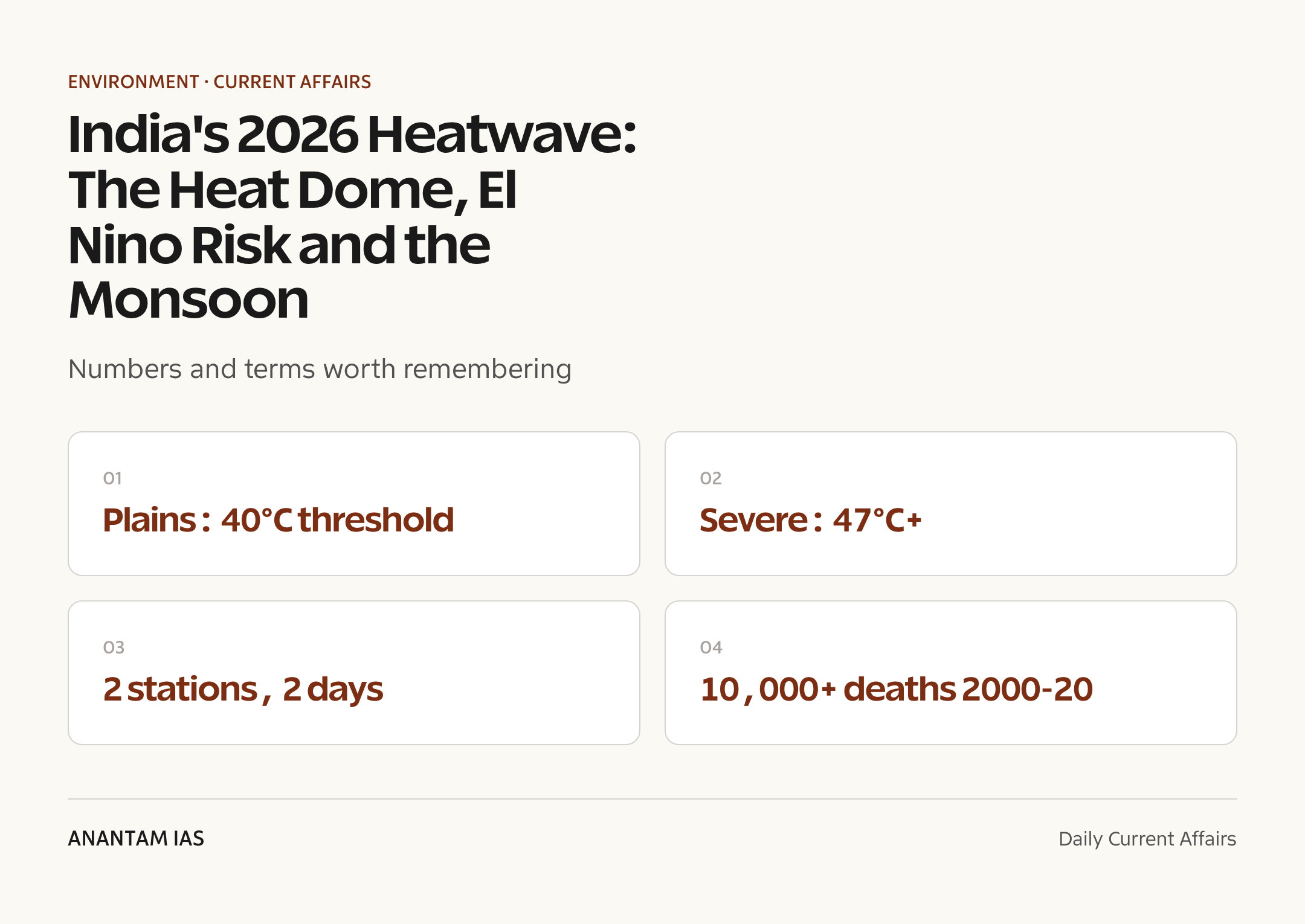
India's 2026 Heatwave: The Heat Dome, El Nino Risk and the Monsoon — quick facts

UPSC Relevance

Prelims Relevance

  • IMD heatwave criteria: declared in plains when the maximum temperature is 40°C or more, in hilly regions at 30°C or more, and at coastal stations when the departure is 4.5°C or more and the maximum is 37°C or above.
  • Departure-based classes: Heat Wave = departure of 4.5°C to 6.4°C; Severe Heat Wave = departure above 6.4°C from normal.
  • Temperature-based classes: Heat Wave when the actual maximum reaches 45°C; Severe Heat Wave at 47°C or more.
  • Declaration rule: thresholds must be met at a minimum of 2 stations in a subdivision for at least 2 consecutive days.
  • Heat dome: a strong high-pressure ridge that caps the atmosphere and traps hot air near the ground, intensifying surface heat.
  • El Nino / ENSO: the warm phase of the El Nino-Southern Oscillation; warmer central-Pacific waters are generally linked with a weaker Indian southwest monsoon.
  • IOD (Indian Ocean Dipole): a positive IOD (warmer western Indian Ocean) tends to support the monsoon and can offset an El Nino’s drying effect.
  • Wet-bulb temperature: the temperature combining heat and humidity; a sustained wet-bulb reading near 35°C is considered the survivability limit for humans.
  • Urban Heat Island (UHI): cities run hotter than surroundings due to concrete, asphalt and reduced green cover.
  • NDMA issues National Guidelines on Heat Wave Management; the colour-coded alerts run Green, Yellow, Orange, Red.

Mains Relevance

GS Paper 3

  • Heatwaves as a climate-change-amplified disaster: rising frequency and intensity, attribution to global warming, and the case for treating heat as a notified disaster for relief funding.
  • Disaster-management response: Heat Action Plans, early-warning colour codes, cooling infrastructure and the gap between plan design and on-ground implementation.

GS Paper 1

  • Physical geography of the event: high-pressure ridges, the heat-dome mechanism, the role of western disturbances and how El Nino-ENSO dynamics shape the monsoon.
  • Geographical vulnerability: why the Indo-Gangetic plains and peninsular interiors face the sharpest pre-monsoon heat.

Essay

  • Climate change has turned the weather into a development problem: heat, harvests and the human cost.
  • Adapting to a warming India: from disaster relief to climate resilience.

Background and Context

What counts as a heatwave in India

The IMD uses fixed thresholds, not loose impressions, before it declares a heatwave.

  • In the plains, a heatwave needs a maximum temperature of 40°C or more; in hilly regions the bar is 30°C or more.
  • At coastal stations, it is declared when the departure from normal is 4.5°C or more and the actual maximum is 37°C or above.
  • By departure, a Heat Wave is a 4.5°C to 6.4°C rise over normal; a Severe Heat Wave exceeds 6.4°C.
  • By absolute value, a Heat Wave is flagged at 45°C and a Severe Heat Wave at 47°C.
  • The condition must hold at a minimum of 2 stations in a subdivision for at least 2 consecutive days.
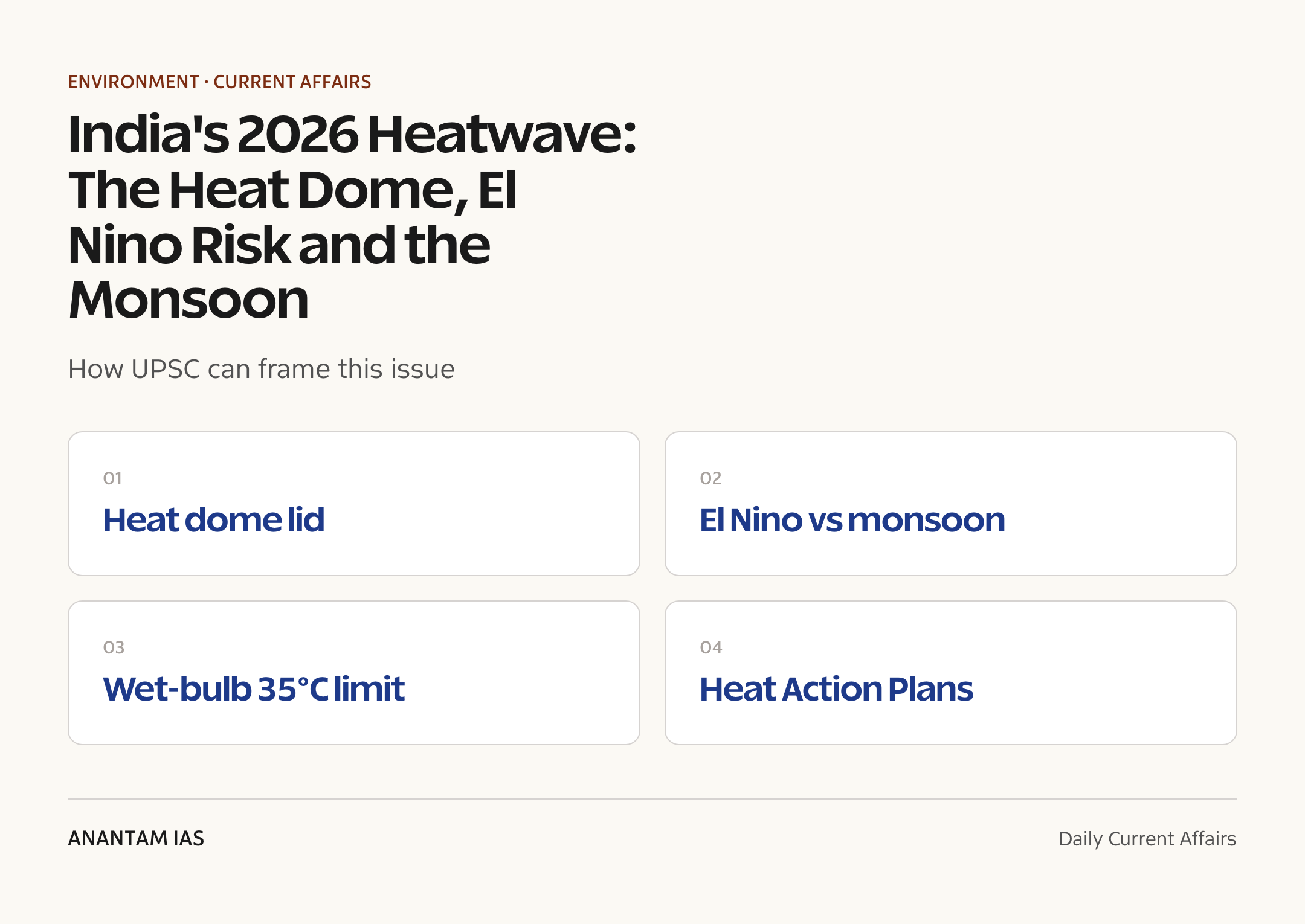
India's 2026 Heatwave: The Heat Dome, El Nino Risk and the Monsoon — exam lens

The heat dome over the plains

A heat dome is the mechanism driving 2026’s early, stubborn heat.

  • A heat dome is a strong, persistent high-pressure ridge in the upper atmosphere that acts like a lid, forcing air to sink, warm and stay trapped near the surface.
  • Vision IAS notes the dome has settled over the Indo-Gangetic plains and eastern India, holding hot air in place.
  • Supporting conditions cited include the absence of cloud cover, low wind speeds and high-pressure systems that concentrate heat at ground level.
  • Western disturbances — the rain-bearing systems that usually bring cooling spells — have been weakened and infrequent this year.
  • The early onset means peak temperatures have arrived weeks ahead of the usual calendar.

El Nino, ENSO and the monsoon link

The bigger worry is what a developing El Nino could do to the southwest monsoon.

  • El Nino is the warm phase of the El Nino-Southern Oscillation (ENSO), marked by unusual warming of the central and eastern Pacific Ocean.
  • El Nino years are broadly associated with a weaker, more erratic Indian southwest monsoon and a higher chance of deficient rainfall.
  • Drishti IAS notes the likelihood of an El Nino developing by July, while some commentary flags a ‘super El Nino’ risk.
  • A positive Indian Ocean Dipole (IOD) — warmer western Indian Ocean — can partly counter El Nino and support monsoon rains.
  • The monsoon delivers the bulk of India’s annual rainfall, so any threat to it touches farm output, reservoirs, power and the rural economy.

Why the heat hurts: health, work and harvests

Extreme heat is a public-health and livelihood emergency, not just a comfort issue.

  • Drishti IAS cites 733 heatstroke deaths reported across 17 states between March and June in the 2024 season.
  • Vision IAS notes over 10,000 deaths were attributed to heatwaves between 2000 and 2020.
  • The most exposed groups are outdoor labourers, the elderly, children and the urban poor without access to cooling.
  • India is projected to lose about 5.8% of daily working hours by 2030 to rising heat, hitting agriculture and construction hardest.
  • Heat speeds soil-moisture loss, can scorch standing crops, and raises wildfire and dust-storm risk that worsens air quality.

Wet-bulb temperature and the urban heat island

Humidity and city design decide how dangerous a given temperature really is.

  • Wet-bulb temperature combines heat and humidity; the body cannot cool by sweating once it climbs too high.
  • A sustained wet-bulb reading near 35°C is widely treated as the survivability limit for a healthy human, even in shade.
  • The Urban Heat Island (UHI) effect makes cities several degrees hotter than their rural surroundings.
  • Concrete, asphalt, dense construction, vehicle and air-conditioner exhaust, and shrinking green cover all trap and re-radiate heat.
  • Loss of wetlands, tree cover and other natural buffers has weakened India’s defences against heat, as Vision IAS notes.

India's institutional response

A multi-layered framework already exists; the test is implementation.

  • NDMA issues National Guidelines on Heat Wave Management that states and cities adapt locally.
  • State Heat Action Plans (HAPs) are in place across heat-prone states, built around vulnerability mapping and a coordinated response.
  • The IMD runs a colour-coded warning system: Green (no action), Yellow (stay updated), Orange (be prepared) and Red (take immediate action).
  • The Ministry of Health and Family Welfare’s National Action Plan on Heat-Related Illnesses (2021) guides the health-system response.
  • Heatwave is not yet a notified disaster under central relief rules, which limits dedicated funding for many states.

Way Forward

Strengthen and fund Heat Action Plans

  • Move HAPs from paper to practice with clear ward-level triggers, named responsible agencies and pre-monsoon drills.
  • Examine notifying heatwave as a disaster so states can draw on dedicated relief funding.

Build cooling and heat-resilient cities

  • Expand public cooling: shaded shelters, drinking-water points and adjusted work hours for outdoor labour.
  • Mainstream cool roofs, reflective materials, more tree cover and water bodies in urban planning to blunt the heat-island effect.

Protect the monsoon-dependent economy

  • Use IMD and ENSO forecasts for contingency cropping plans, heat-tolerant varieties and assured irrigation in deficit-risk districts.
  • Strengthen crop insurance, fodder banks and reservoir management ahead of any El Nino-driven rainfall shortfall.

Restore natural buffers and early warning

  • Reforest, conserve wetlands and revive green cover to rebuild the landscape’s natural cooling.
  • Sharpen district-level early warnings and link them directly to health-system readiness for heatstroke.

Conclusion

The 2026 heatwave is a preview of a warming India, where an early heat dome, weakened western disturbances and a possible El Nino can stack climate, agriculture and public health into a single crisis. The IMD’s thresholds and the NDMA’s guidelines give the country the tools to recognise and respond to it.

The decisive gap is no longer awareness but delivery — turning Heat Action Plans into funded, ward-level action, hardening cities against heat, and shielding the monsoon-dependent rural economy. Treating heat as a serious, recurring disaster rather than a seasonal inconvenience is the shift that 2026 demands.

UPSC Practice Questions

Prelims MCQ 1

With reference to the IMD’s criteria for declaring a heatwave in India, consider the following statements:

  1. In the plains, a heatwave is declared when the maximum temperature is 40°C or more.
  2. A Severe Heat Wave is declared when the temperature departure from normal exceeds 6.4°C.
  3. The criteria must be met at a single station for at least one day.

How many of the above statements are correct?

(a) Only one (b) Only two (c) All three (d) None

Answer: (b) Only two

Explanation:

Statements 1 and 2 match IMD criteria (plains threshold 40°C; severe heat wave departure above 6.4°C). Statement 3 is wrong: the condition must hold at a minimum of two stations in a subdivision for at least two consecutive days.

Prelims MCQ 2

With reference to El Nino and the Indian monsoon, which one of the following statements is most accurate?

(a) El Nino refers to abnormal cooling of the central Pacific and usually strengthens the Indian monsoon. (b) El Nino is the warm phase of ENSO and is broadly associated with a weaker Indian southwest monsoon. (c) A positive Indian Ocean Dipole always worsens the drying effect of El Nino. (d) El Nino has no established link with Indian monsoon rainfall.

Answer: (b) El Nino is the warm phase of ENSO and is broadly associated with a weaker Indian southwest monsoon.

Explanation:

El Nino is the warm phase of the El Nino-Southern Oscillation, linked with a weaker, erratic monsoon. A positive IOD tends to support the monsoon and can offset El Nino, so (a), (c) and (d) are incorrect.

UPSC Mains Questions

  1. Heatwaves are increasingly a climate-change-amplified disaster rather than a routine seasonal event. Examine the institutional framework India has built to manage them and the gaps in its implementation. (GS Paper 3)
  2. Explain the heat-dome mechanism and the El Nino-ENSO link to the Indian southwest monsoon. How do these phenomena together threaten India’s agriculture and water security? (GS Paper 1 / GS Paper 3)

Sources: India Meteorological Department (IMD) and National Disaster Management Authority (NDMA).

Frequently Asked Questions

What is a heat dome?

A heat dome is a strong, persistent zone of high pressure in the upper atmosphere that acts like a lid over a region. It forces air to sink, compress and warm, while blocking clouds and rain. The result is trapped, intensifying surface heat that can last for days, as seen over the Indo-Gangetic plains in 2026.

When does the IMD declare a heatwave?

In the plains the maximum must reach 40°C, in hilly areas 30°C, and at coastal stations the departure must be 4.5°C or more with the maximum at 37°C or above. By absolute value, 45°C marks a heat wave and 47°C a severe heat wave. The threshold must be met at two stations for two consecutive days.

How does El Nino affect the Indian monsoon?

El Nino is the warm phase of the El Nino-Southern Oscillation, when the central and eastern Pacific Ocean warms unusually. El Nino years are broadly linked with a weaker and more erratic southwest monsoon and a higher chance of deficient rainfall, though a positive Indian Ocean Dipole can partly offset this effect.

What is wet-bulb temperature and why does it matter?

Wet-bulb temperature combines heat and humidity into one reading. When it climbs too high, sweat cannot evaporate and the body loses its ability to cool itself. A sustained wet-bulb temperature near 35°C is widely treated as the survivability limit for a healthy person, even resting in the shade.

What is the urban heat island effect?

The urban heat island effect describes how cities stay several degrees hotter than surrounding rural areas. Concrete, asphalt, dense buildings, vehicle and air-conditioner exhaust, and reduced green cover absorb and re-radiate heat. Loss of wetlands and tree cover removes the natural cooling that would otherwise temper city temperatures.

What is a Heat Action Plan?

A Heat Action Plan is a state or city-level strategy, guided by NDMA and the IMD, to reduce heatwave harm. It maps vulnerable groups, sets early-warning triggers using colour codes, and coordinates response measures such as cooling shelters, adjusted work hours, drinking water and health-system readiness for heatstroke.
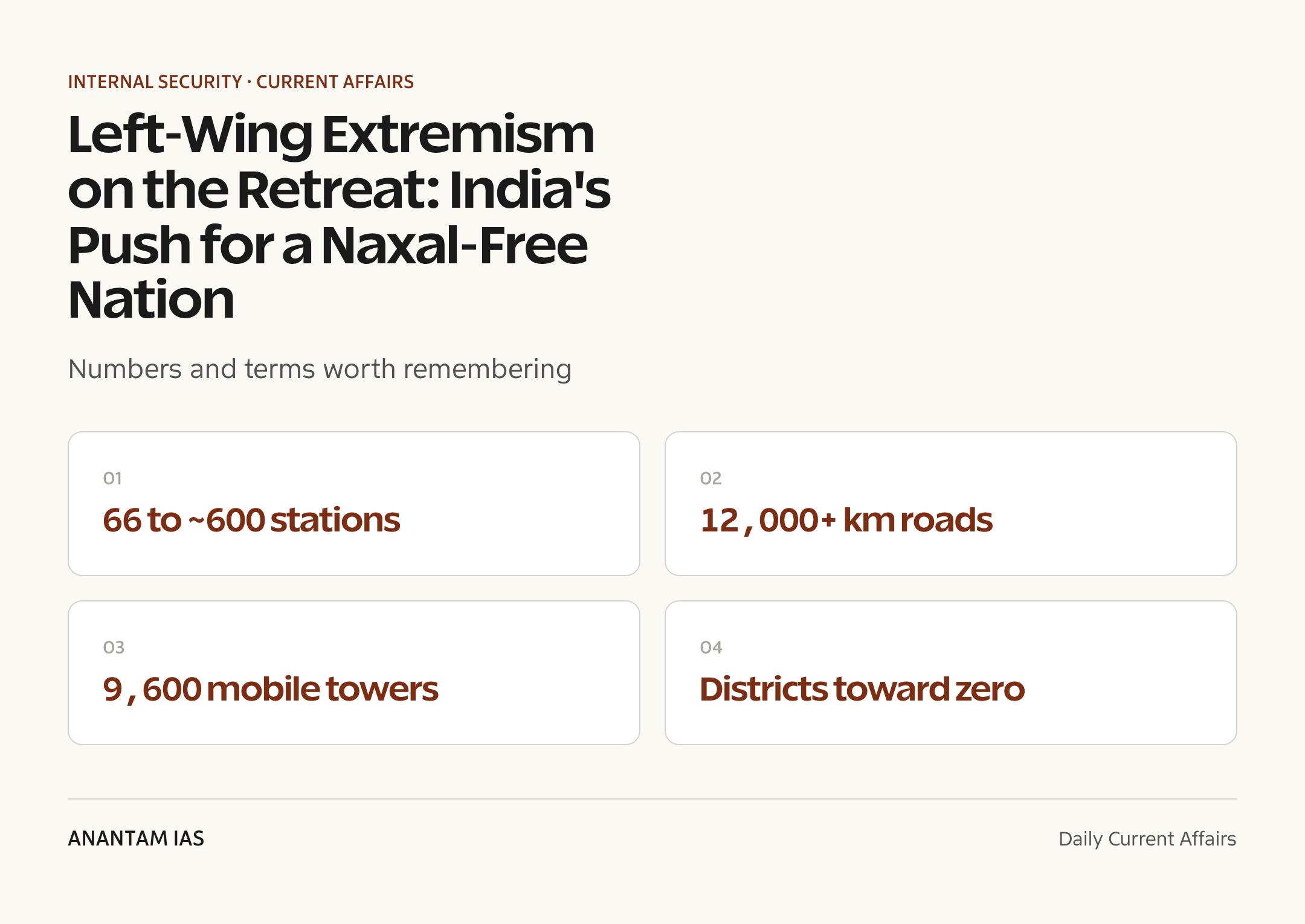
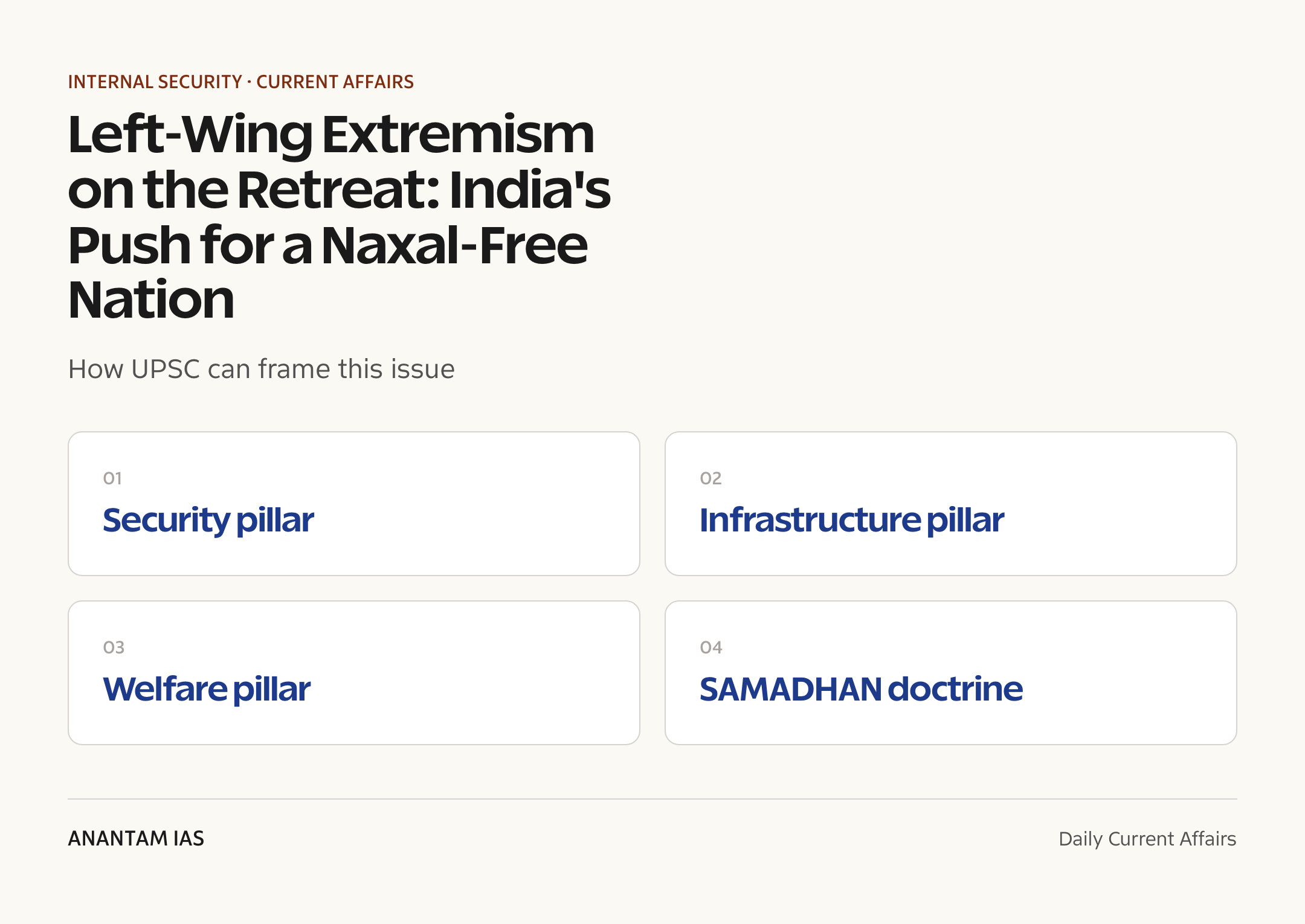
Left-Wing Extremism on the Retreat: India’s Push for a Naxal-Free Nation

Open article →Download PDF

Why in News?

The Ministry of Home Affairs, through the Press Information Bureau, has released fresh 2026 data showing a sharp retreat of Left-Wing Extremism (LWE) — also called Naxalism — and reiterated the government’s target of a Naxal-free India. The figures span fortified police stations, road connectivity, mobile towers and a surge in surrenders, framed around a three-pillar strategy of security, infrastructure and welfare.

Union Home Minister Amit Shah told the Lok Sabha on 30 March 2026 that the count of LWE-affected districts had fallen from 126 in 2014 to just two, and the ‘most affected’ category from 35 to zero, marking the symbolic end of the Red Corridor that once ran across central and eastern India. The data underline a security-development model that other internal-security theatres are now being benchmarked against.

  • Fortified police stations rose from 66 (pre-2014) to nearly 600 in LWE areas, per MHA data.
  • Over 12,000 km of roads have been built in affected districts since 2014 to break geographic isolation.
  • Around 9,600 mobile towers were added, extending 4G into forested interiors.
  • Surrenders climbed steeply, with thousands of cadres surrendering between 2024 and March 2026.
  • The number of LWE-affected districts declined from 126 in 2014 to two by March 2026, per the Home Minister’s Lok Sabha reply.

The development matters in the context of:

  • Naxalism traces to the 1967 Naxalbari (West Bengal) peasant uprising; the dominant outfit today is the CPI (Maoist), banned under the UAPA.
  • The MHA classifies LWE as the country’s gravest internal-security challenge in affected pockets, blending armed insurgency with ideological mobilisation in tribal, forested districts.
Left-Wing Extremism on the Retreat: India's Push for a Naxal-Free Nation — quick facts

UPSC Relevance

Prelims Relevance

  • SAMADHAN doctrine — the MHA’s umbrella anti-LWE strategy (Smart leadership, Aggressive strategy, Motivation and training, Actionable intelligence, Dashboard-based KPIs, Harnessing technology, Action plan for each theatre, No access to financing).
  • National Policy and Action Plan, 2015 — the integrated security-and-development approach against LWE.
  • Security Related Expenditure (SRE) Scheme — reimburses states for security operations, rehabilitation of surrendered cadres and community policing.
  • Special Central Assistance (SCA) — funds public infrastructure and services in the most affected districts.
  • Road Requirement Plan (RRP-I and RCPLWEA) — road connectivity schemes in LWE-affected districts.
  • LWE Mobile Tower Project — phased installation of towers to plug telecom gaps.
  • Aspirational Districts Programme overlaps heavily with LWE geographies for development indicators.
  • CPI (Maoist) is a banned terrorist organisation under the Unlawful Activities (Prevention) Act.

Mains Relevance

GS Paper 3

  • Linkages between development and the spread of extremism — the security-development nexus in LWE-affected tribal districts.
  • Assessment of the MHA’s whole-of-government anti-LWE strategy: what worked, residual risks, and whether a ‘declared end’ is durable.

Essay

  • Security without development is fragile; development without security is impossible.
  • The state’s monopoly on legitimate force versus winning hearts and minds in marginalised regions.

Background and Context

What Left-Wing Extremism Is

A four-decade armed-ideological insurgency, not a law-and-order footnote.

  • LWE / Naxalism seeks to overthrow the state through ‘protracted armed struggle’, drawing on Maoist doctrine.
  • Roots lie in the 1967 Naxalbari uprising; the movement consolidated into the CPI (Maoist) in 2004.
  • It concentrated in a contiguous Red Corridor across Chhattisgarh, Jharkhand, Odisha, Bihar, Telangana and neighbours.
  • Grievances exploited include land alienation, forest-rights denial, displacement and thin state presence in tribal belts.
Left-Wing Extremism on the Retreat: India's Push for a Naxal-Free Nation — exam lens

The Three-Pillar Strategy

The MHA frames its approach as security, infrastructure and welfare working together.

  • Security: clearing and holding territory through CAPF camps, fortified police stations and joint operations with state police.
  • Infrastructure: roads, mobile towers, banks and post offices to end the physical isolation insurgents relied on.
  • Welfare: rehabilitation of surrendered cadres, skilling and delivery of welfare schemes to rebuild trust in the state.
  • The doctrine binding these is SAMADHAN, with dashboard-tracked targets for each affected theatre.

The Security Footprint

Hardened presence and dismantled leadership define the security gains.

  • Fortified police stations grew from 66 before 2014 to roughly 600, per MHA figures.
  • Hundreds of new CAPF camps were established to occupy formerly insurgent-held ground.
  • Security forces report neutralising, arresting or accepting the surrender of thousands of cadres between 2024 and March 2026.
  • MHA accounts note that the CPI (Maoist) top leadership — its Central Committee and Politburo — has been largely neutralised or has surrendered.

Development as a Weapon

Connectivity and services are treated as instruments of pacification.

  • Over 12,000 km of roads built in LWE districts since 2014 opened previously sealed terrain.
  • Around 9,600 mobile towers extended 4G coverage into forest interiors.
  • Financial inclusion expanded through new bank branches, ATMs and post offices in affected blocks.
  • SCA and the Aspirational Districts Programme targeted health, education and livelihoods where the state had been thinnest.

Surrender and Rehabilitation

An exit ramp paired with the military squeeze drove a surge in surrenders.

  • State surrender-and-rehabilitation policies offer cash grants, monthly stipends and skilling to cadres who lay down arms.
  • Surrenders rose sharply, with thousands recorded between 2024 and early 2026 according to MHA data.
  • The SRE Scheme reimburses states for rehabilitation costs alongside security expenditure.
  • Sustained surrenders erode an outfit’s recruitment base and local intelligence shield.

The Declining District Map

The shrinking list of affected districts is the headline metric of progress.

  • The count of LWE-affected districts fell from 126 in 2014 to two by March 2026, with none left in the ‘most affected’ category.
  • Categories such as ‘districts of concern’ and ‘most affected’ were progressively pruned as violence dropped.
  • Annual violent incidents fell to a fraction of their 2010 peak, per government figures.
  • Late-March 2026 saw the Home Minister declare the effective end of the affected-district list.

Way Forward

Consolidate, do not declare victory

  • Treat the milestone as a transition, retaining intelligence grids and CAPF presence to prevent regrouping.
  • Watch for displacement of cadres into urban fronts or neighbouring states rather than genuine collapse.

Lock in development gains

  • Ensure roads, towers and welfare delivery are maintained and expanded so the state’s footprint endures.
  • Implement the Forest Rights Act and PESA fully to resolve the grievances that fed the insurgency.

Make rehabilitation durable

  • Provide sustained livelihoods and reintegration for surrendered cadres to prevent relapse.
  • Protect tribal land and mineral-region communities from fresh alienation that could rekindle conflict.

Conclusion

The 2026 data mark one of independent India’s most striking internal-security turnarounds: a four-decade armed movement reduced from a Red Corridor spanning 126 districts in 2014 to just two on the MHA’s affected list by March 2026. The combination of a hardened security footprint, deliberate development of isolated terrain and a credible surrender pathway shows that the security-development nexus, when funded and tracked, can work.

The harder test is permanence. Insurgencies recede before they vanish, and the underlying grievances — land, forest rights and tribal marginalisation — outlast any single outfit. A durable Naxal-free India depends less on the declaration and more on whether the roads, schools and trust now reaching these districts are sustained long after the headlines fade.

UPSC Practice Questions

Prelims MCQ 1

With reference to government initiatives against Left-Wing Extremism, consider the following statements:

  1. The Security Related Expenditure (SRE) Scheme reimburses State governments for expenditure on anti-LWE operations and rehabilitation of surrendered cadres.
  2. The CPI (Maoist) is a banned terrorist organisation under the Unlawful Activities (Prevention) Act.
  3. SAMADHAN is the umbrella anti-LWE strategy articulated by the Ministry of Home Affairs.

How many of the above statements are correct?

(a) Only one (b) Only two (c) All three (d) None

Answer: (c) All three

Explanation:

All three are correct: the SRE Scheme funds security and rehabilitation costs, the CPI (Maoist) is proscribed under UAPA, and SAMADHAN is the MHA’s overarching anti-LWE doctrine.

Prelims MCQ 2

In the context of the Ministry of Home Affairs’ anti-LWE doctrine, the letters in ‘SAMADHAN’ best correspond to which of the following?

(a) A welfare scheme for tribal districts only (b) A strategic framework covering smart leadership, aggressive strategy, actionable intelligence, technology and cutting off financing (c) A road-connectivity programme for affected districts (d) A surrender-and-rehabilitation cash-grant policy

Answer: (b) A strategic framework covering smart leadership, aggressive strategy, actionable intelligence, technology and cutting off financing

Explanation:

SAMADHAN is an acronym for the MHA’s eight-element strategy — smart leadership, aggressive strategy, motivation/training, actionable intelligence, dashboard-based KPIs, harnessing technology, action plans per theatre, and no access to financing.

UPSC Mains Questions

  1. Examine the security-development nexus in India’s fight against Left-Wing Extremism. To what extent has the Ministry of Home Affairs’ three-pillar strategy of security, infrastructure and welfare driven the decline of the Red Corridor? (250 words)
  2. “Insurgencies recede before they vanish.” Critically assess whether India’s declared milestone toward a Naxal-free nation is durable, identifying the residual risks the state must guard against. (250 words)

Sources: PIB, Ministry of Home Affairs and Ministry of Home Affairs.

Frequently Asked Questions

What is Left-Wing Extremism (LWE)?

LWE, popularly called Naxalism, is an armed-ideological insurgency that seeks to overthrow the Indian state through protracted armed struggle, drawing on Maoist doctrine. It is led mainly by the banned CPI (Maoist) and historically concentrated in tribal, forested districts of central and eastern India known as the Red Corridor.

What is the SAMADHAN doctrine?

SAMADHAN is the Ministry of Home Affairs’ umbrella anti-LWE strategy. The acronym covers smart leadership, aggressive strategy, motivation and training, actionable intelligence, dashboard-based key indicators, harnessing technology, an action plan for each theatre, and no access to financing for extremist groups.

What does a ‘Naxal-free India’ mean here?

It refers to the Ministry of Home Affairs effectively reducing the list of LWE-affected districts to zero. Union Home Minister Amit Shah declared the milestone in Parliament in late March 2026. It signals that no district remains on the official affected list, though analysts caution that residual cells may persist.

What is the SRE Scheme?

The Security Related Expenditure (SRE) Scheme is a central scheme under which the Union government reimburses LWE-affected states for spending on security operations, training, community policing and the rehabilitation of surrendered cadres. It works alongside Special Central Assistance, which funds development in the worst-hit districts.

How did development help defeat LWE?

The MHA paired security operations with roads, mobile towers, banks and post offices to end the physical isolation that insurgents exploited. Over 12,000 km of roads and around 9,600 mobile towers, according to MHA data, brought connectivity and welfare into interior districts, weakening the conditions that sustained the movement.

Is the Naxal threat fully over?

Not necessarily. Independent analysts note that insurgencies recede before they disappear and that underlying grievances — land alienation, forest-rights denial and tribal marginalisation — outlast any single outfit. Sustained security presence, durable rehabilitation and continued development are needed to make the gains permanent.

SHe-Box 2.0: Single-Window Portal to Strengthen the PoSH Act

Open article →Download PDF

Why in News?

The Ministry of Women and Child Development has rolled out an upgraded version of its grievance portal, SHe-Box 2.0 (Sexual Harassment electronic Box), positioned as a single-window system to register and track complaints of sexual harassment at the workplace across all sectors.

The upgrade operationalises the Sexual Harassment of Women at Workplace (Prevention, Prohibition and Redressal) Act, 2013 — the PoSH Act — by giving every working woman, whether in the organised or unorganised sector, a uniform digital channel to lodge and monitor a complaint.

  • SHe-Box 2.0 is a consolidated single-window platform for filing and tracking workplace sexual-harassment complaints across public and private sectors.
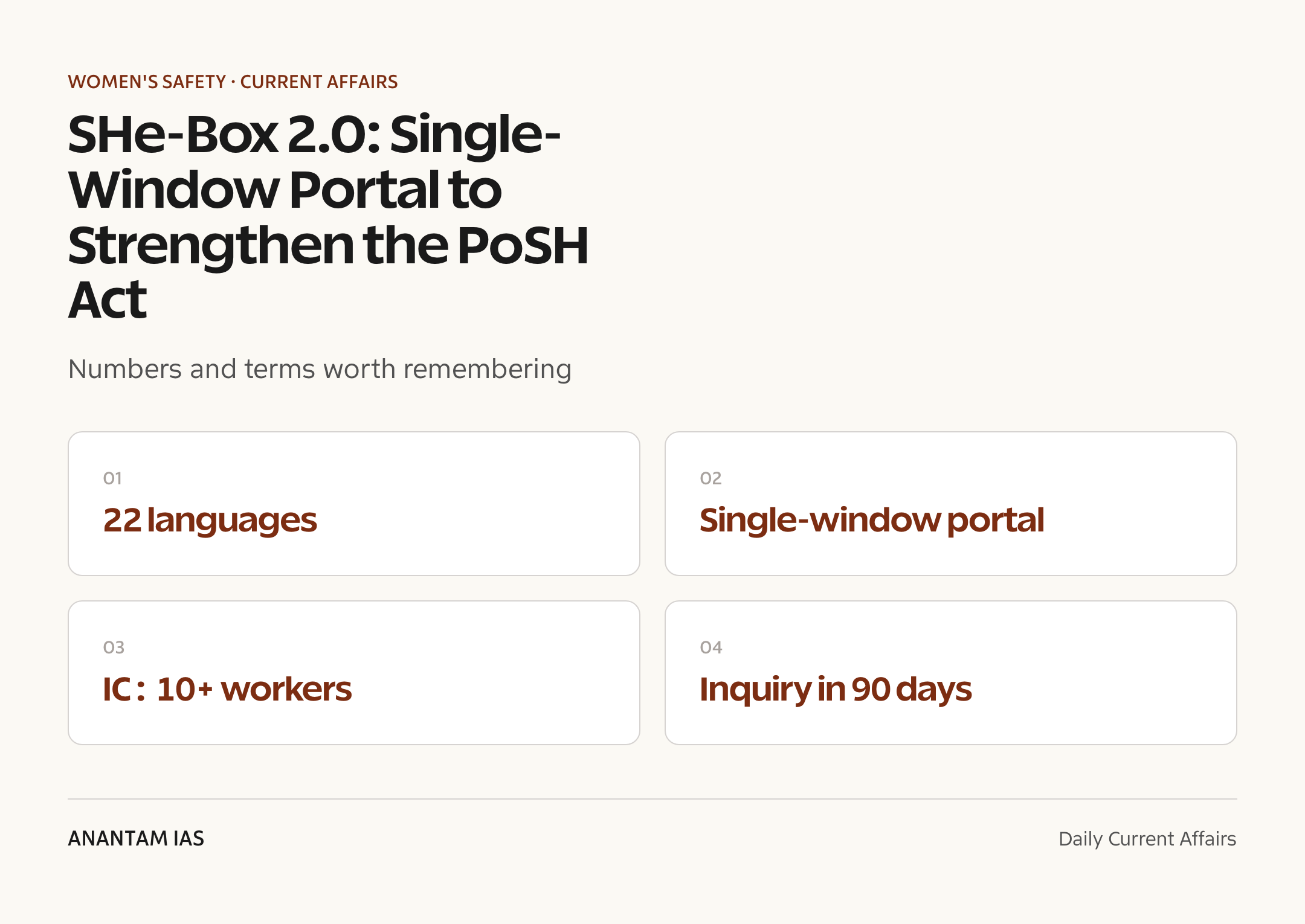
  • It is available in 22 languages to widen accessibility for women across regions.
  • It supports both registration and real-time tracking of the status of a complaint.
  • The original SHe-Box was first launched in 2017; version 2.0 is the redesigned, expanded upgrade.

The development matters in the context of:

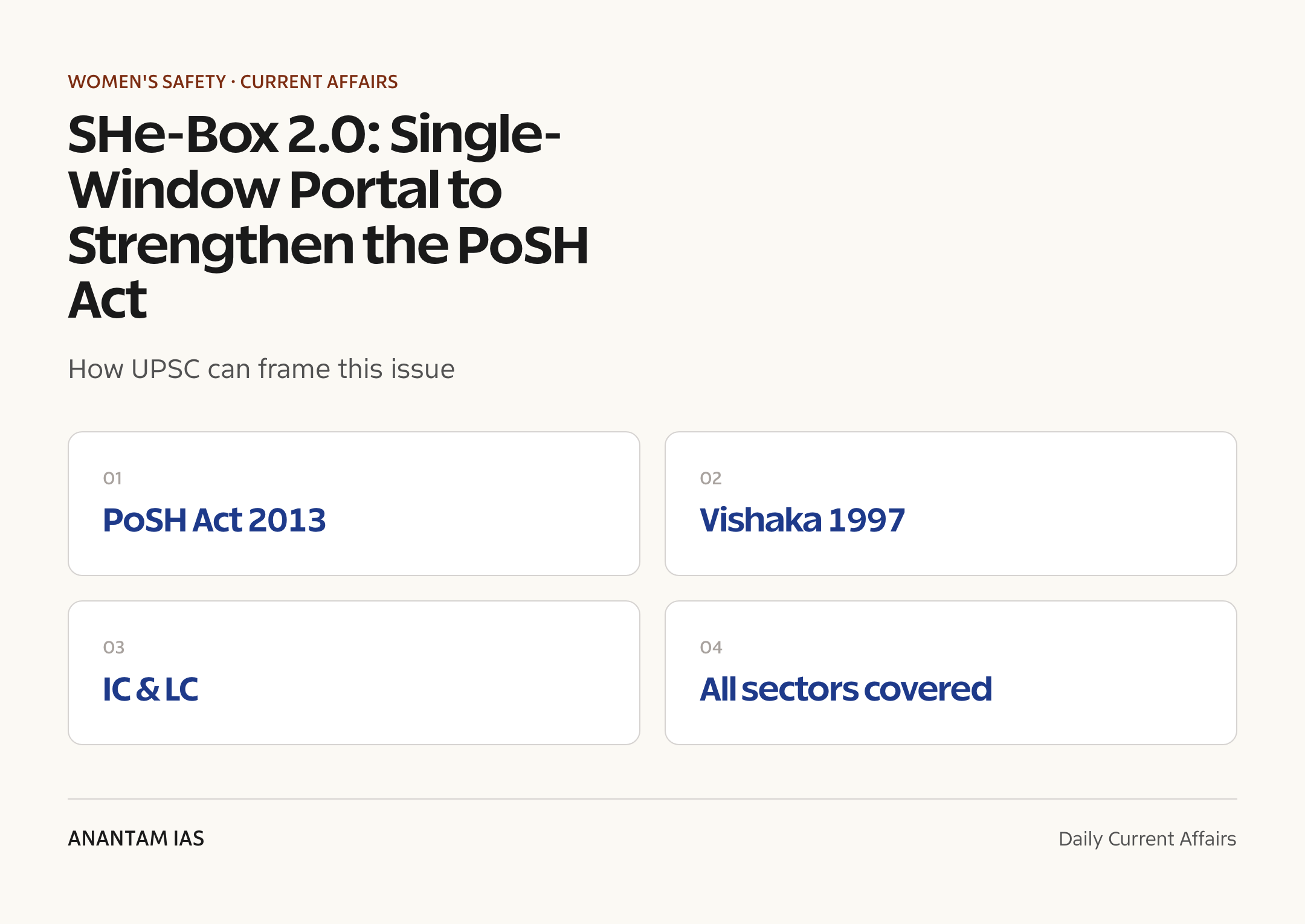
  • SHe-Box implements the redressal architecture of the PoSH Act, 2013, which itself codified the Supreme Court’s Vishaka Guidelines (1997).
  • The portal routes complaints to the appropriate Internal Committee (IC) or Local Committee (LC) for inquiry.
SHe-Box 2.0: Single-Window Portal to Strengthen the PoSH Act — quick facts

UPSC Relevance

Prelims Relevance

  • SHe-Box — Sexual Harassment electronic Box, a Ministry of Women and Child Development portal; original launch 2017, upgraded to 2.0.
  • PoSH Act, 2013 — full name: Sexual Harassment of Women at Workplace (Prevention, Prohibition and Redressal) Act.
  • Vishaka Guidelines (1997) — Supreme Court judgment in Vishaka v. State of Rajasthan that preceded the statute.
  • Internal Committee (IC) — mandatory at workplaces with 10 or more employees.
  • Local Committee (LC) — constituted by the District Officer for establishments with fewer than 10 workers and for the unorganised sector.
  • The IC must be headed by a senior woman employee (Presiding Officer) and include an external member from an NGO/association familiar with the issue.
  • Inquiry is to be completed within 90 days; the employer must act on the report within 60 days.
  • A complaint should ordinarily be filed within three months of the incident (extendable).
  • Nodal ministry: Ministry of Women and Child Development.
  • The Act covers all women regardless of age or employment status, including the unorganised sector.

Mains Relevance

GS Paper 2

  • Mechanisms, laws, institutions and bodies constituted for the protection and betterment of vulnerable sections — SHe-Box as an e-governance tool delivering on a statutory right.
  • Implementation gaps in the PoSH Act — non-constitution of Internal Committees, under-functioning Local Committees, low awareness — and how a single-window portal addresses last-mile grievance redressal.

GS Paper 1

  • Role of women and women’s organisations; workplace safety as a precondition for rising female labour-force participation and women’s economic empowerment.

Essay

  • Dignity at the workplace and the unfinished journey from the Vishaka Guidelines to a digital single-window redressal system.

Background and Context

From Vishaka Guidelines to a statute

The PoSH Act traces directly to a landmark Supreme Court intervention.

  • In Vishaka v. State of Rajasthan (1997), the Supreme Court framed binding guidelines treating sexual harassment as a violation of the fundamental rights to equality (Articles 14, 15) and to life and dignity (Article 21).
  • The Vishaka Guidelines filled a legislative vacuum and remained the law for 16 years until Parliament enacted a dedicated statute.
  • The guidelines drew on India’s commitments under the Convention on the Elimination of All Forms of Discrimination Against Women (CEDAW).
SHe-Box 2.0: Single-Window Portal to Strengthen the PoSH Act — exam lens

What the PoSH Act, 2013 mandates

The Act sets out definitions, committees, duties and timelines.

  • It defines sexual harassment to include unwelcome physical contact, demands for sexual favours, sexually coloured remarks, showing pornography and other unwelcome conduct.
  • Every workplace with 10 or more workers must constitute an Internal Committee (IC), headed by a senior woman and including an external member.
  • A Local Committee (LC) at the district level handles complaints from smaller establishments and the unorganised sector.
  • The IC may recommend interim relief and disciplinary action; an inquiry must conclude within 90 days.

What SHe-Box adds to the framework

SHe-Box is the digital front-end to the statutory machinery.

  • First launched in 2017, SHe-Box was conceived as a centralised portal so a woman need not navigate scattered office-level processes.
  • A complaint filed online is forwarded to the concerned IC or LC, and the complainant can monitor its progress.
  • It covers all sectors — central and state government, public-sector undertakings and private organisations alike.

The 2.0 upgrade

Version 2.0 widens reach and improves usability.

  • SHe-Box 2.0 is presented as a single-window grievance redressal system consolidating registration and tracking on one platform.
  • It is available in 22 languages, lowering the language barrier that often deters complaints from smaller towns and the informal economy.
  • The redesign aims to bring greater transparency and accountability to how complaints are routed and resolved.

Why implementation still matters

A portal is only as effective as the committees behind it.

  • Surveys and audits have repeatedly flagged non-constitution of Internal Committees, especially in smaller firms and the unorganised sector.
  • Many Local Committees remain weakly resourced or unknown to the women they are meant to serve.
  • Under-reporting persists due to fear of retaliation, social stigma and lack of awareness of rights.

Way Forward

Enforce committee compliance

  • Use SHe-Box data to map which districts and sectors lack functioning ICs and LCs, and treat non-constitution as a punishable default.
  • Mandate periodic public disclosure of complaint and disposal statistics by employers.

Strengthen the unorganised sector

  • Resource and publicise Local Committees so domestic, agricultural and gig workers can actually reach them.
  • Link SHe-Box outreach with local self-government and women’s self-help-group networks.

Build awareness and trust

  • Run sustained multilingual awareness drives so the 22-language interface translates into actual usage.
  • Guarantee confidentiality and protection against victimisation to reduce under-reporting.

Conclusion

SHe-Box 2.0 marks an incremental but meaningful step in converting the rights promised by the Vishaka Guidelines and the PoSH Act, 2013 into an accessible, trackable service. A single-window, multi-language portal lowers the threshold for a woman to act on harassment, regardless of which sector she works in.

The portal’s success will ultimately depend on the institutions it feeds into. Well-constituted Internal and Local Committees, credible protection from retaliation, and transparent disposal of complaints are what will make the digital promise real on the ground.

UPSC Practice Questions

Prelims MCQ 1

With reference to the PoSH Act, 2013, consider the following statements:

  1. An Internal Committee is mandatory at every workplace employing ten or more workers.
  2. The Local Committee is constituted at the district level for the unorganised sector and small establishments.
  3. The Act extends protection only to women employed in the organised, formal sector.

How many of the above statements are correct?

(a) Only one (b) Only two (c) All three (d) None

Answer: (b) Only two

Explanation:

Statements 1 and 2 are correct. Statement 3 is wrong — the Act protects women across all sectors, including the unorganised sector, irrespective of age or employment status.

Prelims MCQ 2

Consider the following with reference to SHe-Box and the framework for workplace sexual harassment in India:

(a) SHe-Box is a portal of the Ministry of Home Affairs (b) The PoSH Act, 2013 codified the Vishaka Guidelines laid down by the Supreme Court in 1997 (c) The Vishaka Guidelines were issued in 2013 alongside the Act (d) SHe-Box complaints bypass Internal and Local Committees

Answer: (b) The PoSH Act, 2013 codified the Vishaka Guidelines laid down by the Supreme Court in 1997

Explanation:

SHe-Box is run by the Ministry of Women and Child Development; the Vishaka Guidelines were issued in 1997; and SHe-Box complaints are routed to the relevant IC or LC. Only (b) is correct.

UPSC Mains Questions

  1. The journey from the Vishaka Guidelines to SHe-Box 2.0 reflects both progress and persistent gaps in protecting women at the workplace. Discuss.
  2. A grievance-redressal portal is only as effective as the institutions behind it. In the light of the PoSH Act, 2013, examine the challenges in implementing workplace sexual-harassment law in India and suggest measures to address them.

Source: Ministry of Women and Child Development.

Frequently Asked Questions

What is SHe-Box 2.0?

SHe-Box 2.0 is the upgraded version of the Sexual Harassment electronic Box, a portal run by the Ministry of Women and Child Development. It is a single-window system, available in 22 languages, that lets a woman register and track a workplace sexual-harassment complaint across any sector.

What does the PoSH Act, 2013 stand for?

PoSH stands for the Sexual Harassment of Women at Workplace (Prevention, Prohibition and Redressal) Act, 2013. It is India’s dedicated law requiring employers to prevent harassment, set up complaint committees, and provide a time-bound redressal process for working women.

What are the Vishaka Guidelines?

The Vishaka Guidelines were framed by the Supreme Court in Vishaka v. State of Rajasthan (1997). They treated workplace sexual harassment as a violation of fundamental rights and remained the governing norms for 16 years until the PoSH Act, 2013 was enacted.

What is the difference between an Internal Committee and a Local Committee?

An Internal Committee (IC) is set up by an employer at any workplace with 10 or more workers. A Local Committee (LC) is constituted by the District Officer to handle complaints from smaller establishments and the unorganised sector, where an IC may not exist.

Who can use SHe-Box to file a complaint?

Any woman facing sexual harassment at her workplace can use SHe-Box, whether she works in central or state government, a public-sector undertaking, or a private organisation. The portal routes her complaint to the appropriate Internal or Local Committee.

What are the key timelines under the PoSH Act?

A complaint should ordinarily be filed within three months of the incident, though this can be extended. The Internal or Local Committee must complete its inquiry within 90 days, and the employer must act on the committee’s report within 60 days.

BRICS National Security Advisers’ Meeting: India Hosts the Conclave on Non-Traditional Threats

Open article →Download PDF

Why in News?

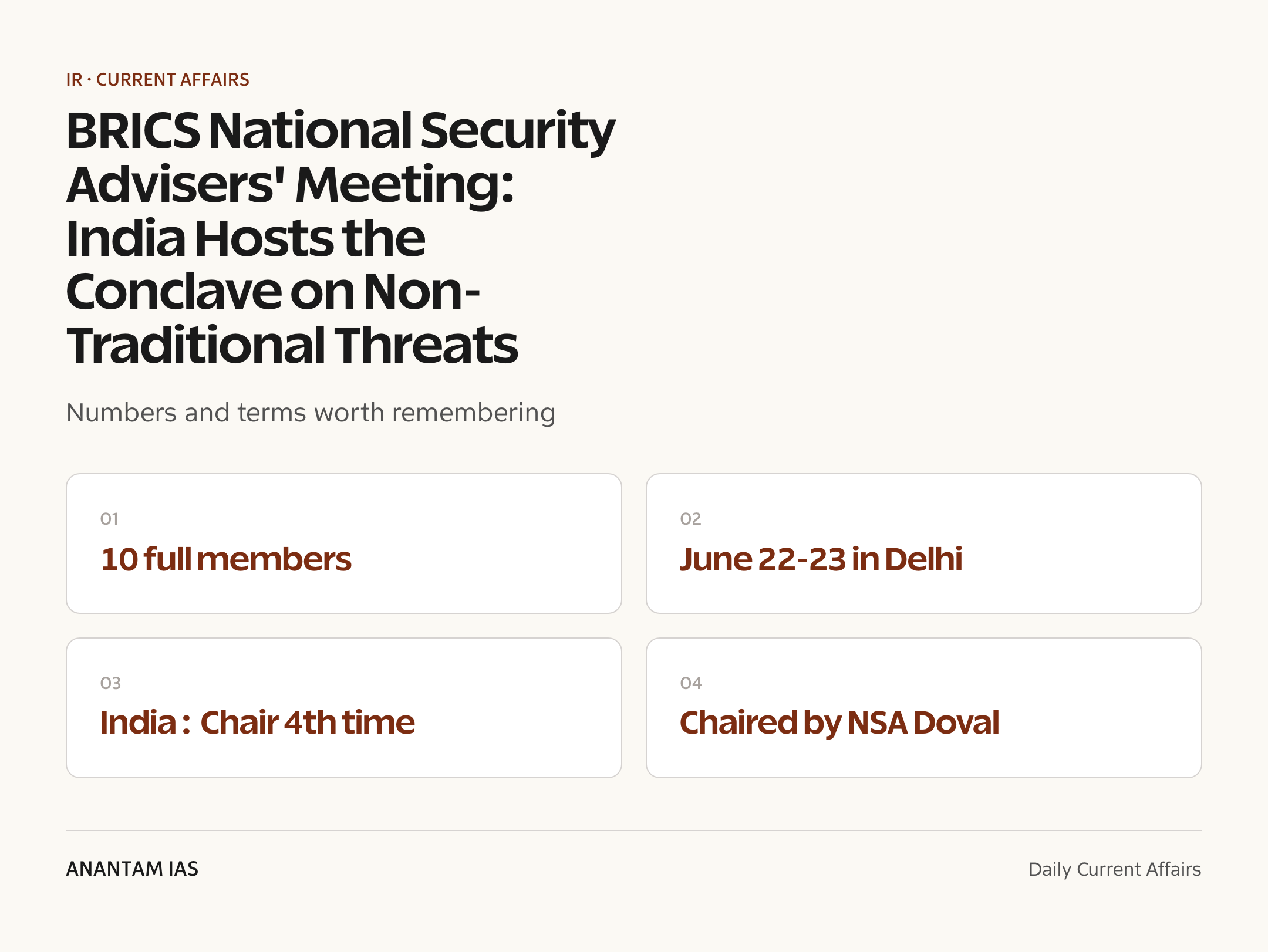
India is hosting the BRICS National Security Advisers’ (NSA) Meeting in New Delhi on June 22-23, 2026, with the conclave chaired by India’s NSA Ajit Doval. The Ministry of External Affairs (MEA) confirmed that the gathering brings together NSAs and Heads of Delegation from BRICS member states around the theme Non-Traditional Security Challenges Confronting the World Today.

The meeting is one of the flagship security-track events of India’s 2026 BRICS Chairship and prepares the ground for the leaders’ 18th BRICS Summit, which India will host in New Delhi later in the year.

  • Chinese Foreign Minister Wang Yi and Russian Security Council Secretary Sergei Shoigu are among the senior delegates expected in New Delhi, per news reports.
  • Agenda priorities flagged by the MEA include counter-terrorism, security of information and communication technologies (ICT) and cyberspace, and the security implications of emerging technologies.
  • Iran’s Supreme National Security Council deputy secretary is also reported among the participants, reflecting the bloc’s 2024-25 expansion.
  • India holds the BRICS Chair for the fourth time (after 2012, 2016 and 2021), steering the agenda through 2026.

The development matters in the context of:

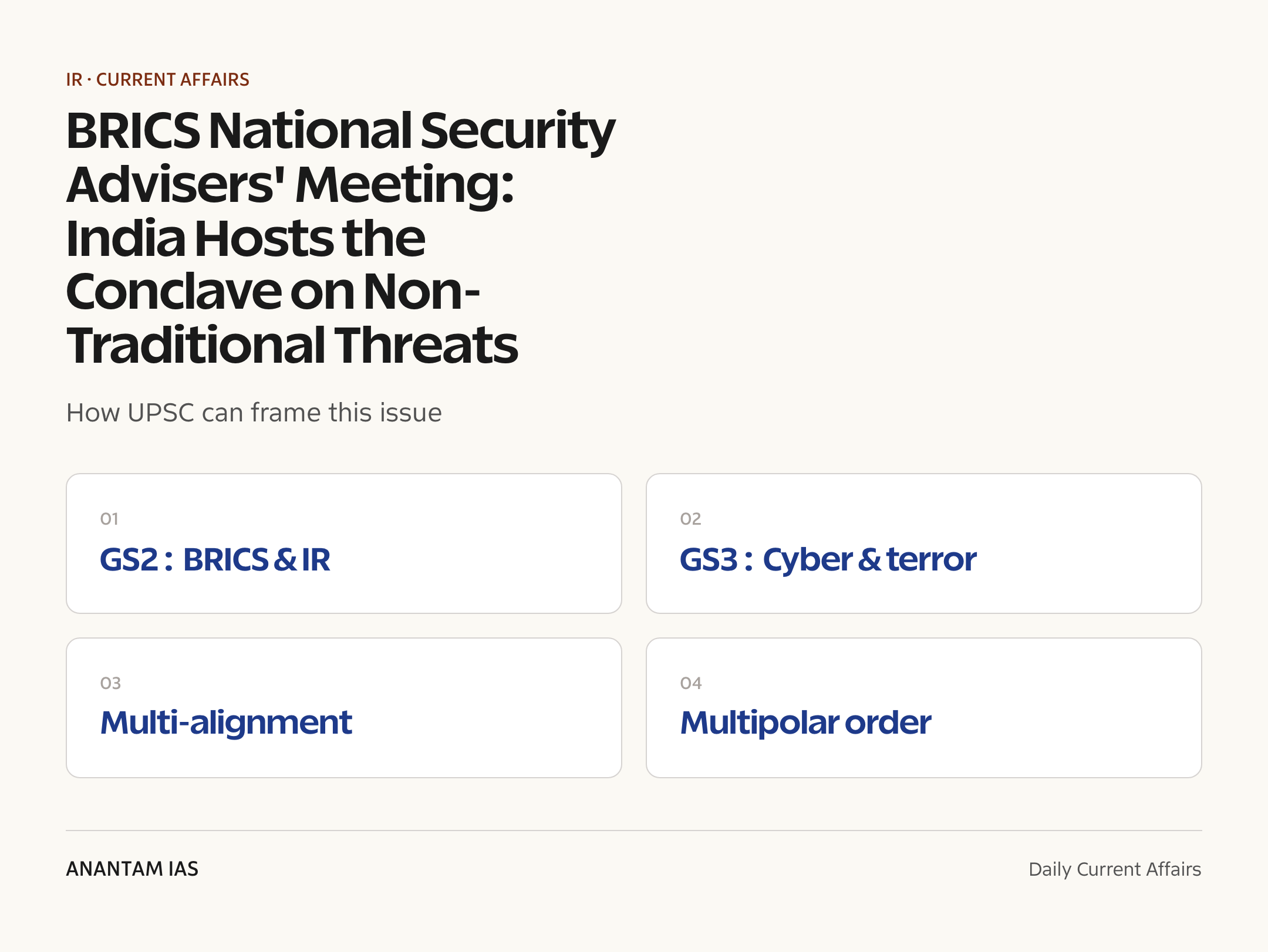
  • Matters in the context of India’s multi-alignment diplomacy — engaging BRICS while deepening Quad and Western partnerships.
  • Matters for internal security, as counter-terrorism and cyber security feature prominently on the BRICS agenda.
  • Matters for the debate on reform of global governance and a multipolar world order pushed by the expanded bloc.
BRICS National Security Advisers' Meeting: India Hosts the Conclave on Non-Traditional Threats — quick facts

UPSC Relevance

Prelims Relevance

  • BRICS founding members: Brazil, Russia, India, China (BRIC, 2009) plus South Africa (joined 2010, making it BRICS).
  • 2024 expansion: Egypt, Ethiopia, Iran and the UAE joined as full members on January 1, 2024.
  • Indonesia became a full member in January 2025 — the first Southeast Asian member.
  • BRICS now has a partner-country category (announced at the 2024 Kazan Summit) distinct from full membership.
  • India is the 2026 BRICS Chair and will host the leaders’ summit in New Delhi.
  • The NSA mechanism is a security-track dialogue, separate from the leaders’ summit and Sherpa channels.
  • Ajit Doval is India’s National Security Adviser and chairs the 2026 NSA meeting.
  • BRICS works by consensus; it has no founding treaty or permanent secretariat.
  • BRICS institutions include the New Development Bank (NDB) and the Contingent Reserve Arrangement (CRA).
  • The grouping’s name traces to a 2001 term coined by economist Jim O’Neill.

Mains Relevance

GS Paper 2

  • BRICS in India’s foreign policy: how a non-Western plurilateral grouping serves India’s pursuit of a multipolar order and reform of global governance.
  • India’s balancing act — co-existing with China and Russia inside BRICS while sustaining Quad and Western strategic ties (multi-alignment).

GS Paper 3

  • Non-traditional security threats — terrorism, ICT/cyber security and misuse of emerging technologies — and the scope for BRICS counter-terrorism cooperation.

Essay

  • The shift from a unipolar to a multipolar world and India’s role as a bridge between blocs.
  • Security in the age of emerging technologies: opportunity, vulnerability and the need for cooperative governance.

Background and Context

What BRICS is and how it grew

BRICS is a plurilateral grouping of major emerging economies that has expanded sharply since 2024.

  • Began as BRIC (Brazil, Russia, India, China) in 2009; South Africa joined in 2010 to form BRICS.
  • Egypt, Ethiopia, Iran and the UAE became full members on January 1, 2024.
  • Indonesia joined as a full member in January 2025, taking the membership into double figures.
  • The bloc operates by consensus, with no founding charter, treaty or permanent secretariat.
  • A new partner-country tier lets interested states join meetings and projects without full voting rights.
BRICS National Security Advisers' Meeting: India Hosts the Conclave on Non-Traditional Threats — exam lens

The NSA mechanism and this year's meet

The National Security Advisers’ meeting is BRICS’s dedicated security-track dialogue.

  • Brings together NSAs and Heads of Delegation of member states ahead of the leaders’ summit.
  • The 2026 edition runs June 22-23 in New Delhi, chaired by NSA Ajit Doval.
  • Theme: Non-Traditional Security Challenges Confronting the World Today, per the MEA.
  • Senior participants reported include China’s Wang Yi and Russia’s Sergei Shoigu.
  • Outcomes feed into the leaders’ 18th BRICS Summit India hosts later in 2026.

India's 2026 Chairship

India is steering the BRICS agenda for the fourth time.

  • India has chaired BRICS in 2012, 2016, 2021 and now 2026.
  • The Chair sets the calendar of ministerial, Sherpa and security-track meetings through the year.
  • India’s priorities stress counter-terrorism, cyber and ICT security and technology governance.
  • Hosting lets India shape the bloc’s tone amid sharp geopolitical tensions among members and partners.
  • The Chairship dovetails with India’s broader push for a reformed, multipolar global order.

Why the security agenda matters

The 2026 agenda is dominated by threats that cut across borders and sectors.

  • Counter-terrorism — a long-standing Indian priority, including action against cross-border and state-sponsored terror.
  • ICT and cyber security — protecting critical infrastructure and data from cyber attacks and misuse.
  • Security risks from emerging technologies such as artificial intelligence and dual-use tools.
  • Other non-traditional threats — organised crime, drug trafficking and financial security.
  • A shared security narrative helps a diverse bloc find common ground despite internal frictions.

BRICS in India's strategic calculus

BRICS is one strand of India’s wider, deliberately diversified diplomacy.

  • Anchors India’s pursuit of a multipolar world and a stronger voice for the Global South.
  • Requires careful management of the India-China relationship within a shared platform.
  • Complements rather than replaces ties such as the Quad and partnerships with the West (multi-alignment).
  • Backs reform of bodies like the UN Security Council, IMF and World Bank.
  • Supports financial alternatives via the New Development Bank and local-currency trade discussions.

Challenges and limits

Expansion has widened BRICS’s reach but also its internal contradictions.

  • A larger, more diverse membership makes consensus harder to reach.
  • Strategic rivalries — notably India-China tensions — constrain deep security integration.
  • Members hold divergent positions on the dollar, sanctions and the West.
  • The bloc lacks a permanent secretariat, limiting institutional follow-through.
  • Critics question whether BRICS can move from declarations to concrete delivery.

Way Forward

Institutionalise the security track

  • Build durable working groups on counter-terrorism and cyber security with measurable deliverables.
  • Create channels for rapid information-sharing on terror financing and cyber threats.

Keep the agenda focused

  • Prioritise issues with genuine convergence rather than overloading an already diverse bloc.
  • Use the Chairship to push India’s counter-terrorism and technology-governance priorities.

Preserve strategic autonomy

  • Engage BRICS without diluting partnerships with the Quad and the West.
  • Manage the China relationship pragmatically while protecting core security interests.

Conclusion

The BRICS NSA meeting positions India at the centre of a non-Western security conversation at a moment of acute global tension. By chairing talks on counter-terrorism, cyber security and the risks of emerging technologies, India steers the bloc toward the agenda it has long championed.

The harder test is converting a widening, diverse membership into cooperation that delivers. For India, BRICS remains one carefully managed strand of a multi-aligned foreign policy aimed at a more balanced and multipolar world order.

UPSC Practice Questions

Prelims MCQ 1

With reference to BRICS, consider the following statements:

  1. Egypt, Ethiopia, Iran and the UAE became full members of BRICS in January 2024.
  2. Indonesia became a full member of BRICS in January 2025.
  3. BRICS functions through a founding treaty and a permanent secretariat based in Shanghai.

How many of the above statements are correct?

(a) Only one (b) Only two (c) All three (d) None

Answer: (b) Only two

Explanation:

Statements 1 and 2 are correct — the 2024 expansion added Egypt, Ethiopia, Iran and the UAE, and Indonesia joined in 2025. Statement 3 is wrong: BRICS works by consensus and has no founding treaty or permanent secretariat.

Prelims MCQ 2

Which of the following best describes the BRICS National Security Advisers’ (NSA) Meeting?

(a) A treaty-based military alliance with a joint command (b) A security-track dialogue of NSAs and Heads of Delegation that feeds into the leaders’ summit (c) A trade-negotiation body under the New Development Bank (d) A UN Security Council subsidiary mechanism

Answer: (b) A security-track dialogue of NSAs and Heads of Delegation that feeds into the leaders' summit

Explanation:

The NSA meeting is BRICS’s security-track dialogue; it is not a military alliance, a trade body or a UN organ. Its discussions prepare the ground for the leaders’ summit.

UPSC Mains Questions

  1. BRICS has expanded rapidly since 2024, yet its growing diversity may dilute its coherence. Critically examine the opportunities and limits the enlarged grouping presents for India’s foreign policy. (250 words)
  2. Non-traditional security threats such as terrorism, cyber attacks and the misuse of emerging technologies increasingly dominate plurilateral security agendas. Discuss how India can leverage its 2026 BRICS Chairship to advance cooperation on these challenges. (250 words)

Sources: MEA and Business Standard.

Frequently Asked Questions

What is the BRICS NSA meeting?

It is the security-track dialogue of BRICS, bringing together the National Security Advisers and Heads of Delegation of member states. The 2026 edition is held in New Delhi on June 22-23 and is chaired by India’s NSA Ajit Doval, focusing on non-traditional security challenges.

Who are the members of BRICS in 2026?

The full members are Brazil, Russia, India, China and South Africa, plus Egypt, Ethiopia, Iran and the UAE (which joined in January 2024) and Indonesia (which joined in January 2025). BRICS also has a separate partner-country category for states that participate without full voting rights.

Why is India chairing BRICS in 2026?

Chairship rotates among members each year. India holds it in 2026 for the fourth time, after 2012, 2016 and 2021. As Chair, India sets the calendar of meetings, shapes the agenda and hosts the leaders’ summit later in the year.

What is on the 2026 NSA meeting agenda?

The theme is Non-Traditional Security Challenges Confronting the World Today. Priorities flagged by the MEA include counter-terrorism, security of information and communication technologies and cyberspace, and the security risks posed by emerging technologies such as artificial intelligence.

How does BRICS take decisions?

BRICS works by consensus and has no founding treaty or permanent secretariat. This keeps it flexible but makes agreement harder as membership widens. Its main institutions are the New Development Bank and the Contingent Reserve Arrangement.

Does BRICS membership conflict with India’s other partnerships?

Not necessarily. India follows a policy of multi-alignment, engaging BRICS alongside the Quad and partnerships with the West. New Delhi treats BRICS as one strand of a diversified diplomacy aimed at strategic autonomy and a multipolar world order.