Opens in a new tab
Join Anantam IAS Channel on Telegram

Daily Digest · Friday

23 October 2026 Current Affairs for UPSC

7 current affairs published on Friday, 23 October 2026

23 October 2026 Current Affairs for UPSC — every Why-in-News article AnantamIAS published on Friday, 23 October 2026, broken down with Why in News?, the exact GS paper it feeds, sub-topic mapping, MCQ-ready facts and a UPSC-style practice question. 7 articles in total, covering Polity, Economy, Environment, S&T, IR, Geography, History, Society and Internal Security — the same Why-in-News + GS-paper-mapping + practice-question format the Compass uses across every daily digest on the site.

Daily current affairs for UPSC is where new material enters your prep stream. Read this 23 October 2026 digest end-to-end in 25–35 minutes, attempt the practice question at the foot of each article (it's MCQ for some, 10/15-marker for others), then bookmark the entries that fall inside your active revision window. Everything stays cross-linked: tap any subject pill to jump to that subject's hub, or use the table of contents above to skip straight to a specific story.

Use this page three ways. Read sequentially for a one-sitting scan of everything that mattered on 23 October 2026. Download the 23 October 2026 PDF below for offline study or print revision. Or use the October 2026 Current Affairs compilation to see this day in the month's full context. For the previous day's reading, see 22 October 2026 Current Affairs.

Why we publish daily current affairs separately from the monthly compilation: daily is learning, monthly is revision. Use the daily page to add fresh material to your notes the day it breaks; come back to the October 2026 compilation 60 days before Prelims when the noise has settled and only the lasting takeaway is worth re-reading.

Small AI Centres: Matching Inference to Local Needs

Open article →Download PDF

Why in News?

IIT Madras announced on October 22 that it would study small AI inference centres, according to a report published by The Hindu on October 23, 2026.

  • The proposed feasibility study concerns distributed “pico centres” designed through frugal engineering for different groups of end users.
  • The report identified agriculture, space, manufacturing, health and law as possible application areas; these references do not establish deployments in those sectors.
  • Bodhan AI, an education-focused centre at IIT Madras, was described as examining frugal centres, with personalised tutoring offered as a possible use.
  • The announcement establishes a research direction; it supplies no demonstrated performance benchmark, operational network or verified savings for the proposed centres.
  • Public-service access depends on whether computing arrangements fit the task, local connectivity and available support, rather than on the size of a facility alone.
  • Procurement decisions should distinguish an attractive architectural idea from evidence that a particular service works reliably for its intended users.

UPSC Relevance

Prelims Relevance

  • Training: learning model parameters from data.
  • Inference: applying an already trained model to new inputs.
  • Latency: delay between a request and its response.
  • Edge computing: processing near the source or user of data.
  • Federated learning: distributed model training, distinct from distributed inference.

Mains Relevance

GS Paper 3

  • Matching AI infrastructure to application workloads.
  • Testing reliability and lifecycle support before procurement.

GS Paper 2

  • Accountability when AI supports local public-service delivery.

Essay

  • Appropriate technology begins with the problem that users need solved.

Background and Context

What a Small Inference Centre Would Do

The central idea is to place suitable computing closer to users while choosing tasks that a small installation can realistically support.

  • Inference applies a trained model to a fresh request, such as interpreting an input or generating a response; it does not mean teaching the model new parameters each time someone uses it.
  • Training changes model parameters using data and an optimisation process, whereas inference uses the resulting parameters; this distinction explains why serving a specific application need not reproduce the original large training installation.
  • A small node could serve a defined community or institution if its model and workload fit available computing resources; the announcement does not specify the hardware, supported model sizes or concurrent user capacity.
  • Local execution concerns where processing happens, not a guarantee of complete offline operation; authentication, external information retrieval, software updates or other application dependencies may still require a functioning connection to a remote service.
  • Distributed inference means that model execution occurs across multiple locations; it should not be confused with federated learning, where participants contribute to model training while retaining their underlying training data at separate locations.

Why the Workload Determines Feasibility

A credible study must connect the intended service to observed demand and acceptable performance before treating smaller installations as a practical alternative.

  • Latency may improve when a request travels to a nearby machine, but the actual response also depends on processing time and queues; proximity alone cannot establish that the proposed service will be faster.
  • Demand varies across places and hours, so testing should include busy periods rather than only isolated requests; a node that handles demonstrations may struggle when a classroom or institution uses it simultaneously.
  • Model suitability matters alongside speed: a quick answer that misinterprets a local language or task is not an effective service; evaluation should assess output quality against the intended users and practical use cases.
  • Connection failures should be tested explicitly by identifying which functions remain available and which stop; describing computing as local without examining these dependencies can create an unrealistic promise of uninterrupted access for users.
  • Feasibility evidence should compare the proposed arrangement with an existing delivery option on the same task and demand conditions; neither smaller physical size nor a research announcement proves affordability or reliable performance in use.

Operating Many Nodes Creates Responsibilities

The proposal also raises an operational question: who keeps geographically dispersed installations dependable and accountable after their initial setup?

  • Maintenance responsibility must identify who diagnoses faults, replaces failed components and restores service; distributing machines without distributing dependable technical support can leave users with equipment that exists but cannot perform its intended function.
  • Security updates require a managed process across installations, including tracking software versions and restricting administrative access; placing data processing nearby does not automatically protect stored inputs or prevent misuse of the local system.
  • Data handling should specify what is collected, retained and transmitted for each application; local processing may reduce some transfers, but privacy depends on these choices rather than on the physical location of hardware alone.
  • Human review remains necessary where an incorrect output could affect health, legal understanding or educational decisions; the feasibility study should define the permitted task and the route for correcting harmful or misleading responses.
  • Evidence status must remain clear: the reported work explores whether frugal centres are workable, while future claims of service improvement would require measured results; proposed applications are not proof of successful implementation across India.

Way Forward

Test a Defined Service Before Expansion

  • Specify the task, expected users and acceptable response quality before selecting a computing arrangement; test representative requests rather than relying on a scripted demonstration.
  • Publish pilot findings on availability, response delays, failures and support requirements, with clear distinctions between measured results and anticipated benefits.
  • Assign an operator responsible for repairs, security updates and complaints, and establish a usable human fallback when the AI service cannot answer reliably.

Conclusion

  • Right-sized AI starts with a defined service and tests whether its model, demand and operating arrangements fit; the IIT Madras announcement opens that inquiry without settling the practical case for widespread adoption.
  • For an analytical answer, distinguish training from inference, local processing from guaranteed offline access, and a feasibility study from deployment; judge public value through reliable service rather than the novelty of a proposed computing architecture.

UPSC Practice Questions

Prelims MCQ 1

With reference to AI infrastructure, consider the following statements:

  1. Inference applies a trained model to new inputs.
  2. Local inference guarantees that every application function works without internet access.
  3. Distributed inference and federated learning describe the same process.

How many of the above statements are correct?

(a) Only one (b) Only two (c) All three (d) None

Answer: (a) Only one

Explanation:

Only statement 1 is correct. Local applications may retain network dependencies. Federated learning concerns distributed training, while distributed inference concerns executing trained models.

Prelims MCQ 2

Which approach best establishes the feasibility of a proposed small AI centre?

(a) Assuming all smaller centres cost less (b) Counting only the machines installed (c) Testing task quality, demand, reliability and support requirements (d) Treating a research announcement as proof of deployment

Answer: (c) Testing task quality, demand, reliability and support requirements

Explanation:

Feasibility depends on the particular service and its operating conditions, supported by measured results.

UPSC Mains Questions

  1. Explain the distinction between AI training and inference. How should this distinction inform the assessment of small computing centres for public services?
  2. Discuss the operational and accountability issues that must be addressed before expanding distributed AI inference facilities.

Source: The Hindu.

Frequently Asked Questions

What has IIT Madras announced?

IIT Madras announced a feasibility study of small, distributed AI inference centres. The report describes a research proposal and possible applications; it does not establish an operational nationwide network or proven savings.

How does inference differ from training?

Training adjusts model parameters using data. Inference applies the trained model to new inputs. A small installation serving a defined application may perform inference without undertaking the large training process that produced its model.

Can a local AI centre operate without internet?

Some functions may run locally, but offline availability depends on the application. Authentication, information retrieval, updates or other dependencies may need connectivity, so local execution alone does not guarantee complete offline operation.

Does distributed inference mean federated learning?

No. Distributed inference places execution of trained models at multiple locations. Federated learning is a training arrangement in which participants contribute to learning while their underlying training data remain distributed.


India–Poland Dialogue: From Defence Contacts to Industrial Cooperation

Open article →Download PDF

Why in News?

India and Poland announced a Defence Industry Dialogue on 22 October 2026, with their joint statement proposing a framework for commercially viable industrial cooperation and mutually agreed technology partnerships.

  • The outcomes list announces establishment of the dialogue; the detailed statement describes it as proposed, without identifying a completed manufacturing project.
  • The framework would encourage business-to-business engagement, technology partnerships, co-development and co-production where both sides agree.
  • An agreement on classified information was expected to be signed soon; the statement does not establish that it had already been signed.
  • Defence diplomacy can connect national security priorities with industrial capability, but political support alone cannot settle commercial terms or production responsibilities.
  • The practical question is whether partnerships improve domestic capability, reliable supply and long-term equipment support, rather than merely increasing the number of meetings.

UPSC Relevance

Prelims Relevance

  • Defence Industry Dialogue: an announced India–Poland industrial cooperation framework.
  • Joint Working Group on Defence: an existing channel for engagement between defence establishments.
  • Co-development: joint participation in designing or developing a capability.
  • Co-production: shared manufacturing arrangements, which need not include ownership of the underlying design.
  • Classified information: security-sensitive material requiring controlled handling and exchange.

Mains Relevance

GS Paper 2

  • Bilateral institutions as channels for translating strategic partnerships into practical cooperation.

GS Paper 3

  • Defence manufacturing, technology absorption and resilient supply chains.
  • Balancing industrial collaboration with information security and export restrictions.

Essay

  • Strategic autonomy depends on usable capabilities as well as diplomatic choices.

Background and Context

What the Dialogue Adds to Defence Relations

The announcement adds an industry-facing channel to existing defence engagement, while leaving specific projects and their terms to subsequent decisions by the participating sides.

  • The joint statement places cooperation within the Strategic Partnership and its action plan, linking political direction with institutional follow-up rather than presenting the industrial dialogue as a standalone equipment purchase agreement.
  • The existing Joint Working Group on Defence supports exchanges between defence establishments. An industry dialogue can bring firms into discussions about capabilities, potential partners and commercially workable projects that governments wish to encourage.
  • Government dialogue identifies shared priorities and helps address obstacles. A business contract must separately define the product, responsibilities, price and delivery obligations; the announcement does not supply those project-specific commercial commitments or terms.
  • The statement makes partnerships conditional on mutual agreement and commercial viability. This matters because a strategically attractive idea may still lack an affordable design, dependable demand or willing industrial partners able to deliver.
  • The outcomes list confirms the announcement, while the detailed statement describes the proposed framework. Read together, they establish a diplomatic initiative, not evidence of completed production, transferred intellectual property or delivered equipment.

How Industrial Cooperation Builds Capability

Different forms of cooperation create different kinds of capability; participation in manufacturing does not automatically confer authority to change a design or export it.

  • Co-development means participating in the work of creating or improving a capability. Partners must clarify design contributions, testing responsibilities and rights over resulting knowledge; participation can otherwise leave important technical dependencies unresolved.
  • Co-production concerns manufacturing under an agreed division of work. A partner may produce components or assemble equipment without receiving full design knowledge, so production activity alone cannot demonstrate complete technological independence in practice.
  • Technology absorption depends on people and institutions being able to understand, reproduce and improve what they receive. Skilled workers, engineering documentation and testing capability matter alongside access to machinery and formal contractual permissions.
  • Supply-chain resilience requires dependable inputs and support over the equipment’s working life. A collaboration should assess spare parts, repair capacity and replacement suppliers, because an initial delivery does not settle future maintenance needs.
  • Commercial viability connects strategic ambitions with usable output. Firms need realistic demand and workable costs, while buyers need reliable performance and support; an announcement alone cannot demonstrate that these conditions have been met.

Safeguards and the Limits of the Announcement

Industrial access, information protection and permission to transfer controlled items are related questions, but each requires its own decisions before sensitive cooperation can proceed.

  • Classified-information protection concerns how sensitive material is shared and handled. The statement’s expectation of an agreement being signed soon signals unfinished institutional work; it does not establish unrestricted access to defence information now.
  • Intellectual property and security classification address different interests: ownership and permitted use of knowledge on one side, protection of sensitive information on the other. A project may need to resolve both before collaboration.
  • Export and legal approvals remain separate from political endorsement. Any future project involving controlled equipment or technology must establish applicable permissions; the joint statement should not be treated as blanket authorisation for transfers.
  • Implementation evidence would include defined projects, agreed responsibilities and subsequent delivery milestones. These would help distinguish institutional progress from industrial results; none should be inferred merely because the dialogue appears in an outcomes list.
  • The proposed critical-minerals MoU was still under negotiation, illustrating another distinction between intention and implementation. Potential cooperation in minerals or emerging technologies does not establish an operational bilateral defence supply chain or specific contract.

Way Forward

Measure Partnerships by Usable Capability

  • Identify specific industrial problems and feasible partners before selecting projects, with clear responsibility for design, production, testing and long-term support.
  • Define information safeguards, intellectual-property terms and applicable transfer permissions before sensitive technical exchange.
  • Assess domestic learning and maintenance capacity alongside deliveries, so manufacturing participation builds skills that remain useful beyond an initial order.

Conclusion

  • The Defence Industry Dialogue creates a route for exploring cooperation, but its value will depend on concrete projects and usable capabilities. Diplomatic intent, contractual commitment and operational delivery are distinct stages requiring separate evidence.
  • For India, the key test is whether collaboration strengthens design understanding, manufacturing competence and dependable support while protecting sensitive information. A partnership should be judged by capabilities retained, not by the announcement alone.

UPSC Practice Questions

Prelims MCQ 1

With reference to the announced India–Poland Defence Industry Dialogue, consider the following statements:

  1. It envisages business-to-business engagement and mutually agreed industrial partnerships.
  2. The joint statement establishes that the classified-information agreement has already been signed.
  3. Co-production necessarily gives every partner full ownership of the equipment’s design.

How many of the above statements are correct?

(a) Only one (b) Only two (c) All three (d) None

Answer: (a) Only one

Explanation:

Only statement 1 is correct. The information agreement was expected to be signed soon. Manufacturing participation does not automatically confer design ownership.

Prelims MCQ 2

Which outcome most directly indicates technology absorption in an industrial partnership?

(a) Announcement of a dialogue (b) Ability of domestic engineers to understand and improve the received technology (c) Inclusion of cooperation in a joint statement (d) Attendance at a business meeting

Answer: (b) Ability of domestic engineers to understand and improve the received technology

Explanation:

Technology absorption concerns usable technical capability. Meetings and announcements can support cooperation but do not establish that capability.

UPSC Mains Questions

  1. Distinguish co-development from co-production. How can defence industrial partnerships strengthen India’s domestic technological capabilities?
  2. Examine why classified-information safeguards, commercial viability and technology-transfer permissions matter when converting defence diplomacy into industrial cooperation.

Sources: PIB, Prime Minister’s Office and PIB, List of Outcomes.

Frequently Asked Questions

What did India and Poland announce?

They announced a Defence Industry Dialogue intended to encourage commercially viable industrial cooperation. The detailed joint statement proposes business engagement and mutually agreed technology partnerships, co-development and co-production.

Has the announcement created a completed manufacturing project?

The cited outcomes do not identify a completed manufacturing project or delivered equipment. They establish an industrial cooperation initiative whose concrete projects, commercial terms and implementation would require subsequent decisions.

How does co-development differ from co-production?

Co-development involves participating in creating or improving a capability. Co-production concerns manufacturing under agreed arrangements. A firm can participate in production without owning the design or receiving all underlying technical knowledge.

Was the classified-information agreement already signed?

The joint statement says both sides expected the agreement to be signed soon. It should be treated as pending in this announcement, rather than as an already operational basis for information exchange.

Statistical Service Reform: Linking Training to Official Roles

Open article →Download PDF

Why in News?

A committee submitted recommendations on 22 October 2026 to reform Indian Statistical Service capacity building through a role-linked competency framework aligned with Mission Karmayogi.

  • The MoSPI report reviews existing training, sets out a future framework and recommends measures for the transition.
  • The proposed institutional anchor is the National Statistical Systems Training Academy (NSSTA), with attention to human resources, training delivery and governance.
  • The PIB release, posted at 11:03 p.m., reports recommendations; it does not establish that new service rules have been adopted.
  • Statistical capacity depends on whether officials can perform their assigned responsibilities, alongside the availability of data and technical systems.
  • Training reform matters when new responsibilities require capabilities that existing courses do not adequately develop.

UPSC Relevance

Prelims Relevance

  • Indian Statistical Service and MoSPI
  • National Statistical Systems Training Academy
  • Mission Karmayogi and competency-based capacity building
  • Functional, domain and behavioural competencies

Mains Relevance

GS Paper 2

  • Civil-service capacity building linked to actual responsibilities
  • Institutional support and accountability for training outcomes

GS Paper 3

  • Human capability underlying official statistics and evidence-based policymaking

Essay

  • Better public decisions require institutions that can turn information into sound judgment.

Background and Context

What the Committee Actually Recommended

The proposal concerns how statistical officers learn and perform their roles, with NSSTA providing institutional support for a more coherent training system.

  • The official release describes role expectations as the starting point: identify what an officer needs to do before deciding which competencies and learning opportunities the position requires within the statistical administration.
  • The committee drew on a Statistical Training Needs Assessment, existing programmes, consultations and international practices. This matters because reform should respond to observed capability needs rather than simply adding courses to an existing catalogue.
  • The roadmap examines the current training system, outlines a future competency framework and provides transition recommendations. These components connect diagnosis, intended capability and institutional change without proving that implementation has already occurred.
  • NSSTA is the proposed anchor for the framework, with stronger human resources, delivery and governance. A training institution needs the organisational capacity to maintain programmes as the responsibilities of statistical officers evolve.
  • The release identifies data governance, advanced analytics and emerging technologies among evolving responsibilities. These examples indicate changing professional demands; they are not a published list of the framework’s priority capability pillars or mandatory courses.

How Role-Linked Learning Can Work

A useful general sequence is to define the role, identify competency gaps, target learning and assess application; the release does not prescribe this detailed sequence.

  • Functional competence concerns performing work tasks; domain competence concerns relevant subject knowledge; behavioural competence concerns how officials work with others. These explanatory distinctions help interpret the report’s categories without inventing its detailed standards.
  • Gap assessment compares the capabilities a role requires with those an officer demonstrates. For example, interpreting a dataset and communicating its limitations may need different learning support, even when both involve the same data.
  • Targeted learning can then address the identified gap through relevant exercises and feedback. The purpose is to build capability for the assigned work, rather than assume that attendance alone establishes readiness to perform it.
  • Assessment of application asks whether learning improves work in practice. An illustrative exercise could require explaining uncertainty in a statistical result; this is a teaching example, not an assessment newly mandated by the committee.
  • Institutional support makes the sequence usable: trainers, appropriate materials, managerial feedback and time for learning all matter. These are practical implementation considerations, not additional measures that the short public release confirms have been adopted.

Distinguish Training Reform From Statistical Results

The strongest examination answer separates the reform’s proposed mechanism from claims about rules, measured performance or newly released statistics that the announcement cannot establish.

  • Course completion records participation, while demonstrated competence shows ability to perform a task. This comparison explains why role-linked training needs an outcome beyond certificates, without treating the existing system as uniformly ineffective or obsolete.
  • Recommendations describe a proposed direction; adoption, implementation and evaluation require further evidence. Submission of the report does not itself establish revised recruitment provisions, promotion criteria or binding obligations for every statistical officer in service.
  • Statistical estimates and staff capability are different subjects. This announcement releases no new GDP estimate, survey result or revised statistical methodology, so it cannot support conclusions about a change in an economic indicator.
  • Better policymaking is the intended benefit, not a measured result established here. Stronger skills may help officials interpret evidence, but dependable statistics also require sound methods and institutions that support careful professional work.

Way Forward

Make Capability Observable

  • Define role expectations clearly enough to guide learning and assessment without reducing professional judgment to a course-completion checklist.
  • Use practical assignments and feedback to assess application, while ensuring that officers have institutional support to use what they learn.
  • Publish implementation decisions and evaluation findings so that proposed reform, actual delivery and demonstrated benefits remain distinguishable.

Conclusion

  • Role-linked capacity building starts with the responsibilities of an official and works backward to the knowledge, skills and behaviour needed to fulfil them; the training institution must support that connection.
  • The ISS committee report offers a governance case study in aligning learning with public responsibilities. Use it as a reform proposal, while reserving claims of success for evidence from implementation and evaluation.

UPSC Practice Questions

Prelims MCQ 1

With reference to the committee recommendations on Indian Statistical Service capacity building, consider the following statements:

  1. The framework is aligned with competency-based capacity building under Mission Karmayogi.
  2. NSSTA is identified as the proposed institutional anchor.
  3. Submission of the report establishes that revised service rules have already been adopted.

How many of the above statements are correct?

(a) Only one (b) Only two (c) All three (d) None

Answer: (b) Only two

Explanation:

The first two statements follow the official release. Report submission does not establish adoption of revised service rules.

Prelims MCQ 2

Which approach best illustrates role-linked competency-based training?

(a) Assigning courses solely according to available classroom seats (b) Treating attendance as sufficient evidence of capability (c) Matching learning to the competencies required for an assigned responsibility (d) Replacing statistical methodology with course certificates

Answer: (c) Matching learning to the competencies required for an assigned responsibility

Explanation:

Role-linked training begins with the requirements of the work and identifies the learning needed to perform it.

UPSC Mains Questions

  1. How can role-linked competency-based capacity building improve civil-service performance? Discuss the institutional conditions needed for effective implementation.
  2. Explain the relationship between professional capacity and the quality of official statistics. Why should training outputs be distinguished from demonstrated improvements in public decision-making?

Source: PIB, Ministry of Statistics and Programme Implementation.

Frequently Asked Questions

What is the proposed ISS training reform?

A committee has recommended role-linked competency-based capacity building for Indian Statistical Service officers. The approach aligns training with the capabilities required for official responsibilities and is linked to Mission Karmayogi.

What role would NSSTA play?

The National Statistical Systems Training Academy is the proposed institutional anchor. The report emphasises strengthening its human resources, training delivery and governance to support the implementation of training reforms.

Have new service rules been adopted?

The cited announcement reports submission of committee recommendations. It does not establish that revised service rules have been adopted or that all recommended training reforms are already operational across the service.

Does this announcement contain new statistical estimates?

No. It concerns capacity building for statistical officers rather than a new GDP estimate, survey result or methodological revision. Its expected benefits for policymaking should not be confused with already measured statistical outcomes.

Border Shelters: Protecting Personnel in Drone-Exposed Terrain

Open article →Download PDF

Why in News?

The Hindu reported that the ITBP Director General on October 22 described underground-shelter pilots and intended expansion, placing personnel protection and everyday habitability within the border-infrastructure modernisation debate.

  • The Director General said pilot projects had begun and designs would be finalised before wider construction.
  • He described an intended three-year expansion to provide underground structures alongside existing above-ground structures; this was an announced objective, not evidence of completed deployment.
  • His stated requirements included ventilation, drainage and bathrooms, making living conditions part of the proposal rather than a secondary concern.
  • The same report attributed continuing confrontations in Arunachal Pradesh to the Director General; the shelter discussion does not independently establish specific operational conditions.
  • Personnel protection depends on usable infrastructure as well as equipment: a shelter must remain safe and habitable through everyday service.
  • Public procurement must distinguish a proposed design, a pilot, a completed building and demonstrated performance; these are different stages of evidence.

UPSC Relevance

Prelims Relevance

  • ITBP: Indo-Tibetan Border Police, a border-guarding force.
  • Passive protection: reducing exposure or consequences through protective infrastructure.
  • Active counter-drone measures: measures directed at detecting or responding to an aerial threat.
  • Habitability: conditions that allow people to occupy and use a structure safely.
  • Lifecycle cost: construction expenditure plus operation, upkeep and replacement needs.

Mains Relevance

GS Paper 3

  • Border infrastructure and personnel protection under changing security threats.
  • Pilot evaluation, maintenance capacity and the limits of equipment-led modernisation.

Essay

  • Security infrastructure must protect both lives and the conditions in which people serve.

Background and Context

What Underground Shelters Can Contribute

The proposal concerns protective accommodation, but the public report establishes an intention and pilot activity rather than verified engineering performance across the border.

  • Passive protection seeks to reduce exposure and the consequences of a threat through protective infrastructure. Its policy purpose is personnel safety and continuity of essential functions, even when preventive measures cannot eliminate every risk.
  • Underground accommodation changes how occupants are separated from the external environment. That does not establish immunity from attack: actual protection depends on independently assessed design, construction quality and conditions that a general announcement cannot demonstrate.
  • Active measures address a threat itself, while protective accommodation addresses exposure and consequences. These approaches can complement each other; investing in shelters does not establish that other safeguards or emergency arrangements have become unnecessary.
  • The reported pilot stage matters because a design considered suitable on paper may create difficulties during occupation. User feedback can reveal whether routine living, upkeep and safe movement are practical before replication across locations.
  • The proposed three-year expansion is a stated direction of work, not a completion certificate. A sound assessment separates the decision to build, approval of a tested design, construction progress and acceptance of finished accommodation.

Why Habitability Is Part of Protection

Protective accommodation must remain usable during ordinary service; requirements for clean air, water management and sanitation are part of personnel welfare and operational reliability.

  • Ventilation concerns the quality and circulation of indoor air. An enclosed shelter should be assessed as an occupied workplace and living space, rather than judged solely by the presence of a covered or reinforced structure.
  • Drainage concerns whether water is managed without persistent dampness or disruption to occupancy. For administrators, the relevant question is whether arrangements remain serviceable through local weather changes, with responsibility for inspection and repairs clearly assigned.
  • Sanitation supports dignity, health and sustained occupancy. Including bathrooms in the reported requirements recognises that infrastructure must serve people over time; a nominally available shelter is inadequate if basic daily needs cannot be met safely.
  • Safe access is another habitability consideration: people must be able to use accommodation without avoidable everyday hazards. Assessment should include emergency arrangements and accessibility needs, while leaving sensitive layouts and technical specifications outside public discussion.
  • High-altitude conditions make the relationship between shelter, wellbeing and maintenance particularly important. The policy lesson is to evaluate actual living conditions and support requirements, rather than assume that underground construction automatically provides comfort or resilience.

From Pilot Construction to Responsible Expansion

Scaling protective accommodation is an administrative decision requiring evidence about usability, workmanship and upkeep; the announcement alone cannot settle those questions for every site.

  • Evaluation criteria should be settled before expansion, including habitability, maintenance needs and compliance with applicable requirements. Otherwise, officials may count completed structures while lacking comparable evidence about whether those structures actually serve their intended purpose.
  • Local suitability limits mechanical replication. Learning from a pilot can inform common requirements, but differences in ground conditions, weather and access need professional assessment; a successful example is not automatic proof of universal suitability.
  • Lifecycle costing extends beyond the initial building contract to utilities, inspections, repairs and replacement needs. Ignoring recurring expenditure can leave accommodation physically present but unreliable, shifting avoidable burdens onto personnel expected to use it daily.
  • Acceptance and accountability connect construction to service. Clear responsibility for checking workmanship, recording deficiencies and securing corrections helps prevent a handover from being treated as proof that all performance or welfare requirements have been satisfied.
  • Evidence discipline also applies to public reporting. The Director General described expected benefits, but the report provides no independent test results establishing universal protection; claims such as bomb-proof accommodation would go beyond the available evidence.

Way Forward

Evaluate Before Replication

  • Use pilot reviews to record user feedback and maintenance problems before approving wider replication.
  • Assign upkeep responsibility and recurring resources alongside construction plans, with documented correction of deficiencies.
  • Report implementation stages accurately, separating announced objectives from completed and accepted facilities without disclosing sensitive details.

Conclusion

  • Border resilience includes the quality of accommodation in which personnel serve. The ITBP proposal is useful for understanding passive protection, but its announced benefits require assessment through credible evaluation and sustained maintenance.
  • Habitability and protection should be assessed together, with ventilation, drainage and sanitation treated as core requirements. Pilot learning can guide expansion without converting an official expectation into a claim of proven performance.

UPSC Practice Questions

Prelims MCQ 1

With reference to protective accommodation, consider the following statements:

  1. Passive protection aims to reduce exposure or consequences through protective arrangements.
  2. An announcement of shelter expansion proves that all planned facilities are operational.
  3. Habitability includes ventilation and sanitation.

How many of the above statements are correct?

(a) Only one (b) Only two (c) All three (d) None

Answer: (b) Only two

Explanation:

Statements 1 and 3 are correct. An announced expansion does not establish completed construction or operational availability.

Prelims MCQ 2

Which approach best supports responsible expansion of protective accommodation?

(a) Replicate a design immediately after its announcement (b) Assess construction cost alone (c) Evaluate pilot usability and provide for lifecycle maintenance (d) Treat all underground structures as equally protective

Answer: (c) Evaluate pilot usability and provide for lifecycle maintenance

Explanation:

Pilot evaluation tests usability, while lifecycle planning includes operation and upkeep. Neither an announcement nor underground location proves adequate performance.

UPSC Mains Questions

  1. Explain how passive protection and habitability can be integrated into border-infrastructure planning.
  2. Why should pilot evaluation and lifecycle maintenance precede large-scale replication of protective accommodation? Discuss.

Source: The Hindu.

Frequently Asked Questions

What did the ITBP Director General announce?

According to The Hindu, he described underground-structure pilots and intended expansion over three years. The report records a proposed direction and pilot activity, not completed deployment across all border outposts.

How is passive protection different from active defence?

Passive protection reduces exposure or consequences through protective arrangements such as accommodation. Active measures address the threat itself. The approaches can complement each other, and neither guarantees complete protection.

Why do ventilation and drainage matter?

A shelter must remain suitable for people to occupy. Ventilation supports indoor air quality, while drainage helps manage water. Both require assessment and upkeep rather than being assumed adequate because construction is complete.

Does an underground shelter guarantee protection?

No universal guarantee follows from underground location. Performance depends on professional assessment, design, construction and conditions. The report does not supply independent test results proving immunity from every threat.

What should a shelter pilot establish?

A pilot should inform decisions about usability, habitability, maintenance needs and suitability for further construction. Its lessons require careful interpretation before replication, including consideration of differing local conditions and recurring support requirements.

Rural Water Finance: Matching Tied Grants to Maintenance

Open article →Download PDF

Why in News?

On 22 October 2026, the Department of Drinking Water and Sanitation discussed convergence between Jal Jeevan Mission 2.0 and Finance Commission grants, focusing on Panchayat budgets for rural water maintenance.

  • The consultation covered permissible expenditure, grant release conditions and reporting requirements; it did not announce a new law or establish that fresh grants had already been disbursed.
  • The maintenance priorities included repairs, pump upkeep, chlorination, water-quality surveillance, electricity expenses and staffing needed to sustain existing drinking-water infrastructure.
  • Officials called for annual O&M plans, interdepartmental coordination and stronger local revenues; the release did not impose a new universal water tariff.
  • A capital asset brings continuing expenditure: financing construction without budgeting for its operation leaves the local service vulnerable to unpaid bills and delayed repairs.
  • Convergence works only when each expenditure has an eligible funding source, an accountable implementing body and a clear reporting trail.

UPSC Relevance

Prelims Relevance

  • Tied grants and untied grants: restrictions on expenditure purposes.
  • Operation and maintenance: recurring requirements of existing water assets.
  • Gram Panchayat Development Plan: integration of local annual priorities.
  • Own Source Revenue: resources raised by the local body.
  • Grant allocation, release and utilisation are different financial stages.

Mains Relevance

GS Paper 2

  • Fiscal decentralisation and Panchayat capacity to manage basic services.
  • Accountability when several departments finance one local service.

GS Paper 3

  • Lifecycle budgeting and sustainable financing of public infrastructure.

Essay

  • Public investment succeeds when maintenance receives the same institutional attention as construction.

Background and Context

Match the Funding Restriction to the Expense

The first budget question is whether a funding stream can legally support the proposed expense, rather than whether money appears available in a local account.

  • Tied grants reserve money for specified purposes. A Panchayat must test a proposed water expense against applicable grant conditions; a general local need does not automatically make spending from that grant permissible.
  • Untied grants allow greater local discretion within their governing rules. They are not unrestricted cash: local priorities, approved budgets and applicable financial procedures still determine how the money should be spent and recorded.
  • Capital expenditure creates or substantially improves infrastructure; recurring O&M keeps it working. A pump installation and its subsequent electricity bills illustrate different funding requirements, even though both relate to the same water system.
  • The official conference account prioritised existing-asset maintenance where systems need support. This is a planning emphasis, not evidence that every kind of new construction is prohibited under every relevant financing instrument.
  • Source sustainability and water-quality management also need budget attention. Eligibility must be checked activity by activity; labelling an expense a water project cannot replace the prescribed conditions for using a particular grant.

Build an Annual Maintenance Budget

The conference linked requirements, resources and responsibilities: a realistic annual plan must connect the work needed, the money available and the institution answerable for delivery.

  • Requirements begin with the assets already operating and the service gaps identified locally. Routine inspections, likely repairs and running costs should become costed tasks, rather than an undifferentiated request for additional village funds.
  • Resources mean usable funding, not merely a headline allocation. Panchayats should distinguish expected grants from released money and identify which recurring obligations can be supported by eligible grants, State resources or local revenues.
  • Responsibilities specify who arranges maintenance, provides technical support, authorises payment and records completion. Where departments share functions, a written division reduces the risk that each assumes another will repair a failed component.
  • The Gram Panchayat Development Plan can bring these tasks into local budgeting. Preventive maintenance should be scheduled alongside repairs, with expenditure estimates linked to actual assets rather than copied from last year without review.
  • User charges were discussed as one revenue mechanism, alongside other resources. Any local approach must follow applicable arrangements and consider affordability; the consultation itself does not create a uniform compulsory charge across rural India.

Converge Funds Without Losing Accountability

Pooling planning effort does not erase separate funding rules; coordination should make expenditure easier to trace from a local requirement to the completed maintenance task.

  • Convergence assigns complementary eligible activities to available programmes and resources. As a budgeting principle, the same repair bill should not be charged twice merely because two schemes both support the wider water service.
  • Release conditions and reporting requirements affect when funds become usable. The conference urged completion of pending compliance; its account does not supply every condition, so officials must consult the applicable detailed framework before expenditure.
  • Expenditure reporting should connect the approved task, payment and asset concerned. Digital records support oversight, but an uploaded entry alone cannot establish that a repaired pump works or that a maintenance contractor completed the job.
  • Capacity building is part of financial sustainability. Local-language maintenance manuals and training can help Panchayat personnel understand permissible activities, reporting duties and when specialist support is needed instead of relying on informal interpretations.
  • Assessment should distinguish an allocation from a release, and a release from verified use. Conference presentations and State examples explain approaches; they are not proof that every Panchayat has received funds or adopted them.

Way Forward

Make the Budget Executable

  • Publish a costed maintenance schedule assigning each task an eligible funding source, responsible official and expected completion period.
  • Reconcile payments and asset records across departments to prevent duplicate claims and expose unfunded recurring obligations.
  • Pair financial reporting with physical checks of completed work, and resolve compliance problems before they delay essential maintenance.

Conclusion

  • Rural water financing requires matching permissible expenditure to recurring needs, rather than treating every available grant as interchangeable. A costed local plan helps translate fiscal transfers into maintenance work with identifiable responsibility and evidence of completion.
  • For a governance answer, connect fiscal decentralisation with administrative capacity: Panchayats need predictable resources, understandable spending rules and technical support. The October consultation offers implementation guidance, not proof of a new law, universal tariff or completed nationwide disbursement.

UPSC Practice Questions

Prelims MCQ 1

With reference to financing rural water services, consider the following statements:

  1. A tied grant restricts expenditure to specified purposes.
  2. A grant allocation is necessarily proof that the recipient has received the money.
  3. Annual maintenance planning should identify resources as well as responsibilities.

How many of the above statements are correct?

(a) Only one (b) Only two (c) All three (d) None

Answer: (b) Only two

Explanation:

Statements 1 and 3 are correct. Allocation and release are separate financial stages; allocation alone does not establish receipt.

Prelims MCQ 2

Which approach best illustrates accountable convergence in a Panchayat water budget?

(a) Charging the same repair invoice to two schemes (b) Treating every grant as unrestricted local revenue (c) Assigning eligible expenses to distinct funding sources and recording responsibility (d) Treating projected grants as money already received

Answer: (c) Assigning eligible expenses to distinct funding sources and recording responsibility

Explanation:

Convergence coordinates complementary funding while retaining eligibility checks, expenditure records and responsibility for delivery.

UPSC Mains Questions

  1. Explain how tied grants and annual maintenance planning can strengthen rural drinking-water services. What administrative safeguards are needed?
  2. Discuss the challenges of converging multiple funding streams at the Gram Panchayat level without weakening financial accountability.

Source: PIB, Ministry of Jal Shakti.

Frequently Asked Questions

What is a tied grant?

A tied grant reserves funding for specified purposes. A Panchayat must check whether its proposed expense is permissible under the governing framework; the availability of money alone does not establish eligibility.

Why does water infrastructure need an annual maintenance budget?

Water assets generate continuing expenses such as electricity, repairs, pump maintenance and treatment supplies. An annual budget identifies these requirements, matches eligible funding sources and assigns responsibility for carrying out the work.

Did the consultation introduce a universal water charge?

No. The release encouraged stronger local revenues and user-charge mechanisms as part of sustainable financing. It did not announce a new uniform compulsory water tariff applicable to every rural household.

What does convergence mean in this context?

Convergence coordinates programmes, departments and local resources around an approved service plan. Each expense still needs an eligible funding source, clear responsibility and reporting; the same bill should not be funded twice.

NSDC Social Finance: Separating Donations From Outcome Payments

Open article →Download PDF

Why in News?

On 22 October 2026, NSDC launched its maiden Zero Coupon Zero Principal issue on the NSE Social Stock Exchange, supporting skilling linked to international employment.

  • NABARD subscribed to the issue supporting language and employability training for economically weaker OBC youth from Madhya Pradesh.
  • NSDC International, a wholly owned NSDC subsidiary, will deliver training aimed at employment opportunities in Japan and Germany.
  • Madhya Pradesh funding is separately linked to successful international placement under a bilateral Social Impact Bond framework with NSDC.
  • Financing design matters because training costs arise before employment outcomes can be demonstrated.
  • Public accountability requires distinguishing money mobilised, training completed and employment secured; each measures a different stage of the programme.

UPSC Relevance

Prelims Relevance

  • ZCZP: Zero Coupon Zero Principal instrument.
  • Social Stock Exchange: platform used for the NSDC issuance.
  • NSDC: works under the aegis of the Ministry of Skill Development and Entrepreneurship.
  • NABARD: institutional subscriber to this issue.
  • Outcome-linked funding: payment conditional on an agreed result.

Mains Relevance

GS Paper 3

  • Employment-linked skill development and blended financing.
  • Distinguishing social-purpose contributions from repayable debt.

GS Paper 2

  • Designing measurable outcomes and protecting vulnerable programme participants.

Essay

  • Accountability in development requires measuring opportunities secured, alongside resources spent.

Background and Context

What a ZCZP Contribution Finances

The first distinction concerns the instrument itself: a social purpose does not make every financing arrangement an ordinary repayable bond.

  • Zero coupon means no interest payment; zero principal means no principal repayment obligation. The contributor supports the social project without receiving the conventional financial repayment promised by a debt instrument.
  • Social-purpose funding still needs accountability. The absence of repayment shifts attention towards transparent deployment and reporting of social outcomes, rather than removing the need to explain where the money went.
  • NABARD’s subscription supports the NSDC initiative through this non-repayable instrument. It should not be described as a loan that participating trainees or the state must automatically repay to the subscriber.
  • Conventional social bonds can finance beneficial activities while retaining debt repayment obligations. The decisive comparison is the instrument’s payment promise, not whether its name includes the word social or its project benefits vulnerable groups.
  • The Social Stock Exchange provides the platform for this issuance. Its involvement does not, by itself, establish that training has succeeded, overseas employment has begun, or participating households have already achieved higher incomes.

How the Separate Outcome Payment Works

The programme combines funding sources, but each source has a different role; the state’s placement condition must remain distinct from the ZCZP contribution.

  • Blended financing here combines beneficiary participation, resources mobilised through the Social Stock Exchange and state funding. These streams support one programme without becoming identical financial instruments or carrying the same payment conditions.
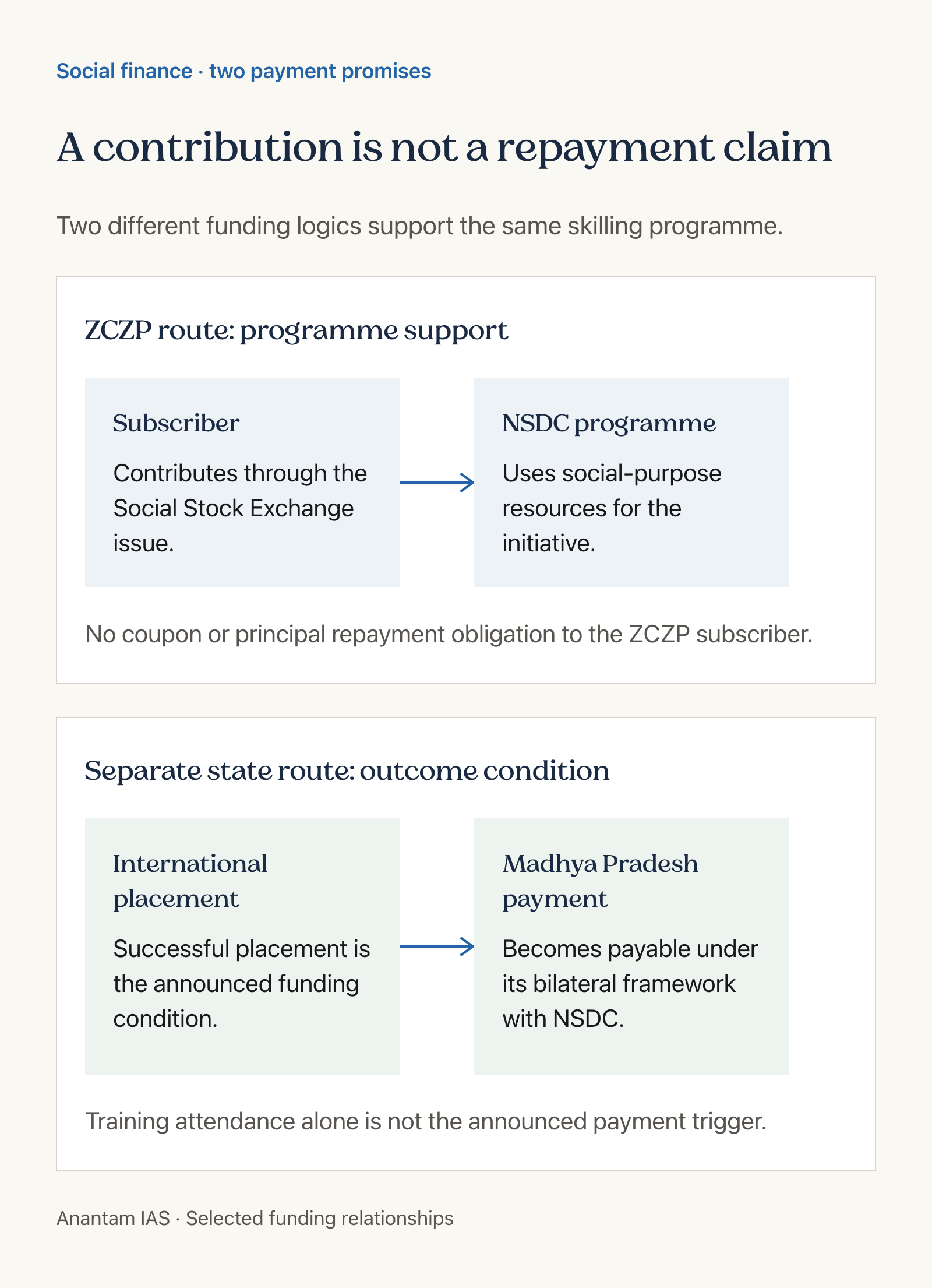
  • The state contribution becomes payable upon successful international placement, according to the announcement. Training attendance alone is not the stated trigger; the intended employment result connects this component of public expenditure to performance.
  • The bilateral Social Impact Bond framework is between NSDC and Madhya Pradesh. That separate arrangement should not be used to imply that the ZCZP subscriber receives interest or recovers principal when placements occur.
  • Timing creates an implementation challenge: language teaching and employability preparation precede placement. Programme managers need to coordinate resources across those stages; a later conditional payment is not interchangeable with cash available for current training.
  • State support also includes candidate mobilisation, residential training infrastructure and language laboratories. Financing alone does not deliver employability: institutions must connect suitable candidates, training provision and destination-specific preparation into a functioning employment pathway.
Separate paths for a non-repayable ZCZP contribution and a placement-linked Madhya Pradesh payment
The ZCZP contribution and the placement-linked state payment have separate payment conditions.

What Counts as Success, and What Remains Unproven

The announcement describes a financing architecture and intended employment pathway; evaluating it requires evidence from implementation rather than treating expected benefits as completed results.

  • Language preparation addresses a practical barrier to working abroad. The programme combines foreign-language and employability training for destination-specific readiness, with opportunities envisaged across caregiving, hospitality, construction and manufacturing rather than one uniform job category.
  • Placement verification needs a clear operational definition. A useful accountability question is whether payment evidence establishes that the candidate actually entered the agreed employment, rather than merely receiving an offer or completing a course.
  • Job quality matters beyond initial placement. Contract terms, worker protection and continuity of employment are relevant evaluation questions; the announcement should not be read as proof that every candidate will secure safe, lasting work.
  • Beneficiary participation raises an inclusion question because the intended participants are economically weaker households. An assessment should examine whether participation costs exclude suitable candidates, while avoiding an unsupported claim that exclusion has already occurred.
  • The official announcement establishes the design, not realised impact. Its expected livelihood gains require follow-up evidence; neither higher earnings nor successful overseas placements should be presented as guaranteed outcomes for every individual enrolled.

Way Forward

Make the Payment Trigger Auditable

  • Define placement evidence before payments fall due, including who checks it and how disputes or failed placements are handled.
  • Publish separate accounts for contributions received, programme spending and state outcome payments so the different funding streams remain traceable.
  • Track participant experience alongside placement totals, including access barriers, employment continuity and grievance resolution after departure.

Conclusion

  • The central distinction is between a non-repayable ZCZP contribution and a separate government payment conditional on placement; combining them does not turn the contribution into repayable debt.
  • For policy analysis, judge whether the financing arrangement produces verifiable employment opportunities without excluding vulnerable candidates, while keeping announced aims separate from demonstrated improvements in workers’ livelihoods.

UPSC Practice Questions

Prelims MCQ 1

With reference to the announced NSDC financing initiative, consider the following statements:

  1. ZCZP instruments entail conventional principal repayment to subscribers.
  2. Madhya Pradesh funding is linked to successful international placement.
  3. The programme combines beneficiary participation, SSE resources and state funding.

How many of the above statements are correct?

(a) Only one (b) Only two (c) All three (d) None

Answer: (b) Only two

Explanation:

Statements 2 and 3 are correct. ZCZP instruments have neither conventional coupon payments nor principal repayment obligations.

Prelims MCQ 2

Which distinction best explains this financing arrangement?

(a) All funding streams become repayable loans. (b) Training attendance automatically triggers the state payment. (c) A non-repayable contribution and a separate placement-linked payment support one programme. (d) An SSE listing guarantees overseas employment.

Answer: (c) A non-repayable contribution and a separate placement-linked payment support one programme.

Explanation:

The ZCZP issuance and bilateral outcome-linked state arrangement have different payment characteristics. Neither issuance nor listing demonstrates completed employment outcomes.

UPSC Mains Questions

  1. Explain the distinction between non-repayable social-purpose contributions and outcome-linked government payments in skill-development financing.
  2. What safeguards can make placement-linked financing accountable without encouraging the exclusion of harder-to-place candidates?

Source: PIB, Ministry of Skill Development and Entrepreneurship.

Frequently Asked Questions

Does a ZCZP subscriber receive principal back?

A Zero Coupon Zero Principal instrument does not carry conventional interest or principal repayment obligations. Its social-purpose contribution must be distinguished from ordinary repayable debt, even when both finance socially beneficial activities.

When does the state funding become payable?

The announcement links Madhya Pradesh’s funding to successful international placement under a bilateral framework with NSDC. This is separate from the ZCZP contribution and is not described as payment merely for training attendance.

Has the programme already delivered its promised employment outcomes?

The announcement describes the financing initiative and intended training and employment pathway. It does not establish completed placements or guaranteed earnings for every participant; those results require evidence from subsequent implementation.

Why does beneficiary participation need scrutiny?

The programme is intended for economically weaker households. Evaluation should examine whether participation costs affect access for suitable candidates, alongside the quality of training and employment, without assuming that exclusion has already occurred.

Yamuna Sewage Projects: Connecting Drains to Effective Treatment

Open article →Download PDF

Why in News?

PIB reported that Delhi inaugurated some Yamuna rejuvenation projects and initiated others on October 22, 2026, covering sewage treatment plants, household sewer connections, pumping and drain interception.

  • The release distinguishes 10 inaugurated projects from 33 initiated projects; these are different stages of delivery.
  • The package includes new STPs and upgrades to existing sewage treatment plants, with foundation stones laid for these works.
  • PIB also describes a decentralised STP pumping station, household sewer-connection work, sewer rehabilitation and drain tapping.
  • River-cleaning projects depend on a connected wastewater service chain: collecting sewage matters as much as building treatment infrastructure.
  • The announcement establishes the scope of works; it does not independently establish plant performance or measured river recovery.

UPSC Relevance

Prelims Relevance

  • STP: sewage treatment plant.
  • Drain interception: capturing sewage-bearing flows for conveyance to treatment.
  • Pumping station: infrastructure that moves wastewater where gravity conveyance is insufficient.
  • Installed capacity: designed treatment capability, distinct from actual sewage treated.
  • Effluent: water leaving a treatment process.

Mains Relevance

GS Paper 3

  • Urban wastewater infrastructure and river pollution control.
  • Connecting infrastructure investment to functioning environmental services.

GS Paper 2

  • Accountability across sewer networks, pumping stations and treatment-plant operators.

Essay

  • Public infrastructure delivers value when its connected parts work together.

Background and Context

What the Yamuna Project Package Actually Covers

The announcement combines assets at different stages, so readers should separate existing infrastructure, upgrades and newly initiated works before judging what services are available.

  • Household connections provide the entry point into a sewer network. A sewer passing through a neighborhood does not establish that every property is connected or that its wastewater reaches the intended treatment destination.
  • Sewer rehabilitation addresses the conveyance network rather than adding treatment capacity by itself. Its relevance lies in restoring the physical route through which collected wastewater can move toward pumping and treatment facilities.
  • Drain tapping brings sewage-bearing flows into an interception arrangement. The useful question is where the captured flow goes next, because diversion without a functioning downstream route cannot demonstrate that sewage has been treated.
  • STP upgrades and new plants concern the treatment stage. The release mentions foundation-stone laying for these works; treating the entire announced package as already commissioned would erase an important distinction in project status.
  • Decentralised treatment places treatment closer to a local catchment, while larger networks convey flows farther. This is a difference in system arrangement; either approach still needs reliable collection, operation and an appropriate outlet.

How Capture, Conveyance and Treatment Work Together

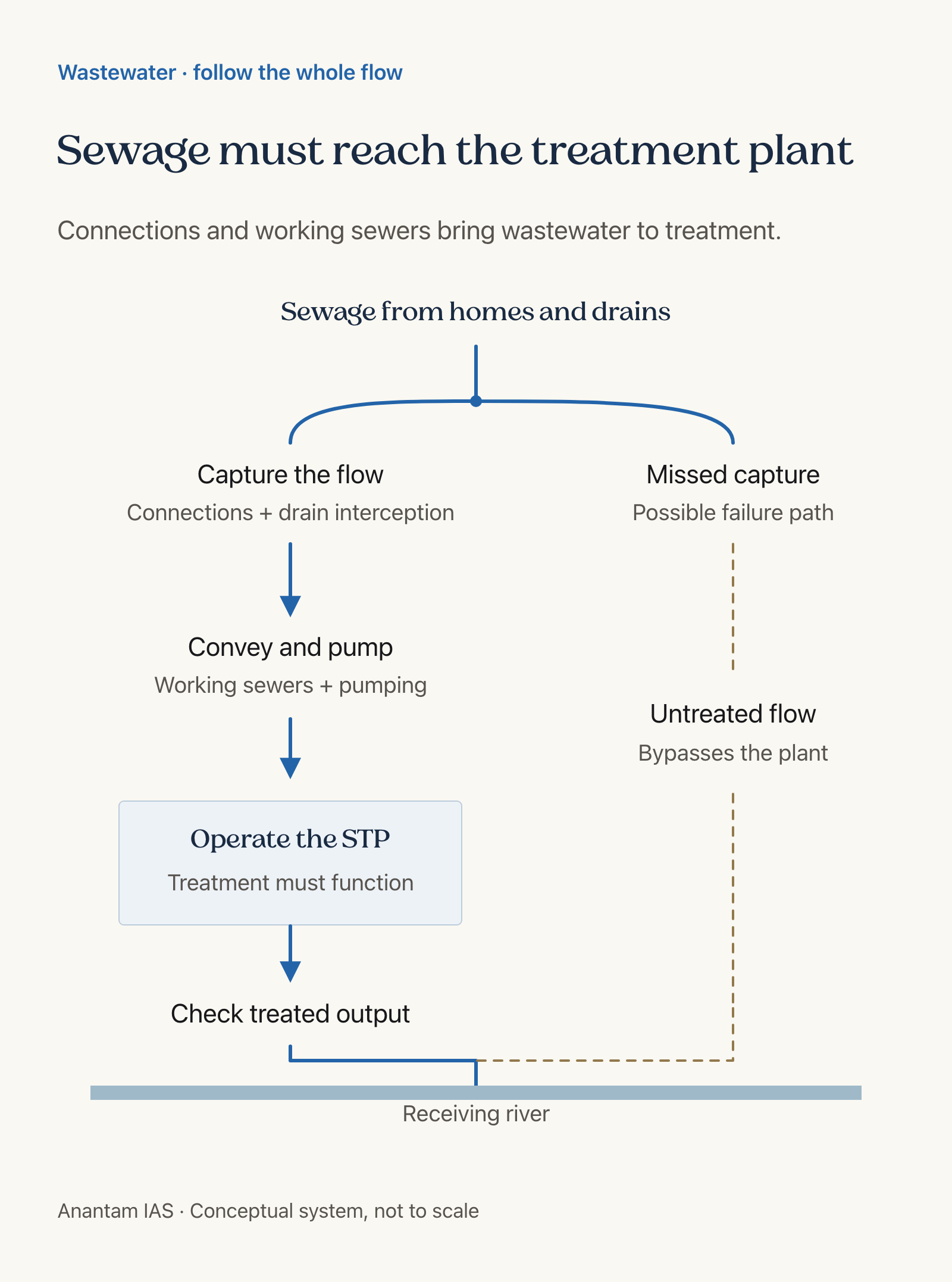
Follow the wastewater physically from its source to the outlet: each stage supplies the next, and a missing connection can interrupt the whole chain.

  • Capture begins with household sewer connections or interception of sewage-bearing drains. Water that never enters the collection system cannot receive treatment at the intended plant, regardless of the capacity available inside that facility.
  • Conveyance carries collected wastewater through sewers toward treatment. Network continuity matters: a completed plant and an unfinished connecting sewer are separate assets, but they do not yet form a complete wastewater service.
  • Pumping supplies the lift needed where gravity alone cannot deliver flow. Electricity, equipment maintenance and operating arrangements become part of the treatment chain because the plant depends on wastewater actually arriving at its inlet.
  • Treatment acts on the wastewater received at the plant. Installed capacity describes what infrastructure is designed to handle; actual throughput depends on incoming flows and working equipment, making the two measures conceptually different.
  • Output management completes the chain through an appropriate discharge or reuse route. A conceptual bypass illustrates how uncaptured sewage could avoid treatment; it is not evidence that a particular Delhi project has such a bypass.
Sewage capture, conveyance, treatment and output checks beside a hypothetical untreated bypass
Conceptual wastewater pathway: collection and conveyance must deliver sewage to functioning treatment. The bypass illustrates a possible failure, not an observed Delhi network.

From Completed Assets to a Working Service

Assess delivery through connected operations, rather than assuming that construction milestones alone establish treatment performance or the condition of the receiving river.

  • Inauguration and initiation must remain separate in progress reporting. The source announces both; it does not provide project-by-project operating records that would allow every component to be classified as delivering continuous treatment today.
  • Capacity and utilisation answer different questions. The first concerns designed capability; the second concerns its use. An underfed plant may reflect missing collection links, so adding another plant would not automatically resolve that bottleneck.
  • Maintenance responsibilities should follow the entire physical route. Sewer blockages, unavailable pumps and plant downtime require different operational responses; reporting only the treatment-plant component can hide a failure elsewhere in the service chain.
  • Commissioning evidence should connect each completed asset to actual operations. For an answer on governance, ask whether household connections, sewer routes, pump operation and plant receipt are demonstrated together rather than through isolated completion certificates.
  • River recovery is a wider environmental outcome than a construction milestone. The present release provides an infrastructure announcement, so a claim of achieved cleanup would require additional evidence beyond the inauguration and foundation-stone ceremony.

Way Forward

Verify the Connected Service

  • Publish project-wise status distinguishing initiated, under-construction, commissioned and operating assets.
  • Check connections and flow routes before expanding capacity where collection or conveyance is the limiting stage.
  • Assign clear operating responsibility for sewers, pumps and plants, including maintenance and interruption response.
  • Report actual treatment delivery alongside installed capacity and construction progress.

Conclusion

  • The Yamuna package illustrates a central infrastructure lesson: collecting, conveying and treating sewage are interdependent functions. A treatment plant becomes useful to a catchment only when wastewater can reliably reach and pass through it.
  • For UPSC answers, distinguish assets, services and environmental outcomes. Use the announcement to explain the delivery chain, while reserving claims about achieved treatment or river recovery for evidence that actually measures those results.

UPSC Practice Questions

Prelims MCQ 1

With reference to urban sewage management, consider the following statements:

  1. Installed STP capacity necessarily equals the volume of sewage treated.
  2. Household connections and drain interception can bring wastewater into a treatment delivery chain.
  3. Pumping may be required where gravity conveyance is insufficient.

How many of the above statements are correct?

(a) Only one (b) Only two (c) All three (d) None

Answer: (b) Only two

Explanation:

Statements 2 and 3 are correct. Installed capacity is designed capability; actual treatment depends on sewage reaching the plant and its operation.

Prelims MCQ 2

A completed sewage treatment plant receives little wastewater because connecting sewers remain unfinished. Which action most directly addresses this bottleneck?

(a) Increasing the plant’s nominal capacity alone (b) Declaring the entire catchment pollution-free (c) Completing the collection and conveyance links (d) Replacing operating records with expenditure totals

Answer: (c) Completing the collection and conveyance links

Explanation:

The immediate constraint is delivery of sewage to the plant. Additional treatment capacity does not itself complete the missing network.

UPSC Mains Questions

  1. Why does installed sewage treatment capacity alone provide an incomplete picture of urban river-cleaning performance? Explain using the wastewater delivery chain.
  2. Discuss how project-wise commissioning and operational accountability can improve the effectiveness of urban sewerage investments.

Source: PIB, Ministry of Home Affairs.

Frequently Asked Questions

What was announced for Yamuna rejuvenation?

PIB reported a package combining inaugurated and initiated works, including sewage treatment plants, household sewer connections, sewer rehabilitation, pumping and drain tapping. The announcement does not mean every component is already operating.

Why are household sewer connections important?

They connect properties to the collection network. Without an effective entry route, wastewater may never reach the intended treatment plant, even when that plant has available capacity and functioning treatment equipment.

What does drain interception do?

It captures sewage-bearing drain flows for onward conveyance to treatment. Its effectiveness depends on the downstream network, pumping where required, and a functioning plant that can receive and treat the intercepted wastewater.

Does installed STP capacity prove the river is clean?

No. Installed capacity describes designed capability. Actual treatment depends on collection and operations, while a claim about river recovery requires additional evidence concerning environmental outcomes beyond the completion of sewage infrastructure.