Opens in a new tab
Join Anantam IAS Channel on Telegram

Daily Digest · Wednesday

23 September 2026 Current Affairs for UPSC

13 current affairs published on Wednesday, 23 September 2026

23 September 2026 Current Affairs for UPSC — every Why-in-News article AnantamIAS published on Wednesday, 23 September 2026, broken down with Why in News?, the exact GS paper it feeds, sub-topic mapping, MCQ-ready facts and a UPSC-style practice question. 13 articles in total, covering Polity, Economy, Environment, S&T, IR, Geography, History, Society and Internal Security — the same Why-in-News + GS-paper-mapping + practice-question format the Compass uses across every daily digest on the site.

Daily current affairs for UPSC is where new material enters your prep stream. Read this 23 September 2026 digest end-to-end in 25–35 minutes, attempt the practice question at the foot of each article (it's MCQ for some, 10/15-marker for others), then bookmark the entries that fall inside your active revision window. Everything stays cross-linked: tap any subject pill to jump to that subject's hub, or use the table of contents above to skip straight to a specific story.

Use this page three ways. Read sequentially for a one-sitting scan of everything that mattered on 23 September 2026. Download the 23 September 2026 PDF below for offline study or print revision. Or use the September 2026 Current Affairs compilation to see this day in the month's full context. For the previous day's reading, see 22 September 2026 Current Affairs; the next day's is 24 September 2026 Current Affairs.

Why we publish daily current affairs separately from the monthly compilation: daily is learning, monthly is revision. Use the daily page to add fresh material to your notes the day it breaks; come back to the September 2026 compilation 60 days before Prelims when the noise has settled and only the lasting takeaway is worth re-reading.

Article 22: Judicial Approval Before Re-arrest

Open article →Download PDF

Why in News?

Indian Express reported on September 23 that the Supreme Court has required judicial approval before re-arresting a person released because Article 22 safeguards were violated.

  • The reported September 21 ruling distinguishes release from unconstitutional detention from release on bail.
  • Investigators seeking renewed custody must approach the jurisdictional magistrate, after furnishing arrest grounds and securing superior-officer endorsement.
  • The report also describes investigation transfer, a departmental enquiry and possible public-law compensation for unconstitutional detention.
  • The issue concerns lawful deprivation of liberty, not whether the underlying accusation is true.
  • A fresh arrest cannot become an automatic administrative correction of an earlier constitutional breach.

UPSC Relevance

Prelims Relevance

  • Article 22(1): grounds of arrest and access to a legal practitioner.
  • Article 22(2): production before the nearest magistrate within 24 hours, excluding necessary journey time.
  • Invalid arrest and release on bail are distinct legal situations.
  • Judicial scrutiny of custody does not itself terminate an investigation.

Mains Relevance

GS Paper 2

  • Constitutional remedies against unlawful detention.
  • Judicial supervision and accountability in the exercise of police powers.

Essay

  • A right becomes meaningful when its violation produces an effective remedy.

Background and Context

What Article 22 protects

The constitutional question begins with the legality of custody, before a court determines whether the accusation has been proved.

  • Article 22(1) requires communication of arrest grounds and protects access to a chosen legal practitioner. The safeguard helps the arrested person understand and contest the State’s justification for taking away liberty.
  • Article 22(2) requires production before the nearest magistrate within 24 hours, excluding necessary journey time. Continued detention beyond that period needs magistrate authority; police custody cannot continue solely on an investigator’s decision.
  • The Constitution provides specific exceptions for enemy aliens and preventive detention. Keep this ordinary criminal-arrest dispute distinct from the separate preventive-detention framework; the reported ruling should not be turned into a universal detention formula.
  • Written grounds give the person a usable account of why arrest is considered necessary. They support consultation with counsel and opposition to remand, rather than leaving the justification only in official knowledge.
  • According to Indian Express, the Court treated breach of these safeguards as invalidating the arrest itself. The seriousness of an allegation cannot, by itself, make unconstitutional detention lawful or remove its consequences.

How the reported re-arrest procedure works

The reported decision places a judicial checkpoint between release from unlawful detention and another attempt to secure custody in the same investigation.

  • The investigating agency must first supply the grounds of arrest. This addresses the informational safeguard before renewed custody is sought; release is not a licence to repeat the same defect with fresh paperwork.
  • It must then apply to the jurisdictional magistrate, explaining why custody is necessary and why the earlier safeguards were not followed. The reported requirement makes the previous constitutional failure relevant to renewed judicial scrutiny.
  • The application needs endorsement by the investigating officer’s immediate superior, according to the report. That brings supervisory responsibility into the process instead of leaving the decision entirely with the officer responsible for earlier non-compliance.
  • The report says the superior must transfer the investigation to another officer and order a departmental enquiry. These steps address responsibility for the violation; they do not amount to deciding guilt in the criminal case.
  • Judicial approval is the central change: police cannot simply repeat the arrest on their own after release for this constitutional breach. The magistrate must examine the renewed request rather than treat custody as an automatic entitlement.

Release, bail and the continuing investigation

For an examination answer, separate the remedy for an unlawful arrest from the merits of the accusation and the future of the investigation.

  • Bail permits release within criminal proceedings under the applicable legal framework. Here, the reported ruling concerns release because the detention itself lacks constitutional validity, making the legal basis of release materially different from bail.
  • Invalidating an arrest does not acquit the accused or decide that the allegation was false. It corrects an unlawful exercise of custody powers while leaving the criminal accusation to be examined through lawful proceedings.
  • Investigation can continue, and custody may still be sought through the prescribed judicial route. Avoid the opposite mistakes of describing release as permanent immunity or treating re-arrest as an unrestricted police power after release.
  • The report states that High Courts may grant public-law compensation for an Article 22(2) breach. This is a possible remedy, not an automatic payment or a fixed compensation amount for every released person.
  • Constitutional accountability and effective investigation can operate together: evidence gathering remains legitimate, while custody must satisfy legal safeguards. A sound answer explains how judicial scrutiny checks coercive power without prejudging the criminal charge itself.

Way Forward

Make the custody decision reviewable

  • Record when arrest grounds were supplied and when the person was produced, so the magistrate can assess compliance from a clear chronology.
  • Keep the reasons for renewed custody separate from explanations for the earlier breach; neither should substitute for the other.
  • Ensure access to legal assistance when release and re-arrest applications are considered, so the constitutional safeguard can be used effectively.

Conclusion

  • The reported ruling treats Article 22 compliance as a condition of lawful arrest. Correcting unconstitutional detention requires a meaningful remedy, while any renewed custody must pass through judicial scrutiny.
  • Use this example to distinguish release from unlawful detention, bail and acquittal. Protecting liberty does not erase an accusation; it requires the State to investigate and seek custody through lawful procedures.

UPSC Practice Questions

Prelims MCQ 1

With reference to Article 22, consider the following statements:

  1. Article 22(1) protects the right to be informed of the grounds of arrest.
  2. Article 22(2) excludes necessary journey time from its 24-hour production requirement.
  3. Release because an arrest was unconstitutional necessarily amounts to acquittal.

How many of the above statements are correct?

(a) Only one (b) Only two (c) All three (d) None

Answer: (b) Only two

Explanation:

The first two statements reflect constitutional safeguards. Invalidating an arrest addresses custody legality, not guilt or innocence.

Prelims MCQ 2

What is the central function of judicial approval before re-arrest in the reported ruling?

(a) To terminate every investigation after an invalid arrest (b) To convert release into an acquittal (c) To scrutinise renewed custody after a constitutional breach (d) To permit police to bypass arrest safeguards

Answer: (c) To scrutinise renewed custody after a constitutional breach

Explanation:

The reported procedure subjects a renewed custody request to a magistrate rather than leaving re-arrest to unilateral police discretion.

UPSC Mains Questions

  1. Distinguish release from unconstitutional detention from bail. Explain why judicial scrutiny of re-arrest matters for personal liberty.
  2. How can accountability for unlawful arrest strengthen criminal justice without preventing legitimate investigation?

Sources: Indian Express Explained and Legislative Department, Constitution of India.

Frequently Asked Questions

What does Article 22(1) protect?

It protects an arrested person’s right to be informed of the grounds of arrest and to consult and be defended by a legal practitioner of their choice, subject to constitutional exceptions.

Does the 24-hour rule include travel time?

Article 22(2) excludes the time necessary for the journey from the place of arrest to the magistrate’s court. Detention beyond the permitted period requires the authority of a magistrate.

Does release after an unconstitutional arrest end the case?

No. The remedy concerns the legality of custody. It does not acquit the accused or end the investigation; renewed custody must follow the lawful procedure described in the reported ruling.

Is compensation automatic after an invalid arrest?

No. Indian Express reports that High Courts may award public-law compensation for an Article 22(2) breach. The reported holding does not establish an automatic payment or a fixed amount in every case.


Manas Rhinos: Why Conservation Must Cross Borders

Open article →Download PDF

Why in News?

The Hindu reported on 23 September 2026 that rhinos frequently crossing from Manas into Bhutan have prompted calls for stronger joint conservation of the shared landscape.

  • A conservation scientist associated with rhino translocation reported repeated movement into Bhutan and called for a joint conservation mechanism.
  • Manas in Assam adjoins Royal Manas National Park in Bhutan, placing wildlife within a connected landscape across an international boundary.
  • Forest officials supported broader landscape cooperation; the report describes a call for stronger coordination, not a newly signed treaty.
  • A recovered rhino population creates management needs beyond releasing animals: protecting their movements, habitat and survival across jurisdictions.
  • Existing cross-border cooperation provides a foundation; the new issue is how to strengthen it for animals moving through the shared landscape.

UPSC Relevance

Prelims Relevance

  • Manas: a protected landscape in Assam adjoining Bhutan.
  • Royal Manas National Park: the contiguous protected area on the Bhutan side.
  • Greater one-horned rhinoceros: the rhino discussed in the current movement report.
  • Reintroduction: returning a species to an area from which it disappeared.
  • Transboundary conservation: cooperation across political borders to manage connected habitats and wildlife.

Mains Relevance

GS Paper 3

  • Landscape conservation after wildlife reintroduction.
  • Shared monitoring, habitat connectivity and local community participation.

GS Paper 2

  • India-Bhutan cooperation for managing an ecologically connected border landscape.

Essay

  • Ecological relationships often extend beyond the boundaries used to govern them.

Background and Context

Why rhino recovery changes the management challenge

The Manas story has moved beyond bringing rhinos back: managers must now protect a recovering population whose movements do not stop at a national boundary.

  • The greater one-horned rhinoceros had disappeared from Manas amid unrest and poaching. The Hindu describes its subsequent return through reintroduction, making protection of an established population the present concern rather than initial release alone.
  • Reintroduction restores animals to a former range, while a self-sustaining population continues through survival and breeding. These are different conservation achievements; returning animals is an intervention, whereas persistence is a longer-term biological outcome.
  • An official quoted in the report describes a breeding, self-sustaining population and credits community support. This assessment should be attributed; the report does not establish a fresh census total for the current year.
  • The scientist’s account of frequent crossings into Bhutan raises a coordination problem even when recovery is successful. A rhino moving beyond one jurisdiction still needs protection, monitoring and suitable habitat on the other side.
  • Movement alone does not prove overcrowding or a failed recovery programme. The report does not establish why each animal crosses; explaining the management response does not require inventing a cause or migration timetable.

A connected habitat spans separate jurisdictions

An international boundary separates administrative responsibilities, but the adjoining Manas protected areas remain part of an ecological landscape through which animals can move.

  • The UNESCO Manas profile places the sanctuary in Assam’s Himalayan foothills, with alluvial grasslands and tropical forests. Its continuity with Bhutan’s Royal Manas makes cooperation relevant to habitat protection beyond one park.
  • Habitat connectivity means animals can use connected areas instead of being confined to isolated patches. Here, adjoining protected landscapes explain why management must consider the surrounding ecological system rather than only an individual reserve.
  • Separate jurisdictions can hold different observations of the same moving animal. Coordinated monitoring helps managers interpret sightings across the boundary instead of treating each country’s records as a complete account of the population.
  • Carrying capacity concerns how many animals habitat can sustain under prevailing conditions. It cannot be inferred merely from a reserve’s area or a sighting across the border; habitat condition and resource availability also matter.
  • UNESCO’s 2026 conservation decision encourages continuing field-level cooperation. This is evidence that cooperation already exists; the current call seeks to strengthen coordination rather than create the first contact between the two sides.

What stronger joint management should achieve

The practical question is how shared information and compatible protection measures can follow wildlife across the landscape while retaining each country’s own administrative responsibilities.

  • Shared monitoring should help distinguish an animal’s movement from disappearance or a new population record. That is an analytical management priority, not a claim that a new common database has already been established.
  • Coordinated protection can address risks across an animal’s range rather than only inside one reserve. Stronger cooperation need not mean merged park administration; the report calls for a mechanism without announcing its legal design.
  • Habitat management should consider connected grasslands and forests alongside wildlife protection. Preserving animals without maintaining the landscape they use would leave the ecological basis of recovery vulnerable, even if immediate poaching risks were controlled.
  • Local participation matters because people living around Manas are credited with supporting recovery. The report links this support partly to tourism expectations; benefits should be examined locally rather than assumed to reach every household equally.
  • People-to-people conservation is raised alongside bilateral cooperation in the report. It can complement official coordination, but should not be confused with a signed agreement, newly notified corridor or completed international conservation programme.

Way Forward

Follow the animal across the landscape

  • Strengthen field-level information exchange so sightings and threats can be understood across the adjoining protected areas.
  • Assess habitat condition and movement patterns before drawing conclusions about carrying capacity or prescribing additional translocations.
  • Support community participation and examine who receives conservation-linked benefits, while keeping proposed cooperation distinct from measures actually implemented.

Conclusion

  • Manas rhino recovery illustrates why conservation must continue after reintroduction. A population moving through a connected India-Bhutan landscape needs management that recognises ecological continuity alongside separate national responsibilities.
  • The durable lesson is landscape-scale cooperation, not a new treaty or census claim. Shared monitoring, habitat protection and local support must reinforce recovery wherever the animals move.

UPSC Practice Questions

Prelims MCQ 1

With reference to Manas and transboundary conservation, consider the following statements:

  1. Manas in Assam adjoins Royal Manas National Park in Bhutan.
  2. An international boundary necessarily prevents wildlife from moving between adjoining habitats.
  3. UNESCO has encouraged continuing field-level cooperation in the Manas landscape.

How many of the above statements are correct?

(a) Only one (b) Only two (c) All three (d) None

Answer: (b) Only two

Explanation:

Statements 1 and 3 are correct. The current report describes rhinos crossing into Bhutan, demonstrating that political boundaries need not prevent ecological movement.

Prelims MCQ 2

Which is the most appropriate inference from repeated rhino movement from Manas into Bhutan?

(a) Reintroduction must have failed. (b) The reserve has necessarily exceeded its carrying capacity. (c) Monitoring and protection should account for the connected landscape across jurisdictions. (d) A new bilateral treaty has already entered into force.

Answer: (c) Monitoring and protection should account for the connected landscape across jurisdictions.

Explanation:

Movement creates a coordination need. It does not, by itself, establish overcrowding, programme failure or a newly concluded legal agreement.

UPSC Mains Questions

  1. Successful species reintroduction creates continuing management responsibilities beyond a protected area. Discuss with reference to rhinos in the Manas landscape.
  2. Examine how field-level cooperation and local participation can strengthen transboundary conservation between India and Bhutan.

Sources: The Hindu and UNESCO, Manas Wildlife Sanctuary.

Frequently Asked Questions

Why are Manas rhinos relevant to India-Bhutan conservation?

The Hindu reports frequent rhino movement into Bhutan from Manas. Because Manas adjoins Royal Manas National Park, monitoring and protection must account for a connected landscape across separate jurisdictions.

Has a new rhino-conservation treaty been signed?

The current report describes calls for a stronger joint conservation mechanism, not a newly signed treaty. Existing field-level cooperation already provides a foundation for further coordination across the landscape.

Does crossing into Bhutan show that Manas is overcrowded?

No. Movement alone does not establish that a habitat has exceeded its carrying capacity. The causes require evidence on habitat conditions, resources and animal behaviour rather than assumptions based on crossings.

How is reintroduction different from a self-sustaining population?

Reintroduction returns animals to a former range, while a self-sustaining population persists through survival and breeding. Protection and suitable habitat remain necessary after release for recovery to continue over time.

P4M Declaration: India Joins an Open Coalition for Multilateralism

Open article →Download PDF

Why in News?

India is an initial co-sponsor of the Partners for Multilateralism (P4M) declaration adopted at the summit on 21 September 2026.

  • The European Council declaration names India among the initial co-sponsors, alongside partners from several regions and the European Union.
  • The initiative supports international law and stronger multilateral institutions, including reform of the United Nations.
  • Its cooperation agenda covers economic resilience, international finance, artificial intelligence, climate change and global health.
  • The declaration envisages regular exchanges open to partners from every region; it does not establish a military alliance.
  • Cross-border problems require coordination even when participating governments disagree on other issues.
  • The distinction between a political commitment and an institution with legal powers is central to understanding this development.

UPSC Relevance

Prelims Relevance

  • P4M: Partners for Multilateralism.
  • India is an initial co-sponsor of the declaration.
  • Sovereign equality and peaceful dispute settlement are UN Charter principles.
  • The declaration supports reform of existing multilateral institutions.
  • An open political coalition is distinct from a treaty organisation.

Mains Relevance

GS Paper 2

  • Issue-based diplomatic coordination and India’s external partnerships.
  • Institutional legitimacy, representation and the implementation gap in global governance.

Essay

  • Cooperation requires shared rules without requiring identical national interests.

Background and Context

What an open coalition can do

P4M creates a platform for political coordination around existing institutions, rather than a new authority placed above participating governments.

  • Multilateralism means addressing shared questions through cooperation among several participants. For this initiative, the practical starting point is consultation: governments identify common positions before trying to advance them in wider international forums.
  • Open participation makes the platform different from an exclusive security bloc. The declaration invites regular exchanges across regions, allowing cooperation to grow around shared concerns without promising that participants will agree on every dispute.
  • Political coordination can reduce the cost of acting alone. A government seeking a change in international practice can consult partners, clarify disagreements and build support before approaching the institution responsible for taking a decision.
  • Co-sponsorship signals support for the declaration and its cooperative agenda. It should not be read as surrendering independent foreign-policy choices or accepting an automatic obligation to support another participant in a future armed conflict.
  • Institutional limits matter as much as the announcement. The declaration does not itself create a treaty organisation, a common defence commitment or a new body empowered to issue binding decisions to other states.

Supporting rules while seeking reform

The central distinction is between preserving the UN-centred framework and changing how effectively and representatively its institutions work.

  • Sovereign equality treats states as legally equal despite differences in economic or military power. It provides a basis for negotiating common rules, while leaving unresolved the political difficulty of securing compliance by powerful actors.
  • Peaceful dispute settlement directs attention towards negotiation and other peaceful means. Supporting this principle is a statement about acceptable conduct; it does not mean the coalition has acquired enforcement powers over an international dispute.
  • Institutional reform concerns the organisation, representation and functioning of bodies that already exist. Supporting reform is different from replacing the multilateral system with a parallel authority or treating existing rules as irrelevant to national interests.
  • UN80 appears in the declaration as an initiative through which the United Nations may be strengthened. This reference expresses support for institutional improvement; it is not evidence that every proposed reform has already been adopted.
  • Implementation must follow the decision procedures of the institution concerned. A summit declaration can encourage negotiations, but it cannot by itself change Security Council membership, redistribute voting rights or complete reforms requiring further agreement.

India's opportunity and the delivery test

For India, the useful question is what this additional diplomatic platform can achieve through cooperation that existing negotiations have struggled to deliver.

  • Issue-based cooperation offers room to work with different partners on different problems. India can support a shared initiative without assuming that every participant shares its positions across trade, security, technology and development negotiations.
  • Supply-chain resilience illustrates the economic agenda: dependence on a narrow set of suppliers can transmit disruption across borders. Diversifying relationships may improve options, but a political declaration alone cannot create alternative production or logistics capacity.
  • Global public goods, such as shared health preparedness, often face a coordination problem. Benefits cross borders, while governments decide national contributions separately; cooperation must connect an agreed objective with practical responsibilities and sustained domestic capacity.
  • Collective influence depends on whether participants sustain common positions when their interests diverge. Broad agreement on international cooperation is easier than settling who bears adjustment costs, changes domestic policy or supplies resources for implementation.
  • Performance assessment should track concrete proposals, institutional decisions and subsequent implementation. Participation counts or a broad statement of support are weak substitutes for evidence that coordination changed how a specific international problem is addressed.

Way Forward

Turn consultation into accountable action

  • Choose specific issues where partners can agree on a practical proposal rather than repeating general commitments at successive meetings.
  • Use existing institutions to negotiate decisions within their mandates, keeping coalition coordination distinct from formal decision-making authority.
  • Publish follow-through on agreed proposals so observers can distinguish consultation, institutional adoption and actual implementation.

Conclusion

  • P4M is an additional channel for cooperation within a UN-centred order. Its significance lies in whether an open group can assemble workable common positions across regions, rather than in the creation of a new supranational institution.
  • Separate commitment from outcome when using this example in an answer. India’s initial co-sponsorship is confirmed; stronger institutions and more effective cooperation remain goals whose achievement requires subsequent decisions and sustained implementation.

UPSC Practice Questions

Prelims MCQ 1

With reference to Partners for Multilateralism (P4M), consider the following statements:

  1. India is an initial co-sponsor of its September 2026 declaration.
  2. Its declaration establishes an automatic collective-defence obligation.
  3. Its exchanges are intended to be open to partners across regions.

How many of the above statements are correct?

(a) Only one (b) Only two (c) All three (d) None

Answer: (b) Only two

Explanation:

Statements 1 and 3 are correct. The declaration supports open multilateral cooperation; it does not establish an automatic collective-defence commitment.

Prelims MCQ 2

Which best describes the relationship between P4M and existing multilateral institutions?

(a) P4M replaces the United Nations. (b) P4M independently changes Security Council voting rules. (c) P4M coordinates political support for strengthening existing institutions. (d) P4M exercises judicial jurisdiction over member states.

Answer: (c) P4M coordinates political support for strengthening existing institutions.

Explanation:

Its declaration supports institutional reform and cooperation. Formal changes still require decisions through the procedures of the institution concerned.

UPSC Mains Questions

  1. How can open political coalitions support multilateral institutions without replacing them? Discuss with reference to P4M.
  2. Assess the opportunities and limitations of issue-based international cooperation for India.

Source: European Council, P4M summit declaration.

Frequently Asked Questions

What is P4M?

Partners for Multilateralism is an open political coalition supporting international law and cooperation through existing institutions. Its declaration envisages regular exchanges among partners across regions to coordinate responses to shared challenges.

What is India’s role in P4M?

The European Council’s published declaration lists India as an initial co-sponsor. This confirms support for the initiative; it should not be confused with an automatic defence commitment or uniform positions on every international issue.

Does P4M replace the United Nations?

No. Its declaration affirms the importance of the UN-centred system and supports strengthening multilateral institutions. It provides political coordination rather than establishing a replacement organisation with authority over the United Nations.

Has P4M completed Security Council reform?

No. Supporting institutional reform does not itself change Security Council membership or voting rights. Such changes depend on the applicable institutional procedures and further agreement, rather than the coalition’s political declaration alone.

TRAI Voice-and-SMS Rules: Recharge Choice Without Data

Open article →Download PDF

Why in News?

TRAI released its final Telecom Consumer Protection amendment on 22 September 2026, requiring more voice-and-SMS-only recharge options with appropriate tariff reductions and specified validity choices.

  • The Thirteenth Amendment addresses the concentration of existing voice-and-SMS-only Special Tariff Vouchers in longer validity periods.
  • Providers must offer short-validity voice-and-SMS alternatives corresponding to every offered voice, SMS and data bundle validity of thirty days or less.
  • A calendar-month renewal option and at least one corresponding longer-validity voice-and-SMS voucher are also required.
  • The official release specifies an appropriate tariff reduction, without announcing a uniform numerical discount.
  • Lower upfront payments can matter to households whose income arrives irregularly, even when longer plans appear economical per day.
  • Unbundling lets consumers choose communication services that better match their needs instead of buying unwanted data allowances.

UPSC Relevance

Prelims Relevance

  • TRAI: Telecom Regulatory Authority of India.
  • STV: Special Tariff Voucher.
  • Voice-and-SMS-only vouchers exclude bundled data.
  • Short-validity matching applies to offered bundle periods of thirty days or less.
  • Calendar-month renewal uses the last date when the corresponding date is absent.

Mains Relevance

GS Paper 2

  • Consumer protection through sectoral regulation.
  • Consultation and proportional regulation of service providers.

GS Paper 3

  • Bundling, consumer choice and affordability in telecom markets.

Essay

  • Access improves when essential services fit household cash flow.

Background and Context

Why a voice-and-SMS option can still be unaffordable

The problem was not simply absence of a product; it was the gap between available recharge durations and consumers’ ability to pay upfront.

  • TRAI observed that existing voice-and-SMS-only vouchers were limited and concentrated in longer validities. A formal choice on an operator’s menu could consequently remain difficult for a low-income subscriber to purchase when needed.
  • Bundling packages voice, SMS and data together. Someone who mainly makes calls or sends messages may prefer paying for those services separately, rather than purchasing a data allowance that adds little practical value.
  • Upfront affordability concerns the money required at recharge, while unit cost concerns the price spread across the service period. A consumer can struggle with the former even when a longer plan offers the latter.
  • Shorter validity allows a smaller purchasing commitment suited to immediate needs and financial capacity. That does not automatically make every shorter voucher cheaper per day; consumers still need clear prices and terms for comparison.
  • Consumer preference is the basis for the choice: the release describes consumers who prefer not to use data-bundled vouchers. It does not frame the option as a subsidy reserved for a verified income category.

What the matching-validity and monthly rules require

The amendment links voice-and-SMS choice to the validity periods operators already offer, then adds a distinct monthly renewal option.

  • Short-period matching means each offered voice, SMS and data voucher validity of thirty days or less must have a corresponding voice-and-SMS-only option. Offering one arbitrary short-duration alternative would not capture that requirement.
  • Appropriate tariff reduction accompanies these voice-and-SMS-only vouchers. The official release does not prescribe a numerical discount for readers to calculate, so an assumed percentage saving should never substitute for the actual offered tariff.
  • Calendar-month renewal means renewal on the same date of every month. This is a calendar-linked arrangement, rather than a promise that each service period contains an identical fixed number of days throughout the year.
  • Missing-date safeguard applies when the renewal date does not exist in a particular month: renewal falls on that month’s last date. It resolves the uneven length of months without inventing another renewal date.
  • Longer validity remains part of the mandated choice through at least one longer-duration voice-and-SMS voucher corresponding to a bundled voucher period. The requirement is not to mirror every longer-duration bundle offered by an operator.

How to assess the regulation without overstating it

Read the amendment as a choice-and-affordability intervention, while separating final regulatory action from unverified claims about prices or availability.

  • Final regulation is the news, not a fresh consultation proposal. TRAI says it finalised the amendment after stakeholder responses, an open-house discussion and its own analysis of the limited choices available to consumers.
  • Unbundling differs from uniform pricing: the regulator requires service choices and appropriate tariff reduction, but the release does not announce one common nationwide charge for all operators or a universal ceiling on recharge prices.
  • Availability matters alongside price. A practical assessment should ask whether consumers can find each required validity option and understand its service terms, rather than assuming that a larger catalogue alone delivers meaningful consumer choice.
  • Service entitlements require careful reading of the offered voucher. The expression voice-and-SMS-only identifies included service categories; it does not itself establish unlimited calling, unlimited messages or a guarantee of free communication for every subscriber.
  • Implementation claims need separate evidence. The official announcement establishes release of the final amendment; it does not justify inventing an effective date or asserting that every operator has already updated its recharge catalogue.

Way Forward

Make the required choice usable

  • Display voice-and-SMS-only alternatives beside comparable bundled vouchers, with price, service entitlement and validity clearly visible.
  • Explain calendar renewal and its missing-date rule in plain language at purchase, so users understand when another payment is due.
  • Assess compliance through required validity coverage and actual tariff terms, rather than the total number of vouchers advertised.

Conclusion

  • TRAI’s intervention addresses a specific market-design problem: voice-and-SMS products existed, but their duration choices could exclude consumers unable or unwilling to make a longer financial commitment.
  • For an analytical answer, distinguish the required range of choices, the tariff-reduction principle and calendar-linked renewal. Judge success by usable consumer options without equating regulatory release with verified market-wide implementation.

UPSC Practice Questions

Prelims MCQ 1

With reference to TRAI’s final voice-and-SMS voucher amendment, consider the following statements:

  1. Short-validity voice-and-SMS options must correspond to each offered bundled voucher period of thirty days or less.
  2. If the calendar renewal date is absent in a month, renewal occurs on that month’s last date.
  3. The official release announces one uniform nationwide price for voice-and-SMS vouchers.

How many of the above statements are correct?

(a) Only one (b) Only two (c) All three (d) None

Answer: (b) Only two

Explanation:

The first two statements reflect the announced requirements. The release requires appropriate tariff reduction, not a uniform nationwide price.

Prelims MCQ 2

Which distinction best explains why a consumer might prefer a shorter recharge voucher?

(a) Upfront affordability can differ from cost per day. (b) Every short voucher guarantees free calls. (c) Calendar months always have the same duration. (d) A final regulation proves universal operator compliance.

Answer: (a) Upfront affordability can differ from cost per day.

Explanation:

A household may be unable to pay a larger amount immediately even when a longer plan has an attractive daily cost.

UPSC Mains Questions

  1. Explain how mandated voice-and-SMS-only recharge choices can address consumer exclusion in telecom markets.
  2. Distinguish upfront affordability from unit-price affordability. Discuss why this distinction matters for the design of essential-service regulation.

Source: PIB, Ministry of Communications.

Frequently Asked Questions

What has TRAI changed for voice-and-SMS recharges?

TRAI’s final amendment requires appropriate tariff reductions and more validity choices for voice-and-SMS-only vouchers, including matching short periods, a calendar-month renewal option and at least one corresponding longer-validity option.

Does the rule mean a fixed discount for everyone?

The official release requires an appropriate reduction in tariff but does not announce a numerical discount or one common nationwide price. Actual voucher prices and service terms must be checked separately.

How is calendar-month renewal different from fixed-day validity?

Calendar-month renewal falls on the same date each month. When that date does not exist, the last date of the month applies. The number of days between renewals can consequently vary.

Does voice-and-SMS-only mean free or unlimited calling?

No such guarantee follows from that description. It identifies the service categories in the voucher. Subscribers must examine the actual calling and messaging entitlements rather than infer free or unlimited service.

UDAN Challenge Mode: Linking Aerodromes With Viable Routes

Open article →Download PDF

Why in News?

On 22 September 2026, the Ministry of Civil Aviation launched Challenge Mode for aerodrome development and released the next-phase UDAN route-bidding scheme document.

  • The Ministry, participating States/UTs and the Airports Authority of India (AAI) signed 21 MoUs covering coordinated aviation-asset development and operationalisation.
  • States and UTs can nominate airstrips and helipads for development based on local connectivity requirements.
  • An upcoming bidding round will invite airlines to bid for identified UDAN routes; the announcement does not establish that these services are already operating.
  • Regional connectivity requires both usable aviation infrastructure and airlines able to sustain services that passengers can afford.
  • This development concerns unserved and underserved regions, where a physical facility and a dependable travel option are different policy outcomes.

UPSC Relevance

Prelims Relevance

  • UDAN: Ude Desh ka Aam Nagrik, the regional air-connectivity scheme.
  • AAI: the implementing agency identified in the announcement.
  • Challenge Mode: States/UTs nominate airstrips and helipads for development.
  • Route bidding: airlines bid for identified routes through competitive selection.
  • Status distinction: nomination, operator selection and actual service operation are separate milestones.

Mains Relevance

GS Paper 3

  • Infrastructure planning must connect physical assets with demand and reliable services.
  • Passenger affordability and operational sustainability require separate evaluation.

GS Paper 2

  • Centre-State coordination in identifying and developing regional aviation assets.

Essay

  • Connectivity should be judged by usable access, not infrastructure announcements alone.

Background and Context

What Challenge Mode changes

The new arrangement gives States and UTs an explicit role in proposing aviation assets while placing their priorities within a coordinated implementation framework.

  • State nomination begins with identifying airstrips or helipads that could meet local connectivity needs. It is a proposal for development, not proof that an airline has committed to serve the location.
  • The MoUs link the Ministry, participating States/UTs and AAI around identification, development and operationalisation of aviation assets. This connects locally identified requirements with the institutions responsible for implementing the regional-connectivity scheme.
  • AAI is described as the implementing agency under UDAN. Its place in the arrangement should not be confused with the separate role of airlines invited to bid for routes and operate services.
  • The ministry presents affordability, operational sustainability, transparent project selection and indigenous manufacturing as the next phase’s pillars. These are policy directions, not evidence that every proposed destination already meets those objectives.
  • The official announcement records the launch and signed agreements, but describes route bidding as upcoming. Administrative progress must be distinguished from completed facilities, selected operators and flights available to passengers.

Infrastructure and air services are complementary

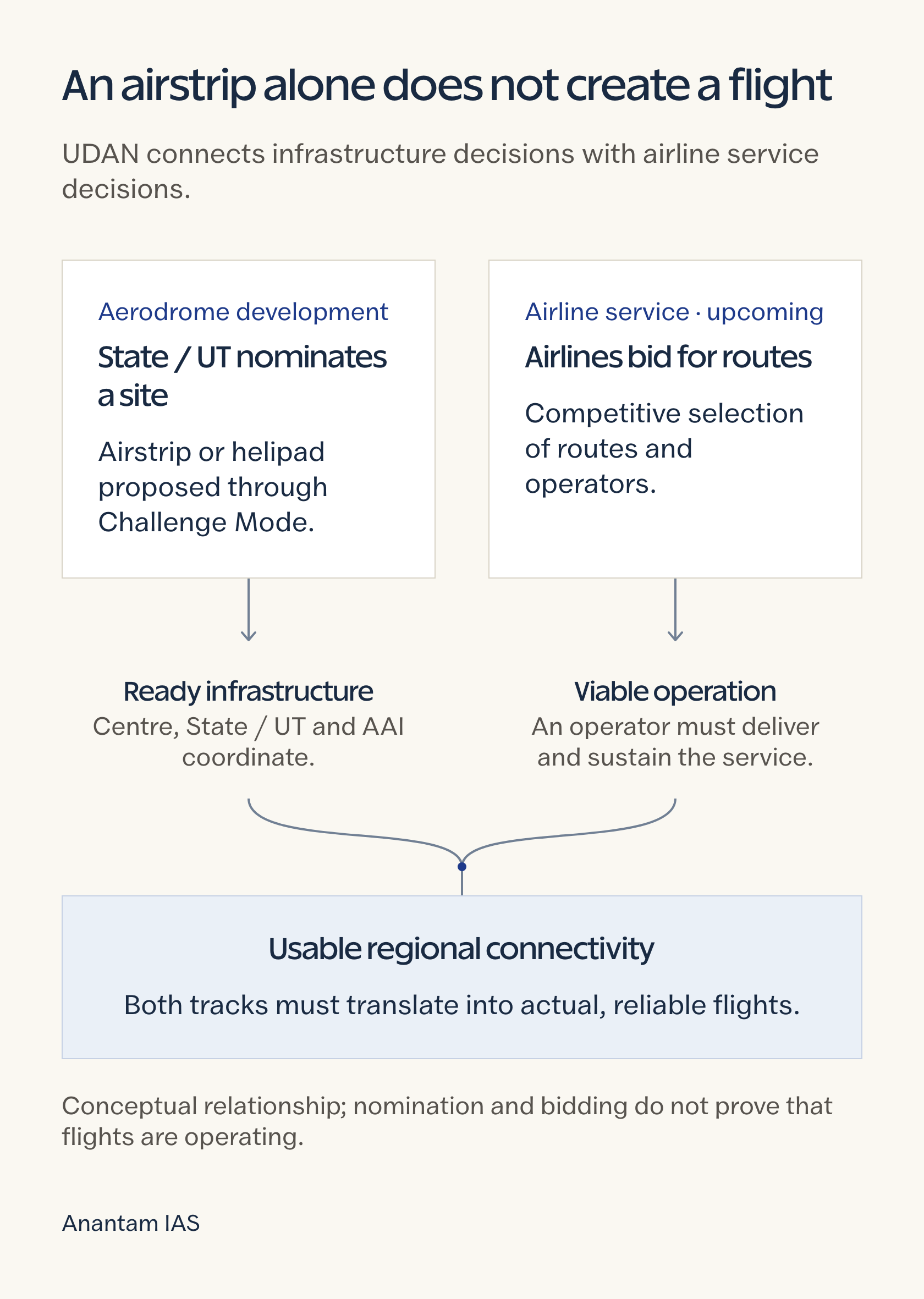
Think of aerodrome development and route bidding as complementary tracks, not a single automatic sequence that turns every nominated airstrip into an operating service.

  • The infrastructure track concerns suitable places for aircraft to arrive and depart. The service track concerns routes and operators; the announcement places competitive airline bidding alongside the development of aviation assets.
  • A nominated airstrip or helipad identifies a potential physical asset, whereas an air route connects locations through an air service. Choosing one does not, by itself, settle all decisions about the other.
  • Competitive bidding is the announced method for selecting routes and operators transparently. The release does not provide a scoring formula, so selection criteria, financial shares or subsidy periods should not be assumed.
  • A completed facility can still lack dependable connectivity if no suitable service operates. Equally, a proposed route needs usable infrastructure; the policy challenge is to align both sides rather than celebrate either alone.
  • These tracks provide an analytical explanation, not a legislated order of mandatory approvals. The release supports their complementary roles but does not establish that every nomination must pass through an identical prescribed sequence.
Diagram showing aerodrome development and airline selection as complementary inputs to operating regional flights
Infrastructure readiness and airline service must work together; nomination and bidding do not themselves establish operational flights.

How to judge regional-connectivity outcomes

The useful comparison is between creating an aviation asset and delivering a lasting travel option; success on the first does not establish success on the second.

  • Affordability asks whether intended passengers can use the service, while operational sustainability asks whether operations can continue. A policy assessment must examine both, rather than treating an inaugurated facility as their common substitute.
  • Demand assessment should examine who would travel and why. Tourism, trade and wider economic activity are stated potential benefits; they remain expected outcomes until evidence shows that services actually support those activities.
  • Local priorities matter because connectivity needs differ across regions. State participation can bring those requirements into project identification, but nomination alone cannot demonstrate passenger demand or establish the commercial viability of a particular route.
  • Implementation monitoring should distinguish nominated assets, infrastructure readiness, operator selection and actual service continuity. Keeping these milestones separate helps identify the unfinished part of a project without misreporting an agreement as an operating connection.
  • The exam trap is equating a scheme-document release with completed route awards. Read the announcement by status: Challenge Mode has launched, agreements have been signed, and the airline bidding round is still described as upcoming.

Way Forward

Match facilities with service plans

  • Assess local travel demand alongside infrastructure proposals so that development priorities reflect plausible passenger needs.
  • Publish clear selection and implementation milestones, keeping nominated assets distinct from awarded routes and services actually operating.
  • Evaluate affordability and service continuity separately; use evidence from operations before claiming that a new connection has delivered wider economic benefits.

Conclusion

  • UDAN Challenge Mode strengthens the link between State/UT proposals and coordinated aerodrome development, while upcoming airline bids address another necessary part of regional connectivity: selecting routes and operators.
  • For a Mains answer, distinguish physical access from functioning services. The central test is whether infrastructure, passenger affordability and sustained operations align, rather than whether a location has merely been nominated.

UPSC Practice Questions

Prelims MCQ 1

With reference to the announced next phase of UDAN, consider the following statements:

  1. States and UTs can nominate airstrips and helipads for development.
  2. The Airports Authority of India is identified as the implementing agency.
  3. Every nominated airstrip has already received an operating airline service.

How many of the above statements are correct?

(a) Only one (b) Only two (c) All three (d) None

Answer: (b) Only two

Explanation:

The first two statements match the announcement. Nomination does not establish service operation, and the route-bidding round was described as upcoming.

Prelims MCQ 2

Which distinction best explains the relationship between aerodrome development and UDAN route bidding?

(a) Both refer only to manufacturing aircraft. (b) State nomination automatically establishes scheduled flights. (c) Development addresses aviation assets, while route bidding involves selection of routes and operators. (d) Route bidding removes the need for aviation infrastructure.

Answer: (c) Development addresses aviation assets, while route bidding involves selection of routes and operators.

Explanation:

Infrastructure and air services are complementary. Neither a facility proposal nor an airline bid alone demonstrates sustained operational connectivity.

UPSC Mains Questions

  1. Creating an aerodrome does not necessarily create dependable regional connectivity. Discuss with reference to UDAN Challenge Mode.
  2. Explain how Centre-State coordination and competitive airline selection can address different constraints on regional air connectivity.

Source: PIB, Ministry of Civil Aviation.

Frequently Asked Questions

What is UDAN Challenge Mode for aerodrome development?

It allows States and UTs to nominate airstrips and helipads for development under the next phase of UDAN, connecting local priorities with a coordinated aviation-infrastructure framework.

What role does AAI have in this announcement?

The Airports Authority of India is identified as the implementing agency under UDAN and a party to the MoUs with the Ministry and participating States and UTs.

Does nomination mean flights have started?

No. Nominating an aviation asset is distinct from selecting routes and operators or beginning services. The announcement describes the airline route-bidding round as upcoming, not as completed operational connectivity.

Why are affordability and operational sustainability separate concerns?

Affordability concerns passengers’ ability to use a service, while sustainability concerns its continuation. A usable aerodrome alone does not establish either outcome, so both require assessment alongside infrastructure progress.

Urban River Plans: Managing Rivers Across the City

Open article →Download PDF

Why in News?

On 22 September 2026, India International Water Week saw the launch of the Sustainable Urban River Management Framework and five Urban River Management Plans.

  • The framework was launched at the inaugural session, according to the Ministry of Jal Shakti release.
  • The five plans were launched at a Global River Cities Alliance session during the same event.
  • The announcement emphasised integrated policy and institutional innovation; launching plans does not demonstrate that river restoration has been completed.
  • A city affects its river through land use, wastewater and drainage, including activities far from the visible waterfront.
  • River management must connect pollution control with water movement and habitat protection; improving appearance alone cannot establish ecological recovery.

UPSC Relevance

Prelims Relevance

  • URMP: Urban River Management Plan, a city-level river-planning instrument.
  • Catchment: land from which water drains towards a river or other common outlet.
  • Stormwater: rainfall runoff; it can carry pollutants even without a sewage connection.
  • Floodplain: land beside a river that can receive floodwater.
  • NMCG and NIUA: institutions associated with the earlier urban river management framework.

Mains Relevance

GS Paper 3

  • Urban flooding, river pollution and ecological restoration as connected management problems.
  • Land-use decisions that change runoff, flood exposure and habitat connectivity.

GS Paper 2

  • Coordination between municipal services, development authorities and river-management institutions.

Essay

  • A city must plan for the water it releases as carefully as the water it consumes.

Background and Context

What an urban river plan changes

The planning unit is a connected river system, not simply the strip of land chosen for a waterfront project or public promenade.

  • An urban river management plan links the river with the city that influences it. Land-use decisions, wastewater services and riverbank activities become connected planning questions instead of isolated projects handled without a shared diagnosis.
  • The earlier NMCG–NIUA framework already used a systems approach covering environmental, economic and social dimensions. The new launch should not be read as the first recognition that rivers need coordinated city-level management.
  • A catchment can extend beyond a municipal boundary. Water and pollution reaching the city may originate upstream, while local decisions can affect downstream communities; administrative jurisdiction does not stop the movement of water.
  • The existing framework complements city plans rather than treating the river as an unrelated sector. This matters because decisions about construction, sanitation and open spaces can strengthen or undermine river-management investments over time.
  • Riverfront beautification improves access or appearance when appropriately designed; river management addresses water quality, flows and ecological functions. A clean-looking promenade cannot by itself establish that sewage interception or habitat protection is working.

How sewage, runoff and floodplains interact

A useful diagnosis separates pollution entering the river from changes in how water reaches it, while recognising that both processes can interact.

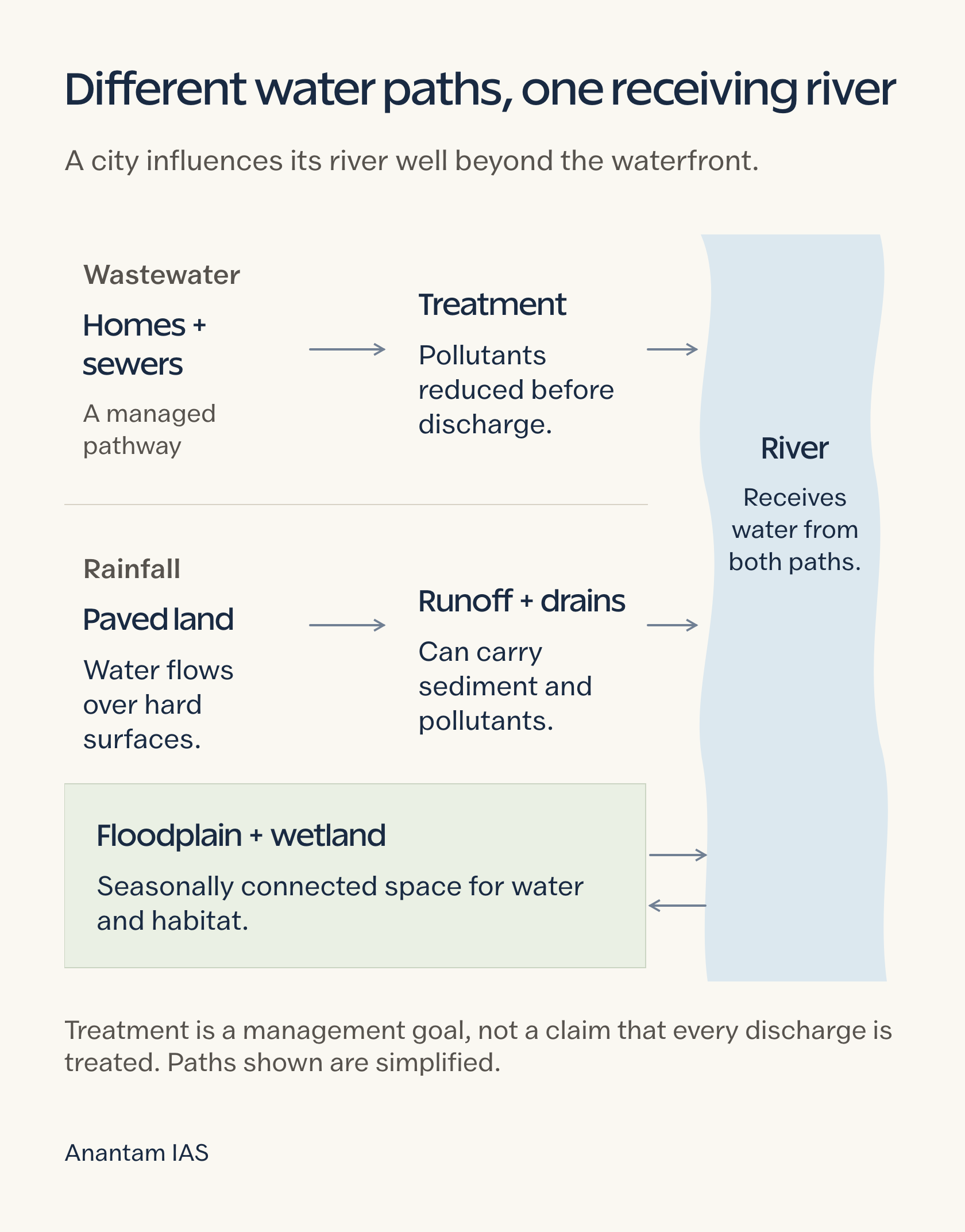
  • Sewage is wastewater requiring collection and suitable treatment. A treatment plant can address the waste routed to it; untreated discharges elsewhere remain a separate problem, so infrastructure must be assessed alongside the collection network.
  • Stormwater starts as rainfall runoff, but it need not remain clean. USGS explains that urban development affects water quality as well as flow; drainage planning must consider pollutants carried towards receiving water bodies.
  • Impervious surfaces, such as roofs and paved roads, reduce infiltration and accelerate runoff towards streams. Faster delivery can increase flood peaks, connecting construction choices across a city with pressures experienced at its river.
  • Floodplains and connected wetlands are part of the river landscape. The Moradabad District Ganga Plan identifies encroachment and wetland degradation as threats to habitats and lateral connectivity, not merely as problems of visual appearance.
  • Environmental flows and pollution loads require attention together. The Moradabad plan separately identifies reduced flows and polluted tributary inflows; treating wastewater does not answer every question about how much water remains in the river.
Diagram separating sewage treatment and rainfall runoff paths into a river, with a connected floodplain
Wastewater, rainfall runoff and floodplain connectivity require coordinated management; treatment is shown as a managed pathway.

Turning a plan into accountable management

Implementation needs a common diagnosis, named responsibilities and observable outcomes; a launch announcement provides none of those outcomes by itself.

  • Start with a baseline: map drains, discharge points, river-linked water bodies and floodplain pressures. The Moradabad plan illustrates why the assessment must connect physical conditions with the institutions responsible for responding to them.
  • River-sensitive master planning connects land use with sanitation, water supply and flood management. NIUA’s existing guidance treats these sectors together, helping avoid situations where one department protects a river while another increases pressure on it.
  • Assign responsibility for each proposed intervention and its upkeep. As a practical governance test, ask who operates the facility, who inspects the result and who must act when monitoring identifies continuing pollution or damage.
  • Judge progress through outcomes, not completed construction alone. Useful assessment questions include whether untreated discharges persist, whether identified floodplain pressures decline and whether the responsible agencies can demonstrate that remedial actions remain functional.
  • The latest PIB announcement confirms a framework and plan launches. It does not establish a new legal prohibition, disclose every plan provision or prove restoration; those claims need the relevant instruments and subsequent implementation evidence.

Way Forward

Link investment with river outcomes

  • Publish a shared action register connecting each identified river pressure with an agency, intervention, maintenance responsibility and measurable result.
  • Protect floodplain connectivity through evidence-based land-use decisions, while assessing upstream and downstream consequences before approving individual waterfront works.
  • Audit sewage collection and treatment together; a functioning plant cannot remove pollution that never reaches it.
  • Use repeat monitoring to revise priorities, separating announced works, operational services and demonstrated improvements in river conditions.

Conclusion

  • Urban river management is a coordination problem with physical consequences: land use shapes runoff, wastewater services shape pollution loads, and floodplain decisions shape the river’s relationship with surrounding land.
  • The new plans matter as a planning step. In a Mains answer, connect each pressure to an intervention and an accountable institution, while distinguishing announced intent from verified ecological improvement.

UPSC Practice Questions

Prelims MCQ 1

With reference to urban river management, consider the following statements:

  1. Impervious surfaces can increase the speed of runoff reaching streams.
  2. Stormwater is necessarily free of pollutants.
  3. A river catchment may extend beyond a municipal boundary.

How many of the above statements are correct?

(a) Only one (b) Only two (c) All three (d) None

Answer: (b) Only two

Explanation:

Statements 1 and 3 are correct. Urban runoff can carry pollutants, so stormwater cannot be assumed clean.

Prelims MCQ 2

Which approach best represents integrated urban river management?

(a) Measuring success only by the length of a promenade (b) Considering sewage treatment without examining collection (c) Connecting land use, wastewater, drainage and floodplain management (d) Restricting assessment to the river channel within municipal limits

Answer: (c) Connecting land use, wastewater, drainage and floodplain management

Explanation:

A systems approach addresses linked pressures and institutional responsibilities across the river landscape.

UPSC Mains Questions

  1. Why can riverfront beautification fail to improve river health? Explain the role of integrated urban river planning. (150 words)
  2. Discuss how land-use planning, sewage management and inter-agency coordination can improve the climate resilience of river cities. (250 words)

Sources: PIB, Ministry of Jal Shakti and NMCG, Moradabad District Ganga Plan.

Frequently Asked Questions

What was announced on 22 September 2026?

The Sustainable Urban River Management Framework was launched at India International Water Week. A Global River Cities Alliance session also launched five Urban River Management Plans, according to the Ministry of Jal Shakti.

How is river management different from riverfront beautification?

Beautification addresses the appearance or public use of a waterfront. River management also considers sewage, runoff, flows, habitats and connected land use, including pressures originating away from the visible riverbank.

Why should sewage and stormwater be distinguished?

Sewage is wastewater needing collection and treatment. Stormwater is rainfall runoff, which can still carry pollutants. Distinguishing them helps identify sources of pollution and choose suitable drainage and sanitation interventions.

Does the framework launch create a new binding law?

The verified announcement establishes a publication launch, not a new binding legal mandate. Any claim about compulsory restrictions must be checked against the relevant legal instrument rather than inferred from the announcement.

I-STEM State Coordination: Sharing Public Research Equipment

Open article →Download PDF

Why in News?

The Office of the Principal Scientific Adviser convened the first I-STEM State Governments Nodal Officers Meeting on September 21 to strengthen shared access to publicly funded research infrastructure.

  • The meeting focused on state universities and laboratories joining the national equipment-sharing ecosystem as users and facility providers.
  • State nodal officers were asked to support institutional onboarding, equipment listing, access and practical coordination.
  • PIB says similar platforms, including CSIR’s ANALYTICS portal, are being integrated with I-STEM through API linkages; this is ongoing work, not confirmed completion.
  • An institution may possess expensive scientific equipment while nearby researchers lack access to the same experimental capability.
  • Shared access can connect existing assets to wider demand, but discovery alone does not ensure that an experiment can actually be carried out.

UPSC Relevance

Prelims Relevance

  • I-STEM connects scientific equipment and facilities with potential users across institutions.
  • The Office of the Principal Scientific Adviser supports the platform.
  • State nodal officers connect state institutions with the national ecosystem.
  • API linkages allow compatible digital systems to exchange information.
  • One Nation One Subscription concerns scholarly resources; I-STEM addresses scientific infrastructure access.

Mains Relevance

GS Paper 3

  • Research infrastructure sharing and efficient public investment.
  • Access barriers faced by smaller research institutions, startups and MSMEs.

GS Paper 2

  • State-level coordination in a national research ecosystem.

Essay

  • Public investment creates greater value when useful capacity can serve people beyond the institution that owns it.

Background and Context

What sharing research infrastructure means

I-STEM addresses an access problem: researchers need specific experimental capabilities, even when their own institution cannot purchase or operate every instrument.

  • A shared facility remains physically located at its host institution while serving users from elsewhere. Sharing access does not mean transferring ownership of the equipment or distributing the instrument among participating institutions.
  • The national listing helps users discover available scientific infrastructure beyond their immediate campus. For a researcher, knowing that a suitable instrument exists is the starting point for exploring access, rather than proof of guaranteed availability.
  • The PIB release identifies researchers, startups, MSMEs and industry as intended users. The access problem spans academic research and innovation: specialised equipment may be needed before an organisation can justify purchasing its own.
  • State universities and laboratories can participate as providers as well as users. Their existing assets can support outside work, while their own researchers can seek capabilities available elsewhere in the national ecosystem.
  • Shared access can reduce unnecessary repeat purchases when suitable capacity already exists. This is a planning rationale, not evidence that every duplicate instrument is wasteful: distance, demand and specialised requirements can still justify additional capacity.

Why state nodal officers matter

A national platform needs institutions to contribute usable information and resolve local access problems; the meeting puts state coordination at that interface.

  • Nodal officers are intended to link state governments, their institutions and the national I-STEM ecosystem. Their coordination role matters because laboratories across a state may have different administrative procedures and levels of readiness.
  • Institutional onboarding brings a facility into the shared system; equipment listing makes its assets discoverable. These are related but different tasks: registering an institution does not automatically create accurate descriptions of every usable instrument.
  • API integration connects existing digital platforms through defined interfaces for exchanging information. PIB describes linkages with similar portals as work underway; the meeting does not establish that every system or equipment record has already been integrated.
  • Infrastructure planning can use the national equipment landscape to identify existing capacity before approving new purchases. A listing is one input into that decision, alongside demand, location, reliability and the suitability of the instrument.
  • The September meeting concerned wider participation and implementation, not the creation of a new research portal or a new law. Its stated priorities should be reported as priorities, rather than demonstrated utilisation gains or quantified savings.

A discoverable instrument must also be usable

The implementation test is whether an outside user can obtain a reliable service, not simply whether the instrument appears in search results.

  • Availability information should distinguish an operational instrument from one awaiting repair. Otherwise a researcher may discover the correct equipment but still be unable to schedule work; this is an operational risk, not a reported nationwide finding.
  • Trained operators and calibration matter for dependable measurements. Sharing a listing cannot replace the technical work that makes an instrument useful; access arrangements need to account for the people and maintenance behind a scientific service.
  • Booking and cost rules should be clear before a user commits time or sends material. Public funding of an instrument does not, by itself, establish free, unlimited or immediate access for every potential external user.
  • Sample handling and research requirements may affect whether a facility can accept a request. A useful access system must help the user and provider establish suitability, rather than equating every listed instrument with an interchangeable service.
  • One Nation One Subscription was also mentioned at the meeting, but it addresses access to scholarly resources. Keep that knowledge-access initiative distinct from I-STEM’s equipment-sharing function; reading research and performing experiments require different supporting arrangements.

Way Forward

Measure whether access actually works

  • Keep equipment status and contact information current so users can distinguish discoverable assets from available services.
  • Track completed access requests and unresolved obstacles alongside new registrations; a larger catalogue alone cannot demonstrate improved research access.
  • Use recurring access problems to guide operator support, maintenance and investment decisions, rather than treating every unmet request as a reason to buy another instrument.

Conclusion

  • I-STEM’s state coordination effort connects publicly funded research capacity with a wider user base. Its practical value depends on institutions making equipment discoverable and translating discovery into reliable access.
  • For an examination answer, connect shared infrastructure with efficient investment and broader research participation. Distinguish the announced coordination priorities from measured outcomes, and equipment access from access to scholarly publications.

UPSC Practice Questions

Prelims MCQ 1

With reference to I-STEM, consider the following statements:

  1. It supports discovery of scientific equipment across institutions.
  2. State institutions can participate as both users and facility providers.
  3. Listing publicly funded equipment guarantees free and immediate access to every user.

How many of the above statements are correct?

(a) Only one (b) Only two (c) All three (d) None

Answer: (b) Only two

Explanation:

The first two statements reflect the platform’s intended role. Public funding and listing do not establish universal free or immediate access.

Prelims MCQ 2

Which distinction between I-STEM and One Nation One Subscription is correct?

(a) Both primarily transfer ownership of laboratory equipment (b) I-STEM concerns scientific infrastructure access, while ONOS concerns scholarly resources (c) I-STEM replaces all institutional laboratories, while ONOS purchases instruments (d) Both automatically guarantee free access to all research services

Answer: (b) I-STEM concerns scientific infrastructure access, while ONOS concerns scholarly resources

Explanation:

The meeting discussed both initiatives, but their functions differ: physical research infrastructure versus scholarly knowledge resources.

UPSC Mains Questions

  1. How can shared scientific infrastructure improve the value of public research investment? Examine the role of state-level coordination.
  2. Explain why discoverability of scientific equipment is necessary but insufficient for effective research access.

Source: PIB, Office of the Principal Scientific Adviser.

Frequently Asked Questions

What is the purpose of I-STEM?

I-STEM helps connect researchers and other users with scientific equipment and facilities across institutions. The state coordination effort seeks wider institutional participation and more effective use of existing publicly funded research infrastructure.

What will state nodal officers do?

The meeting identified nodal officers as links between state governments, their institutions and the national ecosystem. Their role includes supporting onboarding, equipment listing, wider access and resolution of practical coordination problems.

Does public funding mean equipment access is always free?

No. A publicly funded instrument’s listing does not itself establish free, unlimited or immediate access. Users still need clear information about availability, access arrangements and any applicable service costs at the host institution.

Is I-STEM the same as One Nation One Subscription?

No. I-STEM concerns access to scientific infrastructure such as laboratory equipment. One Nation One Subscription concerns scholarly resources. Both can support research, but they address different requirements of the research process.

Why did the SC reject the Methanol rules?

Open article →Download PDF

Why in News?

The Supreme Court in M/s Balaji Formalin Pvt. Ltd. v. Union of India (2026) struck down key provisions of the Maharashtra Poisons Rules, 1972 (amended in 2011) relating to the sale, possession and mandatory denaturing of methanol. 

The Court held that the restrictions violated Articles 14 and 19(1)(g) because they were disproportionate and lacked a sufficient rational connection with their stated objective.

UPSC Relevance: GS-2 Polity and Governance: Fundamental Rights, delegated legislation, judicial review

Prelims: Methanol; Proportionality Test  

Why is Methanol regulated?

  • Methanol (methyl alcohol) is a highly toxic industrial chemical used in pharmaceuticals, solvents, paints, chemicals, fuels and other industries. 
  • Ingestion can cause metabolic acidosis, blindness, neurological damage and death.
  • Its diversion into illicit liquor is particularly dangerous because consumers may mistake methanol-contaminated liquor for ordinary alcohol.
  • Regulatory challenge: Authorities must prevent diversion while preserving legitimate industrial access to a raw material that often requires high purity.

What did the Maharashtra Rules require?

Following a 1991 Mumbai hooch tragedy that killed around 93 people, Maharashtra appointed the P.R. Parthasarthy Committee to recommend preventive measures.

In 2011, the State amended its Poisons Rules and introduced:

  • Rule 18A(1): Required sellers to verify the purchaser’s Form A licence to ascertain the intended use of methanol.
  • Rule 18A(2): Mandated adding a colourant and bitterant before sale, except for methanol purchased for certified drug manufacture.
  • Rule 18B: Made methanol possessed without a valid Form A licence liable to confiscation.

Manufacturers’ objection: Additives could contaminate final products, damage catalysts and make outputs unsuitable for paint, pharmaceutical and laboratory applications.

State’s justification: Colour and bitterness would make methanol identifiable and discourage its use in illicit liquor. 

Why did the Supreme Court strike down the Rules?

The Court accepted the legitimate objective of preventing methanol diversion and hooch deaths, but held that the regulatory measures were not sufficiently connected to that objective and imposed disproportionate burdens on lawful businesses.

  • Lack of rational nexus: The mandatory Form A verification did not reliably establish the actual end-use of methanol because legitimate industrial users could possess/use methanol under other permits, including Form B. Thus, the rule could obstruct lawful users without effectively addressing illegal diversion.
  • Failure of proportionality: Applying the proportionality framework associated with K.S. Puttaswamy, the Court held that although the State had a legitimate objective, it had not demonstrated that these particular measures were suitable, necessary and proportionate to achieving it.
  • Ineffective denaturing requirement: Mandatory addition of colourant and bitterant was not shown to prevent the diversion of methanol or manufacture of spurious liquor. Since the measure did not adequately address the actual source of the risk, the Court found it manifestly arbitrary.
  • Excessive burden on legitimate industry: The denaturing requirement could interfere with legitimate industrial applications requiring methanol of specified purity. Less restrictive alternatives, such as stronger licensing, stock reconciliation and action against diversion, were available.
  • Inconsistency in the licensing framework: Rule 18B, which provided for confiscation of methanol possessed without Form A, could penalise lawful possession under another applicable permit, thereby undermining the coherence of the regulatory system.
Constitutional Principles Involved:

Article 14: State regulation cannot be arbitrary, irrational or disproportionate.
Article 19(1)(g): Citizens have the right to practise a profession or carry on an occupation, trade or business.
Article 19(6): Reasonable restrictions may be imposed in the public interest. However, restrictions must satisfy constitutional standards of reasonableness and proportionality.
Article 47: The State has a duty to work towards prohibition of intoxicating drinks and substances injurious to health. However, public-health objectives do not authorise arbitrary or disproportionate restrictions.

Supreme Court’s Broader Directions

Rather than leaving a regulatory vacuum, the Court emphasised a multi-pronged enforcement approach, including:

  • verification and periodic review of licences
  • reconciliation of methanol consumption and closing stocks
  • investigation of unexplained shortages
  • suspension/cancellation of licences for violations
  • tamper-evident transport and proper sealing
  • stronger inter-departmental coordination
  • monitoring of industrial units for diversion
  • tighter border and transport enforcement and
  • stronger public-health preparedness for mass poisoning incidents.

India needs a risk-based methanol control framework combining: Strict licensing + digital supply-chain tracking + stock reconciliation + secure transportation + targeted enforcement + industrial compliance + rapid medical response.

The effective regulation should prevent the source of harm without unnecessarily obstructing legitimate economic activity.

Practice Prelims MCQ:

Q. With reference to the doctrine of proportionality, consider the following statements:

  1. A legitimate public purpose alone is sufficient to justify any restriction on a fundamental right.
  2. The availability of equally effective, less restrictive alternatives is relevant to assessing necessity.
  3. The burden imposed on rights must be balanced against the expected public benefit.

Which of the statements given above are correct?

(a) 1 and 2 only
(b) 2 and 3 only
(c) 1 and 3 only
(d) 1, 2 and 3

Answer: (b)

Explanation: Statement 1 is incorrect: a restriction must also satisfy suitability, necessity and balancing. Statements 2 and 3 describe these requirements correctly.

Weaponisation of Space and the Governance Gap

Open article →Download PDF

Why in News?

Recently, the U.S. Air Force Secretary acknowledged that the United States operates “on-orbit space control weapons”, describing their purpose as protection against hostile action. Their precise capabilities and deployment dates were not disclosed. 

The announcement raises concerns because U.S. space-control doctrine encompasses both offensive and defensive operations. 

UPSC Relevance: GS-3 Science and Technology: Space Technology 

Prelims: Outer Space Treaty
Mains: Weaponisation of Space: Associated risks and Governance Gap

What is Weaponisation of Space?

  • Weaponisation of space refers to developing, deploying or using capabilities intended to damage, destroy, disable or disrupt space systems, or to attack terrestrial targets from space. It is different from space militarisation, which involves using satellites for military communication, reconnaissance, navigation and missile warning.
  • Counter-space capabilities need not be stationed in orbit: Ground-based missiles, electronic interference and cyber operations can also threaten space infrastructure. The targets may include satellites, ground stations and communication links. 

Major Types of Counter-Space Operations: 

  • Direct-ascent anti-satellite (ASAT) weapons: Ground-launched missiles that fly directly into space to hit and destroy a satellite on impact. India demonstrated this capability through Mission Shakti in 2019. 
  • Co-orbital systems: Manoeuvrable spacecraft can approach another satellite and potentially interfere with its functioning. However, these same close manoeuvres are also used for safe tasks such as inspection, servicing and debris removal.
  • Electronic warfare: Jamming obstructs signals; spoofing supplies deceptive signals to mislead satellite receivers.
  • Cyber operations: Attacks on software, control networks, or ground infrastructure can compromise satellite services without physically destroying a spacecraft.
  • Directed-energy capabilities: Directed energy systems (like high-power lasers or microwaves) can interfere with or damage satellite sensors.

Why Space is the New Military Frontline?

Space is the new frontline of strategic competition because modern military power and daily civilian life completely depend on it.

  • Absolute dependence breeds extreme vulnerability: Satellites provide the backbone for intelligence gathering, precision-guided missile targeting, secure communications, and nuclear early-warning systems. Blinding an adversary’s satellites can instantly cripple their command structure and battlefield awareness, making space infrastructure an incredibly high-yield target.
  • The deterrence paradox: States build counter-space weapons to discourage rivals from attacking their satellites. However, one nation’s defence is another nation’s threat. When a country deploys an anti-satellite system for deterrence, rivals often view it as preparation for a surprise first strike, triggering a defensive arms race.
  • Dual-Use Technology Blurs Intent: Unlike traditional weapons, space technology is inherently dual-use. E.g., A highly manoeuvrable robotic arm designed to repair a friendly satellite or clear dangerous space debris can just as easily be used to rip solar panels off an enemy satellite.
  • Commercial expansion complicates security: Private constellations are increasingly serving civilian and military customers. This dual use blurs the line between commercial infrastructure and warfare, making space security much more complicated.

Every defensive measure by a country to protect its satellites feeds a continuous loop of reciprocal military development, driving the weaponisation of the orbits.

What does International Law Permit and Prohibit?

(i) Outer Space Treaty, 1967:

The Outer Space Treaty (OST) remains the foundational instrument governing activities in outer space. 

  • Article III: Activities in outer space must be conducted in accordance with international law, including the UN Charter.
  • Article IV: It prohibits placing nuclear weapons or other weapons of mass destruction (WMD)  in Earth orbit or stationing them in outer space. It also prohibits military bases, weapons testing and military manoeuvres on the Moon and other celestial bodies. 
  • Article VI: States bear international responsibility for their national space activities, including those carried out by non-governmental entities. 

Critical Limitation: The OST prohibits placing nuclear weapons in space but does not impose a blanket prohibition on conventional weapons in Earth orbit. Therefore, systems such as certain conventional kinetic, electronic or other counter-space capabilities may fall into legal grey areas depending on their characteristics and use. 

(ii) Liability Convention, 1972: 

  • Establishes absolute liability of launching states for damage caused by their space objects on Earth’s surface or to aircraft in flight.
  • Applies fault-based liability to damage caused elsewhere, including to another state’s space object in orbit.

However, attribution, proof of fault and compensation become harder when incidents involve autonomous systems, multiple operators or disruption without physical damage.

(iii) Partial Test Ban Treaty, 1963: Prohibits nuclear explosions in the atmosphere, outer space and underwater. It is distinct from the Comprehensive Nuclear-Test-Ban Treaty.

Why is Space Weaponisation dangerous?

  • Persistent debris and cascading collisions: Destructive attacks can generate fragments that threaten other spacecraft, including those belonging to uninvolved countries. Kessler syndrome describes a self-sustaining process in which collisions generate debris that causes further collisions.
  • Ambiguous actions and accidental escalation: An unexplained manoeuvre, communication failure or cyber intrusion may be misread as an impending attack. The absence of agreed notification procedures and incident-investigation mechanisms increases uncertainty.
  • Disruption of essential civilian services: Satellite attacks can affect navigation, weather forecasting, communications, electricity systems and emergency relief. Even operations that create no debris may produce serious humanitarian consequences.
  • Unequal distribution of costs: A confrontation between major powers could restrict safe orbital access for developing countries and commercial operators that had no role in the conflict. 
  • Risks from autonomous decision-making: Future AI-enabled systems could misclassify another spacecraft’s manoeuvre as hostile. Automated responses may compress the time available for human verification and diplomacy.  

Way Forward: Need for a Credible Governance Framework

  • Clarify capabilities and thresholds: States should disclose broad operational doctrines, explain what they regard as hostile conduct and establish crisis hotlines without necessarily revealing sensitive technical details. 
  • Restrict destructive behaviour: Build on UN General Assembly Resolution 77/41 (2022) concerning destructive direct-ascent ASAT missile testing. 
  • Regulate proximity operations: Develop advance-notification procedures, consent requirements for servicing and debris removal, and context-specific rules for safe approaches.
  • Protect essential civilian services: Where feasible, separate critical civilian functions from military uses and strengthen precautions against disruption of humanitarian and safety-related systems.
  • Establish accountability for autonomy: Require human authorisation for decisions to use force, auditable operational records, fail-safe mechanisms and clear supervision of commercial operators.
  • Use multilateral forums: The UN Open-Ended Working Group on the Prevention of an Arms Race in Outer Space in All Its Aspects provides a forum to develop recommendations and bridge differences over binding rules and responsible behaviour.

Space traffic coordination can reduce accidents, but preventing deliberate attacks also requires security agreements, verification and political restraint. Multilateral rules must protect civilian services, constrain destructive actions and preserve orbital access while addressing states’ legitimate security concerns.  

Practice Prelims MCQ:

Q. With reference to international space law, consider the following statements:

  1. The Outer Space Treaty prohibits every category of weapon in Earth orbit.
  2. States bear international responsibility for national space activities conducted by private entities.
  3. The Liability Convention provides for fault-based liability for damage caused by one state’s space object to another state’s space object in orbit.

Which of the statements given above are correct?

(a) 1 and 2 only
(b) 2 and 3 only
(c) 1 and 3 only
(d) 1, 2 and 3

Answer: (b)

Explanation: Statement 1 is incorrect: the treaty’s orbital weapons prohibition specifically covers nuclear weapons and other WMD. Statements 2 and 3 correctly describe state responsibility and the applicable liability standard.

Mains Practice Question:

Q. “Dual-use technologies and strategic ambiguity make the weaponisation of space a challenge of governance as much as security.” Discuss the limitations of the existing international framework and suggest a suitable approach.

How will Gaganyaan’s Crew Module deploy its Parachutes?

Open article →Download PDF

Context:

Gaganyaan’s success depends on bringing astronauts safely back to Earth. Its parachute-based deceleration system stabilises and slows the returning crew module before splashdown. It comprises 10 parachutes of four types, deployed in a carefully controlled sequence

UPSC Relevance: GS-3 Science and Technology: Space Technology 

Prelims: Gaganyaan mission, Human-rated LVM3, Crew Module and parachute-based deceleration system
Mains: Gaganyaan mission & its significance for India’s space ecosystem and future human-space exploration.

What is the Gaganyaan Mission?

  • Gaganyaan is India’s human spaceflight programme led by the Indian Space Research Organisation (ISRO). It aims to demonstrate India’s capability to send humans to Low Earth Orbit (LEO) and return them safely to Earth.
  • The mission is designed to carry three astronauts (Vyomanauts) to an approximately 400-km orbit for a short-duration mission.
  • Orbital module: Consists of a Crew Module, which houses astronauts and returns to Earth, and a Service Module, which provides power, propulsion and other support in orbit.
  • The astronauts will undertake microgravity experiments and technology demonstrations.
  • The Human-rated LVM3 will serve as the launch vehicle.
  • The Human Space Flight Centre (HSFC) coordinates the programme.
  • The return journey will culminate in a low-velocity splashdown in the sea.

ISRO’s current programme roadmap envisages uncrewed missions before the first crewed orbital mission targeted for 2027

Why are parachutes needed during re-entry?

  • When the Crew Module returns from orbit, it possesses very high kinetic energy. During atmospheric re-entry, aerodynamic drag generated by the atmosphere removes a major part of its velocity. However, atmospheric drag alone is insufficient to bring the spacecraft down gently.
  • The parachute-based deceleration system therefore performs the final stages of velocity reduction and stabilisation before splashdown.
  • The key challenge is that a parachute cannot simply be opened at very high speed. Sudden deployment would generate enormous opening shock and aerodynamic loads, potentially damaging the parachute or imposing dangerous deceleration on the crew.

Hence, Gaganyaan uses a multi-stage, redundant parachute system.

How will Gaganyaan’s parachutes deploy?

The operational Gaganyaan system contains 10 parachutes of four types. 

  • Stage 1: Apex Cover Separation (ACS) parachutes: Two small ACS parachutes are deployed first. Their primary function is not to slow the Crew Module for landing. Instead, they help remove the protective apex cover from the parachute compartment.
  • Stage 2: Drogue parachutes: After the apex cover is separated, two drogue parachutes are deployed. Their functions are to stabilise the Crew Module, reduce its velocity during the early stage of parachute-assisted descent and prepare the vehicle for deployment of the main parachutes. 
  • Stage 3: Pilot parachutes: Once the drogue phase is complete, three pilot parachutes are deployed. These are smaller parachutes whose principal function is to extract the three main parachutes from their packed configuration.
  • Stage 4: Main parachutes: The three pilot parachutes independently extract three large main parachutes. The main parachutes provide the major deceleration required for the final descent and bring the Crew Module to a safe splashdown velocity.

ISRO’s 2025 Integrated Air Drop Test demonstrated the complete sequence using a simulated Crew Module, with the three main parachutes reducing terminal velocity to approximately 8 m/s

Why is the deployment done in multiple stages?

  • Avoiding excessive opening shock: A spacecraft descending through the atmosphere is subjected to significant dynamic pressure. If a large main parachute were opened suddenly while the Crew Module was still travelling too fast, the resulting aerodynamic force could:
    • Tear or damage the canopy.
    • Overload suspension lines and structural components.
    • Produce excessive deceleration for the astronauts.
    • Destabilise the Crew Module.

The solution is progressive deceleration. Each stage operates after the vehicle reaches an appropriate flight condition.

How are the parachutes tested?

Because parachute failure during an actual crewed mission could be catastrophic, Gaganyaan’s parachutes undergo testing under simulated flight conditions.

  • Rail Track Rocket Sled (RTRS) tests: At the Terminal Ballistics Research Laboratory (TBRL), Chandigarh, rocket-powered sleds accelerate test articles along a rail track to reproduce high-speed deployment conditions. These tests have been used for components including the drogue, pilot and apex-cover-separation parachutes. 
  • Integrated Air Drop Tests (IADT): A simulated Crew Module is released from an aircraft or helicopter, and the complete parachute sequence is tested.
    • IADT-01 (2025): A simulated ~4.8-tonne Crew Module was released from about 3 km using an IAF Chinook.
    • IADT-02 (2026): A ~5.7-tonne simulated Crew Module was released from about 3 km, and the complete 10-parachute sequence was successfully demonstrated.
  • Integrated Main Parachute Air Drop Tests: These tests specifically qualify the large main parachutes under high-load and failure scenarios. In 2026, ISRO conducted IMAT-05, using an IAF IL-76 to drop a simulated main-parachute configuration from 2.5 km. It was the fifth test in the IMAT series. 

What happens after splashdown?

  • The parachutes cannot simply remain attached indefinitely after landing. After splashdown, wind or water currents acting on the inflated canopy could drag the Crew Module or destabilise/capsize it.
  • Therefore, the main parachutes are released using parachute-release mechanisms, including pyrotechnic systems. This is particularly important because Gaganyaan’s recovery operation involves the Indian Navy and other recovery assets.

What materials are used?

  • Aerospace parachutes require a combination of:
    • High tensile strength.
    • Low mass.
    • Thermal resistance.
    • Flexibility and elasticity.
    • Resistance to repeated folding and packing.
    • Ability to withstand high dynamic loads.

Common advanced materials include:

  • Nylon: Used extensively in parachute canopy fabrics because of its strength, elasticity and relatively low mass. Its elasticity helps absorb part of the shock during inflation.
  • Kevlar: Its high tensile strength and heat resistance make it useful in load-bearing components such as suspension lines, risers and reinforcement elements.
  • Nomex: A heat-resistant aramid material used in applications where components may experience elevated temperatures.

Aerospace parachutes are not simply larger versions of conventional parachutes. They are highly engineered systems integrating materials science, aerodynamics, pyrotechnics, structural engineering and control of dynamic loads.

Practice Prelims MCQ: 

Q. With reference to the Gaganyaan Crew Module, consider the following statements:

  1. Its parachute-based deceleration system comprises four types of parachutes.
  2. Drogue parachutes primarily help stabilise and decelerate the Crew Module before deployment of the main parachutes.
  3. Three main parachutes are deployed independently through pilot parachutes.

Which of the statements given above are correct?

(a) 1 and 2 only
(b) 2 and 3 only
(c) 1 and 3 only
(d) 1, 2, and 3

Answer: (d)

India’s first blue bond set for launch next week, official says

Open article →Download PDF

Why in news?

Sagarmala Finance Corporation will issue India’s first blue bond on September 28 for maritime projects.

UPSC Relevance

Prelims

Mains

  • GS-III: Mobilisation of resources; investment models; infrastructure (ports); conservation and climate finance.

About First Blue Bond

  • Definition: Blue bonds are debt instruments that fund sustainable water and marine projects: clean water, recycling, shipping, sustainable fishing, ocean energy and mapping.
  • Issuer: Sagarmala Finance Corporation Ltd (SMFCL), a central public sector enterprise and India’s first maritime-focused lender.
  • Date: Maiden blue bond issue on 28 September 2026.
  • Size: Up to ₹600 crore (₹6 billion, about $62.6 million), which includes a greenshoe option of ₹500 crore. The base is ₹100 Crore.
    • A greenshoe option lets an issuer raise extra money beyond the base issue if investor demand is strong. In Sagarmala’s blue bond, up to ₹500 crore more can be retained. The name comes from the Green Shoe Manufacturing Company, the first to use it (1963).
  • Tenor: 10-year bonds, as per a provisional term sheet.
  • Use of money: Maritime sector lending, greenfield port projects and coastal road networks, to be used within FY 2026-27.
  • Rating and arranger: AA+ by ICRA and CARE; SBI Capital Markets is the arranger. Large insurers and provident funds are the target investors.
  • Global first: Seychelles issued the world’s first sovereign blue bond in 2018, with World Bank support, to fund sustainable fisheries.
  • SEBI (Issue and Listing of Non-Convertible Securities) Regulations, 2021: Define ‘green debt securities’. In 2023, SEBI widened the definition to include blue bonds (water and maritime), yellow bonds (solar) and transition bonds.

 Why this matters for India?

  • India has a long coastline (officially re-measured at about 11,098 km in 2025, up from 7,517 km), an EEZ of over 2 million sq km, and 12 major ports.
  • About 95% of India’s trade by volume moves by sea, so port finance is central to trade competitiveness.
  • Government plans such as the Sagarmala Programme (2015), Maritime India Vision 2030, Maritime Amrit Kaal Vision 2047 and the Deep Ocean Mission (2021) need long-term, low-cost money.
  • A blue bond opens a new pool of investors (ESG funds, insurers, pension funds) for maritime projects.

Concerns that remain

  • Is it really ‘blue’? The money will fund greenfield ports and coastal roads. These can damage mangroves, coral reefs and fishing grounds, and may clash with Coastal Regulation Zone (CRZ) rules. Without strict impact reporting, this risks ‘blue-washing’.
  • Small size, big need: ₹600 crore is tiny next to the lakhs of crores planned under Sagarmala. The real value is in creating a market and a benchmark, not in the amount.
  • No national taxonomy yet: India is still finalising its climate finance taxonomy (a draft was released in 2025). Without it, what counts as ‘blue’ is judged against global guides like ICMA principles.
  • Sustainable fisheries and coastal communities are left out of the stated use of proceeds, though they are central to the blue economy.

Types of bonds in India: a comparison

Type of bondWhat the money fundsFramework in IndiaExample / status
Green bondEnvironmental projects: renewable energy, clean transport, energy efficiency, waste management, pollution control, climate adaptationSEBI green debt securities rules (2017; revised 2023, now in NCS Regulations 2021)Sovereign green bonds since 2023; many PSU and corporate issues (e.g. IREDA, NTPC)
Blue bondWater and ocean economy: clean water, wastewater, sustainable fishing, shipping, ports, marine conservation, ocean energyA sub-category of green debt securities under SEBI (added 2023)Sagarmala Finance, 28 Sept 2026 (first in India); Vadodara municipal blue bond planned. World’s first sovereign blue bond: Seychelles (2018)
Yellow bondSolar energy generation and related infrastructureA sub-category of green debt securities under SEBI (added 2023)Recognised label; issuances so far are rare
Transition bondHelping polluting firms shift to cleaner operations (e.g. steel, cement, power moving to lower emissions)A sub-category of green debt securities under SEBI (added 2023)Key for ‘hard-to-abate’ sectors; risk of greenwashing
Social bondSocial outcomes: affordable housing, health, education, basic infrastructure, food security, jobsSEBI ESG debt securities framework (5 June 2025)Must follow ICMA or similar global principles
Sustainability bondA mix of green and social projectsSEBI ESG framework (2025); must meet both green and social rulesUse of proceeds split across both types of projects
Sustainability-linked bond (SLB)General purposes. The money is not tied to projects; instead the interest rate is tied to the issuer meeting sustainability targets (KPIs)SEBI ESG framework (2025)If the target is missed, the coupon usually steps up (issuer pays more)
Sovereign green bond (SGrB)Government spending on green public projects (solar, green hydrogen, metro rail, afforestation)Sovereign Green Bonds Framework (Nov 2022), issued by RBI for the CentreFirst issue Jan–Feb 2023, ₹16,000 crore in two tranches; reviewed by CICERO

Remember the key split: green, blue, yellow, transition, social and sustainability bonds are use-of-proceeds bonds (the money is tied to projects). A sustainability-linked bond is outcome-based (the money is free to use, but the interest rate depends on meeting targets).

Way forward: a national taxonomy; mandatory impact reporting; credit enhancement for smaller issuers; linking blue bonds to CRZ compliance and fishing community welfare to fulfill SDG 6 and 14.

Practice MCQ 

Q1. With reference to sustainable finance in India, consider the following statements:

  1. Under SEBI’s rules, blue bonds and yellow bonds are sub-categories of green debt securities.
  2. Yellow bonds are issued to finance sustainable fisheries and marine conservation.
  3. Sagarmala Finance Corporation is registered with the RBI as a Non-Banking Financial Company.

Which of the statements given above are correct?

(a) 1 and 2 only   (b) 1 and 3 only   (c) 2 and 3 only   (d) 1, 2 and 3

Answer: (b). Statement 2 is wrong: yellow bonds finance solar energy. Sustainable fisheries fall under blue bonds.

Q2. Consider the following statements:

Statement I: In a sustainability-linked bond, the issuer is not required to spend the money raised on specific green projects.

Statement II: In a sustainability-linked bond, the interest rate is linked to whether the issuer meets pre-set sustainability targets.

Which one of the following is correct?

(a) Both statements are correct and Statement II explains Statement I

(b) Both statements are correct but Statement II does not explain Statement I

(c) Statement I is correct but Statement II is incorrect

(d) Statement I is incorrect but Statement II is correct

Answer: (a). An SLB is outcome-based, not use-of-proceeds based. Because the reward or penalty works through the coupon, the money itself need not be tied to projects.

Mains Practice Question 

Q. “Blue bonds can unlock private capital for India’s blue economy, but only if they avoid the trap of blue-washing.” Discuss in the context of India’s first blue bond issue. (10 marks, 250 words)

Water wealth: Groundwater exploitation in Punjab disincentivises small farmers

Open article →Download PDF

Why in news?

The Hindu editorial flags how Punjab’s 152% groundwater extraction is widening wealth gaps among farmers.

UPSC Relevance

Prelims

Mains

  • GS-I: Distribution of key natural resources (water).
  • GS-III: Cropping patterns, irrigation systems, direct and indirect farm subsidies, MSP; conservation and environmental degradation.

2025-26 Dynamic Groundwater Assessment

  • The dynamic groundwater assessment in India is conducted jointly by the Central Ground Water Board (CGWB) and the State/UT Ground Water Departments and the report is released under the authority of the Ministry of Jal Shakti.
  • As per the 2025-26 Dynamic Groundwater Assessment.
    • National SoE (Stage of Groundwater Extraction) is 60.63% which is safe , but 730 of 6,762 units (10.8%) are over-exploited, mostly in the North-West, West and South.
    • Punjab is the worst case: it draws 26.32 BCM against 17.29 BCM extractable, an SoE of 152%. So Punjab uses about 52% more than it can sustainably withdraw.
      • Irrigation uses 24.95 BCM of this.
  • Farm practices drive the crisis: water-hungry crops, free power, MSP bias, flood irrigation and a tube well race.
  • Degradation is about quality too: nitrate, fluoride, arsenic and uranium contamination.

Important concepts

  • Aquifer: An underground layer that stores and releases water.
    • Alluvial aquifers (Punjab, Haryana) recharge easily; hard-rock aquifers (Peninsular India) store little.
  • Recharge: Water that seeps into aquifers from rain, canals, ponds and irrigation. India: 448.52 BCM a year.
  • Stage of Groundwater Extraction (SoE): Extraction ÷ extractable resource × 100.
    • Categories: Safe (up to 70%), Semi-critical (70–90%), Critical (90–100%), Over-exploited (above 100%).
  • Over-exploitation: Drawing more than the aquifer refills each year, which amounts to mining water.
  • Groundwater depletion: A long-term fall in stored groundwater. 
  • Groundwater stress: Pressure on supply to meet the demand, even if water is not absent. India measures it by SoE. 
  • Groundwater scarcity: Water not available or not usable when needed.
    • Physical scarcity: aquifers drying, as in Bundelkhand or Bengaluru’s borewells in 2024. 
    • Economic scarcity: water exists deeper but the poor cannot afford to reach it, as with Punjab’s small farmers buying water.
  • Falkenmark index (per person per year): below 1,700 m³ is stress, below 1,000 m³ scarcity, below 500 m³ absolute scarcity. India’s availability is about 1,486 m³ (2021 estimate), so India is water-stressed.
  • Groundwater degradation: Loss of quality. Nitrate (Rajasthan, Tamil Nadu, Maharashtra), fluoride (Haryana, Karnataka), arsenic (Ganga–Brahmaputra plains), uranium (Punjab’s Malwa belt).
  • Groundwater drought: Water levels stay low even after the monsoon because the aquifer did not refill.
  • Virtual water: Water embedded in traded goods. Punjab’s rice and wheat sent to the central pool carry its aquifer out of the State.

How farming practices affect groundwater adversely?

  • Wrong crops in wrong places: Paddy needs roughly 3,000–5,000 litres per kg yet is grown in semi-arid Punjab and Haryana; sugarcane dominates drought-prone Marathwada.
  • Free or flat-rate power: Free in Punjab since 1997. When pumping costs nothing extra, no one saves water.
  • MSP and assured procurement: Only wheat and paddy are reliably bought, which locks farmers into the rice-wheat cycle.
  • Flood irrigation: Efficiency of about 35–40%, against about 90% for drip.
  • Tube well race: Punjab has about 14 lakh tube wells. Deep submersible pumps replaced shallow ones, and each farmer pumps harder to keep up: a tragedy of the commons (Garrett Hardin, 1968).
    • Tushaar Shah calls India’s groundwater economy an ‘atomistic’ or ‘anarchic’ system: millions of private pumps with no collective control.
  • Loss of recharge structures: Ponds, tanks and johads encroached or silted; canals neglected.
  • Chemical overuse: Excess urea leaches nitrate into aquifers.
  • Soil damage: Compaction, loss of organic matter and stubble burning reduce rain soaking into the ground.
  • Drainage failure: Waterlogging and salinity in SW Punjab (Fazilka, Muktsar), the opposite problem.

Present Legal and institutional framework

  • Water is a State subject (Entry 17, List II), subject to Entry 56, List I.
  • Indian Easements Act, 1882: The landowner can draw the groundwater beneath his land. There is no legal cap on private pumping.
  • CGWA under Section 3(3) of the Environment (Protection) Act, 1986; its 2020 guidelines on groundwater use exempt agriculture.
  • Model Groundwater Bill, 2016 (Mihir Shah Committee): groundwater as a common resource held in public trust.
  • Judgments: Subhash Kumar v. State of Bihar (1991) read clean water into Article 21.

Challenges before the government

  • Subsidy politics: Free power and MSP are hard to touch; metering meets farmer resistance.
  • Legal gap: Land-linked groundwater rights leave no cap on private pumping.
  • Federal limits: Few States have adopted the Model Bill; the CGWA does not regulate farm use.
  • Weak markets for other crops: Maize, pulses and millets lack assured prices, storage and processing.
  • Small landholdings: 86% of farmers are small or marginal (Agriculture Census 2015-16); drip costs too much for them.
  • Food security: Punjab and Haryana feed the central pool, so a sudden shift could hurt the PDS.
  • Data gaps: Sparse observation wells and few metered tube wells.
  • Perverse effects: PM-KUSUM solar pumps make pumping free unless linked to buy-back of surplus power.
  • Collective action and climate change: Shared aquifer, separate decisions; erratic monsoons raise irrigation demand.

Way ahead

  • The Mihir Shah Committee (2016) recommended:
    • Merging the CWC and CGWB into a National Water Commission.
    • Treating groundwater as a common-pool resource held in public trust.
    • Participatory aquifer mapping and management, with farmers as stakeholders.
    • Shifting from supply-side to demand-side management.
    • Procuring water-saving crops to support diversification.
    • Stronger groundwater regulation, taken forward in the Model Groundwater Bill (2016).
  • Price reform: Meter power with a free quota and pay for units saved (Pani Bachao Paisa Kamao). Separate farm feeders (Gujarat’s Jyotigram, 2003). Solar power buy-back (Dhundi solar cooperative, Gujarat). 
  • Monetary incentives : Pani Bachao Paisa Kamao scheme in Punjab incentivises farmers saving per kilowatt hours below the threshold.
  • Crop shift: Per-acre incentives to leave paddy (Haryana’s Mera Pani Meri Virasat). MSP and procurement for maize, pulses, cotton and millets. Direct Seeded Rice and alternate wetting and drying.
  • Efficiency: Micro-irrigation under PMKSY ‘Per Drop More Crop’, with group drip for small farmers.
  • Recharge: Jal Shakti Abhiyan ‘Catch the Rain’, Mission Amrit Sarovar, MGNREGA water works, canal-based managed aquifer recharge.
  • Legal reform: Adopt the Model Groundwater Bill; regulate by aquifer rather than land; bring Punjab into Atal Bhujal Yojana or a State version.
  • Community management: Andhra Pradesh Farmer Managed Groundwater Systems (APFAMGS); Hiware Bazar, Maharashtra.
  • Target the cultivator: Route benefits to tenants and smallholders, not landowners or pump owners.

Mains Practice Question 

“India’s groundwater crisis is less a problem of nature than of policy.” Discuss with reference to agricultural practices, and suggest measures for sustainable groundwater use. (15 marks, 250 words)

Cannot penalise refusal to sing National Song, says SC

Open article →Download PDF

Why in news?

SC said conscientious objectors refusing Vande Mataram stanzas cannot face prosecution; sought Centre’s reply on 2026 Amendment.

UPSC Relevance

  • Prelims: Vande Mataram (origin, adoption, status); Prevention of Insults to National Honour Act, 1971 and its 2026 Amendment; Articles 19(1)(a), 25, 26, 51A(a)
  • Mains – GS-II: Fundamental Rights; Basic Structure (secularism); judicial review of legislation; executive orders vs. law. 

Prevention of Insults to National Honour Act, 1971

  • It protects the National Flag, the Constitution of India and the National Anthem, Jana Gana Mana. 
  • Section 2 deals with the Flag and Constitution. 
  • Section 3 prohibits intentionally preventing the singing of the national anthem, or disturbing any assembly engaged in such singing. 
  • These offences carry up to three years’ jail, a fine, or both, and a second or later conviction carries a minimum of one year.  

What did the 2026 amendment change?

  • It adds the National song to Section 3 such that Vande Mataram gets the same protection as the National Anthem. 
  • Intentionally preventing the singing of the National Anthem or National Song, or disturbing an assembly engaged in such singing, is now punishable with up to three years’ jail, fine, or both. 
  • The government’s rationale rests on the 24 January 1950 Constituent Assembly proceedings, where Dr. Rajendra Prasad gave Vande Mataram status equal to Jana Gana Mana because of its role in the freedom struggle.  
  • Section 3 punishes preventing or disturbing the singing – not for simply refusing to sing. The threat of penalty for non-singers comes from reading the Act together with the MHA orders dated January 28 and July 9, 2026 that require the complete six-stanza version to be sung at specified government, ceremonial and cultural occasions. The compulsion comes from the MHA executive orders.

The constitutionality test

  • Fundamental Rights involved
    • Art. 19(1)(a): Free speech includes the right to remain silent. Compelled speech is also a restriction; it must fit Art. 19(2) grounds.
    • Art. 25: Freedom of conscience and religion (individual). Art. 26: Rights of religious denominations (collective).
      • Paras three to six expressly invoke devotion to Hindu deities, so mandating them violates the secular character of the nation. 
  • Secularism is part of the Basic Structure – S.R. Bommai v. Union of India (1994).
  • Justice Bagchi said the Bijoe Emmanuel ruling protecting those who choose not to sing the national anthem still holds the field. So a conscientious objector who does not recite one or all stanzas should not face criminal prosecution. 
  • He also said that what is the National Song is not in dispute. It is for the democratically-elected state to decide and give aspiration as to what the National Song is. 

Hence, the Court accepted the symbol but signalled it will guard the individual’s conscience.

  • Bijoe Emmanuel v. State of Kerala (1986)
    • Three Jehovah’s Witness children were expelled for not singing the Anthem, though they stood respectfully.
    • Bench (Justices O. Chinnappa Reddy and M.M. Dutt) held the expulsion violated Arts. 19(1)(a) and 25. Standing in respect is enough; no law compels singing. Executive instructions without statutory backing cannot restrict fundamental rights.
    • “Our tradition teaches tolerance; our philosophy preaches tolerance; our Constitution practises tolerance; let us not dilute it.” — Justice O. Chinnappa Reddy

Vande Mataram 

  • Written by Bankim Chandra Chatterjee (1870s); included in his novel Anandamath (1882). 
  • First sung at the INC session of 1896 by Rabindranath Tagore.
  • Became the slogan of the Swadeshi Movement (1905). 
  • In 1937, the Congress Working Committee chose only the first two stanzas for national occasions, as later stanzas invoke Durga, Lakshmi and Saraswati.
  • On 24 January 1950, Dr. Rajendra Prasad declared in the Constituent Assembly that Vande Mataram shall be honoured equally with Jana Gana Mana.
  • The Constitution does not mention a National Song. Article 51A(a) covers only the Flag, Anthem and Constitution.

Practice MCQs 

Q1. Consider the following statements:

  1. Vande Mataram was first published in the novel Anandamath.
  2. Article 51A(a) directs citizens to respect the National Song.
  3. Vande Mataram was accorded equal honour with Jana Gana Mana on 24 January 1950.

How many of the above statements are correct?

  1. Only one
  2. Only two
  3. All three
  4. None

Answer: (b). Statement 2 is wrong: Art. 51A(a) mentions the Constitution, Flag and Anthem only.

Q2. Under Section 3 of the Prevention of Insults to National Honour Act, 1971, which of the following acts are punishable?

  1. Intentionally preventing the singing of the National Anthem
  2. Causing disturbance to an assembly engaged in singing the National Song
  3. Failing to stand while the National Anthem is played

Select the correct answer:

  1. 1 only
  2. 2 and 3 only
  3. 1 and 2 only
  4. 1, 2 and 3

Answer: (c) Not standing is covered by the MHA’s executive orders, not by Section 3.