Opens in a new tab
Join Anantam IAS Channel on Telegram

Daily Digest · Saturday

26 July 2025 Current Affairs for UPSC

5 current affairs published on Saturday, 26 July 2025

26 July 2025 Current Affairs for UPSC — every Why-in-News article AnantamIAS published on Saturday, 26 July 2025, broken down with Why in News?, the exact GS paper it feeds, sub-topic mapping, MCQ-ready facts and a UPSC-style practice question. 5 articles in total, covering Polity, Economy, Environment, S&T, IR, Geography, History, Society and Internal Security — the same Why-in-News + GS-paper-mapping + practice-question format the Compass uses across every daily digest on the site.

Daily current affairs for UPSC is where new material enters your prep stream. Read this 26 July 2025 digest end-to-end in 25–35 minutes, attempt the practice question at the foot of each article (it's MCQ for some, 10/15-marker for others), then bookmark the entries that fall inside your active revision window. Everything stays cross-linked: tap any subject pill to jump to that subject's hub, or use the table of contents above to skip straight to a specific story.

Use this page three ways. Read sequentially for a one-sitting scan of everything that mattered on 26 July 2025. Download the 26 July 2025 PDF below for offline study or print revision. Or use the July 2025 Current Affairs compilation to see this day in the month's full context. For the previous day's reading, see 25 July 2025 Current Affairs; the next day's is 27 July 2025 Current Affairs.

Why we publish daily current affairs separately from the monthly compilation: daily is learning, monthly is revision. Use the daily page to add fresh material to your notes the day it breaks; come back to the July 2025 compilation 60 days before Prelims when the noise has settled and only the lasting takeaway is worth re-reading.

Vice-President Election Process

Open article →Download PDF

image 11

Why In News:

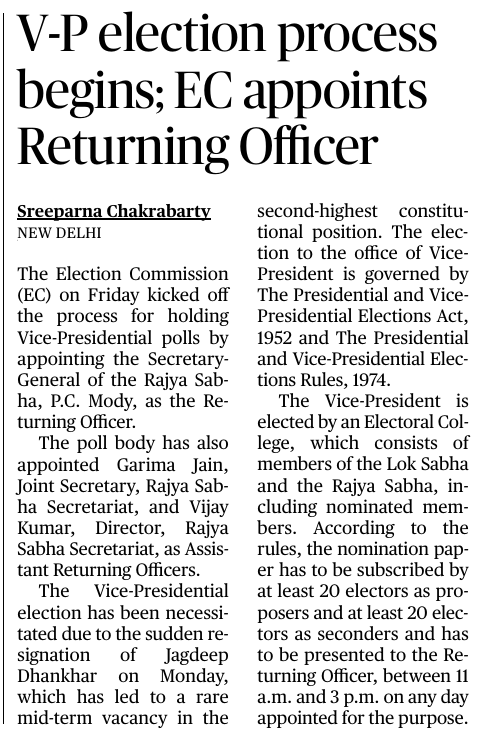
This election has been triggered due to the sudden resignation of Vice-President Jagdeep Dhankhar, leading to a mid-term vacancy in the office. The Election Commission of India has officially started the Vice-Presidential election process. It appointed P.C. Mody, Secretary-General of the Rajya Sabha, as the Returning Officer.
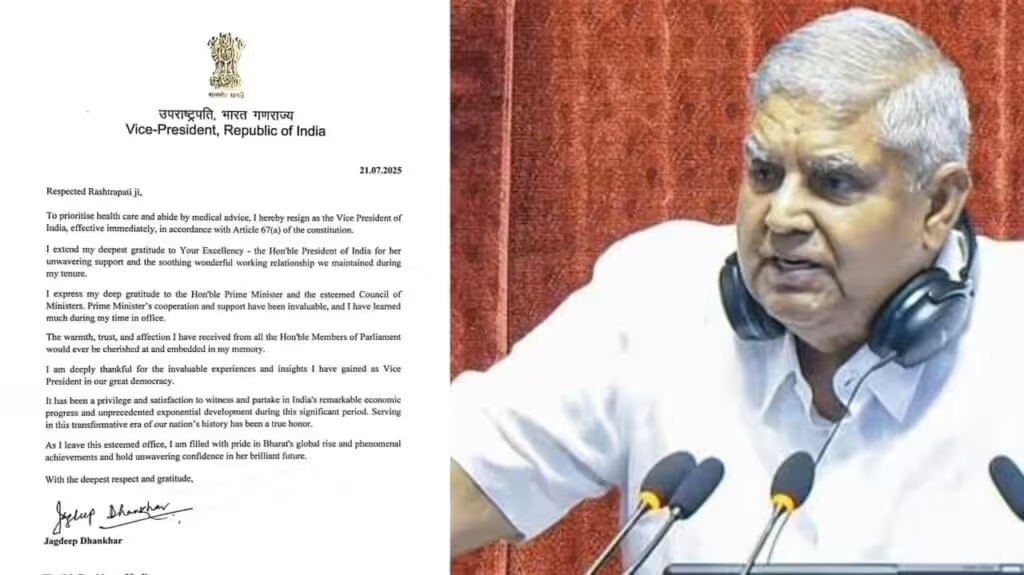
image 12

UPSC relevance: GS II

UPSC CSE in prelims as well as in mains examination has focused on Role of Vice-President and election process of Vice-President. A case in point is a following PYQ.

Prelims PYQ 2013

Consider the following statements
The Chairmen and the Deputy Chairman of the Rajya Sabha are not the members of that House.
While the nominated members of the two Houses of the Parliament have no voting right in the presidential election, they have the right to vote in the election of the Vice President.
Which of the statements given above is/are correct?
A) 1 only
B) 2 only
C) Both 1 and 2
D) Neither 1 nor 2

UPSC Mains PYQ 2022:

Discuss the role of the Vice-President of India as the Chairman of the Rajya Sabha.

Election Process of Vice President:
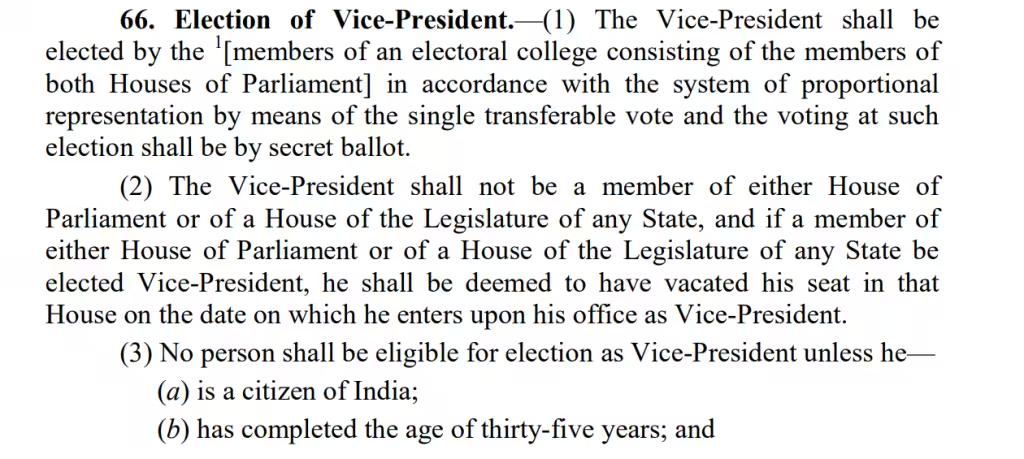
image 12
  • Article 66 of the Indian Constitution define election process of vice-president.
  • The Vice-President is elected by an Electoral College consisting of members of both Houses of Parliament by single transferable vote (including nominated members in case of President only elected candidate Participate).
  • A nomination must be supported by at least 20 proposers and 20 seconders.
  • Nomination papers must be submitted to the Returning Officer between 11 a.m. and 3 p.m. on designated days.

Qualification to become Vice-President under Article 66

  • Must be a citizen of India
  • Has completed the age of thirty-five years
  • Qualified for election as a member of the Council of States
  • A person shall not be eligible for election as Vice-President if he
    holds any office of profit under the Government of India or the Government of
    any State or under any local or other authority subject to the control of any of
    the said Governments.

image 13

Oath or affirmation by the Vice-President:

Article 69: Every Vice-President shall, before entering upon his office, make and subscribe before the of President, or some person appointed in that behalf by him, an oath or affirmation in the following form.

Practice Question:

Consider the following statements

  1. Jagdeep Dhankhar only the third Vice-President in India’s history to resign before completing his term.
  2. In Vice-President election elected members of legislative assembly take part.
  3. The Vice-President Candidate must qualified for election as a member of the Lok Sabha.

How many of the above statements are incorrect?

a) Only one

b) Only two

c) All Three

d) None of the above

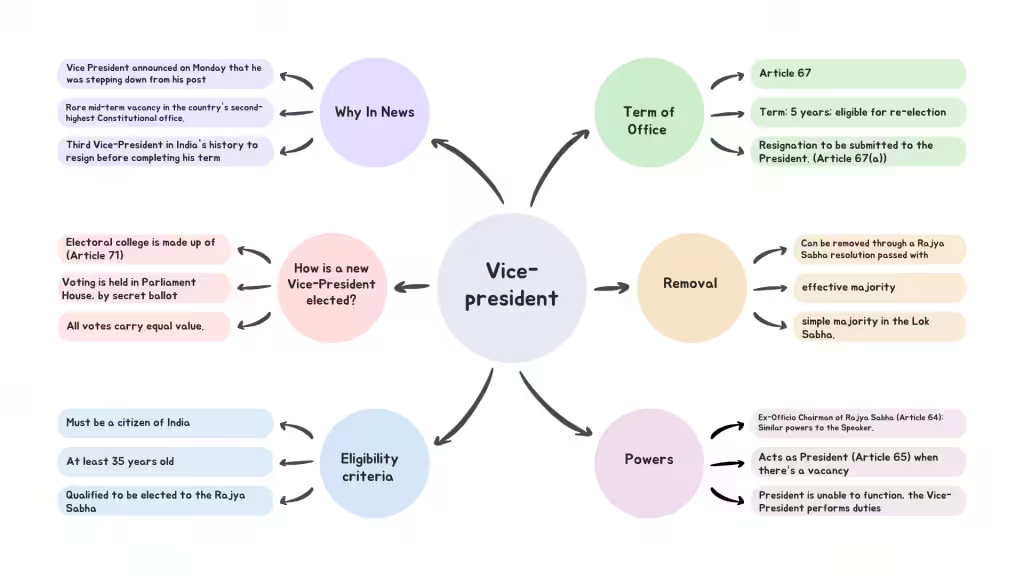
All About Vice-President through Mind Map:
Pastel Modern Design Thinking Process Mind Map Brainstorm1

Citizenship Amendment Act

Open article →Download PDF

image 14

Why in News:

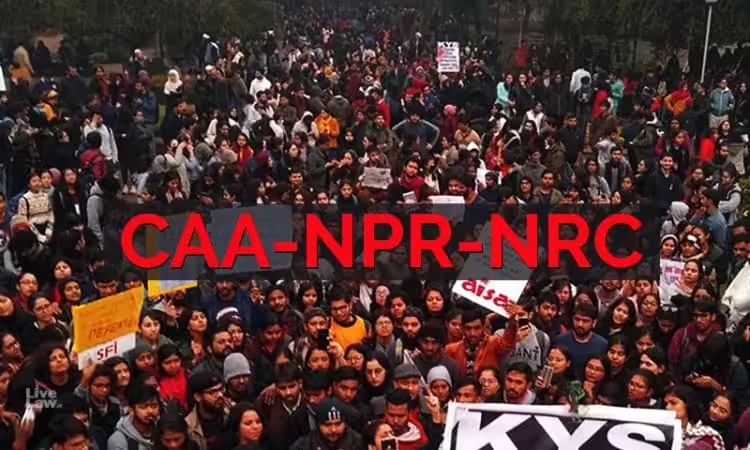
185 Pakistani refugees were officially granted Indian citizenship under the Citizenship (Amendment) Act, 2019 (CAA) in Gujarat’s Rajkot. This marks a major implementation milestone for the CAA, which had seen a long delay in granting citizenship after its passage.

image 14 1

UPSC relevance: GS II

UPSC CSE in prelims as well as in mains examination has focused on Citizenship and Amendments in citizenship act made by GOI for Citizenship. A case in point is a following PYQ.

UPSC Prelims 2021

With reference to India, consider the following statements:

  1. There is only one citizenship and one domicile.
  2. A citizen by birth only can become the Head of State.
  3. A foreigner once granted citizenship cannot be deprived of it under any circumstance

Which of the statements given above is/are correct?

a) 1 only
b) 2 only
c) 1 and 3
d) 2 and 3

Difference Between NPR and NRC:

FeatureNPR (National Population Register)NRC (National Register of Citizens)
Legal BasisCitizenship Act, 1955 and Rules (2003)Citizenship Act, 1955 and Rules (2003)
PurposeTo create a database of usual residents of IndiaTo identify Indian citizens and exclude illegal migrants
Who is Included?All usual residents (citizens + non-citizens) living in IndiaOnly Indian citizens
Documents RequiredNo documents needed at initial stage; based on self-declarationProof of Indian citizenship needed (birth certificates, etc.)
Implemented ByRegistrar General of India (under Ministry of Home Affairs)Registrar General of India (for national NRC); Assam by state govt under SC supervision

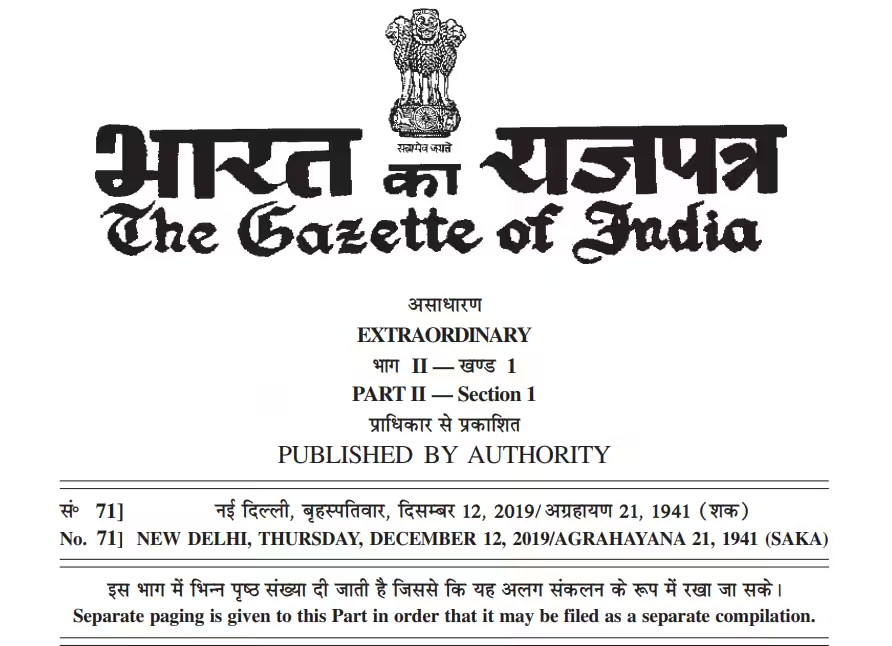
Citizenship Act, 2019:

Source

image 15

Provisions:

  1. Provided that any person belonging to Hindu, Sikh, Buddhist, Jain, Parsi or
    Christian community
    from Afghanistan, Bangladesh or Pakistan, who entered into
    India on or before the 31st day of December, 2014.
  2. Definition of illegal migrants: The Act prohibits illegal migrants from acquiring Indian citizenship. It defines an illegal migrant as a foreigner: (i) who enters India without a valid passport or travel documents, or (ii) stays beyond the permitted time.
  3. In order to get this benefit, they must have also been exempted from the Foreigners Act, 1946 and the Passport (Entry into India) Act, 1920 by the central government.  The 1920 Act mandates foreigners to carry passport, while the1946 Act regulates the entry and departure of foreigners in India. 
  4. To obtain citizenship by naturalization, one of the qualifications is that the person must have resided in India or have been in service of the central government for at least 11 years before applying for citizenship.
  5. Cancellation of registration of OCIs: The Act provides that the central government may cancel registration of OCIs on certain grounds. These include: (i) if the OCI has registered through fraud, or (ii) if within five years of registration, the OCI has been sentenced to imprisonment for two years or more, or (iii) if it becomes necessary in the interest of sovereignty and security of India.

NOTE: Nothing in this section shall apply to tribal area of Assam, Meghalaya, Mizoram or Tripura as included in the Sixth Schedule to the Constitution and the area covered under “The Inner Line” notified under the Bengal Eastern Frontier Regulation, 1873.

Issues:

  1. Violation of Article 14: Article 14 of the Constitution which guarantees all ‘persons’ (not only citizens) equality before the law and equal protection of law. They also argue that making religion a qualifier for citizenship violates secularism, which is a basic feature of the Constitution.
  2. The special treatment given to the specific “persecuted religious minorities” from the three Muslim-majority neighbouring countries does not constitute a “reasonable classification” under Article 14. More so because groups like the Tamil Hindus in Sri Lanka, the Rohingyas in Myanmar and minority Muslim sects like the Hazaras in Afghanistan also face persecution but have been denied similar protection under this law.
  3. Tt is also unclear why there is a differential treatment of migrants based on their date of entry into India, i.e., whether they entered India before or after December 31, 2014.
  4. Bill also excludes illegal migrants residing in areas covered by the Sixth Schedule, that is, notified tribal areas in Assam, Meghalaya, Mizoram and Tripura.  The purpose behind the enactment of the Sixth Schedule of the Constitution was to aid in the development of tribal areas through autonomous councils, while protecting the indigenous population in these areas from exploitation and preserving their distinct social customs.

Delimitation

Open article →Download PDF

image 16

Why in News:

The Supreme Court on 25 July, held that the Centre did not discriminate against the electorates of Andhra Pradesh and Telangana or dampen their “legitimate expectations” by conducting the delimitation of constituencies in the Union Territory of Jammu and Kashmir in 2022.

UPSC relevance: GS II

UPSC CSE in prelims as well as in mains examination has focused on Election and Changes in Parliament. A case in point is a following PYQ.

UPSC PYQ Prelims 2012

With reference to the Delimitation Commission consider the following statements:

  1. The orders of the Delimitation Commission cannot be challenged in a Court of Law.
  2. When the orders of the Delimitation Commission are laid before the Lok Sabha or State Legislative
  3. Assembly, they cannot effect any modification in the orders.

Which of the statements given above is/are correct?

(a) 1 only
(b) 2 only
(c) Both 1 and 2
(d) Neither 1 nor 2

UPSC PYQ Prelims 2024:

How many Delimitation Commissions have been constituted by the Government of India till December 2023?

(a) One 

(b) Two 

(c) Three 

(d) Four   

What is delimitation?

  • Delimitation literally means the act or process of fixing limits or boundaries of territorial constituencies in a country or a province having  a legislative body. In Indian context, it is done for the Lok Sabha and Legislative assemblies constituencies.
  • It also includes determining the seats to be reserved for Scheduled Castes (SC) and Scheduled Tribes (ST) in these houses.

Constitutional Provisions:

Article 82 and 170 of the Constitution mandates that the number of seats in the Lok Sabha and State Legislative assemblies as well as its division into territorial constituencies shall be readjusted after each Census. 

Article 82 : deals with delimitation for the purpose of Lok sabha seats

Article 170(3) : deals with delimitation for the purpose of State Legislative Assembly seats

AD 4nXfuPBYIKSjSBx7

Article 327 empowers Parliament to make laws for delimitation.

AD 4nXeVRq5DB79NimbEdoJ6bk15wssojq6xSN4h55ddJanljkeonIc31fLJGPwjnkEYd5DqBI3zz47jedCWj4VMNfe0MHjbaMeyAZKGJQs5y69S7pUax69erSOnc

Delimitation Commission 

  • The copies of its orders are laid before the House of the People and the State Legislative Assembly concerned, but no modifications are permissible therein by them.
  • The ‘delimitation process’ is performed by the ‘Delimitation Commission’ that is set up under an act of Parliament under Article 82, 170 and 327.
  • The orders of the Delimitation Commission have the force of law and cannot be questioned in any court of law. 
  • These orders come into force on a date to be specified by the  President of India in this regard. 

Delimitations so far :Such an exercise was carried out after the 1951, 1961 and 1971 Census.

  • Since the 1970s, there has been no change in the number of Lok Sabha as well as State Assembly constituencies. The irregularity in the exercise started in 1976, when the 42nd Constitutional Amendment suspended the revision of seats in Lok Sabha and State Assemblies until after the 2001 Census. This froze the Lok Sabha seats at 543.
  • The freeze was introduced to address concerns of those states that successfully implemented population control measures at that time.
  • In 2001, the 84th Constitutional Amendment further pushed the freeze to 2026, with the relevant population figures to be sourced from the first Census after 2026. As a result of this freeze, India still relies on the 1971 Census for allocation of seats in the Parliament to States
  • The last delimitation was done in 2008 based on the 2001 Census. 
  • In 2003,the 87th Amendment to the Constitution, allowed for redistricting within states based on 2001 population figures to account for population changes without modifying the allocation of Lok Sabha and Assembly seats. Thus,the Lok sabha seats are still fixed at 543.
AD 4nXe3WmQQ3JXb8vCrmQTzb9kP zhnkqG4DstuGI17fxXXAwW9jkAWHFOJw3DSzL5Oy r 9uZcENqFy0xzmdKliGSOC46RftcidBzx95sYtPlacIYgHe

Recent SC Judgement 

  • A Bench of Justices Surya Kant and N. Kotiswar Singh said that States could not claim “parity” by arguing that delimitation was done in Jammu and Kashmir, but not for them. “That would be like treat-ing unequals equally,” the court observed. 
  • There was a specific constitutional embargo in Article 170(3) which mandated that the delimitation exercise in States is barred until after the completion of the first Census post 2026. 
  • Jammu and Kashmir, on the other hand, being a Union Territory, is excluded from the freeze on delimitation under Article 170 of the Constitution. The delimitation exercise in the Union Territory had been undertaken on the basis of the 2011 Census.

Mangroves – shaping coastal resilience

Open article →Download PDF

image 16 1

Why in News:

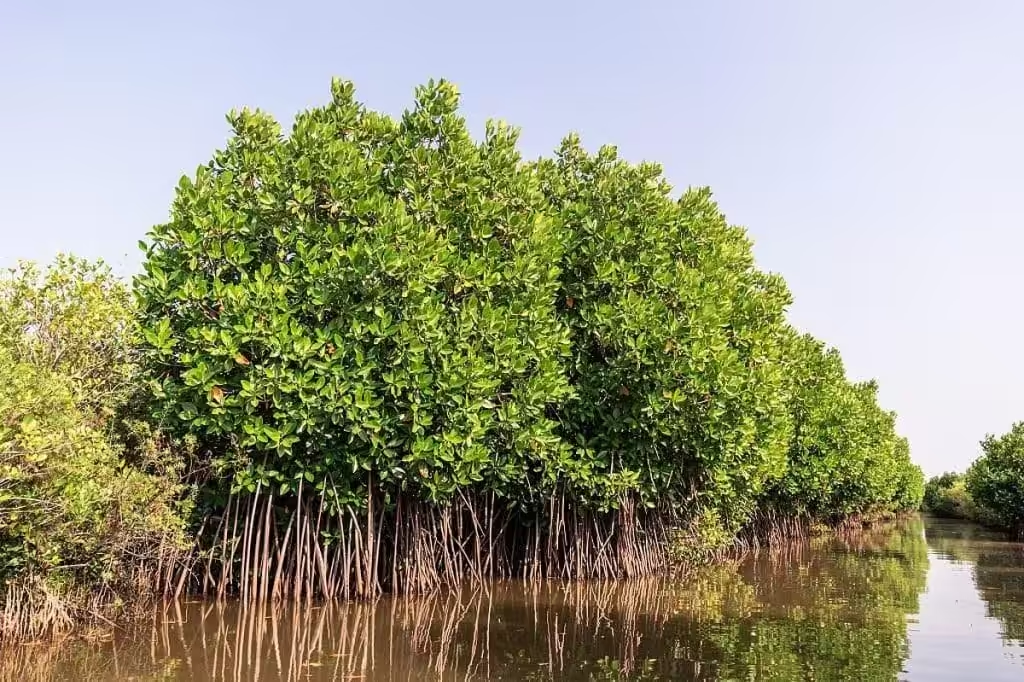
On World Mangrove Day (July 26), an expert has highlighted M.S. Swaminathan’s role in promoting Mangroves’ importance in the coastal ecosystem and its role in building coastal resilience against climate change and disasters.

image 16 2

Mangroves

  • A mangrove is a salt-tolerant plant community belonging to families Rhizophoraceae, Acanthaceae, Lythraceae, Combretaceae, and Arecaceae found in tropical and subtropical intertidal regions. 
  • These ecosystems thrive in high-rainfall areas (1,000–3,000 mm) with temperatures ranging from 26°C to 35°C.
  • Mangrove species are adapted to survive in waterlogged soils, high salinity, and frequent tidal surges. 
  • Some mangrove species like Avicennia are known to excrete salts via leaves and other parts.
  • Respiratory/Adventitious roots/Knee roots (pneumatophores) are characteristic of many species; they project above the mud and have small openings (lenticels) through which air enters, passing through the soft spongy tissue to the roots beneath the mud.
  • Viviparous mode of reproduction, where seeds germinate and develop while still attached to the parent plant, before falling to the ground or into the water as a specialized propagule.

Some prominent species found in India are:

  • Avicennia officinalis – commonly found across coastal States, and salt excretion species.
  • Rhizophora mucronata, also known as red mangrove.
  • Sonneratia alba, also known as mangrove apple, is the state mangrove of Maharashtra.
  • Heritiera fomes, also known as Sundari Species found in Sunderbans

Status of Mangroves in Indian State of Forest Report (ISFR) 2023

  • As per the India State of Forest Report 2023 (ISFR-2023), India’s total mangrove cover stands at 4,991.68 sq. km, constituting 0.15% of the nation’s geographical area. 
  • There has been a net increase of 363.68 Sq.km (7.86%) in Mangrove cover area of the country in 2023 as compared to 2013 and net increase of 509.68 Sq.km (11.4%) between 2001 and 2023. The highest increase in 2021-23 has been in Odisha.
  • West Bengal holds the largest share of the country’s mangrove forests, accounting for 42.45% of the total cover, followed by Gujarat (23.32%) and the Andaman & Nicobar Islands (12.19%).
  • Gujarat has recorded an impressive increase of 253.06 sq. km in mangrove cover between 2001 and 2023, attributed to large-scale plantations, community participation, and public-private partnerships. However, as per ISFR 2023 , there has been a loss of Mangroves in Gujarat during 2021-23.
  • The largest Mangrove sites are Sunderban followed by Bhiterkanika.

AD 4nXdh3wiAGfnmU FFoI1XDwagXleCrXqaAReJeKiXEbPv8LYHIqwQ5EOovQlYtbHmb9lYkj8WPl6LWY7lyPQAT6ucFwdlvYbYiKFSguaHpEdS2rP2OfD

Note: Indonesia holds the largest area under mangrove forest globally, accounting for approximately 21% of the world’s total mangrove cover. Other countries with significant mangrove areas include Brazil, Australia, Mexico, and Nigeria. The Sundarbans, a region shared by India and Bangladesh, represents the world’s largest single patch of mangrove forest.

Significance of Mangroves

  • They serve as crucial biodiversity refuges for aquatic and marine life.
  • Act as bio-shields against extreme climatic events. The immense role played by mangroves during the 1999 Odisha super cyclone and the 2004 Indian Ocean tsunami, in reducing the loss of life and damage to property and natural resources is an example.
  • Rural populations depend on mangroves for biomass-based livelihoods deriving timber and fisheries from it.
  • A significant carbon reservoir that can help mitigate climate change. As per World Wildlife Fund mangroves store 7.5-10 times more carbon per acre than tropical forests.
  • Research on the utilisation of mangrove genetic resources can help to develop new saline-tolerant crops (by transferring genes for salinity tolerance from mangroves to rice and other crops)

AD 4nXcqJ30e8NGsVDnSIqV5n3q0QEUqphhd0j0MSmoi8h4YOUqCPbtnBHdJ2uXjVlxSyCRHJw0SfWLvjfJ60F1rBwq14CqLfutcO ho

AD 4nXfPV v2TrLB3okuurtbKUdH7jdCss9lSFVIBAQ9F7JLfJieKb2GdZYLzY2ngJ52PPC7mmDtaDO0wXN48L9nKuGvEwDJ Klg ymGZAGbjb5DWkbpyeHMQUOYrKlnK Q0v

Regulatory Measures

India has implemented a series of stringent legal frameworks to ensure mangrove protection:

  • Additional protection under the Wildlife (Protection) Act, 1972, Indian Forest Act, 1927, and Biological Diversity Act, 2002, among others.
  • Coastal Regulation Zone (CRZ) Notification, 2019 under the Environment (Protection) Act, 1986, categorises mangroves as Ecologically Sensitive Areas (ESAs), restricting activities within a 50-metre buffer zone where mangrove cover exceeds 1,000 sq. m.
  • Mandates compensatory replantation at a 3:1 ratio if mangroves are affected by development.

Initiatives

Mangrove Initiative for Shoreline Habitats & Tangible Incomes (MISHTI):

  • Launched on 5 June 2023 to promote restoration and afforestation across 540 sq. km in 9 coastal States and 4 Union Territories.
  • Implementation through convergence funding with the National Compensatory Afforestation Fund Management and Planning Authority (CAMPA).

National Coastal Mission – Conservation of Mangroves and Coral Reefs:

  • Financial assistance for the conservation of 38 mangrove sites and 4 coral reef sites across the country.
  • Operates on a 60:40 cost-sharing model between the Centre and States.

GCF-ECRICC Project (Green Climate Fund – Enhancing Coastal Resilience of Indian Coastal Community):

  • Active since 2019 in Andhra Pradesh, Maharashtra, and Odisha.
  • Aims to restore and conserve 10,575 hectares of mangroves.
  • As of 2024, 3,114.29 hectares have been successfully restored.

Challenges in Mangrove conservation 

Reduced Freshwater and Tidal Flows:hallenges in Mangrove conservation 

  • Reduced Freshwater and Tidal Flows: Construction of dams and embankments on rivers and at river mouths can reduce freshwater and tidal water inflow to mangrove areas, leading to increased salinity and affecting mangrove health and regeneration, as seen in Pichavaram, South India. 
  • Destruction and Fragmentation: Mangroves are cleared for various development activities. For instance, conversion to aquaculture (especially shrimp farming), expansion of rice and palm oil plantations, and infrastructure development (like dams and urban expansion) significantly reduce mangrove cover. In India, particularly in the Sundarbans and other coastal regions, these activities have led to substantial loss of mangrove forests. 
  • Pollution and Contamination: Agricultural runoff, industrial discharges, and improper waste disposal contaminate mangrove ecosystems, affecting their health and biodiversity. 
  • Climate Change and Sea Level Rise: Rising sea levels, increased frequency of extreme weather events like cyclones (e.g., Cyclone Amphan), and changes in sediment flux directly threaten mangrove survival, especially in low-lying areas like parts of the Bay of Bengal coast. 
  • Lack of Integrated Management: Mangrove ecosystems are often managed in isolation, without considering their interconnectedness with other coastal ecosystems like coral reefs or seagrass beds, hindering effective conservation efforts. 
  • Overfishing and Unsustainable Harvesting: Overfishing, including destructive practices like using push nets and trawls, can degrade mangrove habitats and reduce their ecological and economic value. 
  • Invasive Species: Non-native species, such as the red mangrove, can outcompete native mangrove species, altering the ecosystem’s structure and function. 
  • Destruction and Fragmentation: Mangroves are cleared for various development activities. For instance, conversion to aquaculture (especially shrimp farming), expansion of rice and palm oil plantations, and infrastructure development (like dams and urban expansion) significantly reduce mangrove cover. In India, particularly in the Sundarbans and other coastal regions, these activities have led to substantial loss of mangrove forests. 
  • Pollution and Contamination: Agricultural runoff, industrial discharges, and improper waste disposal contaminate mangrove ecosystems, affecting their health and biodiversity. 
  • Climate Change and Sea Level Rise: Rising sea levels, increased frequency of extreme weather events like cyclones (e.g., Cyclone Amphan), and changes in sediment flux directly threaten mangrove survival, especially in low-lying areas like parts of the Bay of Bengal coast. 
  • Lack of Integrated Management: Mangrove ecosystems are often managed in isolation, without considering their interconnectedness with other coastal ecosystems like coral reefs or seagrass beds, hindering effective conservation efforts. 
  • Overfishing and Unsustainable Harvesting: Overfishing, including destructive practices like using push nets and trawls, can degrade mangrove habitats and reduce their ecological and economic value. 
  • Invasive Species: Non-native species, such as the red mangrove, can outcompete native mangrove species, altering the ecosystem’s structure and function. 
  • Lack of Awareness and Protection: Despite their importance, mangroves are often undervalued and may lack adequate legal protection, making them vulnerable to exploitation.

Way Ahead

Strengthening Legal Frameworks

  • India has established several regulations to protect mangroves. The Coastal Regulation Zone (CRZ) Notification (2019) categorizes coastal areas and restricts activities damaging to mangroves, while the Indian Forest Act, 1927, and the Wildlife Protection Act, 1972, also offer legal protection, with states like Maharashtra designating mangroves as Reserved Forests. They must be strengthened and implemented strictly.

Promoting Afforestation and Restoration:

  • The Mangrove Initiative for Shoreline Habitats & Tangible Incomes (MISHTI) launched in 2023-24 aims to increase mangrove cover along the coastline and on degraded lands, as seen in Gujarat which expanded its mangrove cover significantly under this scheme. 
  • Techniques like direct seed sowing, raised bed plantations, and fishbone channel plantations are employed, as demonstrated in Gujarat. 

Community Participation and Sustainable Livelihoods:

  • Engaging local communities is crucial for long-term conservation. This can involve people’s involvement in management, awareness programs, and incentivizing sustainable practices on private and village lands. 
  • The “Guardians of the Coastline” project in West Bengal showcases a public-private partnership model where local women’s groups manage and benefit from eco-tourism and sustainable seafood initiatives linked to mangrove conservation, generating income and fostering stewardship. 
  • Karnataka’s Sindhudurg district has conserved mangroves through a multifaceted approach involving local community engagement, alternative livelihood options, and government-supported conservation initiatives.

Ecological Conservation and Scientific Research:

  • Implementing eco-restoration using techniques that promote biodiversity and resilience to climate change is vital. Scientific monitoring of existing mangroves and the use of bio-restoration to revive degraded areas are also important.
  • Establishing green belts and buffer zones around mangrove forests helps maintain ecological integrity. 

Awareness and Education:

  • Raising public awareness about the importance of mangroves through various channels like films, exhibitions, seminars, and celebrating Mangrove Conservation Day can foster a sense of responsibility towards these ecosystems. 

Sustainable Tourism and Economic Alternatives:

  • Promoting eco-friendly tourism in well-managed mangrove areas and developing alternative livelihoods for local communities that are compatible with mangrove conservation can provide economic incentives for protection. 

International Cooperation:

  • Participating in global initiatives like the Ramsar Convention and the Blue Carbon Initiative  and Mangrove Alliance for Climate (MAC) for effective mangrove conservation strategies.

Coconut Oil

Open article →Download PDF

image 16 3

Why in News:

Amidst rise in edible oil prices, Coconut Oil prices has risen to become almost three times the price of other oils making it even more expensive than traditionally premium Sesame oil.

UPSC CSE Relevance:

UPSC CSE in prelims examination has focused on different boards like Tea Board, Coffee Board and Turmeric Board etc. A case in point is a following PYQ.

UPSC Prelims PYQ 2022

Consider the following States:

  1. Andhra Pradesh
  2. Kerala
  3. Himachal Pradesh
  4. Tripura

How many of the above are generally known as tea-producing States?

(a) Only one State

(b) Only two States

(c) Only three States

(d) All four States

Coconut Oil

  • Extracted from dried white flesh of coconut called Copra.
  • Copra is an MSP crop
  • Of the 5.7 lakh tonnes (It) of coconut oil produced in India, only about 3.9 It is used for food (cooking and frying). The rest goes into the manufacture of hair oil, cosmetics, soaps, and in other industrial applications as a  natural solvent.

image 16 4

Largest producers in India: 

  1. Karnataka
  2. Tamil Nadu
  3. Kerala

Largest global producer:

  1. Philippines
  2. Indonesia
  3. India

AD 4nXcwcXe5NrkDxDpU5FqUodhS51PO7ESEJg x2 jMzIH9cKxjGHa1fIqTu5b

Cause of recent rise in prices of Coconut Oil:

  • In addition to this, the aging coconut plantations in the two countries, have led to global supply tightness, and to buyers scrambling to stock up.
  • Experts attribute the unprecedented price rise mainly to output in the Philippines and Indonesia falling due to El Niño-induced drought. These two countries are the world’s top producers-cum-exporters of coconut  oil.

Impact on India

  • Since there is marginal consumption of oil in India, it may accelerate shift to other oils, primarily the imported oils.
  • There are three primarily imported edible oils in India that dominate consumption- palm, soybean and sunflower in decreasing order of consumption.
  • These 3 imported oils account for 74% edible oil consumption in India.
  • The only indigenous oil that has held out is Mustard Oil. It is the most consumed indigenous oil and largest after the three imported oils.

Coconut Growing Conditions:

  • Latitude and Altitude: Coconut is a tropical crop and grows well a hot climate.
  • Temperature: The temperature should be from 20 ° to 32°C.
  • Rainfall: A total of 1000 mm is sufficient, if it is evenly distributed throughout the year. However, rainfall upto 3000 mm is also ideal for coconut cultivation.
  • Humidity and Wind: The optimum relative humidity is 80 – 85 percent.
  • Sunshine: The palm requires plenty of sunlight and does not grow well under shade or in cloudy conditions.
  • Soil types: Laterite, coastal sandy, alluvial, and also in reclaimed soils of the marshy lowlands. It tolerates salinity and a wide range of pH (from 5.0-8.0).

About Coconut Board:

  • Coconut Development Board (CDB) is a statutory body established under the Ministry of Agriculture and Farmers Welfare, Government of India for the integrated development of coconut cultivation and industry in the country with focus on productivity increase and product diversification.
  • The Board which came into existence on 12th January 1981.
  • Its Headquarters at Kochi in Kerala and Regional Offices at Bangalore in Karnataka, Chennai in Tamil Nadu, Guwahati in Assam and Patna in Bihar. 
  • Aim: Adopting measures for the development of coconut industry.