The Supreme Court on 25 July, held that the Centre did not discriminate against the electorates of Andhra Pradesh and Telangana or dampen their “legitimate expectations” by conducting the delimitation of constituencies in the Union Territory of Jammu and Kashmir in 2022.
UPSC relevance: GS II
UPSC CSE in prelims as well as in mains examination has focused on Election and Changes in Parliament. A case in point is a following PYQ.
The orders of the Delimitation Commission cannot be challenged in a Court of Law.
When the orders of the Delimitation Commission are laid before the Lok Sabha or State Legislative
Assembly, they cannot effect any modification in the orders.
Which of the statements given above is/are correct?
(a) 1 only (b) 2 only (c) Both 1 and 2 (d) Neither 1 nor 2
UPSC PYQ Prelims 2024:
How many Delimitation Commissions have been constituted by the Government of India till December 2023?
(a) One
(b) Two
(c) Three
(d) Four
What is delimitation?
Delimitation literally means the act or process of fixing limits or boundaries of territorial constituencies in a country or a province having a legislative body. In Indian context, it is done for the Lok Sabha and Legislative assemblies constituencies.
It also includes determining the seats to be reserved for Scheduled Castes (SC) and Scheduled Tribes (ST) in these houses.
Constitutional Provisions:
Article82 and 170 of the Constitution mandates that the number of seats in the Lok Sabha and State Legislative assemblies as well as its division into territorial constituencies shall be readjusted after each Census.
Article 82 : deals with delimitation for the purpose of Lok sabha seats
Article 170(3) : deals with delimitation for the purpose of State Legislative Assembly seats
Article 327 empowers Parliament to make laws for delimitation.
Delimitation Commission
The copies of its orders are laid before the House of the People and the State Legislative Assembly concerned, but no modifications are permissible therein by them.
The ‘delimitation process’ is performed by the ‘Delimitation Commission’ that is set up under an act of Parliament under Article 82, 170 and 327.
The orders of the Delimitation Commission have the force of law and cannot be questioned in any court of law.
These orders come into force on a date to be specified by the President of India in this regard.
Delimitations so far :Such an exercise was carried out after the 1951, 1961 and 1971 Census.
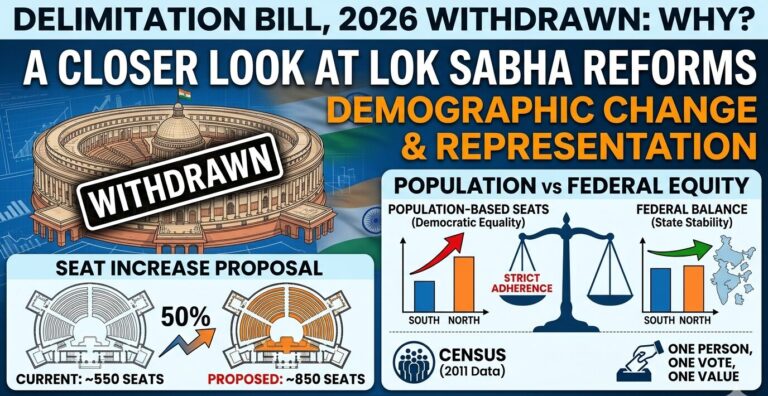
Since the 1970s, there has been no change in the number of Lok Sabha as well as State Assembly constituencies. The irregularity in the exercise started in 1976, when the 42nd Constitutional Amendment suspended the revision of seats in Lok Sabha and State Assemblies until after the 2001 Census. This froze the Lok Sabha seats at 543.
The freeze was introduced to address concerns of those states that successfully implemented population control measures at that time.
In 2001, the 84th Constitutional Amendment further pushed the freeze to 2026, with the relevant population figures to be sourced from the first Census after 2026. As a result of this freeze, India still relies on the 1971 Census for allocation of seats in the Parliament to States
The last delimitation was done in 2008 based on the 2001 Census.
In 2003,the 87th Amendment to the Constitution, allowed for redistricting within statesbased on 2001 population figures to account for population changes without modifying the allocation of Lok Sabha and Assembly seats. Thus,the Lok sabha seats are still fixed at 543.
Recent SC Judgement
A Bench of Justices Surya Kant and N. Kotiswar Singh said that States could not claim “parity” by arguing that delimitation was done in Jammu and Kashmir, but not for them. “That would be like treat-ing unequals equally,” the court observed.
There was a specific constitutional embargo inArticle 170(3) which mandated that the delimitation exercise in States is barred until after the completion of the first Census post 2026.
Jammu and Kashmir, on the other hand, being a Union Territory, is excluded from the freeze on delimitation under Article 170 of the Constitution. The delimitation exercise in the Union Territory had been undertaken on the basis of the 2011 Census.
UPSC Content Team Head · Web Developer & Designer · AnantamIAS
Recognized as one of India’s best content marketers, Gaurav Tiwari is an SEO strategist, WordPress developer, and founder of Gatilab. He builds websites that load in under a second, creates content that ranks on Google’s first page, and develops WordPress plugins and tools used on thousands of live sites.
Specialises in · Writing, web development, design — UPSC prep toolingExperience · 16+ yearsVisit website ↗