Opens in a new tab
Join Anantam IAS Channel on Telegram

Daily Digest · Monday

26 October 2026 Current Affairs for UPSC

7 current affairs published on Monday, 26 October 2026

26 October 2026 Current Affairs for UPSC — every Why-in-News article AnantamIAS published on Monday, 26 October 2026, broken down with Why in News?, the exact GS paper it feeds, sub-topic mapping, MCQ-ready facts and a UPSC-style practice question. 7 articles in total, covering Polity, Economy, Environment, S&T, IR, Geography, History, Society and Internal Security — the same Why-in-News + GS-paper-mapping + practice-question format the Compass uses across every daily digest on the site.

Daily current affairs for UPSC is where new material enters your prep stream. Read this 26 October 2026 digest end-to-end in 25–35 minutes, attempt the practice question at the foot of each article (it's MCQ for some, 10/15-marker for others), then bookmark the entries that fall inside your active revision window. Everything stays cross-linked: tap any subject pill to jump to that subject's hub, or use the table of contents above to skip straight to a specific story.

Use this page three ways. Read sequentially for a one-sitting scan of everything that mattered on 26 October 2026. Download the 26 October 2026 PDF below for offline study or print revision. Or use the October 2026 Current Affairs compilation to see this day in the month's full context. For the previous day's reading, see 25 October 2026 Current Affairs.

Why we publish daily current affairs separately from the monthly compilation: daily is learning, monthly is revision. Use the daily page to add fresh material to your notes the day it breaks; come back to the October 2026 compilation 60 days before Prelims when the noise has settled and only the lasting takeaway is worth re-reading.

Municipal Reform: Matching City Responsibilities With Authority

Open article →Download PDF

Why in News?

On 25 October 2026, the National Urban Conclave concluded with recommendations for stronger municipal leadership, devolution, finances and staffing, according to the Ministry of Housing and Urban Affairs.

  • The Model Municipal Law discussion recommended clearly defined executive powers for mayors, five-year mayoral tenures and stronger coordination with parastatal agencies; these proposals address who can decide and deliver within a city.
  • The recommendations connect fiscal autonomy and technical staffing with municipal responsibilities. Assigning a service without resources or personnel can leave the elected body answerable for work it cannot effectively direct.
  • The NITI Aayog address supported directly elected mayors and a Mayor-in-Council system, alongside changes through state municipal legislation. These remain reform proposals, rather than an announcement that every state has adopted them.
  • State consultations and implementation frameworks are part of the proposed revision of the model law. The conclave establishes a reform agenda; its recommendations do not themselves amend existing state statutes or transfer powers.
  • Urban services overlap: a usable street depends on drainage, pedestrian access, lighting and coordination with other infrastructure, even when different agencies control individual components.
  • Institutional design determines whether residents can identify the responsible authority and whether that authority has the budget, staff and decision-making powers needed to act.

UPSC Relevance

Prelims Relevance

  • Article 243W: state legislation may endow municipalities with powers and responsibilities for self-government.
  • Twelfth Schedule: matters that may be entrusted to municipalities, rather than proof of uniform actual devolution.
  • State Finance Commission: reviews municipal finances and recommends principles for transfers and revenue assignments.
  • Parastatal agency: a separate public body delivering a particular sectoral function.
  • Model legislation: a reform template whose recommendations require the appropriate legal implementation.

Mains Relevance

GS Paper 2

  • Decentralisation: aligning functions, funds and functionaries with municipal accountability.
  • Cooperative federalism: state-law reform and coordination between elected urban bodies and sectoral agencies.

GS Paper 3

  • Urban infrastructure: linking investment to maintenance, service quality and sustainable local financing.

Essay

  • Local democracy: authority must accompany responsibility for public services.

Background and Context

Constitutional Recognition and Actual Devolution

A constitutional framework creates space for municipal self-government; legislation determines how particular powers are assigned.

  • Article 243W permits a state legislature to endow municipalities with powers necessary for self-government. Its wording makes the state-law route central to understanding how responsibilities move to an urban local body.
  • The Twelfth Schedule lists 18 matters, including planning, roads, water supply and sanitation. Listing a subject does not establish that every municipality already controls the corresponding staff, assets, approvals and expenditure.
  • The constitutional provisions also place municipal taxation and funds within a state-law framework. A city cannot infer an unlimited taxing power simply from being responsible for an expensive service.
  • Model-law recommendations provide a common starting point for reform, but implementation requires the appropriate changes in law and administration. An announced recommendation should be distinguished from a power that an authority can presently exercise.
  • Meaningful devolution can be examined service by service: identify who plans, approves spending, appoints personnel and answers complaints. This reveals gaps that a general claim of municipal empowerment might conceal.

Functions, Funds and Functionaries Must Fit Together

The practical test is whether a municipality can carry out the responsibility assigned to it.

  • Functions define the work, but an assignment needs clear boundaries. If several agencies share a street, responsibilities for excavation, restoration and maintenance should be specified so that each cannot redirect the complaint elsewhere.
  • Funds must cover continuing services as well as new assets. Own-source revenue and predictable transfers can support operations, while lawful collection procedures and transparent accounts help residents assess how local money is raised and spent.
  • Functionaries provide engineering, planning, finance and contract-management capacity. A council with formal powers may still struggle if it lacks qualified staff or cannot coordinate the people responsible for implementing its decisions.
  • State Finance Commission recommendations address municipal financial conditions and transfer principles. They connect state-level fiscal decisions with local needs, while actual revenue assignments and budgetary action remain necessary to make recommendations effective.
  • The rural-water financing example illustrates a transferable distinction: available funding and permitted expenditure are different questions. Municipal reform must similarly match usable resources to the responsibilities being assigned.

Accountability Across City Institutions

Stronger local leadership must work with clear institutional responsibilities and public scrutiny.

  • An elected municipality represents the local community, while a sectoral parastatal may deliver a particular service under a separate institutional arrangement. Their coordination cannot be assumed merely because they operate within the same city.
  • Defined mayoral powers can clarify leadership, but tenure alone does not settle control over budgets, personnel or other agencies. The proposal needs an accompanying allocation of executive responsibilities and arrangements for scrutiny.
  • Ward and zonal participation can bring neighbourhood problems into planning and review. Its value depends on whether identified concerns reach the authority that can decide, finance and implement the necessary response.
  • Service outcomes offer a useful accountability test: a completed asset is insufficient if it is inaccessible or poorly maintained. The conclave explicitly connected institutional reform with the quality of services people receive.
  • Electoral access and administrative authority solve different problems. The earlier municipal-nomination discussion concerns participation in elections; this reform agenda concerns the powers and capacity available after representatives take office.

Way Forward

Publish a Service-Wise Devolution Matrix

  • State governments should identify the legal authority, budget source and staffing arrangement for each transferred service, alongside the responsibilities retained by other agencies.
  • Municipalities should report service standards, maintenance responsibilities and complaint outcomes so that citizens can connect expenditure with delivery.
  • Reform reviews should test whether authority and usable resources actually moved, rather than count the number of new committees or published recommendations.

Conclusion

  • Municipal empowerment requires an alignment of powers, finances, personnel and accountability; assigning responsibilities alone cannot establish that a city government has the means to deliver them.
  • The 25 October recommendations are a reform agenda whose implementation depends on state action. Assess each proposal by the decision-making authority and service improvement it would create.

UPSC Practice Questions

Prelims MCQ 1

With reference to municipal devolution in India, consider the following statements:

  1. Article 243W enables state legislatures to endow municipalities with powers and responsibilities.
  2. The Twelfth Schedule alone proves that every municipality exercises full control over all listed matters.
  3. The State Finance Commission reviews the financial position of municipalities.

How many of the above statements are correct?

(a) Only one (b) Only two (c) All three (d) None

Answer: (b) Only two

Explanation:

Statements 1 and 3 are correct. The constitutional framework provides for state-law endowment and a municipal-finance review. The schedule does not establish uniform actual devolution of every listed function.

Prelims MCQ 2

Which arrangement best addresses the problem of municipal responsibility without effective authority?

(a) Assigning a service together with usable funding, appropriate staff and clearly defined decision-making powers (b) Creating a new committee without changing who controls the service (c) Treating a model-law recommendation as an automatic amendment to every state statute (d) Measuring only construction completion while excluding maintenance from review

Answer: (a) Assigning a service together with usable funding, appropriate staff and clearly defined decision-making powers

Explanation:

Effective devolution aligns functions, funds and functionaries, with clear accountability. A new committee or recommendation does not by itself transfer operational authority, and completed construction is not the whole service outcome.

UPSC Mains Questions

  1. Why must the devolution of municipal functions be accompanied by fiscal and administrative authority? Discuss with reference to urban service delivery.
  2. Examine how coordination between elected municipalities and parastatal agencies can improve accountability without obscuring responsibility.

Sources: PIB, Ministry of Housing and Urban Affairs and PIB, NITI Aayog.

Frequently Asked Questions

Did the conclave introduce a new municipal law across India?

No. It produced recommendations for reform, including stronger mayoral powers and a revised model law. The relevant state-level legal and administrative steps are required before those proposals change existing powers.

Does the Twelfth Schedule automatically transfer all municipal functions?

The schedule identifies matters that may be entrusted to municipalities. Article 243W provides for state legislation to endow powers and responsibilities, so the actual assignment must be examined under the applicable legal arrangements.

What are functions, funds and functionaries?

Functions are the responsibilities assigned to a local body, funds are the usable financial resources, and functionaries are the personnel and skills required. Effective devolution needs these elements to work together.

Why does coordination with parastatal agencies matter?

Separate agencies may control different parts of a city service. Clear responsibilities and coordination help connect planning, expenditure and maintenance, while allowing residents to identify the authority answerable for a problem.

How should municipal reform be assessed?

Examine whether the responsible authority can make decisions, finance operations, deploy capable staff and answer residents. Service reliability and maintenance provide stronger evidence of improvement than announcements or asset-completion counts alone.


NCERT AI Module: Learning to Question Machine Outputs

Open article →Download PDF

Why in News?

On 25 October 2026, the Indian Express reported that NCERT had developed an introductory Computational Thinking and Artificial Intelligence module for Classes 9–12, with emphasis on responsible use and critical verification.

  • The introductory module is intended for learners without prior AI knowledge. Reported activities include discussion, experimentation and reflection, linking familiarity with technology to an understanding of its possibilities and limitations.
  • Activities can run with or without digital devices, according to NCERT’s statement quoted in the report. This creates a teaching route for schools with different equipment access without making every exercise dependent on connectivity.
  • The reported priorities include privacy, misinformation, fairness and digital safety. Students are encouraged to examine AI-generated information critically, while human judgment, creativity and ethical responsibility remain central to learning.
  • The Ministry of Education’s earlier policy explanation places computational thinking beneath AI learning as a foundational competency. That background explains the curricular direction; it does not establish the implementation results of this new module.
  • AI literacy requires students to explain a result, test a claim and recognise uncertainty, alongside learning how to operate a tool.
  • Access and learning quality must be assessed together: distributing a resource does not establish that every classroom can teach it effectively.

UPSC Relevance

Prelims Relevance

  • NCERT: National Council of Educational Research and Training; developer of the reported introductory module.
  • Computational thinking: systematic problem-solving using logical reasoning, patterns and clearly specified steps.
  • Algorithm: a specified sequence of instructions for carrying out a task or solving a problem.
  • AI literacy: understanding capabilities, limitations and responsible use, including verification of generated information.
  • Device-optional learning: selected activities can teach concepts without requiring a computer for each learner.

Mains Relevance

GS Paper 2

  • Education quality, teacher preparation and participation across unequal school infrastructure.
  • Curriculum design that connects knowledge, judgment and responsible technology use.

GS Paper 3

  • Capabilities and limitations of AI, data literacy and the verification of machine-generated information.

Essay

  • Technological familiarity becomes educational capability when learners can question and justify outputs.

Background and Context

Computational Thinking Comes Before Tool Use

The central skill is making a problem precise enough to examine its steps and test a proposed solution.

  • Decomposition breaks a complex task into smaller questions. Planning a school activity, for example, involves identifying resources, ordering actions and checking constraints; the reasoning can begin before any software is introduced.
  • Pattern recognition helps learners identify similarities across examples, while abstraction keeps features relevant to the question. A useful classification rule must explain why an item belongs in one group rather than another.
  • A classroom sorting exercise could ask students to group objects, state their rule and test an ambiguous example. This illustrates systematic reasoning without claiming that a particular exercise appears in NCERT’s module.
  • An algorithm specifies steps that others can follow and check. Comparing two solutions encourages learners to identify missing instructions or assumptions, rather than accepting a procedure simply because it produces an answer once.
  • AI and computational thinking overlap but differ: computational thinking is a problem-solving approach; many AI systems learn patterns from examples. Knowing how to frame and test a problem helps students assess the resulting output.

Why a Fluent Answer Still Needs Evidence

An answer can sound convincing while containing claims that have not been established.

  • Fluency is not verification. A generated explanation may be coherent yet contain an incorrect fact or unsupported reference. Students should identify the claim being made before deciding what evidence would support it.
  • Independent checking means consulting a suitable source and comparing the relevant detail. Asking the same tool to repeat or defend its answer does not by itself supply independent evidence that the claim is correct.
  • Context changes meaning: a true statement about one place, date or group may not answer another question. Verification includes checking whether the source addresses the same circumstances as the claim under examination.
  • Fairness requires examining examples and outcomes. If a learning exercise uses a narrow set of examples, students can test whether its rule works for omitted cases before assuming that the result applies equally to everyone.
  • Privacy can be taught through everyday choices: an exercise need not use real classmates’ personal details. Invented examples can support discussion of data handling while allowing learners to practise the intended reasoning task.

Make Participation and Judgment Observable

The teaching method should reveal how students reason, including when equipment access differs.

  • Device-optional activities can introduce classification, sequences and checking through physical objects or paper. They support participation, while direct experience with digital systems can address additional skills when appropriate equipment and supervision are available.
  • Teacher facilitation connects an activity to its concept: students should explain their rule, discuss a counterexample and revise an answer. Completing a worksheet alone cannot establish that learners understand the underlying idea.
  • The earlier tribal-language learning discussion highlights human validation and local context. Classroom material should make sense to its learners; unfamiliar language can obscure whether the difficulty lies in the concept or its presentation.
  • Participation measures need depth. As the education-parity note explains, an aggregate access measure can hide disadvantage. AI teaching likewise needs attention to who can participate, ask questions and demonstrate understanding.
  • Learning outcomes remain an assessment question. The reported module establishes an educational approach and intended competencies; evidence from classroom practice is needed before claiming that it has improved judgment or reduced misinformation.

Way Forward

Assess the Reasoning Behind the Answer

  • Use a small verification task in which students identify a claim, select an appropriate source and explain whether the evidence supports it.
  • Offer device-optional participation where useful, while preparing teachers to connect each activity with its underlying computational or ethical concept.
  • Review explanations and revisions, not only correct final answers, so assessment reveals how students handle uncertainty, counterexamples and mistakes.

Conclusion

  • The durable lesson is critical AI literacy: learners need ways to frame problems, test outputs and justify conclusions, rather than treating confident machine-generated language as sufficient evidence.
  • For an education-policy answer, connect curriculum design with teacher preparation and equitable participation; distinguish a published learning resource from demonstrated improvements in classroom understanding.

UPSC Practice Questions

Prelims MCQ 1

With reference to the reported NCERT Computational Thinking and AI module, consider the following statements:

  1. It is intended only for learners who already possess AI expertise.
  2. Its activities can be conducted with or without digital devices.
  3. Critical verification of AI-generated information is one of its reported priorities.

How many of the above statements are correct?

(a) Only one (b) Only two (c) All three (d) None

Answer: (b) Only two

Explanation:

Statements 2 and 3 are correct. The report describes an introductory module for learners without prior AI knowledge, with device-optional activities and explicit attention to critical verification.

Prelims MCQ 2

Which classroom practice best demonstrates critical verification of an AI-generated claim?

(a) Identifying the claim, checking a suitable independent source and explaining any mismatch (b) Accepting the claim because its wording is fluent (c) Asking the same system to repeat the claim until its wording is consistent (d) Counting the number of technical terms in the answer

Answer: (a) Identifying the claim, checking a suitable independent source and explaining any mismatch

Explanation:

Verification requires evidence relevant to the claim and its context. Fluent wording, repetition and technical vocabulary do not independently establish factual accuracy.

UPSC Mains Questions

  1. Explain how computational thinking and critical verification can complement each other in school AI education.
  2. Discuss how activity-based AI literacy can support participation across schools with unequal digital infrastructure. What role should teacher preparation and assessment play?

Sources: Indian Express, 25 October 2026 and PIB, Ministry of Education, 5 August 2026 policy background.

Frequently Asked Questions

What is the NCERT module discussed in the news?

The Indian Express reported an introductory Computational Thinking and Artificial Intelligence module for Classes 9–12. It combines activity-based learning with attention to AI limitations, privacy, fairness and critical verification.

Does every activity require a digital device?

NCERT’s statement quoted in the report says activities can be conducted with or without digital devices. This supports participation across different school contexts without implying that every digital skill can be taught without equipment.

How is computational thinking different from AI?

Computational thinking is a systematic approach to framing and solving problems. AI concerns systems performing tasks using methods that may include learning patterns from examples; computational thinking helps learners examine those systems and their outputs.

Why should students verify a fluent AI answer?

A convincing explanation can contain an incorrect fact, an unsupported reference or information from the wrong context. Students need to identify its claims and check suitable independent evidence before relying on the answer.

Does publication of the module prove better learning outcomes?

Publication establishes the availability and intended approach of a resource. Demonstrating improved learning requires evidence from classroom use, including participation, teacher facilitation and students’ ability to explain, test and revise their answers.

Operation Trident: Following Drug Networks Beyond Seizures

Open article →Download PDF

Why in News?

On 25 October 2026, the Ministry of Home Affairs described the NCB-led Operation Trident, conducted on 23 October, as a coordinated effort against an alleged transnational narcotics and financial network.

  • The operation covered 38 locations across Assam, Mizoram and Manipur, bringing central agencies and state police into coordinated action against alleged logistical and financial connections identified through earlier investigations.
  • The official release reports 18 arrests and describes cooperation involving the Narcotics Control Bureau, state police and Enforcement Directorate; these are enforcement claims and investigative steps, rather than findings of criminal guilt.
  • The Ministry frames the operation as a move from seizure-focused enforcement toward examining networks and disrupting illicit finances, linking the movement of narcotics with the people and resources sustaining the alleged enterprise.
  • The release also recounts earlier investigation phases. Their financial findings should not all be presented as fresh recoveries on the operation date, because the underlying cases developed over a longer period.
  • Internal security analysis must examine how an illicit organisation replaces lost consignments, moves proceeds and maintains connections across administrative boundaries.
  • Accountable enforcement combines coordinated investigation with evidence that distinguishes suspected links, asset restrictions and eventual judicial outcomes.

UPSC Relevance

Prelims Relevance

  • NCB: Narcotics Control Bureau, which spearheaded Operation Trident.
  • ED: Enforcement Directorate, whose responsibilities include investigating money laundering and tracing proceeds of crime.
  • Backward and forward linkages: connections upstream and downstream from an investigated consignment or participant.
  • Provisional attachment: an asset-related measure distinct from final confiscation.
  • Transnational investigation: an inquiry whose relevant actors, transactions or evidence cross national boundaries.

Mains Relevance

GS Paper 3

  • Organised crime: disrupting the financial and logistical capacity that sustains narcotics networks.
  • Internal security: cooperation among central agencies and state police across connected jurisdictions.

GS Paper 2

  • Institutional accountability: preserving distinct legal roles, reliable evidence and review when multiple agencies coordinate.

Essay

  • State capacity: effective enforcement depends on institutions that can cooperate while remaining answerable for their decisions.

Background and Context

What a Network Investigation Adds

A seized consignment reveals one event; investigators must establish the connections surrounding it.

  • Backward linkage examines the suppliers and organisers connected to the investigated activity. Forward linkage examines subsequent recipients or distribution connections; both seek evidence about relationships rather than treating one seizure as a complete explanation.
  • Logistics and finance answer different questions: how materials moved, and how the activity was funded or its proceeds handled. Combining these inquiries can identify roles that possession of a consignment alone would miss.
  • The release describes financial profiling and digital forensics arising from earlier investigations. Their value lies in testing connections between records and alleged activity, rather than assuming that every recorded contact demonstrates participation.
  • An investigative lead directs further inquiry; it is not automatically proof of a particular offence. Records need context, reliable attribution and corroboration before a proposed connection can support an individual allegation.
  • The analytical comparison is between intercepting a transaction and examining an organisation’s capacity to continue operating. A seizure can interrupt supply, while a wider inquiry considers the linked resources and responsibilities behind it.

Why Coordination Does Not Merge Legal Roles

Different agencies can share information while retaining their own responsibilities and legal processes.

  • NCB and state police contributed to the coordinated narcotics investigation described in the release. State-level knowledge and connected case information can help an inquiry follow relationships that extend beyond one local jurisdiction.
  • The Enforcement Directorate’s mandate includes tracing assets linked to proceeds of crime under money-laundering law. This financial inquiry complements the investigation of the underlying alleged criminal activity.
  • Coordination helps agencies compare evidence and avoid treating connected cases as isolated events. It does not mean that every participating body acquires the powers of every other agency or bypasses its governing procedure.
  • Cross-border connections add institutional difficulties because relevant records and actors may be in different jurisdictions. The earlier BIMSTEC cooperation note provides context for this problem without establishing the facts of Trident.
  • Information sharing needs a clear purpose and accountable handling. The WHO–INTERPOL cooperation case illustrates the broader institutional task of connecting useful alerts with competent investigators, while preserving separate professional responsibilities.

Read Asset Measures and Outcomes Carefully

Enforcement statistics describe different stages and cannot substitute for one another.

  • Freezing or attachment can restrict dealings with identified assets under the applicable legal process. An asset restriction does not, by itself, establish a final criminal conviction or complete the process of permanent confiscation.
  • ED’s official description distinguishes provisional attachment from confiscation by the Special Court under money-laundering law. A report of attached property should retain that procedural distinction rather than describe the property as already finally forfeited.
  • Arrest, prosecution and conviction are different outcomes. The operation’s arrest figure identifies a reported investigative development; it cannot establish that each accused person committed the alleged offence or predict the result of proceedings.
  • Financial links require interpretation: the existence of a transfer or account relationship does not explain its purpose by itself. Investigators must connect the relevant transaction, person and alleged activity through evidence.
  • Performance assessment should follow cases beyond the initial announcement: the quality of evidence, outcomes of legal review and sustained disruption matter. Large seizure or account totals alone cannot show that a network has ceased functioning.

Way Forward

Track the Case From Lead to Legal Outcome

  • Maintain a shared case chronology that separates earlier findings, the current operation and subsequent proceedings, so agencies and public reports do not merge distinct stages.
  • Document each agency’s contribution and the evidentiary basis for alleged links, while protecting sensitive records and preserving the procedures applicable to each investigation.
  • Review outcomes over time, including prosecution progress and asset decisions, instead of treating the first enforcement announcement as the final measure of success.

Conclusion

  • Operation Trident’s durable lesson is the connection between narcotics, logistics and finances. Coordinated investigation can examine the capacity behind repeated criminal activity, rather than stopping its analysis at a single consignment.
  • Effective disruption and legal accountability must develop together: allegations need evidence, asset restrictions need proper process, and operational claims should be assessed against later outcomes rather than accepted as a completed verdict.

UPSC Practice Questions

Prelims MCQ 1

With reference to network-based enforcement against narcotics trafficking, consider the following statements:

  1. Backward and forward linkage investigations can examine connections surrounding an intercepted consignment.
  2. Provisional attachment of property automatically establishes a final criminal conviction.
  3. Financial investigation may examine assets linked to alleged proceeds of crime.

How many of the above statements are correct?

(a) Only one (b) Only two (c) All three (d) None

Answer: (b) Only two

Explanation:

Statements 1 and 3 are correct. Provisional attachment and final conviction are distinct legal outcomes; attaching property does not automatically establish criminal guilt.

Prelims MCQ 2

Which assessment best reflects the purpose of a network-focused narcotics investigation?

(a) Treating every financial contact as conclusive evidence of criminal participation (b) Counting only the weight of the first seized consignment (c) Replacing individual evidence with the overall size of the operation (d) Examining supported links among logistics, participants and finances, then tracking legal outcomes

Answer: (d) Examining supported links among logistics, participants and finances, then tracking legal outcomes

Explanation:

Network investigation examines connected roles and resources. Its conclusions still require evidence about particular allegations, and operational activity must be distinguished from later judicial outcomes.

UPSC Mains Questions

  1. How can coordinated financial and narcotics investigations improve India’s response to transnational organised crime? Discuss the institutional conditions for effective cooperation.
  2. Why should arrest, seizure and attachment figures be interpreted cautiously when assessing an enforcement operation? Suggest outcome measures that preserve legal accountability.

Sources: PIB, Ministry of Home Affairs and Directorate of Enforcement.

Frequently Asked Questions

What was Operation Trident?

It was an NCB-led operation conducted on 23 October 2026 across Assam, Mizoram and Manipur. The Ministry of Home Affairs described coordinated action against an alleged narcotics network and its logistical and financial connections.

What does a network-focused investigation examine?

It examines supported connections among participants, supply and distribution arrangements, funding and alleged proceeds. The purpose is to understand the organisation behind repeated activity, while testing each proposed link against reliable evidence.

Why was the Enforcement Directorate involved?

The official release describes ED’s cooperation in the investigation. Its mandate includes investigating money laundering and tracing assets linked to proceeds of crime, which can complement inquiries into the underlying alleged narcotics activity.

Does attachment mean that property has been finally confiscated?

No. ED’s official description distinguishes provisional attachment from confiscation by the Special Court under money-laundering law. The precise position of any asset depends on the applicable process and the orders actually passed.

Why should earlier results be separated from the latest operation?

The release recounts investigations preceding the 23 October action. Keeping that chronology clear prevents older arrests or financial findings from being wrongly presented as new results obtained during the latest coordinated operation.

Walkie-Talkie Regulation: Why Licence Exemptions Have Conditions

Open article →Download PDF

Why in News?

On 25 October 2026, the Department of Consumer Affairs reported a CCPA order against Hogar Technologies over missing regulatory disclosures in walkie-talkie advertisements.

  • The CCPA imposed a ₹1 lakh penalty after finding that the advertised models lacked clear information about operating frequencies and applicable licensing requirements, potentially misleading buyers about lawful use.
  • The company cited a Dealer Possessing Licence and Equipment Type Approvals in its defence. The authority held that possessing approvals did not remove the obligation to explain material operating conditions.
  • The release identifies 446.0–446.2 MHz as the prescribed licence-exempt range for personal mobile radios under the cited 2018 rules, subject to applicable conditions rather than an unrestricted permission for all radios.
  • The order also covered a lead-generation website without direct checkout. The main technical lesson is that an approved product, a licensed dealer and an authorized use answer different regulatory questions.
  • Spectrum sharing allows useful wireless communication only when equipment and operating conditions remain compatible with other users of the same resource.
  • Regulatory literacy requires identifying what an approval covers, rather than treating any certificate as permission for every possible use of a device.

UPSC Relevance

Prelims Relevance

  • Radio spectrum: frequency ranges used to transmit wireless signals.
  • WPC Wing: the Wireless Planning and Coordination Wing within the Department of Telecommunications.
  • Equipment Type Approval: certification concerning wireless equipment and radio-frequency compliance.
  • Conditional licence exemption: permission applying only within the relevant prescribed requirements.
  • CCPA: consumer-protection authority acting against misleading advertisements and unfair trade practices.

Mains Relevance

GS Paper 3

  • Technology governance: making shared-spectrum rules understandable without removing technical safeguards.
  • Infrastructure regulation: balancing convenient wireless access with interference management.

GS Paper 2

  • Consumer protection: treating operating restrictions as material information before purchase.

Background and Context

Why Radio Use Depends on More Than the Device

A handheld radio combines transmitting equipment with a chosen operating frequency; both matter when determining whether its use fits an exemption.

  • Radio frequency describes how rapidly an electromagnetic signal oscillates. A receiver must be able to receive the relevant signal; a similar-looking handset can operate in a different frequency range from another model.
  • A basic direct radio link can connect nearby users without routing their conversation through a public cellular network. That independence does not remove the need to comply with applicable spectrum-use conditions.
  • Interference arises when unwanted radio signals impair reception. Frequency and other technical restrictions help different users share the spectrum, so an exemption must be read alongside its operating conditions rather than in isolation.
  • Licence-exempt does not mean rule-free. The CCPA release describes a specified range and applicable conditions; it does not declare every handheld transmitter, every selectable channel or every equipment configuration exempt.
  • Equipment capability and permission are different: a radio might technically support a setting that its purchaser is not entitled to use. A broad advertised tuning range cannot itself establish lawful operation throughout that range.

Equipment Approval, Dealer Permission and Lawful Operation

Each regulatory document has a scope; the buyer needs to understand that scope before relying on it.

  • The DoT Equipment Type Approval page identifies WPC certification for wireless devices and a self-declaration route for eligible products. Equipment approval addresses compliance associated with the equipment, rather than an unrestricted choice of operating frequency.
  • The DoT dealer-licence page describes possession, stocking and sale of radio equipment. These dealer functions differ from the conditions under which a purchaser may transmit using a particular model.
  • In the Hogar case, DPL and ETA were company submissions. CCPA still required clear disclosure of frequencies and licensing requirements; the presence of certificates did not settle whether advertisements adequately explained permitted use.
  • Operating authorization must be assessed against the relevant device, frequency and applicable rules. Where an exemption applies, its conditions matter; equipment outside that exemption remains subject to the relevant regulatory requirements.
  • The broader distinction also appears in satellite-service approvals: different permissions serve different purposes. A document should be interpreted by what it authorizes, rather than by the general impression that the product is approved.

How to Read a Conditional Exemption

The useful question is whether the intended operation satisfies the applicable requirements, not whether the advertisement contains the word approved.

  • Identify the operating range for the specific model and intended use. A product category such as walkie-talkie does not identify its frequency settings or demonstrate that all available settings fall within an exemption.
  • Read the qualifying conditions together with the frequency provision. The same frequency label alone does not establish compliance with every relevant requirement; claims about unrestricted use need evidence beyond a product name.
  • Match the certificate to its purpose instead of combining dealer permission, equipment approval and operating entitlement into one claim. This prevents a valid document from creating a misleading impression about matters outside its scope.
  • Distinguish restriction from prohibition: falling outside the cited exemption does not by itself prove that a device can never be used lawfully. It means the relevant regulatory requirements must be established and satisfied.
  • Material omissions affect informed choice because an unusable or restricted device may not meet the purchaser’s needs. The earlier CCPA explosives case explains platform responsibilities; this order adds the specific problem of conditional radio use.

Way Forward

Make Operating Conditions Easy to Check

  • Standardize disclosures around the model, operating frequencies and applicable licensing conditions, with clear links to the relevant official requirements.
  • Separate approval categories in product information so buyers can distinguish equipment compliance from dealer permission and conditions governing transmission.
  • Keep guidance current as authorization procedures change; historic certificates and application instructions should not be presented as a universal current route.

Conclusion

  • A licence exemption is conditional permission. Its usefulness depends on matching the actual equipment and operation to the rule, while preserving the safeguards that allow multiple users to share radio spectrum.
  • For governance analysis, connect technical compliance with informed choice. Consumers need to know the limits of an approval as well as its existence, because a valid certificate cannot answer every regulatory question.

UPSC Practice Questions

Prelims MCQ 1

With reference to the CCPA order on walkie-talkie advertisements, consider the following statements:

  1. The cited exemption for personal mobile radios applies subject to prescribed conditions.
  2. Possession of Equipment Type Approval removes the need to disclose applicable operating conditions.
  3. A promotional website can come within misleading-advertisement scrutiny even without a checkout facility.

How many of the above statements are correct?

(a) Only one (b) Only two (c) All three (d) None

Answer: (b) Only two

Explanation:

Statements 1 and 3 are correct. The official release expressly makes the exemption conditional and covers promotional websites. Equipment approvals do not remove the duty to disclose material operating requirements.

Prelims MCQ 2

Which conclusion best follows when a radio device falls outside the frequency exemption cited in the CCPA release?

(a) It can never be used lawfully in India. (b) Its dealer licence automatically authorizes every buyer to transmit. (c) It is exempt whenever the seller does not accept online payments. (d) Its lawful operation must be assessed under the relevant regulatory requirements.

Answer: (d) Its lawful operation must be assessed under the relevant regulatory requirements.

Explanation:

Being outside an exemption is not the same as a universal prohibition. Applicable authorization and technical requirements must be identified; a dealer document or sales method does not replace that assessment.

UPSC Mains Questions

  1. Explain how conditional spectrum exemptions balance ease of access with interference management. Why must consumers understand the scope of equipment approvals?
  2. Distinguish equipment compliance, dealer permission and operating authorization. Discuss how incomplete disclosures can undermine the regulation of wireless devices.

Sources: PIB, Department of Consumer Affairs and Department of Telecommunications, Equipment Type Approval.

Frequently Asked Questions

Does licence-exempt mean that any walkie-talkie can be used without conditions?

No. The official release cites a prescribed frequency range and applicable conditions. A product label or general claim of approval does not establish that every operating mode satisfies the relevant exemption.

What does Equipment Type Approval establish?

ETA is WPC certification concerning wireless equipment and radio-frequency compliance. It should be read within its scope; its existence does not remove the need to explain the licensing conditions that govern actual operation.

Why was the company’s dealer licence insufficient as a defence?

The company cited dealer and equipment approvals, but CCPA found that material operating information was still missing. Permission associated with dealing in equipment does not eliminate the duty to disclose lawful-use conditions to buyers.

Does a website need an online checkout to be accountable for its advertisements?

No. According to the CCPA release, promotional representations can be examined for misleading advertising even when the website only generates enquiries and the eventual transaction happens through another channel.

Does being outside a licence exemption make a device automatically prohibited?

No. It means the relevant regulatory requirements must be examined. An exemption is one route to lawful operation under stated conditions; its absence does not establish a blanket ban on every possible authorized use.

RBI Digital Infrastructure: Keeping Critical Payments Reliable

Open article →Download PDF

Why in News?

On 25 October 2026, RBI announced the inauguration of its new Data Centre and Cybersecurity Training Institute in Bhubaneswar, linking critical financial infrastructure with specialised human capacity.

  • The data centre will house mission-critical RBI systems, including RTGS and NEFT; the announcement identifies their intended institutional role without stating that all migration and operational testing are already complete.
  • The training institute will develop expertise in cybersecurity, artificial intelligence and emerging technologies, addressing the need for staff who can operate, supervise and respond to problems in increasingly complex financial systems.
  • The pairing matters because reliable payments depend on equipment and trained decisions: an organisation must recognise a disruption, coordinate action and restore trustworthy service, alongside efforts to prevent failures.
  • The official release provides no measured uptime guarantee or evidence that the facilities eliminate cyber risk; inauguration should be read as an infrastructure milestone whose performance requires continuing operational assessment.
  • Financial inclusion depends on usable access: an account offers limited practical benefit when a household or business cannot complete a needed payment.
  • Operational disruption can spread through linked institutions, making reliable shared payment infrastructure relevant to financial stability as well as individual convenience.

UPSC Relevance

Prelims Relevance

  • RTGS: Real Time Gross Settlement; transfers are settled individually rather than through netting.
  • NEFT: National Electronic Funds Transfer; payment instructions are processed in batches.
  • Operational resilience: capacity to deliver critical operations through disruption.
  • Business continuity: arrangements for sustaining or restoring important services when normal operations are interrupted.
  • Cybersecurity training: development of skills for protecting systems and handling incidents.

Mains Relevance

GS Paper 3

  • Financial infrastructure: how dependable payment processing supports transactions, liquidity management and confidence.
  • Cyber resilience: combining technical safeguards with staff capability, tested recovery and oversight.

GS Paper 2

  • Institutional capacity: evaluating public infrastructure through service outcomes and accountability.

Essay

  • Public trust grows when digital institutions remain dependable during difficult conditions.

Background and Context

What Payment Infrastructure Actually Does

A customer instruction must pass through institutional processing before the transfer is complete.

  • A payment interface sends an instruction; the underlying institutions must process it, determine the relevant obligations and complete settlement. A responsive screen alone cannot establish that the entire payment chain has worked correctly.
  • RBI’s RTGS FAQ explains real-time gross settlement as continuous settlement of individual transfers without netting; settlement in RBI’s books gives these payments finality and irrevocability.
  • By comparison, NEFT processes instructions in batches. Its half-hourly settlement cycle differs from RTGS processing, although both services are available around the clock throughout the year.
  • This distinction concerns processing and settlement design, rather than a simple division between digital and physical payments. Both rely on accurate messages, available systems and coordinated action by participating institutions.
  • A disruption may delay the movement of funds even where a customer has sufficient money. Operational availability and the customer’s financial position are separate questions, requiring different explanations and remedies.

Resilience Extends Beyond Preventing Cyberattacks

Systems need a plan for disruption even when preventive controls are strong.

  • Operational risk includes failures involving processes, people, systems and external events. A cyberattack is one possible cause; a faulty change, execution error or failed service provider can also interrupt important financial activities.
  • RBI’s operational-resilience guidance connects critical operations with their dependencies. The practical question is which people, processes, technology and outside services must work together to maintain a particular essential function.
  • Prevention reduces the chance of incidents; detection identifies abnormal behaviour; response contains damage; recovery restores service. These are complementary capabilities, so success in one area cannot substitute for the others.
  • A continuity plan needs realistic exercises: responsible teams should know their roles, test recovery arrangements and identify dependencies that could fail together. Documentation alone does not demonstrate that an arrangement will work.
  • Data integrity must accompany service restoration. Reopening a system quickly is insufficient if records are unreliable; institutions need confidence that transactions and outstanding obligations remain correctly accounted for after the disruption.

Why Skills and Governance Matter

The training institute addresses the human decisions behind dependable infrastructure.

  • Trained staff must interpret alerts, distinguish normal behaviour from incidents and escalate problems. Equipment cannot compensate for unclear responsibilities or teams that have never practised a coordinated response under pressure.
  • Shared software creates dependencies across organisations. The earlier coordinated-patching case illustrates why maintaining an inventory and knowing who acts are necessary complements to installing new computing capacity.
  • Incident learning should change operating procedures and training. Reviewing what failed, how long restoration took and where communication broke down makes the next exercise more useful than merely repeating a completed checklist.
  • Service continuity also relies on links beyond the data centre. The telecom-resilience discussion provides context for examining external connectivity dependencies without assuming that one institution controls every component.
  • The appropriate performance test is whether critical services remain dependable through adverse conditions. The inauguration announcement establishes institutional intent and new facilities; it does not establish specific recovery times or independently measured resilience outcomes.

Way Forward

Test the Complete Service Chain

  • Map dependencies for each critical payment function, assign clear owners and include participating institutions and essential service providers in realistic continuity exercises.
  • Measure recovery through drills that check restored service and transaction-record accuracy, then use findings to revise procedures and staff training.
  • Communicate incidents clearly to affected participants, explaining service status and recovery steps without exposing security-sensitive operational details.

Conclusion

  • Reliable digital finance requires payment processing capacity, skilled people and tested recovery arrangements. The new RBI facilities bring infrastructure and training into the same policy discussion, while their actual performance remains an operational question.
  • For analysis, separate settlement mechanics from operational resilience: RTGS and NEFT explain how transfers are processed, while resilience asks whether essential services can continue or recover when the supporting chain is disrupted.

UPSC Practice Questions

Prelims MCQ 1

With reference to RBI payment systems, consider the following statements:

  1. RTGS settles transfers individually without netting.
  2. NEFT processes payment instructions in batches.
  3. The inauguration of a data centre establishes that all intended systems have completed migration and operational testing.

How many of the above statements are correct?

(a) Only one (b) Only two (c) All three (d) None

Answer: (b) Only two

Explanation:

The first two statements reflect RBI’s FAQs. The third is incorrect: an inauguration announcement does not establish completed migration or testing; this release says the centre will house critical systems.

Prelims MCQ 2

Which action best demonstrates operational resilience in a payment institution?

(a) Treating the purchase of new servers as proof that interruptions cannot occur (b) Measuring only the number of customer accounts opened (c) Removing recovery exercises once preventive controls are installed (d) Testing whether critical services and accurate records can be restored after disruption

Answer: (d) Testing whether critical services and accurate records can be restored after disruption

Explanation:

Operational resilience concerns delivery of critical operations through disruption. Tested recovery, dependable records, clear responsibilities and learning from incidents complement preventive controls.

UPSC Mains Questions

  1. Explain how payment infrastructure and human capability jointly contribute to operational resilience in India’s financial system.
  2. Why should an assessment of digital financial infrastructure examine dependencies and recovery capability alongside cybersecurity prevention?

Sources: Reserve Bank of India and PIB, Prime Ministers Office.

Frequently Asked Questions

What did RBI inaugurate in Bhubaneswar?

RBI announced a new Data Centre and Cybersecurity Training Institute on 25 October. The centre will house critical systems including RTGS and NEFT, while the institute will build expertise in cybersecurity and emerging technologies.

How do RTGS and NEFT differ?

RTGS settles transfers continuously and individually without netting. NEFT processes instructions in batches at half-hourly intervals. RBI’s FAQs describe both as available around the clock, although their processing arrangements differ.

What does operational resilience mean?

Operational resilience is the ability to deliver critical operations through disruption. It involves understanding dependencies, maintaining continuity arrangements, responding to incidents, restoring trustworthy service and improving procedures from lessons learned.

Does a new data centre make financial systems attack-proof?

No. New capacity can strengthen infrastructure, but reliability also depends on processes, staff, external dependencies and tested recovery. The inauguration release does not provide an attack-proof guarantee or measured evidence of uninterrupted performance.

Why is cybersecurity training relevant to payment services?

Staff must interpret alerts, escalate incidents, coordinate recovery and protect accurate transaction records. Training connects technical equipment with informed decisions, especially when a disruption requires teams and institutions to act together.

Samudra Manthan: Sharing Exploration Risk and Recovering Support

Open article →Download PDF

Why in News?

The Hindu reported on 25 October 2026 that the newly issued Samudra Manthan operational guidelines link offshore exploration support to conditional recovery from commercially successful discoveries.

  • Eligible deepwater and ultra-deepwater wells can receive up to 50% of actual well cost, subject to a funding ceiling and approval.
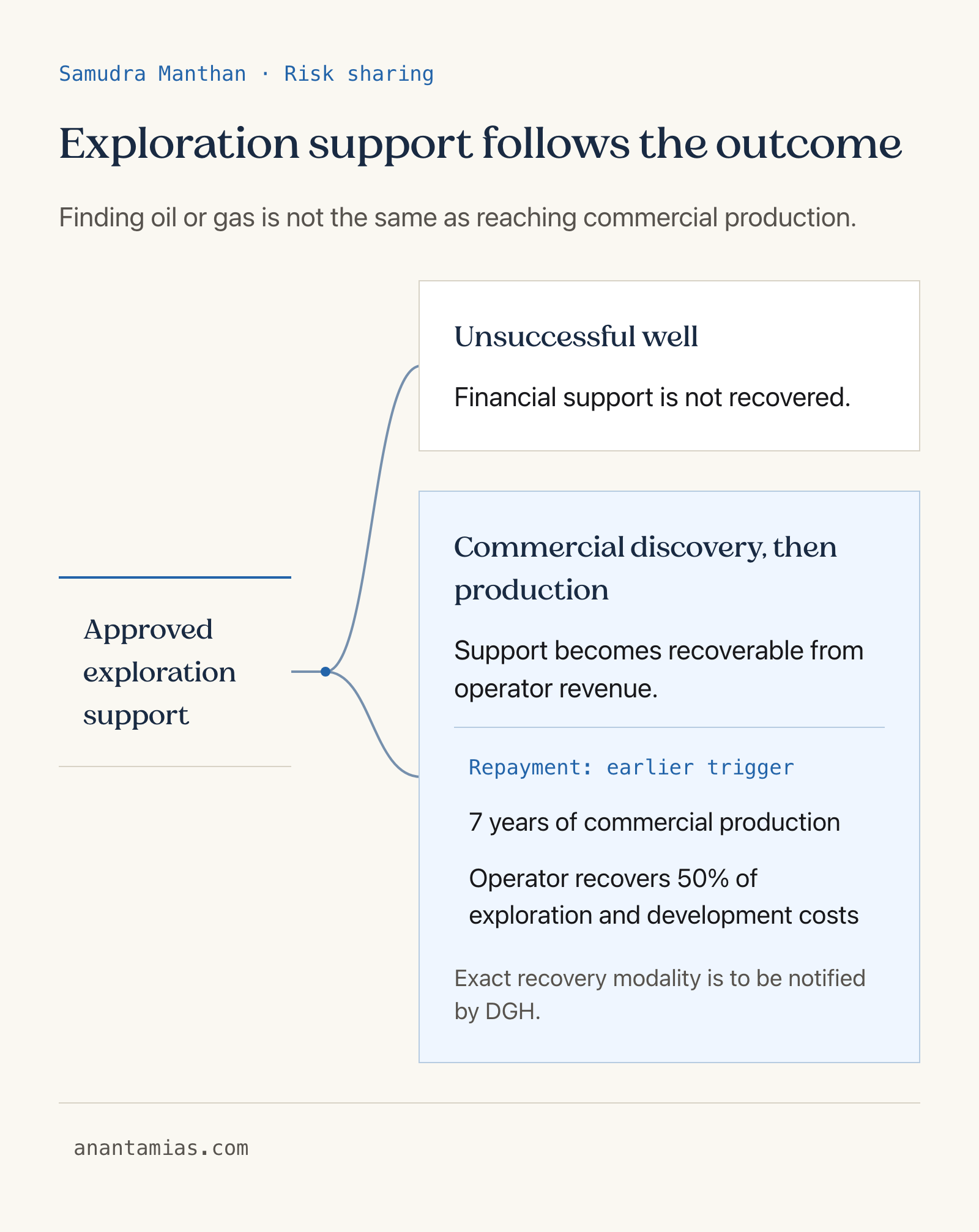
  • Financial support for an unsuccessful well is not recoverable; support linked to a successful commercial discovery becomes recoverable from operator revenue.
  • The Directorate General of Hydrocarbons (DGH) must still notify the exact recovery modality; the guidelines establish the governing conditions.
  • This development concerns operating rules for an existing scheme, including eligibility, milestone payments and repayment, rather than a fresh scheme launch.
  • Exploration risk arises before a producer knows whether costly drilling will yield a commercially usable resource.
  • Public support reduces part of that initial exposure while recovery from successful projects can return some funding to government.

UPSC Relevance

Prelims Relevance

  • Exploration: investigating whether hydrocarbons exist and can be recovered.
  • Development: preparing a commercially viable discovery for regular production.
  • Revenue Sharing Contract: the contractual regime specified for eligible blocks under the well-support component.
  • DGH: verifies eligibility, monitors drilling and administers the recovery mechanism.
  • Commercial production: regular production and sale, excluding production for testing.

Mains Relevance

GS Paper 3

  • Energy security: evaluate how exploration incentives might improve domestic supply without treating possible discoveries as established reserves.
  • Public finance: assess risk sharing, contingent recovery and incentives for credible project selection.

Essay

  • Risk and responsibility: public funding requires both a developmental rationale and mechanisms for accountability.

Background and Context

Why Exploration Needs a Different Funding Logic

Exploration spends money to resolve geological uncertainty; commercial production begins only after a discovery can support regular extraction and sale.

  • Seismic and geological information helps identify prospects, but a promising subsurface structure does not establish an economically recoverable deposit; drilling and evaluation must test whether the expected resource is actually present.
  • An unsuccessful well can be dry or encounter hydrocarbons that are technically or commercially unrecoverable, provided it was drilled and evaluated under the approved program; finding some hydrocarbons alone does not establish success.
  • A commercial discovery requires the contractual determination and an approved development area; the guidelines then distinguish regular production and sale from short testing flows when applying the support-recovery mechanism.
  • The risk-sharing rationale is to lower the operator’s exposure to an expensive uncertain well. Government carries part of the downside, while successful commercial outcomes create a claim for recovery from operator revenue.
  • Exploration and development are separate investment decisions: discovering oil or gas still leaves the task of assessing recovery, planning production and financing the facilities needed to move the resource to market.

When Support Becomes Recoverable

The operational guidelines link recovery to commercial outcomes and specify when repayments begin.

  • For unsuccessful wells, government does not recover the financial support. This protects the intended geological-risk sharing, but it does not remove the operator’s obligations to follow approved drilling, reporting and audit requirements.
  • For a successful commercial discovery, support is recoverable from operator revenue after commercial viability and production are established; a technical discovery or temporary test flow alone does not start the repayment schedule.
  • Recovery starts at the earlier trigger: seven years of commercial production, or recovery of 50% of the operator’s exploration and development costs. The two conditions are alternatives, rather than cumulative requirements.
  • Annual installments come from operator revenue without inflation indexation or time-value adjustment. Scheme repayment is additional to the operator’s existing obligations under its Revenue Sharing Contract, rather than replacing those contractual payments.
  • Project-attributable costs determine the cost-recovery trigger, supported by operator declarations and statutory-auditor certification. DGH must notify the exact recovery modality, making cost records and an implementable collection process central to accountability.
Samudra Manthan support branches to a non-recoverable unsuccessful well or repayment after commercial production at the earlier of two triggers
Unsuccessful-well support is not recovered; support for a successful commercial discovery is recovered from operator revenue after the specified production or cost-recovery trigger.

Eligibility and Safeguards Matter as Much as Funding

Risk sharing works only when eligibility, expenditure and performance can be checked against the approved project.

  • Chapter 9 permits any operator holding a valid deepwater or ultra-deepwater block under the Revenue Sharing Contract regime to seek support. Eligibility does not itself confer an entitlement to government funding.
  • Block and work-program conditions restrict assistance: relinquished acreage is excluded, contractual commitments must be fulfilled or on track, and funding release depends on satisfying outstanding obligations rather than simply submitting a proposal.
  • Milestone-based payments require evidence of drilling progress and completion. No claim or payment may anticipate a milestone; independent technical appraisal and DGH verification connect disbursement to work actually performed under the approved program.
  • Cost overruns do not automatically increase public support: expenditure beyond the approved cap remains with the operator. Eligibility checks also examine environmental and regulatory restrictions, so assistance cannot substitute for the required approvals.
  • Energy-security benefits remain conditional on viable discoveries and production. India’s oil-import concentration explains the policy concern, but approved exploration spending alone cannot demonstrate higher domestic output or reduced import dependence.

Way Forward

Make the Recovery Rule Auditable

  • DGH should specify the recovery process clearly, including attributable costs, reporting duties and the evidence used to identify the first repayment trigger.
  • Publish implementation outcomes that distinguish approved wells, completed evaluation, commercially viable discoveries and actual production; these measure different stages of performance.
  • Preserve independent scrutiny of costs and well results so that support follows verified progress and the public claim on successful outcomes remains enforceable.

Conclusion

  • Samudra Manthan’s central bargain is conditional risk sharing: unsuccessful exploration leaves government carrying its approved contribution, while commercial success creates an obligation to repay support from operator revenue under the specified trigger.
  • Judge the policy through its mechanism: eligibility and milestone checks govern entry, cost records govern recovery, and production outcomes determine whether exploration support eventually contributes to energy security rather than remaining only expenditure.

UPSC Practice Questions

Prelims MCQ 1

With reference to well support under the Samudra Manthan operational guidelines, consider the following statements:

  1. Financial support for an unsuccessful well is not recoverable by government.
  2. A temporary testing flow by itself qualifies as commercial production.
  3. Recovery from a successful commercial discovery is additional to Revenue Sharing Contract obligations.

How many of the above statements are correct?

(a) Only one (b) Only two (c) All three (d) None

Answer: (b) Only two

Explanation:

Statements 1 and 3 are correct. Commercial production excludes production for testing; the recovery mechanism requires commercial viability and production, followed by the specified repayment trigger.

Prelims MCQ 2

Which interpretation best describes the repayment-start rule for a successful commercial discovery?

(a) Repayment begins as soon as drilling identifies any hydrocarbons. (b) Both seven years of production and recovery of half the specified costs must occur. (c) The operator can choose either trigger after production starts. (d) Repayment begins at the earlier of seven years of commercial production or recovery of half the specified exploration and development costs.

Answer: (d) Repayment begins at the earlier of seven years of commercial production or recovery of half the specified exploration and development costs.

Explanation:

Section 9.8.4 uses whichever is earlier. Repayment is made from operator revenue in annual installments, without inflation indexation or time-value adjustment.

UPSC Mains Questions

  1. Examine how conditional public support for offshore exploration can balance energy-security objectives with fiscal accountability.
  2. Distinguish geological discovery from commercial production. Why does this distinction matter when designing government support and repayment conditions for exploration projects?

Sources: Ministry of Petroleum and Natural Gas operational guidelines and The Hindu, 25 October 2026.

Frequently Asked Questions

What does Samudra Manthan’s well support share?

It shares part of the cost of eligible offshore exploration wells under approved conditions. It reduces initial risk but does not guarantee a discovery, commercial production or full reimbursement of an operator’s expenditure.

Does finding hydrocarbons automatically trigger repayment?

No. The guidelines distinguish technical discovery from commercial viability and production. Repayment then starts at the earlier specified production-duration or cost-recovery trigger, rather than immediately upon detecting hydrocarbons.

Who can seek support under the well-funding component?

Chapter 9 permits any operator with a valid deepwater or ultra-deepwater block under the Revenue Sharing Contract regime to seek support. Block conditions, work obligations, appraisal and government approval still apply.

Are all repayment details already specified?

The guidelines establish recoverability, the repayment-start conditions and annual installments. DGH must notify the exact recovery modality, so the governing principle is clearer than every operational collection detail.

Why is an unsuccessful well different from a badly documented project?

An unsuccessful well is defined by approved drilling and evaluation without a successful commercial discovery. Non-recovery of its support does not cancel requirements concerning approved work, accurate records, milestone evidence and audit.

Satellite Connectivity: Who Controls an Operational Link?

Open article →Download PDF

Why in News?

On 24 October 2026, Ukraine’s President said Starlink and Starshield operation had been restored after restrictions, with tests confirming the services were working.

  • The Indian Express explained on 25 October that the reported restrictions concerned terminal movement speed: connections were affected when equipment moved rapidly, rather than simply delivering a lower internet download rate.
  • Starlink and Starshield share underlying technology but serve different customer arrangements, including commercial and government uses. Similar technical foundations do not establish identical permissions, service terms or institutional control over their operation.
  • The restoration statement establishes Ukraine’s reported experience of the service returning. It does not, by itself, establish who imposed the earlier restrictions, their precise implementation or the motive behind them.
  • Conflicting accounts of responsibility remain unresolved in the reporting. The defensible lesson concerns dependence on externally operated infrastructure, without treating a disputed explanation of this particular interruption as an established fact.
  • Strategic dependence can arise after equipment has been purchased and deployed, because continuing access still depends on a functioning service relationship.
  • Procurement scrutiny must consider who can change operating conditions and how a customer can obtain an accountable response when service is interrupted.

UPSC Relevance

Prelims Relevance

  • Satellite terminal: equipment through which a user connects to a satellite communications service.
  • Movement speed and throughput: physical motion and data-transfer rate are different quantities.
  • Service terms: conditions governing the use of a supplied service.
  • Provider and customer: distinct roles that need not hold the same operational authority.
  • Strategic dependence: reliance on capabilities or decisions controlled outside the immediate user organisation.

Mains Relevance

GS Paper 3

  • Critical infrastructure: assessing service-control dependencies in procurement and operational planning.
  • Security governance: reconciling technical capability with authorised uses and accountable incident handling.

GS Paper 2

  • International relations: private providers, government customers and the governance of strategically important services.

Essay

  • Access to technology and authority over its use are different forms of power.

Background and Context

The Terminal Is Only One Part of the Service

A local piece of equipment connects its user to a much larger operating system.

  • A satellite terminal provides the user-facing connection, while the service depends on orbiting infrastructure and network operations beyond that location. Possessing the terminal does not mean possessing or directing the entire network.
  • Technical capability describes what equipment and systems can support; permission describes the uses available under the relevant arrangement. A device’s apparent capacity should not be treated as a promise of unrestricted service.
  • The reported movement-speed restriction concerned how fast a terminal was travelling. Data throughput measures information transferred over time; confusing the two would change the explanation of what users said had been interrupted.
  • Commercial and government-oriented services can use related infrastructure while operating through different agreements. Their branding or shared technology alone cannot tell an observer who holds each decision-making power in a particular arrangement.
  • The practical distinction is between equipment ownership and service access. A buyer needs to understand which elements it controls locally and which depend on a provider, another customer or an external institutional decision.

Contracts Turn Connectivity Into an Operating Relationship

A procurement decision should identify the rights and responsibilities attached to continuing service.

  • Authorised uses define the scope a customer should expect from an agreement. Decision-makers need to establish whether their intended activity is covered, rather than infer permission merely because a terminal can technically connect.
  • Change authority is a separate question: who can alter conditions, suspend access or approve restoration? Clear allocation of these powers helps a customer assess dependence before an interruption makes the ambiguity operationally costly.
  • Incident accountability requires a known contact, escalation path and record of decisions. A customer cannot evaluate a service interruption adequately if technical support, contractual responsibility and government involvement are all treated as interchangeable.
  • Shared underlying infrastructure can connect apparently separate services to some common dependencies. Distinct product names are insufficient evidence that the customer has obtained independent control over every relevant part of the operating arrangement.
  • The earlier satellite-approval discussion concerns entry permissions. This episode raises a later question: after deployment, what contractual and institutional conditions govern the customer’s continued ability to use the service?

What the Evidence Supports, and What Remains Unclear

A useful strategic lesson should remain separate from an unproven account of a particular incident.

  • Restoration and attribution require different evidence. Tests reported by the user can support a claim that service is functioning again, but they cannot automatically identify the person or institution responsible for an earlier restriction.
  • Intent cannot be inferred from timing alone. A disruption occurring alongside diplomatic disagreement may prompt investigation, but that coincidence does not establish that the interruption was deliberately imposed to obtain a political concession.
  • A dependency review should map the provider, contracting customer, permitted uses and decision authorities. It should distinguish documented rights from assumptions, and flag arrangements where responsibility for changes remains unclear to the user.
  • India’s dedicated defence-communication procurement offers context for capability planning. The question here is narrower: what authority and enforceable service expectations accompany access to an externally operated system?
  • Strategic autonomy can be assessed function by function: identify which decisions can be made internally and which require cooperation. This produces a more useful assessment than equating available hardware with complete independence.

Way Forward

Audit the Service Relationship Before Depending on It

  • Document permitted uses and change authority in procurement reviews, identifying unresolved responsibilities before a service becomes essential.
  • Specify incident reporting and escalation so affected users can obtain timely explanations and trace decisions about suspension or restoration.
  • Review dependencies periodically as contracts, providers and operating needs change; retain evidence for both technical performance and institutional commitments.

Conclusion

  • Connectivity is an ongoing service relationship, not merely a terminal purchase. Its strategic value depends partly on the rights, responsibilities and external decisions that determine when and how the customer can use it.
  • The reported restoration is a verified statement, not a settled explanation of responsibility. Use the episode to examine contractual dependence while preserving uncertainty about the cause and control of the restrictions.

UPSC Practice Questions

Prelims MCQ 1

With reference to the reported satellite-service restrictions in Ukraine, consider the following statements:

  1. Terminal movement speed and internet data throughput measure different things.
  2. Shared underlying technology proves that two services have identical contractual permissions.
  3. A statement that service has been restored establishes who ordered its earlier restriction.

How many of the above statements are correct?

(a) Only one (b) Only two (c) All three (d) None

Answer: (a) Only one

Explanation:

Only statement 1 is correct. Shared technology does not establish identical permissions, and restoration does not by itself identify the authority responsible for a prior restriction.

Prelims MCQ 2

Which procurement question most directly addresses service-control dependence?

(a) Whether a terminal has an attractive physical design (b) Whether the provider uses different names for related products (c) Who can change operating conditions, and what rights and escalation arrangements the customer has (d) Whether restoration eliminates the need to investigate an interruption

Answer: (c) Who can change operating conditions, and what rights and escalation arrangements the customer has

Explanation:

Control dependence concerns decision authority and the customer’s service rights. Hardware appearance, product names or a restoration announcement do not establish those responsibilities.

UPSC Mains Questions

  1. Explain how reliance on privately operated satellite communications can create strategic dependencies even when a government possesses the necessary user equipment.
  2. Discuss the contractual and institutional safeguards that should guide procurement of strategically important digital services.

Sources: President of Ukraine, 24 October address and Indian Express Explained, 25 October.

Frequently Asked Questions

What was restored according to Ukraine’s President?

The President said Starlink and Starshield operation had returned to the speeds available before the restrictions, and that tests confirmed the services were working. This is an attributed official account of restoration.

Does movement speed mean internet download speed?

No. Movement speed describes how rapidly a terminal is travelling, while data throughput describes information transferred over time. The reporting concerned connections affected by the movement of equipment, rather than simply slower downloads.

Why does owning a terminal not ensure complete control?

The terminal connects to infrastructure and network operations beyond the user’s location. Continued access also depends on service conditions, contractual permissions and decisions assigned to providers or other institutions within the operating arrangement.

Was responsibility for the restrictions established?

The reporting contained conflicting accounts and did not settle the precise division of control or motive. Restoration should not be used as proof of who imposed the restrictions or why they occurred.

What should a dependency review examine?

It should identify permitted uses, the authority to change conditions, incident-response contacts and the customer’s contractual rights. The review should separate documented responsibilities from assumptions about who controls each part of the service.