Opens in a new tab
Join Anantam IAS Channel on Telegram

Daily Digest · Sunday

25 October 2026 Current Affairs for UPSC

7 current affairs published on Sunday, 25 October 2026

25 October 2026 Current Affairs for UPSC — every Why-in-News article AnantamIAS published on Sunday, 25 October 2026, broken down with Why in News?, the exact GS paper it feeds, sub-topic mapping, MCQ-ready facts and a UPSC-style practice question. 7 articles in total, covering Polity, Economy, Environment, S&T, IR, Geography, History, Society and Internal Security — the same Why-in-News + GS-paper-mapping + practice-question format the Compass uses across every daily digest on the site.

Daily current affairs for UPSC is where new material enters your prep stream. Read this 25 October 2026 digest end-to-end in 25–35 minutes, attempt the practice question at the foot of each article (it's MCQ for some, 10/15-marker for others), then bookmark the entries that fall inside your active revision window. Everything stays cross-linked: tap any subject pill to jump to that subject's hub, or use the table of contents above to skip straight to a specific story.

Use this page three ways. Read sequentially for a one-sitting scan of everything that mattered on 25 October 2026. Download the 25 October 2026 PDF below for offline study or print revision. Or use the October 2026 Current Affairs compilation to see this day in the month's full context. For the previous day's reading, see 24 October 2026 Current Affairs.

Why we publish daily current affairs separately from the monthly compilation: daily is learning, monthly is revision. Use the daily page to add fresh material to your notes the day it breaks; come back to the October 2026 compilation 60 days before Prelims when the noise has settled and only the lasting takeaway is worth re-reading.

AATAL Laboratory: From Pollution Levels to Source Evidence

Open article →Download PDF

Why in News?

The Ministry of Earth Sciences inaugurated AATAL at IITM’s Delhi branch on October 24 to combine atmospheric chemistry, aerosol toxicity analysis and source evidence for Delhi-NCR air-quality management.

  • AATAL brings atmospheric measurements and chemical analysis together to examine gases, fine particles, metals and other constituents of polluted air.
  • The ministry describes source apportionment as a means to estimate contributions from transport, industry, burning, dust and pollution transported from surrounding regions.
  • Integration with IITM’s AIRWISE combines observations, forecasts and source information to support decisions by CAQM and other implementing agencies.
  • These are measurement and decision-support capabilities; the inauguration does not establish that pollution has already fallen or that an individual patient’s illness has been explained.
  • Concentration, composition and source contribution answer different questions. A useful warning about polluted air does not by itself reveal which activities should be targeted.
  • Scientific interpretation must connect laboratory findings with practical intervention and follow-up measurement; acquiring better instruments alone cannot deliver cleaner air.

UPSC Relevance

Prelims Relevance

  • Aerosol: solid particles or liquid droplets suspended in a gas.
  • PM2.5: fine inhalable particles generally 2.5 micrometres or smaller in diameter.
  • Chemical characterisation: identifying the constituents of an atmospheric sample.
  • Source apportionment: estimating the contributions of different sources to measured pollution.
  • Secondary particles: particles formed through reactions in the atmosphere rather than emitted directly.

Mains Relevance

GS Paper 3

  • Using atmospheric science to target pollution controls and assess their effects.
  • Distinguishing measurements, model estimates and evidence of environmental improvement.

GS Paper 2

  • Coordination between scientific institutions, pollution-control agencies and health authorities.

Essay

  • Better public decisions require both useful evidence and institutions able to act on it.

Background and Context

What the Laboratory Measures

The first distinction is between how much pollution is present and what that pollution contains; each measurement supplies a different part of the explanation.

  • Particulate matter contains solid particles and liquid droplets. Measuring its concentration establishes the amount present in air, while chemical analysis examines the mixture that produces that reading and may carry different implications for control.
  • AATAL’s stated capability includes examining atmospheric gases, fine particles, metals and toxic elements. These observations can deepen understanding of the mixture without reducing every pollutant to a single undifferentiated category of smoke or dust.
  • Primary particles enter the air directly from sources such as fires, roads and construction. The US EPA explains that other particles form through atmospheric reactions involving gaseous pollutants, complicating the path from emissions to exposure.
  • Chemical transformation matters because the material measured at a monitoring location need not be identical to what originally left an emission source. Understanding reactions helps explain why simply identifying visible smoke cannot describe the whole mixture.
  • Potential toxicity is a separate question from mass concentration. The ministry says composition evidence can support health-risk assessment, but a laboratory observation does not independently diagnose illness or determine the exposure history of a particular person.

How Measurements Become Source Evidence

Source apportionment is an inference from observations and analytical methods; the instrument does not directly read the identity of every polluter.

  • Receptor models work from chemical and physical characteristics measured where pollution is received. They help identify and estimate contributing source types, complementing other approaches to understanding how emissions affect the air at that location.
  • Source characteristics and patterns within measured data help relate a mixed sample to plausible contributors. This is a reasoned estimation process, so the interpretation and quality of the underlying observations matter alongside the equipment used.
  • Similar source signatures can limit separation. The EPA explains that chemical mass-balance modelling cannot distinguish sources with similar properties; a contribution assigned to a source category does not automatically identify one specific emitting facility.
  • Secondary formation makes attribution harder because atmospheric reactions change the mixture. Supporting analysis can help interpret these contributions; the distinction prevents a simple list of measured chemicals from being treated as a complete explanation of origin.
  • Place and time must remain attached to an estimate. A source contribution observed in one setting should not be presented as a permanent share for the entire region, especially when comparing pollution episodes or evaluating interventions.
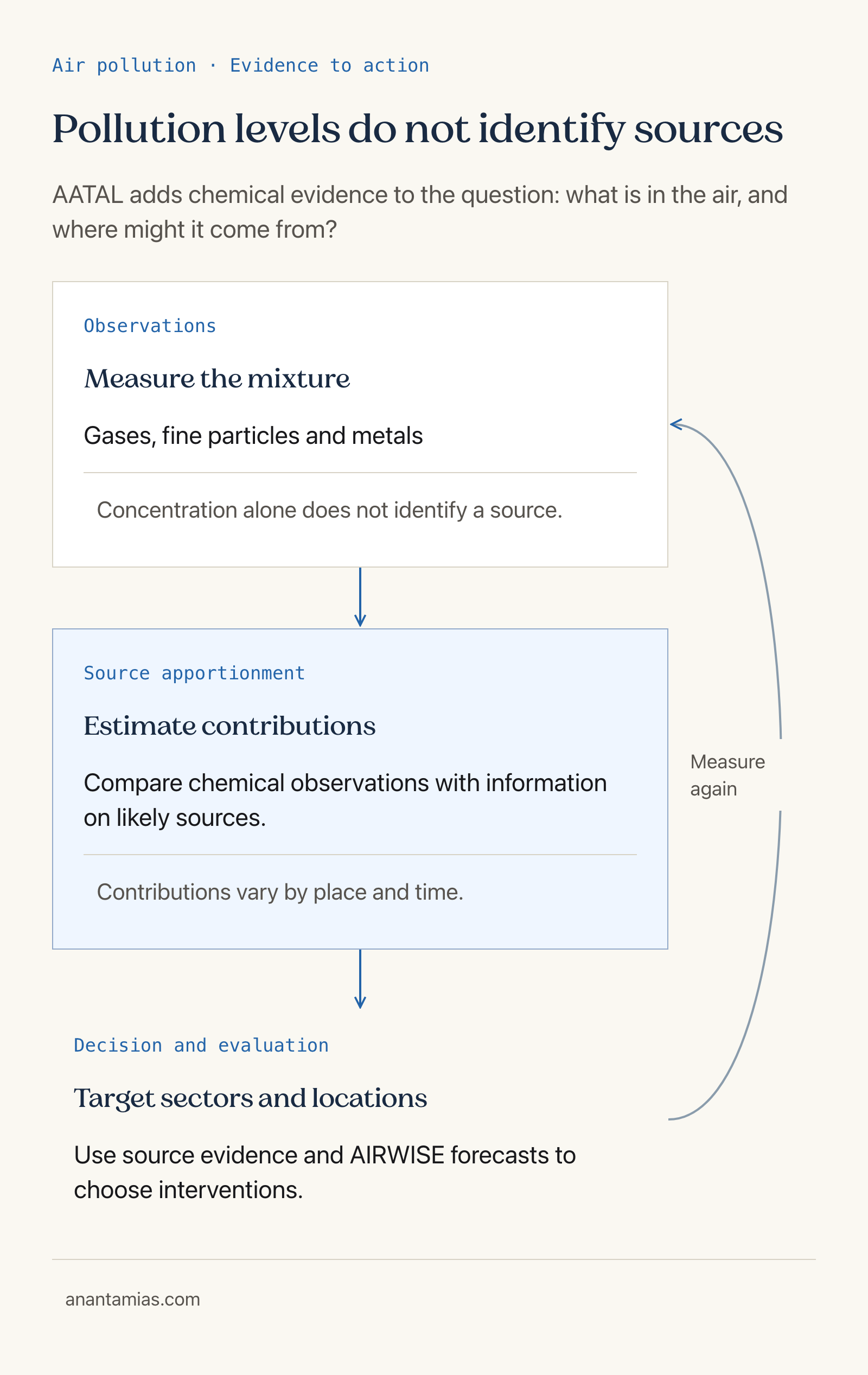
Chemical observations support estimates of pollution-source contributions, which guide targeted action and repeat measurement.
Chemical measurements, source estimation and policy decisions perform different jobs; repeat observations help assess the result.

Turning Evidence Into Accountable Action

The practical value lies in choosing a suitable response, carrying it out and checking whether the intended environmental result follows.

  • Targeted intervention uses source evidence to focus attention on relevant sectors and locations. The ministry identifies CAQM and pollution-control agencies as users of this information, with scientific institutions supplying evidence rather than replacing implementation responsibilities.
  • Forecasts and observations perform complementary jobs: one supports preparation for expected conditions, while the other records what is measured. Combining them can support timely choices without turning a forecast into proof that an intervention has succeeded.
  • Regional coordination matters because the release includes pollutants transported from surrounding areas. A city’s response may require cooperation beyond its administrative boundary, linking local controls with attention to contributions arriving from elsewhere in the region.
  • Warning thresholds and source analysis should inform each other. GRAP’s staged response addresses deteriorating conditions, while source evidence helps explain which contributing activities deserve attention within the wider response and its implementation.
  • Evaluation should compare the action taken with subsequent measurements and relevant conditions. A lower reading alone is insufficient to establish the causal story; transparent interpretation helps agencies distinguish useful control measures from unsupported claims of success.

Way Forward

Connect Analysis With Decisions

  • Publish methods, uncertainty and the place and period represented alongside source estimates so implementing agencies can use them within their actual evidentiary limits.
  • Link identified priorities to named implementing agencies and follow-up measurements, keeping the scientific assessment and the administrative response traceable.
  • Use health and environmental expertise together when interpreting composition, while communicating clearly that source estimates and potential toxicity are different from individual medical diagnosis.

Conclusion

  • AATAL’s significance is the connection between atmospheric measurements, chemical composition and decisions about pollution sources. Its success must be assessed through useful interpretation, targeted action and evidence of outcomes, rather than the inauguration or equipment alone.
  • Evidence has different levels: a concentration reading, a source estimate and an observed improvement establish different things. Keeping these distinctions clear supports more credible environmental policy and more accountable claims about the results of intervention.

UPSC Practice Questions

Prelims MCQ 1

With reference to atmospheric particulate matter and source apportionment, consider the following statements:

  1. All atmospheric particulate matter is emitted directly as particles.
  2. Chemical analysis can help estimate contributions from different source types.
  3. A source-category estimate does not necessarily identify a specific emitting facility.

How many of the above statements are correct?

(a) Only one (b) Only two (c) All three (d) None

Answer: (b) Only two

Explanation:

Statements 2 and 3 are correct. Secondary particles form through atmospheric reactions. Source apportionment estimates contributions, while similar source characteristics can limit identification of particular emitters.

Prelims MCQ 2

Which statement best explains the policy value of combining pollution measurements with source apportionment?

(a) It makes implementation by pollution-control agencies unnecessary. (b) It proves that every illness in the monitored area was caused by one pollutant. (c) It establishes permanent source shares for an entire region from one observation. (d) It helps target relevant sources and evaluate interventions, subject to the limits of the evidence.

Answer: (d) It helps target relevant sources and evaluate interventions, subject to the limits of the evidence.

Explanation:

Measurements and source estimates can guide action and assessment. Their interpretation depends on methods and the conditions represented; they do not independently prove individual illness, permanent shares or successful implementation.

UPSC Mains Questions

  1. Explain how chemical characterisation and source apportionment can improve urban air-quality management. Discuss the limits that policymakers must consider.
  2. How can scientific institutions and implementing agencies connect pollution-source evidence with accountable action? Discuss with reference to AATAL and Delhi-NCR.

Sources: PIB, Ministry of Earth Sciences and US Environmental Protection Agency.

Frequently Asked Questions

What is AATAL?

AATAL is the Integrated Atmospheric Chemistry and Aerosol Toxicity Analysis Laboratory inaugurated at IITM’s Delhi branch. It combines atmospheric measurements, chemical analysis and source evidence to support air-quality management in Delhi-NCR.

How does source apportionment differ from measuring pollution levels?

Concentration measures how much pollutant is present. Source apportionment uses observations and analytical methods to estimate contributions from different sources. It helps explain the mixture rather than simply indicating its overall level.

Why do secondary particles complicate source identification?

Secondary particles form through atmospheric reactions involving gaseous pollutants. The measured mixture can differ from the original emissions, so identifying its sources may require supporting analysis rather than a direct match to one visible emitter.

Does the new laboratory prove that Delhi’s air has improved?

No. The announcement describes analytical and decision-support capabilities. Cleaner air requires effective action and follow-up assessment. Better measurements can guide that process, but the laboratory’s inauguration does not itself establish an improvement.


Submarine AIP: Testing Power for Longer Submerged Endurance

Open article →Download PDF

Why in News?

On 24 October 2026, India’s indigenous submarine Air Independent Propulsion energy module reached the inauguration of Setting to Work Phase-2 at Hazira, with energisation and naval testing still ahead.

  • Naval Materials Research Laboratory, a DRDO laboratory, developed the AIP energy module for diesel-electric submarines; the milestone was announced by the Ministry of Defence.
  • The next phase involves power production and rigorous testing under Indian Navy protocols before the module is handed over for submarine integration.
  • Integration on a Kalvari-class submarine at Mazagon Dock Shipbuilders Limited is planned for early 2027; this is a future programme milestone.
  • The announcement stresses hydrogen and fuel-cell safety; it does not establish completed installation, operational induction or a verified increase in endurance for an inducted submarine.
  • For a conventional submarine, underwater endurance affects how long it can remain submerged before needing access to atmospheric air for conventional power generation.
  • The policy issue is the passage from indigenous technology development to a dependable naval capability, including industrial production, platform integration and operational support.

UPSC Relevance

Prelims Relevance

  • AIP: Air Independent Propulsion, associated here with extending the submerged endurance of diesel-electric submarines.
  • NMRL: Naval Materials Research Laboratory, the DRDO laboratory developing the indigenous system.
  • Fuel cell: an electrochemical device that converts the chemical energy of supplied fuel into electrical energy.
  • Kalvari class: the submarine class identified for the planned integration of this energy module.
  • Technology stages: module testing, platform integration and operational induction establish different levels of readiness.

Mains Relevance

GS Paper 3

  • Indigenous defence technology and the industrial pathway from research to operational capability.
  • Balancing naval endurance gains with safety, testing, maintainability and integration requirements.

Essay

  • Technological self-reliance requires institutions that can test, maintain and improve what they produce.

Background and Context

What Air Independence Changes

AIP addresses a conventional submarine’s dependence on atmospheric air while supplying electrical power below the surface.

  • A diesel-electric submarine can operate submerged using stored electrical energy. Conventional diesel generation needs air, making the need to replenish available energy an important constraint on how the boat sustains underwater operations over time.
  • A fuel cell converts chemical energy into electricity through electrochemical reactions. The US Department of Energy’s explanation identifies electricity, water and heat as the products when hydrogen is the fuel supplied to the cell.
  • Air-independent does not mean that the system needs no chemical reactants. The relevant distinction is reduced dependence on atmospheric oxygen; the announcement does not describe every storage arrangement or internal component of this module.
  • Fuel-cell AIP and nuclear propulsion are different technologies. A fuel-cell installation does not turn a conventional boat into a nuclear-powered submarine, and a common endurance objective does not make their energy systems interchangeable.
  • The useful claim is longer submerged endurance. It should not be expanded into an unsupported promise about maximum speed, a fixed number of underwater days, complete invisibility or unlimited operation under every mission condition.

What the New Testing Stage Establishes

The development pathway has several evidence gates; success at one gate does not settle the questions posed by the next.

  • Earlier land-based prototype tests demonstrated operation under user requirements, according to PIB. That earlier achievement provides development context, while the present announcement concerns a new energy-module activity and its remaining route towards submarine integration.
  • The immediate next step is energising the module for power production and testing it under naval protocols. An inauguration marks the start of an activity; it cannot substitute for the results that testing must establish.
  • Platform integration asks a wider engineering question than whether a module produces power. The installation must function with the submarine as a whole; component-level performance alone cannot establish the readiness of the integrated vessel.
  • The planned handover to Mazagon Dock Shipbuilders Limited places shipbuilding integration after the announced module-testing stage. Keeping those responsibilities distinct helps explain why a successful research programme still needs coordinated delivery across different institutions.
  • The early-2027 integration plan remains a timetable stated by the Ministry. It is not evidence that a submarine already carries the completed installation, or that the Navy has accepted the resulting capability for operational service.

Why Safety and Industrial Capability Matter

The strategic value depends on turning scientific knowledge into a safe system that can be supported throughout its service life.

  • Hydrogen and fuel-cell safety is an explicit concern in the announcement. Safety should be treated as a continuing condition for progress, rather than a procedural formality that can be displaced by an ambitious induction timetable.
  • The programme connects NMRL’s development work, industry participation at L&T and the planned shipyard integration. This division of work illustrates why defence self-reliance depends on coordination across laboratories, manufacturing facilities and the eventual user.
  • An indigenous system can strengthen domestic technical knowledge, but the label alone does not prove that every component is locally sourced. Such a claim would require separate evidence about suppliers, manufacturing and critical dependencies.
  • A useful assessment also asks about maintenance and support: trained personnel, reliable procedures and access to replacement components. These are evaluation questions for sustained capability, not additional programme achievements established by the inauguration release.
  • India’s naval trials platforms and shallow-water anti-submarine craft illustrate different capability requirements. AIP’s specific contribution is to the conventional submarine’s power and endurance problem, rather than replacing those separate surface-fleet roles or development functions.

Way Forward

Make Readiness Claims Follow Test Evidence

  • Link each readiness claim to the relevant completed stage: module performance, safe integration or operational acceptance, with future milestones described as plans.
  • Keep safety requirements central to the testing schedule, with the laboratory, industry, shipyard and naval user coordinating the transition between stages.
  • Assess lifecycle support alongside initial performance so that indigenous development translates into a capability that can be maintained and improved in service.

Conclusion

  • AIP’s importance lies in reducing a diesel-electric submarine’s dependence on atmospheric oxygen and improving submerged endurance. The present milestone advances that pathway while leaving energisation, testing and integration to be completed.
  • Defence self-reliance should be assessed through demonstrated performance, safe platform integration and sustained support. Announced schedules explain intended progress; they cannot stand in for evidence that an operational capability has already been delivered.

UPSC Practice Questions

Prelims MCQ 1

With reference to fuel-cell Air Independent Propulsion, consider the following statements:

  1. It can reduce a diesel-electric submarine’s dependence on atmospheric oxygen.
  2. A hydrogen fuel cell converts chemical energy into electrical energy.
  3. Installing fuel-cell AIP necessarily converts a submarine into a nuclear-powered vessel.

How many of the above statements are correct?

(a) Only one (b) Only two (c) All three (d) None

Answer: (b) Only two

Explanation:

The first two statements describe the stated endurance objective and the fuel-cell mechanism. Fuel-cell and nuclear propulsion are different energy technologies; AIP installation does not imply a nuclear reactor.

Prelims MCQ 2

A submarine energy module has begun a new testing activity, with platform integration planned later. Which conclusion is most justified?

(a) The submarine has already entered operational service with the module. (b) Integration testing is unnecessary once the module produces electricity. (c) The milestone advances development, while later readiness claims still require evidence. (d) The announced integration date guarantees a fixed underwater endurance.

Answer: (c) The milestone advances development, while later readiness claims still require evidence.

Explanation:

The Ministry’s sequence leaves energisation, naval-protocol testing and subsequent integration ahead. Starting a testing activity does not establish completed platform integration or operational induction.

UPSC Mains Questions

  1. Explain how Air Independent Propulsion can improve conventional submarine capability. Why must its contribution be assessed alongside testing, safety and integration requirements?
  2. Indigenous defence development requires a coordinated industrial ecosystem. Discuss with reference to the transition from an AIP energy module to a supported naval capability.

Sources: PIB, Ministry of Defence and PIB, earlier NMRL fuel-cell AIP tests.

Frequently Asked Questions

What does Air Independent Propulsion mean?

AIP enables a conventional submarine to reduce its dependence on atmospheric air while producing power underwater. Its relevance is improved submerged endurance, although actual performance depends on the system and operating conditions.

What is India’s latest AIP milestone?

On 24 October, Setting to Work Phase-2 activity for the indigenous AIP energy module was inaugurated at Hazira. Energisation and naval-protocol testing are the next steps before planned submarine integration.

Does fuel-cell AIP make a submarine nuclear-powered?

No. A fuel cell converts chemical energy into electricity, while nuclear propulsion uses a different energy source. Adding fuel-cell AIP to a conventional submarine does not mean installing a nuclear reactor.

Has the module already been integrated into a Kalvari-class submarine?

The Ministry’s announcement describes integration as planned for early 2027, after the stated testing and handover stages. It does not report completed integration or operational induction of the system on a submarine.

Rail Travel Insurance: Extending Cover to Counter Bookings

Open article →Download PDF

Why in News?

Indian Express reported that the Railway Board on October 24 directed railway zones to extend optional travel insurance to reserved counter-ticket bookings by October 27, following an earlier Supreme Court order.

  • The direction extends an existing optional insurance facility from online reserved bookings to reservation counters; the implementation deadline remains ahead of this note’s publication.
  • The report requires digital collection of the premium and accurate capture of a mandatory mobile number so that passenger details can reach the insurer for policy issuance.
  • The existing IRCTC terms specify 45 paise per passenger, including taxes. If insurance is selected, the option applies to eligible passengers booked under the same PNR.
  • The insurance company issues the policy and settles claims under its terms. The extension does not make insurance automatic or establish coverage for every railway passenger.
  • A benefit available only through an online booking channel can exclude passengers who depend on staffed reservation counters, even when their journey is otherwise eligible.
  • Practical access requires more than a policy announcement: the passenger must understand the choice, complete payment and receive usable policy information.

UPSC Relevance

Prelims Relevance

  • Optional insurance: coverage selected by the passenger rather than attached automatically to every ticket.
  • PNR: the booking record to which the insurance selection applies for the passengers included in it.
  • Premium: the amount paid for insurance coverage under the policy’s terms.
  • Insurer: the company responsible for issuing the policy and assessing insurance claims.
  • Reserved and unreserved travel: a relevant eligibility distinction; booking channel and class label should not be confused.

Mains Relevance

GS Paper 2

  • Inclusive delivery of public services across online and assisted channels.
  • Informed consent, grievance redressal and implementation accountability.

GS Paper 3

  • Financial protection, insurance literacy and barriers created by digital payment requirements.

Essay

  • Equal entitlement becomes meaningful when people can actually use the service.

Background and Context

What Changes at the Reservation Counter

The policy change concerns the route through which eligible passengers can choose insurance, while the existing policy conditions continue to matter.

  • Previously, the facility was available with online reserved bookings. The new direction adds reservation counters, addressing a difference created by the booking channel rather than announcing an entirely separate insurance product for offline passengers.
  • The report links the Board’s instruction to an earlier Supreme Court order. The immediate administrative task is to make the option available by the stated deadline and inform counter staff how it should operate.
  • An implementation instruction establishes what railway zones have been directed to do. It does not, by itself, prove that every counter already offers the facility or that every eligible passenger has received a policy.
  • The reported extension retains the existing terms for eligible reserved tickets, including confirmed, partly confirmed and RAC bookings. It should not be read as a universal cover for unreserved travel or all people entering stations.
  • The relevant comparison is online versus counter access within the eligible booking category. Describing all second-class passengers as excluded would obscure the distinction between reserved and unreserved travel that matters to the reported extension.

Why an Offline Counter Can Still Have Digital Barriers

A staffed booking counter can widen access, but the payment and communication requirements still determine whether the passenger can complete the insurance choice.

  • The scheme remains optional, requiring an understandable choice at booking. Counter assistance should explain the premium, covered events and policy conditions so that an eligible traveller can make an informed decision about purchasing protection.
  • Under the official terms, selecting insurance applies to eligible passengers under one PNR. The choice and its cost should be explained for the whole booking, rather than presented as an unexplained addition to the fare.
  • The Board’s reported instruction requires digital premium collection. A passenger may reach a physical counter yet still face a payment obstacle; assisted access must address the practical transaction, alongside the availability of the option.
  • A correct mobile number connects the booking to policy communication. An incorrectly entered number can obstruct receipt of information, making careful data capture and a way to resolve errors important parts of effective service delivery.
  • As with measuring financial inclusion, access should be assessed through completed service use. Counting equipped counters alone cannot reveal whether eligible passengers understood the choice, paid successfully and obtained their insurance details.

Coverage, Claims and the Limits of the Extension

Insurance creates a defined contractual relationship; its scope and claim process must remain clear when the booking channel expands.

  • The official policy terms place issuance and claims settlement with the insurer. IRCTC provides the connection for purchasing cover; passengers need to know which company issued their policy and where a claim should be addressed.
  • The policy covers specified consequences of rail accidents or untoward incidents, subject to its conditions. It is not an unrestricted health policy, and paying a premium does not guarantee acceptance of every claim.
  • A policy claim and statutory railway compensation are distinct routes. The report describes insurance as additional protection; extending its availability should not be interpreted as replacing legal remedies or automatically deciding entitlement under railway law.
  • The policy provides for nomination and claim documentation, including evidence relevant to the insured event. Clear instructions after purchase matter because a low premium alone does not make the later process understandable to every household.
  • The distinction between eligibility and delivery also applies here: wider availability does not erase exclusions. Authorities should explain who can opt in, while evaluating whether the delivery process actually reaches those passengers.

Way Forward

Make the Insurance Choice Usable

  • Give counter staff short, clear explanations of consent, booking eligibility and the insurer’s role, supported by assistance for passengers who cannot complete the digital transaction independently.
  • Provide a practical route to check policy receipt and correct communication errors, while directing policy and claim queries to the responsible insurer.
  • Review completed purchases and unresolved access problems, alongside counter readiness, so that implementation assessment reflects passengers’ ability to use the facility.

Conclusion

  • Extending insurance to reservation counters addresses a gap between booking channels. Its value depends on informed consent, workable payment arrangements and reliable policy delivery, while retaining the coverage conditions that define the product.
  • Inclusive implementation must distinguish an announced option from completed access. The October 27 deadline is still prospective, and neither the extension nor premium payment establishes universal coverage or guarantees the outcome of a later claim.

UPSC Practice Questions

Prelims MCQ 1

With reference to the optional railway travel insurance scheme, consider the following statements:

  1. Insurance becomes compulsory for every passenger merely because a reserved ticket is purchased.
  2. If the insurance option is selected, the official terms apply it to passengers booked under the same PNR.
  3. The insurance company is responsible for policy issuance and claims settlement.

How many of the above statements are correct?

(a) Only one (b) Only two (c) All three (d) None

Answer: (b) Only two

Explanation:

Statements 2 and 3 are correct under the official IRCTC terms. Insurance remains optional; purchasing a reserved ticket alone does not automatically enrol the passenger.

Prelims MCQ 2

Which indicator would best assess whether extending optional insurance to reservation counters has improved practical access?

(a) The number of counters displaying a notice, without checking completed transactions. (b) The share of eligible passengers who can make an informed choice, complete payment and receive policy details. (c) The assumption that every ticket holder is now insured. (d) The total number of unreserved passengers travelling on the network.

Answer: (b) The share of eligible passengers who can make an informed choice, complete payment and receive policy details.

Explanation:

Effective access requires the passenger to complete the service process. Infrastructure or publicity counts alone cannot establish that consent, payment and policy communication work for eligible travellers.

UPSC Mains Questions

  1. Extending a public service to an offline channel does not necessarily remove digital exclusion. Discuss with reference to optional rail travel insurance at reservation counters.
  2. Explain why informed consent, clear institutional responsibility and usable claims information are necessary for inclusive delivery of low-premium insurance products.

Sources: Indian Express and IRCTC, Optional Travel Insurance terms.

Frequently Asked Questions

What is changing for railway counter bookings?

The Railway Board has directed zones to offer optional travel insurance with eligible reserved counter bookings by October 27. The report extends the existing facility’s booking channel, while retaining the applicable policy terms.

Does every passenger automatically receive insurance?

No. The scheme is optional and subject to eligibility conditions. The official terms state that, once the option is selected, it applies to passengers booked under the same PNR. Unreserved travel is not covered by this extension.

Why are digital payment and mobile details important?

The reported counter instructions require digital collection of the premium and a mandatory mobile number for policy communication. These requirements can remain practical barriers even when the ticket itself is purchased at a staffed counter.

Who handles an insurance claim?

The insurance company issues the policy and settles claims under its conditions. Passengers should use the insurer’s details in the policy document. A claim under this product is distinct from statutory railway compensation.

Railway Complaints: Connecting Response With Police Investigation

Open article →Download PDF

Why in News?

The Ministry of Railways reported on October 24 that GRP personnel had been onboarded onto RailMadad to improve passenger grievance handling, information-sharing and complaint monitoring after a railway-police conference.

  • The concrete change is GRP participation in shared complaint handling, enabling closer coordination with railway authorities and RPF around passenger concerns.
  • The release identifies timely information-sharing and complaint monitoring as intended benefits; it does not establish a guaranteed response time or completed nationwide coverage.
  • The conference also emphasized digital evidence handling, standardized procedures and joint training, linking information exchange with the capacity to act on it.
  • The announcement concerns administrative coordination. It does not announce automatic FIR registration, a new police law or a transfer of State police powers.
  • A passenger’s problem can cross service and policing responsibilities; a visible entry point is useful only when information reaches the agency able to act.
  • Shared monitoring can make handoffs easier to review, but institutional authority, evidence handling and meaningful follow-up still require clear responsibilities.

UPSC Relevance

Prelims Relevance

  • GRP: Government Railway Police, part of State policing arrangements for railway areas.
  • RPF: Railway Protection Force, working alongside GRP and State Police on railway security.
  • Complaint monitoring: tracking receipt, referral and action, without assuming that each stage is a completed investigation.
  • Administrative coordination: connecting institutions while preserving their distinct responsibilities.
  • Digital evidence: information requiring careful preservation and handling when relevant to an inquiry.

Mains Relevance

GS Paper 2

  • Accountability and coordination in public grievance redressal.
  • State policing responsibilities within a shared public-service system.

GS Paper 3

  • Passenger security, information-sharing and evidence handling on transport networks.

Essay

  • Public trust depends on knowing who will act after a concern has been recorded.

Background and Context

Who Responds and Who Investigates

Railway safety involves institutions with connected responsibilities; understanding their roles prevents a shared complaint channel from being mistaken for a single police authority.

  • Government Railway Police operates within State policing arrangements. Uttar Pradesh Police identifies GRP as a separate branch of its force, responsible for law and order at railway stations and in trains, alongside passenger-related crime duties.
  • Passenger assistance and criminal investigation answer different questions. Helping someone obtain an immediate response is important, while suspected crime also requires the responsible police agency to assess the information and take the appropriate investigative steps.
  • The Railway Protection Force convened the conference involving GRP and State Police. The release treats their cooperation as necessary; participation in one communication system should not be read as making their institutional responsibilities identical.
  • Coordination does not itself confer legal authority. The onboarding announcement establishes an administrative change, while the powers available to an officer remain a separate question governed by the applicable legal and institutional framework for that role.
  • The distinction matters when considering particular powers exercised by police officers. An institutional label alone cannot settle every power or procedure; the authority attached to that function must be identified before drawing a legal conclusion.

How Shared Complaint Handling Can Close Handoff Gaps

The useful mechanism is a clearer connection between the passenger’s report, the institution receiving it and the agency responsible for the next action.

  • Shared access to relevant information can reduce repeated explanations and incomplete referrals. The release presents timely information-sharing as an objective, rather than supplying evidence that every handoff already works consistently across the railway network.
  • A useful handoff preserves the substance of the complaint, its location and the action already taken. These details help the receiving agency understand what remains to be done instead of treating a referral as closure.
  • Responsibility should remain visible after a complaint moves between institutions. A passenger needs to know who is handling the concern, while supervisors need enough information to identify unresolved referrals and request a meaningful update on progress.
  • Service records and police procedures must be distinguished. A complaint’s appearance in a shared system does not establish that every required investigative step has occurred; the announcement does not claim that onboarding automatically registers an FIR.
  • As with single-window public services, a common entry point can help coordinate different agencies. Its value depends on what happens after submission, including a clear route to the institution responsible for resolving the underlying issue.

How to Judge Whether Coordination Improves Safety

Evaluation should examine the quality of the response and subsequent action, using records that explain what happened without claiming more than they establish.

  • Activity counts show that complaints were received or forwarded, but cannot establish satisfactory resolution on their own. Assessment should also examine whether the appropriate agency accepted responsibility and whether the passenger received a useful response.
  • Closure needs an explanation that matches the issue raised. An administrative status update should not conceal an unresolved police referral; clear records allow supervisors to distinguish completed assistance from an inquiry that still requires attention.
  • Digital evidence handling was emphasized at the conference. Relevant material should be preserved and transferred carefully, with its origin and handling recorded so that later examination is not weakened by avoidable loss or incomplete information.
  • Joint training and standard procedures can help personnel understand one another’s responsibilities. Their practical purpose is to reduce confusion during handoffs, rather than treating a shared platform as a substitute for staff capacity and professional judgment.
  • Passenger confidence depends on courteous treatment and understandable communication as well as technical connectivity. The release emphasizes professional policing; evaluation should examine the experience of seeking help alongside the records generated by participating agencies during follow-up.

Way Forward

Make Every Handoff Accountable

  • Define responsibility and acknowledgment for referrals, with a clear route for reviewing cases that remain unresolved between institutions.
  • Train personnel in relevant evidence preservation and professional communication, linking shared records with the procedures needed for the particular concern.
  • Evaluate completed assistance and appropriate follow-up, rather than relying only on the number of complaints entered, transferred or marked closed.

Conclusion

  • Shared complaint handling can connect passenger reports with the agencies responsible for action. Its governance value lies in clearer information, visible responsibility and reviewable follow-up, while the participating institutions retain their distinct functions and authority.
  • Onboarding is an enabling step. Better safety requires the subsequent response, referral and investigation to work in practice; the quality of those actions provides stronger evidence of progress than the existence of a common reporting channel alone.

UPSC Practice Questions

Prelims MCQ 1

With reference to the announced GRP onboarding for shared railway complaint handling, consider the following statements:

  1. Government Railway Police operates within State policing arrangements.
  2. Onboarding by itself transfers all criminal investigation powers from State Police to RPF.
  3. The announcement establishes automatic FIR registration for every complaint entered in the system.

How many of the above statements are correct?

(a) Only one (b) Only two (c) All three (d) None

Answer: (a) Only one

Explanation:

Only statement 1 is correct. The official GRP reference identifies its State-police role. The onboarding announcement concerns coordination and monitoring; it does not announce either a transfer of police powers or automatic FIR registration.

Prelims MCQ 2

Which approach best evaluates whether shared railway complaint handling has improved accountability?

(a) Count every forwarded complaint as a completed criminal investigation. (b) Treat registration on the platform as proof that the underlying issue was resolved. (c) Assume that shared access removes the need to identify the responsible agency. (d) Examine whether responsibility was accepted, appropriate follow-up occurred and the passenger received a meaningful response.

Answer: (d) Examine whether responsibility was accepted, appropriate follow-up occurred and the passenger received a meaningful response.

Explanation:

Accountability depends on action after receipt or referral. Tracking responsibility and relevant follow-up distinguishes administrative activity from a response that addresses the passenger’s concern.

UPSC Mains Questions

  1. How can shared complaint handling improve coordination between railway authorities, RPF and GRP without obscuring institutional responsibility?
  2. Digital grievance systems should be evaluated through the quality of follow-up, not only registration and closure counts. Discuss with reference to railway passenger complaints.

Sources: PIB, Ministry of Railways and Uttar Pradesh Police, Government Railway Police.

Frequently Asked Questions

What is the new railway complaint-handling development?

The Ministry of Railways reported GRP personnel onboarding onto RailMadad to improve grievance handling, timely information-sharing and complaint monitoring. The change is intended to strengthen coordination among participating railway and policing institutions.

Is GRP part of the State Police?

GRP operates within State policing arrangements. Uttar Pradesh Police identifies it as a separate branch of its force, with duties including law and order at railway stations and in trains, and passenger-related crime prevention and detection.

Does onboarding automatically register an FIR?

The announcement makes no such claim. Recording or referring a complaint through a shared system must be distinguished from the police procedures appropriate to the reported matter and the actions taken by the responsible agency.

How should the change be evaluated?

Evaluation should examine whether information reached the appropriate agency, responsibility remained clear and useful follow-up occurred. Numbers of complaints entered or forwarded cannot independently establish satisfactory resolution or completed investigation of the underlying matter.

Theatre Commands: Joint Planning and Flexible Air-Power Allocation

Open article →Download PDF

Why in News?

In a PTI interview reported by The Hindu on October 25, the IAF chief advocated theatre reform that preserves flexible air-power allocation, combines centralised control with decentralised execution, and proceeds in phases.

  • The interview supports jointness and integration while questioning the permanent geographical division of fighter assets as the organising principle for theatre reform.
  • The chief stressed India’s specific security requirements, arguing that foreign command models should not be copied without considering the country’s strategic and operational circumstances.
  • His preferred principle combines centralised control where necessary with decentralised execution where appropriate, allowing resources to be concentrated while retaining responsive action.
  • These are attributed views on reform design. The interview does not notify a final command structure or establish that a new arrangement has entered operation.
  • Command design determines how different services translate shared priorities into decisions about limited capabilities and competing demands.
  • Organisational integration must be assessed alongside readiness, clear responsibility and the ability to adapt when requirements change.

UPSC Relevance

Prelims Relevance

  • Jointness: coordinated planning and employment of capabilities across the armed services.
  • Theatre command: an integrated command concept bringing service capabilities together for assigned security responsibilities.
  • Centralised allocation: setting priorities and assigning resources with a wider view of competing requirements.
  • Decentralised execution: allowing responsible commanders to carry out assigned tasks within the agreed framework.
  • Operational readiness: the ability to perform assigned functions, which must be sustained during organisational change.

Mains Relevance

GS Paper 3

  • Joint military planning and efficient allocation of defence capabilities.
  • Balancing integration, flexibility and operational readiness during command reform.

GS Paper 2

  • Institutional design, clear accountability and phased implementation of major reforms.

Essay

  • Effective coordination requires shared purpose and clear authority without eliminating informed initiative.

Background and Context

What Jointness Is Intended to Achieve

The central organisational question is how the services can plan together and combine their strengths while retaining the expertise needed to employ each capability effectively.

  • Jointness concerns coordinated planning and employment across services. The interview presents it as a shared objective; disagreement about a particular command design should not automatically be interpreted as disagreement with the need for closer cooperation.
  • Theatre integration aims to bring capabilities into a common framework for assigned responsibilities. Its value depends on how priorities, decisions and resources fit together, rather than simply placing different service units under a common label.
  • A shared assessment of requirements helps planners consider what each service can contribute. The institutional challenge is to connect those contributions to a common purpose while preventing separate priorities from producing incompatible demands on available resources.
  • The wider theaterisation debate includes organisational choices as well as military capability. Integration is a means: the useful test is whether the arrangement improves coordinated action while preserving the strengths of its constituent services.
  • The chief argues for an India-specific design because strategic, geographical, technological and operational conditions differ between countries. Comparative experience can inform reform, but resemblance to another country’s structure is not sufficient evidence of suitability.

Central Allocation and Local Execution

Air power’s flexibility makes the allocation question especially important: the location from which an asset operates need not define the full range of demands it can support.

  • The interview identifies speed, reach and flexibility as strengths of air power. The organisational implication is that planners should consider changing requirements across sectors, rather than assuming each asset has relevance within one permanent area.
  • A fixed geographical division can make local availability predictable, but may constrain the wider allocation of scarce capabilities. The chief’s stated concern is preserving the ability to concentrate and reallocate resources as requirements change.
  • Centralised allocation enables competing demands to be assessed against broader priorities. It concerns deciding where resources are most needed, rather than requiring every immediate action to be directed from the highest level of the organisation.
  • Decentralised execution gives responsible commanders scope to carry out assigned tasks within that framework. It preserves responsiveness while depending on a clear understanding of the objective, available resources and the limits of delegated authority.
  • The two principles can complement each other: wider coordination sets priorities, while execution remains responsive to circumstances. The design question is where each decision belongs, with responsibilities clear to avoid conflicting instructions or duplicated demands.

Why Reform Needs a Readiness Test

A command structure should be judged through the functions it enables and the transition it requires, rather than through the appeal of an organisational chart.

  • The chief advocates phased implementation so that readiness is maintained during change. A staged approach allows institutional arrangements to be introduced and assessed without assuming that announcing a final structure completes the practical work of reform.
  • Clear responsibility matters during the transition: participants need to understand who sets priorities and who executes decisions. Ambiguous authority can weaken coordination even when the stated objective is to bring the services into closer alignment.
  • The role of the Chief of Defence Staff belongs in the broader institutional context. The interview describes cooperation among senior military leadership, while its allocation principles should be assessed separately from any unnotified final command architecture.
  • Uncertain future conditions favour adaptable arrangements. The chief warns against excessive confidence in predictions and anticipates more closely connected domains, making the ability to adjust an important criterion alongside efficiency under today’s assumptions.
  • A reform assessment asks whether joint planning, resource decisions and execution work coherently while readiness is sustained. These are criteria for evaluating proposals, not claims that the interview demonstrates a completed transformation or verified operational success.

Way Forward

Evaluate Functions Before Finalising Structure

  • Define decision responsibilities clearly, including the relationship between wider resource priorities and the authority needed for timely execution.
  • Use phased implementation and review to assess whether closer integration preserves readiness and the flexibility to respond to changing requirements.
  • Assess proposals against India’s security needs, distinguishing evidence of practical coordination from the announcement of an organisational design.

Conclusion

  • Jointness and flexible allocation address connected parts of military organisation. A common plan must also provide a workable basis for assigning scarce capabilities and allowing responsible commanders to act within clear authority.
  • The interview advances a design argument, with phased reform and readiness as central conditions. Its significance lies in the principles being debated; final structures and demonstrated results require separate evidence.

UPSC Practice Questions

Prelims MCQ 1

With reference to the principles discussed in theatre-command reform, consider the following statements:

  1. Centralised allocation can assess competing demands against wider priorities.
  2. Decentralised execution necessarily means that commanders act without shared objectives or limits.
  3. Joint planning can coexist with flexible reallocation of capabilities.

How many of the above statements are correct?

(a) Only one (b) Only two (c) All three (d) None

Answer: (b) Only two

Explanation:

Statements 1 and 3 are correct. Decentralised execution operates within an agreed objective and authority framework; it does not mean the absence of coordination or limits.

Prelims MCQ 2

Which conclusion follows most directly from the IAF chief’s reported position on theatre reform?

(a) Jointness requires the permanent geographical division of all fighter assets. (b) A foreign command structure is suitable merely because it is already in use elsewhere. (c) Reform should preserve flexible allocation and readiness while integrating planning and execution. (d) The interview itself establishes that a final theatre structure is operational.

Answer: (c) Reform should preserve flexible allocation and readiness while integrating planning and execution.

Explanation:

The reported position supports jointness, flexible employment and phased implementation. It does not treat a permanent geographical split as compulsory or constitute notification of a completed command arrangement.

UPSC Mains Questions

  1. Explain the relationship between centralised allocation and decentralised execution in military organisation. How can these principles support jointness while preserving flexibility?
  2. Why should theatre-command reform be evaluated against operational readiness and national security requirements? Discuss the importance of phased implementation.

Source: The Hindu, reporting a PTI interview.

Frequently Asked Questions

What is the central issue in the latest theatre-command remarks?

The IAF chief supports jointness while arguing that command reform should preserve the ability to concentrate and reallocate air power. His concern is how integrated arrangements employ capabilities, rather than simply dividing them geographically.

How can centralised control and decentralised execution coexist?

Central coordination establishes priorities and allocates resources with a wider view of requirements. Responsible commanders then execute assigned tasks within the agreed framework, retaining responsiveness while remaining connected to the common objective.

Does the interview announce a final theatre-command structure?

No. It presents the chief’s views on design principles and implementation. The report does not itself notify a final architecture or establish that a newly proposed arrangement has entered operational service.

Why does phased implementation matter?

Major organisational change can affect responsibilities and coordination. A phased approach allows arrangements to be introduced and assessed while preserving readiness, rather than treating the announcement of a structure as proof that every practical requirement has been met.

Tumaini Trial: Testing Vaccines Against Bundibugyo Virus

Open article →Download PDF

Why in News?

The first participant in the Tumaini Phase 2/3 vaccine trial was vaccinated in Bunia, Democratic Republic of the Congo, on October 23, beginning evaluation of candidate protection against Bundibugyo virus.

  • Ervebo is the first candidate entering the trial; it is already licensed against Ebola virus, previously called Zaire ebolavirus, rather than Bundibugyo virus.
  • Bundibugyo-specific candidates developed by Moderna and by Oxford with Serum Institute of India are preparing to enter; the announcement does not say all candidates have started vaccination.
  • The adaptive platform can evaluate several candidates within one framework, using a ring-vaccination approach focused on contacts at high risk of infection.
  • The trial will assess safety, immunogenicity and efficacy. Its launch supplies no efficacy result, and there is currently no approved vaccine against Bundibugyo virus.
  • Outbreak research must generate reliable evidence quickly while protecting participants and coordinating with the wider public-health response.
  • India’s research connection includes the Oxford-Serum candidate; preparation for trial entry should remain distinct from demonstrated protection or regulatory approval.

UPSC Relevance

Prelims Relevance

  • Bundibugyo virus: a cause of Ebola disease, distinct from the Ebola virus targeted by Ervebo’s existing licence.
  • Adaptive platform trial: a framework that can evaluate multiple candidates and accommodate approved changes.
  • Ring vaccination: an approach focused on people connected to cases and at elevated exposure risk.
  • Immunogenicity: the ability to produce a measurable immune response.
  • Efficacy: protection against a defined outcome assessed under clinical-trial conditions.

Mains Relevance

GS Paper 3

  • Adaptive clinical research and interpretation of vaccine evidence.
  • Linking scientific development with manufacturing preparedness without overstating results.

GS Paper 2

  • National leadership, international research cooperation and participant trust during public-health emergencies.

Essay

  • Urgent public needs make reliable evidence and honest communication more valuable.

Background and Context

Why an Existing Vaccine Needs New Evidence

A familiar disease label can conceal an important distinction: evidence for a vaccine is tied to the pathogen and use for which it was established.

  • Ebola disease can be caused by different viruses. Bundibugyo virus and Ebola virus are distinct targets, so a vaccine’s established performance against one cannot simply be transferred to the other through a shared disease name.
  • Ervebo’s existing licence provides a starting point for research, while its protection against Bundibugyo remains unproven. The new trial asks a specific question that the product’s approval for Ebola virus does not already answer.
  • The first participant’s vaccination marks the beginning of evidence collection in Tumaini. It establishes that the trial has started, but cannot establish the eventual size, duration or reliability of any protective benefit for participants.
  • The Moderna and Oxford-Serum candidates are being developed specifically for Bundibugyo virus. Their preparation for entry expands the research pathway, while leaving actual participation and subsequent findings as separate stages that still require evidence.
  • The earlier Ervebo research question concerned uncertain cross-protection. Tumaini’s new development is the start of vaccination within a shared evaluation framework, rather than a finding that resolves that uncertainty or establishes an approved Bundibugyo vaccine.

How the Adaptive Platform Organises Research

The platform brings candidate evaluation into a common research framework, while the outbreak response continues to meet immediate clinical and public-health needs.

  • An adaptive platform allows several candidates to be evaluated in parallel within one framework. This can save valuable time during an outbreak, while each candidate still needs interpretable evidence about its own performance and limitations.
  • Candidate entry can occur at different times: Ervebo has entered first, while preparations continue for other vaccines. A shared platform does not mean every product has already been administered or reached the same evidentiary stage.
  • Ring vaccination focuses the study on contacts at high risk of infection. It describes how evaluation is organised around exposure risk; the approach itself does not prove that a candidate protects those offered it.
  • Independent prioritisation and regulatory review govern candidate selection and protocol changes. The announcement identifies WHO’s technical advisory process and approval of corresponding amendments by the DRC regulator, rather than unrestricted changes made during the trial.
  • Congolese leadership connects the research with the national response, supported by international partners. Community engagement and clear participant information help sustain trust, particularly when people must understand both the possibility of benefit and the uncertainty remaining.

Three Evidence Questions Must Stay Separate

Safety, immune response and clinical protection answer different questions; interpreting them separately prevents an early scientific signal from becoming an unsupported claim of success.

  • Safety assessment examines harms and tolerability during evaluation. An absence of a reported problem at the start cannot establish the complete safety profile, because follow-up and careful interpretation remain necessary as evidence accumulates over time.
  • Immunogenicity concerns measurable immune responses after vaccination. Such responses can help researchers understand candidate performance, but a laboratory signal alone does not settle whether people are protected against the disease outcome the trial seeks to assess.
  • Efficacy concerns protection against a defined outcome under trial conditions. WHO’s explanation of efficacy distinguishes this from effectiveness in wider use; Tumaini’s launch announcement supplies neither a completed efficacy estimate nor real-world protection results.
  • Research and response remain complementary. WHO continues to emphasize case detection, care and infection prevention; contact monitoring supports outbreak control while the trial generates knowledge. Participation cannot be treated as a replacement for response measures.
  • Manufacturing readiness can be prepared alongside research so that successful candidates may become available sooner. That preparation remains conditional: facilities, funding or production plans cannot substitute for evidence and the decisions required before approved deployment.

Way Forward

Keep Evidence and Public Communication Aligned

  • Explain candidate status and uncertainty clearly to participating communities, distinguishing trial entry from demonstrated protection and approval.
  • Maintain regulatory oversight and reliable follow-up when adding candidates or changing the protocol, so speed supports interpretable findings.
  • Connect research, outbreak services and manufacturing preparedness, with access planning conditional on credible results and appropriate regulatory decisions.

Conclusion

  • Tumaini advances the search for Bundibugyo protection by starting candidate vaccination within an adaptive platform. Its value will depend on the evidence produced, including how safely and effectively each candidate performs in the study.
  • The central distinction is between promise and demonstrated benefit. Shared research infrastructure can accelerate learning, while transparent oversight, participant trust and careful interpretation determine whether that learning supports a justified public-health decision.

UPSC Practice Questions

Prelims MCQ 1

With reference to the Tumaini vaccine trial, consider the following statements:

  1. Ervebo’s existing licence automatically establishes its efficacy against Bundibugyo virus.
  2. An adaptive platform can evaluate multiple vaccine candidates within a shared framework.
  3. A measurable immune response does not by itself establish clinical protection against disease.

How many of the above statements are correct?

(a) Only one (b) Only two (c) All three (d) None

Answer: (b) Only two

Explanation:

Statements 2 and 3 are correct. Ervebo’s existing approval concerns Ebola virus, not proven protection against Bundibugyo. Platform design and immunogenicity must remain distinct from efficacy results.

Prelims MCQ 2

A vaccine candidate produces a measurable immune response during a trial. Which conclusion is most justified?

(a) It has generated an immunogenicity finding that must be interpreted alongside safety and protection evidence. (b) Its clinical efficacy is established for every related virus. (c) It has automatically received regulatory approval. (d) Other outbreak-control measures can immediately be discontinued.

Answer: (a) It has generated an immunogenicity finding that must be interpreted alongside safety and protection evidence.

Explanation:

An immune response is a specific type of evidence. It does not independently settle clinical protection, regulatory approval or the need for continuing public-health measures.

UPSC Mains Questions

  1. How can adaptive platform trials improve research during disease outbreaks? Discuss the safeguards needed to keep their findings reliable.
  2. Distinguish vaccine safety, immunogenicity and efficacy. Explain why these distinctions matter when evaluating a vaccine against a different Ebola-causing virus.

Sources: CEPI and WHO.

Frequently Asked Questions

What is Tumaini?

Tumaini is a Phase 2/3 adaptive platform trial evaluating vaccine candidates against Bundibugyo virus in the Democratic Republic of the Congo. Its first participant was vaccinated in Bunia on October 23.

Is Ervebo already approved against Bundibugyo virus?

No. Ervebo is licensed against Ebola virus, previously called Zaire ebolavirus. Its protection against Bundibugyo remains unproven, which is why direct evaluation is needed despite the vaccine’s existing approval for another target.

Have all the candidates begun vaccination?

No. Ervebo entered first. The announcement says preparations are underway for Bundibugyo-specific candidates from Moderna and Oxford with Serum Institute of India to enter; it does not report that every candidate has started.

Does an immune response prove protection?

A measurable immune response shows immunogenicity. Researchers must interpret it alongside safety and clinical-outcome evidence before drawing conclusions about protection. The trial’s launch does not itself provide an efficacy result or establish approval.

Vehicle Data Audit: Controlling Access Beyond the Original Portal

Open article →Download PDF

Why in News?

The Hindu reported on October 24 that the Road Transport Ministry sought a CERT-In forensic audit of vehicle-data portals following reports of personal information being sold through apps and websites.

  • The requested forensic audit covers vehicle registration, driving-licence, traffic-violation and pollution-certificate systems; officials also sought a review of the data-sharing policy.
  • The ministry asked NIC to examine whether entities using the logistics interface accessed records within their approved purpose, scope and terms, according to the report.
  • Officials reported tighter access controls and additional verification for government requests, while ruling out a blanket suspension of private-sector data sharing.
  • Officials suspect triangulation across databases; the precise route and responsibility remain under investigation. Unusually high query volumes require examination rather than an automatic finding of theft.
  • Interconnected public databases support useful services, but accountability must follow records through every authorised intermediary and onward recipient.
  • Privacy protection depends on the information returned and its later use, as well as the security of the original government portal.

UPSC Relevance

Prelims Relevance

  • Authentication: checking the identity or credentials of a requester.
  • Authorisation: deciding which resources and actions that requester may access.
  • Data minimisation: limiting the information disclosed to what the stated service needs.
  • Purpose limitation: restricting processing and onward use to the approved purpose.
  • API: an interface through which software systems exchange requests and responses.

Mains Relevance

GS Paper 2

  • Accountability and privacy safeguards in digital public services.
  • Balancing legitimate service delivery with limits on onward data use.

GS Paper 3

  • Forensic evidence, access controls and coordination across interconnected information systems.

Essay

  • Public trust depends on accountable use of information, not merely the convenience of collecting it.

Background and Context

Why a Vehicle Identifier Can Expose Personal Information

The policy problem concerns the chain connecting a visible vehicle identifier to records that describe its owner and the services used.

  • A registration number identifies a vehicle in everyday transactions. The reported misuse involved turning that starting point into access to personal details, making the scope of the returned information central to the inquiry.
  • The report describes a shared transport repository combining registration, licence and related records. Such integration supports legitimate verification, but also makes it important to specify which fields each recipient actually needs for its service.
  • Purpose limitation asks why a recipient needs data and what uses are permitted afterwards. Permission to check a vehicle-related fact should not be treated as unrestricted permission to build or sell an owner profile.
  • Data minimisation concerns the answer supplied to a requester. Where a service needs only confirmation of a relevant fact, returning unrelated personal fields increases exposure without necessarily improving that service or its stated function.
  • Combining records can reveal more than each source appears to disclose alone. Officials suspect such triangulation here; the audit must establish which datasets were combined, by whom, and under what permissions before assigning responsibility.

Authentication Does Not Set the Purpose of Access

A successful login establishes one condition for access; it does not settle what that account should receive or what it may do later.

  • Authentication checks the requester through credentials or other identity controls. Authorisation then limits permitted fields and actions; a verified account can still request information beyond the purpose for which access was originally approved.
  • The reported policy provides selected fields and query caps for private entities, with broader access for specified public agencies. These differences make recipient classification and recorded approvals important parts of the actual access decision.
  • Masking personal fields can reduce direct disclosure. Its effectiveness must be considered alongside other available datasets, because a recipient may be able to connect partial records and infer information that one response conceals.
  • Technical identity, including a digital certificate, serves a different role from deciding the permitted purpose. Both matter: recognising a requester does not by itself justify releasing every field the requester seeks from a database.
  • Security patching addresses weaknesses in software, as the recent PHP security note explains. Access governance also asks whether a legitimate interface supplies excessive information or permits use outside the approved service, even without a software flaw.

What the Forensic Audit Must Establish

The central task is to reconstruct access and use, while distinguishing suspicious behaviour from findings supported by preserved evidence and verified permissions.

  • Access logs should connect requests to accounts, times and returned fields. Examining those records against the approved scope can help distinguish ordinary service activity from a pattern requiring a deeper investigation of onward use.
  • High query volume is an investigative signal rather than a complete explanation. Auditors must compare it with permitted limits, the recipient’s function and other evidence before concluding that a particular entity misused personal information.
  • Intermediary oversight includes the checks made before access was granted and the monitoring performed afterwards. The ministry has reportedly sought these details from the logistics platform’s data-services arm to examine accountability along the sharing chain.
  • Government access also needs scrutiny: the report says enforcement agencies will be audited. A public purpose should be documented and reviewable, with access linked to an authorised function rather than an unrestricted institutional entitlement.
  • Service continuity and corrective action must be considered together. Officials have retained private access in principle; the practical challenge is narrowing unjustified disclosure and addressing misuse while preserving properly authorised verification and other legitimate services.

Way Forward

Make Access Decisions Reviewable

  • Record the approved purpose, necessary fields and responsible recipient for each access arrangement, with review when the service or requested scope changes.
  • Preserve relevant audit evidence and examine unusual patterns against permissions; use findings to correct excessive access and identify responsibilities across intermediaries.
  • Apply field-level controls and periodic review to public and private recipients, while maintaining an accountable route for legitimate requests and service continuity.

Conclusion

  • Trustworthy data sharing requires an accountable chain from the original database to the final use. Identity checks, limited disclosure and reviewable purpose approvals address different parts of that chain and need to work together.
  • The audit’s findings remain pending. The durable governance lesson is to assess both the security of a system and the legitimacy of access through it, while preserving evidence before drawing conclusions about individual responsibility.

UPSC Practice Questions

Prelims MCQ 1

With reference to access controls in digital public services, consider the following statements:

  1. Authentication verifies the identity or credentials of a requester.
  2. An authenticated account is automatically entitled to every field held in the database.
  3. Purpose limitation concerns the uses for which access to information is permitted.

How many of the above statements are correct?

(a) Only one (b) Only two (c) All three (d) None

Answer: (b) Only two

Explanation:

Statements 1 and 3 are correct. Authentication and purpose limitation have distinct roles. Authorisation must still determine which fields and actions an authenticated requester may access.

Prelims MCQ 2

An audit detects an unusually large number of queries from an authorised account. Which response best reflects sound investigative practice?

(a) Compare the activity with approved purpose and limits, preserve logs, and examine supporting evidence. (b) Ignore the activity because the account passed authentication. (c) Treat the query count alone as conclusive proof of data theft. (d) Assume that masking fields makes onward misuse impossible.

Answer: (a) Compare the activity with approved purpose and limits, preserve logs, and examine supporting evidence.

Explanation:

An unusual volume warrants investigation but does not establish the complete cause or responsibility. Permissions, returned fields, access records and onward use must be examined together.

UPSC Mains Questions

  1. How can purpose limitation and data minimisation improve accountability in interconnected government databases? Discuss with reference to vehicle-data sharing.
  2. Distinguish authentication from authorisation. Explain why a forensic audit of data misuse must examine intermediaries and onward use as well as the original portal.

Source: The Hindu.

Frequently Asked Questions

What prompted the vehicle-data audit?

The Hindu reported that the Road Transport Ministry sought a CERT-In forensic audit after reports of vehicle-owner information being sold through apps and websites. The investigation must establish the route of disclosure and responsibility.

How does authentication differ from authorisation?

Authentication checks who is making a request, usually through identity or credentials. Authorisation determines which records, fields and actions that requester may access. Passing an identity check does not grant unrestricted database access.

Does a high query count prove data theft?

No. It is a signal that warrants examination against the account’s approved purpose and limits. Investigators need access records and other evidence to establish whether misuse occurred and identify the responsible parties.

Has private access to transport data been suspended?

The report says officials ruled out a blanket suspension of private-sector sharing while tightening controls. The stated approach preserves legitimate services but reviews whether access and use remain within the approved purpose and scope.