Opens in a new tab
Join Anantam IAS Channel on Telegram

Daily Digest · Saturday

3 January 2026 Current Affairs for UPSC

2 current affairs published on Saturday, 3 January 2026

3 January 2026 Current Affairs for UPSC — every Why-in-News article AnantamIAS published on Saturday, 3 January 2026, broken down with Why in News?, the exact GS paper it feeds, sub-topic mapping, MCQ-ready facts and a UPSC-style practice question. 2 articles in total, covering Polity, Economy, Environment, S&T, IR, Geography, History, Society and Internal Security — the same Why-in-News + GS-paper-mapping + practice-question format the Compass uses across every daily digest on the site.

Daily current affairs for UPSC is where new material enters your prep stream. Read this 3 January 2026 digest end-to-end in 25–35 minutes, attempt the practice question at the foot of each article (it's MCQ for some, 10/15-marker for others), then bookmark the entries that fall inside your active revision window. Everything stays cross-linked: tap any subject pill to jump to that subject's hub, or use the table of contents above to skip straight to a specific story.

Use this page three ways. Read sequentially for a one-sitting scan of everything that mattered on 3 January 2026. Download the 3 January 2026 PDF below for offline study or print revision. Or use the January 2026 Current Affairs compilation to see this day in the month's full context. For the previous day's reading, see 2 January 2026 Current Affairs; the next day's is 4 January 2026 Current Affairs.

Why we publish daily current affairs separately from the monthly compilation: daily is learning, monthly is revision. Use the daily page to add fresh material to your notes the day it breaks; come back to the January 2026 compilation 60 days before Prelims when the noise has settled and only the lasting takeaway is worth re-reading.

Electronics Components Manufacturing Scheme (ECMS): Deepening India’s Electronics Value Chain

Open article →Download PDF

Why in News?

The Union Cabinet has approved the Electronics Components Manufacturing Scheme (ECMS), a dedicated incentive programme run by the Ministry of Electronics and Information Technology (MeitY) to grow domestic manufacture of the electronic components that sit beneath finished devices.

The scheme targets the long-missing components layer of India’s electronics chain — passive parts, printed circuit boards and sub-assemblies — that are still imported in bulk, mostly from China, even as final-device assembly has scaled under the Production Linked Incentive (PLI) route.

  • Covers passive components (resistors, capacitors, inductors), printed circuit boards (PCBs), camera modules, and display and other sub-assemblies.
  • Designed to lift Domestic Value Addition (DVA) in electronics, where India’s value capture stayed low despite record assembly output.
  • Blends turnover-linked and capital-expenditure-linked incentives so both high-volume passives and capital-heavy sub-assemblies qualify.
  • Sits alongside the India Semiconductor Mission (ISM) and the Design Linked Incentive (DLI) scheme, completing the device-to-chip ladder.
  • Anchored in the Atmanirbhar Bharat goal of cutting strategic import dependence in a sector flagged for supply-chain risk.

The development matters in the context of:

  • India became a large mobile-phone assembler under PLI, but most value stayed offshore because components were imported.
  • A components base is a precondition for genuine supply-chain resilience and for moving up the electronics value ladder.
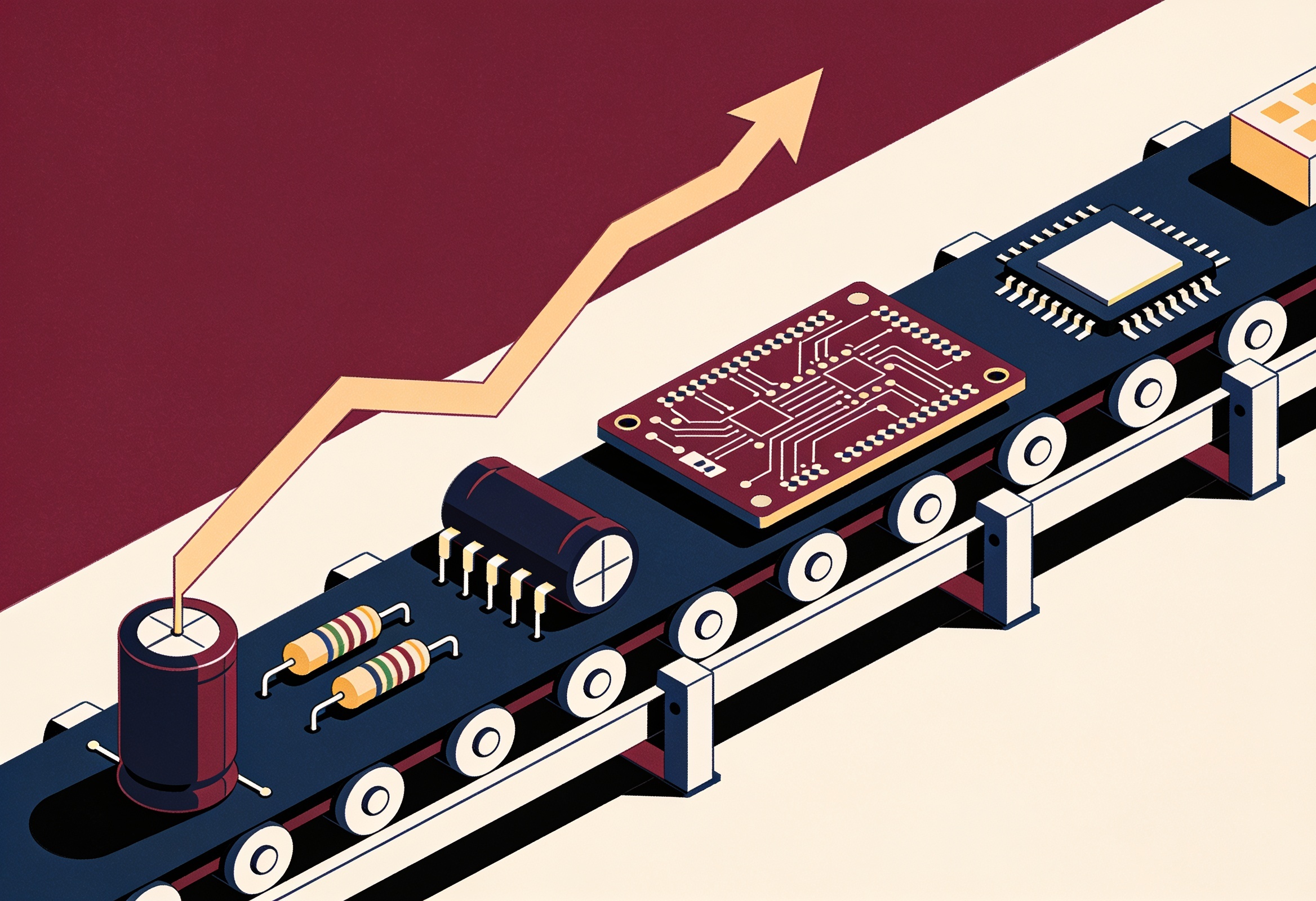
Stylised electronic components on an assembly line with an upward value-chain arrow
Deepening the components layer beneath India's electronics assembly lines Illustration: AI-generated (Freepik)
Electronics Components Manufacturing Scheme (ECMS): Deepening India's Electronics Value Chain — quick facts

UPSC Relevance

Prelims Relevance

  • ECMS — administered by MeitY, not by the Ministry of Commerce or Heavy Industries
  • Difference between active and passive components (passives: resistors, capacitors, inductors)
  • PCB = printed circuit board; the substrate that interconnects components
  • Domestic Value Addition (DVA) as the metric for value capture
  • India Semiconductor Mission (ISM) targets fabs/ATMP; DLI targets chip design
  • PLI rewards incremental sales/turnover; ECMS adds a capex-linked track
  • Sub-assemblies covered: camera modules, display modules
  • Atmanirbhar Bharat framing of import-substitution in electronics

Mains Relevance

GS Paper 3

  • Why deepening the components layer matters more than headline assembly output for value capture and jobs.
  • Electronics as a strategic sector — import dependence on a single source country and supply-chain resilience.
  • How ECMS, PLI, ISM and DLI fit together as a layered industrial-policy stack.

GS Paper 2

  • Design choices in incentive schemes — turnover-linked versus capex-linked support and their trade-offs.

Essay

  • Self-reliance and the limits of assembly-led growth in a globalised value chain.
  • Can industrial policy build durable capability, or only subsidised output?

Background and Context

What ECMS covers

The scheme is built around the parts that finished electronics are assembled from, not the finished devices themselves.

  • Passive components — resistors, capacitors and inductors — high-volume, low-unit-value parts India imports in vast quantities.
  • Printed circuit boards (PCBs) — the boards on which components are mounted and interconnected; bare-board and multilayer types.
  • Sub-assemblies and modules — camera modules, display modules and similar partly-built units that feed final assembly.
  • Selected bare components and supporting materials needed to localise the upstream chain.
  • The aim is a deeper components ecosystem beneath the assembly lines that Make in India and PLI already built.
Electronics Components Manufacturing Scheme (ECMS): Deepening India's Electronics Value Chain — exam lens

Why the components layer was the gap

India’s electronics story so far has been one of assembly volume without matching value capture.

  • Under PLI for Large-Scale Electronics, mobile-phone assembly and exports rose sharply.
  • But Domestic Value Addition stayed modest because components were shipped in and merely fitted together here.
  • Most passives, PCBs and modules came from China and a few East Asian hubs, concentrating supply-chain risk.
  • Without a components base, the higher-margin, higher-skill rungs of the value ladder stayed offshore.
  • ECMS goes straight at this missing middle so more of each device’s worth is created in India.

How the incentives are structured

The scheme mixes two incentive logics so that very different kinds of component makers can both qualify.

  • A turnover-linked track suits high-volume passives where margins are thin and scale is everything.
  • A capital-expenditure-linked track suits capital-heavy sub-assemblies and PCB lines where upfront investment is the barrier.
  • Hybrid support recognises that one flat formula cannot fit both ends of the components spectrum.
  • Eligibility ties to committed investment, output and employment, keeping the payout outcome-linked.
  • MeitY runs the scheme, continuing its lead role across India’s electronics policy stack.

Where ECMS sits in the policy stack

ECMS is the components rung in a deliberately layered set of electronics schemes.

  • PLI — rewards finished-device assembly and incremental sales.
  • ECMS — the new layer for passive components, PCBs and sub-assemblies beneath that.
  • India Semiconductor Mission (ISM) — supports fabrication and assembly-test-mark-pack (ATMP/OSAT) units.
  • Design Linked Incentive (DLI) — backs domestic chip design and IP.
  • Together they trace the chain from chip design to fabrication to components to final assembly.

Strategic and economic stakes

Components are a question of resilience and capability, not just of import bills.

  • A domestic components base reduces exposure to a single supplier country during shocks or curbs.
  • It deepens technology absorption and creates higher-skill manufacturing jobs than bare assembly.
  • It improves the trade math by cutting the import content of every device exported.
  • It supports the broader Atmanirbhar Bharat aim of strategic autonomy in critical sectors.
  • It is a precondition for credibly entering global electronics supply chains as a maker, not just an assembler.

Risks and the critique

Component depth is hard to engineer with subsidies alone, and earlier schemes carry cautionary lessons.

  • Passive-component making is a scale-and-margin game where incumbents enjoy decades of cost advantage.
  • Incentives can buy output without building durable capability if technology and design stay imported.
  • Disbursement and verification delays dogged some earlier PLI rounds; design clarity matters.
  • Genuine value addition must be measured carefully so re-labelling does not pass as localisation.
  • Sustained gains need skilling, logistics, power reliability and stable input duties, not subsidy alone.

Way Forward

Make value addition the real test

  • Tie incentives to verified Domestic Value Addition, not just turnover, so localisation is genuine.
  • Track component-level import substitution rather than headline device output.

Build the enabling base

  • Pair ECMS with skilling, testing labs and stable input-duty structures.
  • Strengthen logistics and power reliability so component lines stay cost-competitive.

Anchor to global chains

  • Court anchor investors and technology partners so domestic firms climb the value ladder.
  • Sequence ECMS with ISM and DLI so design, chips and components reinforce one another.

Conclusion

ECMS is an attempt to fix the structural weakness that assembly-led growth exposed — India built the factories but imported the parts, so the value walked away. By targeting passive components, PCBs and sub-assemblies, the scheme goes after the rung that actually decides how much of an electronic device is made in India.

The test will be capability, not output. If incentives translate into real Domestic Value Addition, a skilled workforce and durable supply-chain resilience, ECMS can move India from assembler to maker. If they only subsidise re-labelled imports, the import bill will simply shift one layer up the chain.

UPSC Practice Questions

Prelims MCQ 1

With reference to the Electronics Components Manufacturing Scheme (ECMS), consider the following statements:

  1. It is administered by the Ministry of Electronics and Information Technology.
  2. It supports manufacture of passive components, printed circuit boards and sub-assemblies.
  3. It funds the setting up of semiconductor fabrication plants.

How many of the above statements are correct?

(a) Only one (b) Only two (c) All three (d) None

Answer: (b) Only two

Explanation:

Statements 1 and 2 are correct — ECMS is a MeitY scheme for the components layer. Statement 3 is wrong: fabrication plants fall under the India Semiconductor Mission (ISM), not ECMS.

Prelims MCQ 2

Which one of the following is a passive electronic component?

(a) Transistor (b) Capacitor (c) Integrated circuit (d) Microprocessor

Answer: (b) Capacitor

Explanation:

A capacitor is a passive component (it stores or filters energy without amplification). Transistors, ICs and microprocessors are active devices.

UPSC Mains Questions

  1. India scaled electronics assembly but captured little value. Examine how the Electronics Components Manufacturing Scheme (ECMS) seeks to correct this, and discuss the conditions needed for it to raise domestic value addition.
  2. Discuss how ECMS, the PLI scheme, the India Semiconductor Mission and the Design Linked Incentive together form a layered industrial-policy stack for electronics. What are the risks of incentive-led capability building?
  3. Self-reliance in strategic sectors needs depth, not just volume. Critically analyse this statement with reference to India’s electronics component manufacturing ecosystem.

Sources: PIB, Ministry of Electronics and Information Technology and Press Information Bureau.

Frequently Asked Questions

What is the Electronics Components Manufacturing Scheme?

ECMS is a Cabinet-approved incentive scheme run by MeitY to grow domestic manufacture of electronic components — passive parts like resistors and capacitors, printed circuit boards, camera and display modules and other sub-assemblies. It targets the components layer that sits beneath finished-device assembly, aiming to cut import dependence and raise the value made in India.

How is ECMS different from the PLI scheme?

PLI for electronics mainly rewards finished-device assembly and incremental sales, such as mobile phones. ECMS targets the layer below that — the components and sub-assemblies those devices are built from. The two are complementary: PLI built the assembly base, while ECMS tries to localise the parts that assembly still imports.

Why does India need a domestic components base?

Despite record assembly output, most components were imported, mainly from China, so domestic value addition stayed low and supply-chain risk stayed high. A components base captures more value at home, creates higher-skill jobs, improves the trade balance and reduces exposure to a single supplier country during shocks or curbs.

How does ECMS relate to the India Semiconductor Mission?

They cover different rungs of the same chain. ISM supports semiconductor fabrication and assembly-test units, and the Design Linked Incentive backs chip design, while ECMS handles passive components, PCBs and sub-assemblies. Together with PLI they form a layered stack from chip design through fabrication and components to final assembly.

What kinds of incentives does ECMS offer?

The scheme blends a turnover-linked track, suited to high-volume passive components with thin margins, and a capital-expenditure-linked track, suited to capital-heavy sub-assemblies and PCB lines. This hybrid design lets very different kinds of component makers qualify, with payouts tied to committed investment, output and employment.

What are the main risks for ECMS?

Passive-component making is a scale-and-margin game dominated by long-established global players, so incentives may buy output without building durable capability if technology stays imported. Disbursement delays seen in earlier schemes, weak value-addition checks, and gaps in skilling, logistics and power reliability could blunt the scheme’s impact.

ASUSE: What the Survey of Unincorporated Enterprises Tells Us About the Informal Economy

Open article →Download PDF

Why in News?

The Ministry of Statistics and Programme Implementation (MoSPI), through the National Statistics Office (NSO), runs the Annual Survey of Unincorporated Sector Enterprises (ASUSE) to measure India’s vast non-agricultural informal economy. As the survey moves to an annual cycle, its findings have become a recurring fixture in debates over jobs, productivity and the true size of the unorganised sector.

ASUSE counts the country’s small, owner-run units — roadside workshops, tailors, kirana shops, household manufacturers — and reports their number, employment, Gross Value Added (GVA) and increasingly their use of the internet and formal registration. It is the primary input MoSPI uses to estimate output for the unorganised segment in national accounts.

  • ASUSE succeeds the older NSS unincorporated-enterprise surveys (the 73rd round of 2015-16 was the last in the earlier series).
  • It covers non-agricultural establishments across manufacturing, trade and other services that are not registered as companies.
  • Estimates feed directly into GDP/GVA figures for the unorganised sector compiled by the NSO.
  • Recent rounds added indicators on internet use and maintenance of accounts, tracking digital adoption and formalisation.

The development matters in the context of:

  • Why it matters for jobs: the informal sector employs the overwhelming majority of India’s non-farm workforce, so its health is a proxy for livelihood security.
  • Why it matters for data: without reliable enterprise surveys, GDP estimates for the unorganised economy rest on weak benchmarks.
  • Why it matters for policy: schemes like Udyam registration and e-Shram are judged by how far the informal sector is formalising.
Illustration of small informal businesses linked by data and chart motifs under a magnifying glass examining a bar chart
Surveying India's unincorporated enterprises — counting the workshops, tailors and shops that make up the informal economy. Illustration: AI-generated (Freepik)
ASUSE: What the Survey of Unincorporated Enterprises Tells Us About the Informal Economy — quick facts

UPSC Relevance

Prelims Relevance

  • ASUSE — Annual Survey of Unincorporated Sector Enterprises; conducting body NSO under MoSPI.
  • Predecessor: NSS surveys of unincorporated non-agricultural enterprises (last full round 73rd, 2015-16).
  • Coverage: non-agricultural manufacturing, trade, other services; excludes companies and agriculture.
  • Key concept: Gross Value Added (GVA) = output minus intermediate consumption.
  • Unincorporated vs incorporated: unincorporated units are proprietorships/partnerships, not registered as companies under the Companies Act.
  • Formalisation tools: Udyam Registration (MSMEs) and e-Shram (unorganised workers’ database).
  • MoSPI also conducts the Periodic Labour Force Survey (PLFS) and Annual Survey of Industries (ASI) — distinguish the three.
  • OAE vs establishment: an Own-Account Enterprise (OAE) runs without any hired worker; an establishment hires at least one.

Mains Relevance

GS Paper 3

  • Significance of robust enterprise surveys for credible national income estimation and the unorganised sector.
  • Informal sector’s role in employment, productivity gaps, and the challenge of formalisation.

GS Paper 2

  • Strengthening India’s official statistical system and the governance of data quality.

Essay

  • The unseen economy: counting the work that holds India together.
  • Data is the new oil only if we choose to measure honestly.

Background and Context

What ASUSE actually measures

ASUSE is a sample survey of unincorporated non-agricultural enterprises, designed to capture the economic activity that company registers and factory rolls miss.

  • Universe: proprietary and partnership units in manufacturing, trade and other services that are not incorporated as companies or cooperatives.
  • Variables captured: number of enterprises, employment, fixed assets, GVA, value of output and operating expenses.
  • Distinguishes Own-Account Enterprises (OAEs) — run by household labour alone — from establishments that employ at least one hired worker.
  • Newer rounds record internet use, computer use and whether the unit maintains accounts — signals of digitisation and formal practice.
  • Excluded: agriculture, and any unit registered under the Factories Act or as a company (those are picked up by the Annual Survey of Industries).
ASUSE: What the Survey of Unincorporated Enterprises Tells Us About the Informal Economy — exam lens

From NSS rounds to an annual survey

ASUSE is the successor to a long line of National Sample Survey (NSS) enterprise surveys, but with a crucial upgrade — frequency.

  • Earlier, unincorporated enterprises were surveyed only periodically; the 73rd NSS round (2015-16) was the last in that older series.
  • ASUSE shifts measurement to an annual cycle, narrowing the gap between successive benchmarks.
  • Annual data lets the NSO update GDP estimates for the unorganised sector with fresher inputs rather than projecting from a dated base year.
  • It complements the annual Periodic Labour Force Survey (PLFS), giving both an enterprise-side and a household-side view of informal work.

Why it feeds GDP and national accounts

The informal sector is statistically hard to see, so ASUSE acts as the empirical anchor for estimating its contribution to the economy.

  • National income for the unorganised segment is largely estimated, not directly recorded — ASUSE supplies the per-worker GVA benchmarks used in that estimation.
  • These benchmarks are combined with workforce numbers to scale up sector output in the national accounts.
  • A stale benchmark risks mis-stating the size of the informal economy and, with it, headline GDP.
  • So ASUSE matters far beyond the units it surveys — it shapes how the whole unorganised economy is valued.

What the data reveals about the informal economy

Read together, ASUSE indicators sketch a sector that is huge in headcount but thin in productivity.

  • A very large share of non-farm units are tiny Own-Account Enterprises with no hired worker — survival livelihoods rather than growing firms.
  • Average GVA per worker in the informal sector trails the formal sector sharply, exposing a deep productivity gap.
  • Rising internet and account-keeping adoption hints at gradual formalisation, but from a low base.
  • Sectoral mix is dominated by trade and services, with manufacturing units smaller and more vulnerable to shocks.

Formalisation: Udyam, e-Shram and the bridge to data

Policy increasingly tries to pull informal units into formal registers, and ASUSE is one way to check whether that bridge is being crossed.

  • Udyam Registration brings MSMEs onto a formal portal, unlocking credit, schemes and procurement preferences.
  • e-Shram builds a national database of unorganised workers to deliver social security and benefits.
  • ASUSE’s questions on registration and account-keeping help gauge whether such drives are widening formal coverage on the ground.
  • Formalisation is not automatic: many units stay informal to avoid compliance cost, so survey evidence keeps the policy debate honest.

Where ASUSE sits in MoSPI's statistical system

ASUSE is one pillar of a broader official statistics architecture, and confusing it with its siblings is a common exam trap.

  • ASUSE — unincorporated, non-agricultural enterprises (the informal/unorganised side).
  • Annual Survey of Industries (ASI) — registered factories under the Factories Act (the organised manufacturing side).
  • Periodic Labour Force Survey (PLFS) — household-based employment and unemployment data.
  • All three are run by the National Statistics Office (NSO) within MoSPI, the apex body for India’s official statistics.

Way Forward

Tighten the statistical backbone

  • Sustain the annual frequency so GDP benchmarks stay current rather than drifting on old base years.
  • Improve the sampling frame by linking it to live registers like Udyam and GST data to reduce coverage gaps.

Use the data to lift productivity

  • Target credit, skilling and digital tools at the low-GVA Own-Account Enterprises that ASUSE flags.
  • Treat formalisation as a means to better terms — credit, markets, social security — not as an end in itself.

Pair ASUSE with PLFS and administrative data so that enterprise-side and worker-side evidence are read together, giving policymakers a single, coherent picture of the informal economy rather than fragments.

Conclusion

ASUSE is unglamorous but foundational. By systematically counting the workshops, shops and home-based units that make up the bulk of India’s non-farm economy, it turns an otherwise invisible sector into measurable evidence — and that evidence flows straight into the nation’s GDP estimates.

For UPSC, the survey is best understood as the meeting point of three durable themes: the informal economy, the integrity of India’s statistical system, and the long project of formalisation. Get those linkages right, and ASUSE stops being a name to memorise and becomes a lens on how India sees its own economy.

UPSC Practice Questions

Prelims MCQ 1

With reference to the Annual Survey of Unincorporated Sector Enterprises (ASUSE), consider the following statements:

  1. It is conducted by the National Statistics Office under MoSPI.
  2. It covers registered factories operating under the Factories Act.
  3. It excludes agricultural enterprises from its coverage.

How many of the above statements are correct?

(a) Only one (b) Only two (c) All three (d) None

Answer: (b) Only two

Explanation:

ASUSE is conducted by the NSO under MoSPI (1 correct) and excludes agriculture (3 correct). It covers unincorporated non-agricultural units, NOT registered factories — those fall under the Annual Survey of Industries (2 wrong).

Prelims MCQ 2

Which of the following is correctly matched with the population it primarily surveys?

(a) ASI — household employment and unemployment (b) PLFS — registered factories under the Factories Act (c) ASUSE — unincorporated non-agricultural enterprises (d) ASUSE — incorporated companies under the Companies Act

Answer: (c) ASUSE — unincorporated non-agricultural enterprises

Explanation:

ASUSE surveys unincorporated non-agricultural enterprises. ASI covers registered factories, PLFS measures household employment, and incorporated companies are outside ASUSE’s scope.

UPSC Mains Questions

  1. Reliable measurement of the informal sector is essential for credible national income estimation. In this light, examine the significance of the Annual Survey of Unincorporated Sector Enterprises (ASUSE) for India’s statistical system. (250 words)
  2. The informal economy employs the bulk of India’s non-farm workforce yet contributes far less per worker than the formal sector. Discuss the productivity challenge this poses and suggest measures to address it. (250 words)
  3. Formalisation of enterprises is often presented as a policy goal in itself. Critically evaluate this view with reference to instruments such as Udyam registration and e-Shram. (150 words)

Sources: MoSPI, National Statistics Office and PIB, Ministry of Statistics and Programme Implementation.

Frequently Asked Questions

What is ASUSE?

ASUSE is the Annual Survey of Unincorporated Sector Enterprises, conducted by the National Statistics Office under MoSPI. It measures India’s non-agricultural informal enterprises — their number, employment, Gross Value Added, assets and increasingly their internet use and registration status — to map the unorganised economy.

Who conducts ASUSE?

It is conducted by the National Statistics Office (NSO), which functions under the Ministry of Statistics and Programme Implementation (MoSPI). MoSPI is the apex body for India’s official statistics, and the NSO also runs surveys such as the Periodic Labour Force Survey and the Annual Survey of Industries.

How is ASUSE different from the Annual Survey of Industries?

ASUSE covers unincorporated, non-agricultural units that are not registered as companies or factories — the informal sector. The Annual Survey of Industries (ASI) covers registered factories operating under the Factories Act, which form the organised manufacturing side. The two surveys deliberately measure different universes.

Why does ASUSE matter for GDP?

Output of the unorganised sector is largely estimated rather than directly recorded. ASUSE supplies per-worker Gross Value Added benchmarks that the NSO combines with workforce numbers to scale up the sector’s contribution in the national accounts. A stale benchmark can distort the estimated size of the informal economy and headline GDP.

What did ASUSE replace?

ASUSE succeeds the older National Sample Survey rounds on unincorporated non-agricultural enterprises, the last full round of which was the 73rd round in 2015-16. The key change is frequency: ASUSE measures the sector annually, keeping national-accounts benchmarks fresher than the earlier periodic approach.

How does ASUSE connect to formalisation?

ASUSE records whether units maintain accounts, use the internet and are registered. Read alongside drives like Udyam registration for MSMEs and the e-Shram database for unorganised workers, these indicators help gauge whether the informal sector is gradually entering formal registers and practices.